As he wrote the annual report on Dar es Salaam district in 1931, W. Fryer could not get the image of automobile-using Africans out of his head. After nearly a decade of mandate rule in Tanganyika, the District Commissioner was frustrated about the government's inability to regulate social and political change, a state of affairs he summarized by describing a group of motoring Africans whom he called ‘sophisticated natives’:
There was a time not so long ago when one of the first concerns of the majority of natives was to get if possible money to pay his tax. … The younger generation between 20 and 35 years of age who have grown up in the Dar es Salaam district prefer to travel by motor car, accompanied often by their wives, to walking and putting aside the cost of the fares for the payment of their tax and fulfilment of their just obligation to the government. He does not often carry his own produce to the market but conveys it by motor lorry and tens of thousands of shillings available in former times for paying tax now go to paying for the cost of motor cars. … The native knows that all he need say when demand for tax is made is, ‘I have no money’.Footnote 1
While motor vehicle use was on the rise in the 1930s, neither the fiscal nor the political obstacles to British rule are reducible to a new generation of ‘sophisticated’, motoring Africans. Instead, this image stuck with Fryer for reasons that were at the heart of colonial rule. As Janet Roitman observes, the quest for the knowable civil and fiscal subject was predicated on fixing African bodies and movement in governable spaces (Roitman Reference Roitman2005: 136). In Fryer's eyes, this mobile group of tax-dodging Africans threatened more than the annual budget, for they also challenged the claims of the colonial administration to control bodies, resources and technologies at the seat of colonial power in Tanganyika.
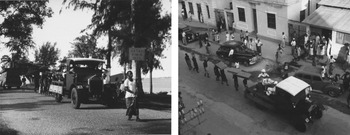
Two decades later, the colonial government staged what it considered a more acceptable form of automobility on Dar es Salaam's streets (Figure 1). In a 1953 parade celebrating Queen Elizabeth II's coronation, a float featuring a government lorry, two colonial officers and six African porters recalled a period of British rule when ‘men were men and Africa was very dark’.Footnote 2 Inspired by the early work of the Public Works Department (PWD) in the mid-1920s, the float was introduced to bystanders with a sign stating, ‘Danger PWD’, referencing the department's task – to conquer African nature by putting a modern colonial infrastructure in its place. ‘Safari Bwanas’ featured the government's first registered vehicle, GT 1, a 1923 two-ton Albion lorry, carrying two white men in safari gear. Pictures show the safari gentlemen reading, lounging and drinking whisky in the truck's bed along with a ‘giant wooden sword in hand to ward off hostile tribesmen’.Footnote 3 Following the lorry are six African men dressed as porters, wearing only cloth around their waists. The first three carry oversized books on their heads, while the others cart the ‘essentials of life’ for touring colonial officials: whisky, baked beans and quinine. This ‘delightful piece of pure fun’ helped the PWD win an award for the coronation's most humorous float.Footnote 4 Whatever laughter it elicited from the parade's African, Asian and European bystanders, the exhibition mocked African labour and presented an ideal of colonial order that never existed on Tanganyika's roads.
The comedic ‘Safari Bwanas’ float of 1953 featuring GT 1, British Tanganyika's first government vehicle, in a choreographed ideal of colonial automobility that never existed. (Photographs used with permission of The National Archives UK)

Using the biographies of two African drivers, this article explores how moving bodies and technologies provoked discussions about social health and political order in colonial and independent Tanzania. It begins with the life of Vincent Njovu, the African man who drove GT 1 (the Albion lorry pictured above) from 1924 to the early 1940s. His memoir, Dereva wa Kwanza Tanganyika (The First Driver of Tanganyika – hereafter, The First Driver), describes the driver's ability to undermine colonial hierarchies of race in which Africans were deemed incompatible with European cultures of mobility and technology. Seizing on the description of GT 1 as the ‘love of his heart’ (kipenzi chake cha moyo), I narrate Njovu's life as an unlikely love story between an African colonial employee and an ideal colonial machine (Njovu 1980: 40). His life illustrates that tools of empire were not always triumphant and that, in the hands of African colonial employees, they could be used to undercut the logic of imperial rule from within structures of power. The second section uses a series of memoirs written by Tanzania's renowned female driver, Hawa Ramadhani, to examine the gendered structures of mobility and technology that accompanied post-colonial modernization. Ramadhani used automotive skills learned from nuns in the 1940s to build a reputation that has turned into a legend, eventually becoming Dar es Salaam's first female bus driver and the heroine of a fictional children's book, Hawa the Bus Driver. Though some accused her of prostitution, her career on rural roads and urban bus routes provided an alternative to state-led visions of modernization that not only privileged men's labour and mobility, but also predicated it upon women's confinement to the home and exclusion from skilled work. Together, the narratives reveal the importance of mobility and technology to social and political imagination in twentieth-century Tanzania. While Africa's roads are often linked to social decline and marginality, in the lives of Njovu and Ramadhani they feature as spaces of innovation where two unlikely heroes contested hierarchies of race and gender through the practice of everyday life.
The Swahili words for hero or heroism, shujaa and ushujaa, are used in each of the narratives, but the designation ‘heroes of the road’ is largely my own. The term serves two purposes. First, it alludes to the production of knowledge in the memoirs and biographies used in this article. Published in 1981 during Tanzania's socialist period, The First Driver is a post-colonial form of narration Thomas Geider calls a ‘habari’ text for its ability to inform readers about unsung cultural heroes instead of pre-colonial rulers or the political figures associated with African nationalism (Geider Reference Geider and Harneit-Sievers2002: 272–3). Using a recognizable Swahili lexicon of socialism, the publishers celebrate the driver's ability to ‘game’ a capitalist (ubepari) and imperialist (ubeberu) system of rule by defying colonial categorization and by using a tool of empire for his own benefit. Ramadhani's personal papers, written by the driver in the early 1990s, situate her success against the challenges she faced as an automobile woman from the 1950s to the 1980s. In the main texts used below, ‘The life and development of Hawa Ramadhani’ and ‘The life of the first women to be a driver in Tanzania’, Ramadhani distinguishes herself from her male colleagues and the association of career driving (udereva) with post-colonial discourses of social and economic decline, emphasizing instead her ability to embody alternative forms of development through a life of transgressive mobility. More than self-aggrandizing narratives, these sources take us away from the concerns of political authorities evidenced in the opening vignettes to the actions and thoughts of two drivers whose everyday practice of mobility challenged established norms of social health and political order. By doing so, these sources not only provide a glimpse of the ‘underside, or the obverse, of the better known face of social and political history in Africa’ (Barber Reference Barber and Barber2006: 3). They also bring into focus the historical possibilities generated by individuals who modelled alternatives to lived realities when the direction of structural change was uncertain (Cooper Reference Cooper2005: 18; Hodgson and McCurdy Reference Hodgson, McCurdy, Hodgson and McCurdy2001).
Second, thinking about drivers as heroes of the road allows us to reconsider the politics of mobility in African history, namely the manner in which African movement is so often presented as unnatural, disconcerting, or as an indication of social crisis and decline.Footnote 5 ‘Whatever the causes,’ James Ferguson writes, ‘the high level of spatial mobility of Africans has often confounded modern colonial and post-colonial apparatuses of knowledge, bound as they generally have been to modern Western assumptions about the use and control of space.’ Writing about Zambia's Copperbelt, Ferguson identifies a myth of permanence that blinded colonial reformers and academics alike to the migratory practices of African labourers (1999: 79–81). While scholars have since undercut long-held perceptions of African permanence by showing the constitutive role of movement in creating political, religious and economic communities (White Reference White1990; Rockel Reference Rockel2006; Lydon Reference Lydon2009), rarely is mobility recognized as a constitutive act in the formation of historical imaginations or a practice through which unlikely political actors are seen and remembered.Footnote 6 For this reason, Africa's roads are often analysed as malignant spaces that condense long histories of forced labour and capitalist penetration, and drivers are talked about as vectors of disease or dangerously reckless behind the wheel (Setel Reference Setel1999; Weiss Reference Weiss1993; Burton Reference Burton2005).Footnote 7
In particular, few have challenged the manner in which representations of movement are used to talk about Africa as a peripheral place defined by a history of marginality.Footnote 8 As Anna Tsing demonstrates in Indonesia, the construction of peripheral spaces first requires an erasure of movement and contact with the external world. Only then can such places be presented as pristine, untouched, and inhabited by ‘primitives’; and only then can proponents of external intervention make claims about bringing a backward, uncivilized place into the redeeming circulations of global capitalism and technological modernity (Tsing Reference Tsing2005: 214, 1993). The issue is not whether people are moving or not. Instead, the politics of mobility is about the reasons certain forms of movement count and others do not when claims to power are being made (Creswell Reference Cresswell1999, Reference Cresswell2005). As seen in the ‘Safari Bwanas’ float pictured above, it is impossible to talk about whose mobility counts and whose does not without analysing perceptions of Africa as a backward place in need of European technological intervention. Indeed, tackling the long history of road transport in Africa forces one to confront a double marginality in which both mobility and technology fuel perceptions of social crisis and of passivity in the face of external forces, or present an underside to modernity in which Africa is incompatible with global standards of change.
For these reasons, thinking about drivers as heroes of the road creates a different set of expectations about movement and historical forces in African history. In contrast to perceptions of African mobility as an unnatural practice or a symptom of decline, speaking of drivers as heroes builds upon David William Cohen's recognition of movement as a ‘central element in African social structure and process’ and an integral part of African political and historical imaginations (Cohen Reference Cohen and Zunz1985: 214). It also underscores what Tim Creswell identifies as the ‘transgressive potential of differentially embodied mobilities’ for challenging lived realities and for offering alternatives to the status quo (1999: 176). This does not occlude arguments made by other scholars about the dangers of motor transport or the physical and spiritual risks of a life on the road. Instead, it shows how a space associated with forced labour, physical danger and social decline provided a stage on which two unlikely individuals could become heroes by exhibiting different ways to live in changing worlds.
RACE, LOVE AND THE TECHNOPOLITICS OF COLONIAL MOBILITY
W. Fryer's 1931 report and the ‘Safari Bwanas’ float of 1953 were products of the way Europeans had constructed knowledge about Africa since the mid-nineteenth century. To explorers ‘opening up’ Africa or District Officers on tour, mobility and travel writing (later known as ‘safari reports’) were constitutive acts of imperial rule through which Africa could be made knowable, governable and transformable as part of Europe's civilizing mission. More than a means to an end, colonial mobility was also a representative act through which Africa became a peripheral place in need of Europe's technological assistance. Whether travelling on foot or by car, and sometimes when being carried by porters, officials and missionaries used observations from their daily acts of movement to construct discourses of racial difference and to justify imperial intervention.Footnote 9 They cited as evidence a lack of transport infrastructure, the reaction of Africans to European technology, and most importantly, the problem mobile Africans posed to the transformation of colonial societies. As a constant threat to imperial designs for social and economic transformation, East African cultures of mobility were linked to various forms of social malaise, including slavery, criminality, the spread of disease and ‘detribalization’, a synonym for colonial social disorder often followed by the ‘sophistication’ Fryer observed on Dar es Salaam's streets. This section replaces colonial representations of movement and social order with a love story between Tanganyika's first African driver, Vincent Njovu, and a perfect colonial machine, his lorry GT 1.
As tools of colonial social engineering, roads and motor vehicles were supposed to transform African economies and societies by carrying the civilizing mission throughout Tanganyika. Here, the ‘Safari Bwanas’ float, in spite of its comedic intentions, accurately depicts imperial aspirations for change: white men and their machines would bravely lead the construction of colonial modernity with docile and obedient Africans in tow. Instead, as tools of empire, roads and cars revealed the contradictions at the heart of colonial technopolitics: not only were metropolitan technologies insufficient partners for effecting large-scale change, but their introduction also offered African colonial employees like Njovu unique opportunities for social mobility, as well as the skills and tools to contest racial hierarchies of technology and movement.Footnote 10 As a rare example of African travel writing, Njovu's memoir replaces representations of African marginality generated by travelling Europeans with stories of technological competence, social innovation and love. Like the best love stories, this one has a happy ending, but before we get there, we must examine why Njovu, like any African man or woman in the early twentieth century, was in an unlikely position to become a hero of the road.
During the latter half of the nineteenth century, explorers and advocates of imperial intervention identified two traits of African mobility they found particularly disturbing. The first was the infrastructure of African transport. As Steven Rockel (2006) illustrates, descriptions of paths, caravan roads and swamps in European travel literature presented East Africa as a static and uncivilized place where movement was arduous, if not impossible. The second trope was the association of African mobility with slavery and illegitimate commerce – in particular, the role of porters in long-distance trade. In spite of relying on, and sometimes being carried by porters on their own journeys well into the 1930s, travellers presented porterage to European audiences as a practice that was inseparable from East Africa's slave trade and, thus, incompatible with legitimate commerce.Footnote 11 Taken together, these tropes ignored the region's built infrastructure (namely, ‘native paths’), criminalized its mobile cultures, and popularized a phenomenology in which moving Europeans were the most credible sources for understanding Africa. But they also did important political work: early representations of African movement helped mobilize and rationalize claims about the need for Western intervention in East Africa and created a more enduring tradition in which Europeans used movement within Africa to make political claims about the continent's societies (Galbraith Reference Galbraith1972; Franey Reference Franey2001; Freed Reference Freed2011).
As a solution to the problems of African mobility, entrepreneurs and humanitarians proposed the construction of European-style roads from the Swahili coast to Central Africa, emphasizing their ability to end the slave trade and establish ‘legitimate’ commerce. Writing in 1888, abolitionist Professor Lindsay described the Stevenson Road, a route proposed for the lakes region of East-Central Africa, this way: ‘For humanitarian purposes, it is the road into the heart of the continent, for it cuts in two all the important routes of the Slave caravans … . If this route be held, the Slave-trade is cut in two and is paralysed.’Footnote 12 Two years later, roads (including railroads) became the first tool of mass social engineering in colonial Africa when they were ‘internationally recognized’ in the Brussels Act as ‘among the most effectual means of attacking the slave trade at its source’.Footnote 13 Financing companies like the Imperial British East Africa Company saw the civilizing potential of European roads as the perfect excuse for economic colonization, what they termed the ‘opening up’ of Africa.Footnote 14 They advertised the East African Road, an ambitious road-building project from Dar es Salaam to the Congo, as a humanitarian venture in which new corridors of commerce could end the slave trade and save souls (Galbraith Reference Galbraith1972). But roads also came with a high price and many unforeseen challenges. The Stevenson and East African Roads succumbed to a number of technological, financial and environmental glitches, none more glaring than the companies' struggle to convince African labourers to join their cause.Footnote 15 With both projects floundering by the turn of the century, road building exposed the limits of technology transfer and the massive cost of building empire in East Africa. But the logic behind the projects remained: proper circulation, civilization and social order were inseparable, and European technologies provided a way to transform each one.
Rhetoric about mobility, civilization and technology grew more intense after the introduction of motor vehicles in the early 1900s. Automobiles were first used under German rule, but it was British soldiers during the First World War who most clearly articulated the racial hierarchies that were tied to using and understanding these moving machines. In their memoirs, British Motor Transport drivers describe the crucial tasks they performed in their ‘jiggie’ Ford trucks as they battled terrible roads, weather, insects, disease and Germans. Barely visible in these descriptions are the thousands of porters who literally carried the British military in its pursuit of the German army.Footnote 16 Instead, Africans are de-masculinized and infantilized as ‘boys’ who are limited to manual labour and menial tasks, including road clearing, carrying broken-down lorries, changing tyres, killing snakes, and domestic duties while at camp and on the road. In spite of working on and with vehicles daily, African drivers and mechanics are presented as seemingly stupefied by the ‘magic’ of vehicles whose design is ‘incomprehensible to them’ (Campbell Reference Campbell1928: 105). This description of African mechanics is typical:
We came to like our black workshop companions for their unaffected, innocent simplicity. I remember one day watching my boy squirting grease through the bung-hole of the differential gear box. … With the inside of a motor car a complete mystery to him, it must be understood that although the actual operation was carried out all right after I had started him, he had not the remotest idea of the object (Campbell Reference Campbell1928: 166).
As for African drivers, representations of their recklessness helped complete an image of Africans as racially incompatible with European cultures of technology and mobility (Campbell Reference Campbell1928: 185; Hecht Reference Hecht2012: 16–18).
Following the war, this hierarchy of technology and movement pervaded ideologies of colonial development, again treating Africans as passive and incapable actors in efforts to transform Tanganyika into a modern colony. In the 1920s and 1930s, the articulation of this racial identity occurred during ‘motor trials’ and motor safaris conducted by British officials and European residents on the colony's rough and narrow roads. For Tanganyika's new administration, these journeys were a practical tool aimed at mapping the territory, cutting new road routes, and setting up an administrative framework in areas previously beyond the government's reach.Footnote 17 More importantly, they were an act that stabilized hierarchies about whose technology and movement mattered most. Travel writing from this period glorifies both the spirit and technology of European motorists, while portraying Africans through two highly racialized tropes. The first emphasized technological simplicity and backwardness, not only describing Africans as ‘terrified’ of automobiles, but also including pictures of naked women and handcrafted wooden objects as supporting evidence of racial difference. The second trope presented Africans as stationary, their role being to assist in the production of colonial automobility by pushing vehicles out of the mud or selling refreshments on the side of the road, but not partaking in it actively.Footnote 18 However, the introduction of a unique colonial machine helped set in motion a different story about race, mobility and technology on Tanganyika's roads.
Long before GT 1 was used to celebrate the Queen's coronation, its arrival in Tanganyika in 1924 provided a technological answer to the challenges the Transport Department confronted on a daily basis. From its inception in 1919, the department set colonial rule in motion by carrying the material burdens of imperial administration, and measured progress in tons of things hauled. When tonnage increased from 10,297 tons per year in 1921 to over 15,500 in 1925, the transport officer highlighted the tangible benefits of colonial rule distributed throughout the territory by his vehicles. For the PWD, the department's vehicles materialized colonial power throughout Tanganyika by building new roads, houses, and administrative outposts. At the Health and Sanitation Department, ‘cess lorries’ worked tirelessly transporting human excrement from Dar es Salaam's new European housing complexes in order to make the city a more sanitary, and thus more modern place.Footnote 19 But this progress also revealed the limits of the department's technological capacity. Formed with vehicles that survived Britain's war with Germany in East Africa, the department struggled to keep its fleet running, let alone meet the rising haulage demands of the early 1920s.Footnote 20 None of its aging vehicles fulfilled the two ideal attributes of the perfect colonial vehicle – to be both strong and cheap.Footnote 21 Even vehicles specifically designed for ‘tropical’ Africa's harsh motoring environment, and tested in East Africa by British manufacturers, failed to fulfil the colonial dream of cheap, reliable, and ‘road-less’ transport.Footnote 22 Instead, the government was forced to hire 30,000 porters per year to keep its vision for colonial change in motion. More than compromising its rhetoric about African mobility and the civilizing mission, this recourse to porterage was expensive and eventually exposed the government's inability to produce African labour even for its most basic needs.Footnote 23
Only one lorry stood out as durable and flexible enough to meet the demands of colonial administration in Tanganyika. Imported from Scotland in 1924 to haul European excrement in Dar es Salaam, the 1923 two-ton Albion was the first new government vehicle to arrive in the colony and proved to be ideal for the territory. This first Albion, registered as GT 1, looked like and performed the tasks of the generic colonial lorry, but hidden under the hood was a paraffin carburettor that turned it into a special colonial technology.Footnote 24 Designed in the early 1900s, paraffin carburettors allowed engines to be powered with kerosene instead of motor spirits. Because kerosene imported into Tanganyika at half the price of motor fuel and was available in larger quantities, this carburettor made the two-ton Albion a perfect tool for the frugal administrator.Footnote 25 Cost-effective at only 51 cents per mile or 25.5 cents per ton, this Albion model quickly became the standby of the government's fleet – 16 were in service by 1926 – and it was the only type of vehicle dispatched by personal order of the Governor to the colony's most important construction projects. A colonial hero in its own right, GT 1 received the honour of starring alongside the Safari Bwanas in the Queen's coronation parade in 1953. But it was also an ‘undisciplined technology’ that defied its intended purpose by creating Tanganyika's first African driver and our first hero of the road (Latour 2002: 116).
Vincent Njovu was one of nine Africans hired by the Transport Department in 1924, but he was the only one assigned to GT 1, making him the colony's first African driver. His biography, The First Driver of Tanganyika, begins in south-western Tanzania during the Maji Maji rebellion of the early twentieth century. Njovu was only a child at the time, but the conflict between Africans and German colonists had a deep influence on his life and world-view. In particular, Njovu mentions the ineffectiveness of local knowledge and technology against German power. Maji Maji soldiers claimed their medicine would turn German bullets into water, but the result for Njovu's family was violence and displacement. Sensing the powerlessness of Africans against the European administration, Njovu joined a German mission school near his home in Peramiho (Njovu Reference Njovu1981: 1–12). Life at the school was difficult and violent; it also placed the child in a precarious social position. ‘Some saw African mission workers or servants as fortunate and respected them for being close to European knowledge,’ he explains. ‘Others despised them as people who betrayed African ways’ (ibid.: 4). Despite this ambiguity, Njovu passed each level at the top of his class, eventually earning a rare opportunity to enter secondary school in Dar es Salaam. Germany's defeat in the First World War temporarily disrupted Njovu's goal of becoming a colonial clerk, but he quickly adapted to British rule by becoming the houseboy of a British military officer in Dar es Salaam before abuse forced him to transfer to a Catholic mission. After watching a fleet of vehicles arrive at the port in 1924, Njovu asked his employer to supply the Transport Department with letters of recommendation and, shortly thereafter, he was learning how to drive and repair GT 1 (ibid.: 23–6).
As a foil to colonial travel writing, The First Driver presents an African colonial employee who leveraged access to technology and mobility for personal and collective gain. In contrast to the simple, naked and stupefied Africans described by tourists and officials on safari, Njovu's memoir offers a historical actor who was technologically competent and socially innovative. Two themes from The First Driver establish Njovu's credentials as an anti-colonial hero. First, Njovu erases the conventional colonial narrative of African mobility made visible in anti-slavery publications, Transport Department reports, and the coronation parade of 1953, providing instead a history of African ingenuity in which the colonized were always one step ahead of the colonizers. The most remarkable instance is the driver's defiance of colonial categorization, writing that he received two-and-a-half times the pay of ‘Bantu’ Africans (250 shillings per month instead of 60) by listing himself as an African-American on his application to the Transport Department (Njovu Reference Njovu1981: 29–30). If Njovu's claim is odd in the context of 1920s colonial history, it nevertheless serves two important purposes. First, it transforms his sanctioned form of colonial automobility into a transgressive act and a gaming of unjust hierarchies. More importantly, Njovu mocks the entire technical apparatus of power through which colonial citizens were made and controlled. The ideal colonial subject was fixable, knowable and taxable, and those who failed to pay taxes (or present tax receipts) were assigned forty days of roadwork with no pay.Footnote 26 By passing as an African-American, Njovu upset the logic of rule from within, showing himself to be the type of unfixable, ‘sophisticated native’ Fryer denounced in his 1931 report (Osborn Reference Osborn2003; Lawrance, Osborn and Roberts Reference Lawrance, Osborn, Roberts, Lawrance and Roberts2006).
Second, Njovu's memoir replaces racially based stereotypes of technological incompetence with a love story between an ideal colonial machine and its African driver. By doing so, The First Driver draws attention to an important, but often overlooked, fact of colonial life: technology was central to African personhood and integral to Africans’ opportunities for social mobility, especially among young men. Consider, for example, the reasons Njovu claimed GT 1 as a ‘lover’ – a word he does not use for any human relationships. His assignments for the Transport Department, and later the PWD, took him all over Tanganyika territory, gave him access to three different colonial departments, paid him well, and offered paid leave. His first project, building the Dodoma–Iringa Road, must have provided a stark contrast between his sanctioned mobility and that of other colonial subjects who largely encountered motor transport through the forced labour of roadwork. For two years, he sat behind the wheel of GT 1 transporting water, food and labourers to different road camps as road gangs of wage labourers, criminals and tax dodgers performed back-breaking and dangerous work at a fraction of his pay, if they were paid at all. Subsequent trips took Njovu and GT 1 to Northern Rhodesia, Dodoma, Tabora and Arusha in the service of the Public Works Department and the Department of Land and Mines, allowing the driver to practise a type of spatial and social mobility available to very few Africans (ibid.: 23–32). He even credits his relationship to GT 1 with saving his life. When he was conscripted to fight in the Second World War, he did so as part of a Rhodesian Motor Transport division, sparing him action on the front lines with African troops (ibid.: 40–9). Finally, by Njovu's retirement in the late 1940s, he was wealthy enough to return home and contribute both time and money to anti-colonial movements, eventually earning a position on a local development committee. Far from a colonial machine that confused or intimidated its African driver, or a tool of empire that transformed African societies and economies, GT1 emerges from The First Driver as an ‘undisciplined technology’ that was used by Njovu for personal and collective good.
For all Njovu accomplished as a driver, his most lasting achievement was to make a colonial machine relevant in a post-colonial context. At the Dar es Salaam Institute of Technology, Njovu signed GT 1 into the care of the institute's small museum, publicly sharing his love as he turned the ideal colonial vehicle into a national display about his heroic career as an African driver. Entrusted to a national institute of technology, the vehicle is catalogued not as an artefact of colonial superiority and ingenuity, or of the history of colonial travel. Rather, the GT 1 catalogues its driver's heroism and the history of those who changed the course of colonialism from within.Footnote 27
A WOMAN AT THE WHEEL
Gender replaced race as the primary lens for discussing mobility, technology and social health following Tanzanian independence in 1961, a reality recognized by Daily News reporter, Halima Shariff. In a 1981 article, ‘Women on the wheel’, Shariff asked five women about their unlikely presence in driving (udereva), a career dominated by men. ‘No work is better than the other and no work is meant for one sex only,’ stated Vicky Chale, a driver for the Tanzania Tourist Corporation who started her career in the military. ‘What really pulled me into this career is my envy for men drivers. I thought if men could manoeuvre the trucks well on the road within the camp and outside, why not me?’ If the answer to this question was not obvious to the article's readers, Chale and her colleagues highlighted the obstacles women faced in their quests to drive. Patricia Nditi, a driver for the Ministry of Lands, Housing and Rural Development, located the problem in perceptions of women's bodies. Women she recommended to the ministry were rated as physically ‘unable’, and even Nditi had to be accompanied by a male co-driver because of her gender and the perceived physical limitations of her sex. ‘I did not like it,’ she explained, ‘but I also could not avoid it anyway.’Footnote 28
Explanations about the physical limitations of women's automobility were less about what women could do with motor vehicles and more about perceptions of what motor vehicles would do to women and, by extension, society. Mary Mucheleka, one of Dar es Salaam's first female bus drivers, faced accusations she would lose her femininity and womanhood if she continued to operate vehicles. She assured readers women could balance the seemingly contradictory practices of automobility and femininity, but she was working against cultures of technology and mobility in which her presence behind the wheel cut across dominant ideologies of gender and social health. Automobility, defined as autonomous self-movement, was about as far as a woman could get from the post-colonial ideals of womanhood on which economic and political modernization were predicated in Tanzania (Featherstone Reference Featherstone2004: 2). In spite of playing a crucial role in national mobilization during the 1950s – a role that required both physical mobility and the capacity to mobilize resources (Geiger Reference Geiger1997) – women in post-colonial Tanzania were expected to be good wives, mothers, teachers and farmers: that is, good producers and reproducers. These tasks linked their personhood to the household and to children's lives, not to the possibilities or dangers of an open road. Consequently, women and their bodies were most visible when they upset these gendered expectations of mobility and fixity. Consider this description of Bibi Titi Mohamed, former leader of the national women's league, whose treason charges were linked by a party secretary to her deviant mobility:
Bibi Titi was a particular kind of woman – the kind who obviously no husband would put up with [because] she was riding around in a TANU Landrover with men for months on end. … There are many educated women in politics, and this is acceptable because they have drivers who bring them home at night. (Quoted in Geiger Reference Geiger1997: 185)
This section examines the relationship between gendered bodies and social bodies from Tanzanian independence in 1961, a period of hope and expectation about the possibilities of social and economic change, to the mid-1980s, a period associated with decline, stagnation and the limits of state-led national development. Using personal histories written by Hawa Ramadhani, it shows how one woman's life on the road generated a new set of meanings about the nature of post-colonial modernization as an economic and political project that not only celebrated men's bodies and mobility, but was also enacted through social positions dominated by men. By examining the changing relationship between gendered bodies and social health, this section demonstrates how and why the sex roles of national development could be inverted and replaced with new ways to think and act in a changing world.Footnote 29 The task here is not to deconstruct idealized gender roles or show the tension between gender norms and historical reality. Instead, I am interested in how Ramadhani's gender, body and mobility became a way to talk about the possibilities and limits of social and political change during Tanzania's first three decades of independence. Like Njovu's story, a key feature of Ramadhani's history is the transgressive nature of her movement. Precisely because automobility was narrowly construed as a masculine activity, it was a spatial practice through which individuals could ‘undo gender’ in order to critique socio-political realities and model alternatives to top-down visions of change (Lorber Reference Lorber1995; Deutsch Reference Deutsch2007; Cohen and Odhiambo Reference Cohen and Atieno Odhiambo1989; Hodgson and McCurdy Reference Hodgson, McCurdy, Hodgson and McCurdy2001).
In the decades following Tanzanian independence, mobile things were masculine things. Modernization in Tanzania, as elsewhere, was founded on an ideology of circulation that equated national health to the controlled movement of people and things. Ideas of what constituted a functioning economy were informed by Western medical ontologies of healthy bodies: in the same way that veins and capillaries moved blood throughout the body, modern economies required transport infrastructures capable of circulating resources both within nations and beyond their borders (van der Vleuten Reference van der Vleuten2004). Whether in cars, on tractors, in factories, or in coordinating national development in government ministries, Tanzanian men performed a disproportionate share of the tasks that put things in motion or required mobility themselves, ranging from the collection and distribution of resources at the ministerial level to acts of physical mobility practised by truck drivers or technocrats touring their districts (Tripp Reference Tripp1997: 4; Ivaska Reference Ivaska2011: 111–13). As in the colonial period, physical and social mobility in independent Tanzania were directly tied to hierarchies of knowledge and technology. Men dominated careers not only in motor transport, but also in all forms of wage labour based on ‘hard’ scientific or technical knowledge.Footnote 30 As other scholars have noted, this masculinization of labour and knowledge was tied to scientific and technological cultures of post-war development that valued the ‘hard’ knowledge and labour of men over the ‘soft’, domestic production of women (Edwards Reference Edwards, Lerman, Oldenziel and Mohun2003; Lerman Reference Lerman, Lerman, Oldenziel and Mohun2003). In this manner, Tanzania was not unique, but was instead connected to global structures of modernization that privileged men's mobility and knowledge and also defined social health accordingly.Footnote 31
In a world where men were the sole purveyors of a healthy, circulating economy, the masculinity of driving was linked to the technology itself. In interviews, male drivers speak of a time before automatic vehicles to emphasize the physical strength needed to put lorries into gear or make fixes on the open road.Footnote 32 Newspapers from the 1960s and 1970s are filled with advertisements that show young, muscular men operating or fixing large vehicles. One for Safari King Cigarettes features a brawny lorry driver changing a tyre and announces that ‘The man's man is now in town’, while another sets a bus against the backdrop of a giant boxing glove, evoking one of Tanzania's most popular masculine pastimes.Footnote 33 In addition to this rhetoric about physical capacity, much of the gendered structure of driving occurred through training and the process of gaining knowledge about how mechanical things worked. After independence, turnboi (turn-boy) and boispana (spanner boy), words rooted in the use of (mainly younger) men to assist in the repair and operation of automobiles during the colonial period, were transferred from the vocabulary of a racialized culture of technology to enter one based upon gender exclusivity. Naming the lowest status in the apprentice system training mechanics and drivers, the very terms now suggest that only young men enter the auto-training system, and thus that only men earn the right to work with and on automobiles.Footnote 34
Although development rhetoric in Tanzania celebrated women's unique role as both producers and reproducers, structurally women were limited to the private sphere or to careers based on the domestic sciences, including elementary education, nursing or secretarial work (Ivaska Reference Ivaska2011: 91; Lal Reference Lal2010; Prichard Reference Prichard2013). In contrast to the iconography that celebrated men's physical and social mobility as nation builders, women were mothers of the nation who were featured in advertisements that tied them to their homes, specifically to the kitchen and washroom. Instead of engendering discussion of social and political well-being, women's mobility was often used to discuss social decline, moral depravity and the effects of modernization on African cultures. As Andrew Ivaska demonstrates, women's bodies were at the centre of a ‘sexualized performance of power’ that used women's dress, autonomy and mobility to fabricate social and political crisis and justify patriarchal power. Women in motion were prostitutes, ‘wicked women’, and sexually promiscuous ‘roamers’ who challenged the normativity of domesticity and settled life as well as control over the manner in which women became visible in public life (Ivaska Reference Ivaska2011: 104; Hodgson and McCurdy Reference Hodgson, McCurdy, Hodgson and McCurdy2001). Taking on the role assigned to African men during colonialism, women in independent Tanzania were supposed to assist in the production of automobility but not to partake in it as equals.Footnote 35
According to the author of ‘Women on the wheel’, women offered something unique to Tanzania's culture of professional driving: they were not men. Writing in 1981, Shariff argued that a masculine culture of automobility was destroying the material and human resources Tanzania needed for economic growth. In particular, she blamed masculine driving for the destruction of vehicles that were purchased and kept running with the country's limited foreign capital, and targeted drunk driving as a common practice of men who cared more about alcohol than building the nation. While Shariff's characterization of male driving was grossly generalized, her argument extended beyond Tanzania's culture of automobility to the fundamental relationship between social bodies and gendered bodies in public discussions about modernization. If masculine automobility was analogous to a society out of control, she argued that ‘women on the wheel’ could foster a different type of social and economic development because of the care they showed to vehicles and people.Footnote 36 In other words, the very ideals used to construct national womanhood and to exclude women's automobility also provided a set of values capable of transforming public life through women's automobility. Roads, instead of being defined as spaces of physical and social danger unbefitting to women, were places of social and physical danger that required a woman's touch for proper development to occur. While Shariff's argument was undoubtedly influenced by the changing economic realities of the early 1980s, it also reflects two points examined below. First, it underscores the way bodies, especially moving ones, could be used to talk about changing economic realities or to model new possibilities for economic and political life (Livingston Reference Livingston2005). Second, Shariff's story is noteworthy because it replaces state-generated ideologies of social health with the experiences, ideas and actions of historical actors who modelled alternatives to the status quo through their everyday lives.
One woman featured in ‘Women on the wheel’ was Hawa Ramadhani, born in the early 1930s.Footnote 37 Unable to pay for her school fees, her parents asked missionaries at an orphanage near Morogoro to raise their daughter. There, Ramadhani met Pharisidia, a German missionary who accepted Hawa into her home and made her feel like her own child. She initially learned domestic duties like needlework, but was also taught how to manoeuvre a tractor and fix a water pump. One year, Pharisidia surprised the young girl by teaching her how to drive the lorry the mission used for transporting its harvest. Ramadhani writes that, from this day on, Pharisidia made the child her private driver on daily trips between home and church. In her memoirs, the driver mentions no technical details about vehicles or learning to drive, only that she learned quickly and was the only African woman in the entire village who could drive. ‘In those days, it would be a shock to see a woman riding a bicycle,’ she writes, ‘so in the village, it was a big deal for me to be seen by elders driving a car, though it surprised them each time.’Footnote 38
By 1961, Tanganyika had won its independence and Ramadhani had established herself as a reputable driver. Initially revelling in the attention attracted by her job, she soon found that her career choice raised serious, life-changing questions about her moral character. Ramadhani was first hired at the Dar es Salaam Port Authority, where she found that, as a woman driver, she was assumed to be sexually promiscuous. After unwanted advances from her boss, she transferred to a position as a bus driver at one of the city's prisons, only to find that her status as an ‘auto-mobile’ woman caused the ruin of her first marriage because her husband equated her driving to prostitution. Writing her memoir three decades later, she dismissed the accusations of her first husband as part of the job. ‘Because driving was a man's job and I entered a male domain, I was often called a prostitute.’ And yet, cognizant of her liminality, she remarried, explaining that ‘in those days, for a woman to live without a husband was strange’ and could also lead to accusations of immorality. What matters here is not Ramadhani's sexual past, but that promiscuity, driving, and a life of mobility were closely linked – a condition acceptable for men, but so unacceptable for a woman that she might be considered a prostitute simply as a consequence of driving. Even her children, born in wedlock, were teased as ‘illegitimate’ because she left them with her family when she was on the road.Footnote 39
Far from defining Ramadhani's driving career, these accusations provided a context in which she could ‘undo gender’ by exhibiting the personal and social benefits of her life on the road. She begins her memoir, ‘The life and development of Hawa Ramadhani’, by addressing the functionalist physical traits associated with masculine automobility, even embracing the essentializing notions that linked masculine able-bodiedness to motor vehicle use. ‘I was bigger and stronger than other women, having the strength and size of a man,’ she writes.Footnote 40 But instead of dwelling on the customary relationship between strength and driving, Ramadhani ties her success as a driver to her femininity. Consider, for example, her ability to link economic development, efficiency and expectations of post-colonial womanhood to a life on Tanzania's rural trucking routes during the 1960s and 1970s. ‘Many businessmen just liked the way I did things. I didn't pursue, or even like, the comfortable lifestyle of male drivers,’ she states, referring to drivers’ reputation for parking at trucking depots for sex and alcohol. Instead of sleeping at stations, she rested on the side of the road before continuing her journey. ‘My car was always ahead of the drivers who liked that other lifestyle. That's why they were always late. They would drive a little and then stay at a station. … These drivers didn't think about their own development.’Footnote 41 Here, Ramadhani is playing with notions of development shared by many long-haul drivers during this period – that is, a life on the road was only worth the physical and social risks of driving if it produced a domestic life for oneself and one's family.Footnote 42 Domesticity, in other words, was the goal of all drivers, and those who produced it best on the road had the resources to produce it best at home.Footnote 43 In this context, performing post-colonial womanhood on rural road routes was more than an imposition for Ramadhani – though it certainly was that. It was also a strategy for personal development that challenged norms about whose access to technology and mobility produced social health as well as an opportunity to play with the boundaries of post-colonial womanhood by justifying their extension from the home to the open road.
Ramadhani's mobility was most visible during the late 1970s and early 1980s, a time when citizens were openly questioning the efficacy of modernization as a state-controlled project defined by masculine production (Tripp Reference Tripp1997).Footnote 44 From 1977 to 1984, Ramadhani shuttled passengers through the city, and gained a reputation as a stern but understanding and safe driver. At first, her colleagues and passengers wondered how a woman could drive a bus, often mentioning the size of steering wheels on the city's large buses, the stickiness of the gears, and the difficulty navigating Dar es Salaam's deteriorating roads. While most answered this question by ascribing to Ramadhani a masculine physique, they soon turned their focus to the type of mobility she embodied. According to former passengers and her own conductor, Ramadhani transformed the inside of her bus from a place of overcrowding and chaos – a constant theme in letters to the editor about Dar es Salaam's socialist bus company – into a space of respect, safety and care.Footnote 45 Long-time Dar es Salaam residents remember her being actively engaged in discipline on her bus, likening her conduct to that of a mother in her own home.Footnote 46 On several occasions, interviewees responded to my question about Ramadhani's bus by grabbing my forearm to explain that the driver did not tolerate disrespect on her bus. They also remember her compassion, and Ramadhani herself writes that she took pride in giving free rides to those who could not afford the fare.Footnote 47 As a result, unlike other women who travelled to and within Dar es Salaam in the first decades of independence, her body is not remembered for transgressing the boundaries of proper circulation, but for exemplifying an alternative to the gendered demarcation of public space and to the division of labour upon which modernization was predicated.
By 1982, the nation's most-read periodical, The Worker (Mfanyakazi), recognized Ramadhani's ability to transform public space in Dar es Salaam by calling her a ‘big-time hero’ and encouraging other women to follow her example.Footnote 48 She retired in 1984 and died in 2010, but the story of her work as a bus driver continues to inform discussions of development and gender through the children's book, Hawa the Bus Driver, a part of Tanzania's primary school curriculum since 1987. By playing with notions of body and movement, Ramadhani inverted the sex roles of national development schemes and provided new avenues for using gender to talk about social health. The histories she wrote and the histories told about her career replace top-down visions of post-colonial modernization with the contingencies of historical experience and the ‘alternatives that appeared to people in their own time’ (Cooper Reference Cooper2005: 18). As a result, her life replaces narratives of decline and stagnation – in which the late 1970s and early 1980s constitute a point of rupture – with the sense of possibility and opportunity Shariff identified in the ‘Women on the wheel’.
CONCLUSION
The heroes discussed in this article shared more than a career in common. Each driver also used a life on the road to model new forms of political and social action at important historical junctures. Njovu, by finding an unlikely ally in colonial Tanganyika's first and best motor vehicle, destabilized racialized metanarratives about the incompatibility of Africans and mechanized technology. Behind the wheel of GT 1 he transformed colonial roads from places of forced labour and governmentality into the setting of a love story between an African employee and a tool of empire. A theme we must not overlook in The First Driver is Njovu's ability to play with the central mechanism of colonial power, its ability to know and to categorize, by claiming an African-American identity and a higher rate of pay. In contrast to nationalist narratives that mobilized political support by claiming exploitation, Njovu provides a ‘hidden history’ of African ingenuity in which the colonized understood systems of exploitation and could use tools of imperial plunder and control for a greater good. Following independence, gender replaced race as the dominant analytic in representations of mobility and social order. Ramadhani's long career on Tanzania's roads challenged post-colonial cultures of knowledge and labour that idealized masculine bodies and sanctioned their mobility through physical space and social hierarchies. On the basis of her driving career alone, some accused her of violating gender norms, but others saw in her work-life a new model of personal and social development that provided solutions to the emerging challenges of economic and social life during the late 1970s and early 1980s. In the midst of concerns about decline and stagnation, her everyday practice of mobility on Dar es Salaam's streets inverted stereotypes about gendered bodies in public discussions about social health and modernization.
The lives of Njovu and Ramadhani allow us to draw a different set of conclusions about roads and representations of mobility in African history. Instead of social crisis, global marginalization, or an underside to modernity, these memoirs show mobility – particularly, transgressive mobility – as a practice of social and political ingenuity in which unlikely individuals can become important historical actors. Roads – instead of being tools of intervention, sites of top-down social engineering, or objects of development – emerge as important public places where racial and gendered hierarchies are challenged and reconfigured, and as spaces where alternative visions to hegemonic social orders can be modelled through the practice of daily life.
ACKNOWLEDGEMENTS
Gabrielle Hecht and Laura Fair offered helpful comments, as did two anonymous reviewers. Thanks to Jennifer Hart and Gabriel Klaeger for organizing the initial conference panel and for their work organizing this issue.