The aim of this paper is to identify characteristics of an ‘elephant-fruit’, Balanites maughamii, an African savanna tree species. These characteristics can be used to identify other likely elephant-fruit for evolutionary and conservation studies, as well as to test speculations on characteristics of anachronistic Elephantidae fruits such as South American gomphothere fruits (Guimarães et al. Reference GUIMARÃES, GALETTI and JORDANO2008, Janzen & Martin Reference JANZEN and MARTIN1982).
Previous studies on the forest congener Balanites wilsoniana in Uganda have showed greatly improved germination of seeds from forest elephant dung, compared with those from uneaten fruit (Chapman et al. Reference CHAPMAN, CHAPMAN and WRANGHAM1992). Midgley et al. (Reference MIDGLEY, GALLAHER and KRUGER2012) suggested that similarly improved germination of Sclerocarya birrea after ingestion by elephants, is not due to digestive dissolution but due to mastication which damages the strong seed-coat. The role of mastication has largely been ignored as a characteristic of megaherbivore fruit, thus we tested B. maughamii for seed strength and for the impacts of damage to the seed coat on germination. As elephants have an excellent sense of smell and relatively poor eye-sight, often feeding in the dark (Sukumar Reference SUKUMAR2003), the expectation is for elephant fruit to be dull coloured but strongly scented. Balanites maughamii seeds are strongly scented and we determined the basis of this scent.
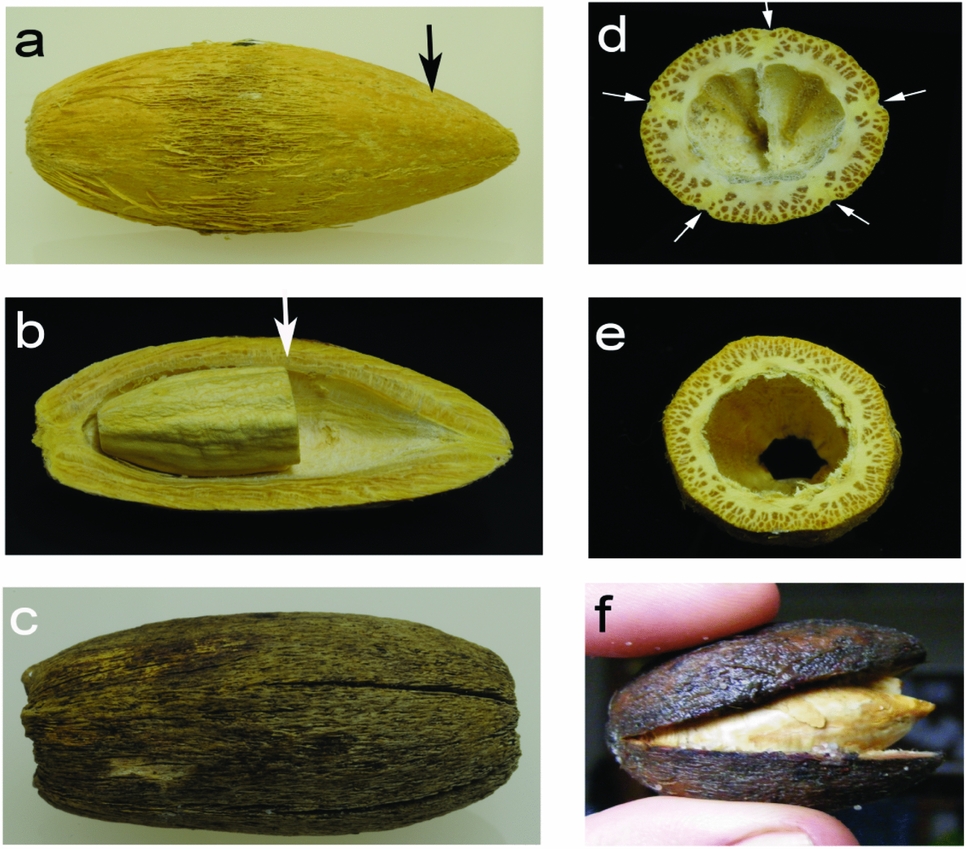
Balanites maughamii Sprague subsp. maughamii (Zygophyllaceae) is an upper-canopy deciduous savanna tree distributed from KwaZulu-Natal, through the Kruger National Park (where fruit were obtained and field observations were made) to southern Tanzania (Sands Reference SANDS2001). The tree produces odorous, single-seeded fruits with a cylindrical to oblong-ellipsoid shape and from 3–5 cm in length. The fruit and seeds consist of a thin exocarp, an oily mesocarp, and a thick fibrous endocarp (Sands Reference SANDS2001, Figure 1a, b). Not mentioned in Sands (Reference SANDS2001) is the observation that fruits are brownish green colour when ripe and that ripe fruits soon drop to the ground. Fruit-fall occurs during the dry period between May and July.
External view of cleaned Balanites maughamii seeds (5 cm in length). Note absence of distal flanges. Arrow indicates where 1d was sectioned (a). Cross-section of seed showing the embryo within a sealed endocarp. Arrow indicates where 1e was sectioned (b). External view of seed taken from elephant dung showing distal flanges (c). Cross-section of seed apex showing the absence of flanges and with arrow showing the lines of weakness that become the flanges (d). Mid-section showing absence of lines of weakness (e). Germinating seedling extends apical flanges to split endocarp lengthwise (f).

Seeds were frequently observed in elephant dung in the Skukuza area of the Kruger National Park (South Africa) indicating that it is attractive to elephants. We collected ingested cleaned seeds from elephant dung as well as whole fruits from beneath the canopies of adult fruiting trees in the Skukuza Village during June 2013 and May 2014. These were used for (1) fruit volatile scent analysis, (2) mechanical analysis and (3) germination trials.
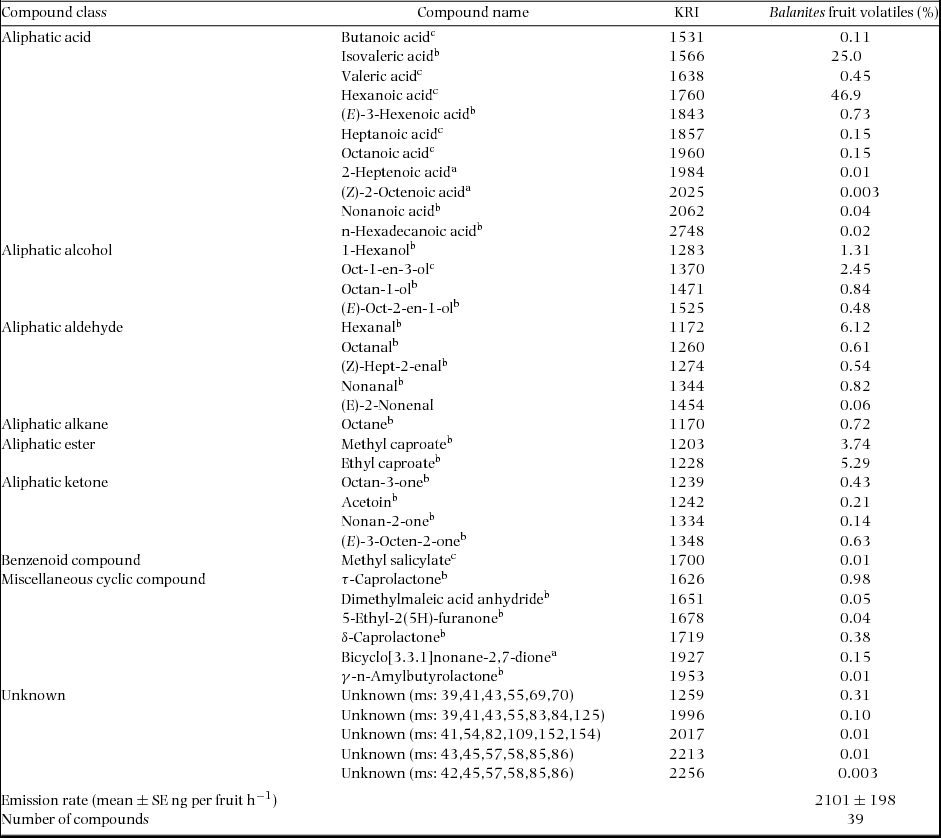
Up to 39 compounds were identified, most of which are aliphatic acids (Appendix 1), from fruit scent traps using Gas Chromatography–Mass Spectrometry (GC-MS, see Appendix 1). The greatest proportion of scent compounds resemble animal smells such as hexanoic acid (47% of the scent profile with cheesy, goat odour), isovaleric acid (25%, sweaty) and hexanal (6%, rancid, sweaty). Fruity tones were found in ethyl caproate (5.3%) and methyl caproate (3.7%). Oct-1-en-3-ol (2.45%) and 1-Hexanol (1.3%) make up the only other scents over 1%. Breaking the exocarp of fresh fruits increased the overall scent emissions four-fold (over 8000 ng per fruit h−1), whilst 3-mo-old fruits were still very smelly and still emitted a scent at quarter strength of fresh fruit. Although scent analyses of many different fruits have shown many compounds are produced, almost none has shown the functional role of these compounds. For example, the well-known durian (Durio spp.) produces many different scent molecules, including fruity esters and sulphurous compounds, some of which may activate heat pathways (Chin et al. Reference CHIN, NAZIMAH, QUEK, CHE MAN, ABDUL RAHMAN and MAT HASHIM2007, Terada et al. Reference TERADA, HOSONO, SEKI, ARIGA, ITO, NARUKAWA and WATANABE2014). How these scent molecules function with dispersers is unknown and this applies to our B. maughamii data. Thus much work is needed before we can quantify the contribution of fruit odours in shaping mammal dispersal dynamics (Dudareva et al. Reference DUDAREVA, NEGRE, NAGEGOWDA and ORLOVA2006, Herrera Reference HERRERA, Herrera and Pellmeyr2002). Our point though is to suggest that scent appears to play a significant role in elephant attraction (see trail camera video footage of elephants (supplementary material video V1) searching out single B. maughamii fruits on the ground with their trunks). Sclerocarya birrea fruits produce sweet fruity terpene-rich scent to the human nose. Balanites maughamii scent is different; it is strong and unpleasant (smelly socks). This suggests elephants are attracted to a variety of strong scents.
The endocarp encloses the endosperm in a thick sealed container (Figure 1b) representing a formidable obstacle to germination and for seedlings to emerge. In Balanites the seedling emerges through the distal apex where the valves or flanges of the endocarp separate (Figure 1c, f). The flanges are merely lines of weakness to be further developed by stress, rather than being pre-formed slits, and the weaknesses only occur in the distal end of the endocarp (compare Figure 1 d, e).
To determine the maximum force required to break the woody endocarp, cleaned seeds (i.e. exocarp and mesocarp were manually removed) were subjected to mechanical crushing using a Zwick (Zwick, Germany) 1484 200-kN load cell machine at the Mechanical Engineering Department, University of Cape Town. A total of 50 of these cleaned seeds were laterally compressed at a speed of 100 mm min−1. When there was a rapid increase in the displacement of the crosshead plate of the machine (i.e. the seed-coat was partially squashed), or when there was an audible crack, the maximum force that the seed had withstood was noted.
Cleaned seeds were subjected to experimental crushing to mimic elephant mastication in order to compare this impact on germination of untreated control seeds. Seeds were mechanically crushed to 90% (2.43 kN) and 70% (1.89 kN) of the average maximum force (2.7 kN) needed to crack seeds. We compared these with naked seeds (the whole endocarp was removed with careful grinding) and those in which a small hole (2-mm diameter) was sanded through the basal end of the endocarp, through which air and water could pass. Seeds were also obtained from elephant droppings. All seeds were then soaked under water for 24 h. Groups of 25 seeds were used for each treatment, although some were lost due to rotting. All seeds were sown at a greenhouse at the University of Cape Town during August 2013, using river sand in plastic punnets containing eight seeds each. Punnets remained moist by being watered every second day. They were checked for signs of germination weekly. Longitudinal splitting of the flanges to enable opening of seed by the expanding seedling was considered to constitute germination (Figure 1f). The greatest germination frequency (80%) was for the naked seeds (20 out of 25) and elephant ingested seeds (39/50), whereas germination of intact control seeds was only 3% (2/68). Further evidence that the woody endocarp limits the ability of the seedling to emerge through the apex is clearly seen in seeds in which the endocarp had been opened with a small basal hole. In 68% (17/25) of these seeds, the seed had swollen and had clearly germinated and the seedling was bulging through the hole, but there was no indication that the seedling was able to separate the distal flanges and emerge apically (and therefore germination was rated as zero). Both the naked seeds and those having a small hole germinated within 1 wk of being sown. For these, maximum cumulative germination success was recorded after 3 wk, whereas all other treatments only yielded initial germinants after 6 wk.
Seeds treated with a compressive force of 2.43 kN showed very low germination success (1/48), presumably due to ensuing damage of the embryo. However, the 1.89-kN treatment yielded a higher germination success (12/48, 25%) than controls. In these seeds the weakened endocarp allowed germination and the seedling to emerge from the closed endocarp.
While protection of the soft endosperm and embryo is a necessity if these seeds are to survive mastication and digestion so as to be dispersed via elephant endozoochory, having a strong endocarp imposes a significant obstacle to the germinating embryo that has to access water and oxygen through it and then escape from it. Additionally, the drastically reduced time taken to germinate when the endocarp was removed, or damaged, indicates a further advantage to the seed when the endocarp is split by elephant chewing. Rapid germination during the first rains would facilitate more rapid seedling establishment during the wet period. Balanites wilsoniana has an endocarp thickness of about 1 cm compared with 0.6 cm for B. maughamii (Sands Reference SANDS2001). This implies that B. wilsoniana can resist greater mastication forces and would be more dependent on elephants to provide this force. Elephants chew by a downward and backward motion across enamel plates (Maglio Reference MAGLIO1972), which grinds off the flesh from B. maughamii fruits, as can be observed by the presence of very clean fruit in elephant dung. It is unlikely that mastication by any other herbivore, even mega-herbivores, besides elephants, would be powerful enough to enhance germination.
Not all Balanites species have thick endocarps but the Asian species, B. roxburghii with a thick endocarp of about 6 mm (Sands Reference SANDS2001), may also be an elephant fruit. There are no data on the bite force of elephants; the values we have determined that facilitate germination of B. maughamii and previously for S. birrea (Midgley et al. Reference MIDGLEY, GALLAHER and KRUGER2012) suggest a maximum of about 2 kN. Greater force than this would damage seeds, which we frequently observed in elephant dung. Amongst herbivores, this could only realistically be provided by an elephant and it represents the upper value amongst all carnivores (Christiansen & Wroe Reference CHRISTIANSEN and WROE2007). Although elephants may use a more back-and-forth way of chewing compared with the more side-to-side grinding-shearing of the gomphotheres (Maglio Reference MAGLIO1972), our results nevertheless suggests that large gomphothere seeds should also be very resistant to being crushed and that this aspect should be added to the list of characteristics of anachronistic gomphothere fruit. For some putative megafaunal fruit, in the absence of the megafauna, slow germination of large, hard seeds buried by scatterhoarders may be rescuing establishment (Jansen et al. Reference JANSEN, HIRSCH, EMSENS, ZAMORA-GUTIERREZ, WIKELSI and KAYS2012), whereas in those fruits with small hard seeds, dispersal by smaller animals may enable establishment (Sekar & Sukumar Reference SEKAR and SUKUMAR2013).
The green to yellow-brown colour of B. maughamii suggests that its disperser most likely does not rely heavily on visual stimulus, as these fruit tend to be well camouflaged in their environment (pers. obs.). Seeds drop rapidly to the ground once mature and are therefore not presented to dispersers in the canopy. This mirrors the situation in S. birrea in which green fruits drop to the ground, where they ripen and turn yellow (pers. obs.).
In conclusion, the traits displayed by the obligate elephant dispersal syndrome are medium-large (2–10 cm long), fleshy, dull-coloured, cylindrical to circular, strongly scented fruits that drop to the ground rather than remaining in the canopy and which enclose an exceptionally hard seed-coat.
ACKNOWLEDGEMENTS
Penny Park-Ross of the Centre for Materials Engineering at the University of Cape Town provided instruction on the use of the Zwick Load cell, and scent analysis was possible thanks to Dr Adam Shuttleworth at UKZN, who ran the GC-MS samples. Joe White, Petra Muller and Nicci Illing helped with figure and video preparation. We thank SanParks for permission to work in Kruger National Park.
SUPPLEMENTARY MATERIALS
For supplementary material for this article, please visit http://dx.doi.org/10.1017/S0266467415000437
Supplementary Material Video V1. Elephants foraging for fallen fruits below a Balanites maughamii tree in the Kruger National Park, South Africa.
The chemical composition of scent emitted from fresh fruits of Balanites maughamii. Scent compounds are listed according to compound class and Kovats retention indices (KRI). Data presented are average relative proportions per fruit over three samples of a total of 12 fruits. Compound identification criteria and notes: a = comparison of MS with published data; b = comparison of MS and retention time with published data (e.g. http://webbook.nist.gov (Linstrom & Mallard Reference LINSTROM and MALLARD2010) and references therein); c = comparison of MS and retention time with published data and authentic standard. We used a Bruker 450 GC with a Bruker BR-SWAX column (30 m × 0.25 mm internal diameter; film thickness 0.25 μm) coupled to a Bruker 300 quadrupole MS in electron-impact ionization mode at 70 eV. The detector was set by Extended Dynamic Range (EDR). A ChromatoProbe thermal desorption device (Amirav & Dagan Reference AMIRAV and DAGAN1997) was linked to the Bruker 1079 injector in which the scent traps were placed. Helium carrier gas was run through the sample at a flow rate of 1.8 ml min−1. The injector was held at 40°C for 2 min with a 20:1 split. For the following 10 min, the temperature was increased to 200°C at 200°C min−1, and then increased to 250°C at 200°C min−1 and held for a further 10 min. After the initial 2 min, the split was removed for thermal desorption and then a 100:1 split was introduced after 4.2 min to flush the injector. The GC oven was held at 40°C for 3 min and then heated up to 240°C at 10°C min−1 and kept at this temperature for 12 min. Compounds present in the scent samples were identified using Varian Workstation software with the NIST2011 mass spectral library (NIST/EPA/NIH Mass Spectral Library; MS search software version 2.0 g) and verified, where possible, using retention times of authentic standards and published Kovats indices. To calculate absolute emission rates per fruit, known amounts of methyl benzoate were injected into cartridges and thermally desorbed under identical conditions to the samples.