

Introduction: problematising process
Across Europe, the transition from the Neolithic to the Copper or Bronze Age has often been conceptualised as a major social transformation. Idealised images of these periods are usually contrasted starkly from one another, with deathways at the centre. Leveraging burial practices to illustrate social change reduces the burial record to a series of simplified ideal types. North of the Alps, the Neolithic is often equated with collective deposition in megalithic tombs, distinct from the Chalcolithic and Early Bronze Age preoccupation with single burials in cists and barrows (Barrett Reference Barrett1994; Edmonds Reference Edmonds1999; Thomas Reference Thomas1999; Whittle Reference Whittle1996). Such contrasts do not apply well to other parts of Europe, particularly the Mediterranean, where single burial usually preceded collective burial. Even within regions, deathways are often characterised by a single normative treatment (for instance, single burial in the LBK and Impressed ware traditions), but these represent one option amongst many (Bradbury Reference Bradbury2025; Weiss-Krejci Reference Weiss-Krejci, Skeates and Bergsvik2012). Seeing deathways as a succession of normative ideal types feeds into macro-scale causal narratives. For example, a perceived shift from Neolithic collective tombs to post-Neolithic single burials has grounded interpretations of the emergence of prestigious elites, warrior aristocrats, or social ‘individuals’ (Earle Reference Earle2002; Kristiansen Reference Kristiansen, Carman and Harding1999; Shennan Reference Shennan and Hodder1982; Reference Shennan1987).
At stake, then, is how we interpret change in the past. Seeing the past in terms of abrupt, stadial or ‘block-time’ (Crellin Reference Crellin2020) Big Changes lends itself to simple causal narratives: it leads to a logic where dramatic changes are linked to major external prime movers such as migrations, climate change, technological innovations, or demographic booms or collapses. Although stadial models can be a valuable heuristic, there are at least three good reasons for questioning them.
Firstly, they may not fit empirically. They often describe specific regions and/or are based on a selective handful of ‘type sites’, filtering out variability. They may also be based on numerically insignificant ‘diagnostic’ finds which change rapidly, such as highly decorated pottery, making them ideal for chronological dating but masking continuities. Secondly, they have in-built expectations about patterns of change. For example, they assume that key features of society change in tandem, and they prioritise rapid rather than gradual changes. Thirdly, by characterising change as simple, they obscure its mechanisms. Mess, variability, and asynchrony may not be random ‘noise’ to be eliminated, but may be highly informative about the nature of social processes, for instance demonstrating its endogenous beginnings, complex pathways, or relationships to other processes. In contrast, seeing change as an accumulation of granular variability may reveal local shifts in social reproduction becoming gradually institutionalised over time.
In this paper, we examine the Neolithic to Copper Age transition through close analysis of burial practices in southern Italy over almost three millennia. This has two principal goals. One is to provide a generational overview of funerary practices in the southern Italian Neolithic. Since the last such overview (Robb Reference Robb1994), the available data have more than doubled. Through systematic literature review, we bring together all reported Neolithic funerary depositions in the modern regions of Puglia, Basilicata, and Calabria. Secondly, we use these data to characterise changing patterns in funerary practices and address which models of social process they support. The core question is whether looking at how change occurred tells us anything about why it occurred. These results have implications both for understanding change in prehistoric Italy (and Europe) and for how archaeologists construct narratives of major social transitions.
Conceptualising transition and change
Recent theoretical work has problematised how we approach change archaeologically (Crellin Reference Crellin2020; Harris & Robb Reference Harris, Robb, Robb and Harris2013), demonstrating that change needs to be studied at multiple scales. While this point was most notably made by Annales scholars (Braudel Reference Braudel1973) and time perspectivists (Bailey Reference Bailey2007), these approaches never resolved how different scales of time can be related nor how change ripples out from local causes to general structures, or vice versa. Critically, post-structuralist thinkers emphasise the interplay of structure and contingency (Harris & Robb Reference Harris, Robb, Robb and Harris2013; Sahlins Reference Sahlins1981), while posthuman and post-anthropocentric thought sees change as emerging from relations (Crellin Reference Crellin2020).
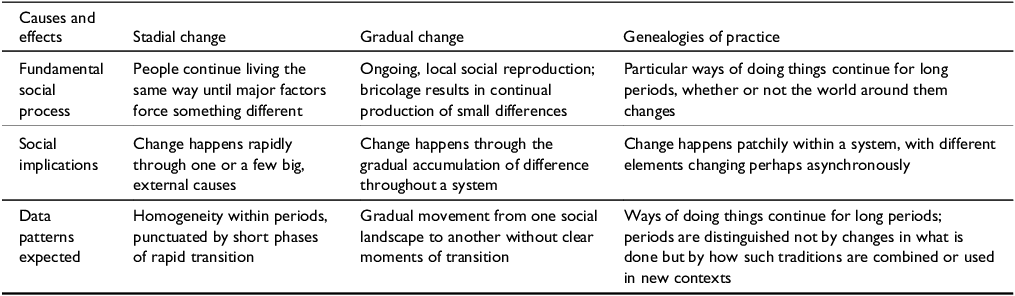
Two basic models of change have already been mentioned (Figure 1): stadial change asserts that major changes occurred as a rapid step-change from one way of life to another. Gradual change does not merely describe what a step-change looks like (before empirical complexities are filtered out to achieve analytical simplicity) but is a different model in its own right which needs no intermediate inflection point at which change occurred more rapidly than elsewhere. Change is equally continuous throughout, and discontinuity can only be imposed artificially.
Heuristic models of change.

Figure 1 Long description
Each model of social change is visualised as vertical blocks of colour, representing social process, with an arrow pointing downwards to the left to show increasing time. Three snapshots from each block represent the colour, and therefore the range of processes present at each time. In the stadial change model, process is depicted as a red block and below it a blue block, with only the middle snapshot representing stark change from one social process to the next as it captures both red and blue. Gradual change is represented by gradients of colour, with red shading to blue over time, and each snapshot representing a different colour, or process. Genealogies of practices are represented by multiple thin vertical blocks of different colours which have different lengths. Each snapshot captures a range of colours, which shows social change is a bricolage of multiple practices at any one time.
To these we would add a third model, genealogical change (Table 1). In this model, society consists of a mosaic or bundle of diverse practices. All are defined within specific traditions and reproduce or change them. Imagine people in a village in southern Italy around 5200 BCE dug a hole to bury a recently-deceased family member in an abandoned village. They drew on precedents of burying someone in a single grave, and of associating burials with places of habitation. Hence, we can characterise this burial as repeating a tradition (Gell Reference Gell1998) or drawing on a genealogy of practice (Thomas Reference Thomas1999). Furthermore, at any moment, some practices may be changing even as they draw on convention, for instance through incremental variation (each decade, it becomes increasingly usual to enclose burials in stones) or modification (e.g. burying the dead in a former habitation site, rather than an active village). Even if a practice remains unchanged, its meaning may shift as the world around it changes, arcing through stages from an innovative statement to an unremarkable normal practice, and eventually a retro-style anachronism. Overall social change is not defined by any one practice, nor even by the preponderance of change and stability among different practices, but by the overall configuration of relations between them (Crellin Reference Crellin2020).
Three models of social change

Table 1 Long description
The table describes the causes and effects of each of the three models. These are listed as the fundamental social processes, social implications, and expected data patterns of the stadial change model, gradual change model and genealogies of practice.
The Neolithic in southern Italy
In southern peninsular Italy from around 6000 BCE, culturally Neolithic societies were established, earliest in the south-east (Natali & Forgia Reference Natali and Forgia2018; Palmisano et al. Reference Palmisano, Bevan, Kabelindde, Roberts and Shennan2021; Parkinson et al. Reference Parkinson, McLaughlin, Esposito, Stoddart and Malone2021). The Early Neolithic here is characterised by Impressed wares and village life. This Early–Middle Neolithic village world is well-documented through excavations such as at Passo di Corvo (Tiné Reference Tiné1983) and other ditched villages, particularly across the Tavoliere of Puglia and the Matera region (Cassano & Manfredini Reference Cassano and Manfredini2004; Hamilton & Whitehouse Reference Hamilton and Whitehouse2021). Corresponding with peak settlement activity in the mid-6th millennium, stylistic differences in pottery form and decoration proliferated, becoming highly local. Ritual activities became more visible, particularly the use of caves for cult and funerary activities, and obsidian trade increased markedly (Farr & Robb Reference Farr, Robb, Blake and Knapp2005; Muntoni & Acquafredda Reference Muntoni, Acquafredda, Radina and Tenore2025; Pessina & Tiné Reference Pessina and Tiné2018, 237–8). A few centuries later, around 5200 BCE, ditched villages were gradually abandoned, new ceramic styles such as Serra d’Alto wares emerged, and the funerary repertory expanded. Something of a return to settled life is attested from around 4500 BCE (D’Onghia & Radina Reference D’Onghia, Radina and Radina2023a; Parkinson et al. Reference Parkinson, McLaughlin, Esposito, Stoddart and Malone2021).
Throughout, diet was based predominantly on cereal agriculture and domesticated animals, with some local variation (Arena et al. Reference Arena, Gualdi-Russo, Olsen, Philippsen and Mannino2020; Soncin et al. Reference Soncin and Tafuri2025; Tafuri et al. Reference Tafuri and Robb2023). Lives in Neolithic Italy were probably centred around maintaining kin and co-residence groups, land, and livestock, punctuated by specialist activities such as travel for hunting and trade, construction projects, and ritual cycles. Such projects may have intersected with particular social groups according to age and gender (Whitehouse Reference Whitehouse and Bolger2013). Neolithic deathways were intriguingly variable: beyond intramural primary burial, deathways included disarticulation, exposure, secondary deposition, unusual ritual depositions, and cremation (Robb Reference Robb2007, 56–61). These disparate practices may have formed multi-stage rituals (Thompson et al. Reference Thompson and Robb2024). Moreover, practices varied even within a few kilometres (Thompson et al. Reference Thompson and Robb2024).
The Copper Age in southern Italy (3800–2400 BCE) has generally been seen as an organic evolution from the Late Neolithic Diana-Bellavista ‘culture’. Although settlements are known, villages were generally less prominent. Agriculture remained the economic basis, but the Copper Age is usually described as a time of dispersed settlement and intensified pastoralism (Dolfini Reference Dolfini2020, 515). Metal objects are rare in southern Italy, and change was mostly social rather than technological. The principal archaeologically obvious innovations were in deathways; virtually all Copper Age groups are defined by burial sites rather than settlements (Bailo Modesti & Lo Porto Reference Bailo Modesti and Lo Porto1988; Cazzella et al. Reference Cazzella, Cocchi Genick, Del Lucchese, Grifoni Cremonesi, Maggi, Moscoloni, Negroni Catacchio, Radi, Sarti and Vagliardi1988; Cocchi Genick Reference Cocchi Genick1996). Copper Age burials often occurred in caves or rock-cut tombs and typically involved repeated or successive single inhumations. Grave goods became common in some areas, sometimes in standardised combinations related to the identity of the deceased (Dolfini Reference Dolfini2006).
Although the Neolithic and the Copper Age are usually conceptualised as stadial periods, the transition between them has been poorly theorised. All theorists recognise strong continuities between the Neolithic and the Copper Age and typically see the latter as evolving locally from the former. Not coincidentally, there has been little attempt to ascribe the transition to external factors such as migrations. However, a principal focus remains how to impose a dichotomy between them. Thus, it is debated whether copper metallurgy needed to match or outstrip stone tool use before the transition can be considered ‘complete’ (Cazzella Reference Cazzella1994; Pearce Reference Pearce2019). Similarly, Andrea Dolfini (Reference Dolfini2020, 507) comments that Neolithic archaeologists treat the Copper Age as a ‘hyper-evolved late Neolithic’, while Copper Age specialists overlook the role of the preceding centuries, emphasising discontinuity. Such characterisations do little to help understand the social processes involved in this transition.
The archaeology of Neolithic funerary practices in southern Italy
Here, we collate the Neolithic burial data for the modern regions of Puglia, Basilicata, and Calabria. Puglia has a rich research history; Basilicata and Calabria have received comparatively less study and excavation (Fugazzola Delpino et al. Reference Fugazzola Delpino, Pessina and Tiné2004). A comprehensive review was carried out to identify all archaeological sites containing human remains dated (either absolutely or relatively) to the Neolithic. This included published syntheses (Fugazzola Delpino et al. Reference Fugazzola Delpino, Pessina and Tiné2004; Grifoni Cremonesi Reference Grifoni Cremonesi, Bernabo Brea, Maggi and Manfredini2014; Pessina & Tiné Reference Pessina and Tiné2018; Robb Reference Robb1994; Whitehouse Reference Whitehouse1972), regional studies (Radi Reference Radi and Adamesteanu1999; Radina Reference Radina2017; Tunzi Reference Tunzi2015; Tunzi Sisto Reference Tunzi Sisto1999), site monographs (Tiberi Reference Tiberi2011; Venturo & D’Onghia Reference Venturo, D’Onghia and Radina2017), and excavation and osteoarchaeological reports. The full data are provided in Supplementary Materials S1 and S2.
Across these three regions, 114 sites containing the remains of approximately 682 individuals were identified (Figure 2). As expected from literature spanning over a century, the detail available for each site, burial, and deposit is highly variable. Some sites are fully analysed with up-to-date methods; at others, burials or disarticulated bones are mentioned only in passing. Accordingly, the data which can be included in each part of the analysis differ. Six sitesFootnote 1 which probably originally contained human remains but for which no detail is available (Figure 3, with MNI = 0 on legend) are not included in further analysis. An additional four sitesFootnote 2 have a published MNI but no further osteological information and are also excluded from further analysis. For 104 sites, details of each burial or stratigraphic level containing bones were recorded, including type of site (village, cave, necropolisFootnote 3 ); context (grave, tomb, surface); cultural phase; 14C date (if available); depositional mode (primary, secondary, reduction); minimum number of individuals (MNI) per feature; depositional information such as orientation of the body and grave goods; osteological information including age and sex estimation; and taphonomic details on position and articulation (Supplementary S2). Depositional modes are defined as primary when skeletons were mostly complete and in anatomical connection; secondary when remains were disarticulated and likely not in their original burial place; and ‘reduction’ is applied to denote the clearance of remains in the same burial space to make space for successive depositions (Duday Reference Duday2009, 72). Data for at least some of these categories are available for 664 individuals. Several assemblages were analysed directly by the authorsFootnote 4 , but we mostly relied on published osteological assessments. New taphonomic data on human remains from Masseria Candelaro, Fonteviva, and Passo di Corvo are presented in Supplementary Material S1.
Map of Neolithic sites in southern Italy included in this study (n = 114). All sites mentioned in the text are labelled (produced in QGIS v. 3.38.1).

The range of the minimum number of individuals (MNI) recorded at each site within the study, divided by phase of the Neolithic, and including sites which could not be securely dated to phase (produced with R v. 4.3.3).

Figure 3 Long description
The top left map depicts Early Neolithic sites, the top right map Middle Neolithic, the bottom left Late Neolithic and the bottom right Unknown Neolithic sites. In each, the majority of sites are located in Puglia.
Dealing with chronology in legacy data
Any study of change depends upon arranging archaeological information sequentially in time. This apparently simple operation turns immensely complex in practice. Traditionally, sites and depositions are dated relatively through stratigraphy and material typologies. In southern Italy, the Neolithic ceramic sequence is well-defined and divides the 2500-year long period into discrete sub-periods. The Early Neolithic (c. 6000–5500 BCE) is defined by Impressed wares. From c. 5500 BCE, the Middle Neolithic yields painted ceramics (bichrome and trichrome) and other decorative styles (Matera scratched wares, Stentinello wares). The Middle to Late Neolithic transition around 5200–5000 BCE featured elaborate Serra d’Alto painted wares. The Late Neolithic, from 4300 BCE, saw a return to simpler, undecorated forms in the widespread Diana-Bellavista tradition. Though this sequence is widely agreed upon, elements remain controversial. For example, it is unclear whether Middle Neolithic styles replace each other or overlap (Tiné & Simone Reference Tiné, Simone and Mazzei1984; Whitehouse Reference Whitehouse1969). More recently, there are ‘high’ and ‘low’ chronologies for the Diana periodFootnote 5 . Applying this sequence to funerary depositions can be challenging. Many burials do not have associated materials or ‘grave goods’, and some date to a different phase than the site’s main occupation. Nonetheless, this is the only method by which most sites can be placed within chronological subdivisions.
Alternatively, we can date depositions in calibrated radiocarbon years, which avoids imposing a stadial model of change and (particularly if dates are directly on human bones) allows investigation of process and potential asynchrony. However, only a small and sometimes non-representative number of sites and individuals are radiocarbon dated. All published radiocarbon dates obtained from human bone were collated and the authors obtained new radiocarbon dates on several sites (including Titolo, Masseria Candelaro, Diga di Occhito, and Cava Ripatetta). These help to ground the overall sequence and provide a genealogy of funerary practices.
A total of 105 14C dates on human bone were available (Supplementary S2). Following inspection, 96 dates were suitable for analysis (Supplementary S1): two were associated with high error margins (>100 years), two were identified as outliers, and ten duplicated dates were combined or the date with the smallest error retained. In total, dates were available from 36 sites: six caves/karsts (five sites provided only one date each, and Grotta Scaloria provided 14 dates on bone); six necropolises provided 27 dates; and 24 villages provided 45 dates (usually one or two per site, although ten are available from Masseria Candelaro). All dates were calibrated with IntCal20 (Reimer et al. Reference Reimer and Talamo2020) and modelled as a sequence in OxCal v4.4.4 (Bronk Ramsey Reference Bronk Ramsey2021). Culturally ‘Neolithic’ burials in southern Italy are modelled as beginning around the first quarter of the 6th millennium BCE, between 5800–5660 (95.4%) or 5750–5680 (68.3%) cal BCE, and ending between 3970–3830 (95.4%) or 3950–3890 (68.3%) cal BCE (Supplementary S1).
Kernel Density Estimation (KDE) was implemented to inspect trends in depositional practices. Dates were calibrated and KDEs calculated with the R script rowcal (McLaughlin Reference McLaughlin2019), which uses simulation to randomly draw calendar ages from the posterior probability distribution of each radiocarbon measurement. Two models were calculated for each set of contexts, one derived from all available radiocarbon dates, and another using only one date per generational phase at each site, identified using cluster analysis. Overall activity levels for the three major site types (villages, caves, and necropolises) was modelled by applying KDE, with comparison to settlement dates obtained from Eóin Parkinson and colleagues (Reference Parkinson, McLaughlin, Esposito, Stoddart and Malone2021) and Alessio Palmisano and collagues (Reference Palmisano, Bevan, Kabelindde, Roberts and Shennan2021).
Peaks in the burial data, as captured by the KDE models (McLaughlin Reference McLaughlin2019), closely reflect fluctuating activity levels seen in the modelled settlement dates (Figure 4; Supplementary S1). The onset of settlement around the 6th millennium BCE was consistent with the emergence of village burials. Settlement peaked just before the mid-6th millennium, corresponding to the floruit of occupation around the Tavoliere and Matera. This is consistent with a peak and shortly thereafter a decline in intramural burials. The apparent increase in cave burials during the early Middle Neolithic reflects a bias in the large number of dates obtained from Grotta Scaloria (Manfredonia, Foggia) (Robb Reference Robb, Elster, Isetti, Robb and Traverso2016). Applying the one-date-per-phase method, funerary activity in caves is shown to continue into the 5th millennium BCE, and a further small peak in village burials occurs at a similar time, consistent with the re-use of earlier Neolithic villages and settlement features. A small but notable later peak in settlement activity in the mid-5th millennium BCE is contemporary with the emerging phenomenon of necropolises.
KDE models of radiocarbon dates from Neolithic human bone in southern Italy, according to context, and compared to dates from settlement sites available in Parkinson et al. (Reference Parkinson, McLaughlin, Esposito, Stoddart and Malone2021) and Palmisano et al. (Reference Palmisano, Bevan, Kabelindde, Roberts and Shennan2021).

Figure 4 Long description
The top radiocarbon date model shows a peak in dates from human bone in villages around 5500 BCE which drops off gradually over the next 500 years and sees only small peaks again around 5000 BCE, just before 4500 BCE and 4000 BCE. The second graph shows radiocarbon dates for human bone from necropolises only from 5000 BCE, steeply peaking at 4500 BCE and declining around 4200 BCE. The third graph shows radiocarbon dates from human bone in caves from around 5700 BCE, peaking around 5300 BCE and declining steeply, with only gradual peaks again around 5000, 4600 and 3600 BCE. Dates from all materials found in settlements show a gradual incline, peaking around 5700 BCE and enduring until around 5300 BCE when they gradually decline, to peak slightly again around 4500 BCE and 4000 BCE.
In this analysis we adopt the least unsatisfactory approach to chronology: when absolute dates are available, we use them, but when they are not, we accept the periodisation provided by the conventional sequence. While not perfect, the conventional sequence has been validated as an approximate framework by an increasing number of radiocarbon dates, and using it maximises the number of sites which can be included. In what follows, the core narrative of change is defined by traditional periodisation and supported, where possible, through radiocarbon dates. Our large dataset provides the opportunity for nuanced analyses of change over time but ultimately must defer to the regional chronology. We assess the data quantitatively according to three major phases: Early (6000–5500 cal BCE), Middle (5500–4300 cal BCE), and Late Neolithic (4300–3800 cal BCE) (following Tafuri et al. Reference Tafuri and Robb2023). Only for a handful of well-dated sites are narrower timeframes possible.
Early Neolithic: 6000–5500 cal BCE
The first half of the 6th millennium BCE is characterised by a tendency to bury the dead within villages. Bodies were generally placed in a shallow grave on their side, in a flexed position, and without grave goods. Graves were usually filled and the bodies left undisturbed. Some graves could be stone-lined and/or covered by stone slabs (e.g. Balsignano T3, Torre Sabea T1) (Figure 5c) or small stone mounds (e.g. Titolo T2) (Grifoni Cremonesi et al. Reference Grifoni Cremonesi, Mallegni, Tramonti, Guilaine and Cremonesi2003; Radina Reference Radina and Martini2006; Radina et al. Reference Radina, Aprile, D’Onghia, Russo, Sicolo, Sivilli and Tiberi2020). A small majority of individuals were buried singly (52.0%, n = 51). Only one probable double inhumation is known, a young adult male placed above a young adult female in the ditch at Ripa Tetta village (Lucera, Foggia) (Tozzi Reference Tozzi, Fugazzola Delpino, Pessina and Tiné2002). There are some early examples of burial chambers or niches carved in the bedrock of village enclosure ditches, for example at Masseria Valente (Manfredonia, Foggia) and Serra di Cristo (Biccari, Foggia) (Cassano & Manfredini Reference Cassano and Manfredini1983; Tunzi & Lozupone Reference Tunzi, Lozupone and Gravina2018). But many ditch burials occurred slightly later, around the mid-6th millennium BCE, at a time of heightened occupation in the Tavoliere (Cassano & Manfredini Reference Cassano and Manfredini2004; Parkinson & McLaughlin Reference Parkinson and McLaughlin2020, 346). The tradition of intramural burial speaks to an intention to insert the dead within the space of the living, perhaps to create ancestral links and solidify associations between specific residence groups and newly divided territories.
Variation in Early and Middle Neolithic funerary practices. a) Ripa Tetta T2: Early Neolithic exposed surface deposition in ditch, scavenged and partially burnt (Robb et al. Reference Robb, Mallegni and Ronco1991); b) Madonna di Loreto SD F1/3: Early Neolithic disturbed burial in ditch (Tunzi Sisto Reference Tunzi Sisto1999, 132); c) Torre Sabea T1: Early Neolithic primary burial covered by a large stone slab (Grifoni Cremonesi et al. Reference Grifoni Cremonesi, Mallegni, Tramonti, Guilaine and Cremonesi2003); d) Masseria Candelaro T3: Middle Neolithic primary burial inside a niche in the village’s enclosing ditch (Marconi et al. Reference Marconi, Muntoni, Cassano, Manfredini, Carboni, Curci, Cassano and Manfredini2004). All illustrations redrawn by Sofia Panella.

Figure 5 Long description
Image a on the top left shows disarticulated bones from one individual scattered in a ditch at Ripa Tetta, representing an individual whose body was exposed and their remains scavenged. Image b on the top right shows an incomplete skeleton in the ditch at Madonna di Loreto; their body was placed on the left side with lower limbs flexed, but most of their upper body bones and their skull are absent, and only a lithic axe remains in the area where their head would have been positioned. Image c on the bottom left shows a tightly flexed skeleton placed on their left side with a slab over their lower body in a grave at Torre Sabea. Image d on the bottom right shows a burial inside a niche of the ditch at Masseria Candelaro, with the lower limbs tightly flexed and placed on their right side and upper body supine.
Primary depositions constitute almost half (41.8%, n = 41) of the individuals recorded for this phase. Some indicate the emergence of more complex funerary processes. At Ripa Tetta, one individual (T2) was exposed at the base of the ditch and their remains scavenged and partially burnt (Figure 5a) (Robb et al. Reference Robb, Mallegni and Ronco1991). Others display the extraction and curation of specific bones, especially skulls and crania. The skull of the adult buried in the ditch at Madonna di Loreto (Trinitapoli, Barletta-Andria-Trani) was removed some time after soft tissue decomposition (Figure 5b) (Tunzi Sisto Reference Tunzi Sisto1999, 131–3). Such variations may have responded to unusual circumstances of death or social transgressions, as well as the beginnings of ritual processes drawing on the dead as a generic ancestral presence.
Despite their archaeological visibility, primary burials were not the dominant practice. Secondary depositions were slightly more common (52.0%, n = 51) and account for most depositions containing more than one individual, with commingled remains within the same context or feature. These are more common around the end of the Early Neolithic, alongside the preponderance of ditch burials. This indicates that a range of other deathways existed which involved the processing, use, curation, and modification of remains. In the Early Neolithic levels at Coppa Nevigata (Manfredonia, Foggia), four perforated femoral heads were apparently found (Mosso Reference Mosso1908)Footnote 6 . Multiple depositions usually contained two to five people (19.4%). These were typically commingled cave deposits (e.g. Latronico (Latronico, Potenza), Grotta delle Mura (Monopoli, Bari), Grotta di San Candida (Francavilla Fontana, Brindisi)), but also included pits in villages (e.g. Samari (Gallipoli, Lecce)), likely representing the partial and fragmented remains of individuals finally deposited after processes such as excarnation and disarticulation (Calattini & Greco Reference Calattini and Greco2000; Coppola Reference Coppola1985; Mallegni Reference Mallegni1978; Radina et al. Reference Radina, Aprile, D’Onghia, Russo, Sicolo, Sivilli and Tiberi2020; Robb et al. Reference Robb, Mallegni and Ronco1991). Presumably, many more individuals were treated in ways that did not leave lasting traces.
Middle Neolithic: 5500–4300 cal BCE
The Middle Neolithic sees the consolidation of Early Neolithic social practices, with a broader range of village sizes and diversified ceramic styles and funerary traditions. These differences may mark boundaries between neighbouring groups. Within these practices, human bone assumed a particular significance and the dead were treated in novel ways. Alongside an almost equal archaeological representation of individuals in primary (39.6%, n = 165) and secondary depositions (39.1%, n = 163), there are disturbed burials (3.4%, n = 14), the spatial displacement of earlier burials, or reductions (5.3%, n = 22), and cremation (4.8%, n = 20). There is increased evidence for deposition in open spaces, where the body was exposed and perhaps excarnated, or returned to to remove specific elements. Cremation was probably carried out on already defleshed and dry bone (Mariotti et al. Reference Mariotti, Muntoni and Belcastro2020) (Supplementary S1). Bones were commonly strewn on living surfaces, placed in pits or village ditches (Figure 5d), and disposed of in caves. Thus, bone was regularly present during everyday life, possibly as a carefully managed resource. Rarely, bone modification may have continued: the possible human bone flute from Grotta di Monte Fellone (Martina Franca, Taranto) probably dates to this phase (Rittatore Vonwiller Reference Rittatore Vonwiller1965).
The apogee of this experimentation emerges between c. 5500–5200 cal BCE on the Tavoliere plain in northern Puglia; other sites such as Madonna delle Grazie (Rutigliano), Pulo di Molfetta, and Cala Colombo (all in the Bari region) show similar experimentation, so it is unclear whether northern Puglia displays heightened creativity or is simply better researched. Body parts (some bearing traces of defleshing) were transported to the ritual site of Grotta Scaloria and deposited collectively (Robb et al. Reference Robb, Elster, Isetti, Knüsel, Tafuri and Traverso2015). In the nearby villages of Masseria Candelaro (Supplementary S2) and Passo di Corvo (Mariotti et al. Reference Mariotti, Muntoni and Belcastro2020), disarticulated remains as well as skeletons buried in anatomical position displayed cutmarks. Some bone fragments from Masseria Candelaro and Grotta Scaloria show intentional working, with smoothed and polished edges (Supplementary S2). Radiocarbon dates indicate that a cache of broken crania and mandibles at Masseria Candelaro, involving mainly adult probable males, was curated over multiple generations (Muntoni & Salvadei Reference Muntoni, Salvadei, Cassano and Manfredini2004; Thompson et al. Reference Thompson and Robb2025). At Passo di Corvo, skulls and/or crania were removed mostly from female adults or nonadults (Mariotti et al. Reference Mariotti, Muntoni and Belcastro2020). At Fonteviva, cranial bone was broken while partly fresh and deposited in a ditch surrounding a hut (Supplementary S2). At Passo di Corvo (T1, T3) and in the child burial at Grotta Scaloria (Trench 6) we see evidence for post-burial skull retrieval (Mariotti et al. Reference Mariotti, Muntoni and Belcastro2020). The substance of bone itself arguably became important, perhaps as a symbol of belonging or as an efficacious or potent material. While there is much overlap in funerary practices across sites, whose remains were retrieved and curated may have reflected distinctly local concerns.
A turning point around the 5th millennium BCE saw the introduction of Serra d’Alto ceramics. New developments included more formal necropolises, increased deposition of grave goods (see Supplementary S1), and built funerary architecture. The increased construction of cists probably represents a later, stone-lined form of Early Neolithic graves (Figure 6a) (Pessina & Tiné Reference Pessina and Tiné2018, 285–7). At Cava Ripatetta (Lucera, Foggia), a necropolis of 33 rock-cut tombs which resemble Late Neolithic tombs has surprisingly been AMS-dated 500–1000 years earlier, to the earlier 5th millennium BCE (Pessina & Tiné Reference Pessina and Tiné2018, 285–7) (Supplementary S2). Elsewhere, burials were inserted into partially-filled ditches or disused storage pits in abandoned earlier villages, as at Serra d’Alto and other sites (Lo Porto Reference Lo Porto1989). Disarticulated bones were also scattered within enclosure ditches and hut compound ditches. This was common on the Tavoliere but is also evident in the Matera region of Basilicata, for example at Serra d’Alto. Further south, at Serra Cicora (Nardo, Lecce), megalithic burial structures were built on the site of an earlier Neolithic village where at least one burial had been deposited about a millennium before (Fabbri & Lonoce Reference Fabbri, Lonoce and Tiberi2011; Tiberi Reference Tiberi2011). This may have constructed fictive relations between the new inhabitants and the original settlers of the village. These practices drew on communal memory by inserting specific individuals in ancestral spaces.
Variation in Middle and Late Neolithic funerary practices a) Balsignano T2: Middle Neolithic primary cist burial (Radina Reference Radina and Martini2006); b) Serra d’Alto, Fondo Gravela: Middle Neolithic burial in side niche of a pit containing a stela (Lo Porto Reference Lo Porto1989, 52); c) Contrada Galliano T5: Middle Neolithic single burial in rock-cut tomb with entrance blocked by stone slabs (Radina Reference Radina and Radina2023); d) Contrada Galliano T10: Late Neolithic multiple burial in rock-cut tomb with entrance blocked by stone slabs (Radina Reference Radina and Radina2023). All illustrations redrawn by Sofia Panella.

Figure 6 Long description
Image a on the top left shows a primary inhumation from Balsignano; the skeleton is on its left side in a flexed position within a cist, bordered by stone slabs of varying sizes. Image b on the top right shows a plan and section view of a burial from Serra d’Alto, Fondo Gravela, where the skeleton is on its right side with flexed limbs placed in a side niche of a large pit containing an upright stela. Image c on the bottom left shows a primary burial in a rock-cut tomb at Contrada Galliano; the upper body of the skeleton is supine and their legs are flexed on the right side. Several ceramic vessels were placed around their head and the tomb etrance is blocked by large stone slabs. Image d on the bottom right is of another rock-cut tomb at Contrada Galliano, with disarticulated bones around the back of the tomb and a primary inhumation of a skeleton with upper body supine and legs flexed on the right side in front of these; the entrance is blocked by large stone slabs.
There are examples of local variations on these architectural forms. At the Serra d’Alto Fondo Gravela village, a burial was placed in a rock-cut niche to the side of a large pit containing a 1.23 m tall stela (Figure 6b) (Rellini Reference Rellini1925, 270). In Bari, two unique sites show hyper-local creativity. At the ritual site of Lama Santo Stefano (Monopoli), a large undecorated stela was surrounded by multiple pits with diverse contents, as well as a large megalithic cist and external pit containing the remains of one adult and two nonadults (Radina & D’Onghia Reference Radina, D’Onghia and Miari2020). Diverse funerary rites were evident at the Ipogeo F hypogeum (Polignano a Mare): burials surrounded by stones (resembling cists or tumuli), secondary deposits of partially-articulated bones, a child frontal bone placed next to a dog cranium, and an adult cranium deposited between closure slabs (Sanseverino Reference Sanseverino and Gravina2018; Sanseverino et al. Reference Sanseverino, Sublimi Saponetti and Vigliarolo2020).
The use of caves also increased. These contained complex deposits of disarticulated bone, as well as cremations, as at Grotta Pavolella (Cassano allo Ionio, Cosenza) (Carancini & Guerzani Reference Carancini and Guerzani1987). Excarnation, exposure, and bone circulation remained ongoing, but evidence for disturbed burials – where bones may have been taken from – is rarer. Some distinctive burials (such as Fondo Gravela, above) may have marked important individuals interred in ancestral spaces or ritually important locales. On the other hand, most communities apparently adapted new lifestyles and experimented with new burial mnemonics. Some individuals were buried singly in monumental spaces, others were brought into caves and ritual sites as circulated and perhaps curated bones; probably many more were disposed of in other ways, leaving their remains dispersed and disintegrated across the landscape.
Late Neolithic: 4300–3800 cal BCE
The final half millennium of the Neolithic marked a series of stark changes. Settlements dispersed, probably reflecting an increased reliance on pastoralism, seasonal occupation, and more extensive landscape use (Parkinson et al. Reference Parkinson, McLaughlin, Esposito, Stoddart and Malone2021; Pessina & Tiné Reference Pessina and Tiné2018). Interregional trade systems continued to move materials across large distances, indicating long-range communication networks. There were early experiments with metallurgy, for example at Pizzica Pantanello and Tegole (Giardino & D’Annibale Reference Giardino and D’Annibale2017; Robb Reference Robb2007, 295; Tunzi et al. Reference Tunzi, Lo Zupone, Bubba, Martino, Diomede, Malorgio and Gravina2012; Reference Tunzi, Martino, Gasperi, Bubba, de Armentia and Cocchi Genick2013). Ceramic styles were simplified; the restricted forms of Diana-Bellavista pots featured plain, burnished reddish or brownish-black surfaces.
Earlier experiments with monumental funerary architecture were similarly funnelled into a more restricted range of options. Outside of caves, most of the dead were buried in formal necropolises (Radina Reference Radina and Radina2023). Although introduced during the Serra d’Alto phase, it now became predominant to gather large numbers of the dead in the same space, away from settlements (Figure 7)Footnote 7 . Necropolises materialised landscapes for the dead, in which relationships to place and probably also kin were physically mapped out. Although genetic evidence on biological relatedness is awaited, kinship likely increasingly provided the core mnemonic for constructing relations among the dead. At sites such as Pozzo Pascuccio (Deliceto, Foggia) and Contrada Galliano (Figures 6c–d) (Palagiano, Taranto) (Tunzi Sisto Reference Tunzi Sisto and Tunzi Sisto2015; Venturo & D’Onghia Reference Venturo, D’Onghia and Radina2017), differing numbers of individuals were buried and deposited; this could suggest each necropolis was in use for a different span of time, used by communities of varied size, or reflected distinct burial traditions. Single burial continued to be an option. For example, while most tombs at Contrada Galliano contained two to three individuals, T8 contained only one primary inhumation (D’Onghia & Radina Reference D’Onghia, Radina and Radina2023b). At the Middle–Late Neolithic site of Cava Ripatetta, single burials in tombs are both contemporary with and later than multiple depositions. Even within sites, a range of deathways continued to be implemented, perhaps reflecting individual circumstances or relationalities.
Percentage distribution of depositions in the major site types throughout the Italian Neolithic phases, based on 405 burials distributed as follows: Early Neolithic = 67; Middle Neolithic = 251; Late Neolithic = 92.

Figure 7 Long description
The bar representing the Early Neolithic shows (from the top to the bottom): 9% of burials in caves (in light blue), 9% in necropolises (in light green), 47.8% of burials in villages (in green), 32.8% of burials in village ditches (in pink), and 1.5% of burials in unknown site types (shown in dark orange). The Middle Neolithic burials were in caves (10.4%, in light blue), hypogea (1.6% shown in dark blue), necropolises (25.5% shown in light green), 39% were in villages (shown in dark green), 20.3% in village ditches (shown in pink), and 2% and fewer in village huts (shown in red), other site types (shown in light orange) and unknown site types (in dark orange). The Late Neolithic burials were in caves (25%, shown in light blue), 45.7% in necropolises (shown in light green), 26.1% in villages (shown in dark green), 2.2% in village ditches (shown in pink), and 1.1% in other site types (shown in light orange).
Primary (36.9%, n = 52) and secondary depositions (30.5%, n = 43) decreased slightly in this phase, while reductions (13.5%, n = 19) increased (Figure 8). Bodies and bones were regularly interacted with, but there was one core difference from earlier practice: earlier burials were mostly managed and manipulated within the enclosed space of the tombs and not in open settlement areas. Bones were probably occasionally removed from tombs, but this is difficult to identify and quantify, mainly owing to minimal information regarding the specific skeletal elements at each site. At the megalithic sites of Masseria Bellavista and Scoglio del Tonno (both Taranto, Puglia), mostly crania or skulls and long bones were said to have been found, although this may be an artefact of the early date of excavation (Quagliati Reference Quagliati1906). With little evidence for isolated deposits of disarticulated bone or bone in non-funerary contexts, bones do not seem to have been regularly redeposited elsewhere in the Late Neolithic.
Percentage distribution of deposition types throughout the Italian Neolithic phases, based on 656 analysed individuals distributed as follows: Early Neolithic = 98; Middle Neolithic = 417; Late Neolithic = 141.

Figure 8 Long description
The number of individuals in Early Neolithic depositions (from top to bottom) are divided by primary depositions (41.8%, shown in light blue), secondary depositions (52%, shown in light green), reductions (1%, in dark green), and unknown types account for 5.1% and are shown in red. 39.6% of individuals in the Middle Neolithic depositions were primary (light blue), 3.4% were disturbed primary depositions (shown in dark blue), 39.1% were secondary (in light green), 5.3% were reductions (in dark green), 4.8% were cremations (in pink) and 7.9% of unknown type (in red). The number of individuals in Late Neolithic depositions were divided as follows: primary (36.9%, in light blue), disturbed primary accounted for only 4.3% (shown in dark blue), secondary accounted for 30.5% (in light green), reductions for 13.5% in dark green, and unknown types for 14.9% shown in red.
In many ways, the Late Neolithic is very different to what came before. The most obvious change is how many individuals were deposited in collective burial spaces. Multiple depositions increased; rock-cut tombs or megalithic cists commonly held two to five individuals, and sometimes more (such as the estimated ten individuals at Diga di Occhito, Minozzi pers. comm.). Archaeologists often associate these practices with the Copper Age. Yet, collective depositions of small numbers of individuals in tombs, and the simultaneous practice of single, primary burial and collective deposition, are actually typical of Neolithic deathways in this region, from the mid-5th millennium BCE onwards.
Deathways in the 4th–3rd millennium BCE
After 4000 BCE, ‘Neolithic’ deathways waned. Copper Age deathways cannot be analysed quantitatively in the same way, as the data are less substantial, but a qualitative appreciation shows both clear continuities and changes. Change was gradual. In southern Italy, the typical narrative of Copper Age deathways centres around collective burials in rock-cut tombs, concomitant with the Gaudo and Laterza ceramic phases (Anzidei et al. Reference Anzidei and Pizzuti2011; Biancofiore Reference Biancofiore1967; Rubini et al. Reference Rubini, Zaio and Mogliazza2011). But these were mid-to-late Copper Age developments following a millennium of experimentation during the Early Copper Age. Settlement and funerary evidence from the centuries after 3800 cal BCE is remarkably sparse in much of southern Italy (Parkinson et al. Reference Parkinson, McLaughlin, Esposito, Stoddart and Malone2021; Tunzi et al. Reference Tunzi, Lo Zupone, Bubba, Gasperi and Radina2017). Nevertheless, the available evidence reveals both local idiosyncrasies and continuity with Later Neolithic themes and practices (Anzidei & Carboni Reference Anzidei and Carboni2020; Bernardini Reference Bernardini2022; Bernardini et al. Reference Bernardini, Coppa, Moggi-Cecchi, Barbaro, Alhaique, Tagliacozzo, Goude and Tafuri2021). At Contrada San Martino di Taurasi (Avellino, Campania) (Talamo Reference Talamo2004; Reference Talamo2008), five structures contained multiple cremations in urns, pits, and on the floor surface; some contained multiple individuals and/or fauna (Talamo Reference Talamo2004; Reference Talamo2008). The site dates between 3500–3200 BCE, consistent with the nearby Santa Maria dei Bossi tombs (Passariello et al. Reference Passariello, Talamo, Onofrio, Barta, Lubritto and Terrasi2010). Excavations in northern Puglia identified similar cremation practices at Giardinetto (Orsara di Puglia, Foggia) (Tunzi et al. Reference Tunzi, Bubba, Gasperi, Martino, de Armentia Iturralde, Klodian, Lo Zupone and Gravina2014; Reference Tunzi, Lo Zupone, Bubba, Gasperi and Radina2017). Here, 23 quadrangular stone-lined enclosures were excavated. Most contained cremated human (and sometimes also animal) bone in ceramic vessels or pits, and the enclosures were likely covered by stone tumuli; some cremation vessels were deposited outside the enclosures (Tunzi et al. Reference Tunzi, Bubba, Gasperi, Martino, de Armentia Iturralde, Klodian, Lo Zupone and Gravina2014; Reference Tunzi, Lo Zupone, Bubba, Gasperi and Radina2017). While this assemblage of architectural and funerary elements is novel, the rectangular stone structures and mounds are reminiscent of the stone-lined burial cists used from the later 6th millennium BCE onwards. Cremation was also present, albeit rare, in Neolithic contexts.
Near Giardinetto, the rock-cut tombs at Monte Pucci (Peschici, Foggia) may evidence early Copper Age burials containing Macchia a Mare ceramics (Cuda Reference Cuda and Gravina1990; Tunzi et al. Reference Tunzi, Lo Zupone, Bubba, Gasperi and Radina2017). Some cave occupation continued; human remains from the Grotta Nisco (Cassano delle Murge, Bari) and Cunicolo dei Diavoli (Otranto, Lecce) date to the second half of the 4th millennium BCE (De Angelis et al. Reference De Angelis and Rickards2021; Quarta et al. Reference Quarta, Giorgia, Ingravallo, Tiberi and Calcagnile2018). Recent excavations outside Scaloria cave (Manfredonia, Foggia) have discovered two separate Copper Age burials: a commingled deposit with remains of at least six individualsFootnote 8 which may represent a collapsed tomb, and nearby, a partial, disarticulated skeleton of an adult male with no discernible burial architecture (Beta-447235: 4340±30 BP, 3072–2895 cal BCE, 95.4%) (E. Isetti & A. Traverso, pers. comm.). Further south in Puglia, large megalithic funerary mounds at Macchia Don Cesare (Salve, Lecce) contained mostly cremations and appear to represent developments from the Taurasi phase (Aprile et al. Reference Aprile, Ingravallo, Tiberi and Cocchi Genick2013; Reference Aprile, Ingravallo and Tiberi2018). There is little evidence for 4th millennium BCE burials in Basilicata or Calabria; while some caves were occupied during this transition, they are poorly dated, and most rock-cut tombs are more consistent with 3rd millennium BCE developments.
The Copper Age sees substantial cultural diversity and complexity. From the 3rd millennium BCE onwards, Middle Copper Age Gaudo and Late Copper Age Laterza traditions of rock-cut tomb and megalithic burials are far more standardised and stereotypical and there are similar developments in central and northern Italy (Cazzella et al. Reference Cazzella, Cocchi Genick, Del Lucchese, Grifoni Cremonesi, Maggi, Moscoloni, Negroni Catacchio, Radi, Sarti and Vagliardi1988). Thus, unexpectedly, the typical picture of Copper Age collective burials is largely built upon post-4th millennium BCE developments. Copper Age rock-cut tombs are reminiscent of Late Neolithic Diana-Bellavista necropolises, yet they are separated by around 1500 years during which there is no single majority tradition.
Discussion: parsing patterns of change
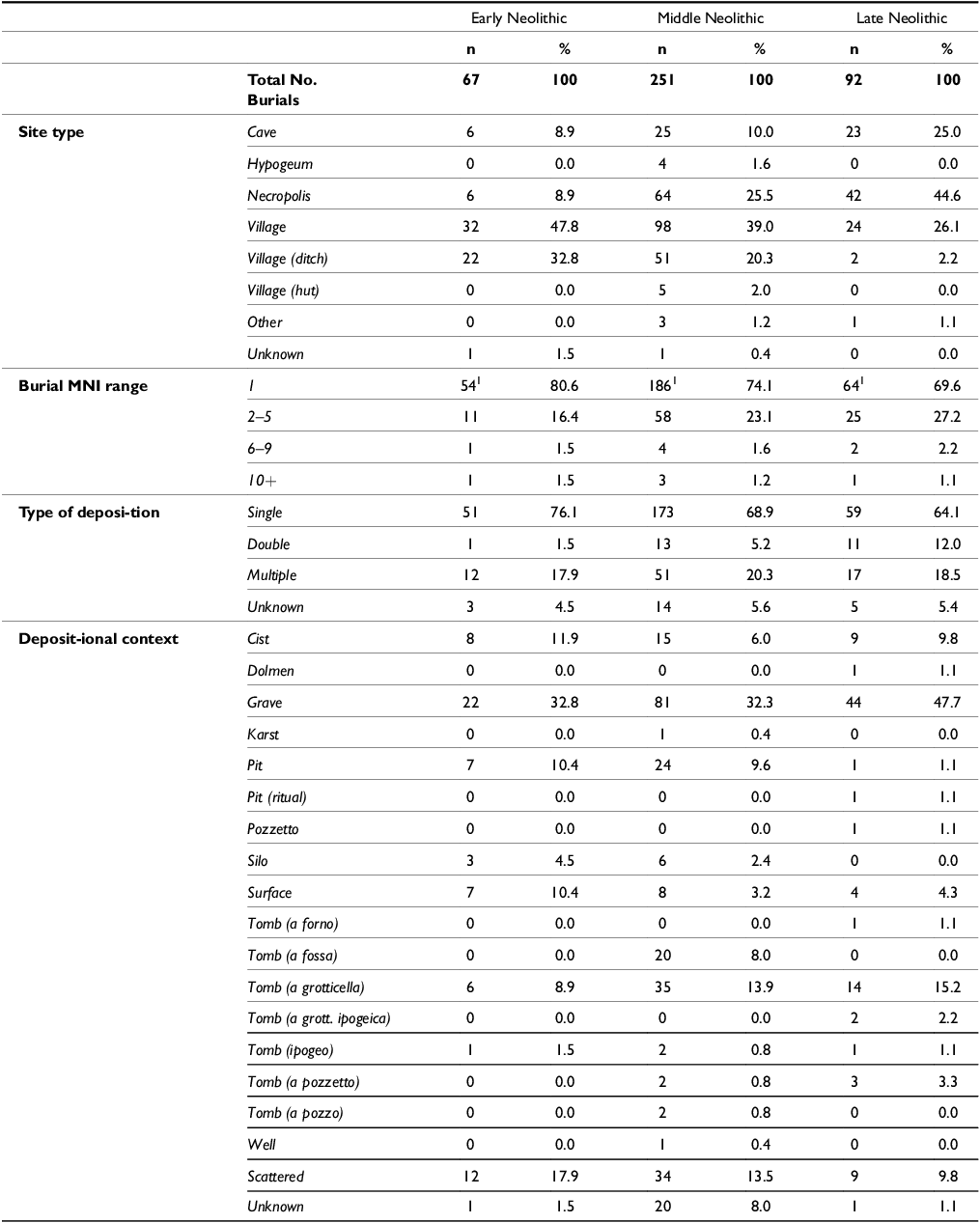
Collating data exhaustively creates a very different picture of social change and process than working from selective ‘typical’ examples. While the assembled data reflect a great deal of nuance, the statistical review shows the basic situation clearly (Table 2). Most importantly, deposition patterns across the Neolithic varied substantially (χ2(10) = 46.77, df = 10, p < 0.001), secondary depositions were overrepresented in the Early Neolithic and underrepresented in the Late Neolithic, exactly the opposite for reductions. Cremations were overrepresented in the Middle Neolithic and virtually absent in the other periods. Primary depositions and ‘primary disturbed’ burials remained relatively stable across time, with no major changes.
Change and continuity in funerary practices. Summary of Neolithic burials in southern Italy, divided by phase, according to site type, MNI, depositional type, and context. Italian tomb or grave forms: forno: oven-shaped; fossa: pit grave; grotticella: rock-cut tomb; grotticella ipogeica: monumentalised rock-cut tomb; ipogeo: hypogeum; pozzo: well-shaped; pozzetto: small well-shaped. Burials that could not be attributed to a phase were excluded (n = 5), for a total of 405 burials. Some burials contained multiple individuals dated to different periods; as a result, the sum of burials by period does not match the overall number of burials. 1Burials with MNI = 1 contain both single depositions and all or some of the ‘unknown’ category

Table 2 Long description
The data are divided by phase in columns which describe the number and relative percentage for categories in rows which relate to: the variety of site types identified, the range of minimum number of individuals buried, types of depositions (single, double, multiple or unknown), and depositional context.
Of the three general models of change posed above, stadial change clearly does not help us understand burial practices over almost 2500 years of the Neolithic, nor does it clarify the Neolithic–Copper Age transition. There is too much continuity. Virtually every time we identify a practice as ‘typical’ of one period, we find that it was used both earlier and later. However, while a ‘gradual change’ model represents such continuities better, it does not deal well with the intermittent nature of such histories, nor with the multiple simultaneous practices. For instance, removing crania from burials in the 6th millennium BCE foreshadows the preferential preservation of crania in 5th millennium Diana-Bellavista tombs and in later (3rd millennium) Copper Age tombs. Megalithic and rock-cut tomb architecture in the 4th millennium BCE echoes earlier Diana-Bellavista tombs, themselves reminiscent of Serra d’Alto burial niches cut into ditch walls. Multiple or collective burial, sometimes considered characteristic of the Copper Age, is known from the Middle Neolithic onwards. Cremation occurs sporadically in many phases.
We therefore trace long genealogies of practice for many forms of burial (Figure 9). Clearly, funerary practice in any period is not defined by specific single practices but by combinations of practices. However, even as they exhibit continuity, individual practices evolved, and the logic governing the overall repertory of funerary practices changed with its social context.
Summary of change in funerary practices over time (grey indicates sporadic or occasional practices).

Figure 9 Long description
Chronologies are represented on the left side of the diagram starting from the Early Neolithic at the top and ending with the Late Copper Age at the bottom. Chronologies are divided in three ways: as date ranges, ceramic phases, and the ‘moments’ of funerary history suggested in this study. The range of funerary practices identified in this study are described at the top. The presence and intensity of each of these practices is represented by bars with graduated shading, where white is absence, grey indicates sporadic or occasional practices, and black represents strongly present practices.
This is clear in the three most important changes characterising the overall sequence:
-
1. Objects deposited with the dead increased in frequency and standardisation. People deposited durable objects with the dead from the Early Neolithic onwards (Figure S1.7). However, this was infrequent. Moreover, the objects deposited varied immensely, expressing no common range of reference and no apparent relationship to the social identity of the deceased. They cannot be described as ‘grave goods’ in the sense familiar from later prehistory. Depositing pottery vessels with the dead became more common with the Middle–Late Neolithic Serra d’Alto group and the Late Neolithic Diana-Bellavista group, and even then, it is unclear whether these related to the particular identity of the deceased. They do, however, provide a thread of practice which is elaborated in the later 4th millennium BCE into Copper Age ‘grave goods’, in which recurrent sets of objects relate systematically to the identity of the dead.
-
2. A narrowing repertory of practices compressed and formalised interaction with the dead. The greatest variety in how people interacted with the dead is observed in the Middle Neolithic (later 6th millennium BCE), particularly in the Tavoliere, where well-studied sites such as Masseria Candelaro, Grotta Scaloria, and Passo di Corvo each exhibit over half a dozen distinct burial practices, including some unique to each site. These give us insight into the creative process involved. Deathways did not work according to a ‘cookbook’ of formalised practices. Rather, there were basic principles such as the importance of associating the dead with the place they originated in and the significance of human bone as a meaningful substance. These provided a foundation for ongoing, open-ended bricolage using a shared vocabulary of practices such as inhumation, defleshing, and retrieving bone from burials. Direct comparison is difficult because almost no Copper Age sites have been studied taphonomically. However, the overall impression is that, as this repertory was handed down to the Late Neolithic and Copper Age, it narrowed: practices such as deposition in living sites, defleshing, and circulating skeletal elements became less frequent or ceased. In practical terms, simplifying the repertory meant abbreviating the possibilities – and the locales used – for prolonged and intimate interaction with the dead.
-
3. The dead were relocated to their own places. Perhaps the most striking change is the invention of extramural necropolises: places separate from the living. There are Early–Middle Neolithic precedents for providing the dead with a place of their own (for instance Titolo, where burials occupied a separate precinct and people may have been returned to the site post-mortem for burial; or Grotta Scaloria, where bones were collected and redeposited in an otherworldly underground environment). However, through the Early and Middle Neolithic, the most common place to deposit the dead was around houses and in village ditches. The place of caves is ambiguous; people throughout the Neolithic and Copper Age deposited the dead in caves, but most also have evidence of quotidian frequentation. Such deposition identified where people lived with an ancestral presence. The heyday of numerous, architecturally well-defined Neolithic villages tapered around 5000 BCE. Strikingly, in the centuries around and after this point, people apparently returned to former living sites specifically to bury their dead. The best-known examples are Serra Cicora in southern Puglia and Serra d’Alto in Matera, but this is known for other Serra d’Alto and Diana-Bellavista sites as well (for instance, Masseria Santa Tecchia, Fontanarosa Uliveto, Masseria Candelaro). Effectively, looking backward, these maintained the tradition of depositing the dead at ancestral living places, even if people no longer lived there. At the same time, looking forward, they established a precedent of ancestral places occupied solely by the ancestors. As time passed and the memory of living at specific places faded, what remained was establishing specific locations for the dead set apart from living spaces. This may have made the dead more special, as the focus of constructions such as burial sites and tombs; but paradoxically, it may also have removed them from the life of the living and made involvement with them episodic rather than continual.
This diachronic examination deconstructs the idea of a single ‘Big Change’ in burial practice. Instead, we identify both long-term continuities and numerous smaller-scale changes. These suggest that a ‘genealogies of practice’ model may be appropriate. In this model, it is not the presence of one element of funerary practice (such as single or multiple burial) that is important, but how it is bundled together with other practices, such as constructing funerary structures, including objects in the burials, or relations to a changing landscape. To understand ongoing relational reconfiguration, it is useful to trace how funerary practices adapted and changed continuously through a series of historical moments between 6000–3800 BCE. Each varied a lot and all dates are approximate, so these should not be taken as rigid ‘periods’, and they demonstrably do not necessarily coincide with archaeological periodisations:
-
• Moment 1: 6000–5500 BCE (approximately Early Neolithic). As the Neolithic farming landscape developed throughout southern Italy, burial was defined around basic principles such as locating the dead in living sites as generalised ancestors and maintaining ongoing interaction with them, mediated by the active use of selected bone. A core repertory of funerary practices for enacting this was established in various ritual contingencies.
-
• Moment 2: 5500–5200 BCE (approximately the earlier part of the Middle Neolithic). As the Neolithic farming landscape filled up and village size increased, there followed several centuries of particularly active ritual innovation; this includes many of the most florid Neolithic funerary depositions at sites such as Grotta Scaloria, Masseria Candelaro, and Passo di Corvo.
-
• Moment 3: 5200–4600 BCE (approximately the latter Middle Neolithic and earlier Late Neolithic, including Serra d’Alto and earlier Diana-Bellavista groups). The gradual abandonment of Neolithic village landscapes triggered experimentation and redefinition in funerary practice. Some recurrent features include revisiting earlier sites to deposit burials at ancestral places; placing a ceramic vessel or two with the dead; experimentation with red ochre in burials; experimentation with formally constructed tombs and megalithism (such as the village ditch niche burials at Masseria Candelaro, or small rock-cut tombs containing one to three people at Cava Ripatetta).
-
• Moment 4: 4600–3800 BCE (approximately the final part of the Late Neolithic and initial Copper Age). Burial sites were no longer associated with present or previous living sites; other than deposition in caves, the most common form was a group of small rock-cut tombs containing one or a few individuals, often with pottery, and sometimes with subsequent disturbance and conservation of the crania.
-
• Moment 5: after 3800 BCE (approximately the earlier Copper Age). A phase of experimentation, in which communities dispersed over greater distances developed localised traditions such as cremations in varied features and vessels. Known deathways are variations on the themes of cremations, cave depositions, and rock-cut tombs containing few people and objects. The forms of burial often considered stereotypical of the Copper Age (especially Gaudo and Rinaldone group traditions involving rock-cut tombs containing the remains of c. 10–20 people, sometimes with elaborate grave goods) really flourished from around 3000 BCE.
Conclusion: a big change happens one day at a time
People did not wake up one day in an entirely different Copper Age world, with new and unfamiliar social structures, technologies, and deathways. Yet, the transition from Neolithic to post-Neolithic is predominantly framed in oppositional terms: from single to collective burial (or, elsewhere in Europe, collective to single); from no grave goods to grave goods; and the emergence of new kinds of personhood. Our foray into thousands of years of funerary practices in southern Italy leads us to question these binary narratives. This concern has also been taken up by proponents of posthuman, assemblage-based approaches to change and historicity (Crellin Reference Crellin2020), as well as from a statistical perspective (Bevan & Crema Reference Bevan and Crema2021).
In this analysis, tracing change over the 3000 or so years of the Neolithic and Copper Age requires a big scale of analysis, but without preconceptions about the units and process of change. Examining all available data for Neolithic burials in Puglia, Basilicata, and Calabria, it is clear that a new narrative is needed. It is not the case that one dominant practice in the Neolithic (intramural single burial) is replaced by a different normative mode in the Copper Age (collective deposition in rock-cut tombs). Instead, recurrent multiplicities of funerary rites were adapted and recombined in a changing landscape of social and political action.
As we show, the idea of stadial change, whether between Neolithic and Copper Age or between segments of the Neolithic, does not describe change in funerary practice well. These periods were never internally homogeneous, and most or all funerary practices continued across them. Instead, the pattern of change includes long-term continuities of practice. At the same time, the balance of specific practices and how they were used changed. Through such shifts of combination and emphasis, small-scale changes in deathways were keyed into broader cultural transformations. The motor of change is an incremental everyday process over a long timescale, rather than imposed by major external actors or forces. Everyday action, as a series of iterative praxes, provided constant opportunity to reaffirm or renegotiate social relations. Experienced ‘on the ground’, this was probably felt as continuity with minor local innovations, some of which remained idiosyncratic one-offs while others spread in popularity. The core of the process was bricolage, with small groups making free-form ritual practice to suit the circumstances at hand, while drawing upon a lexicon of traditional possibilities. As the parameters of life – group size, mobility, cosmological and gender beliefs, forms of relatedness, and other social distinctions – shifted, the resulting choices did as well. Over time, this added up to major changes.
As many mystery novels say, when you know the ‘how’, you also know a lot of the ‘why’. Seeing change as a single big transition predisposes explanation towards prime mover narratives in which a few major causes drive change. In contrast, seeing change as a continual process of continuity, reconfiguration, and local innovations shifts the emphasis to processes of social reproduction and gradual responses to multiple, interacting factors. These factors could include social relations and cultural contexts as well as more ‘external’ factors. For example, a gradual shift towards a decentralised settlement pattern, tied to an increasing emphasis on pastoralism, might produce extramural cemeteries only if conditioned by a belief that the cultural epicentre of a group was represented by the location where communal ancestral substance was concentrated.
For prehistoric archaeology generally, the significance of this approach is not that fine-grained local analysis is the sole and obligatory strategy for understanding change. The appropriate scale of analysis is relative to the problem we are trying to address, and sometimes big-picture analysis can reveal patterns invisible in close-up analysis (Harris & Robb Reference Harris, Robb, Robb and Harris2013; Wobst Reference Wobst1978). Periodisations and normative characterisations using ‘diagnostic’ indicators such as highly decorated pottery styles were developed as tools for classification and dating, and they remain essential for that purpose. But they have inbuilt biases. They highlight discontinuity over continuity and abrupt change over incremental change, and they suggest that changes happened in synchrony, rather than different aspects of life changing independently of each other. Moreover, they predispose theorists to explanations which can be linked to such patterns. For instance, a rapid, across-the-board social change may imply that a major external force was necessary to cause it, excluding models of endogenous change. Examining the evidence for change in closer detail, this study shows much more evidence of continuity, and how, via social reproduction models of bricolage situated in a gradually changing landscape of action, people themselves can be the motor of dramatic change over the longue durée.
Supplementary material
To view supplementary material for this article, please visit https://doi.org/10.1017/ppr.2026.10097
Acknowledgements
For providing information about various archaeological sites, we are grateful to Claudio Cavazzuti, Pierfrancesco Fabbri, Eugenia Isetti, Italo Muntoni, Donatella Pian, Ada Preite, Francesca Radina, Sandro Sublimi Saponetti, Ida Tiberi, and Antonella Traverso. Access to the human remains studied by JR, JET, and SP was provided by Trish Biers (Duckworth Laboratory, University of Cambridge), Francesca Candilio, and Alessandra Sperduti (both Servizio di Bioarcheologia, Museo delle Civiltà). New radiocarbon dates published here were supported by Elena Dellù (Soprintendenza Archeologia, Belle Arti e Paesaggio per la Città Metropolitana di Bari), Italo Muntoni (Soprintendenza Archeologia, Belle Arti e Paesaggio per le province di Barletta-Andria-Trani e Foggia), Francesca Radina (formerly Soprintendenza Archeologia, Belle Arti e Paesaggio per la Città Metropolitana di Bari), and Simona Minozzi (University of Pisa). We are grateful to Noah Steuri and Penny Bickle for inviting us to present earlier versions of this work and to the audiences for their comments. The Cambridge University Libraries team provided essential resource support and we especially thank Julie Burgess, Bettina Rex, and Alison Zammer for all of their help.
Funding statement
This research was supported by the European Union through the European Research Council Advanced Grant ‘Making Ancestors: The Politics of Death in European Prehistory’ (No. 885137).





 Open access

