Introduction
Byssoloma Trevis. is the type genus of the Pilocarpaceae (lichenized Ascomycota) and is mainly distributed in tropical and subtropical regions worldwide (Lücking Reference Lücking2008). At present, 58 species are recognized worldwide, growing mainly on living leaves and bark, sometimes on rocks and on the thalli of other lichens (Santesson Reference Santesson1952; James Reference James1971; Vězda Reference Vězda1975, Reference Vězda1986, Reference Vězda1987, Reference Vězda1994; Sérusiaux Reference Sérusiaux1978, Reference Sérusiaux1979, Reference Sérusiaux1996, Reference Sérusiaux1998; Kalb & Vězda Reference Kalb and Vězda1990, Reference Kalb and Vězda1994; Coppins et al. Reference Coppins, James and Hawksworth1992; Sipman & Aptroot Reference Sipman and Aptroot1992; Fárkas & Vězda Reference Fárkas and Vězda1993; Malcolm & Vězda Reference Malcolm and Vězda1995; Ekman Reference Ekman1996; Kondratyuk Reference Kondratyuk and Wasser1996; Aptroot et al. Reference Aptroot, Diederich, Sérusiaux and Sipman1997; Lücking et al. Reference Lücking, Sérusiaux, Maia and Pereira1998, Reference Lücking, Sérusiaux and Santesson2002; Thor et al. Reference Thor, Lücking and Matsumoto2000; Sérusiaux et al. Reference Sérusiaux, Gómez-Bolea, Longán and Lücking2002; Schubert et al. Reference Schubert, Lücking and Lumbsch2003; Lücking Reference Lücking2006, Reference Lücking2008, Reference Lücking2013; Messuti & de la Rosa Reference Messuti and de la Rosa2007; Lumbsch et al. Reference Lumbsch, Ahti, Altermann, de Paz G, Aptroot, Arup, Bárcenas Peña, Bawingan, Benatti and Betancourt2011; Breuss Reference Breuss2013, Reference Breuss2014; Cáceres et al. Reference Cáceres, Santos, Mendonça, Mota and Aptroot2013; Aptroot Reference Aptroot2014; van den Boom Reference van den Boom2016; Elix & McCarthy Reference Elix and McCarthy2018; Wang et al. Reference Wang, van den Boom, Sangvichien and Wei2020a). The genus Byssoloma is characterized by its byssoid apothecial margin (inconspicuous in some species) and I+ dark blue asci with a tubular structure at the apices (‘Byssoloma type’ in Hafellner (Reference Hafellner1984)), pyriform or oblong conidia, and mainly transversely 1–7-septate ascospores, sometimes up to 19(–23)-septate in some species (Sérusiaux Reference Sérusiaux1993; Lücking Reference Lücking2008).
During the study of Byssoloma specimens housed in the herbarium of the National Museum of Nature and Science (TNS), Tsukuba, Japan, several specimens collected in Japan and China were recognized as an undescribed species. The aim of this study is to describe and illustrate the new species Byssoloma orientale, and to discuss the variation within the species and the differences with similar taxa.
Materials and Methods
Morphology and chemistry
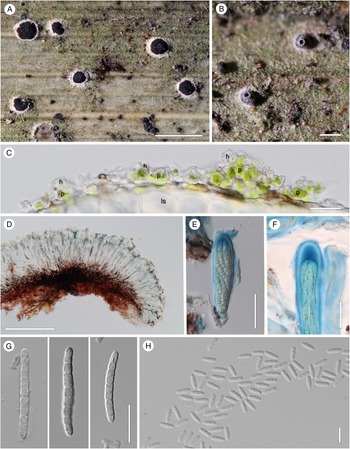
Morphological observations and photography were performed using a dissecting microscope (SZX16; Olympus, Tokyo, Japan) and a differential interference contrast microscope (BX51; Olympus) equipped with a digital camera (EOS Kiss X10i; Canon, Tokyo, Japan). Anatomical examinations were carried out using hand-cut sections mounted in GAW (glycerin:ethanol: water = 1:1:1) solution (Asahina Reference Asahina1936). The digital images in Fig. 2A & B were prepared using CombineZP image stacking software developed by Alan Hadley (GNU Public License).
Ascus amyloidity was examined using Lugol's solution (I) and K reaction for fungal tissues was tested using 5% KOH solution. Secondary substances were analyzed using high-performance thin-layer chromatography (HPTLC) following Schumm & Elix (Reference Schumm and Elix2015). The solvent B′ (n-hexane:methyl tert-butyl ether:formic acid, 140:72:18) (Culberson & Johnson Reference Culberson and Johnson1982) was used for HPTLC. The spot colour was checked under 254 and 366 nm wavelength of UV and visible light, before and after spraying with 10% sulphuric acid on the HPTLC plate and charring at 90 °C for 20 min.
DNA extraction, PCR amplification and sequencing
DNA extraction for PCR was performed following a modified method of Izumitsu et al. (Reference Izumitsu, Hatoh, Sumita, Kitade, Morita, Gafur, Ohta, Kawai, Yamanaka and Neda2012) (see Miyazawa et al. Reference Miyazawa, Ohmura and Yamaoka2022). Partial sequences of the small subunit of the mitochondrial ribosomal RNA gene (mtSSU) were amplified using the primers mrSSU1 and mrSSU3R (Zoller et al. Reference Zoller, Scheidegger and Sperisen1999) according to the following protocol. PCR was performed in a 15 μl reaction solution containing 2 μl DNA template, 7.5 μl GenRED PCR Mix Plus (Nippon Gene, Tokyo, Japan), 1.5 μl of each primer (2 pmol μl−1), and 2.5 μl of distilled water. PCR conditions followed the method of Wang et al. (Reference Wang, Sangvichien, Wei and Wei2020b), using a TaKaRa PCR Thermal Cycler Dice® Touch (TaKaRa, Tokyo, Japan). The PCR products were checked by electrophoresis on a 1.5% agarose gel stained with Midori Green Direct DNA Stain (Nippon Genetics, Tokyo, Japan) and visualized using WSE-5200 Printgraph 2M (ATTO Corporation, Tokyo, Japan). PCR products were purified using the ExoSAP-IT™ PCR Product Cleanup Reagent (Thermo Fisher Scientific, Massachusetts, USA). A volume of 13 μl of PCR products with 2 μl of four times diluted ExoSAP-IT™ was incubated at 37 °C for 15 min, then 80 °C for 15 min.
DNA sequencing was performed either on an Applied Biosystems™ 3500xL Genetic Analyzer (Thermo Fisher Scientific) using the BigDye® Terminator v. 3.1 Cycle Sequencing Kit (Thermo Fisher Scientific) following the manufacturer's instructions, or through a DNA sequencing service provided by Eurofins Genomics in Tokyo, Japan.
Molecular phylogenetic analyses
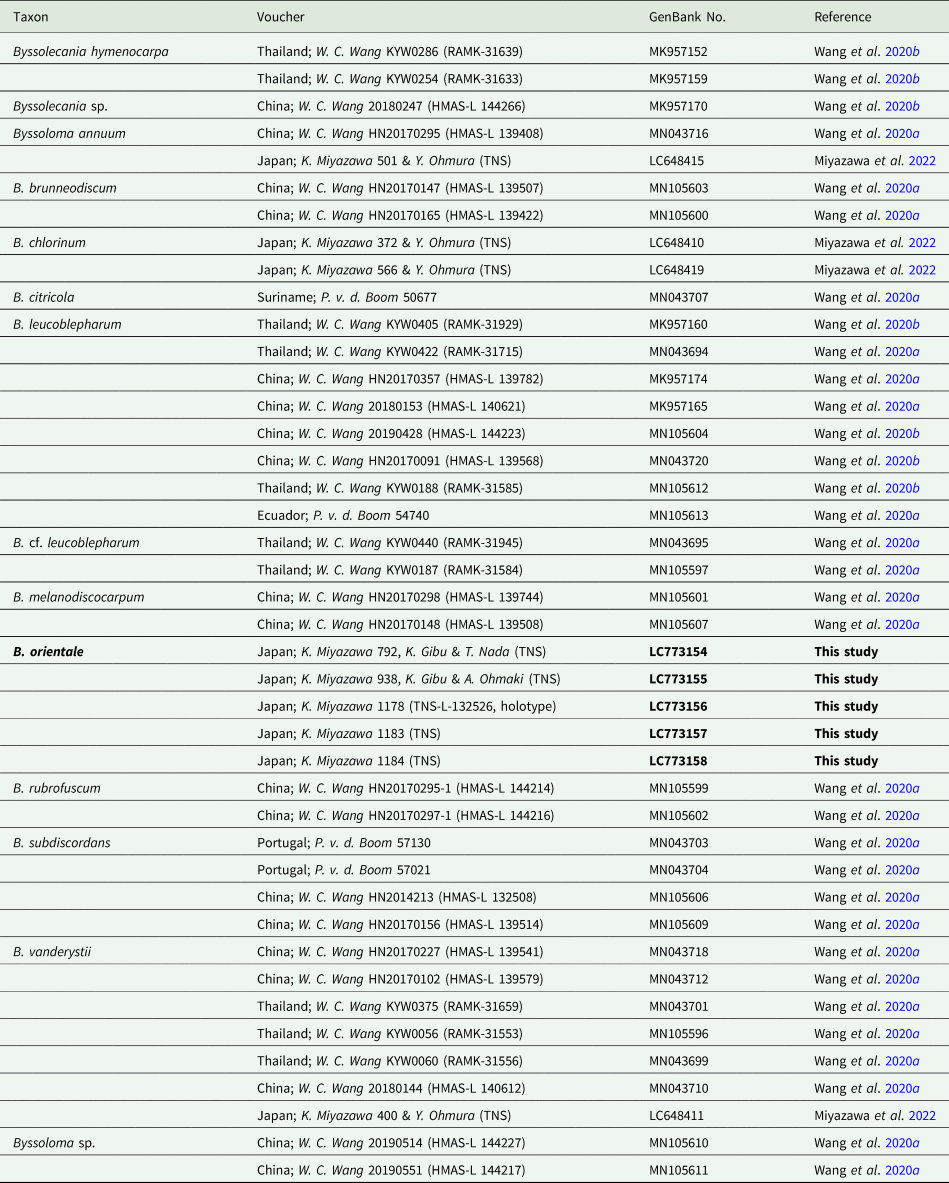
The five mtSSU sequences of Byssoloma orientale from Japanese material were aligned with the 37 registered sequences of selected taxa in GenBank (Table 1) using MAFFT v. 7 (Katoh et al. Reference Katoh, Rozwicki and Yamada2019) with default settings. For the outgroup, the sequences of Byssolecania hymenocarpa (Vain.) Kalb et al. (MK957152 and MK957159) and Byssolecania sp. (MK957170) from GenBank were used to enable a comparison with the phylogenetic tree generated by Wang et al. (Reference Wang, van den Boom, Sangvichien and Wei2020a). The final alignment of 631 sites was used for the molecular phylogenetic analyses, after removing sites with gaps and missing data.
Voucher information, GenBank Accession numbers and references for Byssoloma and related taxa used in the phylogenetic analysis (Fig. 1). New sequences obtained in this study are in bold.

Maximum likelihood (ML) tree of mtSSU sequences from selected taxa in Byssoloma showing the phylogenetic position of Byssoloma orientale collected from Japan (in bold). Byssolecania spp. are used as an outgroup. Maximum likelihood and neighbour-joining (NJ) support values (≥70) are presented for each node (ML/NJ). Branches highly supported (≥90) by both analyses are indicated with bold black lines. Alphanumeric codes indicate the GenBank number, voucher number and country code (CH = China; EC = Ecuador; JP = Japan; PT = Portugal; SR = Suriname; TH = Thailand).

The maximum likelihood (ML) phylogenetic tree was generated with the Tamura 3-parameter model (Tamura Reference Tamura1992) plus gamma distribution which was selected as the best-fitting model. Bootstrap values (≥70%) with 1000 replicates for ML and the neighbour-joining method (NJ) are shown on each branch (Fig. 1). A branch with high bootstrap values (≥90%) in both analyses is indicated with a bold black line. All calculations were conducted in MEGA X (Kumar et al. Reference Kumar, Stecher, Li, Knyaz and Tamura2018).
Results and Discussion
Within the Japanese material of the new species Byssoloma orientale, there are five variable sites and five gap sites in the 825 aligned sites of mtSSU. The identity among five samples was 99.4–99.9%. Since no discernible differences in morphology were observed, these genetic differences were treated as variations within a species.
The ML phylogenetic tree is shown in Fig. 1. The topology of our phylogenetic tree including the sequences of B. orientale and other Japanese Byssoloma taxa registered in Miyazawa et al. (Reference Miyazawa, Ohmura and Yamaoka2022) shows no conflict with that of Wang et al. (Reference Wang, van den Boom, Sangvichien and Wei2020a). The samples of B. orientale formed a monophyletic clade with high support values (ML/NJ = 100/100) and sister to B. vanderystii Sérus. with high support (ML/NJ = 99/99).
Taxonomic Treatment
Byssoloma orientale K. Miyaz. & Y. Ohmura sp. nov.
MycoBank No.: MB 849345
Differs from B. vanderystii Sérus. by the pure black disc of the epithecium which has a dense accumulation of aeruginous pigment, and by the longer and (7–)9–12(–17)-septate ascospores (18.3–49.2 × 2.0–4.0 μm).
Type: Japan, Ryukyu Islands (Okinawa Pref.), Takae, Higashi-son, Kunigami-gun (26°39′59″N, 128°14′46″E), on leaf of Arenga engleri along a stream, 75 m elev., 15 November 2022, K. Miyazawa 1178 (TNS—holotype TNS-L-132526). GenBank Accession no.: LC773156 (mtSSU).
(Fig. 2)
Byssoloma orientale collected from Japan. A, thallus with apothecia (holotype, TNS). B, pycnidia on thallus (holotype, TNS). C, a vertical section of thallus with photobiont cells (holotype, TNS); h = hyphae of mycobiont, p = photobiont cell, ls = leaf surface. D, section of apothecium (K. Miyazawa et al. 792, TNS). E, ascus with ascospores stained by Lugol's solution (K. Miyazawa et al. 792, TNS). F, apical structure of ascus stained by Lugol's solution (K. Miyazawa et al. 792, TNS). G, ascospores with various numbers of septa (K. Miyazawa et al. 792, TNS). H, conidia (holotype, TNS). Scales: A = 1 mm; B = 200 μm; C = 10 μm; D = 50 μm; E & F = 20 μm; G = 15 μm; H = 5 μm. In colour online.

Thallus crustose, irregular in shape, continuous, 20–60 mm across, 5–15 μm thick, minutely farinose, light green. Photobiont trebouxioid, ellipsoid, (3.6–)4.2–5.3(–5.5) × (2.3–)2.8–3.8(–4.7) μm (n = 30).
Apothecia sessile, rounded, 0.4–1.2 mm diam., 85–130 μm tall; margin well developed, densely byssoid, persistent, spreading laterally over thallus surface, 50–300 μm wide, white, sometimes brownish white, composed of loosely woven colourless hyphae; disc slightly to strongly convex, pure black; epithecium with abundant aeruginous pigment, 1.5–4.5 μm tall; hymenium 40–65 μm tall, colourless, with or without aeruginous pigment; hypothecium 40–65 μm tall, reddish brown, K+ purple; apothecial base brownish black, K−; paraphyses branched and sometimes anastomosing, 0.6–1.7 μm wide, often apically thickened (up to 2.2 μm wide). Asci clavate, 8-spored, I+ dark blue with the tubular structure at the apices, tholus amyloid (‘Byssoloma-type’ in Hafellner (Reference Hafellner1984)), 32–60 × 9–13 μm. Ascospores cylindrical, (7–)9–12(–17)-septate, with or without slight constriction at septa, colourless, (18.3–)21.0–35.5(–49.2) × (2.0–)2.4–3.3(–4.0) μm (n = 30), 6–16.5 times as long as wide.
Pycnidia flask-shaped, 100–140 μm diam., greyish black, covered by whitish loose hyphal tissue. Conidia oblong without constriction, aseptate, colourless, (3.7–)4.4–5.1(–5.6) × (0.9–)1.1–1.3(–1.6) μm (n = 100), 2.5–5 times as long as wide.
Chemistry
No secondary substance was detected with HPTLC.
Etymology
The epithet ‘orientale’ is a Latin adjective that refers to the Far East, where the new species was collected from Japan and China.
Habitat and distribution
This species grows on living leaves of Arenga engleri, as well as on bark of evergreen broadleaf trees, in conserved rainforests of southern Japan at elevations of 40–300 m and central China at elevations of 400–500 m.
Notes
Byssoloma orientale is similar to B. vanderystii in the byssoid apothecial margin spreading laterally over the thallus surface (Fig. 2A), the 7–17-septate ascospores (Fig. 2G) and the oblong conidia (Fig. 2H), whereas other Byssoloma species typically have 3–5-septate ascospores and pyriform conidia. Morphological and molecular phylogenetic analyses in this study show that B. orientale is closely related to B. vanderystii but that the two species are genetically independent. Byssoloma orientale differs from B. vanderystii in having longer ascospores with more septa (18.3–49.2 × 2.0–4.0 μm, (7–)9–12(–17) septa vs 22–33 × 2.0–3.5 μm, 7 septa in B. vanderystii) (Sérusiaux Reference Sérusiaux1979; Lücking Reference Lücking2008; Miyazawa et al. Reference Miyazawa, Ohmura and Yamaoka2022) and in the accumulation of aeruginous pigment in the epithecium resulting in a pure black disc appearance.
Byssoloma orientale resembles B. kakouettae (Sérus.) Lücking & Sérus. and B. laurisilvae Breuss in having ascospores with more than 7 septa. However, B. kakouettae, which is reported from Macaronesia and Western Europe, differs from B. orientale in having no apothecial margin extending laterally over the thallus surface, an orange to black disc without a pigmented epithecium, larger ascospores (40–67 × 2.5–6 μm) with up to 19(–23) septa, no well-branched paraphyses, and narrow and bifusiform to obpyriform conidia (Sérusiaux Reference Sérusiaux1993; Sérusiaux et al. Reference Sérusiaux, Gómez-Bolea, Longán and Lücking2002; van den Boom Reference van den Boom2021). Byssoloma laurisilvae, reported from the Canary Islands, differs from B. orientale in having apothecial margins not extending into the thallus surface, a yellowish to ochre disc without a pigmented epithecium, longer ascospores (40–48(–55) × (3.5–)4–5 μm) with 11–16 septa, and bifusiform conidia (Breuss Reference Breuss2013; van den Boom Reference van den Boom2021).
Byssoloma orientale might be confused with B. chlorinum (Vain.) Zahlbr. because both have a light green farinose thallus, a pure black disc and a byssoid apothecial margin which spreads laterally over the thallus surface (Fig. 2A). However, B. chlorinum differs in having 3-septate ascospores and pycnidia that produce pyriform conidia (Lücking Reference Lücking2008; Miyazawa et al. Reference Miyazawa, Ohmura and Yamaoka2022). The differences between the two species are also supported by the results of the molecular phylogenetic analysis in this study (Fig. 1).
Additional specimens examined
China: Jianxi Sang Province: Yichun Region, Yifeng Co., Mazhishango, Jiulingshan Mts (Guanshan Nature Reserve), on tree bark along river, 400–500 m elev., 1995, H. Kashiwadani 41330 (TNS).—Japan: Kyushu, Hyuga Prov. (Miyazaki Pref.): Inohae Valley, Kitagawachi, Kitagou-cho, Nichinan-city (31°43′N, 131°22′E), on twig of Machilus japonica, c. 100 m elev., 2021, K. Miyazawa 938, K. Gibu & A. Ohmaki (TNS). Ryukyu Islands (Okinawa Pref.): Takae, Higashi-son, Kunigami-gun (26°39′59′′N, 128°14′46′′E), on leaf of Arenga engleri along a stream, 75 m elev., 2022, K. Miyazawa 1177 pr. p. (in collection of Byssoloma vanderystii) (TNS); ibid., on trunk of broadleaf tree along a stream, K. Miyazawa 1183 (TNS), K. Miyazawa 1184 (TNS); Genka, Nago-city (26°36′55–59ʺN, 128°03′46–49ʺE), on trunk of broadleaf tree along Genka River, 40 m elev., 2021, K. Miyazawa 792, K. Gibu & T. Nada (TNS); along the mountain path, Mt Katsuu, Nago-city (26°37′53ʺN, 127°56′14ʺE), on trunk of evergreen broadleaf tree, 300 m elev., 2023, K. Miyazawa 1301 (TNS).
Acknowledgements
We thank two anonymous reviewers for the careful reading of our manuscript and for providing valuable comments; K. Gibu for coordinating the field investigations on Okinawa Island; I. Okane for helping us to obtain the necessary permissions for our collections on Okinawa Island. Permissions to collect on Okinawa Island were kindly granted by the Okinawa Amami Nature Conservation Office, Kyushu Regional Environment Office, the Ministry of the Environment Government of Japan (no. 2102242), and for Inohae Valley by the Miyazaki Nambu Forest Management Station, Forestry Agency, and the Ministry of Agriculture, Forestry and Fisheries Government of Japan (no. 1). This study was partly supported by JSPS KAKENHI (no. 22J20567) to KM.
Author ORCIDs
Kento Miyazawa, 0009-0002-0629-5551; Yoshihito Ohmura, 0000-0003-2557-2761.