In agreement with the points raised by Kryst et al. (Reference Kryst, Żegleń, Wronka, Woronkowicz, Bilińska-Pawlak and Das2019b) we recognize the ethnic differences in the body composition among individuals of South Asian origin, which often challenges the clinical utility of conventional obesity indicators in this population. We also acknowledge the paucity of literature in this regard, especially from the Indian subcontinent (Kryst et al., Reference Kryst, Zeglen, Wronka, Woronkowicz, Bilinska-Pawlak and Das2019a).
The utility of conventional obesity indicators like body mass index (BMI), waist circumference, hip circumference, waist–hip ratio, waist–height ratio and neck circumference in individuals of different ethnicity can be enhanced by using ethnicity-specific cut-offs for the identification and treatment of at-risk individuals (Yajnik & Yudkin, Reference Yajnik and Yudkin2004). Though data are emerging on novel cut-offs for different measures of obesity among different ethnicities, there is a definite need to generate more evidence to study their utility in the primary and secondary prevention of cardio-metabolic disorders, before they can be incorporated into public health practice guidelines (Xin et al., Reference Xin, Liu, Niu, Feng, Zhao and Ma2012).
More recently, the Canadian Obesity Network (CON) devised a novel obesity scoring system that categorized obese individuals into five stages depending on the presence and severity of the obesity-related co-morbidities (Martinez & Martinez, Reference Martinez Urbistondo and Martinez2017) – the Edmonton Obesity Staging System (EOSS). Padwal et al. (Reference Padwal, Pajewski, Allison and Sharma2011) showed that there was a concurrent increase in long-term mortality with increasing stages of EOSS.
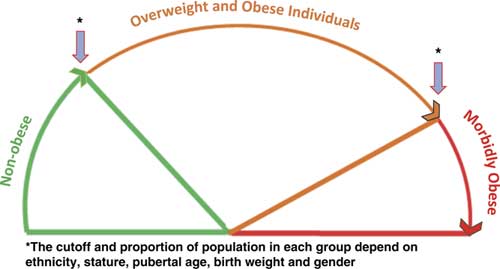
The other important point raised by Kryst et al. (Reference Kryst, Żegleń, Wronka, Woronkowicz, Bilińska-Pawlak and Das2019b) is regarding the alarming rise of obesity in young adults, adolescents and children, who are likely to develop metabolic diseases earlier in age, so affecting their fitness, well-being and quality of life in the most productive years of their life. To interpret obesity indicators in this age group, in addition to ethnic differences, it is important to take into consideration other aspects such as stature, pubertal age, birth weight and sex (Thomas et al., Reference Thomas, Grunnet, Poulsen, Christopher, Spurgeon and Inbakumari2012; Baxi et al., Reference Baxi, Vasan, Hansdak, Samuel, Jeyaseelan and Geethanjali2016). The threshold used for any obesity indicator determined by these factors would also alter the proportion of individuals in each obesity category in the community. This will impact the planning and execution of public health management strategies (Fig. 1).
Schema showing the role of obesity indicators in determining the prevalence of obesity in the community.

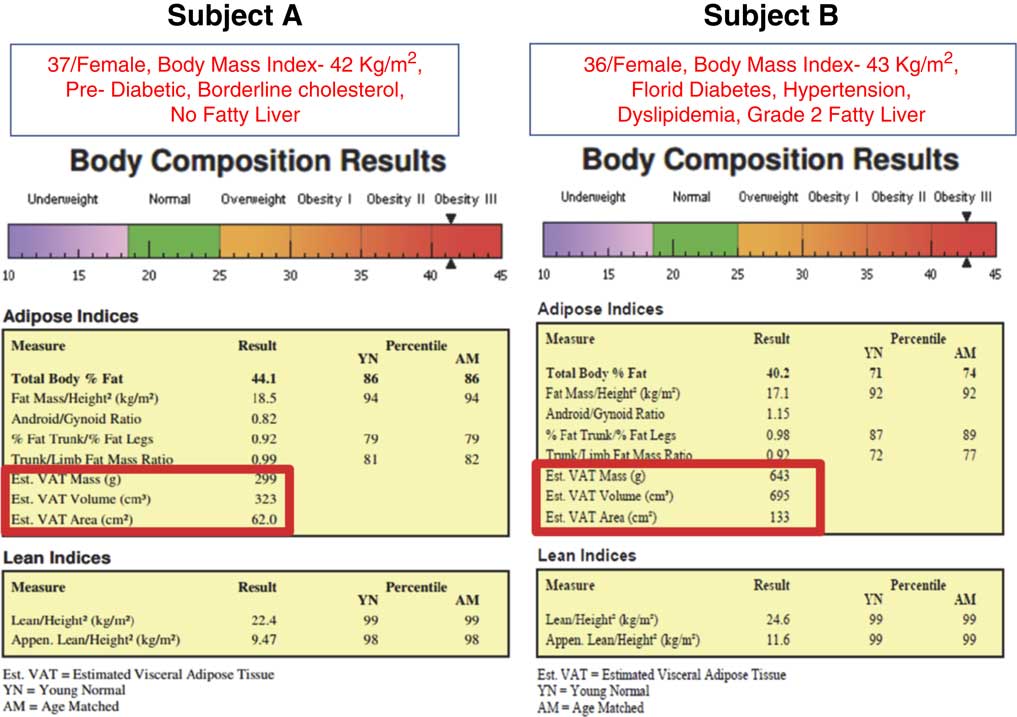
Further to the response by Kryst et al. (Reference Kryst, Żegleń, Wronka, Woronkowicz, Bilińska-Pawlak and Das2019b) on the role of measuring visceral adipose tissue in obese individuals, its clinical use is shown in Fig. 2. This shows that two individuals with morbid obesity, of similar age and BMI, have different visceral adipose tissue contents as measured by a DXA (Dual-energy X-ray Absorptiometry) scan. These individuals have very distinct metabolic co-morbidities despite an extreme yet comparable BMI, reflecting the importance of measuring visceral adipose tissue in the screening and follow-up of obese patients (LaForgia et al., Reference Laforgia, Dollman, Dale, Withers and Hill2009). The other upcoming methods of fat estimation include body plethysmography and potassium counter, magnetic resonance imaging and even fat biopsies in some individuals. In the recent past, there has also been an upcoming role of genetic indicators of obesity in the evaluation and management of obesity, especially in highly consanguineous South Asian populations (Kapoor et al., Reference Kapoor, Chapla, Furler, Paul, Harrap, Oldenburg and Thomas2019b).
Role of measuring visceral adipose tissue (VAT) in obese individuals. Despite having a similar age, sex and BMI the two subjects depicted in this figure have disparate visceral adipose tissue content and contrasting metabolic phenotypes.
To summarize, the key message from this debate is that even though obesity indicators are useful clinical tools in the measurement of obesity, it is important for clinicians to appropriately interpret their values in individuals of different ethnic origin. Further research is needed to identify optimal cut-offs for these measures that can predict the occurrence of cardio-metabolic co-morbidities in a particular population.
Acknowledgments
The authors would like to acknowledge the ENCORE (Excellence in NonCOmmunicable disease Research (ENCORE) between Australian and India) programme for facilitating this joint publication.
Ethical Approval
This study was conducted according to the guidelines laid down in the Declaration of Helsinki. The authors declare that no competing interests exist, funding or an ethics statement was not required for this work.
Conflicts of Interest
The authors have no conflicts of interest to declare.
Funding
This research received no specific grant from any funding agency, commercial entity or not-for-profit organization.