Introduction
Stratospheric ozone depletion over the Antarctic and the consequent increase of ultraviolet-B radiation (UV-B, 280–315 nm) is a well known fact and, despite efforts to minimize the anthropogenic impact on ozone destruction, little improvement is expected for total column ozone in the Antarctic for decades (Weatherhead & Andersen Reference Weatherhead and Andersen2006). Ultraviolet-A radiation (UV-A, 315–400 nm) and photosynthetically active radiation (PAR, 400–700 nm) are involved in photoreactivation and photorepair of the DNA (Karentz Reference Karentz1994 and references therein). It is therefore of particular concern that ozone depletion results in increased harmful UV-B radiation without a proportional increase in UV-A and PAR. In the study area, UV radiation (UVR, 280–400 nm) can penetrate to a considerable depth into the water column (19 m, corresponding to 1% of the irradiance at the water surface), and could thereby also affect subtidal organisms. Although the sediment has been considered to be a refuge to escape harmful radiation, UVR has been shown to penetrate c.1 mm into a sandy sediment (Wulff et al. Reference Wulff, Nilsson, Sundbäck, Wängberg and Odmark1999).
In shallow water areas (estuaries) microphytobenthic communities can account for a substantial part (50%) of the total primary productivity (Underwood & Kromkamp Reference Underwood and Kromkamp1999). Moreover, subtidal benthic microalgae on the continental shelves can account for 42% of the total areal primary productivity (Nelson et al. Reference Nelson, Eckman, Robertson, Marinelli and Jahnke1999). Also, in polar areas, the marine microphytobenthos forms an important food source for both benthic and pelagic heterotrophs. In Antarctic ecosystems in particular, a poor development of pelagic microalgae (Schloss et al. Reference Schloss, Ferreyra and Curtosi1998) but an important contribution of resuspended benthic diatoms to the phytoplankton has been suggested and/or observed (e.g. Ahn et al. Reference Ahn, Chung, Kang and Kang1994).
UV radiation has been shown to negatively affect benthic microalgae in various ways with a potential cascade effect on the whole ecosystem (Bothwell et al. Reference Bothwell, Sherbot and Pollock1994). For example, UVR reduced the photosynthetic performance of microphytobenthos, and damaged the DNA (reviewed in Franklin & Forster Reference Franklin and Forster1997). Primary targets are the D1/D2 protein complex in photosytem II (PS II), and the water-splitting complex (Franklin & Forster Reference Franklin and Forster1997 and references therein). However, the susceptibility of microphytobenthos towards UVR has mainly been studied on soft bottom communities. For example, ambient UV-B was proven to be a stress factor for sand-living microbenthic communities and a selective force during early growth and succession (Wulff et al. Reference Wulff, Wängberg, Sundbäck, Nilsson and Underwood2000). Important functional factors such as primary productivity and carbon allocation were strongly affected by ambient (Wulff et al. Reference Wulff, Nilsson, Sundbäck, Wängberg and Odmark1999) and enhanced levels of UV-B (Sundbäck et al. Reference Sundbäck, Odmark, Wulff, Nilsson and Wängberg1997, Wulff et al. Reference Wulff, Wängberg, Sundbäck, Nilsson and Underwood2000). Structural variables (e.g. biomass and species composition) were not affected by UV-B (Sundbäck et al. Reference Sundbäck, Odmark, Wulff, Nilsson and Wängberg1997, Wulff et al. Reference Wulff, Nilsson, Sundbäck, Wängberg and Odmark1999). However, responses of microalgal photosynthesis to ambient UV-B are not clear-cut and vary with substrate type and community density as well as irradiance (Franklin & Forster Reference Franklin and Forster1997, Villafañe et al. Reference Villafañe, Sundbäck, Figueroa, Helbling, Helbling and Zagarese2003).
There are basically two ways for the microalgae to react to UV-B radiation: adaptation or avoidance. Adaptation processes include protection and repair mechanisms. Mycosporine-like amino acids (MAAs) production has been found to be a protective mechanism in planktonic centric Antarctic diatoms (Hernando et al. Reference Hernando, Carreto, Carignan, Ferreyra and Gross2002). However, benthic diatoms are mostly comprised of pennate diatoms producing very low, if any, amounts of UV absorbing compounds (Wulff et al. Reference Wulff, Nilsson, Sundbäck, Wängberg and Odmark1999, Roux et al. Reference Roux, Gosselin, Desrosiers and Nozais2002). Avoidance of UV-B includes the ability to move away from the harmful radiation (Underwood et al. Reference Underwood, Nilsson, Sundbäck and Wulff1999, Wulff & Zacher in press) and, on a community level, “self-shading” i.e. cells deeper in the assemblages get protection through light absorption by cells at the surface (Blanchard & Cariou-Le Gall Reference Blanchard and Cariou-Le Gall1994).
Our study was motivated by the fact that very few studies deal with the response of Antarctic benthic marine microalgae to UVR. The objective of this study was therefore to estimate the impact of UV-B and UV-A on various features (photosynthetic efficiency, species composition, cell density and specific growth rate) of benthic diatom communities.
Material and methods
The study was carried out in November and December 2003 at Dallmann Laboratory, Potter Cove, King George Island, Antarctica (62°15′S, 58°41′W). Fine grained sandy sediment was collected from 5–7 m water depth by SCUBA divers. The top layer (1 cm) was scraped off and the sediment was gently shaken and sieved (mesh size 500 µm) using filtered surface seawater. The sediment was stirred and the overlying water containing suspended microalgae was transferred to a glass beaker gently bubbled with air and left to grow for around three weeks under dim white light (c.10 µmol photons m-2 s-1). The overlying water was enriched once a week with nutrients corresponding to f/2 medium (Guillard Reference Guillard, Smith and Chanley1975).
Experimental treatments
Two experiments were carried out (A1 and A2, Table I) in a temperature controlled laboratory container at 2–4°C. Suspended microalgae were transferred to a plastic tray with 32 Petri dishes (55 mm, n = 4) for each experiment. Each Petri dish contained a c. 0.5 mm layer of acid-cleaned sand (5 g). After 12 hours the Petri dishes were transferred to the experimental aquarium (55 x 45 x 20 cm). To increase the light reflection, the bottom of the aquarium was covered with aluminium foil and a flow-through system was installed to ensure nutrient exchange between the sediment and the overlying water. In addition, every third day, 1 litre (5% of the total water volume) of the water in the aquarium was replaced with new 0.2 µm filtered surface seawater. The water depth in the aquarium was 8 cm and the Petri dishes were placed to get an even light intensity between replicate treatments. Salinity was 37 PSU and the pH 6–6.5.
Treatment, exposure time and radiation conditions of the two experiments. PAR and UV-A was applied for 15 h daily, UV-B for 6 h daily.

Microalgae were repeatedly exposed to PAR+UV-B+UV-A (PAB) and PAR+UV-A (PA, Experiment A1), and PAB and PAR (P, Experiment A2) for 16 and 13 days, respectively. The light:dark cycle was 15:9 h, while UV-B radiation was applied for 6 h daily (Table I). The PA treatments were covered by 0.13 mm transparent polyester film (Folanorm-SF/AS, Folex GmbH, Cologne, Germany) which blocked radiation < 320 nm. The P treatment was covered by Ultraphan URUV Farblos (Digefra GmbH, Munich, Germany). Before the treatments started, eight Petri dishes were sampled for initial values, while the remaining 24 Petri dishes were placed in the aquarium and given their respective treatment. Each Petri dish was randomly assigned a treatment and a sampling date. After 3, 10 and 16 days (A1) and 3, 10 and 13 days (A2), four replicates of each treatment were sampled for species identification, cell counts and to measure photosynthetic efficiency (see below for details). To allow for a maximal UV-B effect, samples were taken just before the UV-B lamps were turned off.
Light treatments
Light was provided by white fluorescent lamps (Osram GmbH, L65 Watt/25S, Munich, Germany) emitting background PAR, and UV lamps (Q-Panel UV-A-340, 40 Watt, Cleveland, USA), emitting a spectrum qualitatively similar to solar radiation in the range of 295 to 340 nm. Light intensity in the laboratory was measured using a Solar Light PMA 2100 radiometer (Solar Light, Philadelphia, USA) equipped with a UV-A (PMA 2110) and a UV-B broadband sensor (PMA 2106; Solar Light, Philadelphia, USA). PAR was measured using a flat-head LICOR 190 SA quantum sensor (cosine corrected) connected to a LICOR LI-1400 datalogger (LI-COR Bioscience, Lincoln, USA) and a spherical microquantum sensor (US-SQ S/W, Water-PAM, Walz GmbH, Effeltrich, Germany). Light intensities and doses under the different treatments are shown in Table I. Mean daily UV-A and UV-B doses in the air for November/December 2003 (n = 45) were 514 (±203) and 18 (±7) kJ m-2, respectively, measured with a 32-channel single-quantum counting spectroradiometer (Isitec, Bremerhaven, Germany).
Microalgal photosynthesis
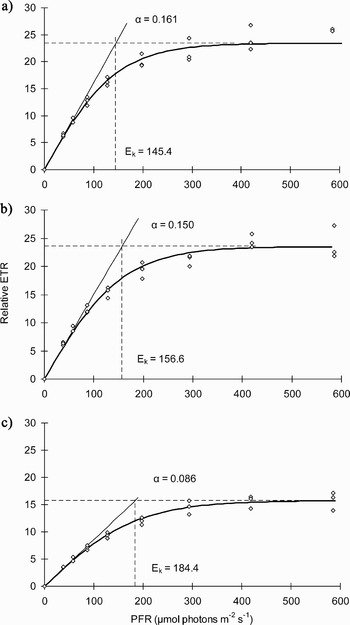
To characterize the adaptation of the diatom suspension, photosynthesis (in terms of relative electron transport rate, rETR = PFR (photon fluence rate) x ΔF/Fm' (effective quantum yield) versus irradiance curves (PE curves) were measured (Bischof et al. Reference Bischof, Hanelt, Tüg, Karsten, Brouwer and Wiencke1998). Measurements were performed for diatom suspensions exposed to dim white light from the fluorescent tubes described above (< 10 µmol photons m-2 s-1), to 1 h of 90 and for 2 h of 223 µmol photons m-2 s-1 (n = 3). The hyperbolic tangent model of Jassby & Platt (Reference Jassby and Platt1976) was used to estimate PE curve parameters described as:

where rETRmax is the maximum relative electron transport rate, tan h is the hyperbolic tangent function, α is the initial slope in the light-limited part of the PE curve (as a measure for the electron transport efficiency) and E is the photon fluence rate of PAR. The saturation irradiance for electron transport (E k) was calculated as the intercept between α and the ETRmax values. Curve fit was calculated with the Solver module of MS Excel using the least square method comparing differences between measured and calculated data.
The effects of UV radiation on photosynthetic efficiency of the microalgal suspension were determined by measuring the variable chlorophyll fluorescence of PS II by use of a pulse-amplitude modulated fluorometer (Water-PAM, connected to a PC with WIN CONTROL Software, Walz GmbH, Effeltrich, Germany). The content of the whole Petri dish was sampled in a 20 ml vial, the bottle was shaken for 30 sec, the sand grains left to settle for 30 sec, and 4 ml of the microalgal suspension was pipetted into 5 ml quartz cuvettes for measurements in the Water-PAM. PSII maximum efficiency (Fv/Fm) was measured after 5 min dark adaptation to determine changes in the photosynthetic efficiency. A 5 min dark adaptation was checked to be sufficient. Prior to the dark adaptation, the samples were exposed for 5 sec to weak far-red light (intensity 6, Water PAM). Two measurements were performed on each sample and the average values were used for further calculations of treatment effects.
Microalgal density and identification
After the measurements of photosynthetic efficiency, microalgal cell density was estimated. The sample was vigorously shaken by hand for 30 sec and, after c. 30 sec (to allow sand grains to settle), two individual subsamples (40 µl) of the algal suspension were pipetted onto a light microscope slide (20x, Zeiss, Axiolab, Germany) and cells with and without intact chloroplasts were counted. Specific growth rate day-1 was calculated for the different treatments. In Expt A2, no cell counts were done on the last sampling date (day 13). Naphrax mounted slides were prepared for diatom species identification. Samples were washed with distilled water to remove the salts and then boiled with 30% H2O2 to remove organic matter. 1 or 2 drops of 50% HCl were added to remove carbonates and to eliminate H2O2. After washing, diatom suspensions were allowed to settle on a cover slip and left to dry before being mounted. For species identification, differential interference contrast and phase contrast microscopy (100x magnification) were used (Axioplan 2 imaging, Zeiss, Germany). Diatoms were identified following Hustedt (Reference Hustedt and Rabenhorst1927–66), Krammer & Lange-Bertalot (Reference Krammer, Lange-Bertalot, Ettl, Gerloff, Heynig and Mollenhauer1986–91), Hendey (Reference Hendey1952, Reference Hendey1964) and Witkowski et al. (Reference Witkowski, Lange-Bertalot and Metzelin2000). The nomenclature was updated with the help of Round et al. (Reference Round, Crawford and Mann1990).
Statistical analyses
A one-way ANOVA was used to test for the effects of UVR on photosynthetic efficiency for each exposure time (P < 0.05). Prior to analysis, data were tested for homogeneity of variances (Cochran's test). Statistical analysis were done using StatisticaTM 6.0 software package or MS Excel. Species composition of communities was compared by ANOSIM (for treatment and time effects, respectively), and in case of significance, followed by SIMPER to quantify the relative contribution of species to observed dissimilarities (PRIMER TM 5 software package, Plymouth Marine Laboratory). ANOSIM used a Bray-Curtis similarity matrix based on square root transformed data (cell number m-2).
Results
General photosynthetic performance
The PE curves shown in Fig. 1 reveal the differences in the photosynthetic performance of the diatom suspension after different light exposures. The values for α (an index of light-harvesting efficiency) varied between 0.161 and 0.086 (Fig. 1). Photosynthetic efficiency was clearly highest during the weak light exposure and decreased after high light exposure (233 µmol photons m-2 s-1). Photosynthetic capacity (rETRmax) was higher in the initials (rETRmax = 23.4) and after an exposure to 1 h of 90 µmol photons m-2 s-1 (rETRmax = 23.5) in comparison to the exposure to 2 h of 233 µmol photons m-2 s-1 (rETRmax = 15.8). At photon fluence rates > 600 µmol photons m-2 s-1, the photosynthetic capacity slightly decreased (data not shown). The Ek values increased from 145.4 µmol photons m-2 s-1 in dim light to 184.4 µmol photons m-2 s-1 after exposure to 233 µmol photons m-2 s-1 (Fig. 1).
Photosynthetic performance (PE curves, n = 3) of diatom suspensions exposed to a. dim white light (< 10 µmol photons m-2 s-1), b. 1 h of 90 µmol photons m-2 s-1, and c. 2 h of 233 µmol photons m-2 s-1. PFR is the respective photon fluence rate of actinic white light and rETR is the relative electron transport rate.

General observations and community succession in the various treatments
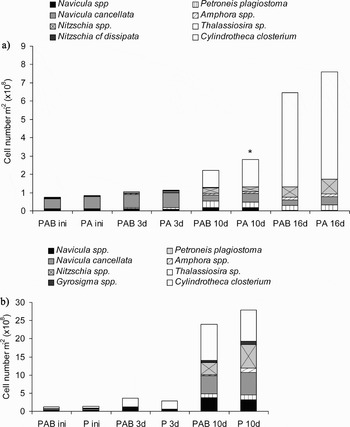
At all sampling occasions the sediment surface was brown with air bubbles (from photosynthetic oxygen production). The cell numbers increased over time in both experiments. Most frequently observed genera or species in Expt A1 (PAB exposure) were Navicula cancellata Donkin, Cylindrotheca closterium (Ehr.) Lewin & Reimann, Nitzschia spp. and Petroneis plagiostoma (Grun.) Mann. In Expt A2 (PA exposure), similar genera/species were observed with addition of Navicula spp. (Fig. 2). A general shift in genera/species composition of the microalgal community was observed for both experiments (ANOSIM: A1 Global R = 0.928, P < 0.001 and A2 Global R = 0.984, P < 0.001) and was not due to the respective light treatments. The changes were mainly caused by an increase in the cell number of Cylindrotheca closterium, Navicula cancellata and cells of Nitzschia. In Expt A1, percentage of cells without intact chloroplasts was initially around 21% ± 1 and decreased with time in both treatments (day 3: 9% ± 2, day 10: 9% ± 1). The percentage of cells without chloroplasts in experiment A2, was initially around 22% ± 3, decreased on day 3 (day 3: 8% ± 1) and increased again on day 10, both treatments (day 10: 20% ± 3). For A1, day 0 to day 16, the specific growth rates day-1 were 0.15 (PAB and PA). In A2, the growth rates were higher with values of 0.33 (PAB) and 0.34 (P) (day 0 to day 10).
Diatom cell numbers of the most frequently observed groups after exposure to different light treatments. Experiment a. A1, and b. A2 (n = 4) without UV-B or UVR, respectively. * marks significant differences in total cell number (one-way ANOVA).

UV treatment effects on photosynthesis
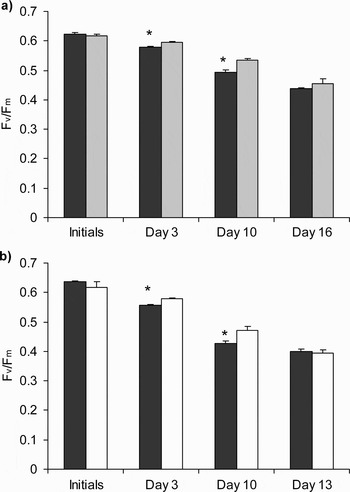
In both A1 and A2, the PSII maximum efficiency (Fv/Fm) decreased over time irrespective of treatment (Fig. 3). In experiment A1, there was a significant reduced Fv/Fm in the PAB treatment on day 3 (ANOVA, F1,6 = 6.87, P = 0.040), and on day 10 (ANOVA, F1,6 = 18.57, P = 0.005). On the last sampling date, however, this treatment effect had disappeared although a tendency was still visible. A similar trend was found in experiment A2, where a significant reduction in Fv/Fm for the PAB treatment was observed on both day 3 (ANOVA, F1,6 = 37.63, P < 0.001) and day 10 (ANOVA, F1,6 = 9.48, P = 0.022), disappearing on day 13.
Experiment a. A1, and b. A2 (n = 4). PSII maximum efficiency of microalgae after exposure to different light treatments (± SE), without UV-B or UVR, respectively. * marks significant differences within the respective light treatments (one-way ANOVA). Dark grey = PAB (PAR+UV-A+UV-B), light grey = PA (PAR+UV-A) and white = P (PAR) treatment.

No significant treatment effects on species composition were found throughout experiment A1. In the second experiment (A2), again no significant UV effects on species composition were observed (but day 10; ANOSIM, Global R = 0.292, P = 0.057). Some species, for example Nitzschia spp. and Navicula cancellata, were negatively affected (abundance) by UVR, whereas others were more frequently observed under the PAB treatment in comparison with the P treatment (Navicula spp. and Cylindrotheca closterium), although the change was not statistically significant.
In Expt A1, a significant UV effect on total cell numbers was found on day 10 (ANOVA, F1,6 = 11.38, P = 0.015, Fig. 2a). In Expt A2, no significant UV effects were found on cell numbers for any sampling date (Fig. 2b). No significant treatment effects were found for specific growth rate in any of the two experiments.
Discussion
In the study area, c. 20% of the incoming UV-B radiation reached 5 m water depth and the daily dose reaching the subtidal microalgal community was 3.6 kJ (Richter et al. in press). In our experiment, the microalgae were exposed for 4.7 kJ per day, which is 23% higher than the actual UV-B dose received at 5 m depth. The applied UV-A intensity, however, could penetrate down to 10 m in the water column. The daily UV-A dose in our experiment was 45% higher than the actual UV-A dose received at 5 m depth. Together with the low PAR dose, the ratio between PAR/UV-A/UV-B differed from natural conditions. Thus, the study was not designed to perfectly mimic natural conditions and should be considered mechanistic.
The general decrease in PSII maximum efficiency (Fig. 3, day 13 and 16) may indicate a possible nutrient limitation (Geider et al. Reference Geider, LaRoche, Greene and Olaizola1993, Underwood et al. Reference Underwood, Nilsson, Sundbäck and Wulff1999). Although Fv/Fm as an indicator of nutrient stress is questioned (Kruskopf & Flynn Reference Kruskopf and Flynn2005), in our case (under conditions with constant irradiance) a decreasing Fv/Fm over time probably reflects nutrient starvation. Furthermore, the high cell numbers on day 16 (Expt A1) could indicate an incipient nutrient limitation but, on the other hand, a decreasing Fv/Fm over time seems to be a common response for benthic diatoms under laboratory conditions, despite the nutrient conditions (Wulff et al. personal observations). Self-shading as a possible explanation can be excluded, although high cell numbers at the end of the experimental period (A1, A2) may point to it. Self-shading means light limitation, and under this condition Fv/Fm generally increases. In addition, the PE curves showed that the diatoms could be considered low light adapted (with the underlying assumption that low light adapted cells are more susceptible to UVR). At irradiances <10 µmol photons m-2 s-1 the photosynthetic efficiency was highest and with increasing light levels the photosynthetic capacity decreased, indicating a rising high light stress rather than a high light acclimation. The maximum Ek value (c. 184 µmol photons m-2 s-1) was within values observed by others. For intertidal benthic diatoms the Ek varied between 258 and 411 µmol photons m-2 s-1 (Blanchard & Cariou-Le Gall Reference Blanchard and Cariou-Le Gall1994) and Barranguet & Kromkamp (Reference Barranguet and Kromkamp2000) observed Ek values of 400–1000 µmol photons m-2 s-1. In these studies, the microphytobenthos were very seldom photoinhibited under in situ conditions. Benthic diatoms from 5 m depth at the Swedish west coast showed typical Ek values of 185 µmol photons m-2 s-1 (using Diving-PAM, Walz, Germany) and when treated with light intensities of 6 µmol photons m-2 s-1 for 2 h the Ek values decreased to 166 µmol photons m-2 s-1 (Engelsen, personal communication 2002). In our study, however, the decrease in the PE curves (α and ETRmax) with increasing irradiance indicated a photoinhibition (especially at 233 µmol photons m-2 s-1).
The initial species/group composition differed between the experiments possibly due to a different light history or a later stage of succession. The microalgae used in the two experiments were sampled at the same site but at different dates (c. three weeks in between). Therefore, a direct comparison of the results from the two experiments might be difficult to interpret. Moreover, a shift in species composition was observed over time regardless of treatment. An enclosure of a microalgal community will naturally influence the species composition simply due to changed environmental conditions (cf. Wängberg & Selmer Reference Wängberg, Selmer and Häder1997). Some species grow better under culture-like conditions than others; in our study, for example, Cylindrotheca closterium was found to completely dominate the microalgal community after 3–10 days.
UV treatment effects
The exposure of benthic Antarctic diatoms to UVR resulted in a decreased PSII maximum efficiency on day 3 and 10 compared with the control treatments (PA and P). The significant decrease was caused by the UV-B part of the spectrum. We measured Fv/Fm towards the end of the UV-B exposure period to ensure maximal UV-B effects but in the study by Waring et al. (Reference Waring, Underwood and Baker2006) the maximal UV-B effects occurred earlier in the UV-B exposure period, and a possible recovery could have taken place within the exposure period. The cell density was lower in the UV-B treatment after 10 days (A1). However, these treatment effects diminished after 13 and 16 days, respectively. The microalgae seemed to have a capability to acclimate to the repeated UV exposure with time (see also Waring et al. Reference Waring, Underwood and Baker2006); similar effects have also been reported for macroalgae (Bischof et al. Reference Bischof, Hanelt and Wiencke1999).
UV effects on microalgae are often species-specific (e.g. Karentz et al. Reference Karentz, Cleaver and Mitchell1991). For example, UVR can affect the photosynthetic efficiency of some species more negatively than others (Waring et al. Reference Waring, Underwood and Baker2006). Over a longer experimental time (e.g. as in our study) this could lead to a shift in the microalgal composition towards more UV resistant species (Worrest et al. Reference Worrest, Thomson and Dyke1981, Wängberg & Selmer Reference Wängberg, Selmer and Häder1997, Vinebrooke & Leavitt Reference Vinebrooke and Leavitt1999). This was observed also in our experiments, although no significant shifts in species composition between the treatments could be detected.
One of the dominating species in later successional stages of our experiments was the diatom Cylindrotheca closterium. The photosynthetic efficiency of C. closterium has earlier been found to be negatively affected by UV-B (Waring et al. Reference Waring, Underwood and Baker2006). However, this diatom was not negatively affected by UVR (in terms of growth) in our study. The UV-B intensities applied by Waring et al. (Reference Waring, Underwood and Baker2006) were approximately three times higher than in the present study. Our results were in agreement with Wängberg et al. (Reference Wängberg, Garde, Gustavson and Selmer1999) where C. closterium remained unaffected by UV-B over a seven day microcosm study.
Many of the species in our mixed diatom community presumably have a good ability to recover from UV-B induced stress, later confirmed by further experiments performed in the study area (Wulff et al. unpublished). In these experiments, the diatom photosynthesis recovered within 10 min (20% recovery) after exposure to UVR. Furthermore, two 3.5 months UV field experiments in the same area (intertidal and subtidal), showed no impact of UVR on the diatom assemblages studied (Campana et al. unpublished, Zacher et al. Reference Zacher, Hanelt, Wiencke and Wulff2007).
Vertical migration has been suggested to be a key mechanism for epipelic benthic diatoms to avoid UV-B radiation. In the study by Underwood et al. (Reference Underwood, Nilsson, Sundbäck and Wulff1999), the epipelic diatom Gyrosigma balticum (Ehr.) Rabenhorst responded to UV-B by vertical migration, but significant damage to PSII was still apparent after five days of repeated UV-B exposure. UV-B radiation has been shown to penetrate down to 0.6 mm sediment depth (Wulff et al. Reference Wulff, Nilsson, Sundbäck, Wängberg and Odmark1999), and we cannot exclude that the diatoms in our experiment escaped the UV-B. In a short-term experiment (6 h UV exposure), an indication of UV-induced vertical migration was found (Wulff & Zacher in press). Other UV protective mechanisms are the production of photoprotective carotenoids, such as beta-carotene. Furthermore, de-epoxidation of diadinoxanthin to diatoxanthin is known to occur in excessive light (PAR) as a protection against photooxidation (Arsalane et al. Reference Arsalane, Rousseau and Duval1994), but the effect of UV-B on the de-epoxidation process is not clear. DNA repair has been proposed as an UV protective mechanism (Buma et al. Reference Buma, de Boer and Boelen2001), but no DNA damage could be found in benthic Antarctic diatoms from the same study area (Wulff et al. unpublished).
In conclusion, laboratory experiments should never be uncritically extrapolated to determine community responses but they still give valuable information on underlying mechanistic processes. In our study, the UV effects found were transient (photosynthetic efficiency and cell density but the growth of the benthic diatoms was generally unaffected). Thus, according to our results, UVR does not seem to be a threat to benthic marine Antarctic diatoms. From an evolutionary perspective, it might be that these species have a capacity to endure UVR. During the course of evolution, they may have been exposed to high irradiance levels and UVR exerted a selective pressure. It is thus possible that the cause of this “endurance” is due to key mechanisms which have yet to be identified. However, determinations of UV effects on natural Antarctic microphytobenthos require more in situ measurements of the photosynthetic activity and productivity.
Acknowledgements
This work has been done under the agreement on scientific cooperation between the AWI and DNA at Dallmann Laboratory, annex to Jubany station. The authors thank the German and the Argentine dive crews of Jubany and Dallmann for assistance in the field. We gratefully acknowledge financial support by the foundations of YMER, KVVS, Lennander, Längmanska and Helge Ax:son Johnson (A.W.), the Swedish Institute (K.Z.), the German Research Council (DFG), and the Alfred Wegener Institute for Polar and Marine Research, Germany (A.W. and K.Z.).