








1. Introduction
For $\lambda \in (0,\,1/2]$ let $K_\lambda$
 be the self-similar set generated by the iterated function system (simply called, IFS) $\left \{ f_{\lambda,d}(x)=\lambda x + d(1-\lambda ): d=0,\,1 \right \}.$
 Then $K_\lambda$
 is the unique nonempty compact set satisfying (cf. [Reference Hutchinson13])

Clearly, $1-\lambda$ is chosen so that the convex hull of $K_\lambda$
 is the unit interval $[0,\,1]$
 for all $\lambda \in (0,\,1/2]$
 . Then $0$
 and $1$
 are common points of $K_\lambda$
 for all $\lambda \in (0,\,1/2]$
 . For other $x\in (0,\,1)$
 it is natural to ask how likely the self-similar sets $K_\lambda,\, \lambda \in (0,\,1/2]$
 contain the common point $x$
 ? Or even ask how likely the self-similar sets $K_\lambda,\, \lambda \in (0,\,1/2]$
 contain any given points $y_1,\,\ldots,\, y_p\in (0,\,1)$
 ? These questions are motivated by the work of Boes, Darst and Erdős [Reference Boes, Darst and Erdős4], in which they considered a class of fat Cantor sets $C_\lambda$
 with positive Lebesgue measure. They showed that for a given point $x\in (0,\,1)$
 the set of parameters $\lambda \in (0,\,1/2)$
 such that $x\in C_\lambda$
 is of first category.
Given $x\in [0,\,1]$ , let

Then $\Lambda (x)$ consists of all $\lambda \in (0,\,1/2]$
 such that $x$
 is the common point of $K_\lambda$
 . Note that $K_\lambda$
 is symmetric, i.e., $x\in K_\lambda$
 if and only if $1-x\in K_\lambda$
 . Then $\Lambda (x)=\Lambda (1-x)$
 for any $x\in [0,\,1].$
 So, we only need to consider $x\in [0,\,1/2]$
 . Note that $\Lambda (0)=(0,\,1/2]$
 , and $\Lambda (1/2)=\left \{ 1/2 \right \}$
 . So, it is interesting to study $\Lambda (x)$
 for $x\in (0,\,1/2)$
 .
Recall that a set $F\subset \mathbb {R}$ is called a Cantor set if it is a non-empty compact set containing neither interior nor isolated points. Our first result considers the topology of $\Lambda (x)$
 .
Theorem 1.1 For any $x\in (0,\,1/2)$ the set $\Lambda (x)$
 is a Cantor set with $\min \Lambda (x) = x$
 and $\max \Lambda (x) = 1/2$
 .
By theorem 1.1 it follows that $\Lambda (x)$ is a fractal set for any $x\in (0,\,1/2)$
 . Our next result considers the Lebesgue measure and fractal dimension of $\Lambda (x)$
 .
Theorem 1.2 For any $x \in (0,\, 1/2)$ the set $\Lambda (x)$
 is a Lebesgue null set of full Hausdorff dimension. Furthermore,

where $\dim _H$ denotes the Hausdorff dimension.
In 1984, Mahler [Reference Mahler18] proposed the problem on studying how well elements in the middle third Cantor set $K_{1/3}$ can be approximated by rational numbers in it, and by rational numbers outside of it. Some recent progress on this problem can be found in [Reference Fishman and Simmons10, Reference Fishman and Simmons11, Reference Levesley, Salp and Velani16, Reference Schleischitz22] and the references therein. On the other hand, this question also motivates the study of rational numbers in a fractal set (cf. [Reference Shparlinski23, Reference Wall26]). As a corollary of theorem 1.2 we show that for Lebesgue almost every $\lambda \in (0,\,1/2)$
 the Cantor set $K_\lambda$
 contains only two rational numbers $0$
 and $1$
 .
Corollary 1.3 For Lebesgue almost every $\lambda \in (0,\,1/2]$ the set $K_\lambda \setminus \left \{ 0,\,1 \right \}$
 contains only irrational numbers.
Proof. By theorem 1.2 it follows that $\Lambda (x)$ has zero Lebesgue measure for any $x\in (0,\,1)$
 . But if $K_\lambda \setminus \{0,\,1\}$
 contains a rational number, then $\lambda \in \bigcup _{x\in \mathbb {Q}\cap (0,1)}\Lambda (x)$
 which has zero Lebesgue measure.
Given $y_1,\,\ldots,\, y_p\in (0,\,1/2)$ , by theorems 1.1 and 1.2 it follows that the intersection $\bigcap _{i=1}^p\Lambda (y_i)$
 is small from the topological and Lebesgue measure perspectives. On the other hand, by using the thickness method introduced by Newhouse [Reference Newhouse19] we can show that $\bigcap _{i=1}^p\Lambda (y_i)$
 contains a sequence of Cantor sets whose thickness can be arbitrarily large, and from this we conclude that the intersection $\bigcap _{i=1}^p\Lambda (y_i)$
 has full Hausdorff dimension.
Theorem 1.4 For any points $y_1,\, y_2,\, \ldots,\, y_p \in (0,\, 1/2)$ we have

Recently, the first three authors studied in [Reference Jiang, Kong and Li14] analogous objects but with different family of self-similar sets (their self-similar sets have different convex hulls). Theorem 1.4 shows that the intersection of any finitely many $\Lambda (y_i)$ has full Hausdorff dimension, while in [Reference Jiang, Kong and Li14, Theorem 1.5] their method can only prove this result for the intersection of two associated sets.
The rest of the paper is organized as follows. In § 2 we prove theorem 1.1 for the topology of $\Lambda (x)$ ; and in § 3 we investigate the local Hausdorff dimension of $\Lambda (x)$
 and prove theorem 1.2. In § 4 we consider the intersection $\bigcap _{i=1}^p\Lambda (y_i)$
 and prove theorem 1.4; and in the final section we make some further remarks.
2. Topological properties of $\Lambda (x)$

In this section we investigate the topology of $\Lambda (x)$ , and prove theorem 1.1. Given $x\in (0,\,1/2)$
 , note by (1.1) that for each $\lambda \in \Lambda (x)\setminus \left \{ 1/2 \right \}$
 there exists a unique sequence $(d_i)\in \left \{ 0,\,1 \right \}^\mathbb {N}$
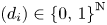 such that $x=(1-\lambda )\sum _{n=1}^\infty d_n\lambda ^{n-1}$
 . We will show that $\Lambda (x)$
 is homeomorphic to a subset in the symbolic space $\left \{ 0,\,1 \right \}^\mathbb {N}$
 , and then the topological properties of $\Lambda (x)$
 can be deduced by studying the corresponding symbolic set.
First we recall some terminology from symbolic dynamics (cf. [Reference Lind and Marcus17]). Let $\left \{ 0,\,1 \right \}^\mathbb {N}$ be the set of all infinite sequences of zeros and ones. For a word we mean a finite string of zeros and ones. Let $\left \{ 0,\, 1 \right \}^*$
 be the set of all words over the alphabet $\left \{ 0,\,1 \right \}$
 together with the empty word $\epsilon$
 . For two words $\mathbf {c}=c_1\ldots c_m,\, \mathbf {d}=d_1\ldots d_n$
 from $\left \{ 0,\,1 \right \}^*$
 we write $\mathbf {cd}=c_1\ldots c_md_1\ldots d_n$
 for their concatenation. In particular, for $n\in \mathbb {N}$
 we denote by $\mathbf {c}^n$
 the $n$
 -fold concatenation of $\mathbf {c}$
 with itself, and by $\mathbf {c}^\infty$
 the periodic sequence with period block $\mathbf {c}$
 . Throughout the paper we will use lexicographical order ‘$\prec,\, \preccurlyeq,\, \succ$
 ’ or ‘$\succcurlyeq$
 ’ between sequences and words. For example, for two sequences $(c_i),\, (d_i)\in \left \{ 0,\,1 \right \}^\mathbb {N}$
 , we say $(c_i)\prec (d_i)$
 if $c_1< d_1$
 , or there exists $n\in \mathbb {N}$
 such that $c_1\ldots c_n=d_1\ldots d_n$
 and $c_{n+1}< d_{n+1}$
 . For two words $\mathbf {c},\, \mathbf {d}$
 , we say $\mathbf {c}\prec \mathbf {d}$
 if $\mathbf {c} 0^\infty \prec \mathbf {d} 0^\infty$
 .
Let $\lambda \in (0,\,1/2]$ . We define the coding map $\pi _\lambda : \left \{ 0,\,1 \right \}^\mathbb {N}\to K_\lambda$
 by

If $\lambda \in (0,\,1/2)$ , then the IFS $\left \{ f_{\lambda,d}(x)=\lambda x+d(1-\lambda ): d=0,\,1 \right \}$
 satisfies the strong separation condition, and thus the map $\pi _\lambda$
 is bijective. If $\lambda =1/2$
 , then $\pi _{1/2}$
 is bijective up to a countable set. The map $\pi _\lambda$
 defined in (2.1) naturally induces a function with two parameters:

Note that the symbolic space $\{0,\,1\}^\mathbb {N}$ becomes a compact metric space under the metric

Equipped with the product topology on $\left \{ 0,\,1 \right \}^\mathbb {N}\times (0,\,1/2]$ we show that $\Pi$
 is continuous.
Lemma 2.1 The function $\Pi$ is continuous. Furthermore,
(i) for $\lambda \in (0,\,1/2]$
the function $\Pi (\cdot,\,\lambda )$ is increasing with respect to the lexicographical order, and is strictly increasing if $\lambda \in (0,\,1/2)$;(ii) if $0^\infty \prec (i_n)\preccurlyeq 01^\infty$
, then $\Pi ((i_n),\,\cdot )$ has positive derivative in $(0,\,1/2)$.


Proof. First we prove the continuity of $\Pi$ . For any two points $((i_n),\, \lambda _1),\, ((j_n),\, \lambda _2)\in \left \{ 0,\,1 \right \}^\mathbb {N}\times (0,\,1/2]$
 we have

Note that if $\rho ((j_n),\, (i_n))\le 2^{-m}$ , then $|\Pi ((j_n),\, \lambda _2)-\Pi ((i_n),\, \lambda _2)|\le \lambda _2^{m-1}\le 2^{1-m}$
 . So the first term in (2.4) converges to zero as $\rho ((j_n),\, (i_n))\to 0$
 . Moreover, since the series $\Pi ((i_n),\, \lambda )=(1-\lambda )\sum _{n=1}^\infty i_n\lambda ^{n-1}$
 with parameter $\lambda$
 converges uniformly in $(0,\,1/2]$
 , the second term in (2.4) also converges to zero as $|\lambda _2-\lambda _1|\to 0$
 . Therefore, $\Pi$
 is continuous.
For (i) let $\lambda \in (0,\,1/2]$ and take two sequences $(i_n),\, (j_n)\in \left \{ 0,\,1 \right \}^\mathbb {N}$
 . Suppose $(i_n)\prec (j_n)$
 . Then there exists $m\in \mathbb {N}$
 such that ${ i_1\ldots i_{m-1} =j_1\ldots j_{m-1}}$
 and $i_m< j_m$
 . This implies that

where the second inequality follows from $\lambda /(1-\lambda ) \le 1$ for $\lambda \in (0,\,1/2]$
 , and this inequality is strict if $\lambda \in (0,\,1/2)$
 .
For (ii) let $(i_n)\in \left \{ 0,\,1 \right \}^\mathbb {N}$ with $0^\infty \prec (i_n)\preccurlyeq 01^\infty$
 . Then $i_1=0$
 . So for any $\lambda \in (0,\,1/2)$
 we have $\Pi ((i_n),\,\lambda )= (1-\lambda ) \sum _{n=2}^{\infty } i_n \lambda ^{n-1}.$
 This implies that

where the strict inequality follows since $\lambda < 1/2$ and $(i_n)\succ 0^\infty$
 . This completes the proof.
Note that the map $\Pi$ defined in (2.2) is surjective but not injective. Given $x\in [0,\,1]$
 , for $\lambda \in (0,\,1/2]$
 we consider the horizontal fibre

Then $\Gamma _x(\lambda )\ne \emptyset$ if and only if $\lambda \in \Lambda (x)$
 . Furthermore, by lemma 2.1 (i) it follows that for any $\lambda \in \Lambda (x)\cap (0,\,1/2)$
 the fibre set $\Gamma _x(\lambda )$
 consists of only one sequence; and if $\lambda =1/2\in \Lambda (x)$
 then the set $\Gamma _x(1/2)$
 consists of at most two sequences. This defines a map

where $\Psi _x(\lambda )$ denotes the lexicographically largest sequence in $\Gamma _x(\lambda )$
 . The sequence $\Psi _x(\lambda )$
 is also called the greedy coding of $x$
 in base $\lambda$
 .
Given $x\in (0,\,1/2)$ , we reserve the notation $(x_n):=\Psi _x(1/2)$
 for the greedy coding of $x$
 in base $1/2$
 . Then $(x_n)$
 begins with $0$
 and does not end with $1^\infty$
 .
Lemma 2.2 For any $x\in (0,\,1/2)$ the map $\Psi _x: \Lambda (x)\to \Omega (x)$
 is a decreasing homeomorphism, where

Proof. Let $x\in (0,\,1/2)$ . By lemma 2.1 it follows that $\Psi _x$
 is strictly decreasing. Observe that $x\notin K_\lambda$
 for any $\lambda < x$
 . Then $\Lambda (x)\subset [x,\, 1/2]$
 . Note that $\Psi _x(x)=01^\infty$
 and $\Psi _x(1/2)=(x_n)$
 . Since $\Psi _x$
 is monotonically decreasing, we have

So, $\Psi _x(\Lambda (x))\subset \Omega (x)$ .
Next we show that $\Psi _x(\Lambda (x))=\Omega (x)$ . Let $(i_n)\in \Omega (x)$
 . Then by lemma 2.1 it follows that

So, by the continuity of $\Pi$ in lemma 2.1 there must exist $\lambda \in (0,\,1/2]$
 such that

If $\lambda \in (0,\,1/2)$ , then (2.6) gives that $\Psi _x(\lambda )=(i_n)$
 . If $\lambda =1/2$
 , then by (2.6) and using $(i_n)\succcurlyeq (x_n)$
 we still have $\Psi _x(\lambda )=(i_n)$
 . This proves $\Psi _x(\Lambda (x))=\Omega (x)$
 . Hence, $\Psi _x: \Lambda (x)\to \Omega (x)$
 is a decreasing bijection.
To completes the proof it remains to prove the continuity of $\Psi _x$ and its inverse $\Psi _x^{-1}$
 . Since the proof for the continuity of $\Psi _x^{-1}$
 is similar, we only prove it for $\Psi _x$
 . Take $\lambda _*\in \Lambda (x)$
 . Suppose $\Psi _x$
 is not continuous at $\lambda _*$
 . Then there exists $N\in \mathbb {N}$
 such that for any $\delta >0$
 we can find $\lambda \in \Lambda (x)\cap (\lambda _*-\delta,\, \lambda _*+\delta )$
 such that $|\Psi _x(\lambda )-\Psi _x(\lambda _*)|\ge 2^{-N}$
 . Letting $\delta =1/k$
 with $k=1,\,2,\,\ldots,$
 we can find a sequence $(\lambda _k)\subset \Lambda (x)$
 such that

Write $\Psi _x(\lambda _k)=(i_n^{(k)})$ and $\Psi _x(\lambda _*)=(i_n^*)$
 . Then by (2.7) we have $i^{(k)}_1\ldots i^{(k)}_N\ne i_1^*\ldots i_N^*$
 for all $k\ge 1$
 . Note that $(\left \{ 0,\,1 \right \}^\mathbb {N},\,\rho )$
 is a compact metric space, where $\rho$
 is defined in (2.3). So we can find a subsequence $\{k_j\}\subset \mathbb {N}$
 such that the limit $\lim _{j\to \infty } (i_n^{(k_j)})$
 exists, say $(i_n')$
 . Then $i_1'\ldots i_N'\ne i_1^*\ldots i_N^*$
 . Observe that

Letting $j\to \infty$ in (2.8), by (2.7) and lemma 2.1 it follows that

If $\lambda _*=1/2$ , then $\lambda _{k_j}\le \lambda _*$
 for all $j\ge 1$
 . Since $\Psi _x$
 is decreasing, it follows that $\Psi _x(\lambda _{k_j})\succcurlyeq \Psi _x(\lambda _*)=(i_n^*)$
 for all $j\ge 1$
 , and thus $(i_n')\succcurlyeq (i_n^*)$
 . Note that $(i_n^*)$
 is the greedy coding of $x$
 in base $\lambda _*$
 . Then by (2.9) it follows that $(i_n')=(i_n^*)$
 , leading to a contradiction with $i_1'\ldots i_N'\ne i_1^*\ldots i_N^*$
 . If $\lambda _*<1/2$
 , then (2.9) gives that $(i_n')=(i_n^*)$
 . This again leads to a contradiction. Therefore, $\Psi _x$
 is continuous at $\lambda _*$
 . Since $\lambda _*\in \Lambda (x)$
 is arbitrary, $\Psi _x$
 is continuous in $\Lambda (x)$
 . This completes the proof.
Proof of theorem 1.1 Let $x\in (0,\,1/2)$ . By lemma 2.2 it follows that $\min \Lambda (x)=\Psi _x^{-1}(01^\infty )=x$
 and $\max \Lambda (x)=\Psi ^{-1}_x((x_n))=1/2$
 . Observe that $\Omega (x)$
 is a Cantor set under the metric $\rho$
 defined in (2.3), which means that $\Omega (x)$
 is a non-empty compact, perfect and totally disconnected set under $\rho$
 . Then by lemma 2.2 we conclude that $\Lambda (x)$
 is also a Cantor set.
3. Lebesgue measure and Hausdorff dimension of $\Lambda (x)$

In this section we will prove theorem 1.2, which states that for any $x\in (0,\,1/2)$ the set $\Lambda (x)$
 is a Lebesgue null set of full Hausdorff dimension. The key ingredient in our proof of theorem 1.2 is proposition 3.1 (see below), which indicates that the local Hausdorff dimension of $\Lambda (x)$
 at some $\lambda _0\in \Lambda (x)$
 is equal to the Hausdorff dimension of the self-similar set $K_{\lambda _0}$
 . This property on the interplay between the ‘parameter space’ (in this case, $\Lambda (x)$
 ) and the ‘dynamical space’ (in our case $K_\lambda$
 ) was first observed by Douady [Reference Douady6] in the context of dynamics of real quadratic polynomials. A similar result was proved by Tiozzo [Reference Tiozzo24], who considers for $c\in \mathbb {R}$
 the set of angles of external rays which ‘land’ on the real slice of the Mandelbrot set to the right of $c$
 (parameter space) and the set of external angles which land on the real slice of the Julia set of the map $z\mapsto z^2+c$
 (dynamical space), showing that these two sets have the same Hausdorff dimension. Some other similar results in different settings can be found in [Reference Bonanno, Carminati, Isola and Tiozzo3, Reference Carminati and Tiozzo5, Reference Kong, Li, Lü, Wang and Xu15, Reference Urbanski25].
Proposition 3.1 Let $x \in (0,\,1/2)$ . Then for any $\lambda \in \Lambda (x)$
 we have

The second equality in (3.1) is obvious, since for any $\lambda \in \Lambda (x)$ the self-similar set $K_\lambda$
 is generated by the IFS $\left \{ \lambda x,\, \lambda x+(1-\lambda ) \right \}$
 satisfying the open set condition (cf. [Reference Hutchinson13]). So it suffices to prove the first equality in (3.1).
Lemma 3.2 Let $x\in (0,\,1/2)$ . Then for any $\lambda \in (x,\,1/2)$
 we have

Proof. Let $\lambda \in (x,\, 1/2)$ . Note by lemma 2.2 that $\pi _\lambda \circ \Psi _x: \Lambda (x)\cap [x,\,\lambda ]\to K_\lambda$
 is injective. By [Reference Falconer7, Proposition 3.3] we only need to prove that the inverse map $(\pi _\lambda \circ \Psi _x)^{-1}$
 is Lipschitz. In other words, it suffices to prove that for any $\lambda _1,\, \lambda _2\in \Lambda (x)\cap [x,\, \lambda ]$
 we have

where $C>0$ is a constant independent of $\lambda _1$
 and $\lambda _2$
 .
Take $\lambda _1,\,\lambda _2 \in \Lambda (x)\cap [x,\,\lambda ]$ with $\lambda _1 < \lambda _2$
 , and write $\Psi _x(\lambda _1) = (i_n)$
 , $\Psi _x(\lambda _2) = (j_n).$
 By lemma 2.2 we have $i_1 =j_1=0$
 and $(i_n) \succ (j_n)$
 . Then there exists $m \ge 2$
 such that $i_1\ldots i_{m-1} = j_1\ldots j_{m-1}$
 and $i_m > j_m$
 . Note that

Then

where the first inequality follows by $i_1\ldots i_{m-1}=j_1\ldots j_{m-1}$ , and the second inequality follows by $\lambda _1<\lambda _2$
 . This, together with $\lambda _1<\lambda _2\le \lambda$
 , implies that

Therefore,

where $C=x(1-2\lambda )^2/\lambda >0$ (since $\lambda <1/2$
 ). This proves (3.2), and then completes the proof.
Lemma 3.3 Let $x\in (0,\,1/2)$ . If $\lambda \in \Lambda (x) \setminus \left \{ 1/2 \right \}$
 such that $\Psi _x(\lambda )$
 does not end with $0^\infty$
 , then for any $\delta >0$
 ,

Proof. Let $\lambda \in \Lambda (x)\setminus \left \{ 1/2 \right \}$ such that $(c_n) = \Psi _x(\lambda )$
 does not end with $0^\infty$
 . Take $\delta >0$
 . We will construct a sequence of subsets in $\Lambda (x)\cap [\lambda,\, \lambda +\delta ]$
 whose Hausdorff dimension can be arbitrarily close to $\dim _H K_\lambda$
 .
Since $\lambda <1/2$ , by lemma 2.2 we have $(c_n)\succ \Psi _x(1/2)=(x_n)$
 . Then there exists $n_0\ge 2$
 such that $c_1\ldots c_{n_0-1}=x_1\ldots x_{n_0-1}$
 and $c_{n_0}>x_{n_0}$
 . Since $(c_n)$
 does not end with $0^\infty$
 , we can find an increasing sequence $\{n_k\}\subset \mathbb {N}$
 such that $n_0< n_1< n_2<\cdots$
 , and $c_{n_k}=1$
 for all $k\ge 1$
 . Now for $k \ge 1$
 , we define

Note by lemma 2.2 that $\Psi _x(\Lambda (x) \cap [\lambda,\, 1/2]) = \left \{ (i_n) : (x_n) \preceq (i_n) \preceq (c_n) \right \}.$ Then by using $c_{n_0}>x_{n_0}$
 and $c_{n_k}=1$
 it follows that

Since ${\delta >0}$ , by (3.3), (3.4) and lemma 2.2 there exists $N\in \mathbb {N}$
 such that

So, to finish the proof it suffices to prove that

Take $k\ge N$ , and consider the map $\pi _\lambda \circ \Psi _x: \Psi _x^{-1}(\Omega _{\lambda,k}) \to \pi _\lambda (\Omega _{\lambda,k})$
 . Let $\lambda _1,\,\lambda _2 \in \Psi _x^{-1}(\Omega _{\lambda,k})$
 with $\lambda _1 < \lambda _2$
 , and write $\Psi _x(\lambda _1) = (i_n),\, \Psi _x(\lambda _2) = (j_n).$
 Then $(i_n),\, (j_n)\in \Omega _{\lambda, k}$
 . Since $\lambda _1<\lambda _2$
 , by lemma 2.2 we have $(i_n) \succ (j_n)$
 . So there exists $m>n_k$
 such that $i_1\ldots i_{m-1}=j_1\ldots j_{m-1}$
 and $i_m>j_m$
 . Note that $i_mi_{m+1}\ldots$
 does not contain $k$
 consecutive zeros. Then

On the other hand,

Note that $\lambda _1,\,\lambda _2 \in \Lambda (x)\cap [\lambda,\, 1/2]$ . Then by (3.6) and (3.7) it follows that

This implies that

where the last inequality follows by $\lambda _1,\,\lambda _2 \le 1/2$ .
So, by (3.3) and (3.8) it follows that

as $k\to \infty$ . This proves (3.5), and then completes the proof.
Proof of proposition 3.1 Take $\lambda \in \Lambda (x)$ . Note that $\Lambda (x)\subset [x,\, 1/2]$
 and $x,\, 1/2\in \Lambda (x)$
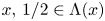 . We will prove (3.1) in the following two cases.
Case I. $\lambda \in \Lambda (x)\cap [x,\, 1/2)$ . Then by lemma 3.2 it follows that for any $\delta \in (0,\, 1/2-\lambda )$
 ,

This implies that

On the other hand, take $\delta >0$ . Note by theorem 1.1 that $\Lambda (x)$
 is a Cantor set, and $\lambda \in \Lambda (x)$
 . Then we can find a sequence $\{\lambda _k\}$
 in $\Lambda (x)\cap (\lambda -\delta,\, \lambda +\delta )$
 such that each $\Psi _x(\lambda _k)$
 does not end with $0^\infty$
 , and $\lambda _k\to \lambda$
 as $k\to \infty$
 . Therefore, by lemma 3.3 it follows that

as $k\to \infty$ . This, together with (3.9), proves (3.1).
Case II. $\lambda =1/2$ . The proof is similar to that for the second part of Case I. Let $\delta >0$
 . Since $\Lambda (x)$
 is a Cantor set and $\max \Lambda (x)=1/2$
 , there exists a sequence ${\{\lambda _k\}}$
 in $\Lambda (x)\cap (1/2-\delta,\, 1/2)$
 such that each $\Psi _x(\lambda _k)$
 does not end with $0^\infty$
 , and $\lambda _k\nearrow 1/2$
 as $k\to \infty$
 . Then by lemma 3.3 it follows that

proving (3.1).
As a direct consequence of proposition 3.1 we have the following result of $\Lambda (x)$ .
Corollary 3.4 Let $x \in (0,\,1/2)$ . Then for any open interval $I\subset \mathbb {R}$
 with $\Lambda (x) \cap I \ne \emptyset$
 we have

Proof of theorem 1.2 By corollary 3.4 it follows that

Furthermore, for any $n\in \mathbb {N}$ the Hausdorff dimension of $\Lambda _n(x):=\Lambda (x)\cap [x,\,1/2-1/n]$
 is strictly smaller than one, and thus each $\Lambda _n(x)$
 has zero Lebesgue measure. Since $\Lambda (x)\setminus \left \{ 1/2 \right \}=\bigcup _{n=1}^\infty \Lambda _n(x)$
 , the set $\Lambda (x)$
 also has zero Lebesgue measure. This together with proposition 3.1 completes the proof.
4. Hausdorff dimension of the intersection $\bigcap _{i=1}^p\Lambda (y_i)$

Given finitely many numbers $y_1,\, y_2,\, \ldots,\, y_p\in (0,\,1/2)$ , we will show in this section that the intersection $\bigcap _{i=1}^p \Lambda (y_i)$
 has full Hausdorff dimension (see theorem 1.4). Note by theorem 1.1 that each set $\Lambda (y_i)$
 is a Cantor set. We will construct in each $\Lambda (y_i)$
 a sequence of Cantor subsets $C_\ell (y_i),\, \ell \ge 1,$
 such that each $C_\ell (y_i)$
 has the same maximum point $1/2$
 , and the thickness of $C_\ell (y_i)$
 tends to infinity as $\ell \to \infty$
 . Then by using a result from Hunt, Kan and Yorke [Reference Hunt, Kan and Yorke12] (see lemma 4.2 below) we conclude that the intersection $\bigcap _{i=1}^p \Lambda (y_i)$
 contains a sequence of Cantor subsets whose thickness tends to infinity. This, together with lemma 4.1 (see below), implies that $\bigcap _{i=1}^p \Lambda (y_i)$
 has full Hausdorff dimension.
4.1. Thickness of a Cantor set in $\mathbb {R}$

First we recall the thickness of a Cantor set in $\mathbb {R}$ from Newhouse [Reference Newhouse19] (see [Reference Astels1] for some recent progress). Let $E$
 be a Cantor set in $\mathbb {R}$
 with its convex hull $conv(E)=E_0$
 . Then the complement $E_0 \setminus E = \bigcup _{n=1}^\infty V_n$
 is the union of countably many disjoint open intervals. The sequence $\mathscr {V}= (V_1,\, V_2,\,\ldots )$
 is called a defining sequence for $E$
 . If moreover $|V_1| \ge |V_2| \ge |V_3| \ge \cdots$
 , where $|V|$
 denotes the diameter of a set $V\subset \mathbb {R}$
 , then we call $\mathscr {V}$
 an ordered defining sequence for $E$
 . Let $E_n := E_0 \setminus \bigcup _{k=1}^n V_k$
 . Then $E_n$
 is the union of finitely many disjoint closed intervals. So, for any $n\ge 1$
 , the open interval $V_n$
 is contained in some connected component of $E_{n-1}$
 , say $E_{n-1}^*$
 . Then the set $E_{n-1}^* \setminus V_n$
 is the union of two closed intervals $L_{\mathscr {V}}(V_n)$
 and $R_{\mathscr {V}}(V_n)$
 , where we always assume that $L_{\mathscr {V}}(V_n)$
 lies to the left of $R_{\mathscr {V}}(V_n)$
 . We emphasize that both intervals $L_{\mathscr {V}}(V_n)$
 and $R_{\mathscr {V}}(V_n)$
 have positive length, since otherwise $E$
 will contain isolated points which is impossible. Then the thickness of $E$
 with respect to the defining sequence $\mathscr {V}$
 is defined by

and the thickness of $E$ is defined by

where the supremum is taken over all defining sequences $\mathscr {V}$ for $E$
 . It was shown in [Reference Williams27] that $\tau (E)=\tau _\mathscr {V}(E)$
 for every ordered defining sequence $\mathscr {V}$
 for $E$
 .
The following lower bound for the Hausdorff dimension of a Cantor set in $\mathbb {R}$ in terms of thickness was proven by Newhouse [Reference Newhouse20] (see also [Reference Palis and Takens21, P. 77]).
Lemma 4.1 [Reference Newhouse20, P. 107]
If $E$ is a Cantor set in $\mathbb {R}$
 , then

Two Cantor sets in $\mathbb {R}$ are called interleaved if neither set lies in the closure of a gap of the other. The following result for the intersection of two interleaved Cantor sets was shown by Hunt, Kan and Yorke [Reference Hunt, Kan and Yorke12].
Lemma 4.2 [Reference Hunt, Kan and Yorke12, Theorem 1]
There exists a function $\varphi : (1+\sqrt {2} ,\,\infty ) \to (0,\,\infty )$ such that for all interleaved Cantor sets $E$
 and $F$
 in $\mathbb {R}$
 with $\tau (E) ,\, \tau (F) \ge t > 1+ \sqrt {2}$
 , there exists a Cantor subset $K \subset E \cap F$
 with $\tau (K)\ge \varphi (t)$
 .
Remark 4.3
(i) In [Reference Hunt, Kan and Yorke12, P. 882] the authors pointed out that when $t$
is sufficiently large, $\varphi (t)$ is of order $\sqrt {t}$. So, lemma 4.2 implies that if the thicknesses of two interleaved Cantor sets $E$ and $F$ in $\mathbb {R}$ are sufficiently large, then the thickness of the resulting Cantor set $K\subset E\cap F$ is also very large.(ii) It is clear that if two Cantor sets $E$
and $F$ in $\mathbb {R}$ have the same maximum point $\xi$, then they are interleaved. Furthermore, if the maximum point $\xi$ is also an accumulation point of $E\cap F$, then from the proof of [Reference Hunt, Kan and Yorke12, Theorem 1] (see also [Reference Hunt, Kan and Yorke12, P. 887]) it follows that the resulting Cantor set $K\subset E\cap F$ in lemma 4.2 can be required to have the same maximum point $\xi$.


We first construct a sequence of disjoint Cantor subsets of $\Lambda (x)$ whose thickness tends to infinity. Then by the following lemma, we can construct a sequence of Cantor subsets of $\Lambda (x)$
 with the same maximum point, whose thickness also tends to infinity. These Cantor sets will be used to show that the intersection has full Hausdorff dimension.
Lemma 4.4 Let $\{F_k\}_{k=1}^\infty$ be a sequence of Cantor sets with $\alpha _k = \min F_k$
 and $\beta _k = \max F_k$
 . Suppose that
(i) $\alpha _1 < \beta _1 < \alpha _2 < \beta _2 < \ldots < \alpha _k < \beta _k < \ldots$
, and $\beta : = \lim _{k \to \infty } \beta _k$;(ii) $\lim _{k \to \infty } \tau (F_k) =+\infty$
;(iii)
\[ \lim_{k \to \infty} \frac{\beta_k - \alpha_k}{\alpha_{k+1} - \beta_k}={+}\infty,\quad\lim_{k \to \infty} \frac{\beta - \alpha_{k+1}}{\alpha_{k+1} - \beta_k} ={+}\infty. \]


Then

Proof. For $k \ge 1$ , let $\mathscr {V}_k = \{V_{k,j}\}_{j=1}^\infty$
 be an ordered defining sequence of the Cantor set $F_k$
 , i.e.,

with $|V_{k,1}| \ge |V_{k,2}| \ge |V_{k,3}| \ge \ldots$ . For $\ell \ge 1$
 , write

Note by (i) that each $C_\ell$ is a Cantor set, and the convex hull of $C_\ell$
 is $[\alpha _\ell,\, \beta ].$
 Moreover, we have

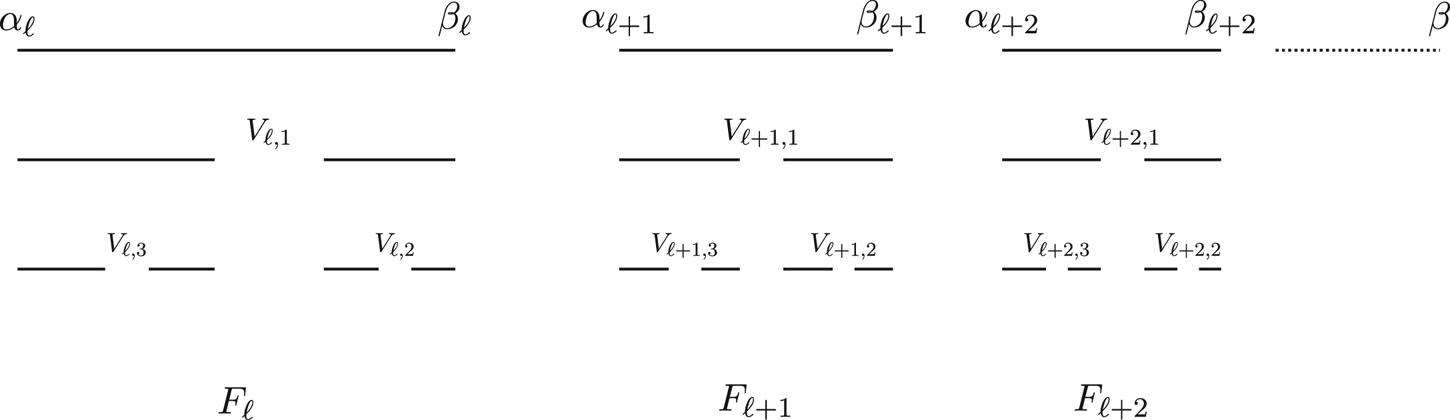
To estimate the thickness of $C_\ell$ , we enumerate the open intervals $(\beta _k,\, \alpha _{k+1})$
 and $V_{j,k}$
 with $k \ge \ell,\, j\ge 1$
 in the following way:

This means that we first remove from $[\alpha _\ell,\, 1/2]$ the open interval $(\beta _\ell,\, \alpha _{\ell +1})$
 , and next remove $V_{\ell, 1}$
 , and then $(\beta _{\ell +1},\, \alpha _{\ell +2}),\, V_{\ell +1,1},\, V_{\ell, 2},\, (\beta _{\ell +2},\, \alpha _{\ell +3})$
 , and so on. Thus, (
) gives a defining sequence $\mathscr {W}_\ell =\left \{ (\beta _k,\, \alpha _{k+1}),\, V_{k,j}: k\ge \ell,\, j\ge 1 \right \}$ for $C_\ell$
 (see Fig. 1).
A defining sequence $\mathscr {W}_\ell =\left \{ (\beta _{k},\, \alpha _{k+1}),\, V_{k,j}: k\ge \ell,\, j\ge 1 \right \}$ for the Cantor set $C_\ell =\bigcup _{k=\ell }^\infty F_k \cup \{\beta \}$
 , and for each $k\ge \ell$
 a defining sequence $\mathscr {V}_k=\left \{ V_{k,j} \right \}_{j=1}^\infty$
 for the Cantor set $F_k$
 ; see (4.3) and (4.4) for more explanation.

For the defining sequence $\mathscr {W}_\ell$ for $C_\ell$
 , by (4.4) we have that

and

Note that $\tau _{\mathscr {V}_k}(F_k) = \tau (F_k)$ . Then by (4.1) it follows that

Note that $\tau (C_\ell ) \ge \tau _{\mathscr {W}_\ell }(C_\ell )$ . We conclude by (ii) and (iii) that $\lim _{\ell \to \infty } \tau (C_\ell ) = +\infty$
 .
4.2. Construction of Cantor subsets of $\Lambda (x)$

Let $x\in (0,\,1/2)$ . We will construct a sequence of Cantor subsets $\{F_k(x)\}_{k=1}^\infty$
 of $\Lambda (x)$
 satisfying the assumptions (i)–(iii) in lemma 4.4. Note by lemma 2.2 that

where $(x_n)=\Psi _x(1/2)$ . Moreover, $\Psi _x$
 is a decreasing homeomorphism from $\Lambda (x)$
 to $\Omega (x)$
 . Based on this, our strategy to construct these Cantor subsets $\left \{ F_k(x) \right \}_{k=1}^\infty$
 in $\Lambda (x)$
 is to construct a sequence of Cantor subsets $\left \{ \Omega _k(x) \right \}_{k=1}^\infty$
 in the symbolic space $\Omega (x)$
 .
Note by the definition of $(x_n)=\Psi _x(1/2)$ that $x_1=0$
 and $(x_n)$
 does not end with $1^\infty$
 . Denote by $\{n_k\}$
 the set of all indices $n>1$
 such that $x_n=0$
 . Then $x_{n_k}=0$
 for any $k\ge 1$
 , and $x_n=1$
 for any $n_k< n< n_{k+1}$
 . For $k \ge 1$
 , we define

Then ${\Omega _{k}(x)} \subset \Omega (x)$ , which implies that

Note by (4.5) that for each $k\ge 1$ the set $(\Omega _k(x),\, \rho )$
 is a topological Cantor set, where $\rho$
 is the metric defined in (2.3). By lemma 2.2 it follows that each $F_k(x)$
 is a Cantor subset of $\Lambda (x)$
 .
Write $\alpha _k = \min F_k(x)$ and $\beta _k = \max F_k(x)$
 . Clearly, $\alpha _k$
 and $\beta _k$
 depend on $x$
 . For simplicity we will suppress this dependence in our notation if no confusion arises. Since $\Psi _x$
 is decreasing by lemma 2.2, by (4.5) and (4.6) we have

Note that $x_1 x_2 \ldots x_{n_{k+1}-1}1^\infty =x_1 x_2\ldots x_{n_k-1}01^\infty \prec x_1 x_2 \ldots x_{n_k -1} 1 0^\infty$ for all $k\ge 1$
 . Thus,

Furthermore, the sequence $x_1 x_2 \ldots x_{n_k -1} 1 0^\infty$ decreases to $(x_n)=\Psi _x(1/2)$
 as $k\to \infty$
 , again by lemma 2.2 we obtain that $\beta _k \nearrow {1}/{2}$
 as $k\to \infty$
 . Therefore, the sequence $\left \{ F_k(x) \right \}_{k=1}^\infty$
 of disjoint Cantor sets satisfies the assumption (i) of lemma 4.4.
In the following we show that the sequence $\left \{ F_k(x) \right \}_{k=1}^\infty$ also satisfies the assumption (ii) of lemma 4.4.
Proposition 4.5 For any $x\in (0,\,1/2)$ we have $\lim _{k\to \infty }\tau (F_k(x))=+\infty.$

In view of the definition of thickness, we first describe a defining sequence for the Cantor set $F_k(x)$ . Clearly, $[\alpha _k,\,\beta _k]$
 is the convex hull of $F_k(x)$
 . By lemma 2.2 it follows that

where

We enumerate these open intervals $V_{k, \omega }$ , $\omega \in \left \{ 0,\,1 \right \}^*$
 according first to the length of $\omega$
 and then to the lexicographical order of $\omega$
 :

where $\epsilon$ is the empty word. Thus, (4.7) gives a defining sequence $\mathscr {V}_{k} = \{ V_{k, \omega }: \omega \in \left \{ 0,\,1 \right \}^* \}$
 for $F_k(x)$
 , and moreover, we have

Note by (4.8) that the endpoints of $L_{\mathscr {V}_k}(V_{k,\omega })$ and $R_{\mathscr {V}_k}(V_{k,\omega })$
 have codings ending with $\omega 1^\infty,\, \omega 0^\infty,\, \omega 10^\infty,\, \omega 01^\infty$
 , respectively. In view of (4.1), to prove $\lim _{k\to \infty }\tau (F_k(x))$
 we need the following inequalities.
Lemma 4.6 Let $x\in (0,\,1/2)\setminus \left \{ 1/4 \right \}$ with $(x_n)=\Psi _x(1/2)$
 , and let $m\ge 3$
 such that $x_m=1$
 .
(i) If $\lambda _1,\, \lambda _2\in \Lambda (x)$
satisfy $\Psi _x(\lambda _1)= j_1 j_2 \ldots j_q 1^\infty$ and $\Psi _x(\lambda _2) = j_1 j_2 \ldots j_q 0^\infty$, then
\[ \lambda_2 - \lambda_1 \ge \frac{1}{4} \lambda_2^q. \]
(ii) If $\lambda _3,\, \lambda _4\in \Lambda (x)$
satisfy $\Psi _x(\lambda _3)=x_1 \ldots x_m j_1 \ldots j_q 1 0^\infty$ and $\Psi _x(\lambda _4)=x_1 \ldots x_m j_1 \ldots j_q 0 1^\infty$, then
\[ \lambda_4 - \lambda_3 \le \min\left\{ 2(1-2\lambda_3) \lambda_3^{q+2}, 2(1-2\lambda_4) \frac{\lambda_4^{m+q}}{\lambda_3^{m-2}} \right\}. \]


Before giving the proof we emphasize that for $x=1/4$ we have $(x_n)=\Psi _x(1/2)=010^\infty$
 . So we can not find $x_m=1$
 for $m\ge 3$
 , which plays an essential role in the proof of lemma 4.6 (ii).
Proof. Since $x\in (0,\,1/2)\setminus \left \{ 1/4 \right \}$ , the expansion $(x_n)=\Psi _x(1/2)$
 satisfies $x_m=1$
 for some $m\ge 3$
 . For (i), let $\lambda _1,\, \lambda _2\in \Lambda (x)$
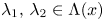 with $\Psi _x(\lambda _1)= j_1 j_2 \ldots j_q 1^\infty$
 and $\Psi _x(\lambda _2) = j_1 j_2 \ldots j_q 0^\infty$
 . Then by lemma 2.2 we have $\lambda _1<\lambda _2$
 . Note that $x = \pi _{\lambda _1}( j_1 j_2 \ldots j_q 1^\infty ) = \pi _{\lambda _2}( j_1 j_2 \ldots j_q 0^\infty )$
 . Then

where the inequality follows by lemma 2.1 (ii) since for any $(i_n)\in \Omega (x)$ we have

This proves (i).
For (ii) let $\lambda _3,\, \lambda _4\in \Lambda (x)$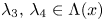 such that

where $x_m=1$ with $m\ge 3$
 . Then by lemma 2.2 we have $\lambda _3 < \lambda _4$
 . Note that $x = \pi _{\lambda _3}(x_1 \ldots x_{m} j_1 j_2 \ldots j_q 1 0^\infty ) = \pi _{\lambda _4}(x_1 \ldots x_{m} j_1 j_2 \ldots j_q 0 1^\infty )$
 . Then

where the last inequality follows by lemma 2.1 (ii) since by using $x_m=1$ with $m\ge 3$
 and (2.5) we have

Therefore, by (4.9) and using $\lambda _3<\lambda _4$ it follows that

and

This completes the proof.
When $x=1/4$ we prove similar inequalities by using different estimation.
Lemma 4.7 Let $x=1/4$ . Then $(x_n)=\Psi _x(1/2)=010^\infty$
 .
(i) If $\lambda _1,\, \lambda _2\in \Lambda (x)$
satisfy $\Psi _x(\lambda _1)=010^m j_1 j_2 \ldots j_q 1^\infty$ and $\Psi _x(\lambda _2)=010^m j_1 j_2 \ldots j_q 0^\infty$, then
\[ \lambda_2 - \lambda_1 \ge \frac{ \lambda_2^{m+2+q} }{1-2\lambda_1 + (m+3) 2^{{-}m}}. \]
(ii) If $\lambda _3,\, \lambda _4\in \Lambda (x)$
satisfy $\Psi _x(\lambda _3)= 01 j_1 j_2 \ldots j_q 1 0^\infty$ and $\Psi _x(\lambda _4)=01 j_1 j_2 \ldots j_q 0 1^\infty$, then
\[ \lambda_4 - \lambda_3 \le \lambda_3^{2+q}. \]


Proof. For (i) we note by lemma 2.2 that $\lambda _1 < \lambda _2$ . Since $x = \pi _{\lambda _1}( 010^m j_1 j_2 \ldots j_q 1^\infty ) = \pi _{\lambda _2}( 010^m j_1 j_2 \ldots j_q 0^\infty ),$
 we have

where the inequality follows by lemma 2.1 (ii) since by (2.5) we have

This proves (i).
For (ii), note by lemma 2.2 that $\lambda _3 < \lambda _4$ . Then by using $x = \pi _{\lambda _3}(01 j_1 j_2 \ldots j_q 1 0^\infty ) = \pi _{\lambda _4}(01 j_1 j_2 \ldots j_q 0 1^\infty )$
 it follows that we have

This implies that

as desired.
Proof of proposition 4.5 Write $\Psi _x(1/2)=(x_n)$ . Let $\{n_k\}$
 be the enumeration of all indices $n>1$
 such that $x_n=0$
 . Recall from (4.7) the defining sequence $\mathscr {V}_k = \{V_{k,\omega }: \omega \in \{0,\,1\}^*\}$
 for $F_k(x)$
 . It follows from (4.1) that

Note by (4.8) that

Then

Observe by lemma 2.2 that $\alpha _k \le \gamma _{\omega,1} < \gamma _{\omega,2} < \gamma _{\omega,3} < \gamma _{\omega,4}$ , where $\alpha _k=\min F_k(x)$
 . Case (A). $x\in (0,\,1/2)\setminus \{1/4\}$
 . Then there exists an integer $m \ge 3$
 such that $x_m=1$
 . Take a sufficiently large $k$
 so that $n_k > m$
 . By lemma 4.6 it follows that

and

where $q$ is the length of the word $\omega$
 . So, for any $\omega \in \{0,\,1\}^*$
 we obtain that

Thus, for sufficiently large $k$ we have

Note that $\alpha _k\nearrow 1/2$ as $k \to \infty$
 because $\beta _k \nearrow 1/2$
 . Therefore, $\tau (F_k(x)) \to +\infty$
 as $k \to \infty$
 .
Case (B). $x= 1/4$ . Then $(x_n)=\Phi _x(1/2) = 010^\infty$
 , which gives $x_1\ldots x_{n_k-1}=010^{n_k-3}$
 for all $k \ge 1$
 . By lemma 4.7 it follows that

and

where $q$ is the length of the word $\omega$
 . This implies that for all $\omega \in \{0,\,1\}^*$
 ,

Thus,

Note that $\alpha _k \nearrow 1/2$ and $n_k \to +\infty$
 as $k \to \infty$
 . Therefore, $\tau (F_k(x)) \to +\infty$
 as $k \to \infty$
 , completing the proof.
4.3. Hausdorff dimension of $\bigcap _{i=1}^p \Lambda (y_i)$

For any $\ell \ge 1$ , we define

Note that $\mathrm {conv}(F_k(x))=[\alpha _k,\,\beta _k]$ for all $k\ge 1$
 , and

Since $F_k(x)\subset \Lambda (x)$ for all $k\ge 1$
 and $1/2\in \Lambda (x)$
 , it follows that each $C_\ell (x)$
 is a Cantor subset of $\Lambda (x)$
 .
Proposition 4.8 For any $x\in (0,\,1/2)$ we have $\lim _{\ell \to \infty }\tau (C_\ell (x))=+\infty.$

Proof. Take $x\in (0,\,1/2)$ . Write $\Psi _x(1/2)=(x_n)$
 . Let $\{n_k\}$
 be the enumeration of all indices $n>1$
 such that $x_n=0$
 . By lemma 4.4 and proposition 4.5, it remains to prove that

where

and

Case (A). $x\in (0,\,1/2)\setminus \left \{ 1/4 \right \}$ . There exists $m\ge 3$
 such that $x_m=1$
 . For sufficiently large $k$
 , we have $n_k > m$
 . By (4.12), (4.13) and lemma 4.6 it follows that

which implies

Note that $\alpha _k \nearrow 1/2$ , $\beta _k \nearrow 1/2$
 and $n_k \to \infty$
 as $k \to \infty$
 . We obtain (4.11) by letting $k \to \infty$
 .
Case (B). $x= 1/4$ . Then $(x_n)=\Phi _x(1/2) = 010^\infty$
 . By (4.12), (4.13) and lemma 4.7 it follows that

This implies

On the other hand, note by (4.13) that

This implies that

Note by (4.14) that $\alpha _{k+1} - \beta _k \le \beta _k^{n_k -1} { <} \alpha _{k+1}^{n_k-1}$ . This, together with (4.16), implies that

Note that $\alpha _k\nearrow 1/2$ , $\beta _k\nearrow 1/2$
 and $n_k \to +\infty$
 as $k\to \infty$
 . Letting $k\to \infty$
 in (4.15) and (4.17) we obtain (4.11), completing the proof.
Proof of theorem 1.4 Let $y_1,\, \ldots,\, y_p\in (0,\,1/2)$ . Then by (4.2), (4.10) and proposition 4.8 it follows that each $\Lambda (y_i)$
 contains a sequence of Cantor subsets $C_\ell (y_i),\, \ell \ge 1$
 such that $\max C_\ell (y_i)=1/2$
 for all $\ell \ge 1$
 , and the thickness $\tau (C_\ell (y_i))\to +\infty$
 as $\ell \to \infty$
 . So, by lemma 4.2 and remark 4.3 (i) it follows that for sufficiently large $\ell$
 and for any $i,\, j\in \left \{ 1,\,2,\, \ldots,\, p \right \}$
 the intersection $C_\ell (y_i)\cap C_\ell (y_j)$
 contains a Cantor subset $C_\ell (y_i,\, y_j)$
 such that

Note that for any $k\in \left \{ 1,\,2,\,\ldots,\, p \right \}$ we have $\min C_\ell (y_k)\nearrow 1/2=\max C_\ell (y_k)$
 as $\ell \to \infty$
 . Furthermore, $C_{\ell }(y_k)\supset C_{\ell +1}(y_k)$
 for any $\ell \ge 1$
 . Then by (4.18) it follows that the maximum point $1/2$
 is an accumulation point of $C_\ell (y_i)\cap C_\ell (y_j)$
 . So, by remark 4.3 (ii) we can require that the resulting Cantor set $C_\ell (y_i,\, y_j)\subset C_\ell (y_i)\cap C_\ell (y_j)$
 has the maximum point $1/2$
 for sufficiently large $\ell$
 and any $i,\, j\in \left \{ 1,\,2,\,\ldots,\, p \right \}$
 .
Proceeding this argument for all $y_1,\, y_2,\,\ldots,\, y_p$ we obtain that for sufficiently large $\ell$
 the intersection $\bigcap _{i=1}^p C_\ell (y_i)$
 contains a Cantor subset $C_\ell (y_1,\,\ldots,\, y_p)$
 such that $\max C_\ell (y_1,\,\ldots,\, y_p)=1/2$
 , and the thickness $\tau (C_\ell (y_1,\, \ldots,\, y_p))\to +\infty$
 as $\ell \to \infty$
 . Therefore, by lemma 4.1 it follows that

as $\ell \to \infty$ . This completes the proof.
At the end of this section we remark that in the proof of theorem 1.4 we construct a sequence of Cantor subsets $C_\ell (y_1,\,\ldots,\, y_p),\, \ell \ge 1$ in the intersection $\bigcap _{i=1}^p\Lambda (y_i)$
 such that the thickness $\tau (C_\ell (y_1,\,\ldots,\, y_p))\to +\infty$
 as $\ell \to \infty$
 . By a recent work of Yavicoli [Reference Yavicoli28, remark of Theorem 4] it follows that the intersection $\bigcap _{i=1}^p\Lambda (y_i)$
 contains arbitrarily long arithmetic progression.
5. Final remarks
At the end of this paper we point out that our results theorem 1.1–1.4 can be extended to higher dimensions. To illustrate this we give two examples.
Example 5.1 For $\lambda \in (0,\, 1/2]$ let $K_\lambda$
 be the self-similar set defined in (1.1). Then for $n\in \mathbb {N}$
 the product set $\bigotimes _{i=1}^n K_\lambda$
 is also a self-similar set in $\mathbb {R}^n$
 . For $\mathbf {a}=(a_1,\,\ldots,\, a_n) \in (0,\,1/2)^n$
 let

be the set of parameters $\lambda \in (0,\,1/2]$ such that the $n$
 -dimensional self-similar set $\bigotimes _{i=1}^n K_\lambda$
 contains the given point $\mathbf {a}$
 . It is clear that $\Lambda (\mathbf {a})=\bigcap _{i=1}^n\Lambda (a_i)$
 , where for $x\in (0,\,1/2)$
 the set $\Lambda (x)$
 is defined as in (1.2). So, by theorems 1.2 and 1.4 it follows that $\Lambda (\mathbf {a})$
 has zero Lebesgue measure and full Hausdorff dimension for any $\mathbf {a}\in (0,\,1/2)^n$
 .
Example 5.2 Let $n\in \mathbb {N}$ and let $\lambda _i\in (0,\,1/2]$
 for all $1\le i\le n$
 . Then $\bigotimes _{i=1}^n K_{\lambda _i} \subset \mathbb {R}^n$
 is a self-affine set generated by the IFS $\left \{ (\lambda _1 x_1,\, \lambda _2 x_2,\,\ldots,\, \lambda _n x_n)+{\bf i}:\; {\bf i}\in\right. \left. \bigotimes _{i=1}^n\left \{ 0,\, 1-\lambda _i \right \} \right \}.$
 For any $\mathbf {b}=(b_1,\,\ldots,\, b_n)\in (0,\,1/2)^n$
 let

Then $(\lambda _1,\,\lambda _2,\,\ldots,\, \lambda _n)\in \Lambda '(\mathbf {b})$ if and only if $b_i\in K_{\lambda _i}$
 for all $1\le i\le n$
 , which is also equivalent to $\lambda _i\in \Lambda (b_i)$
 for all $1\le i\le n$
 . So, $\Lambda '(\mathbf {b})=\bigotimes _{i=1}^n \Lambda (b_i).$
 By theorem 1.1 it follows that for any $\mathbf {b}\in (0,\,1/2)^n$
 the set $\Lambda '(\mathbf {b})$
 is a Cantor set in $\mathbb {R}^n$
 , i.e., it is a non-empty compact, totally disconnected and perfect set in $\mathbb {R}^n$
 . Furthermore, by [Reference Falconer7, product formula 7.2] and theorem 1.2 we obtain that $\Lambda '(\mathbf {b})$
 has Lebesgue measure zero and $\dim _H\Lambda '(\mathbf {b})=n$
 for any $\mathbf {b}\in (0,\,1/2)^n$
 .
Note that in examples 5.1 and 5.2 the higher dimensional self-similar sets all have the product form $\bigotimes _{i=1}^n K_{\lambda _i}$ . However, if the higher dimensional self-similar sets do not have the product form, our results theorems 1.1–1.4 can not be applied directly. Some recent progress on the extension of Newhouse thickness theorems to higher dimensions may be useful in this direction (cf. [Reference Biebler2, Reference Falconer and Yavicoli8, Reference Feng and Wu9, Reference Yavicoli29]).
Acknowledgements
The authors thank the anonymous referee for many useful comments which greatly improve the paper. K. Jiang was supported by NSFC No. 11701302, Zhejiang Provincial NSF No. LY20A010009, and the K.C. Wong Magna Fund in Ningbo University. D. Kong was supported by NSFC No. 11971079. W. Li was supported by NSFC No. 12071148 and Science and Technology Commission of Shanghai Municipality (STCSM) No. 22DZ2229014. Z. Wang was supported by Fundamental Research Funds for the Central Universities No. YBNLTS2023-016.