Introduction
Mexico's geographical and climatic setting generates a wide variety of diverse ecosystems (Ramamoorthy et al. Reference Ramamoorthy, Bye, Lot and Fa1993), which make it one of the six megadiverse countries in the world (Mittermeier Reference Mittermeier and Wilson1988). The Mexican lichen biota is estimated at between 3000 and 5000 species (Herrera-Campos & Lücking Reference Herrera-Campos and Lücking2003; Lücking et al. Reference Lücking, Rivas Plata, Chaves, Umaña and Sipman2009a ), of which only about half are reported in the literature (B. D. Ryan, T. H. Nash III & M. A. Herrera-Campos, unpublished data; Sipman & Wolf Reference Sipman and Wolf1998; Herrera-Campos & Lücking Reference Herrera-Campos and Lücking2002, Reference Herrera-Campos and Lücking2003; Nash et al. Reference Nash, Ryan, Gries and Bungartz2002, Reference Nash, Ryan, Diederich, Gries and Bungartz2004, Reference Nash, Ryan, Gries and Bungartz2007; Herrera-Campos et al. Reference Herrera-Campos, Martínez Colín, Bárcenas Peña and Lücking2004a , Reference Herrera-Campos, Lücking, Pérez, Campos, Martínez Colín and Bárcenas Peña b , Reference Herrera-Campos, Huhndorf and Lücking2005).
The Lichen Flora of the Greater Sonoran Desert Region, covering one of the best studied regions in the world in terms of its lichen biota (Nash et al. Reference Nash, Ryan, Gries and Bungartz2002, Reference Nash, Ryan, Diederich, Gries and Bungartz2004, Reference Nash, Ryan, Gries and Bungartz2007), includes c. 1113 micro- and macrolichen species for Mexico. This contrasts with the rest of the country, where the lichenological knowledge is still fragmented or incomplete and lacks floristic and taxonomic treatments, especially for crustose lichens, except for the foliicolous species from its tropical areas (Herrera-Campos et al. Reference Herrera-Campos, Lücking, Pérez, Campos, Martínez Colín and Bárcenas Peña2004b ; Lücking Reference Lücking2008).
Currently, an inventory of the crustose lichen biota from different vegetation types in the central and southern portions of Mexico is being undertaken, focusing on tropical rain and seasonally dry forests. An important component of this diversity is Graphidaceae, the most speciose family among tropical microlichens (Lücking Reference Lücking2009; Lücking et al. Reference Lücking, Archer and Aptroot2009b ; Rivas Plata et al. Reference Rivas Plata, Lücking and Lumbsch2012). Particularly interesting is the genus Graphis, with 330 species included in a recent worldwide key (Lücking et al. Reference Lücking, Chaves, Sipman, Umaña and Aptroot2008, Reference Lücking, Archer and Aptroot2009b ; Lücking Reference Lücking2009).
Recent molecular studies have produced several taxonomic changes to Graphis s. lat. (Staiger et al. Reference Staiger, Kalb and Grube2006; Mangold et al. Reference Mangold, Martin, Lücking and Lumbsch2008; Rivas Plata et al. Reference Rivas Plata, Hernández, Lücking, Staiger, Kalb and Cáceres2011). We follow the genus concept established by Staiger (Reference Staiger2002), Staiger et al. (Reference Staiger, Kalb and Grube2006), Lücking (Reference Lücking2009), and Lücking et al. (Reference Lücking, Chaves, Sipman, Umaña and Aptroot2008, Reference Lücking, Archer and Aptroot2009b ), characterizing the genus by usually lirelliform, sessile or immersed ascomata with the exciple partially to totally carbonized, hyaline and amyloid (I+ violet), transversely septate to muriform ascospores, as well as the usually corticate, mostly white to greyish thallus. Many species do not have chemical substances, while others produce stictic, norstictic, salazinic, hypostictic, or protocetraric acids, as well as lichexanthone and/or anthraquinones as major compounds. We realize that in the interim, Graphis has been split into two genera (Rivas Plata et al. Reference Rivas Plata, Hernández, Lücking, Staiger, Kalb and Cáceres2011), but since the correct nomenclature for the second genus has not been clarified, we treat Graphis here in the sense of Staiger (Reference Staiger2002) and Lücking (Reference Lücking2009).
At the beginning of this project, 54 species of Graphis were known from Mexico: 41 from literature reports (Wirth & Hale Reference Wirth and Hale1963; B. D. Ryan, T. H. Nash III & M. A. Herrera-Campos, unpublished data; Staiger & Kalb Reference Staiger, Kalb, Nash, Ryan, Diederich, Gries and Bungartz2004; Mangold & Lumbsch Reference Mangold, Lumbsch, Nash, Gries and Bungartz2007; Lumbsch et al. Reference Lumbsch, Ahti, Altermann, Amo De Paz, Aptroot, Arup, Bárcenas Peña, Bawingan, Benatti and Betancourt2011) and 13 more represented in MEXU's lichen collection. This figure still represents a low number of species considering the extent of the country's territory and its variety of vegetation types. For example, 115 species have been reported from Costa Rica, a country much smaller than Mexico (Lücking et al. Reference Lücking, Chaves, Sipman, Umaña and Aptroot2008). In the present paper, we describe three new species from tropical rain and dry forest, and provide updates to the world key (Lücking et al. Reference Lücking, Archer and Aptroot2009b ) for these and an additional 38 species described between 2009 and 2013 (Jagadeesh Ram & Sinha Reference Jagadeesh Ram and Sinha2009; Jia & Wei Reference Jia and Wei2009; Dal-Forno & Eliasaro Reference Dal-Forno and Eliasaro2010; Joshi et al. Reference Joshi, Lücking, Yamamoto, Wang, Koh and Hur2010; Lendemer Reference Lendemer2010; Lücking et al. Reference Lücking, Lumbsch, Von Konrat and Naikatini2010, Reference Lücking, Seavey, Common, Beeching, Breuss, Buck, Crane, Hodges, Hodkinson and Lay2011, Reference Lücking, Sutjaritturakan and Kalb2012; Nakanishi et al. Reference Nakanishi, Kashiwadani, Futagami and Moon2010; Chitale et al. Reference Chitale, Makhija and Sharma2011; Jia Reference Jia2011; Lumbsch et al. Reference Lumbsch, Ahti, Altermann, Amo De Paz, Aptroot, Arup, Bárcenas Peña, Bawingan, Benatti and Betancourt2011; Moon et al. Reference Moon, Nakanishi, Futagami and Kashiwadani2011, Reference Moon, Nakanishi and Kashiwandani2012; Neuwirth & Aptroot Reference Neuwirth and Aptroot2011; Seavey & Seavey Reference Seavey and Seavey2011; Sharma & Khadilkar Reference Sharma and Khadilkar2011; Cáceres et al. Reference Cáceres, Santos Vieira, Santos De Jesus and Lücking2012; Weerakoon et al. Reference Weerakoon, Wijeyaratne, Wolseley, Rivas Plata, Lücking and Lumbsch2012; Rivas Plata & Lücking Reference Rivas Plata and Lücking2013).
Materials and Methods
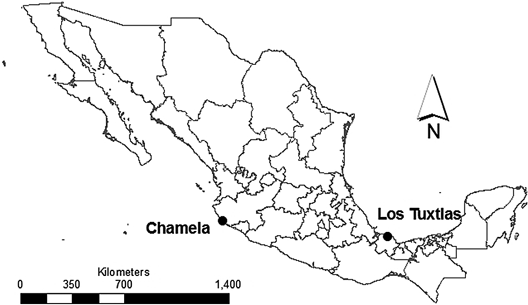
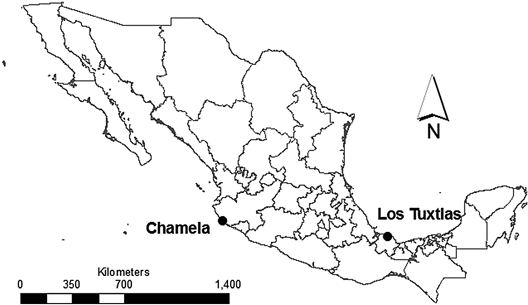
The new species were discovered in Los Tuxtlas Biosphere Reserve, Veracruz and Cuixmala-Chamela Biosphere Reserve, Jalisco. Los Tuxtlas Biosphere Reserve is located in the Sierra de Los Tuxtlas, south of Llanura Costera del Golfo de Mexico (Fig. 1), with an altitudinal range from 200 to 1700 m (Soto & Gama Reference Soto, Gama, González, Dirzo and Vogt1997). The climate of the region is classified as warm A and semiwarm A(C), with mean annual temperatures between 22–26°C and a annual average precipitation of 4500 mm (García Reference García1981; Soto & Gama Reference Soto, Gama, González, Dirzo and Vogt1997). The dominant vegetation is tropical rainforest (Miranda & Hernández-X Reference Miranda and Hernández-X1963; Ibarra-Manríquez et al. Reference Ibarra-Manríquez, Martínez-Ramos, Dirzo, Nuñez-Farfán, González, Dirzo and Vogt1997). Cuixmala-Chamela Biosphere Reserve is situated on the Pacific coast, north of the Transvolcanic Belt, between sea level and 2400 m (Fig. 1). Its climate is warm sub-humid (Aw0i), with a mean annual temperature of 24·9°C and a annual average precipitation of 748 mm, 80% of which falls during the summer months (July to November), with the highest values between August and September (García Reference García1981; Bullock Reference Bullock1986; García-Oliva et al. Reference García-Oliva, Camou, Mass, Noguera, Vega, García and Quesada2002). The main vegetation type corresponds to seasonally dry tropical forest (Miranda & Hernández-X Reference Miranda and Hernández-X1963; Durán et al. Reference Durán, Balvanera, Lott, Segura, Pérez-Jiménez, Islas, Franco, Noguera, Vega, García and Quesada2002; García-Oliva et al. Reference García-Oliva, Camou, Mass, Noguera, Vega, García and Quesada2002).
Location of study sites. Chamela: Chamela Biological Station in the Cuixmala-Chamela Biosphere Reserve, Jalisco. Los Tuxtlas: Los Tuxtlas Tropical Biological Station in the Los Tuxtlas Biosphere Reserve, Veracruz.
Collections were made along transects laid for an ecological study (Barcenas Peña et al. Reference Barcenas Peña, Herrera-Campos, Miranda-González and Lücking2012) and the identification of the specimens followed the keys by Lücking et al. (Reference Lücking, Archer and Aptroot2009b ) and Staiger (Reference Staiger2002). Thallus observations were made with a stereoscope Zeiss Stemi DV4. Microscopic observations were carried out using a compound microscope (Zeiss Axiostar Plus) on thin and semi-thin transverse sections of lirellae and thalli cut with a freezing microtome, Leica CM1850, and mounted in water. Ascospores were stained with Lugol's solution to check the amyloid reaction and measured in water. Secondary metabolites were identified by thin-layer chromatography (TLC) following standard procedures (Culberson & Ammann Reference Culberson and Ammann1979; Culberson & Johnson Reference Culberson and Johnson1982; Orange et al. Reference Orange, James and White2001); additionally, the usual spot tests (Hale Reference Hale1979) were performed on the exposed medulla of the thalli. Photographs of thalli were taken using a Macroscope Leica Z16 APO A and Leica Applications Suite. Ascocarp sections and ascospores were photographed with a digital camera Canon PowerShot G6; some sections were observed with a polarized lens and also photographed.
The Species
Graphis bungartzii Barcenas-Peña, Lücking, Herrera-Campos & R. Miranda sp. nov.
MycoBank No.: MB804537
Differing from Graphis elegans in the erumpent lirellae with lateral thalline margin and the smaller ascospores, from G. filiformis in the labia becoming striate, and from G. schiffneri in the laterally carbonized excipulum.
Type: Mexico, Jalisco, Municipio La Huerta, Cuixmala-Chamela Biosphere Reserve, Chamela Biological Station (UNAM), near Hornitos stream, 19°30′56·1″N, 105°02′7·2″W, 59 m, seasonally tropical dry forest, on bark of Croton sp., June–July 2011, Barcenas Peña 1247 (MEXU—holotype); same locality and date, on bark of Thouinia sp., Barcenas Peña 1248, 1249 (MEXU—paratypes).
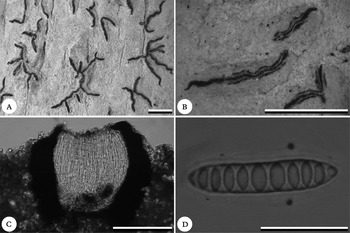
Graphis bungartzii (holotype). A, habit and flexuose, branched, erumpent lirellae; B, concealed disc; striate labia, and thick lateral thalline margin; C, section through a lirella, laterally carbonized excipulum, and not inspersed hymenium; D, mature transversely septate ascospore. Scales: A & B=1 mm; C=100 µm; D=20 µm.

Thallus corticolous, 2–5 cm diam., up to 150 µm thick, continuous; surface smooth, pale greenish grey; prothallus absent. Thallus in section c. 30 µm with cartilaginous upper cortex, irregular algal layer, and large clusters of calcium oxalate crystals.
Apothecia lirelliform, flexuose, branched, erumpent, with lateral thalline margin, 1·5–3·5 mm long, 0·1–0·2 mm wide, 0·03–0·05 mm high; disc concealed; proper margin thin, labia striate, black; thalline margin thick, of the same colour as the thallus. Excipulum entire, laterally carbonized, 15–45 µm wide, black, basally orange-brown; laterally covered by corticated algiferous thallus including large clusters of calcium oxalate crystals; hypothecium prosoplectenchymatous, 20–27 µm high, pale orange-brown; hymenium 90–110 µm high, colourless, not inspersed, paraphyses hyaline, unbranched; epithecium granulose, 5·0–7·5 µm high, brown. Asci fusiform, 70–90×10–20 µm. Ascospores 8 per ascus, ellipsoid to fusiform, transversely 5–11-septate, 25–38×5–8 µm, 3–4 times as long as wide, colourless.
Chemistry (TLC)
Norstictic and connorstictic acids (thallus K+ yellow turning red, in sections with yellow outflow with precipitating red needles).
Etymology
This new species is dedicated to Frank Bungartz for his support and encouragement offered to Alejandrina Barcenas-Peña and Ricardo Miranda González, and his interest in Mexican lichens.
Distribution and ecology
The type locality, at an elevation of 59 m, is characterized by a tree mixture of the transition between dry forest and the more humid and taller semi-deciduous forest at arroyos (Lott et al. Reference Lott, Bullock and Solís-Magallanes1987). In this locality, three specimens of the new species were found growing on the bark of Croton sp. and Thouinia paucidentata. The additional specimens cited were collected in different sites, between 2 and 13·5 km from the type locality in dry forest at an altitude of 50–300 m. Although morphologically G. bungartzii could be placed in the G. duplicata group, its known ecology contrasts with that of most other species in that group, which have typically been reported from higher elevations (750–1500 m) and from evergreen rainforests with a slight to distinct dry season (Lücking et al. Reference Lücking, Chaves, Sipman, Umaña and Aptroot2008).
Remarks
Currently there is only one other species known with labia becoming striate, a laterally carbonized excipulum, clear hymenium, small, transversely septate ascospores, and the chemical combination of norstictic and connorstictic acids, viz. Graphis elegans (Sm.) Ach. (Lücking et al. Reference Lücking, Archer and Aptroot2009b ). That species differs from the new one in the erumpent to prominent lirellae lacking a thalline margin and the larger, thick-walled ascospores with 9–13 septa, although it shares the same secondary substances. Graphis filiformis Adaw. & Makahija is also similar to Graphis bungartzii, but differs in having longer, irregularly to radiately branched lirellae with entire labia, and it lacks connorstictic acid. The eastern paleotropical Graphis schiffneri Zahlbr. agrees with the new species in most aspects but has a completely carbonized excipulum, thicker thalline margin, and only norstictic acid as the main secondary substance.
Specimens examined. Mexico: Jalisco: Municipio La Huerta, Cuixmala-Chamela Biosphere Reserve, Chamela Biological Station (UNAM), 100 m E from station buildings, between Chachalacas trail and Camino Antiguo Sur dirt road, 19°29′51·1″N, 105°02′30·2″W, 68 m, seasonally tropical dry forest, on bark of Thouinia paucidentata, 2009, Miranda 1088; 300 m W from Tejón trail at 600 m sign, 19°30′11·4″N, 105°02′53·8″W, 41 m, seasonally tropical dry forest, on bark of Thouinia paucidentata, 2010, Miranda 1774; Ejido Gargollo, S of Chamela Biological Station (UNAM), 19°24′17·9″N, 104°58′56·5″W, 57 m, seasonally tropical dry forest, on bark of Thouinia paucidentata, 2010, Miranda 4266 (all MEXU).
Graphis chamelensis Barcenas-Peña & Lücking sp. nov.
MycoBank No.: MB804538
Differing from Graphis emersa in the longer, partly branched lirellae, and from G. conferta in the norstictic acid chemistry.
Type: Mexico, Jalisco, Municipio La Huerta, Cuixmala-Chamela Biosphere Reserve, Chamela Biological Station (UNAM), near Hornitos stream, 19°30′52·6″N, 105°02′05·5″W, 59 m, seasonally tropical dry forest- semideciduous arroyo forest transition, on bark of Forchhammeria pallida, June–July 2011, Barcenas Peña 1239 (MEXU—holotype).
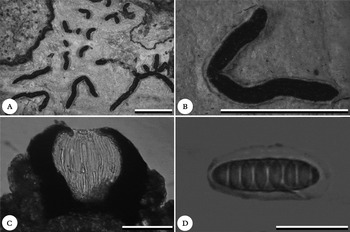
Graphis chamelensis (holotype). A, habit and prominent lirellae; B, concealed disc; labia entire, and basal to lateral thalline margin; C, section through a lirella, entire, completely carbonized excipulum and not inspersed hymenium; D, mature transversely septate ascospore. Scales: A & B=1 mm; C=100 µm; D=20 µm.

Thallus corticolous, 0·5–1·0 cm diam., 40–80 µm thick, continuous; surface smooth, pale greenish grey; prothallus absent. Thallus in section with thick cartilaginous upper cortex, irregular algal layer, and large clusters of calcium oxalate crystals.
Apothecia lirelliform, flexuose, partly branched, prominent, with basal to lateral thalline margin, 1–3 mm long, 0·2–0·4 mm wide, 0·25–0·30 mm high; disc concealed; proper margin thick, labia entire, black. Excipulum entire, completely carbonized, 50–70 µm wide, black, basal internal parts brown; hypothecium prosoplectenchymatous, 20–30 µm high, colourless to pale yellowish; hymenium 80–100 µm high, colourless, clear, paraphyses unbranched; epithecium granulose, 10–25 µm high, olive-brown. Asci fusiform, 70–90×15–25 µm. Ascospores 4–8 per ascus, oblong, transversely 7–10-septate, 25–35×7–10 µm, 2–4 times as long as wide, colourless.
Chemistry (TLC)
Norstictic acid (thallus K+ yellow turning red, in sections with yellow outflow with precipitating red needles).
Distribution and ecology
The type material of Graphis chamelensis was collected in the same transitional vegetation as G. bungartzii, but on the bark of Forchhammeria pallida. The additional specimens were found growing on Bursera heteresthes and Guettarda elliptica in three different sites in dry forest at 48–95 m, 1–2 km from the type locality. Although G. chamelensis was found on a higher number of different phorophytes than G. bungartzii, it seems to grow in a more limited area, probably requiring more specific microclimate conditions. Although the species forms part of the G. nuda group, its ecological preferences contrast with those of other species in that group, which are more typically found at high altitudes (Lücking et al. Reference Lücking, Chaves, Sipman, Umaña and Aptroot2008).
Remarks
Graphis chamelensis is similar to G. emersa Müll. Arg., from which it differs mainly by the presence of longer, partly branched prominent lirellae with a sometimes basally developed thalline margin. Both species have the same chemistry (Lücking et al. Reference Lücking, Archer and Aptroot2009b ). Graphis conferta Zenker is morphologically like G. chamelensis; however, it has sessile lirellae without a thalline margin, slightly longer ascospores, and no secondary substances.
Additional specimens examined. Mexico: Jalisco: Municipio La Huerta, Cuixmala-Chamela Biosphere Reserve, Chamela Biological Station (UNAM), near Tejón trail, 19°30′25·6″N, 105°02′32·8″W, 48 m, seasonally tropical dry forest, on bark of Forchhammeria pallida, 2011, Barcenas Peña 2000; 19°30′29·3″N, 105°02′29·8″W, 83 m, on bark of Bursera heteresthes, Barcenas Peña 2001; 19°30′34·4″N, 105°02′21″W, 95 m, on bark of Guettarda elliptica, Barcenas Peña 2002 (all MEXU).
Graphis rosae-emiliae Barcenas-Peña & Lücking sp. nov.
MycoBank No.: MB804539
Differing from Graphis syzygii in the larger ascospores and the lack of secondary substances, and from G. aurita in the inspersed hymenium and larger ascospores.
Type: Mexico, Veracruz, Municipio San Andrés Tuxtla, Los Tuxtlas Biosphere Reserve, Los Tuxtlas Tropical Biology Station, near Laguna Zacatal, 18°35′07·1″N, 95°05′23·4″W, 242 m, lowland rainforest, on bark of Orthion oblanceolatum, May 2011, Barcenas Peña 1235 (MEXU—holotype); same locality and date, on bark of unidentified phorophyte, Barcenas Peña 1254 (MEXU—paratype).
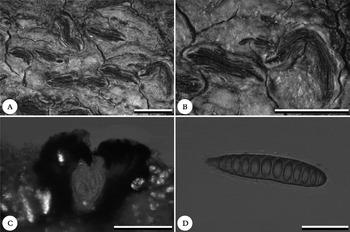
Graphis rosae-emiliae (holotype). A, habit and flexuose, unbranched, erumpent lirellae; B, concealed disc; labia striate, lateral thalline margin; C, section through a lirella, completely carbonized excipulum, inspersed hymenium, and calcium oxalate crystals visible with polarized light; D, mature transversely septate ascospore. Scales: A & B=1 mm; C=100 µm; D=20 µm.

Thallus corticate, 1–3 cm diam., 120–180 µm thick, continuous; surface smooth, greenish grey; prothallus absent. Thallus in section with cartilaginous upper cortex, irregular algal layer, and large clusters of calcium oxalate crystals.
Apothecia lirelliform, flexuose, unbranched, erumpent, with lateral thalline margin, 1–3 mm long, 0·25 mm wide, 0·1 mm high; disc concealed; proper margin thick, labia striate, black. Excipulum completely carbonized, 70–90 µm wide, black; hypothecium prosoplectenchymatous, 20–25 µm high, colourless; hymenium 80–90 µm high, colourless, inspersed (type A according to Lücking Reference Lücking2009), paraphyses unbranched; epithecium granulose, 10–15 µm high, colourless to pale yellowish. Asci fusiform, 70–90×10–20 µm. Ascospores 8 per ascus, oblong, transversely 9–13-septate, 45–55×5–10 µm, 5–9 times as long as wide, colourless.
Chemistry (TLC)
No substances detected (all spot tests negative).
Distribution and ecology
The type locality is characterized by an exuberant tropical rainforest with high humidity, at an elevation of 242 m along the east side of San Martín Tuxtla volcano. The type material of G. rosae-emiliae was found on the bark of canopy branches of Orthion oblanceolatum. The additional specimen was also found in the canopy, in a different locality and on a different date, 21 km from the type locality, at 345 m, on the northern slope of the Santa Marta Volcano.
Remarks
Graphis rosae-emiliae is characterized by its unbranched, erumpent lirellae with striate labia and lateral thalline margin, the completely carbonized excipulum, and the inspersed hymenium (type A), as well as transversely septate ascospores and lack of secondary metabolites. Other species with a similar lirella type, inspersed hymenium, and transversely septate ascospores are G. leucaenae Aptroot, G. inspersolongula Aptroot, and G. syzygii Aptroot (Lücking et al. Reference Lücking, Archer and Aptroot2009b ). Both G. leucaenae and G. inspersolongula have much larger ascospores and produce norstictic acid. Graphis syzygii Aptroot differs in its smaller ascospores and the presence of stictic acid. Finally, G. cinerea Fée shares the same chemistry as G. rosae-emiliae but it has very large ascospores (100–200×18–30 µm) and a different type of inspersion, among other morphological differences. Morphologically and chemically similar is G. aurita Eschw., but it lacks inspersion and its ascospores are smaller.
Specimen examined. Mexico: Veracruz: Municipio Catemaco, Los Tuxtlas Biosphere Reserve, Selva del Marinero, Ejido Adolfo López Mateos, 18°26′0·5″N, 94°57′44·1″W, 345 m, lowland rainforest, on bark of unidentified phorophyte, 2009, Barcenas Peña 1170 (MEXU).
Updates to the world key to species of Graphis
The publication by Lücking et al. (Reference Lücking, Archer and Aptroot2009b ) of a first global working key to the genus Graphis, as redefined by Staiger (Reference Staiger2002) and Lücking (Reference Lücking2009), has boosted the discovery and description of new species. Including the three species introduced here, no less than 41 species have been described or reinstated in the four years following publication of the key, representing an increase of 12·4% over the 330 species treated in the key. Of these, six are from North America (Lendemer Reference Lendemer2010; Lücking et al. Reference Lücking, Seavey, Common, Beeching, Breuss, Buck, Crane, Hodges, Hodkinson and Lay2011; Seavey & Seavey Reference Seavey and Seavey2011), four from Mexico (Lumbsch et al. Reference Lumbsch, Ahti, Altermann, Amo De Paz, Aptroot, Arup, Bárcenas Peña, Bawingan, Benatti and Betancourt2011; this paper), one from Central America (Costa Rica: Lücking et al. Reference Lücking, Sutjaritturakan and Kalb2012), nine from South America (Peru: Rivas Plata & Lücking Reference Rivas Plata and Lücking2013; Brazil: Dal-Forno & Eliasaro Reference Dal-Forno and Eliasaro2010; Lumbsch et al. Reference Lumbsch, Ahti, Altermann, Amo De Paz, Aptroot, Arup, Bárcenas Peña, Bawingan, Benatti and Betancourt2011; Cáceres et al. Reference Cáceres, Santos Vieira, Santos De Jesus and Lücking2012), three from Europe (Neuwirth & Aptroot Reference Neuwirth and Aptroot2011), 16 from Asia (India: Jagadeesh Ram & Sinha Reference Jagadeesh Ram and Sinha2009; Chitale et al. Reference Chitale, Makhija and Sharma2011; Sharma & Khadilkar Reference Sharma and Khadilkar2011; Sri Lanka: Weerakoon et al. Reference Weerakoon, Wijeyaratne, Wolseley, Rivas Plata, Lücking and Lumbsch2012; Cambodia: Nakanishi et al. Reference Nakanishi, Kashiwadani, Futagami and Moon2010; Moon et al. Reference Moon, Nakanishi, Futagami and Kashiwadani2011; South Korea: Joshi et al. Reference Joshi, Lücking, Yamamoto, Wang, Koh and Hur2010; Moon et al. Reference Moon, Nakanishi and Kashiwandani2012; China: Jia & Wei Reference Jia and Wei2009; Jia Reference Jia2011; Indonesia: see key entries below), one from Fiji (Lücking et al. Reference Lücking, Lumbsch, Von Konrat and Naikatini2010), and one pantropical species (this paper: see key entries below). We expect that this trend will continue in the near future; for the Graphis scripta group alone, Lücking (Reference Lücking2012) predicted nearly 50 missing species based on the data from the published key. Some nomenclatural and taxonomic changes were also proposed, the scope of which are summarized below.
Since the publication of a complete, updated key would go beyond this paper and would also be futile in the light of possibly many more species being described in the near future, for each of the newly established species or nomenclatural or taxonomic changes, we provide a detailed entry based on the key published previously (Lücking et al. Reference Lücking, Archer and Aptroot2009b ). For the moment, we apply the concept of Graphis sensu Staiger (Reference Staiger2002) and Lücking (Reference Lücking2009), although it has been shown that this encompasses two genera (Rivas Plata et al. Reference Rivas Plata, Hernández, Lücking, Staiger, Kalb and Cáceres2011). However, at present the second genus, which has tentatively been named Allographa (Rivas Plata et al. Reference Rivas Plata, Hernández, Lücking, Staiger, Kalb and Cáceres2011), cannot be named formally until the type species of Hemithecium has been sequenced. The reason for this is that the name Allographa is invalid and must be validated, but the type species of Hemithecium potentially belongs in that clade, providing a valid name that would then have priority.
One species, Graphis parvicarpa B. O. Sharma & Khadilkar (Sharma & Khadilkar Reference Sharma and Khadilkar2011), turned out to belong in the genus Pallidogramme. The apical carbonization, as shown in the excellent illustrations in the protologue, is not part of the excipulum but of the epithecium. The type of hymenial inspersion agrees with Pallidogramme, and nearly hyaline ascospores are often found in that genus. We therefore propose the following combination:
Pallidogramme parvicarpum (B. O. Sharma & Khadilkar) Lücking comb. nov.
MycoBank No.: MB804862
Graphis parvicarpa B. O. Sharma & Khadilkar, Lichenologist 43: 487 (2011).
Names that were validated or changed in nomenclature or taxonomic concept are:
-
Graphis arbusculaeformis (Vain.) Lücking (Lücking et al. Reference Lücking, Sutjaritturakan and Kalb2012); validated.
-
Graphis betulina (Pers.) Ach. (Neuwirth & Aptroot Reference Neuwirth and Aptroot2011); replaces G. scripta (L.) Ach. auct. p.p.
-
Graphis caribica Lücking (Lumbsch et al. Reference Lumbsch, Ahti, Altermann, Amo De Paz, Aptroot, Arup, Bárcenas Peña, Bawingan, Benatti and Betancourt2011); validated.
-
Graphis inustuloides Lücking (Lücking & McCune Reference Lücking and McCune2012); replaces G. britannica sensu Staiger auct.
-
Graphis macrocarpa (Pers.) Röhl. (Neuwirth & Aptroot Reference Neuwirth and Aptroot2011); replaces G. scripta (L.) Ach. auct. p.p.
-
Graphis norvestitoides Sutjaritturakan (Lücking et al. Reference Lücking, Sutjaritturakan and Kalb2012); validated and taxonomy corrected (see key below, Group 18, couplet 3 and Group 20, couplet 1).
-
Graphis pedunculata Bungartz & Aptroot (Bungartz et al. Reference Bungartz, Lücking and Aptroot2010); validated.
-
Graphis pulverulenta (Pers.) Ach. (Neuwirth & Aptroot Reference Neuwirth and Aptroot2011); replaces G. scripta (L.) Ach. auct. p.p.
-
Graphis rongklaensis Sutjaritturakan (Lücking et al. Reference Lücking, Sutjaritturakan and Kalb2012); validated.
The following are updates to the key entries in the world key to Graphis (Lücking et al. Reference Lücking, Archer and Aptroot2009b ), for 41 newly described or reinstated species from 2009 to 2013:
-
Group 1, couplet 10: Excipulum laterally carbonized; hymenium clear; norstictic acid; ascospores muriform; 50–100×20–30 µm; USA. ... Graphis hodgesiana Lendemer (Lendemer Reference Lendemer2010)
-
Group 1, couplet 10: Excipulum laterally carbonized; hymenium clear; norstictic acid; ascospores submuriform; 20–35×10–15 µm; USA. ... Graphis tamiamiensis Lendemer (Lendemer Reference Lendemer2010)
-
Group 2, couplet 2: 2-methoxy-psoromic acid; thallus sorediate; ascospores 30–35×7–8 µm; Cambodia ... Graphis taneina M. Nakan. et al. (Moon et al. Reference Moon, Nakanishi, Futagami and Kashiwadani2011)
-
Group 3, couplet 3: Lirellae prominent, with complete thalline margin, elongate and irregularly branched; India ... Graphis elevativerrucosa Chitale et al. ... (Chitale et al. Reference Chitale, Makhija and Sharma2011)
-
Group 4, couplet 5: Lirellae prominent to sessile, with thick lateral thalline margin, very short and unbranched (dussii-morph); norstictic and salazinic acids; China ... Graphis paradussii Z. F. Jia (Jia Reference Jia2011)
-
Group 4, couplet 35: Disc exposed, non-pruinose; lirellae with rounded ends; Europe ... Graphis macrocarpa (Pers.) Röhl. (Neuwirth & Aptroot Reference Neuwirth and Aptroot2011)
-
Group 4, couplet 35: Disc exposed, pruinose or weakly pruinose; lirellae with acute ends and conspicuously thick lateral thalline margin; Europe ... Graphis betulina (Pers.) Ach. (Neuwirth & Aptroot Reference Neuwirth and Aptroot2011)
-
Group 4, couplet 35: Disc exposed, pruinose; lirellae with acute ends and thin lateral thalline margin; Europe ... Graphis pulverulenta (Pers.) Ach. (Neuwirth & Aptroot Reference Neuwirth and Aptroot2011)
-
Group 4, couplet 41: Graphis scripta (L.) Ach. s. str. would key out under G. pinicola Zahlbr. according to the characters given by Neuwirth & Aptroot (Reference Neuwirth and Aptroot2011); possibly the collections of G. pinicola from subtropical regions (with lateral thalline margin) represent G. scripta s. str., whereas tropical material (with apically thin complete thalline margin) would have to be named G. guineensis C. W. Dodge; this issue needs further study.
-
Group 6, couplet 12: Disc exposed, non-pruinose; South Korea ... Graphis jejuensis K. H. Moon et al. (Moon et al. Reference Moon, Nakanishi and Kashiwandani2012)
[In the original description (Moon et al. Reference Moon, Nakanishi and Kashiwandani2012), this species is given as carbonized apically or in the upper half, and thus far only G. pertricosa (Kremp.) A. W. Archer is known with such a character combination, differing in the muriform ascospores and norstictic acid; however, the illustrations provided by Moon et al. (Reference Moon, Nakanishi and Kashiwandani2012) suggest a laterally carbonized excipulum]
-
Group 6, couplet 12: Disc concealed; labia non-pruinose; lirellae immersed in distinct, raised, pseudostromatic areas; USA ... Graphis elevata Seavey & J. Seavey (Seavey & Seavey Reference Seavey and Seavey2011)
-
Group 7, couplet 6: Ascospores 70–100×15–20 µm; lirellae erumpent, with thick lateral thalline margin (subserpentina morph); Fiji ... Graphis collinsiae Lücking & Lumbsch (Lücking et al. Reference Lücking, Lumbsch, Von Konrat and Naikatini2010)
-
Group 8, couplet 7: Lirellae prominent to sessile, with thick lateral thalline margin, very short and unbranched (dussii-morph); norstictic and salazinic acids; China ... Graphis paradussii Z. F. Jia (Jia Reference Jia2011)
-
Group 8, couplet 10: Lirellae prominent, with basal thalline margin, irregularly branched; ascospores 35–65 µm long; USA ... Graphis brittoniae Seavey & J. Seavey (Seavey & Seavey Reference Seavey and Seavey2011)
-
Group 8, couplet 15: Lirellae erumpent to prominent, lacking or with basal thalline margin; short and sparsely branched; thallus distinctly verrucose to almost isidiate; China ... Graphis guangdongensis Z. F. Jia & J. C. Wei (Jia & Wei Reference Jia and Wei2009)
-
Group 8, couplet 17: Lirellae erumpent; thallus verrucose; Brazil ... Graphis invisibilis Dal-Forno & Eliasaro (Dal-Forno & Eliasaro Reference Dal-Forno and Eliasaro2010)
-
Group 8, couplet 18: Lirellae stellately branched and clustered into pseudostromata; thallus isidiate; Brazil ... Graphis itatiaiensis Nelsen et al. (Lumbsch et al. Reference Lumbsch, Ahti, Altermann, Amo De Paz, Aptroot, Arup, Bárcenas Peña, Bawingan, Benatti and Betancourt2011)
-
Group 8, couplet 20: Thallus green; lirellae 1–5 mm long, lacking basal margin, with grey-black labia; Mexico ... Graphis marusae B. Peña & Lücking (Lumbsch et al. Reference Lumbsch, Ahti, Altermann, Amo De Paz, Aptroot, Arup, Bárcenas Peña, Bawingan, Benatti and Betancourt2011)
-
Group 8, couplet 29: Lichexanthone; disc exposed (handelii morph); South Korea ... Graphis flavopalmicola Y. Joshi et al. (Joshi et al. Reference Joshi, Lücking, Yamamoto, Wang, Koh and Hur2010)
-
Group 8, couplet 36: Lirellae prominent, with basal to lateral thalline margin, elongate and irregularly branched; Mexico ... Graphis chamelensis Barcenas-Peña & Lücking (this paper)
-
Group 8, couplet 42: Lirellae elongate to very long, prominent; thallus sorediate; Brazil ... Graphis lueckingii Dal-Forno & Eliasaro (Dal-Forno & Eliasaro Reference Dal-Forno and Eliasaro2010)
-
Group 8, couplet 51: Lirellae irregularly branched, with apically thin complete margin; ascospores regularly 3-septate, 15–20×5–6 µm; Peru ... Graphis pitmanii Rivas Plata & Lücking (Rivas Plata & Lücking Reference Rivas Plata and Lücking2013)
-
Group 8, couplet 51: Lirellae irregularly branched but not radiate, with very thin complete margin; ascospores 7–11-septate, 35–55×10–12 µm; Brazil ... Graphis paranaensis Dal-Forno & Eliasaro (Dal-Forno & Eliasaro Reference Dal-Forno and Eliasaro2010)
-
Group 10, couplet 6: Lirellae prominent, with thick lateral thalline margin (marginata morph); ascospores 50–70 µm long; Sri Lanka ... Graphis srilankensis Weerakoon et al. (Weerakoon et al. Reference Weerakoon, Wijeyaratne, Wolseley, Rivas Plata, Lücking and Lumbsch2012)
-
Group 10, couplet 13: Lirellae prominent, with basal to lateral thalline margin and exposed disc; Peru ... Graphis apertoinspersa Rivas Plata & Lücking (Rivas Plata & Lücking Reference Rivas Plata and Lücking2013)
-
Group 13, couplet 1: 2-methoxy-psoromic acid; thallus sorediate; ascospores 30–35×7–8 µm; Cambodia ... Graphis taneina M. Nakan. et al. (Moon et al. Reference Moon, Nakanishi, Futagami and Kashiwadani2011)
-
Group 13, couplet 7: Ascospores medium-sized to large, 50–95×7–9 µm, 8 per ascus; labia non-pruinose; lirellae erumpent to prominent, lacking or with basal thalline margin, very long and irregularly to radiately branched; India ... Graphis neoraensis Jagadesh & G. P. Sinha (Jagadeesh Ram & Sinha Reference Jagadeesh Ram and Sinha2009)
-
Group 13, couplets 8 and 9: Thallus distinctly verrucose but not isidiate; lirellae with verrucose lateral thalline margin; Sri Lanka ... Graphis allugallenensis Weerakoon et al. (Weerakoon et al. Reference Weerakoon, Wijeyaratne, Wolseley, Rivas Plata, Lücking and Lumbsch2012)
-
Group 13, couplet 14: Thallus white-grey; lirellae erumpent, labia non-pruinose; ascospores 40–60 µm long; USA. ... Graphis appendiculata Common & Lücking (Lücking et al. Reference Lücking, Seavey, Common, Beeching, Breuss, Buck, Crane, Hodges, Hodkinson and Lay2011)
-
Group 13, couplet 20: Lirellae with lateral thalline margin; thallus white-grey; pantropical ... Graphis subtenella Müll. Arg.
-
Group 13, couplet 20: Lirellae with basal thalline margin; thallus green-grey; Indonesia ... Graphis chlorotica A. Massal.
[Revision of type material of G. chlorotica revealed that it differs morphologically from G. subtenella, which is why the latter is removed from synonymy and accepted as a separate species]
-
Group 14, couplet 6: Ascospores medium-sized, 45–65×12–16 µm; lirellae erumpent, with lateral thalline margin, elongate and irregularly branched (tenella morph); India ... Graphis panhalensis (Patw. & C. R. Kulk.) Chitale et al. (Chitale et al. Reference Chitale, Makhija and Sharma2011)
[This species is close to G. parilis Kremp. but appears to differ by the narrower ascospores, a feature that needs to be evaluated with more material]
-
Group 15, couplet 5: Ascospores small, 25–38×5–8 µm, 5–11-septate, not conspicuously thick-walled; lirellae erumpent, with lateral thalline margin; Mexico ... Graphis bungartzii Barcenas-Peña et al. (this paper)
-
Group 16, couplet 1: Norstictic acid; lirellae prominent, with complete thalline margin (acharii morph); ascospores 70–95×25–35 µm; Cambodia ... Graphis cambodiensis M. Nakan. et al. (Nakanishi et al. Reference Nakanishi, Kashiwadani, Futagami and Moon2010)
-
Group 16, couplet 1: Stictic acid; lirellae erumpent, with lateral thalline margin, elongate and irregularly branched (tenella morph); ascospores 25–42×13–17 µm; India ... Graphis maharashtrana Chitale et al. (Chitale et al. Reference Chitale, Makhija and Sharma2011)
-
Group 17, couplet 7: Ascospores very large (120–150 µm long); lirellae very short to rounded, prominent, with complete thalline margin; Brazil ... Graphis brachylirellata M. Cáceres & Lücking (Cáceres et al. Reference Cáceres, Santos Vieira, Santos De Jesus and Lücking2012)
-
Group 17, couplet 11: Lirellae erumpent, lacking or with basal thalline margin; Sri Lanka ... Graphis dotalugensis Weerakoon et al. (Weerakoon et al. Reference Weerakoon, Wijeyaratne, Wolseley, Rivas Plata, Lücking and Lumbsch2012)
-
Group 17, couplet 15: Lirellae prominent, lacking thalline margin but labia grey-black; thallus green; Mexico ... Graphis marusae B. Peña & Lücking (Lumbsch et al. Reference Lumbsch, Ahti, Altermann, Amo De Paz, Aptroot, Arup, Bárcenas Peña, Bawingan, Benatti and Betancourt2011)
-
Group 18, couplet 3: Graphis norvestitoides Sutjaritturakan is incorrectly keyed out here since it has an inspersed hymenium (see below, Group 20, couplet 1); the correct species to be keyed out here is; Costa Rica ... Graphis pseudoaquilonia Lücking (Lücking et al. Reference Lücking, Sutjaritturakan and Kalb2012)
-
Group 18, couplet 6: Ascospores 4–6 per ascus, 25–30×10–13 µm; norstictic acid; lirellae erumpent, with basal thalline margin; Brazil ... Graphis archeri Dal-Forno & Eliasaro (Dal-Forno & Eliasaro Reference Dal-Forno and Eliasaro2010)
-
Group 19, couplet 1: Ascospores small, 30–40×7–8 µm; norstictic and stictic acids; lirellae erumpent from pseudostromatic areas; USA ... Graphis hinnulea Seavey & J. Seavey (Seavey & Seavey Reference Seavey and Seavey2011)
-
Group 19, couplet 1: Ascospores small to medium-sized, 45–55×5–10 µm; no substances; lirellae erumpent with lateral thalline margin; Mexico ... Graphis rosae-emiliae Barcenas-Peña & Lücking (this paper)
-
Group 19, couplet 2: Stictic acid; ascospores 80–100×15–20 µm; lirellae prominent, with complete thalline margin; Brazil ... Graphis cerradensis Marcelli et al. (Lumbsch et al. Reference Lumbsch, Ahti, Altermann, Amo De Paz, Aptroot, Arup, Bárcenas Peña, Bawingan, Benatti and Betancourt2011)
-
Group 20, couplet 1: Ascospores terminally muriform; norstictic acid; ascospores 80–100×15–20 µm; Thailand ... Graphis norvestitoides Sutjaritturakan (Lücking et al. Reference Lücking, Sutjaritturakan and Kalb2012)
-
Group 20, couplet 2: Thallus ecorticate; labia pruinose; Sri Lanka ... Graphis knucklensis Weerakoon et al. (Weerakoon et al. Reference Weerakoon, Wijeyaratne, Wolseley, Rivas Plata, Lücking and Lumbsch2012)
Financial support from CONACYT (scholarship 165048), PAPIIT-UNAM (project IN225808), and Posgrado de Ciencias Biológicas, UNAM is acknowledged. We are grateful to M. S. Álvaro Campos for his assistance in the field and help with phorophyte identification, to Biol. Rosamond Coates for logistical support at Los Tuxtlas, and to Biol. Susana Guzmán for assistance in the Laboratorio de Microscopía y Fotografía de la Biodiversidad IB-UNAM. The participation of Robert Lücking in the project, in addition to some of the fieldwork, was financially supported by two grants from the National Science Foundation: Neotropical Epiphytic Microlichens—An Innovative Inventory of a Highly Diverse yet Little Known Group of Symbiotic Organisms (DEB 715660 to The Field Museum; PI R. Lücking) and “ATM—Assembling a taxonomic monograph: The lichen family Graphidaceae” (DEB-1025861 to The Field Museum; PI T. Lumbsch, CoPI R. Lücking). Christine Giannoni kindly assisted in obtaining some of the literature used for updating the key to Graphis. We also acknowledge the comments of two anonymous reviewers.