In 1995, a local Iranian official wrote about the vexing situation in Khorramshahr and Abadan, the oil-rich towns bordering Iraq and devastated by the Iran–Iraq War (1980–88). After decades of local efforts to provide housing, employment, and welfare to exiles, migrants, and refugees, many of these impoverished people now occupied government land. Since Saddam Hussein's early expulsion of Iranians from Iraqi soil in 1969, locals had shouldered the responsibility for these newcomers and demanded that Tehran increase its financial aid, regardless of the Iraqi origins or refugee status of the new arrivals. The defensive official, who attested to the welfare programs Tehran had initiated, stressed the urgency of the situation by stating that “more than two-thirds of the population [of Khorramshahr and Abadan] are comprised of them [migrants from Iraq].”Footnote 1 This was perhaps an exaggeration, reminiscent of Saddam Hussein's claim that Iranians comprised 10 percent of the Iraqi population.Footnote 2 Still, why had these two border towns, and the province of Khuzistan more generally, become a magnet for migrants throughout the century, a smuggling center in the 1950s, and the site of war in 1980?Footnote 3 The records suggest that, beginning in the early nation-building period, Khuzistanis, like many other border dwellers, did not accept the state's definitions of borders, citizenship, or licit trade. In fact, border dwellers and migrants complicated the state's understanding of and approach to citizenship on the frontier.
Khorramshahr and Abadan did not become migrant towns purely as a result of wartime pressures, but from the constant movement of people and goods over the course of the 20th century. An Iranian official in 1926, decades before the confrontation between local charities and the Islamic Republic in 1995, made this argument, highlighting local support for transnational smuggling. “Perhaps . . . my evaluation of the issue will ring untrue,” the official qualified, “but it seems clear that the smugglers are so important to the locals of this area that they ask, on a daily basis, about their progress.”Footnote 4 Border dwellers encouraged smuggling and migrant labor, causing some hysteria among Iranian officials in the early Pahlavi period.Footnote 5 This continued into the 1970s, despite major changes in patterns of governance as well as regimes. In fact, when the Islamic Republic established itself in Tehran in 1979 and sent officials to assess the Khuzistan-Basra frontier, their first order of business was to address smuggling—after all, smugglers brought weapons (in addition to less threatening contraband), settled, and blended into the local environs.Footnote 6
Tehran failed to entice locals to cooperate in enforcing their vision of the border. Although more established Western nations might have struggled with the execution of deportations, they nevertheless often succeeded in working with locals to enforce immigration laws. As Adam McKeown writes of Chinese immigration to California at the turn of the 20th century, “Immigration officials occasionally received anonymous letters tipping them off to undocumented Chinese. They would find the accused immigrants exactly where the letter indicated, arrest them, try them, and sentence them to deportation.”Footnote 7 This understanding between inhabitants and the state, however, did not exist in Khuzistan nor, indeed, in many other Middle Eastern borderlands. As scholars of the early Pahlavi period have noted, border dwellers rejected the efforts of the state to curb illegal crossing and, in fact, encouraged smuggling and migration.Footnote 8
Inhabitants of frontiers create meaning out of borders, which typically represent a culturally and historically contingent space. As I have argued elsewhere, the border dwellers of Khuzistan in the Qajar period (1789–1925) treated the border separating Khuzistan from Basra with ambivalence.Footnote 9 Peter Sahlins writes in his pioneering work on the French-Spanish borderland that “local social relations” played a large role in constructing national borders.Footnote 10 Matthew Ellis expands on this concept in his study of Ottoman Egypt and Libya by examining the “lived experience of territoriality as the conceptual lens that best enables scholars to capture the dynamic interaction between state and local actors.”Footnote 11 I agree with Firat Oruc's assessment that “the crucial question at stake . . . is how communities can participate in shaping the public and political culture of the nation to which they belong without just being fixated in the social hierarchy through some granted rights and space.”Footnote 12 This presupposes that “territoriality . . . [was not] the sole province of state power . . . but rather more of a feedback loop.”Footnote 13 Indeed, migrants and border dwellers challenged the boundaries of citizenship as well as the definition of borders throughout the 20th century. The metropole predictably attempted to control movement, whereas locals, equally predictably, imbued the border with their own meaning by traveling across it.
How did migration complicate citizenship status? And in what ways did locals and politicians rebuff Tehran's efforts to control the parameters of citizenship and the border? Beginning in the Qajar period, when claims to citizenship depended on documentation, migrants posed a unique problem. Firoozeh Kashani-Sabet examines the Iranian state's effort, at the turn of the 20th century, in trying to “‘return citizenship’ to Iranians living abroad.” After all, the state “had maintained few records on emigrants.”Footnote 14 According to Iranian legal codes from the late Qajar period, “The connection between land and identity, and therefore nationality, is unmistakable, and land in a sense begot its offspring.” But did land really beget its offspring? What of citizens begotten in a foreign land? This article expands on the idea of the “hierarchy of privileges” described by Kashani-Sabet, as well as “the guidelines [that] encouraged fealty to the birthplace with their promise of citizenship for indigenous Iranians.”Footnote 15
As is found on other frontiers, the culture and demographics of Khuzistan distinguished its (mostly Arab) inhabitants from the culture and demographics (mostly Persian and Turkish) dominating the urban centers of the nation. In the early 1920s, an Arab tribal chief, Shaykh Khaz‘al, led a revolt against Tehran, finally quelled by Reza Shah. Throughout the Pahlavi period, Arabs in the borderland province demanded greater autonomy from Tehran. When Saddam Hussein came to power in 1968, Khuzistan would house tens of thousands of Iranians expelled by Iraq. Unlike other Iranian borderlands, Khuzistan experienced Saddam Hussein's invasion, supposedly designed to liberate Iran's Arab community, a legacy of the racialization of citizenship throughout the century that suggested Arabs belonged in nations ruled by Arabs. As on most frontiers, particular geographic and demographic realities made the region challenging to control.
Not only did Tehran struggle to integrate Khuzistanis into the national fold, the metropole also struggled to assert its sovereignty in the region as Iraqi governments questioned the border arrangement. From the mid-19th century until 1988, the border of Khuzistan and Basra had been hotly contested. The robust literature regarding the Iran–Iraq relationship explores the human exchange between them, although scholars and journalists have more deeply investigated the political relationship between the two states.Footnote 16 Many traveled across the border to visit family in Basra, study Shi‘i doctrine in Najaf, trade in the international marketplace, or engage in human trafficking.Footnote 17 Historians of the Pahlavi period such as Stephanie Cronin and Ervand Abrahamian have long noted the importance of smuggling at the time Reza Shah first established his rule. I extend the scope further into the 20th century. Pahlavi documents elucidate the difficulties officials faced enforcing national laws as well as preventing peripheral communities from evading state policies. As Eric Tagliacozzo does in his study of smuggling in South Asia, I emphasize “individual people and places” to unearth the ways voluntary and involuntary immigrants interacted with legal systems, shaping local understandings of the border and citizenship.Footnote 18
Khuzistan: An Ambiguous Borderland
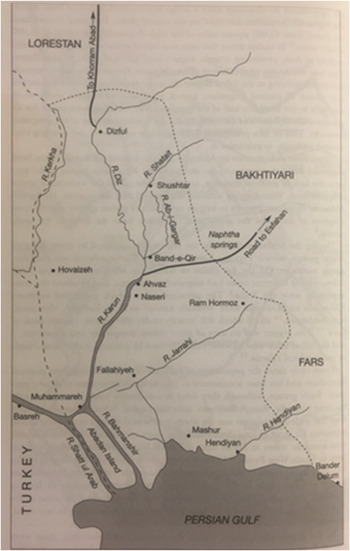
Over the course of the 20th century, this southwest Iranian borderland went by three names: Arabistan, al-Ahwaz, and Khuzistan. The oil-rich Arab towns on the borderland also went by different (and, invariably, politically-charged) names. Before the discovery of oil in Khuzistan and the influence of Arab nationalism on local understandings of the border, the British traveled through the region to report on their observations of the population, a mix of Arab and Persian tribes, as well as the geography. John Gordon Lorimer, an English civil servant in Punjab, commissioned to create a handbook of the Persian Gulf for British diplomats in 1903, described the island Saddam Hussein invaded in 1980 as ‘Abbadan (Abadan, in Persian), “a large and valuable island enclosed by the Karūn river on the north, by the Shatt-al-‘Arab on the west, by the Persian Gulf on the south, and by the Bahmanshir on the east” (Fig. 1). Although the area was small and “mostly desert,” the locals cultivated dates thanks to the surrounding waters.Footnote 19 Indeed, the Abadan/Khorramshahr landscape is jarring, with desert expanses interrupted by vast bodies of water and palm tree groves. The Shatt al-Arab in particular represented the natural boundary between the Qajar and Ottoman empires for over a century. The two bodies of water separate at the mouth of the Gulf, with the Karun traveling northeast toward the city of Ahwaz in Iran and the Shatt al-Arab continuing northwest toward Basra in Iraq. In the case of this particular frontier, inhabitants and migrants interacted with a river border, which, Richard Schofield reminds us, is one of the most volatile (and inadequate) means of separating nations.Footnote 20
Map of the Khuzistan-Basra region. In Iran's southwestern corner, one finds Khorramshahr and Abadan island, as well as Basra north of the two cities in Iraq. From Shahbaz Shahnavaz, Britain and the Opening up of South-west Persia 1880–1914: A Study in Imperialism and Economic Dependence (London: Routledge, 2005), 4.

Like other bodies of water that separated polities, “merchants, migrants, mercenaries, missionaries, conquerors, refugees, and slaves moved permanently or crossed repeatedly to the other side, while goods and ideas were briskly exchanged.”Footnote 21 A region once rich in cash crops, the economy had experienced a precipitous decline.Footnote 22 Despite the relative poverty of the marsh Arabs and the seminomadic tribes of the southern frontier, the strategic and economic importance of the Karun River cannot be overstated; it was, after all, the only “navigable stream in Persia” and “the most feasible entry into Persia for commercial purposes, as both sides of the river belong[ed] to that country.”Footnote 23 In the 20th century, border dwellers nurtured a frontier society with an unregulated economy, large migrant communities, and a transnational social milieu.
The Middle East was not the only region with ambiguous borderlands troubling state leaders, of course. As the editors of Borderlands in World History write, over the course of the last century of study, “the meaning of borderlands has shifted from the notion of Europe ‘taming’ a wild and dangerous frontier to a zone of cultural commingling, and—more recently—to contested spaces marked by violent encounters.”Footnote 24 Analyses of cultural comingling as well as the popular conception of taming seemingly wild peripheral nomads in the Americas have offered valuable methodological insights to historians of the Middle East.Footnote 25 In early modern Europe, peoples living on the edges of empires slowly assimilated to definable national communities, somewhat similar to the experience of the Ottoman-Qajar frontiers.Footnote 26 Peter Sahlins’ influential study of the Cerdanya valley in the Pyrenees persuasively argues that “the shape and significance of the boundary line was constructed” not by the elite but “out of local social relations in the borderland.”Footnote 27 Khuzistanis similarly constructed their own understandings of the border and citizenship—often at odds with the state's definition. As a result, local dynamics continued to shape community bonds and activities.
From the Iranian archives, it is evident that the state appreciated these different understandings of the border and citizenship. Consequently, the monarchy created an informal hierarchy (i.e., of those residing abroad and those residing domestically) as well as alternatively rewarding and punishing citizens by offering or withholding their rights, respectively. Since the 1980s, researchers like Akhil Gupta have reimagined the role of the nation–state in the era of globalization “[wherein the] national space is transnationally defined.” For many, the phenomenon of mass migration proves the significance of “transnational governance” and the deficiencies in categories like “nation, citizenship (or belonging, more broadly), and the state.”Footnote 28 The necessity for transnational governance and extranational pressures on sovereignty, however, existed in Iran throughout the 20th century, including at the Khuzistan-Basra frontier, due to the high level of transnational movement as well as Iraq's open claim on Khuzistan's border towns.
Furthermore, in the Pahlavi period, migrants put into sharp relief the state's “favored” citizens (recalling Kashani-Sabet's “hierarchy of privileges”): those who had been born and raised in Iran, without a sojourn abroad, and abided by Iran's secular legal codes. Although Gupta highlights the contemporary neoliberal order in which global capital and human beings increasingly travel as the cause of the “unevenly experienced and spatialized” nature of citizenship, Pahlavi Iran struggled with these same obstacles.Footnote 29 In fact, the monarchy complicated the connection between Iranians and their homeland by unevenly applying citizenship rights. Ultimately, however, locals could either acknowledge or refuse to acknowledge a migrant's rights, regardless of Tehran's position on the subject.
Although historians focus on the centralization of the Iranian state, especially in urban centers, it is important to recognize that the state did not permeate all aspects of life in the Pahlavi period.Footnote 30 In fact, the dispute between Iran and Iraq for control of Khuzistan's borderland—particularly Abadan, Khorramshahr, and Ahwaz—reveals the extent to which these towns remained isolated from national cultures. Both Iranians and Iraqis insisted that Arabs on the Khuzistan frontier “belonged” in their national communities, citing local customs and language as well as the discourse generated by political activists of the region as their evidence. This contest ultimately resulted in a war, which offered Khuzistanis themselves the opportunity to select their preferred national community, a unique experience for a marginalized ethnic group.
Due to the fact that Khuzistani Arabs straddled the borderland of a pan-Arab state, they were attuned to the debates within Pan-Arabism as well as the contradictions within Iranian nationalism. Nevertheless, locals maintained cultural and political distance from the metropoles. Like Cyrus Schayegh, I argue that the growth of a formidable state, here the Pahlavi monarchy, did not vacate local areas of their unique cultural and economic features. As Schayegh writes in The Middle East and the Making of the Modern World, “A more intense presence of state power in a city did not mean less city.”Footnote 31 In fact, the culture and economy of border towns near Iraq remained independent. The state could neither prevent the movement of people or goods nor, often, effectively supervise them. By examining migrants, smugglers, and border dwellers, I historicize the limits of state authority, the demands of transnational governance, and the ambiguity of citizenship throughout the century. I emphasize the alternatively vulnerable and liberating social cleavages, especially between citizen and foreigner, in which many resided.
Transnational Movement and Settlement
Tribesmen, who straddled both sides of the border for centuries, often crossed under the noses of border surveyors. Most officials focused on smugglers, but many also complained that they could not properly evaluate the claims of refugees. Arabs in Basra, mostly Shi‘is, traveled to Iran to study in Qom or live in a nation that embraced Shi‘ism.Footnote 32 Since the 18th century, Shi‘i clerical families from Iran had settled in Iraq and remained there for several generations.Footnote 33 Scholars of both countries have produced transnational histories of Shi‘ism and politics.Footnote 34 These histories of religious migration have not fully captured the experiences of border dwellers, refugees, and economic migrants, however.
In April of 1926, for instance, one official reported on the influx of wealthy Arabs into Khuzistan. “About a hundred families” from Iraq, the official stated, had claimed refugee status by fashioning themselves as “Arab shaykhs.” Presumably expecting sympathy from Iranian Shi‘is, the Arabs presented themselves as persecuted clerics. Entering the country under this pretext, they brought goods with them, including “livestock, wool, oil . . . sugar, tea,” causing officials to worry that these families voluntarily migrated to benefit from trade on the Iranian side of the border. It is possible they were right; indeed, according to the official from Delvar quoted earlier in this piece, it is likely that Khuzistanis would greet these smugglers warmly and purchase their goods. Border officials insisted that they required more “training” to properly “address the problem” of refugees. Officials expressed concern that some migrants intended to manipulate them to trade goods in the black market.Footnote 35 Training, however, proved difficult in a region with rampant corruption among border patrolmen.Footnote 36
Nevertheless, some in Iran regarded in-migration, as dubious as the claims of some immigrants might have been, as a necessity. That same year, in 1926, the Iranian daily newspaper Ettela‘at (Information) published a several-part series entitled “The Law of Migration to Iran” by a Mr. Shirvani. With a sophisticated correlation of population density and economic prosperity, the author argued that, since the late Safavid period, Iran had suffered from out-migration. “Everyone completely understands that Iran's population compared to the vastness of its exceptional natural and financial resources is extremely low and something must be done about it so that Iran may increase in strength.”Footnote 37 The solution? The author suggested that the government repatriate those who left Iran during the “chaos” of the 18th century “to the furthest corners of Syria and the Levant.”Footnote 38 Likening small villages to “cemeteries,” Shirvani insisted that the return of the Iranian “race” from their generational sojourns abroad would revitalize Iranian society.Footnote 39 Although the problem of maintaining security while inviting immigrants into the country vexed the author, he assumed that anyone willing to make the arduous journey to Iran would be loyal to the nation.Footnote 40
Indeed, some immigrants heeded nationalist calls like Shirvani's to return to the homeland. These Iranians soon discovered, however, that citizenship status did not protect them from persecution and that local dynamics outweighed national policies. In 1932, one Kurdish man, the leader of his tribe, entered a protracted legal battle during his inauspicious return to Iran after living in Iraq for several decades. During the late-Qajar period, he and five thousand families had abandoned their native town of Posht-i Kuh, in Iran's province of Luristan, to settle in Bayn al-Nahrayn, a town in southern Iraq between the Euphrates and the Tigris Rivers. The exchanges between Hassan and the Pahlavi monarchy demonstrate the continued strength of local cultures and political actors alongside the growing power of Tehran. The Pahlavi monarchy, ultimately, was in no position to guarantee Hassan's birthright.
In 1922, just after Reza Shah took control of the military, Ahmad Mehr, then head of Parliament, made it official government policy to lure wealthy Iranians, specifically from Bayn al-Nahrayn, back to Iran. In fact, Mehr approved of sending a bank in Baghdad a sum of five thousand tumans to entice their return from Bayn al-Nahrayn, and Iraq more generally.Footnote 41 The monarchy's ability—or will—to protect the rights of immigrants upon their return to Iran remained an open question, as Kashani-Sabet suggests. Hassan son of Gholi relocated himself and his tribe to Iran to learn that, although a central government apparatus now existed, local communities still exerted tremendous influence over the lives of their denizens.
After repeatedly visiting the Iranian embassy to ensure that he maintained Iranian identification (for patriotic reasons, no less) Hassan son of Gholi decided to return home, according to his personal account. Although successful in Iraq, he read in the newspapers that the Pahlavi monarchy, which had attacked state corruption, would allow migrants to return home. This recalls the concluding scene of Iran's first talkie, Dokhtar-e Lur (The Lur Girl, directed by ‘Abd al-Husayn Sapanta), shot in India in 1932, three years after Hassan began his journey home. The protagonists, happy and comfortable in India, discover that Reza Shah has taken control of Iran and has ameliorated the nation's problems. The tribes no longer reign supreme, and Tehran has established national order and offered all Iranians civil protections. Thrilled by the news, the protagonists agree to return home.Footnote 42 Hassan's story picks up where the film concludes.
Hassan requested a letter from the Pahlavi state in 1929, which promised him the legal protection of Iranian citizens. After some consideration, he and his tribe made the journey back to Posht-i Kuh, with their 4,800 sheep and goats, donkeys, and other livestock. As soon as they arrived, however, they discovered that local officials did not follow the Pahlavi monarchy's leadership.Footnote 43 The deputy mayor of the town, Mr. Gholyan, and his uncle, Seyyed Ahmad, harassed the newcomers and did not fulfill their obligations to the returnees. Unable to conduct business or purchase land to maintain livestock, the tribe began to sell its belongings to support itself. Hassan stated that he and his family had become the “ridicule of the town,” and that the local leadership made life impossible for them. Unable to cope, he and his family returned to Bayn al-Nahrayn and wrote a letter asking the central government to investigate their case. Local dynamics, to the frustration of this émigré family, still mattered. Despite the existence of national laws that protected their citizenship status, they did not have the same access to rights because of the continued importance of local social networks and patterns of governance.
The monarchy reprimanded the local officials, and, on 30 December 1935, the Ministry of Foreign Affairs sent Hassan a letter promising him safe passage to Posht-i Kuh. At this point, it seems that much of the tribe did not follow him; he took 900 sheep and 60 donkeys, which the border patrol allowed after seeing his official travel permit. He purchased some land and began to farm. Soon, however, the tribe faced the wrath of Gholyan, furious that Hassan had taken his case to the central authorities. Gholyan confiscated all of the tribe's property and denied its members rights as Iranian citizens. In his letter to the shah, Hassan wrote, “I am hopeless, I am hopeless, I am hopeless” in Arabic. His letters are a testament to the linguistic fluidity of peripheral communities, mixing Arabic, Kurdish, and Persian, a subject to which I will return. Hassan threatened that, if forced to return to Iraq again, he would describe his suffering to “all of the newspapers in the area,” and deter other Iranians from returning.Footnote 44
This tactic was not uncommon. For example, in 1952, Abbas Tavaokli wrote the daily national newspaper Bakhtar-i Emruz (Today's West), an arm of Iran's National Front, of his mistreatment by the Iraqi government. He complained that, rather than help him and other families in the same circumstances, the Iranian government had turned its back on its citizens abroad.Footnote 45 The public appeal demonstrates the monarchy's aversion to intervening in migrant affairs. By printing the appeal in newspapers, journalists expressed their sympathy but also advertised the limits of Tehran's reach; residing outside the nation–state robbed Iranian citizens of their civil privileges and protections.
Hassan eventually appealed his case to General Lazempour, who sent him to prison for twenty-four days. When Hassan's case reached a judge, his pleas were not ignored. As an agent of the state, the judge ruled in his favor, forcing local officials to return some of Hassan's property to him. Lazempour, however, told Hassan to travel to Khorramabad, in eastern Luristan, where he submitted his complaint to the head of police, an officer named Mashallah. Mashallah recommended that he leave Posht-i Kuh: Tehran would not be able to help him there, given the uncooperative nature of the local leadership. If he farmed in Khuzistan, a more migrant-friendly province, Mashallah promised the return of his livestock and family. Hassan thus migrated to Khuzistan. He received no word about his family or livestock, however. Again, he began contacting the central government by telegram but did not receive a response. He begged for permission to return to Posht-i Kuh to see his wife and children, who had no means of supporting themselves. After years of traveling between Iran and Iraq, he had lost all of his belongings; he could no longer afford to put his family through this misery, he lamented, and would have to return to Iraq, after all.Footnote 46
Local politics prevented him from residing in Iran, despite the monarchy's support for his relocation. Citizenship rights might have been endowed by the nation, but without local cooperation those rights were not safeguarded. Local political actors needed to accept the newcomers in order for those newcomers to access their birthrights. Though Khuzistanis might have allowed Hassan to settle, as Mashallah suspected, the leadership in Luristan had not.
Many migrants, who regularly crossed the border between Iran and Iraq, did not travel for patriotic reasons, however. At around the time Hassan began the process of organizing his documents to resettle in Iran, Pahlavi officials commented that Iranian citizens in the borderland traveled to Iraq “when they needed to, for personal reasons,” flagrantly ignoring the laws that “forbid travel to Iraq.”Footnote 47 Those personal reasons included academic studies, visiting family, or trade. The British advisor to Baghdad's Ministry of the Interior in 1942 admitted that the enforcement at the borders allowed for tribes to increase “their subsidies” from the black market. Underlined and accompanied by an exclamation point in the margins, the advisor reported: “They are evidently trying to make the best of both worlds.”Footnote 48 The financial consequences for the illegal movement of goods were great. According to Ervand Abrahamian, “earnings from state monopolies expanded from almost nothing to over 1.2 billion rials annually as the government imposed monopolies on such consumer goods as sugar, tea, tobacco, and fuel.”Footnote 49 Racketeers disrupted these monopolies by evading taxes and draining resources from the government.
Historians of Iranian tribes have long commented on the give-and-take between Tehran and the various tribes that dominated regional politics. These studies, however, are typically interested in the failure of the Qajar monarchy to bring non-state actors under control as well as the more effective strategies employed by the later Pahlavi monarchy to end the autonomy of tribes.Footnote 50 The declining political clout of the tribes does not correspond to their absence in international trade, however. Black market trade of sugar from Iraq, smuggled through Khuzistan, for instance, was one of the most serious challenges to Iran's national economy. In fact, contraband sugar led another Iranian border province, Kermanshah, to “ban all imported goods from Iraq” in 1934. Continuing “the status quo” would only benefit Iraq, officials in Kermanshah warned.Footnote 51 British officials in Baghdad suspected that the Iraqi government encouraged Iranian smugglers (“as it is a fruitful source of revenue to the Government”), although Iranian authorities publicly claimed that both countries shared the same interests in curbing the activities of smuggling networks.Footnote 52
Iranian officials, increasingly concerned about these illicit trading networks, described the activities of armed smugglers as “Arab invasions,” resulting in the deaths of residents of Khorramshahr. One particular neighborhood had been “repeatedly attacked” by troublemaking Iraqis, an official noted in 1931. During the “days of Shaykh Khaz‘al's rule over the province,” he wrote nostalgically of the Arab tribal chieftain ousted by Reza Shah, “the Iraqi border was attacked by mischievous (Iranian) thieves and the [Khuzistan] border in the direction of Muhammarah [Khorramshahr] was entirely safe. Now, the problem is reversed. Only the border of Iraq has criminals and thieves while evil and murderers appear on the Iranian side and honestly this is a very sad and powerful problem.”Footnote 53 Although this situation improved over the course of the 1950s, the Iranian regime took significant efforts to curb the activities of these smugglers through economic boycotts and a refusal to invest in transportation infrastructure in the region.
The same year Kermanshah banned imported goods from Iraq, Tehran issued a report analyzing the effects of unregulated trade: “The route to transport sugar through Muhammarah [or Khorramshahr] discourages [legitimate] traders . . . as contraband traders smuggle sugar illegally.”Footnote 54 Officials in provinces like Kermanshah considered Khorramshahr the focal point of smuggling networks. The authorities caught some of these smugglers, who then contested their imprisonment, leaving behind a record of their activities.
In 1944, two Iranian men, Husayn and `Ali Rida, hired a human smuggler to help them reach Basra. Husayn reported that for two hundred tumans, certainly no small sum in 1944, he and his companion hired a cook to take them on a rather eventful journey across the border. Husayn was taken by surprise when, upon arriving in Basra, the cook-cum-smuggler also turned out to be a scammer, demanding another two hundred tumans. This Hussein refused to pay. In retribution, the smuggler reported Husayn and `Ali Rida to the authorities. The men appealed to the Iranian government to arrest the “malevolent and insidious” smuggler and rescue them from imprisonment.Footnote 55
Iranian officials dismissed the men's claim that they intended to travel to Karbala for a religious pilgrimage. Rather, officials surmised that Husayn and `Ali Rida were contrabandists whose intended destination was, indeed, Basra. Iranian officials thus expressed an understanding that border dwellers manipulated the language of national loyalty to their benefit while also flouting national laws. In any event, the Iranian consulate could do little to protect Iranians once they were imprisoned in Iraq. As they were subject to Iraqi “laws and due process,” Iran's representative in Basra informed the Ministry of Foreign Affairs that officials would have to wash their hands of responsibility for smugglers.Footnote 56
The Ministry of Food attempted to regulate the market, disturbed by smugglers like Husayn and `Ali Rida, through artificially controlling the price of cash crops like sugar, in 1946. Nearly two years after these renewed efforts, the Department of Finance issued a massive report about the continued smuggling of “sugar, provisions, opium, canvas, tea, tobacco, coinage, livestock, wood and coal” to Iraq and Kuwait.Footnote 57 These smugglers built on the elaborate trading networks that merchants and tribesmen had established in the 19th-century throughout the Persian Gulf, explored by historian Shahbaz Shahnavaz.Footnote 58 Many inhabitants of the borderland became ensnared in legal troubles because, according to another official in 1944, “Khorramshahr and Abadan and Ahwaz are the centers of contraband activities,” and thus “more and more people are lured to cross the border to Iraq through the Shatt al-Arab.”Footnote 59 The smugglers in Iranian border towns worked closely with those in Basra and Maysan to clandestinely move people and goods across the border. Increasingly dependent on each other, inhabitants and smugglers cultivated a “multi-urban patchwork” rather than “a centralized [national] region.”Footnote 60 The development of a distinct community, characterized by ethnic diversity and illicit trade, confused many about the national loyalties of inhabitants of the frontier. Border dwellers appealed to their political leadership in order to resolve legal quagmires that they inevitably fell into by virtue of operating outside the confines of national laws. In the estimation of the official writing in 1944, contrabandists feared Iran's border patrol more than Iraq's.Footnote 61 Better to fine and arrest smugglers in Iran than allow them to reach Iraq and face the consequences of breaking foreign laws, the official argued.
In 1946, a commission in Khuzistan sent its evaluation of the border's permeability to the Iranian congress in Tehran. The report made several recommendations to improve communication between Khuzistan and Basra as they monitored illegal movement across land and sea routes. Still, the problem was not limited to Khuzistan, the surveyors asserted. “[T]he smuggling of goods and peoples is not only prevalent at the [Khuzistan] border but between Iran and Iraq and Turkey and the coast of the Persian Gulf and the borders of Baluchistan and Afghanistan, and to end this undesirable state of affairs certain measures must be taken.”Footnote 62 Again, this same story may be told about other borderlands in Iran and, more generally, the Middle East. The state response included increased border security and stronger enforcement of immigration laws. The authors of the report “express[ed] hope” that “the establishment of customs office guards will succeed in preventing the goods and the illegal movement of peoples with no identification.”Footnote 63
The new hires at the border, however, would need substantial help. Few had the resources they needed to properly patrol the border, and, in 1946, the Iranian parliament allocated four million rials to send “all needed equipment and cars and anything else” to Khuzistan, following the recommendation of General Jahansoozi, the head of the nation's border control. Like most reports, this commission stressed water routes as the nation's most vulnerable sites of transnational exchange.Footnote 64 This state of affairs continued into the 1950s, when Tehran banned all sugar imports from Baghdad; in June of 1953, officials in Hamedan, a city just north of Tehran, reported that the ban had the desired effect and legitimate trade was slowly becoming more profitable.Footnote 65 Unsurprisingly, investments in sugar cultivation also increased during this period; in 1960, Tehran devoted about 200 hectares of land in Khuzistan to sugar cultivation, encouraging the legitimate and taxable trade of cash crops in the region.Footnote 66
The Iranian government, however, adjusted its expectations and stalled modernization efforts to accommodate the reality of transnational movement. Tehran feared that improved transportation, like trains, would strengthen transnational smuggling networks at the border. As a result, the Administration of National Customs recommended that a train not be built in 1946.Footnote 67 In fact, the Iranian regime worked tirelessly to keep Iraqis out and natives in, whether smugglers or potential migrants. Following the overthrow of the Hashemite monarchy in 1958, for example, the Pahlavi state worried that ‘Abd al-Karim Qasim's Iraqi Republic planned, with “advertisements,” to “deceivingly lure . . . uneducated [Iranian] villagers” into Iraq by falsely promising them a stipend. The official noted four regions that were most vulnerable to the call in the margins of his notes: “western Azerbaijan, Kurdistan, Kermanshah, Khuzistan.”Footnote 68 The regime believed that border dwellers were easily swayed to abandon their homeland for economic opportunity. These Iranians would be in a liminal state, with Iranian identification but no guarantee of an Iranian identity, as exemplified by Zahra Husayni's memoir.Footnote 69
Perhaps Husayni's father had seen such an advertisement, inducing him to travel across the border with his family to work in Iraq. Husayni, whose book Da (“mother” in Kurdish) is the most famous female memoir of the Iran–Iraq War series, Nimehye Penhan-i Mah (The Hidden Half of the Moon), describes her experience as a Kurdish Iranian born and raised in Basra, Iraq.Footnote 70 Husayni's brief biographical sketch of her parents reveals that “a few years before the[ir] marriage . . . they emigrated from their Kurdish village of Zarrinabad Dahlran to Basra. For this reason, I and four of my brothers and sisters were born in Basra.” Her father moved to Basra in the 1950s at the age of eighteen, in search of employment, but did not learn Arabic well. Husayni's mother, on the other hand, emigrated from Iran earlier in her adolescence and, as a result, knew “all the etiquettes and laws” of the Arabs.Footnote 71 I will return to language acquisition and the adoption of cultural norms among Iranians abroad in studies of Iranian exiles in 1968, which vindicate Husayni's assessment as well as the Iranian regime's fears that nationality required indoctrination, not just documentation.
Da describes Basra as a bustling city filled with immigrants, allowing readers to speculate about the relationship between the Iranian migrants and Tehran. Many of them had moved to Iraq for economic opportunity, just as many smugglers had tried to make the “best of both worlds” by traveling between Iran and Iraq to sell goods. In Basra, Husayni attests that her family adopted Arab traditions while maintaining Kurdish culture in ethnic enclaves. “Life in Basra, a city whose people speak Arabic, caused us to learn Arabic well and speak it fluently.” Not only did Kurds adopt the Arabic language but “our clothes were also in the style of the Arabs in our area.” However, Husayni states that “in our homes and with our fellow immigrant city-dwellers, we spoke Kurdish,” reflecting the practice in many ethnic enclaves.Footnote 72
When Husayni met a Persian family from Iran in Basra, everything about them seemed alien. “In our opinions, the Persian language,” she admits, “sounded strange and foreign.”Footnote 73 Connected to the Kurdish and Arabic worlds, she and her siblings did not identify with Persian Iranians in Basra, complicating the conception of citizenship and kinship. In fact, the Pahlavi monarchy later refused to acknowledge Iranians exiled by Iraq, in part due to their lack of Persian language knowledge and Iranian education.
In Gol-i Simin: Khaterat-i Saham Taghati (Simin's Flower: The Memoir of Saham Taghati), Saham Taghati similarly describes the social complexity of immigrant communities on the Iranian side of the border, demonstrating the difficulty facing Tehran in monitoring, and inspiring loyalty among, peripheral populations. Her mother ‘Alaham, an Arab Iranian who grew up in Iraq, married a distant relative from Khorramshahr. “My mother had no one in Khorramshahr. Her family lived in Iraq; original Iranians (Irani ol-‘asl) who years ago immigrated to Iraq and became residents of Mada‘en.” Her father crossed the border to meet ‘Alaham (presumably in the late-1950s, although the memoir does not offer a specific date) and her family then took her “to Khorramshahr and held the wedding [there].”Footnote 74 One can only surmise a point of origin for people like Taghati's mother as well as for other Arab Iranians from Khuzistan.
Furthermore, Taghati's mother elucidates the unique role played by migrants in the Khuzistan borderland. Having lived in Iraq her whole life, she served as a cultural link between Iran's Arab heartland and the rest of the Arab world. For instance, the women of her community appealed to her “as an expert sewer of Arab chadors,” suggesting a local desire to maintain a cultural connection to Arabs in the region. Iraqi Pan-Arabists also described the desire of Khuzistan's borderland Arabs to preserve their heritage and remain attuned to their wider ethnic community.Footnote 75 Migrants did not only serve an economic function by bringing much needed goods but also a cultural function: they provided knowledge about the Arab world, and locals embraced the newcomers as conduits of that knowledge.
Although the Iranian and Iraqi states observed the realities of the frontier, where intermarriage, the labor market, and trade often collapsed the significance of borders, there was little they could do to curtail this movement. The author of one memoir who grew up in 1960s Khuzistan writes that “because of . . . the border of Abadan and Khorramshahr with Iraq as well as the continuous relationship with Arab countries on the borders . . . diverse and new thoughts and ideas were injected into the city.”Footnote 76 With the borderland came transnational movement, ethnic and religious diversity, a robust black market, and an exchange of ideas.
Ultimately, Tehran did not render local dynamics irrelevant, as Reza Shah (and, later, Mohammad Reza Shah) had promised. Although the monarchy purported to monitor every city and village with an omnipresent eye, local political actors, citizens, and merchants continued to shape day-to-day life in the borderlands, well into the late twentieth century. Much to the frustration of citizens who expected the authority of Tehran to protect them everywhere (within the country and outside it), the Pahlavi monarchy could not exert that kind of authority, allowing national frontiers some autonomy over their own affairs. As a result, citizenship became a localized and contested category, like so many other strictly defined concepts of the modern age, like borders or licit trade. This phenomenon was evident in the Pahlavi monarchy's reaction to the deportation of tens of thousands of Iranians sojourning (sometimes for several generations) in Iraq.
Refugees in the Borderland
The same concerns that animated officials in the 1920s, specifically the inability of patrolmen to properly evaluate the refugee status of migrants (often taken for contrabandists), became much more serious after the Ba‘th Party took over Baghdad in 1968. The studies of deported Iranian Iraqis conducted by researchers at the University of Tehran in the early 1970s demonstrate both the fluidity of the borderland late in the 20th century as well as the experiences of migrants writ large. The expulsion of so many people at once made the move exponentially more challenging—many did not know Persian, could not find housing or employment, and were not prepared for the transition.
Due to heightened anxiety over the high proportion of Iranians in Iraq (“over a million Iranians” in a country of ten million people, claimed some), the Ba‘th Party, which came to power in 1968, began to deport Iranians.Footnote 77 The University of Tehran's School of Social Sciences and Applied Sciences studied Iraqi deportees in Iran, covering an enormous territory that included the Iranian provinces of Khuzistan, Isfahan, Luristan, Yazd, Kerman, and Bushehr. These reports demonstrate Iranian assimilation in Iraq and provide data about relocation in the early 1970s. Iraqis interacted, engaged in business, studied, and intermarried with Iranians in Iraq. One report argued that the exiled identified strongly with Iraq, describing them as assimilated Iraqis rather than Iranian nationals. Mohammad Reza Shah's regime, unsurprisingly, questioned the loyalty of these refugees deported to Iran.Footnote 78 In fact, top-level officials in Mohammad Reza Shah's government insisted that the exiled should return to Iraq.
Although about half of the deportees were born in Iraq (of the individuals deported in the month of November 1971, for instance, 49 percent were born in Iraq), many had Iranian passports, making their claim to citizenship indisputable.Footnote 79 Nevertheless, the characteristics that denoted nationality (language, education, military service, etc.) were absent due to their long sojourns abroad. Perhaps the most revealing statistic was the Persian fluency of the deportees. Only 3 (out of one sample of 236) could speak Persian fluently, compared to 62 fluent Arabic speakers and 61 fluent Kurdish speakers. Of the same sample set, 195 could speak Arabic well, compared to 103 Persian and 159 Kurdish. The data suggest that many of the migrants belonged to Iran's Kurdish or Arab communities, although the relatively high number of people who spoke Persian well suggests that Persian speakers did not have a large enough community in Iraq to maintain their linguistic heritage and presumably began to speak Arabic and Kurdish instead. Thus, Persian speakers were in the minority among migrants, as described in Hosseini's recollections.
Literacy rates indicated a lack of general education, but especially an absence of Persian language and Iranian national education. Again, using the same 236 sample set, the vast majority of deportees could not write or read in any language, with only 23, 40, and 10 capable of reading Persian, Arabic, and Kurdish well, respectively (similarly, only 17, 38, and 9 were capable of writing Persian, Arabic, and Kurdish well).Footnote 80 Some were evidently educated in Arabic language Iraqi schools; a minority were educated in Iranian schools located in Iraq. The researchers asked if the youth, who had received most of their education in Iraqi schools, could be integrated into Iran. The Pahlavi monarchy struggled to deport a population with legitimate claim to Iranian residency. For Chinese immigrants to California at the turn of the 20th century, the situation proved extremely similar: “In the end, inability to prove they were illegal entrants made citizens out of them.”Footnote 81 These possibly illegal entrants, in the eyes of the Iranian state, would struggle to be integrated citizens, not only because of their occasional lack of papers but also their almost universal lack of national education.
This is of no surprise, given the importance placed on education within the nationalist program. If a different national community educated a citizen, did they really qualify as Iranian? Farzin Vejdani writes, “Education became a core component of citizenship.” In fact, “Educators [in the era of the Constitutional Revolution] used the language of citizenship to elaborate on the obligations binding on every Iranian.” The Pahlavi monarch argued that “‘civilized governments’ promoted primary education as ‘one of the necessities of citizenship.’”Footnote 82 Many nationalists believed that the connection between a citizen and his or her language, land, and civilization must be taught. Without that grounding, the state feared individuals would not be loyal to their national community.
The influx of around twenty-five thousand people posed unique challenges to the Pahlavi monarchy and was only compounded by a second wave of deportations after the Islamic Revolution of 1979, which this piece does not cover. In 1969, the lack of suitable housing caused the greatest impediment. Many lived in refugee camps, like Zinabieh in Isfahan, which researchers acknowledged had not been well funded. Others lived in funeral homes, schoolyards, mosques, or other charity centers.Footnote 83 Some of the exiled had property in Iran but had difficulty claiming it to build a new life.Footnote 84 Most, however, could afford to pay their own rent or accessed support from philanthropists or relatives.Footnote 85 One woman in Rafsanjan, for instance, provided ten houses at no cost to be distributed among several exiled families.Footnote 86 Unlike Hassan son of Gholi, who encountered local political actors who did not wish to welcome thousands of new arrivals from Iraq, the refugees were supported by Khuzistanis and Isfahanis who, by and large (although with significant exceptions), welcomed them.
Although the deportation has been described by many historians, to my knowledge, there has been no systematic study of their resettlement in Iran. A study of this resettlement illuminates the experiences of migrants and refugees in Iran during the period. In Khuzistan, refugees made about 400 tumans per month, and over 80 percent spent about a third of their income, 130 tumans per month, on rent (consistent with the average for the resettled exiles).Footnote 87 Comparison to the national average ratio of rent to income, 1 to 20, demonstrates the dire circumstances of these households. More than half of the returned Iranians in Khuzistan (56.7 percent) lived in rentals, and 58.3 percent of households had up to 10 people—the average being 7.5 (slightly higher compared to the average family size for refugees).Footnote 88 This level of poverty was likely familiar to many migrants to Iran before the deportations, since Iranian Iraqis had larger families. The average size of an exile family was 6.2, and the average number of rooms they shared was 1.6, or one room per 3.8 persons.Footnote 89
Interestingly, the report states that the expertise of many refugees was well suited to self-employment (shoemaker, baker, tailor, mechanic, electrician, carpenter, etc.), but not necessarily to administrative jobs.Footnote 90 This illuminates the kind of work Iranians engaged in while residing in Iraq. Most of the exiles, however, searched for employment in manufacturing and industrial labor, fields that had limited growth, likely because the monarchy had restricted the number of business licenses in towns, despite the fact that the increased migrant population merited an increase in the number of shops.Footnote 91 In fact, the state was mostly occupied with shutting down immigrant-owned businesses due to the fact that many Iranian Iraqis, understandably, were unfamiliar with Iranian laws.Footnote 92 Their ability to do so demonstrated more effective administration of the periphery. Ultimately, the Pahlavi monarchy resisted counting the refugees as members of their communities, therebypreventing the expansion of crucial services needed by the swelling population, which would in turn have offered opportunities for the newcomers to earn a living.Footnote 93
Why did Khuzistan represent such a popular place to settle? First and foremost, as the present study elaborates, the refugees considered the culture, language, and traditions of the locals similar to those in Iraq.Footnote 94 Also, critically, unemployment was not so dire, despite the depressed local economy. Around 75 percent of the population was employed (compare this to the 80 percent employment rate of returnees in the province of Isfahan, the second most popular region for refugee resettlement, and far more prosperous than Khuzistan). Almost 70 percent of the employed in Khuzistan were entrepreneurs (compared to 63 percent in Isfahan), meaning that many in Khuzistan bypassed the state's limitations on opening businesses and entered their fields of expertise; 20 percent were employed by the private sector (compared to 34 percent in Isfahan); and 10 percent had found government posts (compared to Ifsahan's 2.8 percent).Footnote 95 The researchers accumulating this data acknowledged that the state had, for the most part, abandoned the population. Even in the 1990s, after the Iran–Iraq War, the Islamic Republic's mishandling caused many to depend on private donations and charities.
Indeed, the Iranian Iraqi community had an ambiguous relationship with Iran and many Iranians. Just as the local leaders rejected Hassan son of Gholi, many local leaders rejected the Iranian Iraqis. “In spite of the acceptance and cooperation of some areas to accommodate the exile population,” the researchers noted vaguely, the exiles were derided as “Iraqis, Ba‘athists, Arabs, the Reviled, Rejects, and Foreigners.”Footnote 96 This recalls Rogers Brubaker's assessment of the “dominance of citizenship over nationality” or, put another way, the “political over ethnocultural conceptions of nationhood . . . best expressed by Tallien's remark of the spring of 1795: ‘the only foreigners in France are the bad citizens.’”Footnote 97 It was not that these refugees did not hold Iranian passports; they were “bad citizens” for having abandoned their homeland. One governor, for instance, who controlled the Red Lion and Sun charity organization, refused to offer employment to the exiled because he regarded them as “lazy and unproductive.”Footnote 98 Confronted by an unsympathetic population and dismissive bureaucrats, refugees depended on more informal social networks for support.
Study of the province Iranian Iraqis chose to settle the most, Khuzistan, illustrates the triumph of the local. By the early 1970s, many resettled where they could maintain some distance from Tehran. The researchers found areas in Khuzistan that had not assimilated to Iranian society and allowed the exiled to remain connected to Iraq. Deportees were attracted to the border province, they surmised, because the climate was so similar to the Iraqi border provinces of Basra and Maysan, part of the “multi-urban patchwork” of the borderland where many of them had lived. They also argued that the exiles chose Khuzistan because they had “familiarity with [it] from the radio, television, and travelers who, until just a few years ago, freely traversed between the southwest border of Iran and Iraq (especially the border of Dasht-e Mishan and Khorramshahr).” This allowed Iranian Iraqis to create a community with “Arabic language compatriots,” which enriched their lives far more than other areas of Iran could, the researchers stated.Footnote 99
Areas that maintained a deeper relationship with Iraqi society than Iranian society had flourished under the Pahlavi regime, so much so that Iranian Iraqis felt at home there. Furthermore, the preference of this newly settled community for Khuzistan demonstrates the liminality of the province, where migrants and border dwellers intermingled and built a home with which they culturally identified, distinct from the metropole. When Mohammad Reza Shah refused to acknowledge their rights in Iran early on, Khuzistanis adopted responsibility for the migrants by renting to them, purchasing goods from them, contracting their services, and, as their fathers and grandfathers had done earlier in the century, challenging the Pahlavi monarchy's ability to define either citizenship or borders.
This was not an exceptional circumstance. Other border dwellers similarly protected people whose rights had been denied by the state, forcing Tehran's hand. In 1978, an Iranian spy for Iraq's Ba‘thist government reported that Kurdish political refugees found support from co-ethnics in Iran. Whether these Kurds had Iranian nationality is unclear, but the Pahlavi monarchy, at first unwilling to absorb them, finally accepted their presence in Iran, in large part due to the support they received from the local Kurdish community.Footnote 100 Furthermore, transnational travel did not become more onerous after the 1969–75 deportations. In fact, Iraqi officials regularly complained about the continued movement after 1975. For instance, in 1976 a local Ba‘th official sent a list of seventeen villages to the central branch, and their distances from the border, responsible for sending the most migrants to Iraq.Footnote 101 Thus, on the heels of the Iran–Iraq War, both countries appreciated the porousness of their shared border and continued to report the difficulties of preventing migration due to local acceptance of and even support for newcomers.
Conclusion
Citizenship, defined by nation–states as civil rights granted at birth, represented a complex web of obligations for individuals and local political actors, and Tehran debated the assignment and application of those rights. As Rogers Brubaker finds in his own study of citizenship in Western Europe, nowhere are “the distinctive and deeply rooted . . . understandings of nationhood . . . more striking than in the policies and politics of citizenship vis-à-vis immigrants.”Footnote 102 Did Iranian expatriates, perhaps abroad for several generations, represent a foreign population (if not legally, then socially)? What activities made a citizen more deserving of a birthright? Why should local politicians honor the claims of returnees? Could Tehran safeguard the rights of Iranians who returned to their homeland or monitor trade to ensure Iranian merchants playing by the rules benefited from the national economy? These issues manifested themselves locally with observable, if unintentional, patterns. Local sociopolitical dynamics often superseded national policies. Tehran failed to effectively monitor trade and struggled to integrate Iranians returning to their homeland. A hierarchy of citizenship became increasingly noticeable, culminating in the public rejection of Iranian citizens returning from Iraq in 1969.
Furthermore, the illicit movement of goods and peoples across the border offered peripheral communities an opportunity to define their own kinship ties and rebuff state efforts to limit the parameters of the nation. Critically, the Iranian archives expose the development of unique cultural and demographic realities on the frontier, with large populations who had spent significant time abroad influencing the language, politics, entertainment, and aesthetics of the region. Although Tehran became increasingly present in the national periphery throughout the 20th century, it also is true that hegemonic nation–states did not submerge local cultures. The inhabitants, politicians, organizations, and businesses of peripheral communities created liminal zones throughout the country, encouraging more migrant and refugee settlement.