




No CrossRef data available.
Article contents
- Abstract
- I. Four Irreducibly Distinct Explanations of Personal Identity
- II. Bodiliness, Choice, and Identity in Aquinas and Shakespeare
- III. Nature, Inclinations, Character, and Honor in All's Well That Ends Well
- IV. Self-Consciousness and Commitment in Aquinas and Shakespeare
- V. Commitment and Identity in Marriage
- VI. Humiliation and Identity in All's Well That Ends Well
- VII. Repentance and Identity
- VIII. Maturity and Decay
- IX. Conclusion
“THE THING I AM”: PERSONAL IDENTITY IN AQUINAS AND SHAKESPEARE
Published online by Cambridge University Press: 15 June 2005
Article contents
- Abstract
- I. Four Irreducibly Distinct Explanations of Personal Identity
- II. Bodiliness, Choice, and Identity in Aquinas and Shakespeare
- III. Nature, Inclinations, Character, and Honor in All's Well That Ends Well
- IV. Self-Consciousness and Commitment in Aquinas and Shakespeare
- V. Commitment and Identity in Marriage
- VI. Humiliation and Identity in All's Well That Ends Well
- VII. Repentance and Identity
- VIII. Maturity and Decay
- IX. Conclusion
Abstract
The four kinds of explanation identified by Aquinas at the beginning of his commentary on Aristotle's Ethics are deployed to show that the identity of the human person is sui generis and mysterious, even though each of its elements is more or less readily accessible to our understanding. The essay attends particularly to the explorations by Aquinas and, with different techniques, by Shakespeare of the experience and understanding of (a) one's lasting presence to oneself as one and the same bodily and mental self, and (b) one's self-shaping by one's free choices, especially of commitments. Shakespeare further explores these, quite deliberately, through displays of mistaken identity and humiliating deflations of the personas one constructs for life in society.
Information
- Type
- Research Article
- Information
- Copyright
- © 2005 Social Philosophy and Policy Foundation
I. Four Irreducibly Distinct Explanations of Personal Identity
Questions about identity are questions about what some object of attention and inquiry is and whether it is the same as, or different from, another object of attention and inquiry. So, for example, one might attend to the uttering of this paragraph, on some occasion, by a speaker. Considering the speaking source of the beginning of the utterance and the speaking source of the end of it, one might ask whether—and if so, how and why—one and the same object, this speaking person, was the source of the whole utterance. Explanatory affirmations or denials of identity will be as irreducibly various as the kinds of explanation that, in any field of inquiry whatever, are available for fruitfully answering pertinent questions.
At the beginning of his commentary on what in fact, though not in name, is Aristotle's main treatise on persons, the Nicomachean Ethics, Thomas Aquinas set out what he considered the four irreducibly distinct kinds of explanation (i.e., of scientia), corresponding to four irreducibly distinct aspects of reality or, more precisely, real kinds of order.1
I have given an account of this part of the prologue to Aquinas's commentary in John Finnis, Aquinas: Moral, Political, and Legal Theory (Oxford and New York: Oxford University Press, 1998), 20–23; see also John Finnis, Natural Law and Natural Rights (Oxford and New York: Oxford University Press, 1980), 135–39.
The first kind of order is that of nature, of things that are what they are independently of our considering them and understanding them to be so—the kind of order that is the subject of all the natural sciences in the broadest sense of that term (which will include a philosophical explanation of the kind being pursued here). Each of us, each human person, is by nature an animal with the naturally given capacity not only for all the kinds of activity found in other animals but also for the kinds of understanding, reflection, explanatory judgment, language, and community with other persons that open up to us in and by being understanding speakers (and readers) of the linguistically communicated—for example, of this sentence. In this order and its corresponding mode of explanation, one has one's identity, one's personal identity, as a given (independently of one's thinking about it, or about anything else), as one's subsisting and continuity as this animal.
The second kind of order is that of thought itself, of consciousness, observation, attention, consideration, inquiring, understanding, reasoning, and judging. In this order, one has one's identity, one's personal identity, in and by subsisting as knowing, as conscious of one's remembered childhood ignorance, one's present improved but incomplete understanding, and one's envisaged and intended future increase of knowledge. So the primary aspect of one's identity in this order is one's identity as the subject of knowing (and erring), who knows (and errs about) oneself along with other objects (as what Shakespeare, as we will see, regularly calls “the thing I am”). The secondary aspect, then, is precisely one's identity as object of one's knowing (and erring), as something of which one has reflexive knowledge both immediate and inferential, in and in respect of one's awareness (and inattention), observing (and oversight), knowing (and erring), choosing and character, self-expressive activity (and ineptitude), and one's whole makeup as someone whose given capacities and exercise of them in activities include all this, remembered, present in consciousness, and anticipated. In this order there can be self-awareness, self-deception, and more or less (un)perceptive self-consciousness. Grasp of oneself as object is difficult. Even great philosophers—but not Aquinas—have often failed to notice themselves adequately as objects within the subject-matter of their general propositions, and have thus fallen into the self-referential inconsistency that disqualifies so many philosophical theories. That is why one's identity as object of one's understanding is secondary to one's identity as the subject of coming to know whatever, in all orders of explanation, one knows and intends to come to know.
The third kind of order is that which is anticipated and shaped in deliberation, choice, intentional actions, and thus—because choices last in the chooser until negated by a contrary choice—is instantiated in one's subsisting character as self-centered or generous, constant or treacherous, converted or perverted, and so forth. In this order one has one's personal identity both as self-determining and as self-determined. The latter, the identity that has the content of one's unrepented choices, is the more important: what counts is what one becomes in choosing what one chooses. Self-determination, the fact of autonomy and its exercise, is not itself, as such, a good, but rather is simply the fact that one can and does make oneself good or evil, and that this freedom is a necessary condition for the moral goodness which is the proper measure deployed (even if only implicitly) in fully adequate explanations and explanatory descriptions in this third order.
The fourth of the four irreducibly distinct kinds of order is that of culture, or mastery over materials (in the broadest sense of material)—every kind of techne. This order includes not only language but also all (or important elements in all) the crafts of self-expression—of rhetoric, poetry, drama, lectureship, essay writing—and not only these as crafts but also the adopting of a persona (or personas) whereby one communicates to others some truth or falsehood about oneself. Of course, the adoption of such a “personal identity” is a morally significant act in, and to be assessed by, the third order. (So too is a choice to attend to one's health, or to engage in intellectual activity, or to exercise self-discipline in one's choosing.) But the persona is an artifact, intelligible and assessable as a means of communication, and by all the criteria applicable to the arts.
In this essay, I shall elaborate and illustrate these four senses of personal identity by pointing out some of the consideration given to them by two great masters of reflective openness to and appropriation of the complexity and depths of human nature and existence. Most if not all the aspects of reality that are alluded to, since the late seventeenth century, with the phrase “personal identity” are central to Shakespeare's work. Very many of the thoughts his plays and poems are intended to convey, and/or do in fact suggest, are conveyed or suggested in the resonant opening words of Hamlet: “Who's there?”—when those words are heard or read in the context not only of the whole of that play but also of the entire Shakespearean corpus. Shakespeare is a writer who conveys his own understanding of human existence, nature, and personality not didactically like Aristotle, Aquinas, Locke, or Hume, or even dialogically like Plato, but for the most part dramatically. Characters in a play, such as those I shall recall and discuss a little in this essay, are not persons we could bump into and who could make free choices. Everything they are presented as doing is necessitated by their playmaster's choice to make them so. But when the playwright has made us appreciate something of the force and depth of his understanding of human persons, we can reasonably make his characters and their doings material for reflection comparable to the material we find in biographies and autobiographies, which also, after all, present us with a kind of drama in which the reality of the life stories narrated is more or less overlaid by masks, misunderstandings, fabrications, and various (other) principles of selection of parts from a whole known adequately, no doubt, to no one.
II. Bodiliness, Choice, and Identity in Aquinas and Shakespeare
In Aquinas's account, the foundation of one's2
The English semantics of “one”—taken always in the first-person singular—is highly convenient for expounding the philosophy of personal existence, of action, and of social reality as a function of the existence, activity, and dispositions to act, of individual human persons.
Taking his natural science (biology, embryology, etc.) largely from Aristotle's empirical studies, Aquinas was unaware of the role of the male and female gametes in human generation. He envisaged it as resulting from the active, formative influence of male semen on essentially passive and inanimate (though not formless) female menstrual blood. He therefore supposed that it must naturally take some time (about forty to sixty days from the outset of conception) for the process of generation to yield a body sufficiently elaborated (complexionatum) and organized (organizatum) to receive and be organized anew by the rational, specifically human soul. See, e.g., Thomas Aquinas, Summa contra Gentiles (hereafter ScG) II c. 30 n. 12; c. 89 n. 6; IV c. 44 n. 5. It seems clear that, had he known of the extremely elaborate and specifically organized structure of the sperm and the ovum, their chromosomal complementarity, and the typical, wholly continuous self-directed growth and development of the embryo or embryos from the moment of insemination of the ovum, Aquinas would have concluded that the specifically human, rational (and sensitive and vegetative) animating form and act (soul)—and therefore personhood (personalitas: ScG IV c. 44 n. 3)—can be and doubtless is present from that moment. If in some cases a single embryo divides to become twins, he would equally have understood this as an unusual (though not in any other sense unnatural) form of generation, either of two new embryos from one now deceased or of one new one from the older one that began a few days earlier and now continues as the newer one's sibling-parent. (On nonsexual generation by division in some animals, see ScG II c. 86 n. 3.)
In her vapid infatuation with Bottom, the weaver magically given an ass's head visible to all but himself, Titania, queen of the fairies in A Midsummer Night's Dream, promises him that she “will purge thy mortal grossness so, / That thou shalt like an airy spirit go” (3.1.153–54). But she doesn't, and even when imaging the fantasy of magical transformations, Shakespeare never loses hold of the personal identity that each of his characters has by being this living body rather than that. “What I am” is (includes) for each of us, even the most elevated in rank, the corporeal susceptibility to “the icy fang / And churlish chiding of the winter's wind, / Which … bites and blows upon my body / Even till I shrink from cold….”4
As You Like It, 2.1.612–15. This famous speech by the exiled Duke goes on: “Even till I shrink from cold, I smile, and say / ‘This is no flattery. These [icy winds] are counsellors / That feelingly persuade me what I am.’ / Sweet are the uses of adversity….” Note: all emphases in quotations have been added by the author of this paper. Act and scene divisions and line numbers are taken from the Folio text as presented by Internet Shakespeare Editions: http://ise.uvic.ca.
Cf. 1 Corinthians 15:42, 53 (Geneva Bible) (“The body is sown in corruption and is raised in incorruption…. For this corruptible [body] must put on incorruption, and this mortal [body] must put on immortality.” The Vulgate Latin for “put on” is induere, to clothe or vest oneself or another; indumentum means a garment = vesture.) Note that Aquinas sums up the body-soul dualism that (not unfairly: see Alcibiades 129d–130c) he ascribes to Plato (and rejects) in the metaphor of the soul using the body as one uses a garment (homo utens indumento): ScG II c. 57 n. 4.
Richard III, Julius Caesar, Hamlet, and Macbeth.
But the ghost in Hamlet, the only Shakespearean ghost visible to more than one character onstage, has no part in the play's resolution—and may even be a devil who has assumed the appearance of Hamlet's father, rather than a genuine remnant or reappearance, from Purgatory, of the father himself.7
See, e.g., Harry Morris, Last Things in Shakespeare (Tallahassee: Florida State University Press, 1985), 19–33.
Aquinas, Commentary on I Corinthians, 15.2 (on v. 19). See also Finnis, Aquinas, 318n, 179n.
We should not expect to understand this remnant until we understand better than we do the interrelation between time and eternity. Cf. Peter Geach, God and the Soul (London: Routledge and Kegan Paul, 1969), 17–29, with Peter Geach, The Virtues (Cambridge: Cambridge University Press, 1977), 57–66.
Aquinas, ScG IV c. 81 n. 7; see also Finnis, Aquinas, 178n. A spirit that is not the form and act of a body—an angel—cannot both share its nature with and yet be an individual distinct from other individuals of the same nature: so each angel is of a different species from every other angel: Thomas Aquinas, Summa Theologiae (hereafter ST) I q. 50 a. 4.
Neither in Aquinas nor in Shakespeare does this stress on bodiliness blunt their acute, meditated, and appropriated awareness of one's capacity to be uniquely, particularly (“personally”) present to oneself in one's perceiving other things, as also in one's reflecting, deliberating, choosing, and carrying out one's choices in acting. At the very outset of his work, in the first pages of his youthful Commentary on the Sentences, Aquinas articulates a datum of our conscious life: “in one and the same operation I understand something intelligible and understand that I understand.”11
Aquinas, I Scriptum super Sententiis (hereafter Sent.) d. 1 q. 2 a. 1 ad 2; see also Finnis, Aquinas, 177n.
Aquinas, I Sent. d. 3 q. 4 aa. 4c and 5c; see also Finnis, Aquinas, 177–78.
“Experitur enim unusquisque seipsum esse qui intelligit”—each of us experiences that [= is conscious that] it is he himself that understands: Aquinas, ST I q. 76 a. 1c.
Thomas Wright, S.J.—who in or before 1597, while associated with the Earl of Essex, wrote an English treatise, The Passions of the Mind, clearly following Aquinas, and dedicated the book's second edition (1604) to the Earl of Southampton (close friend of the late Earl of Essex)—says at the end of chapter 1 that what the ancient injunction “Know thyself” tells us to seek is a knowledge that “principally consisteth of a perfect experience every man hath of himself in particular, and an universal knowledge of men's inclinations in common. The former is greatly helped by the latter, the which knowledge is delivered in this treatise.” Aquinas treats what Wright calls “experience [of oneself]” as itself an understanding, albeit an understanding that can be enhanced by reflection and a philosophical anthropology based on information and reflection on human beings and their inclinations and actions in general.
See Aquinas, ST I q. 76 a. 1c: “ipse idem homo est qui percipit se et intelligere et sentire”—one and the same human person [man] perceives himself both to understand and to have sensations/feelings.
Thinking/contemplating, too, is a physical act, even if it is also much more than a physical act. So too is mental prayer, whether or not it is divided and distracted as when “my words fly up, my thoughts remain below” (Hamlet, 3.3.97).
Aquinas, ST I-II prol. and q. 1 a. 1.
One has no direct, unmediated, noninferential knowledge of oneself (as distinct from knowledge of characteristics of human beings in general) other than of what one experiences as happening to one corporeally (which includes psychologically) and of what one is doing or actively inclined to do, whether spontaneously or compulsively, or by one's free choices.18
That thesis is an implication of Aquinas's pervasive thesis that one understands (comes to know) the nature of something only by understanding its capacities, and understands its capacities only by understanding its act(ivitie)s: see Finnis, Aquinas, 29–33.
Aquinas, ST I q. 76, a. 1c.
Meaning: “by/in body and soul one [human being/human person].” The phrase does not occur in Aquinas but is used by the Second Vatican Council, Pastoral Constitution Gaudium et Spes (1965), sec. 14, as a compressed formulation rightly judged to convey the essence of Aquinas's position (a position rejected by virtually all theologians when first articulated by Aquinas).
John Locke, An Essay Concerning Human Understanding, II, xxvii.
Especially when taken as an account of one's subsisting identity as one and the same human being, rather than, as Locke often claims,22
See, e.g., ibid., II, xxvii: “21 … whatsoever to some men makes a man, and consequently the same individual man, wherein perhaps few are agreed, personal identity can by us be placed in nothing but consciousness (which is that alone which makes what we call self)…. 26. Person, as I take it, is the name for this self. Wherever a man finds what he calls himself, there I think another may say is the same person. It is a forensick term appropriating actions and their merit; and so belongs only to intelligent agents capable of a law, and happiness and misery. This personality extends itself beyond present existence to what is past, only by consciousness, whereby it becomes concerned and accountable, owns and imputes to itself past actions, just upon the same ground, and for the same reason that it does the present. All which is founded in a concern for happiness, the unavoidable concomitant of consciousness; that which is conscious of pleasure and pain, desiring that that self that is conscious should be happy. And therefore whatever past actions it cannot reconcile or appropriate to that present self by consciousness, it can be no more concerned in, than if they had never been done.”
The classic critiques of Locke on personal identity: George Berkeley, Alciphron (1732), VII. viii; Joseph Butler, Dissertation I, “Of Personal Identity,” appended to The Analogy of Religion, Natural and Revealed, to the Constitution and Course of Nature, 2d ed. (London, 1736); Thomas Reid, Essays on the Intellectual Powers of Man (Edinburgh, 1785), 319–20, from essay III, chap. 4, “Of Identity.” A recent restatement of them: David Wiggins, Sameness and Substance Renewed (Cambridge: Cambridge University Press, 2001).
That it is a pseudo-concept is argued, without explicit reference to Locke, but drawing on Aquinas and Geach (who however does use the phrase) by Christopher F. J. Martin, “Thomas de Aquino y la Identidad Personal,” Anuario Filosófico 26 (1993): 249–60. Cf. also Robert Sokolowski, “Language, the Human Person, and Christian Faith,” Proceedings of the American Catholic Philosophical Association 76 (2003): 27–38, taking up the thought that “person” is not a sortal noun.
Locke, Essay Concerning Human Understanding, II, xxvii, 15: “[S]hould the soul of a prince, carrying with it the consciousness of the prince's past life, enter and inform the body of a cobbler, as soon as deserted by his own soul, every one sees he would be the same person with the prince, accountable only for the prince's actions: But who would say it was the same man?”
Being responsible is one thing; being held responsible is another, even when everyone concerned knows all the facts of the case and is currently acting reasonably.
III. Nature, Inclinations, Character, and Honor in All's Well That Ends Well
At the most obvious level, mistaken identity is the hinge of plots, subplots, and countless scenes in most of Shakespeare's comedies and romances and many of his tragedies.27
As George T. Wright, Hearing the Measures: Shakespearean and Other Inflections (Madison: University of Wisconsin Press, 2001), 75, observes:
Compared with earlier Elizabethan playwrights, Shakespeare complicates and multiplies the false supposes under which his gullible characters labor; like theatrical audiences—like us—they seem hungry for supposes. Throughout his work characters adopt disguises, change costumes, are misidentified, misread visual or political clues, make verbal mistakes, play-act, pretend to beliefs or affections they do not hold, or are miraculously transformed into other creatures or into people they never supposed they could become. Lies, deceptions, mistakes, and impersonations make his characters' dramatic lives treacherous for them and appealing or appalling to his audience…. Mistakes by the deceived and maskings by their deceivers mirror their counterparts in life and in the theater and are followed at some point in most of the plays by unmaskings, by moments in which the masking personages resume their original identities, disclose or discover their true ones, undeceive their victims, or adopt new masks.
“Personal” is used by Shakespeare in a variety of relevant senses, e.g., “no mightier than thyself or me in personal action” (Julius Caesar, 1.3.77); “I know no personal cause to spurn at him” (ibid., 2.1.11). He does not use “character” in the modern sense of personal individuality.
Joseph G. Price, The Unfortunate Comedy: A Study of “All's Well That Ends Well” and Its Critics (Liverpool and Toronto: Liverpool University Press and Toronto University Press, 1968) is a valuable account of the many misunderstandings of this play down to 1964, and a fine vindication (pp. 133–72) of its many excellences, showing how “the play is tightly knit through parallels, parodies, anticipations, and commentaries” and unified through its theme of honor, or rather, the “nobility of virtue” (p. 171). The introductory essay in the New Cambridge Shakespeare edition shows that this “is a great play whose time has come round”: Russell Fraser, ed., All's Well That Ends Well (Cambridge and New York: Cambridge University Press, 1985), 8. Neither Price nor Fraser, however, understands Parolles as fully as may be desired.
Like almost all of Shakespeare's drama, this comedy takes for its core a story well known to many in the sophisticated courtly audiences and well-educated readership for which the plays were obviously intended. Here the tale derives from Boccaccio's Decameron (1353), and Shakespeare copies enough of the story's main lines, and of its characters' names, to keep it in the reader's mind, thereby pointing up the substantial changes he makes to both plot and character, and the wholly new (and evidently original, unsourced) subplot he introduces; that subplot will be the focus of Section VI below. Boccaccio's tale is set in the part of the Decameron that tells of people who win what they want through their personal initiative and ingenuity. The daughter of a physician falls in love with a young man of much higher social status, a young count. Following him to the French court, she uses one of her late father's secret prescriptions to heal the king, who accordingly keeps his promise to bestow her in marriage to whomever she nominates. She nominates the young count, but he bitterly objects to being married to a woman of such inferior origin and, when the king insists on the marriage, refuses to consummate it. Instead, he goes away to the Italian wars, stating that he will never live with her until she possesses the ring on his finger and bears him a son—two “things impossible” because of his deliberate absence far away. But she follows him from France to Florence, where she finds him courting a poor but honest young Florentine woman. The abandoned wife reveals her identity to this young woman and her impoverished mother, and arranges with them to allow the count to have intercourse, in a dark room, with someone he supposes is the young woman he loves but in fact is his wife. And they make it a precondition of these liberties that he send ahead his ring as a token of his love. In this way, his wife both obtains his ring and conceives by him a son, indeed twin sons. Thus, when he has returned to his stately home in France, she is able, in due course, when he is holding a great feast, to confront him with the ring and his offspring. In admiration for her “good wit,” he acknowledges her as his wife and they live happily ever after.
All's Well That Ends Well retains (while subtly changing) all these elements except the twin sons and the great feast at the end. That is replaced by an immensely more elaborate scene in which the young count, Bertram, is comprehensively humiliated in the presence of the king and court and his own mother. The young Florentine woman Diana, whom he thought he had brought to bed with insincere promises of marriage, confronts him at the French court with the ring he gave away as his love-game, or purchase price. As he had mistaken his wife Helena for Diana, in a dark room in Florence, so in the broad daylight of the crowded French court Bertram takes Diana to be the woman to whom he made love and gave his ring. He lies to the king repeatedly about both the woman and the ring, representing Diana as a mere camp follower who could be bought at market rate. His multiplying and excruciatingly public30
The play's audience knows what Bertram's courtly audience does not, that Diana was poor but honest and that Bertram's various stories about how he parted with the ring are false.
Some deny this, and certainly everything essential in the play's last minutes is compressed to the barest minimum. But the reality of his repentance is made more plausible for the audience by the play's thesis that Helena's cure of the king's ailment was miraculous and the choice to wager herself on achieving it was divinely approved: Price, The Unfortunate Comedy, 152, 161. E. M. W. Tillyard, speaking as “a modern,” reaches the same conclusion in his Shakespeare's Problem Plays (London: Chatto and Windus, 1961), 117: “[W]hen Bertram goes on to say that he will love Helena ‘dearly, ever dearly’, we should believe him implicitly. Helena has got her man; and he needs her moral support with such pathetic obviousness that she never need fear his escape.”
All's Well's philosophically minded interest in the interrelation of nature and virtue (or vice) in personal identity is opened up early in its first scene. Helena's father's skill as a physician “was almost as great as his honesty,” says the count's mother, using “honesty” in the sense in which it is still close to honestus, worthy, virtuous; if his skill had “stretched so far [as his moral worth, it] would have made nature immortal” (1.1.23–24). And this man's daughter Helena, says the old countess (her guardian), is having an education that

Recent Oxford and Arden editors have thought that the “virtuous qualities” that can be carried by an unclean mind (“virtues and traitors too”) are accomplishments of “learning without reference to morality,” as contrasted with “the inborn bad disposition.” But much more probably the playwright is resuming the classical and medieval problematic of the unity of the virtues (connexio virtutum): as Aquinas explains, virtues like courage, whether “in us by nature” or by usage (sive a natura sive ex assuetudine), are radically imperfect unless the individual person who has them has no vices but rather all the virtues, especially the unifying and directing virtue of practical reasonableness, prudentia.32
Aquinas, ST I-II q. 65 a. 1c.
The property of being “good alone”—that is, good simpliciter, i.e., without qualification—is taken up, again in relation to Helena, by the king in 2.3.1019–31, where he equates it with her being “all that is virtuous.” A recent Cambridge editor, in a generally illuminating commentary, says, “[W]e are told how Helena inherits her ‘dispositions’, and also her ‘honesty’. She achieves her goodness, though (1.1.30–35). Evidently, natural disposition makes an antithesis to goodness. The papist and the puritan come down hard on this antithesis, but their psychology is disabling, and they fail to grasp what it means. Goodness involves a return on the talents which a provident man puts out at interest …” (Fraser, ed., All's Well That Ends Well, 24). Whatever Fraser may mean by “come down hard on,” it is clear that neither the play nor the central (“papist”) tradition suggests an “antithesis” between natural disposition and the human goodness simpliciter of perfect virtue (being simply “a good person”). The gifts dispose one to virtue, but only by one's free choices and acts is one actually virtuous, straightforwardly good. The play emphasizes the priority of grace to freedom, and the gratuity and transcendence of grace and Providence: see Section IV below, though in this essay I largely abstract from this important dimension of the play.
In relation to the adoption of children into a family, the countess declares (1.3.469–70): “Adoption strives with nature, and choice breeds / A native slip to us from foreign seeds.” In the context of her moral-anthropological analyses, this remark casts the light of analogy onto the problematic of becoming a good person, even when one has admirably virtuous parentage and gifts and natural dispositions.

As the play shows, the king's characterization of Helena as “young, wise, fair,” like the old countess's assumption that Helena has complete prudentia, is simplistic. Nature, her own nature (personality) as a rational animal of strong appetite, makes her susceptible to the infatuation that disables her judgment of the count, “a bright particular star … so above me in his bright radiance and collateral light … the lion … his arched brows, his hawking eye, his curls …” (1.1.90–98). Indeed, the play sets out, it seems, to show from many angles the commingling of good and bad dispositions in each of the persons in whose character it takes an interest. This commingling, and its universality, is articulated by two French noblemen, captains in the count's French regiment fighting in support of the Florentines, who reflect like a chorus on the count's seduction of—as he and the two commentators suppose—Diana, the young Florentine gentlewoman “of most chaste renown,” in the “spoil of [whose] honor” he “fleshes his will”:

And then, more generally: “The web of our life is of a mingled yarn, good and ill together. Our virtues would be proud if our faults whipped them not, and our crimes would despair if they were not cherished by our virtues” (4.3.2177–80).
The play looks to ends, and tells us that Heaven, using weak human instruments, is capable of great works of healing and restoration and—why not?—conversion, especially when such results were least expected.35
See Helena's speeches to the king, 2.1.745–54, 757–61 (quoted in the text after footnote 46 below), ratified by the king (2.1.786–89), by events, and by Lafeu and Parolles (2.3.893–929).
See 1.3.532–38:

IV. Self-Consciousness and Commitment in Aquinas and Shakespeare
When one tries to extend one's awareness of one's identity, beyond the awareness of one's psychosomatic unity and continuity of being, to an understanding and knowledge of one's own character as formed by one's commitments and other choices, the way to knowledge is beset by pitfalls at least as much as any other kind of search for knowledge. Shakespeare spends much of his play Richard II showing this. King Richard is strongly interested in himself, at once self-conscious and self-regarding in the idiomatic senses of those terms—indeed, self-centered. Yet he shows himself to be a man who never understands that he is being deposed in response to his own and his henchmen's crimes, negligences, and injustices—misconduct that he never admits to himself, nor even really denies. For all his regrets, he never approaches or even contemplates repentance. In Richard III, his successor, awakening from a dream of visitation by the ghosts or visible souls of associates and friends whom he has murdered, articulates with utter clarity the difficulties, indeed the incoherence, inherent in the self-determining37
The Tragedy of Richard III, 1.1.30–32: “and therefore, since I cannot prove a lover / To entertain these fair well-spoken days, / I am determined to prove a villain… .”
3 Henry VI, 3.2.1663.
Ibid., 3.2.1692.

Richard III, 5.3.3641–65.
So Richard III, too, fails to repent, or even to consider repentance as a serious option. Indeed, it would be more accurate to say: he refuses to repent; he does not really try, and his nonrepentance is an(other) (guilty) exercise of his self-determination. But at least he understands himself rather well, if not fully.
In the soliloquy just quoted, the typographer of the First Folio (1623) has maximized the apparent reference to a “self,” or even two “selves,” within oneself. Latin syntax is less open to the illusions that English syntax and orthography may generate hereabouts. Take, for example, Aquinas's treatment of one's first free choice(s). Until one reaches a certain age, the “age of reason” as we say, one cannot make free choices. When one does reach it, one is immediately confronted, Aquinas says, with the rational necessity of deliberating about oneself (de seipso), and about the direction, the integrating point, of one's whole life (salus sua), so that in that choosing one (a) treats oneself like an end in oneself to which other things are related as quasi-means (de seipso cogitet, ad quem alia ordinet sicut ad finem), and (b) either does or fails to do “what is in oneself” (quod in se est).41
Aquinas, ST I-II q. 89 a. 6c ad 3; II Sent. d. 42 q. 1 a. 5 ad 7; De Veritate q. 28 a. 3 ad 4; and see De Malo q. 7 a. 10 ad 8.
John Finnis, “Law and What I Truly Should Decide,” American Journal of Jurisprudence 48 (2003): 107–29 at 109–11, discusses one such kind of choice.
Aquinas, ST I-II q. 18 a. 9 and parallel passages from Sent. (early) and De Malo (late).
Still, it may be that Aquinas exaggerated the extent to which acting persons integrate their choices around relatively or absolutely “ultimate” purposes (ends). He may have underestimated, or at least understated, the extent to which such integration does not take place without more or less explicit commitment—of a kind that not everyone makes, not even every healthy and active adult—to wide-ranging, open-ended ways of thinking and acting: ways of life like a religious faith, a marriage, a vowed religious (e.g., monastic) state, a profession embraced as a vocation. Such character-shaping commitments, by which one constitutes, we can say, a distinct personal identity, are made by choices, and such choices have in a straightforward way the characteristics that Aquinas spoke of in relation to the child's first choice. Such choices are de seipso, about oneself, and by them one does quod in se est, “what is in one.”
This last phrase might, of course, be taken to allude to some idea of intrinsically good and virtuous authenticity by fidelity to a somehow given “real self,” which it is one's business to discover and follow, as if it were some supra-moral standard of right judgment and action. But by “what is in one” Aquinas surely has in mind nothing other than the capacities, inclinations, and dispositions one has, in the first instance as givens of one's makeup, that is, “by nature,” as “seeds of the virtues”—capacities, that is, to pursue and do good and avoid evil (which is never more than good's negation). Love of neighbor has as its standard and measure love of self, but this normativity of love of self would be unintelligible unless love of self means wanting for oneself what is truly good, the fullness of virtue(s) in action.44
On the tightly inter-defined circle of practical reasonableness (prudentia), justice, flourishing (beatitudo), virtue, and love of self and neighbor, see Finnis, Aquinas, chap. 4.
Aquinas is quite clear that one's individual nature may contain flaws, such as proneness to anger or lust or sloth, in a form or measure particular to oneself.45
Aquinas, ST I-II q. 41 a. 3c; q. 78 a. 3c; q. 31 a. 7c; De Malo q. 16 a. 2c; Finnis, Aquinas, 93.
Though he does not, I think, articulate it, Aquinas would not have dissented from the summary thesis that (to put it in slogan form) “faith is the fundamental option”—that the most fundamental and pervasively self-determining, identity-shaping option and commitment one can make is faith, understood not in the classic Protestant sense of an awareness of having been saved, but as the choice, lived out in action and constantly reaffirmed, to believe in God's self-disclosure and offer of adoption into the divine household, and to accept his love as object, and living in it as motive, of all one's most basic orientations to action in which one's neighbor is as valued as oneself.46
See Aquinas's explanation of the virtue of faith (informed by caritas), and of its primacy, in ST II-II q. 4. That faith is the fundamental option is proposed, within a broadly Thomist tradition, by Germain Grisez, Christian Moral Principles (Chicago: Franciscan Herald Press, 1983), secs. 16-E, 16-G, 23-C, 25-A, 25-F, 26-B, 27-E, 32-D; John Paul II, Encyclical Veritatis Splendor, 6 August 1993, sec. 66; see also sec. 65: “[F]reedom is not only the choice for one or another particular action; it is also, within that choice, a decision about oneself [de seipso] and a setting of one's life for or against the Good, for or against the Truth, and ultimately for or against God.”

The king's “health shall live free, and sickness freely die” on the presupposition, Helena says, of “the greatest [G]race lending grace” (2.1.770). And grace was so lent, the play seems to say. But the heavenly promised reward, a husband of her choice, remained more nominal than real until she had demonstrated in action the partial truth of her earlier statement about the relation between human freedom and divine providence:

None of Helena's formulations precisely articulates the subtle truth about the relation(s) between grace and freedom, but each attempt comes close, and together they approximate it well enough.
V. Commitment and Identity in Marriage
Comparable to the identity-shaping commitment of religious faith is the commitment of marriage, a commitment to which, once made, Aquinas and the tradition for which he speaks give the same name, fides—understood not in the thin modern sense of avoiding “infidelity” but rather as the disposition of this man and this woman, the spouses, to be maritally united to each other and to no other creature in that unique societas and friendship, their marriage.47
Finnis, Aquinas, 143–54.
John Finnis and Patrick Martin, “Shakespeare's Intercession for Love's Martyr,” Times Literary Supplement, 18 May 2003, 12–14.
The poem's final lament (“threne”) says that they now rest to eternity “Leaving no posterity, / 'Twas not their infirmity, / It was married Chastity.”

Here, it seems, is the poem's disclosure, for some of its original readers, of the identity of the two “birds”; the Euclidean definition of a line—length and no breadth—points via “Distance and no space” to Roger and Anne Line, whose name is then echoed in the next stanza's “shine” and “mine.” There are many other pointers to this young couple in the poem and the circumstances of its origin. Anne Line was executed in London in February 1601 for having a priest perform a religious ceremony in her house.
That is, individuality (though the word is also punning, I believe, on the disinheritance—for his religion—of the husband allusively referred to throughout, Roger Line—and “appalled” alludes to the pall, the cloth that hides the chalice before and after the canon of the mass). In such a totally true marriage, the original individuality of husband and wife is so clothed and hidden “that the self [is] not the same” (a line that equally bears further meanings). In the background throughout is a metaphysical theology like the Friar's in Romeo and Juliet (2.6.1430): in sacramental marriage, “holy Church incorporate[s] two in one.”
Abstractly (at least on the surface) but with an intensity that gives substance to its hyperbole, the poem articulates the philosophical and theological understanding of interpersonal love as a thoroughgoing unity (amounting even to a shared “single nature”) without, however, any loss of personal identity—”neither two nor one,” a twain, concordant, of co-supremes: a union initiated and maintained, until death, by free choice and the willed virtue of constancy, of being “true,” in a measure which Reason itself affirms, “as Chorus,” but which is far beyond reason in its attaching of this person to that, compounding this “simple” with that “simple.” All this is the more remarkable if it affirms, as I think it does, that there can be, and concretely has been, such a unity of spouses even though they have chosen to renounce the sexual intercourse, open to procreation, which is the rationale for this form of union.
At the end of All's Well, Diana brings to its close her extended tour de force of riddling allusion to the substitution of Bertram's supposedly dead wife Helena for Diana in the latter's supposedly “unchaste composition” with Bertram in Florence:

“The greatest Grace lending grace,” and human choices responding as they ought—not least with Bertram's “dearly, ever dearly”—this suffices to make the marital union of Helena and Bertram begin to be real and live, and, as Helena declares by indirection, makes fanciful any prospect that “deadly divorce” will “step between me and you.” Her direct response to Bertram's plea for pardon is an allusion (her second) to what she discovered in what was, in fact, the consummation, highly anomalous but not incontestably unreal, of their marriage: “O my good lord, when I was like this maid / I found you wondrous kind.”52
All's Well That Ends Well, 5.3.3047–48. “Kind” means both affectionate/generous and nature/species, and both meanings are here in play. “Found/find” is one of the play's theme-words (used more than twice the average rate for Shakespeare's plays), and its primary reference is to discovering what or who someone really is, in their personal/individual nature. So Helena's words here directly echo the words of the chastened Parolles to his new master, Lord Lafeu: “O my good lord, you were the first that found me” (5.2.2683); Parolles' “every braggart shall be found an ass” (4.3.2434); and many other instances in the play.
VI. Humiliation and Identity in All's Well That Ends Well
The humiliation of Count Bertram has, as I said, its artful parallel in a brilliantly comic subplot. The playwright has provided the count with a flamboyant and eloquent personal assistant, Parolles (“Words”). Upset at the loss of the regimental drum in the Sienna-Florence wars, Captain Parolles boastfully undertakes to recapture it by a lone mission behind the enemy lines. Other French officers in the count's regiment, anticipating that Parolles will lack what it takes to accomplish such a difficult mission, ambush him as he is excogitating some deceitful cover story to explain away his failure. They blindfold him, and then act—albeit farcically—as if they were a foreign military unit, perhaps Muscovites, and with threats of death and torture interrogate him about the dispositions of the French forces and the personal character of the very officers who, unrecognized by him, are interrogating him—and who now include the count, his master. Just as in a dark bedroom the count will mistake the identity of the woman he is lying with, so Parolles in the darkness of a blindfold mistakes the identity of his interrogators and, in love with his own life, acts the traitor—or at least, enacts the identity of a traitor. He betrays (so it seems) the dispositions of the forces and extravagantly defames his master and the other principal officers until, pretending to be about to execute him, they take off his blindfold and let him experience, not death but crushing humiliation. Mocking him with politesse and irony, they all depart, leaving him alone on stage:

The scene immediately shifts back to the main plot; Helena, having accomplished her purpose in doing what was necessary to conceive by her husband (and obtain his ring), is conferring with Diana and her mother about the next phase in her “business.” Many earlier plays in the European repertoire had involved the bed-trick, as does Shakespeare's Measure for Measure (probably written a couple of years before All's Well). The biblical prototypes of this substitution ruse were well known.53
Leah and her father play the bed-trick on Jacob (Genesis 29:21–24). One of Leah's sons, Judah, has the bed-trick played on him by his widowed daughter-in-law Tamar (Genesis 38:14–26) in circumstances that include getting his ring as a precondition, and conception of twins from one act of intercourse.

“Sweet use” alludes directly to the pleasure of what, for her, was (as well as was not) a usus matrimonii, marital intercourse;54
Her prospective first usus matrimonii was floridly evoked by Parolles (2.4.1251–57) as go-between excusing the count's purportedly initial and temporary refusal to participate in it:

Notice also that Shakespeare takes great care to depart from Boccaccio by having Helena arrange that Bertram receive letters informing him of her death—information which arrives just before their tryst. Thus, though his intent in courting Diana was probably adulterous, his eventual act of intercourse did not involve him willing to go through with adultery; it was at least open to him to be willing the marriage he probably but not certainly insincerely promised Diana in order to get her agreement (as he thought) to surrender to him her virginity. Notice, thirdly, that Aquinas would doubtless point out the equivocation or error in “both not sin” in Helena's on the whole remarkably clearheaded moral analysis of the bed-trick as “wicked meaning [Bertram's] in a lawful deed, / And lawful meaning [hers] in a lawful act, / Where both not sin, and yet a sinful fact [Bertram's probable intent to fornicate]” (3.7.1906–8).
The deception/betrayal is, on a first level, by the ruse of Diana and Helena, but on a second level is by the count's own desire/lust/”will.” This becomes clearer when one notices the association of ideas and images—so characteristic of Shakespeare's works—between this passage (taken with the parallel cozening of Parolles, the “hoodman” [4.3.2227] deceived behind a blindfold) and the passage in Hamlet where Hamlet denounces, in a series of hyperboles, the decision of his mother to go in marriage to the bed of Claudius. The hyperboles are constructed for the relish of readers familiar with a philosophical vocabulary, and conclude that in Gertrude “reason panders will.” The thesis is that in preferring Claudius to her true husband Gertrude has acted on “compulsive ardure” [ardor] and her “judgment” or “sense” has been and is “apoplex'd, for madness would not err, / Nor sense to ecstasy was ne'er so enthrall'd / But it reserv'd some quantity of choice / To serve in such a difference. What devil was't / That thus hath cozen'd you at hoodman-blind?” (3.4.2454–56 [Folio and Second Quarto synthesized]). The “devil” or “hell” is not, however, anything outside Gertrude, but is—this is Hamlet's argument—the lust that “mutine[s] in” her “matron's bones” (2458), bringing her to “live / In the rank sweat of an enseamed bed, / stew'd in corruption, honeying and making love …” (2468–70). (To note the parallel and its sense is not to assume that Hamlet's accusation is sound in relation to Gertrude.)
The wintriness of this personal experience beneath its sweetness is suggested two sentences later, in a passage like a patch of color in this most monochrome of Shakespeare's plays—a passage further emphasized by its explication of the play's own title, as Helena turns away from Italy toward her home country:

This triplet of substantially identical saws seems to echo the Latin triplet near the end of (pseudo-) Aquinas's commentary on (pseudo-) Boethius, In Boethii De Scholarium Disciplina: “exitus acta probat et item finis coronat et insuper a fine omnia denominari.” There were sixteenth-century editions of this commentary available in England.
“As sweet as sharp”: this is one of several metaphors for the play's motif (see Section IV above), the commingling of good and bad dispositions in a single character, the “web of our life” being “of a mingled yarn, good and ill together” (4.3.2177–78).
How does this evocation of mingled yarn apply to Parolles? There can be no other character in Shakespeare who is the object of more unbridled denigration—denigration first at the hands of every substantial character in the play, and thereafter by virtually every critic. As he enters for the first time, Act 1 scene 1, Helena says to herself and the audience, “I know him a notorious liar, / Think him a great way fool, solely a coward….”57
All's Well That Ends Well, 1.1.105–6. However, Helena is the only one of his denigrators who does not condemn the man wholesale, for she goes on (1.1.108–9): “Yet these fixed evils sit so fit in him / That they take place when virtue's steely bones / Looks bleak i'th' cold wind.”
Ibid., 2.3.893–929. That the cure is miraculous is a considerable shift from Boccaccio.
What the play shows about Parolles is rather different. True, he is shown to be a braggart whose boasts trap him into attempting the impossible, and who is (he says) prepared to lie on oath to save face. And his letter to Diana, warning her against Bertram's unscrupulousness and immaturity, is indeed “tainted,” addressing her as if she were willing to sell her favors, if not hinting that he would be a better beneficiary of them than his master. But the accusations that he leads Bertram into wickedness are never verified: the playwright makes it clear that it was the count's own decision to go to the Tuscan wars rather than attend to his wife, and the count's decision to pursue Diana. So far as the play indicates, Parolles does no more than second these decisions and act as an agent and go-between (not wholly reliable) in carrying them out. When he is begging for his life, he pours out purported details of the French and other pro-Florentine forces and of their officers' bad character. But nothing shows that the details are really military secrets of use to the enemy, or at all—his purported counting of the infantry asserts that numbers totaling 3,600 total 15,000—and the character sketches he offers are either fair enough (as when he says the count his master is “a foolish idle boy but for all that very ruttish”), or so laughably exaggerated that no real enemy would give them a moment's notice. And whatever the truth about his character before his humiliation and self-knowledge, he afterward acts as a teller of the truth, who at appropriate royal command says what he knows about Bertram's relationship with Diana, and does so without dishonoring him (or her). As the play reaches its benign resolution, his new master, wise old Lord Lafeu, weeping with joy, confers on Parolles a subtly new status, raised from the depths, by asking for a handkerchief for his own use from “Good Tom Drum.”
We must conclude that Parolles' carefully constructed persona, his sartorial and rhetorical flamboyance and his affectation of military zeal, was a failure of technique. As a means of getting and keeping influence with the immature, it was engaging and seductive, but as a means of gaining the confidence of the relatively mature, it was the failure that Lafeu encapsulates with his dismissive “no kernel in this light nut; the soul of this man is his clothes. Trust him not… .”
The phrase “the thing I am,” in Parolles' meaning, signifies what was true about him all along (so to speak), underneath his bragging and overreaching of himself in foolhardy action and shamefaced deception. We, like so many of the play's leading characters, suppose we know the nasty truth about him, but perhaps, led on by all his critics, are mistaken about his real identity, that is, his true character. Certainly it seems that he does not confront or acknowledge the whole truth about himself, and his resolution to eat, drink, and sleep soft in a lower station—indeed, in “foolery”—is neither morally uplifting nor true to his own manifest talents.59
These talents are first shown in the brilliance of his bawdy, philosophical, but crisp exposition (1.1.140–54) of the case against virginity (and in favor of procreation rather than libertinism)—an exposition with echoes of Erasmus's colloquy on marriage and of William Gager's Latin Oxford play Meleager; see John Finnis and Patrick M. Martin, “An Oxford Play Festival in 1582,” Notes & Queries 50 (2003): 391–94. The talents are soon shown again in his equally brilliant duet with Lafeu about the miraculous character of Helena's cure of the king, “the rarest argument of wonder that hath shot out in our latter times”—a duet that ends:

The play, moreover, seems to back this hypothesis against “our philosophical persons [who] make modern [= everyday] and familiar things supernatural and causeless” (2.3.894–95).

The thing I am thus stands over against what I was; more cautiously put, there has been a vital change—”my conversion”—in the one and the same I.
VII. Repentance and Identity
Thus, to the radical shaping of personal identity by religious faith and by commitment to one's spouse in marriage can be added its shaping in conversion or repentance. Parolles' change of heart is left ambiguous, like his future relationship with his new master, Lafeu. Most critics take it at its surface appearance, a future as the old lord's fool, but Lafeu's “I'll make sport with thee” may well envisage something much less unequal, such as riding together to the hunt. Be that as it may, Parolles' resounding “simply the thing I am shall make me live” echoes two of Shakespeare's earlier articulations of a convert's change of personal identity. Oliver's we have just seen articulated by one who was the vicious would-be murderer of his own brother, and who, finding himself the beneficiary of that brother's generosity of spirit in action, is transformed by repentance into someone fit to love and marry a woman of high character and charm. Perhaps more well known is the new King Henry V's repudiation of Sir John Falstaff, entertaining enough but fundamentally vile, come up to Westminster on stolen horses to claim high office in the court of the new monarch, his long-time companion in low life:

The History of King Henry IV, Part Two, 5.5.3268–76. Modern audiences, directors, and readers tend to side with Falstaff, but are deeply and to some extent willfully mistaken—seduced.
The new king does not deny that, as Falstaff's companion Prince Hal, he has been the kind of person that Falstaff happily assumed him to be—just the kind of person that the old king denounced him as being, an enemy of the kingdom's common good, a favorer of ruffians, wild dogs, scum. This “dear and deep rebuke” by the dying king elicited from the prince the same response as Bertram makes to his humiliation at the end of All's Well: “O pardon me….” The articulation of the new king's new identity in repudiating Falstaff affirms in act the repentance and reform that he chose, it seems, when he was at the king's deathbed, his conscience scoured by that rebuke. To all this we must add, however, that when this play is taken with its companion play Henry IV Part One, the reality of this repentance, reform, and conversion remains in doubt, along with the reality of the depravity that the prince affected and appeared to share with Falstaff. For at the end of the first occasion when we are shown these two men together, the prince discloses to us in soliloquy that in consorting with Falstaff in crime, he'll “so offend to make offence a skill” so that in due course “when this loose behaviour I throw off … like bright metal on a sullen ground, / My reformation, glitt'ring o'er my fault, / Shall show more goodly and attract more eyes / Than that which hath no foil to set it off” (1.2.309–16). Yet the seriousness of Henry's reformation seems vouched for by much in the preceding scenes, including his testing by his dying father, and his own testing of and by the Chief Justice. The fact is that the playwright teases us, across three whole plays, with the possibility that Henry V was never really debauchee, never really convertite, and so, perhaps, never the authentic Christian king he ends up seeming. Dissipation and conversion, too, can be masks, personas in the word's oldest sense. The choice of masks both shapes and reveals the person who chooses them, but only to one who knows that the choice has been made and persisted in. The Shakespearean soliloquy puts an audience in such a Godlike position—or seems to.
VIII. Maturity and Decay
Both All's Well and As You Like It, comedies of repentance or conversion, also make searching play of aging as maturation and decay. Early in All's Well, the king, who in his own long and apparently incurable illness has “persecuted time with hope” (a hope he has by now abandoned), reports and seconds the saying of Helena's late father, the great physician whose skill, had it stretched as far as his honesty, would have “made [his] nature immortal” (1.1.18, 24). Speaking to the young count Bertram, the king says:

Note the orderly philosophical sequence: “apprehensive senses,” “judgment,” “constancy [of will].”
It now, regrettably, seems necessary to observe that this wish is not even conditionally an intent or willingness to commit suicide or accept euthanasia.
This contrast between younger and older is part of the play's strong surface structure, in which old king, old countess, old Lord Lafeu, and old Florentine widow are foils to the immaturities, ventures, achievements, follies, fecundity, and resource of Helena, Bertram, and Diana. And as the play's last act opens, the king is again speaking to Bertram, now returned from Florence and both prematurely and casually asking forgiveness (for having gone away to the wars against a royal prohibition):
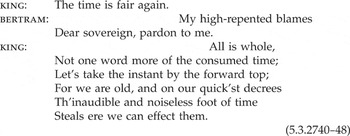
As You Like It gives to its maverick melancholic Jaques a bravura rendering of late-sixteenth-century reflections on the “seven ages of man,” finishing up:

The stagey morbidity of Jaques's reflections is undercut by the immediate entrance of the hero's aged servant, the venerable Adam, a man of unalloyed goodness and constancy. Almost eighty, he has in an earlier scene declared himself, somewhat optimistically, “strong and lusty”: “my age is as a lusty winter, / Frosty but kindly. Let me go with you, / I'll do the service of a younger man / In all your business and necessities” (2.3.756–59). However, the hungry journey into exile does prove too much for him, physically. And in any case, Jaques's depiction of decrepitude does tell a truth.
Does it tell the whole truth about the personal identity of someone thoroughly disabled by age? The question is difficult, and not directly answered, I think, by either Shakespeare or Aquinas. But just as neither believes that the dissolution of the person in death leaves no surviving remnant awaiting resurrection in heaven, purgatory, or hell, so neither believes that descent into the darkness of senility or other like disorder of mind expunges the identity shaped by free choices—by a freedom now lost. The choice to repent can cancel vice, but decay cannot cancel virtue or merit, the personal identity known to him who is “the top of judgment.” As the heroine of another of Shakespeare's three “problem plays” says:

She is pleading for her brother's life with a man at the height of his powers, in the full pride of life, and of unshaken repute for his austerely virtuous character. She assumes that in the eye of God this man's character is nonetheless not free from vice—and so is in need of forgiving mercy—but she will be astounded and for a time incredulous when such vices, and very great ones, are disclosed to her later in their encounter. It is not too hazardous to think that Shakespeare and Aquinas, with the whole tradition in which they work, take for granted that what matters in divine judgment on human persons is not how weak they are through immaturity, illness, or senility at the time of their death, but what they are in the identity they have made for themselves. For they make this identity (if they do) by their free choices, during the time, short or long, that they can freely choose. And in the view of Aquinas, whereas God can remedy all deficiencies of nature such as immaturity or senility, giving to each the psychosomatic condition of a human being of the age Christ had at his death and resurrection,63
Aquinas, ST Supp. q. 81 a. 1; ScG IV c. 88 n. 5 [4231]—”by reason of the perfection of nature which is found in that age alone.”
Aquinas, ST I-II q. 113 aa. 3 and 4. So until death ends the personal narrative, we can say no more of someone than what the king says in the play's last lines: “All yet [so far] seems well… .”
IX. Conclusion
As Germain Grisez, who took up and developed incipient elements of Aquinas's philosophical understanding of the person, rightly says:

Germain Grisez, Beyond the New Theism: A Philosophy of Religion (Notre Dame and London: University of Notre Dame Press, 1975), 349. On the four orders, see Section I above.
Ibid., 351.
Grisez's account seems intended to suggest that he does not accept Aquinas's account of the human soul as the substantial form of the human body, an account that looks as if the soul and thus too the human person as a whole is to be understood and explained as simply a reality in the first (natural) order. But in speaking of the soul as that which—we know not how—unifies all the irreducibly distinct but interpenetrated aspects of the person, including the bodily (that is, the psychophysical), Grisez retains the elements of Aquinas's account that I have emphasized, above all its insistence that when (for example) I deliver a lecture, that which is producing physical and psychophysical effects by audibly speaking, and being acted upon physically and psychophysically by hearing, is identical—qua human person, I myself—with that which is reasoning logically (or perhaps correcting or failing to correct logical invalidity), and carrying out a choice to devote precious time to this act of communication, and using internalized technical resources, especially the English language and the techniques of effective utterance.67
On the philosophical significance of the distinction between langue, language as resource (found in dictionaries and in the competence of speakers), and parole, language as use of that resource in acts of communication (of inexhaustible variety and, often, novelty), see David Braine, The Human Person: Animal and Spirit (Notre Dame and London: University of Notre Dame Press, 1992), 353–63, 461–65, etc. Braine's entire book is of great value as a thoroughgoing rethinking and restoration of an Aristotelian-Thomistic understanding of the human person and personal identity, making rich use of natural science and of recent English-language “analytical” philosophy. Not unlike Grisez, he concludes that the soul is what gives nature, identity, unity, and operation to the human body and its parts and that “we can utilize the much more general Aristotelian conception of ‘formal cause’ and apply it to the soul, but it is … entirely optional whether we apply to the soul the separate (and in the development of Aristotle's thought, later) idea of ‘form’ as the correlate of ‘matter’” (527).
In short, there is the identity I have as the particular human being I have been since I was formed in my mother's womb with all the radical capacities, and thus the nature, of a human person. There is the identity I have as a person conscious of much that I have experienced and thought since first I began to be aware of myself (my toes and my fears …) in relation to other things including people, and began to inquire and assert and deny and argue. There is the identity I have as a person with the character I have made for myself by the choices I have made within the constraints, and between the opportunities, that have arisen from the nature of things, the choices of others, and the accidental conjunctions, by all of which factors, as Shakespeare and Aquinas each depict, divine providence “shapes our ends, / rough hew them how we will” (Hamlet, 5. 2.3509–10). And there is the identity I have as an object of cultural forms (a citizen of Australia) and a user of them (English-speaking, tie-wearing) and a projecter of new and partly new personas.
The literary critic Gary Taylor has recently suggested that Shakespeare errs in trying to “flatter the would-be transcendentalism of the ego”:

Gary Taylor, “The Cultural Politics of Maybe,” in Theatre and Religion: Lancastrian Shakespeare, ed. Richard Dutton, Alison Findlay, and Richard Wilson (Manchester and New York: Manchester University Press, 2003), 242–58 at 256. The allusion is to Thomas Middleton (1570–1627), The Changeling (first performed 1624), 3.4.140.
Aquinas and Shakespeare, I have argued, would agree that we are each, in some respects, created by our actions, as well as by our experiences and skills, and scarcely by our self-regarding fantasies; and that as creatures of our actions we will be slaves to them unless we choose to reassert the mastery over them that we had when first we chose them. They would agree that “the secret subjectivity that you imagine for yourself” matters far less than “the substantive social and material identity created by what you have actually done.” But they would add that what one has actually done was the carrying out of intentions—proposals shaped, however rapidly, in deliberation and adopted by choices—and that one's deliberative shapings of intention, extended (by those choices and their execution) into one's actions, are one's real subjectivity, at once secret and made known. And they would also add that one's “social identity” may be a mask of which one might, in principle, be stripped as of a blindfold, revealing even to oneself something partly the same but partly different.
 You have
Access
- 27
- Cited by