

If the consensus required to sustain a democratic foreign policy
is represented by ‘Humpty Dumpty,’ then we need to know
how many fissures (dimensions) and broken pieces (types)
there are in order ‘to put Humpty Dumpty together again’.
(Chittick and Billingsley, Reference Chittick and Billingsley1989: 204).
Introduction
Since the early years of the Post-Cold War era, with the monumental changes occurred in both the international arena and the domestic political context, scholars have debated on the analytical dimensions explaining Italy’s strategic culture and international behaviour. Drawing on neo-realist and constructivist approaches to international relations, a first line of research has indicated a certain stability in Italian foreign policy (IFP) (Attinà, Reference Attinà1991; Bonvicini et al., Reference Bonvicini, Carati, Colombo, Matarazzo and Silvestri2011; Cladi and Webber, Reference Cladi and Webber2011), demonstrated by the persistent commitment of both ruling and opposition parties to the two major pillars (or circles) of IFP: the Atlantic Alliance and the European integration process. In this perspective, Italy’s foreign policy was conceived, within these interdependent pillars (Andreatta and Hill, Reference Andreatta and Hill1997; Carbone, Reference Carbone2007; Croci, Reference Croci2007, Reference Croci2015), as defensive and low-profile multilateralism. Most important for this study, a bipartisan consensus, overruling the increasing polarization of the political system and the confrontational tones of the political debate, would have emerged in matters of foreign policy. As suggested by Davidson, alternation between centre-left and centre-right coalitions produced continuity rather than change in the foreign policy of Italy’s Second Republic (Davidson, Reference Davidson2009). Historical, cultural, situational and, in the realist perspective, systemic factors were used to explain foreign policy preferences and the strategic choices of the Italian political elite (Missiroli, Reference Nau2007; Ignazi et al., Reference Ignazi, Giacomello and Coticchia2012; Rosa, Reference Rosenau2014).
A second line of research contested this ‘immovable’ approach to IFP. With the end of the bipolar order and the emergence of new and unconventional threats to individual and collective security, a more active role for what had, until then, been described as a ‘free-rider’ in terms of international security was required. Italy had to rethink its approach to international affairs in the midst of a profound transformation of the domestic political system. Although Italy’s external projection was still conditioned by the American and European pillars, relative closeness to each of these pillars was influenced by political ideology (Carbone, Reference Carbone2007; Walston, Reference Welch2007). While IFP was anchored to the American ally (i.e. ‘Atlanticism’) during centre-right governments, the commitment to the European project (i.e. ‘Europeanism’) and supranational institutions was stronger with centre-left governments (e.g. Brighi, Reference Brighi2007; Quaglia, Reference Reifler, Scotto and Clarke2007; Andreatta, Reference Andreatta2008).
Both lines of research based their assessments on the analysis of the Italian governments’ foreign policy outputs and strategies in the short (e.g. Croci, Reference Croci2005, Reference Croci2008a; Brighi, Reference Brighi2006; Del Sarto and Tocci, Reference Del Sarto and Tocci2008; Croci and Valigi, Reference Croci and Valigi2013) and the long term (e.g. Brighi, Reference Brighi2007; Davidson, Reference Davidson2009; Ignazi et al., Reference Ignazi, Giacomello and Coticchia2012; Croci, Reference Croci2015). None of these research efforts, however, have examined the belief system and attitudinal factors underpinning the foreign policy choices of Italian decision-makers. Not differently from what Putnam stated in the introduction of his seminal work on elite political culture in Britain and Italy, ‘most studies of the activities of political leaders […] have focused on the pull of environmental factors’. ‘Relatively fewer inquiries have been directed at understanding the other [pushing] element in the behavioural equation’ (Putnam, Reference Pye1973: 3), that is, the cognitive and attitudinal predispositions of the very same actors. Although elite preferences have been used to explain continuity or change in IFP (Davidson, Reference Davidson2011), the interests, postures, orientations, and values at the basis of the IFP consensus have been deductively assumed (Aliboni and Greco, Reference Aliboni and Greco1996) or only marginally explored in other research fields (see Bellucci, Reference Bellucci2005; De Giorgi and Verzichelli, Reference De Giorgi and Verzichelli2012). Similarly, although some scholars point out that international and domestic constraints ‘de facto’ limit the possibility and ability of decision-makers to develop a new foreign policy course (Croci, Reference Croci2015), only systemic and operational elements have received enough attention. Previous research, for instance, has qualitatively (Foradori and Rosa, Reference Foradori and Rosa2007) and quantitatively (Olmastroni, Reference Olmastroni2014a) examined Italy’s defence capabilities and foreign policy commitments to determine patterns of change or continuity in IFP over time and across executives. However, the role played by governmental and political actors, interest groups, the general and organized public has been often disconnected from previous reflections on the (constant or evolving) trajectories of IFP (Isernia, Reference Isernia1996; Battistelli et al., Reference Battistelli, Galantino, Lucianetti and Striuli2012; Olmastroni, Reference Olmastroni2014b).Footnote 1 Hence, a comprehensive approach to the strategic preferences of all actors directly or indirectly involved in the IFP-making is not only desirable but also necessary to gain insight into the ideas and motivations behind foreign policy choices.
This article aims to fill this gap by comparing the way Italian (governmental and political) elites and (organized and general) publics perceive the international system and conceive of the role of Italy in it by using an ad hoc survey conducted specifically for this study. In order to establish whether a horizontal (left-right) and vertical (top-down) consensus exists on foreign policy, special attention will be paid to divergence and convergence patterns in terms of threat perception, feelings towards the (American and European) allies, support for the main institutional mechanisms of coordination and cooperation, and willingness to use military power to defend the constituted order and the national interest. In doing this, the study will control for the position and level of action of each actor within the foreign policy-making process as well as her or his ideological orientations. While tracing elites’ and publics’ attitudes towards a wide range of foreign policy and security issues as well as their preferences on the best strategies to deal with the world’s major challenges, the study empirically tests the effect of ideological and situational factors on the strategic choices of national elites. This will help us define both the substance and boundaries of the alleged consensus, based on shared norms and historical legacies, supposedly overcoming socio-economic and political cleavages in matters of foreign policy.
Dimensions of the IFP consensus
Explaining how different actors structure their views of the international system and conceive of the role of the country in it can contribute to a better understanding of why IFP is sometimes characterized by change and, at other times, by continuity of purpose and action. As Verba pointed out ‘the system of empirical beliefs, expressive symbols, and values […] defines the situation in which political action takes place’ (Reference Walker1965: 513) constituting the national political culture. Not only, but this culture ‘consists of both an elite subculture and a mass subculture, and the relationship between the two is another critical factor determining the performance of the political system’ (Pye, Reference Pye1968: 220) in domestic as well as in foreign policy matters.
Although these considerations could in principle be extended to different issue areas, this study focusses on security and economic affairs. In order to assess whether and to what extent there is – as is often alleged – a wide consensus in the realm of foreign policy, three interconnected dimensions of IFP are investigated: perception of threats to the country’s security and economic stability; feelings towards the (American and European) allies, and support for the main institutional mechanisms of coordination and cooperation with other countries; willingness to use military power to defend the constituted order and the national interest.
The first dimension of IFP deals with the definition of the elites’ and publics’ concerns and whether there are significant differences between levels of the foreign policy-making process and across ideological clusters. The second dimension has to do with the sense of affinity with other countries – namely Europe and the United States – and Italy’s involvement in major international institutions. The third dimension explores differential attitudes on the use of military force both in principle and in specific circumstances.
The choice to focus on these three dimensions is not only determined by previous research in the field and the fact that scholars have pointed to them to identify elements of continuity and change in IFP (see Brighi, Reference Brighi2013 for a recent overview of this literature), but also by the consideration that they do seem to constitute fundamental aspects of the structure of elite and mass beliefs on foreign policy.
Perception of threats to the security of a state is often considered a crucial aspect to the existence of differing worldviews both across countries (Kagan, Reference Katzenstein and Keohane2002; Nau, Reference Nincic and Ramos2008) and between groups (Chittick et al., Reference Chittick, Billingsley and Travis1990) and thought to be linked to the propensity to use military measures (i.e. our third dimension) in response of the perceived threat (Chittick et al., Reference Chittick, Billingsley and Travis1995). At the end of the Cold War, substantial research demonstrated that both American leaders (Jervis, Reference Kagan1976; Tetlock, Reference Verba1983; Koopman et al., Reference Lerner and Gorden1989) and citizens (Hurwitz and Peffley, Reference Hurwitz and Peffley1987, Reference Hurwitz and Peffley1990) structured their foreign policy attitudes on the notions of ‘threat’ and ‘enemy’, prominently represented by the Soviet Union. The fact that the ‘enemy image’ as a crucial element in the organization of foreign policy beliefs was subject to some criticism after the fall of the Berlin Wall (e.g. Murray and Cowden, 1999) raises some important questions on whether, and in what circumstances, threat perception is a precondition for shared understanding and commitment to strategic decisions both within and across levels of the foreign policy-making system out of the American context.
As mentioned in the introductory section, feelings towards the US and European partners and support for the country’s involvement in transnational institutions have been used as benchmarks in the study of continuity and change in IFP. Much of the controversy is centred on the allegiance of national elites to the Atlantic Alliance and their support for the European integration process. The question of stability or change in IFP has been framed in terms of relative closeness of centre-right and centre-left decision-makers to each of these pillars (Carbone, Reference Carbone2007, Reference Carbone2011; Walston, Reference Welch2007). IFP was thought of as lying on a Euro-Atlantic continuum,Footnote 2 with centre-left governments generally leaning towards the European side of this continuum and centre-right political leaders skewed towards the Atlanticist side (Brighi, Reference Brighi2013). That said, individual stances on Atlanticism, Europeanism and, more in general, institutional forms of cooperation also capture the degree of consensus on the preferred approach to security and economic affairs. The issue is not only whether Italy ought to engage with the world (i.e. the so-called isolationist–internationalist divide), but also how and with whom Italy should coordinate its foreign policy projection.
Finally, questions referring to the use of force describe people’s attitudes towards ‘security goals’ (Chittick et al., Reference Chittick, Billingsley and Travis1990) and deal with the means (military or non-military) of accomplishing these goals (Maggiotto and Wittkopf, Reference Wittkopf1981; Chittick and Billingsley, Reference Chittick and Billingsley1989). In the United States as well as in other Western democracies, preferences about the use of the military abroad have been traditionally used as factors to structure individuals’ conception of international affairs during and after the Cold War (Wittkopf, Reference Wittkopf1981, Reference Wittkopf and Maggiotto1994; Holsti and Rosenau, Reference Holsti1988, Reference Holsti and Rosenau1990, Reference Holsti and Rosenau1993; Reifler et al., Reference Reifler, Scotto and Clarke2011; Gravelle et al., Reference Gravelle, Reifler and Scotto2015). Most of these studies centre on support for the use of military force to build a militarist–non-militarist dimension upon which to classify public and leadership foreign policy opinions. This dimension, in combination with interstate cooperation (i.e. our second dimension), has been long described as a ‘gold standard’ (Nincic and Ramos, Reference Nincic and Ramos2010) of typologies of foreign policy preferences (Gravelle et al., Reference Gravelle, Reifler and Scotto2015). Following Wittkopf’s works (Wittkopf, Reference Wittkopf1981, Reference Wittkopf1986; Wittkopf and Maggiotto, Reference Wittkopf and Maggiotto1983) in which the main difference between militant and cooperative internationalists was their willingness to use military force rather than working to conciliatory solutions with other countries,Footnote 3 models of foreign policy attitudes invariably consider not only whether an individual favours or not her or his country’s active role in international affairs (isolationists vs. internationalists), but also whether she or he supports the exercise of military (hard) power to defend the national interest or, on the contrary, a non-forceful and intergovernmental approach to world politics.
The analysis of these dimensions (i.e. threat perception; feelings towards the American and European allies, and support for the main institutional mechanisms of coordination and cooperation; and willingness to use military power) can, therefore, shed some comparative light on the issue of whether and how different actors of the IFP-making share a common way of structuring their attitudes towards foreign and security policy. As there is not particular reason to expect a dramatic change in the structure of foreign policy attitudes over time (Chittick et al., Reference Chittick, Billingsley and Travis1990), unless a reconceptualization of the issues used to operationalize these dimensions occurs, evidence of a significant difference in the way actors both at the same and different levels of the system structure their beliefs will contribute to verify the existence of the IFP consensus at present and in the near future. A mutual consensus on matters of foreign policy will be confirmed if differences across and within levels are not strong and deeply polarized. On the contrary, an IFP consensus will hardly exist if individuals show different preferences on the three dimensions depending on ideological and situational characteristics.
Ideology and level of action
Respondents’ positions on the three IFP dimensions are here examined controlling for ideology and their role (i.e. level of action) in the foreign policy-making process. Background characteristics, personality, and cultural traits may undoubtedly impact on foreign policy beliefs. However, the scope of this study is to ascertain the existence of ideological and situational divides and whether they affect people’s worldviews. Building upon previous research investigating the underpinnings of Americans’ foreign policy belief system, the article examines whether these divides exist in the Italian context and the extent to which both role and ideology interact in structuring foreign policy preferences. In this respect, our aim is to discern how foreign policy stances cluster across the different levels of the system and sides of the ideological spectrum.
Scholars have long debated on the importance of ideology in structuring foreign policy preferences. At the mass level, early studies assumed that people lack the necessary interest, knowledge and intellectual skills to deal with the complexity of international politics. Rather than reflecting structured and coherent ideological positions, the public’s response to foreign policy issues was either indifference or ‘formless and plastic moods which undergo frequent alteration in response to changes in events’ (Almond, Reference Almond1950: 53; see also Converse, Reference Converse1964). In marked contrast to the ‘mood theory’, others observed reasonable stability in mass public attitudes about foreign policy (Caspary, Reference Caspary1970; Shapiro and Page, Reference Shapiro and Page1988; Page and Shapiro, Reference Page and Shapiro1992; Peffley and Hurwitz, Reference Putnam1992) with ideology either ‘not closely related to foreign policy preferences’ (Peffley and Hurwitz, Reference Putnam1992: 432) or ‘characterizing conservative and liberal world views and encouraging parallel patterns of reference’ between the domestic and external realms of politics (Nincic and Ramos, Reference Nincic and Ramos2010: 120).
At the elite level, it has been thought – and Italy is not an exception in this respect – that being policy-makers motivated by the same national interest and cultural identity, their foreign policy beliefs would not be constrained by ideological cleavages as it happens in the domestic political arena. However, studies conducted on American (political, business, and military) samples not only showed that ideological cleavages on domestic and foreign policy issues ‘tend to be overlapping rather than cross-cutting’ (Holsti and Rosenau, Reference Holsti1988: 288; see also Holsti and Rosenau, Reference Holsti and Rosenau1996, Reference Holsti and Rosenau1999), but also that ‘leaders’ foreign policy beliefs are constrained across domains by their ideological orientations’ (Murray and Cowden, 1999: 476–477).
Results are therefore not univocal and the question of whether Italian elites and public opinion rely on ideological heuristics to organize their preferences on foreign policy issues is worthy of investigation. In addition to this, it is of special interest to verify whether or not ideological constraints have the same impact at different levels of the system. To this purpose, the position occupied by each actor within the foreign policy-making process (i.e. government official; politician; military official; businessman; trade unionist; religious official; non-governmental organization (NGO) representative; expert; citizen) will serve as an intervening variable to establish whether preferences are determined more by role conceptions and institutional affiliation (Holsti, Reference Holsti1970; Rosenau, Reference Shapiro and Page1987; Walker, Reference Walston1987) – an influence captured by Miles’ law ‘where you stand depends on where you sit’ (see Allison, Reference Allison1969; Allison and Halperin, Reference Allison and Halperin1972; Welch, Reference Welch1992) – than by ideological considerations.
Data and measures
The mass and elite surveys used in this study were conducted by the Laboratory for Political and Social Analysis (Laboratorio Analisi Politiche e Sociali, LAPS) of the University of Siena from 13 January to 31 March and from 20 January to 16 August 2016, respectively. With the exception of a module on role scenarios and a battery of questions aimed at gauging elites’ evaluation of key actors of IFP, a common questionnaire was developed and administered to both samples with the aim of exploring attitudes and preferences towards IFP.
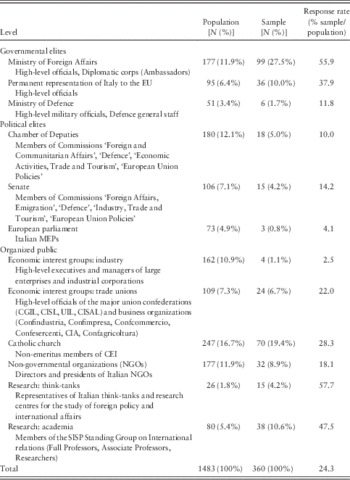
The mass data set consists of 802 telephone interviews with Italian residents contacted via landline (68.7%, n=551) and cell phones (31.3%, n=251) selected through random-digit dialling (RDD).Footnote 4 The target group for this survey was the general public (non-institutional adult population, aged 18 or older) in all urban and non-urban areas of Italy.Footnote 5 The elite data set consists of 360 online (98.6%, n=355) and telephone (1.4%, n=5) interviews with governmental, political, military, socio-economic, religious, non-governmental, and cultural actors. While governmental elites (n=141) represent top officials in the Ministries of Foreign Affairs and Defence and the Permanent representation of Italy to the EU, political elites (n=36) are national parliamentarians (i.e. Deputies and Senators) in a relevant commission (i.e. Foreign affairs; Defence; Economic activities, Trade, and Tourism; EU policies) and Italian Members of the European Parliament (MEPs). Representatives of socio-economic, religious, non-governmental and cultural organizations compose the ‘organized public’ sample and are drawn from different sources: (a) socio-economic representatives (n=28) are high-level executives and managers of some of the largest Italian enterprises and industrial corporations for revenue with extensive overseas involvementFootnote 6 as well as high-level officials of the major union confederations (CGIL, CISL, UIL, CISAL) and business organizations (Confindustria, Confimpresa, Confcommercio, Confesercenti, CIA, Confagricoltura); (b) religious representatives (n=70) are non-emeritus members of the Italian Episcopal Conference (CEI); (c) non-governmental representatives (n=32) are a nationwide sample of directors and presidents of Italian NGOs; (d) cultural representatives (n=53) are presidents and directors of Italian think-tanks and research centres with a primary interest in foreign policy and international affairsFootnote 7 and members of the Società Italiana di Scienza Politica Standing Group on International relations at the level of assistant professor or higher.
The target population, sample size, and detailed response rates for this survey are illustrated in the Appendix (Table A1). The mass sample has been weighted by gender, age group, level of education, and macro-area of residence using the Italian National Institute of Statistics official data (1 January 2015) and the 2011 population census to reflect the actual demographic composition of the Italian population aged 18 or over. The weighted sample size is n=773.
Each dimension of IFP was operationalized through multiple items designed to capture different aspects of a common but multifaceted domain. Threat perception was measured through a question asking respondents to what extent a series of political and economic phenomena, including ‘global warming’, ‘the growth of international terrorism inspired by groups such as Al Qaeda and ISIS’, ‘the growing aggressiveness of Putin’s Russia’, ‘the economic crisis with its consequences on employment and growth’, ‘the organized transnational crime’, ‘immigration from extra-EU countries’, and ‘grave and reiterated violations of human rights in foreign countries’, represented a threat to Italy. As for the second dimension, feeling towards the American and European allies was explored by examining respondents’ sense of affinity with the United States and with two countries – Germany and Greece – often sketched as stereotypical antipodes in the European economic, cultural, and political landscape. Support for the main institutional mechanisms of cooperation was investigated by focussing on general orientations towards and perceived benefit of Italy’s participation in new or long-established alliances in economic and security affairs, namely the Eurozone, the Transatlantic Trade and Investment Partnership (TTIP), and the Common European Defence and Security policy. Finally, willingness to use military power is measured through a battery of questions asking whether the respondent would favour or oppose Italy’s use of force in both hypothetical circumstances (i.e. the protection of the country’s economic interests abroad, the fight on international terrorism, the defence of the country from an external attack, the removal of an authoritarian regime, the settlement of conflicts between two or more countries, the establishment of peace, and the respect of human rights in a country affected by a civil war) and real scenarios (i.e. Libya and the territories of Syria and Iraq controlled by ISIS).
In order to establish whether convergence or divergence of views exist between levels of actions and across ideological groups, items will be analysed individually and not indexed in summary scales. While scale indices have the advantage of simplicity as they condense a substantial amount of information into a single variable, the main drawback is that they do not capture ‘inter-item’ differences and specificities. All the analytical dimensions under examination include heterogeneous indicators that provide valuable information on how leaders and public opinion perceive today’s international system and believe Italy should act in a complex, changing, and adaptive reality. By summing them up all this item-level information would be overlooked in order to produce a factorial design.
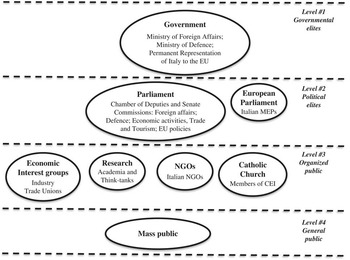
With regards to the independent variables, ideology is measured using a standard 11-point scale ranging from left (0) to right (10). Level of action has been operationalized into four categories (i.e. governmental elites, political elites, organized public, general public) depending on the subject’s position within the foreign policy-making process (see Figure 1 and section below for further details).
Levels and actors of Italian foreign policy covered in the study. MEPs=Members of the European Parliament; CEI=Italian Episcopal Conference.

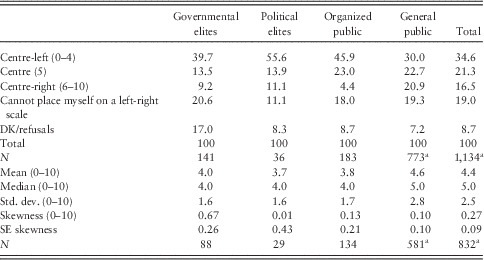
Table 1 shows how cases are distributed along these variables. Although ideological self-placement appears to be positively (but not significantly) skewed at all levels of action,Footnote 8 the limited presence of centre-right respondents could make generalization to the whole population problematic only at the political elite and organized public levels. Some caution will be therefore necessary before making inferential statements about these sub-groups.
Distribution of the sample by ideology and level of action (%)

a Sample weighted with post-stratification weights (i.e. gender, age group, level of education, and macro-area of residence).
Findings
Threat perception
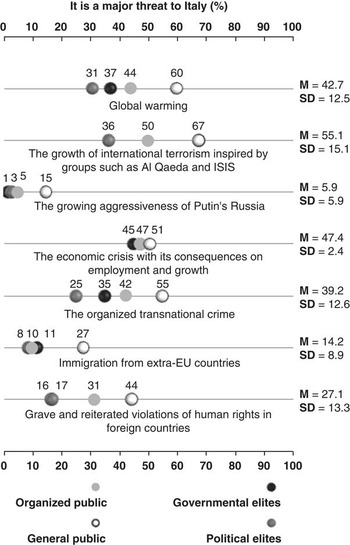
A preliminary analysis of the perception of threat highlights that actors at different levels of the IFP-making system do not necessarily look at the world with the same lenses (Figure 2). Overall, the general public tends to be more concerned than governmental and political elites about some of the most pressing challenges facing the world today. The widest gaps between leaders and citizens are observed for the growth of international terrorism (Δgeneral public−political elites=31%), global warming (Δgeneral public−political elites=29% and Δgeneral public−governmental elites=23%), the organized transnational crime (Δgeneral public−political elites=30% and Δgeneral public−governmental elites=20%), and grave and reiterated violations of human rights in foreign countries (Δgeneral public−governmental elites=28% and Δgeneral public−political elites=27%). While the organized public consistently lies in between Italian leaders and citizens, governmental and political elites diverge from each other only in two items: the growth of international terrorism (Δgovernmental elites−political elites=31%) and the organized transnational crime (Δgovernmental elites−political elites=10%). The political and economic phenomena that elicit greater concern among the different groups are terrorism (intergroup mean=55%), global warming (intergroup mean=43%), the economic crisis (intergroup mean=47%), and the transnational crime (intergroup mean=39%). On the contrary, the growing aggressiveness of Russia (intergroup mean=6%) and immigration (intergroup mean=14%) are not perceived as relevant threats to Italy. Even though citizens show higher levels of concern (i.e. +12 and +18%) than the other actors together about both issues, inter-group dispersion is smaller than that of the other phenomena and only slightly higher (+3.5 and +6.5%, respectively) than that associated with the item on which all actors largely agree (intergroup std. dev.=2.4%), that is, the economic crisis.
Perception of threat by level of action. LAPS, Survey PRIN-PEI 2016. N=1134. Q: For each of the following political and economic phenomena, please indicate how much it represents a threat to Italy (% A major threat). Values on the right are inter-group means and standard deviations.

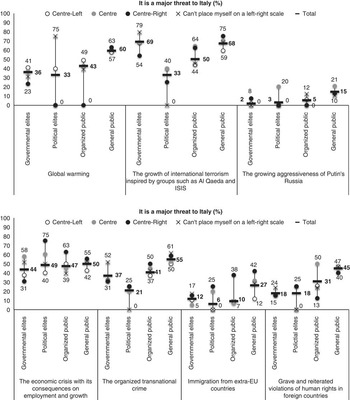
The introduction of ideology in the relationship paints a more complex and nuanced picture about what threatens Italians. A clear left-right divide emerges for immigration, with respondents on the centre-right of the political spectrum more concerned than those on the centre-left at all levels of action. Similarly, and with the exception of governmental elites, the growth of international terrorism, transnational crime, and the economic crisis appear to be pressing concerns more for centre-right than centre-left individuals. On the contrary, excluding the mass public sample, global warming is more a problem for centre-left than centre-right respondents and a similar result is observed for violations of human rights in other countries. In this case, however, those who show an opposite trend are not the citizens but the politicians.
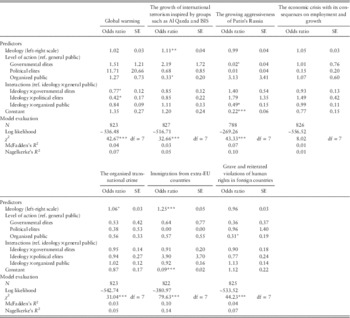
In order to test to what extent these results are significant and verify both the relative and interactive impact of ideology and level of action on the perception of threat, a binary logistic regression model was estimated for each item presented in Figures 2 and 3. Coefficients are shown in Table 2, along with the goodness-of-fit tests. Ideological orientations exert a statistically significant effect on the assessment of threat from terrorism, immigration, and the organized transnational crime. In all these cases the odds of perceiving a threat to the country are higher for individuals leaning towards the right of the ideological scale. The net effect of ideology is not confirmed for other global challenges. Level of action is a significant predictor in the case of terrorism and human rights, with the organized public less sensitive than the general public (i.e. the referent group) to these issues. Governmental elites are slightly less likely to perceive Russia as a threat than the general public. Finally, the interaction between ideology and level of action shows that the marginal effect of ideology on the perception of threat is depressed in the cases of global warming and Russia’s perceived aggressiveness when respondents belong to the governmental/political elites or the organized public, respectively.
Perception of threat by ideology and level of action. LAPS, Survey PRIN-PEI 2016. N=1045. Don’t knows and refusals on ideology are excluded from computation.

Relative and interactive effects of ideology and level of action on the perception of threat

Dependent variable: For each of the following political and economic phenomena, please indicate how much it represents a threat to Italy? (Reference category: not a major threat).
+ , *, **, *** statistically significant at 0.10, 0.05, 0.01, 0.001 level, respectively.
Feelings towards the American and European allies
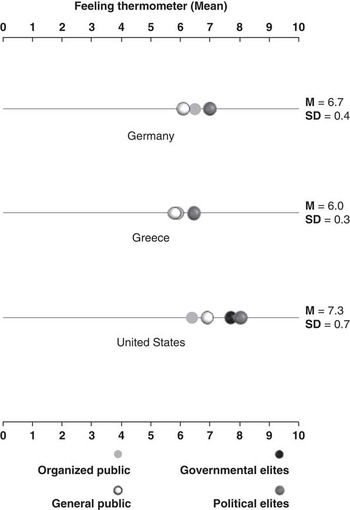
Affective attitudes towards the ally have been used as a proxy of the sense of community (e.g. Chamorel, Reference Chamorel2004; Katzenstein and Keohane, Reference Koopman, Snyder and Jervis2007; Holsti, Reference Holsti and Rosenau2008) and the operationalization of these attitudes is often based on a question that asks an individual to express his or her feeling towards the ally on an interval scale. Respondents to the LAPS survey were asked to rate some countries on a 11-point scale ranging from a ‘very negative and unfavourable’ (0) to a ‘very positive and favourable’ (10) feeling. Figure 4 displays the mean values by level of action for Germany, Greece, and the United States. A first takeaway from the figure is that actors at all levels have a similar feeling towards each of the European allies and that Germany has an intergroup average score (M=6.7) slightly higher than Greece (M=6.0), with the widest gap at the governmental level (M Germany=7.0; M Greece=5.9). Inter-level cohesion is less robust and the intergroup average feeling is warmer when respondents rate the American ally. In this case, the mean values range from 6.4 (organized public) to 8.0 (political elites) – a result that would confirm an improved image of the United States and strengthened levels of Atlanticism during the Obama administration (Everts et al., Reference Everts and Isernia2014: 11).
Feelings towards the American and European allies by level of action. LAPS, Survey PRIN-PEI 2016. N (Germany)=1120; N (Greece)=1112; N (United States)=1122. Q: Now we would like to know your feelings towards some countries on a 0–10 scale with 0 meaning a very negative and unfavourable feeling, 10 meaning a very positive and favourable feeling, and 5 meaning not particularly unfavourable or favourable. You can use any number from 0 to 10 to express your feelings (Mean). Values on the right are inter-group means and standard deviations.

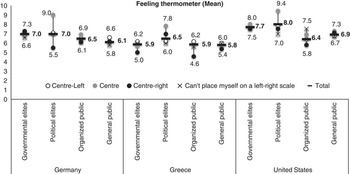
These results are confirmed when ideology is added to the mix (Figure 5). However, we also find out that politicians and those of the organized public who self-place at the centre of the left-right continuum have, on average, a warmer feeling towards the United States and Angela Merkel’s Germany, whereas centre-left governmental elites, organized and general publics do express a more positive view of Alexis Tsipras’ Greece than other respondents at the same level of action.
Feelings towards the American and European allies by ideology and level of action. LAPS, Survey PRIN-PEI 2016. N (Germany)=1035; N (Greece)=1028; N (United States)=1037. Don’t knows and refusals on ideology are excluded from computation.

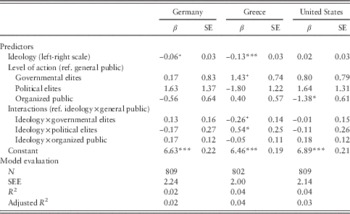
A linear regression model using the feeling towards each country as an outcome variable documents the highly statistical significance of ideology in the case of Greece – with an average decrease of 0.13 points in the feeling thermometer for each unit move towards the right-side of the ideological scale – and more tempered attitudes towards the United States at the organized than at the general public level. As also shown in Figure 5, the negative impact of ideology on the dependent variable is significantly reduced when centre and centre-right politicians rate their feelings towards Greece, whereas it further increases for government officials with a centre and centre-right ideological orientation (Table 3).
Relative and interactive effects of ideology and level of action on feelings towards the allies

Dependent variable: Feeling on a 0–10 point scale (0=very negative and unfavourable feeling; 10=very positive and favourable feeling).
+ , *, **, *** statistically significant at 0.10, 0.05, 0.01, 0.001 level, respectively.
Support for the main institutional mechanisms of coordination and cooperation
Europeanism and Atlanticism have been traditionally defined as the support for the European integration process and the Atlantic Alliance, respectively (Croci, Reference Croci2008b). These two concepts imply general disposition to cooperate with the European and American allies through multilateral institutions in security affairs and in other policy areas, such as the economy, as well (Everts and Isernia, Reference Everts, Isernia and Olmastroni2015; see also Everts et al., Reference Everts and Isernia2014; Olmastroni, Reference Page and Shapiro2016). Three questions have been used to discern general orientations towards the European Union and the transatlantic relations. The first two questions asked respondents about their preferred solution in the context of a common European defence and security policy and their evaluation of the country’s membership of the Eurozone. The third question is about the perceived effects of the TTIP on the national economy. Unfortunately, no item in the questionnaire refers to NATO or other forms of military cooperation between Italy (or Europe) and the United States.
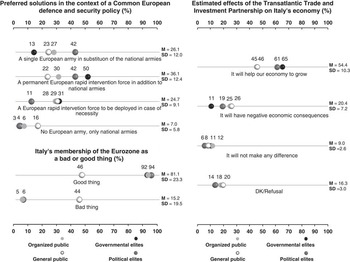
Differences across groups appear to be greatest for both the security and economic aspects of the European integration (Figure 6). The idea of a single European army in substitution of the national armies is approved by a relative majority of the political elite sample (42%), but the general and organized publics only marginally endorse it (27 and 23%, respectively). Remarkably, governmental elites prefer either a permanent (50%) or – in contrast to politicians (11%) – ad hoc intervention force (31%) to be deployed when needed. While the general and organized publics approve the establishment of some form of military cooperation at the EU level, they do not seem to favour one solution over the others. That said, the complete abandonment of any military synergy among European countries is not a credible solution at all levels and only approved by small portions of the samples. As for the economy, a large and perilous divide opens up between elites and the organized public, on the one side, and the general public, on the other side. Italy’s membership of the Eurozone is regarded as a good thing by the overwhelming majority of government officials (92%), politicians (94%), and representatives of the organized groups (92%), but perceived as such only by a tiny majority of the mass public (46%). Euro-scepticism is the product of a combination of many different factors and it is not the purpose of this work to investigate their relative influence. However, what emerges from this analysis is a real schism between what elites and organized groups think of the Eurozone and what ordinary people feel about the consequences of the single currency. A similar consideration is also valid for the TTIP. Although the inter-group gap is lower than previously observed and majorities at all levels believe that it will stimulate Italy’s economy growth, citizens, and the organized public are more critical than political and governmental elites about its possible effects on the national economy. Moreover, between one-fourth and about one-third of the samples either agrees that TTIP will not produce any effect or do not have an opinion on the issue.
Support for the institutional mechanisms of cooperation by level of action. LAPS, Survey PRIN-PEI 2016. N=1134. Q: Which of the following solutions is preferable in the context of a Common European defence and security policy? (%). Q: Generally speaking, do you think that our membership of the Eurozone is a good or bad thing for the Italian economy? (%) Q: Which of the following statements about the Transatlantic Trade and Investment Partnership is closer to your own opinion? (%). Values on the right are inter-group means and standard deviations.

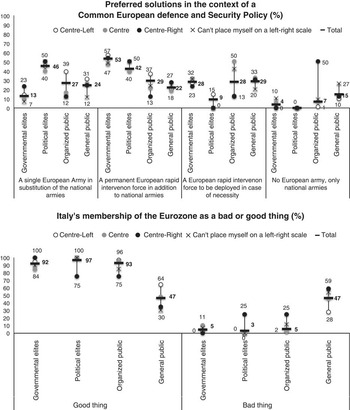
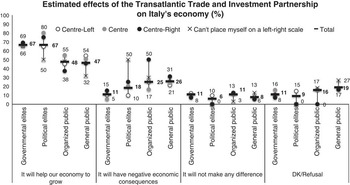
Mixed ideological cleavages do emerge in regard to ‘security Europeanism’ (Figure 7). The establishment of a single European army is somewhat preferred by centre-right elites and centre-left publics. Centre-left elites are in favour of a rapid intervention force and only at the centre-right pole of the organized public there is a desire for the abandonment of a military cooperation. Much more clear is the interpretation of the economic dimension of Europeanism. With the only exception of the governmental level, being on the centre-right side of the ideological spectrum negatively affects the belief that Italy’s membership of the Eurozone is a good thing while favouring the opposite view. Finally, centre-right positioning seems to increase the likelihood of a negative evaluation of the estimated effects of the TTIP (Figure 8).
Support for the institutional mechanisms of cooperation at the European level by ideology and level of action. LAPS, Survey PRIN-PEI 2016. N=1045. Don’t knows and refusals on ideology are excluded from computation.

Support for the institutional mechanisms of cooperation with the United States by ideology and level of action. LAPS, Survey PRIN-PEI 2016. N=1045. Don’t knows and refusals on ideology are excluded from computation.

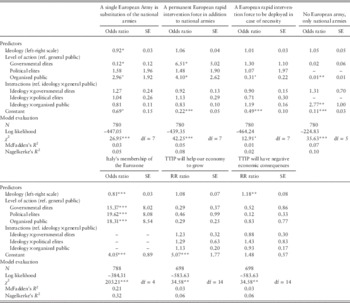
Three logistic regression models have been used to evaluate the statistical significance of these results (Table 4).Footnote 9 Ideology emerges as a significant predictor of economic Europeanism and Atlanticism. In both cases a shift to the right of the ideological scale depresses an individual’s evaluation of the perceived benefits produced by the Eurozone membership and the TTIP. While ideology is significantly related to the establishment of a single European army in substitution of the national ones, level of action shows a positive relationship with approval of a strengthened military cooperation at the level of the organized public and governmental elites. It has to be noticed that a shift to the right of the ideological spectrum has a positive and significant impact on the organized public’s support for a national approach to security. In agreement with our descriptive results, elites and the organized public are remarkably more Euro-enthusiastic than the general public.Footnote 10
Relative and interactive effects of ideology and level of action on support for the institutional mechanisms of cooperation

Dependent variables:
Model 1: Which of the following solutions is preferable in the context of a Common European defence and security policy?
Model 2: Generally speaking, do you think that our membership of the Eurozone is a good or bad thing for the Italian economy? (Reference category: Bad thing).
Model 3: Which of the following statements about the Transatlantic Trade and Investment Partnership (TTIP) is closer to your own opinion? (Reference category: it will not make any difference).
+ , *, **, *** statistically significant at 0.10, 0.05, 0.01, 0.001 level, respectively.
Use of force
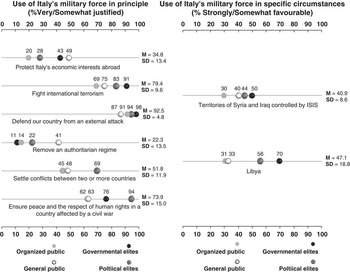
In both hypothetical and real circumstances, political and governmental elites are more likely to approve the use of military force abroad than the organized and general publics (Figure 9). The only situations in which the general public – but not the organized public – is more eager to resort to the military instrument is either to protect Italy’s economic interests abroad (49%) or to remove an authoritarian regime in a third country (41%). In line with the principal policy objective theory advanced by Jentleson (Jentleson, Reference Jentleson1992; Jentleson and Britton, Reference Jentleson and Britton1998), inter-group differences are small (Δgovernmental elites−general public=11%) and support for the use of force is widespread when the military is used to defend the country from an external aggression, that is, ‘to coerce foreign policy restraint [FPR] by an adversary engaged in aggressive actions’ against the country (Jentleson, Reference Jentleson1992: 50). By contrast, Italians are, on average, less likely to support the use of force when it is employed to engineer internal political change (IPC) within another country. The other circumstances in which the exercise of military power is perceived as legitimate are the fight on international terrorism and a humanitarian intervention aimed at ensuring peace and the respect of human rights. In these occasions, as mentioned above, the gap between the elite and the public level is wider (Δ Fight on Terrorism governmental elites−organized public=22% and Δ Humanitarian Intervention political elites−organized public=32%) than in foreign policy restraint and IPC policy objectives. As we move from hypothetical to real circumstances (i.e. Libya and the territories of Syria and Iraq controlled by ISIS), the publics’ willingness to use military force markedly decreases, especially in the case of a military action against Libya (Δgovernmental elites−organized public=39%).
Use of military force (in principle and in specific circumstances) by level of action. LAPS, Survey PRIN-PEI 2016. N=1134. Q: For each of the following circumstances, please indicate whether Italy’s use of military force is very justified, somewhat justified, not very justified, or not justified at all? (% very/somewhat justified). Q: Would you favour or oppose Italy’s participation in a multilateral military intervention in …? (% strongly/somewhat favourable). Values on the right are inter-group means and standard deviations.

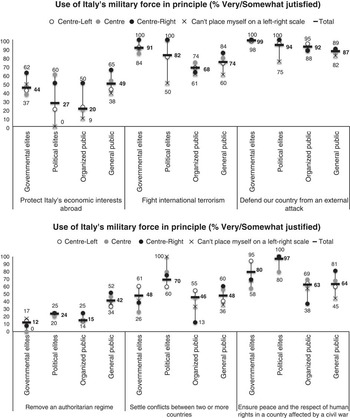
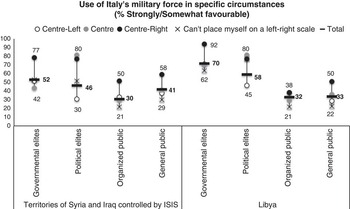
Ideological positioning appears to be closely related to the use of force (Figures 10 and 11). Excluding the case in which the country has to react to an external attack, left-right divides exist in all other situations. Individuals on the centre-right are remarkably more likely to approve a military intervention both in principle and in practice. The only exceptions in which centre-left respondents show higher levels of approval of the use of force than those on the centre-right are peace enforcement and peacekeeping operations. In particular, governmental elites and the organized public on the centre-left side of the ideological continuum are more willing to approve the deployment of Italian armed forces to settle a conflict between two or more countries or to ensure peace and the respect of human rights than their centre-right counterparts.
Use of military force (in principle) by ideology and level of action. LAPS, Survey PRIN-PEI 2016. N=1045. Don’t knows and refusals on ideology are excluded from computation.

Use of military force (in specific circumstances) by ideology and level of action. LAPS, Survey PRIN-PEI 2016. N=1045. Don’t knows and refusals on ideology are excluded from computation.

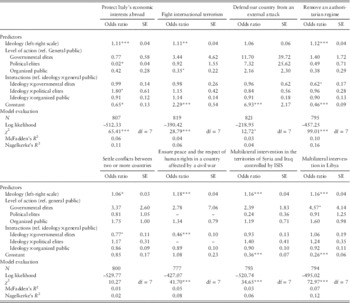
Regression analyses confirm the significant effect of ideology on approval of the use of military force (Table 5). Log-odds coefficients are always >1, meaning that support for the military instrument increases as ideology moves to the right. Only within the context of an external aggression, ideology is not a statistically significant predictor. Level of action matters when the military force is envisaged to protect the country’s economic interests abroad – politicians are less likely than the public (i.e. the reference group) to approve such an use of the armed forces – fight terrorism – with the organized public less willing than the public to support the use of the military – or solve the Libyan dilemma – with government officials willing to support the military solution. Last but not least, the effect of ideology on approval of the use of force is significantly affected by level of action in the case of protection of Italy’s economic interests (positive impact for Italian parliamentarians), regime change, peacekeeping, and peace enforcement operations (negative impact for governmental elites).Footnote 11
Relative and interactive effects of ideology and level of action on support for the use of force

Dependent variable: Would you favour or oppose Italy’s participation in a multilateral military intervention in …? (Reference category: somewhat/strongly oppose).
+ , *, **, *** statistically significant at 0.10, 0.05, 0.01, 0.001 level, respectively.
Conclusion
Ideological cleavages do persist in the Italian society after almost 30 years since the fall of the Berlin wall and the end of the Cold War. Sometimes scholars have minimized the effect of such divisions on IFP, arguing that the stable commitment of both ruling and opposition elites to the Atlantic Alliance and the European integration process along with the country’s consolidated role of middle power prevented any drastic change in its foreign policy (Davidson, Reference Davidson2009; Bonvicini et al., Reference Bonvicini, Carati, Colombo, Matarazzo and Silvestri2011; Cladi and Webber, Reference Cladi and Webber2011). At other times, scholars have contended that relative closeness to Atlanticism or Europeanism (Carbone, Reference Carbone2007; Walston, Reference Welch2007) as well as willingness to use military force or act within supranational and transnational institutional settings were influenced by governments’ ideological orientation (Brighi, Reference Brighi2007; Quaglia, Reference Reifler, Scotto and Clarke2007; Andreatta, Reference Andreatta2008). Both lines of research have based their assessments on the analysis of Italy’s foreign policy outputs, while substantially disregarding the attitudinal predispositions underpinning the foreign policy choices of Italian decision-makers and their possible disconnections with other actors (and levels of action) of the foreign policy-making system.
This study has entered the debate by investigating whether the often-alleged consensus on matters of foreign policy exists across the different levels of the system and sides of the ideological spectrum. Four different groups have been examined on three dimensions of IFP: threat perception; feelings towards the (American and European) allies and support for the main institutional mechanisms of coordination and cooperation; willingness to use the military power to defend the constituted order and the national interest.
All together the evidence presented here demonstrates that the range of views of world politics and the role of Italy in it are neither monolithic nor unidirectional. Levels of threat perception are generally lower at the (governmental and political) elite than at the (general and organized) public level with two of the most pressing issues (i.e. immigration and international terrorism) running along the ideological scale. Senses of affinity with the European and American allies as well support for supranational mechanisms of cooperation in economic affairs are significantly correlated with ideology, whereas the establishment of an integrated European military force is appreciated by those acting at the organized public level. Finally, ideology is identified as a major predictor of a key component of foreign policy beliefs, that is, support for the use of military force both in hypothetical and real circumstances. In some occasions, level of action may play either an autonomous (protection of the country’s economic interests abroad, fight on terrorism, military action against Libya) or mediating (regime change, peace enforcement, peacekeeping) role on an individual’s approval of the military solution.
Undoubtedly, other factors besides ideology and level of action contribute to organization of what others have defined a hierarchical model of foreign policy belief systems (Hurwitz and Peffley, Reference Hurwitz and Peffley1987; Peffley and Hurwitz, Reference Putnam1992). This study does not pretend to offer an alternative and all-encompassing explanation of the cognitive structures of attitudes towards foreign policy. More simply, it compares how Italian elites and publics look at the world and whether their foreign policy stances are somehow influenced by their ideological and situational positions. Although further research is necessary to fully uncover the horizontal and vertical axes of the alleged IFP consensus, it can be confidently stated that IFP is also a matter of role and ideology.
Financial Support
This research received financial support from the project ‘The Italian Foreign Policy in front of the new challenges of the international system: actors, institutions and policies’ (PRIN 2010-2011, grant n. 201032T8ZE) funded by the Italian Ministry of Education, University and Research (MIUR).
No conflicts of interest.
Data
The replication data set is available at http://thedata.harvard.edu/dvn/dv/ipsr-risp.