1 Introduction
The topic of this article is the construction consisting of a form of BE and a present participle. Its aim is to examine the changing functions of this construction in its early stages, roughly between 1150 and 1640, with a particular focus on its interaction with various text-structuring constructions. In Present-day English, the most common function of this construction is to refer to the ‘in-progress’ nature of a situation at a different, topical, point (or period) in time. This topic time is the time ‘for which the particular utterance makes an assertion’ (Klein Reference Klein1994: 37), and as such it differs from situation time, the entire time the situation takes from start to end. The ‘progressive’ situation itself is typically an activity (1), but may just as well be an accomplishment or – occasionally – achievement (2). In line with Killie (Reference Killie, Maurizio, Dossena and Dury2008) I refer to this function, where the topic time defines the phase of the event (expressed in [BE Ving]) that is focused on, as the focalized use or function of [BE Ving].
-
(1) Activity · Andrew was playing tennis when Jane called him.
-
(2) Accomplishment · As I was getting into the bath the fire alarm went off.
Besides this typical use of [BE Ving], other uses have been attested too. Among them are some that are seemingly far removed from the focalized use, such as for instance that of emphasizing a particular state, as in (3).
-
(3) State · Two Ganesh statues are standing in a line (= stand in a line)
The focus of this article is on the development of the focalized use out of the stative (adjectival) use. Because of this, I will not refer to the pattern BE + present participle as the progressive construction. The term progressive is normally restricted to those instances that show an event-oriented verbal function. This restriction imposes an artificial divide between verbal and adjectival uses of the participle, which prevents acquiring a clear picture of the emergence of this verbal function (see, e.g., Núñez-Pertejo Reference Núñez-Pertejo2003). For this reason, I will use the term ‘[BE Ving] construction’ instead, which covers all instances of all functions of this pattern, non-verbal and verbal alike.Footnote 2
There are two theoretical points this article wishes to make. The first is that pragmatics may turn into semantics as a result of shifting relative frequencies. As [BE Ving] has acquired quasi-obligatory status as a progressive aspect marker in Present-day English, its development is also an instance of grammaticalization. In this context the transfer from pragmatic to semantic content (a form of semanticization) has been called pragmatic strengthening (Traugott Reference Traugott1988). By examining this process in [BE Ving], this article also aims to enhance our understanding of what makes grammaticalization of a particular function succeed at its early and intermediate stages. Keller (Reference Keller1994) and Haspelmath (Reference Haspelmath1999), among other scholars, have argued that incipient grammaticalization is a side effect of the maxim of extravagance (often referred to as expressivity), that is, speakers’ use of unusually explicit formulations in order to attract attention. One way of achieving social success is by talking ‘in such a way that you are noticed’. This may explain why some speakers introduce innovations such as by means of (a hammer) for with (a hammer). After one or more socially influential people have independently used the same innovative expression, this innovation may be picked up by other speakers, and eventually spread through the language community (1999: 1057–8). In a similar vein, Bybee (Reference Bybee, Bybee and Noonan2001), summarizing earlier work, concludes that early grammaticalization typically occurs in main clauses, which convey the new, important part of the message. Because language users want this part to stand out the most, they experiment more in main clauses with prosody or word order (e.g. owing to focalization or topicalization strategies). While extravagance is certainly an important factor in language change, and may have played a role in the case of [BE Ving] as well, I will argue that an appeal to extravagance is insufficient to explain the development [BE Ving] goes through in Middle English – which happens to begin in subordinate clauses.Footnote 3 Instead, I will argue that the changes in Middle English, which lead to the semanticization of the ‘progressive’ function of [BE Ving], are essentially a side-effect of changes elsewhere in the English grammatical system. These other changes turned a textual context (a co-text) of use of [BE Ving] from being uncommon to becoming predominant, which led to the construction acquiring the semantics of ongoingness.
Second, the particulars of this case study provide evidence for the systematic nature of the interaction between a construction and its broader textual environment (and see Petré Reference Petré2014 for some other case studies). In particular, the analysis of [BE Ving] also contributes to our understanding of how seemingly independent changes in a specific language's grammar may interact. In the case of English, their collective behaviour may even have led to a partial typological shift. This shift has recently been named by Los (Reference Los, Meurman-Solin, López-Couso and Los2012) the shift from bounded to unbounded construal. So, not only do yesterday's pragmatics and text structure determine today's semantics, they also determine today's grammar.
The article is divided into seven sections. After this introductory section, a brief sketch of the scope of previous studies reveals that the transition between Middle and Early Modern English remains largely uncharted territory. Specifically, while it has been acknowledged that the merger of gerundial -ing and participial -ende endings starts in Middle English (e.g. Dal Reference Dal1952: 5–15), the lack of a clear increase in this merged [BE Ving] in Middle English has led to a relative neglect of its functional development during this period (section 2). In section 3, the hypothesis is developed that underlying this constant frequency there was a shift in the relative frequency of the co-texts of use of [BE Ving], which led to a semantic shift in [BE Ving] itself. Section 4 outlines the theoretical concepts and classification necessary to test this hypothesis, and section 5 gives an overview of the data that were used to test it. The actual analysis is presented in section 6. It is shown that the focalized use increases already in Middle English, at the cost of the stative use. This is explained as a by-effect of a general increase in subordinate backgrounding (especially adverbial) clauses. Section 7 concludes that shifting relative frequencies may play an important part in triggering a process of semanticization (and grammaticalization) and draws attention to the importance of taking into account the interaction between dynamic, changing co-text and changes in the construction in understanding small as well as bigger changes in a language-specific grammatical system.
2 Previous studies
The [BE Ving] construction has been intensively studied, both diachronically and synchronically. It is impossible to even briefly outline all the various views that have been proposed. Good overviews that focus on the diachronic picture may be found in Denison (Reference Denison1993), Núñez-Pertejo (Reference Núñez-Pertejo2004), Killie (Reference Killie, Maurizio, Dossena and Dury2008) and especially Kranich (Reference Kranich2010). The number of extensive studies dealing in detail with the Middle English period, however, is not very big. Instead of trying to give a representative overview, I will introduce insights from previous literature whenever appropriate. The most important observation to be made currently about the previous literature is that almost all detailed quantitative analyses only start from Early Modern English onwards. This decision is based on the common observation that [BE Ving] only started to increase significantly in Early Modern English (see Kranich Reference Kranich2010: 95 for an overview of quantitative studies).
An important exception is Killie (Reference Killie, Maurizio, Dossena and Dury2008). Her study was the first to observe a significant increase in the focalized function between the Middle and Early Modern English period.Footnote 4 Her classification of the various uses of [BE Ving] will be largely adopted here (see section 4.3). Killie rightly concludes that Bertinetto, Ebert & de Groot's (Reference Bertinetto, Ebert, de Groot and Dahl2000) hypothesis does not hold, which claims that the English progressive, similar to many progressives cross-linguistically, evolved out of a locative construction through what is called PROG drift. This drift comprises a shift from stative/durative to durative to focalized (progressive) meaning. However, no indications can be found that [BE Vende] has ever been locative. Killie also observes a surprising decrease in the focalized function from Old to Middle English. Yet caution may be called for, as one of the three examples provided of Old English focalized use, here repeated as (4), is clearly out of place (Killie Reference Killie, Maurizio, Dossena and Dury2008: 78–9).
-
(4) Saga me for hwam stanas ne synt berende?
-
Killie: ‘Tell me, why are you not carrying stones?’
-
My translation: ‘Tell me: why are stones not fruitful?’ (Sol I 36.1)
This sentence is part of a riddle dialogue between Solomon and Saturn, and is a generic question about a property of stones, and not about an ongoing situation at all. I would welcome future studies that could confirm the presence of more focalized uses in Old English.
Generally, a construction may be seen as having acquired fully grammatical status when it has become part of a paradigm whose forms largely have complementary functions, each form being obligatory with its respective function. As is commonly known, [BE Ving] only starts to show signs of becoming an obligatory grammatical marker of progressive aspect in the nineteenth century (see Smitterberg Reference Smitterberg2005: 243–50). Even today there is some variation with the simple tenses in a number of genres and contexts (Kranich Reference Kranich2010: 237). Determining when [BE Ving] started on the route to grammatical status is even harder. Generally, quantitative studies begin in the sixteenth century, when [BE Ving] started to show a marked increase. Yet while it is defensible to start looking at the preparatory developments from 1500 onwards for pragmatic reasons, taking the lumped frequency of [BE Ving] as a benchmark is problematic from a theoretical point of view. The tacit reasoning guiding such a decision seems to be that, since there is no significant change in frequency prior to 1500, there has been no significant development in the functionality of [BE Ving] before that time either. Put differently, even if [BE Ving] in some uses might have reached the status of a verbal periphrasis – itself a moot point – the process of the grammaticalization of [BE Ving] only takes off after 1500. In this article I will show that such a view is untenable. To do so, I will elaborate on Killie's (Reference Killie, Maurizio, Dossena and Dury2008) analysis and combine her findings with new insights into the interplay between syntax and function, showing that the increase in focalized uses originates in (subordinate) adverbial clauses and that the general increase in [BE Ving] from Early Modern English onwards marks the generalization of the focalized function to other contexts.
In addition to previous research specifically on [BE Ving], another strand of research central to this article is that of the relationship between frequency and grammaticalization. Many studies have focused on various aspects of this relation. Early on, Bybee (Bybee & Scheibman Reference Bybee and Scheibman1999; Bybee Reference Bybee2006) drew attention to various roles of frequency, among them also the relation between frequency and routinization, with possible phonetic reduction as a consequence. As Traugott & Trousdale (Reference Traugott and Trousdale2013: 35) point out, frequency here is more of a consequence than a cause of first grammaticalization, even if it may serve as input for later stages of grammaticalization. Other studies have shown how changing collustructional frequencies may be both output of and input to grammaticalization (e.g. Hilpert Reference Hilpert2008), have drawn attention to the role of frequency thresholds as points of no return (Petré Reference Petré2012), or have shown how different uses of grammaticalizing constructions may increase at different rates (e.g. De Smet Reference De Smet2012: 609). Closer to my own approach, Peng (Reference Peng2012) has drawn attention to the importance of the frequency of a grammaticalizing item in co-texts with similar pragmatic inferring conditions, where co-frequency of other types of co-texts may not lead to the grammaticalization of an otherwise similar construction. In a similar vein, Traugott (Reference Traugott, Cloutier, Hamilton-Brehm and Kretzschmar2010) has explored the importance of dialogic contexts in grammaticalization. The approach taken here wishes to address an aspect that has been largely left undiscussed by these studies, namely: how do concurrent frequency changes in the co-text interact with frequency changes in the grammaticalizing construction?
3 Hypothesis
Most diachronic studies observe or have claimed that the frequency of [BE Ving] is more or less stable throughout the Old and Middle English periods. This observation has been used to justify taking Early Modern English as the starting point for quantitative analysis (e.g. Elsness Reference Elsness1994: 10). However, what if underlying this constant frequency there is a significant shift in the preferred function of [BE Ving]? The hypothesis that underlying a constant frequency significant changes in relative frequencies are going on during the Middle English period leads to some pertinent questions. Why did the relative frequencies change? Put differently, why does the increase in one function – specifically the focalized function – seemingly proceed at the cost of a decrease in the other functions? This seems odd, given the huge potential for expansion that was realized after Middle English. It would seem more logical that the focalized function simply started to expand, without the other functions having to decrease. What does a shift in relative frequencies imply for the role of frequency in grammaticalization in general? In the remainder of this article, these questions, and more, will be addressed on the basis of an extensive quantitative analysis. In particular, the frequency facts will be interpreted as evidence that it is not [BE Ving] itself which is changing initially, but rather the textual environment in which [BE Ving] appeared. Specifically, there is evidence for a syntactic shift in the encoding of background and foreground that bears directly on the history of [BE Ving].
4 Theoretical background
This section briefly introduces the concept of grounding (section 4.1), paying special attention to its relation to the various functions of [BE Ving] (section 4.3). In between, section 4.2 briefly comments on the categorical status of the [BE Ving] construction, which from early on mixed adjectival and verbal properties.
4.1 Grounding
The distinction between background and foreground is well known in narrative theory and linguistics. In its basic form, foregrounded material reports events belonging to the actual story line. Backgrounded material, by contrast, is supportive in nature. It may provide a setting or a frame for the foreground, or may comment on it. At a finer-grained level, their distinction translates into a universal set of distinctive characteristics. In a seminal paper, Hopper (Reference Hopper and Givón1979) linked these characteristics to a number of linguistic strategies to realize these distinctions, and suggests that cross-linguistically only a limited number of configurations are found. Later studies have refined this view and suggested that foreground and background are poles on a cline (e.g. Fleischman Reference Fleischman1985, the literature cited in Brinton Reference Brinton1996), but the linguistic characterization of these poles as set out by Hopper still holds.
Relevant characteristics include the following:
-
• Sequentiality. In terms of sequentiality, foregrounded clauses succeed one another in the narrative in the same order as in the real world. By contrast, backgrounded clauses are concurrent, or overlapping, with foregrounded events, on which they comment. They need not be sequenced with respect to each other.
-
• Topic time. Foregrounded events take place at topic time. Backgrounded events do not have a one-on-one relationship with the topic time.
-
• Aspect. In terms of aspect, foregrounded clauses are typically perfective, and often contain punctual verbs, representing the dynamic action of the storyline. Backgrounded clauses are often imperfective, and contain mostly durative, iterative or stative verbs (states, descriptions, recurrent events).
-
• Transitivity. As is elaborated in more detail in Hopper & Thompson (Reference Hopper and Thompson1980), foregrounded events are typically high in transitivity, involving for instance highly individuated agents and/or highly affected patients. By contrast, backgrounded events tend to be low in transitivity. States, for instance, are typical instances of intransitive predicates.
-
• Syntax. Foregrounded events are typically expressed in main clauses, and backgrounded events in subordinate clauses.
4.2 Note on the early history of [BE Ving]
Old English forms that are generally assumed to have contributed to the emergence of [BE Ving] were combinations of the copula, a verbal root V with the suffix -ind(e)/-end(e), which I refer to as [BE Vende] (see, e.g., Denison Reference Denison1993: 387). These were either originally adjectival participles or agentive nominalizations. The adjectival status is shown for instance in the ability to take comparative forms, as in (5) (example first provided by Reference VisserVisser 1963–73: §1815). The modifier ealra þinga ‘of all things’ in the genitive in (6) supports the interpretation of reccend as a nominalization.
-
(5)


-
(6)

Yet already from early Old English onwards [BE Vende] also shows verbal properties. An early example from the Old English Pastoral Care is given in (7) (adopted from Warner Reference Warner1993: 96).
-
(7) Ðæs modes storm se symle bið cnyssende ðæt scip ðære heortan.
-
‘The mind's storm, which continually is battering the ship of the heart.’ (c.894. CP: 59.4)
In (7), if the form cnyssende were interpreted as adjectival or nominal, one would have expected its object (ðæt scip ðære heortan ‘the ship of the heart’) to appear in the genitive, as in (6) – which is the more common pattern. Yet in (7) we have an accusative direct object instead, pointing to the inheritance of verbal semantics and formal behaviour of the [Vende] construction. Complementary evidence on the verbal status of [BE Vende] already in Old English comes from the interpretation given by Traugott (Reference Traugott and Hogg1992: 188–9) of example (8). Substitution by dyde here suggests that beo sittende is a periphrastic verbal construction. If sittende were a predicative adjective, a form of be would be expected.
-
(8)

It should be stressed though that these verbal properties do not constitute a clear-cut divide with purely adjectival participles, nor vice versa (see also Núñez-Pertejo Reference Núñez-Pertejo2003). For instance, Kranich (Reference Kranich2010: 15) excludes instances of the type in (9) on the basis of the presence of the expression of the notional object in a prepositional phrase.
-
(9)

In Kranich's example, the verb is flattering and the object to me. To classify this as adjectival seems justified (*this flatters to me). But this criterion cannot be generalized. In (9), the to-phrase is inconclusive, since finite forms of the verb may also take the to-phrase: Þe banning ders noght Bot to þat sun ‘The outlawing does not hurt but to the son’ (a.1400(a.1325). Cursor [Vsp A.3]: 12061)
Generally, it seems that the mixed nature of these participles, combining a verbal root with an adjectival suffix, resulted in a certain amount of free variation between construing the participle verbally or adjectivally, with most cases fitting into both categories.
4.3 Contexts of use of [BE Ving]
The four major categories under which instances of [BE Ving] were subsumed are the stative, durative, focalized and narrative categories. They are based on Killie (Reference Killie, Maurizio, Dossena and Dury2008). Importantly, these categories are largely distinguished on the basis of the formal and/or semantic textual context of each instance (König Reference König and Rohrer1980 and Fitzmaurice Reference Fitzmaurice, Stein and Sornicola1998 also draw attention to the importance of context). Therefore I refer to them as the stative, durative, focalized and narrative co-texts of [BE Ving] respectively. Only at an advanced stage does focalized [BE Ving] get semanticized, resulting in the emergence of what may be called a progressive proper. This classification proves to be far more insightful than distinguishing functions on the basis of narrow formal criteria limited to the constituents [BE] and [Ving] alone. A detailed look at these four functions will also further clarify the construction's relationship with backgroundedness. Indeed, many instances of the [BE Ving] construction readily reveal what will turn out to be a significant natural association with backgrounded material.
Examples (10) and (11) may serve as a further illustration of the properties of [BE Ving] in a stative context (or stative [BE Ving] for short).
-
(10) Take off your Troll's clothes and massage them gently. This is very relaxing, especially to stressed-out trolls. (www.wikihow.com/Make-a-Troll-Spa [accessed 5 May 2015])
-
(11) For ðan ðe we habbeð hier te-foren writen þat godes milsce last æuremo to alle ðo mannen ðe him bieð dradinde. . .
‘For we have written before that God's mercy lasts forever to all those men who are dreading him. . .’ (a.1225(c.1200). Vices: 59)
[BE Ving] is considered stative when the following criteria apply. Semantically, the construction denotes a(n often temporary) quality of a non-agentive subject. Importantly, [BE Ving] does not have a progressive quality in this use. It is fully stative in that all phases of the situation are identical. As such, the participle functions similarly to a predicative adjective (see De Smet & Heyvaert Reference De Smet and Heyvaert2011 for synchronic evidence). In (10), its adjectival status is clear because of the adjectival modifier very. As was pointed out above, functioning as a predicative adjective does not prevent the participle from realizing arguments verbally. This holds for instance for dradinde ‘dreading’ in (11), where it takes a direct object. The formal realization of participants should not be taken as a criterion in this respect. At the level of grounding, instances of stative [BE Ving] often belong to the background of the narrative discourse and are no immediate part of the main action or plot line. In (10), the main clause containing the [BE Ving] construction comments on the preceding clause, pointing out the general effect on trolls of the action of massaging. As regards (11), one may object that the men may be dreading God actively, in which case (11) would better fit the durative category. However, the durative quality of (11) is arguably overriden by its generic quality. Generic statements side with stative events, in the sense that they typically express a ‘time-stable and prototypical (but not necessarily essential) property of the topic’ (Behrens Reference Behrens2005: 275). (11) is harder to interpret in terms of grounding, because it is not a narrative text. Still, it is clear that the relative clause merely specifies the referent of mannen ‘men’, but does not contain an independent argument that advances the general line of argumentation, similar to what a foregrounded action would do (for the parallelism between narrative and argumentative texts, see e.g. Carroll & Lambert Reference Carroll, Lambert, Dimroth and Starren2003: 169–70 and Los Reference Los2009: 104).
In a durative context, [BE Ving] is more verbal and process-oriented than in a stative one. An Old English example is given in (12). As in (1) and (2), an ongoing activity is expressed in (12). Contrary to focalized [BE Ving], however, the ongoing event is not viewed as intersecting with a single point topic time, but rather as being sustained by an agent for a limited period of time. Topic time, in this case, coincides with the situation time of the [BE Ving] situation.
-
(12) Hie alle on þone cyning wærun feohtende oþ þæt hie hine ofslægenne hæfdon.
-
‘And they all were/kept fighting against the king until they had killed him.’ (c.891. ChronA: 755)
In the durative use, the subject of [BE Ving] is agent-like, because controlled effort is needed to keep up the situation expressed by [BE Ving]. It performs an activity for a bounded amount of time (the topic time), which is either explicit (as the temporal clause oþ þæt . . . in (12)) or is implied in the context. Unlike what we found with the stative use, durative co-texts do not show a clear association with backgroundedness.
Thirdly, [BE Ving] may be focalized. Such focalized use is the most common use in Present-day English. It is the development of this use in Middle English and Early Modern English from being context-dependent to being semanticized into a part of the meaning of [BE Ving] which is the major issue of this article. [BE Ving] is considered focalized when it is ‘viewed as going on at a single point in time, here called “focalization point”’ (Bertinetto, Ebert & de Groot Reference Bertinetto, Ebert, de Groot and Dahl2000: 527). This focalization point may be explicit or implicit. Typically, focalized [BE Ving] expresses a background action (Bertinetto Reference Bertinetto and Dahl2000: 565), which serves as a frame for an intervening foregrounded action (the focalization point), as in (13). This use corresponds to the time-frame use first defined by Jespersen (see Kranich Reference Kranich2010: 35).
-
(13) Andrew was playing tennis when Jane called him.
As will be seen, such usage is particularly common in past-tense narrative.Footnote 5 Alternatively, the focalization point may also be the topic time at which the situation expressed by [BE Ving] is going on. This is typical of the usage in present-tense drama and letters, where this topic time is the ‘now’, which may be expressed explicitly (14) or left implicit (15). This usage corresponds to the ‘aktuelles Präsens’ use (Nehls Reference Nehls1974: 60; Kranich Reference Kranich2010: 36).Footnote 6 In contrast to the time-frame usage, instances of the ongoing present may express foregrounded situations as well as more backgrounded ones. In section 6 it will be argued that the more general applicability of the ‘aktuelles Präsens’ is an index of [BE Ving] having reached the next stage in its grammaticalization process.
-
(14) Now. . . he is walking. Now, he is truly flying. . . and he’s looking out for all of us. (http://quantumleap-alsplace.com/forum/showthread.php?t=1246 [accessed 4 June 2015])
-
(15) Oh, sweet kisse! but ah, shes waking!
-
Lowring beautie chastens me:
-
Now will I for feare hence flee. (1591. Sidney, Astr. & Stella)
A final usage context of [BE Ving] is what is called by Killie (Reference Killie, Maurizio, Dossena and Dury2008: 80) narrative [BE Ving]. In the narrative use, the [BE Ving] construction views an event as a completed whole (bounded) and emphasizes the action denoted by the participle. An example of a narrative progressive is given in (16). The time adverb butan eldenne ‘without hesitating’ makes clear that no duration or progressivity is involved.
-
(16)

The narrative use has some currency in Old English, but is rare in Middle English, and disappears towards the end of that period. Its disappearance, as also suggested by Killie (Reference Killie, Maurizio, Dossena and Dury2008), may well be related to the increase and grammaticalization of the focalized use, whose imperfective aspectuality is clearly at odds with the perfectiveness of the narrative use.
In sum, both the stative and (past-tense) focalized uses of [BE Ving] have a clear association with backgroundedness. The relation between [BE Ving] and background has been noticed previously (in Hopper Reference Hopper and Givón1979, also by Fitzmaurice Reference Fitzmaurice, Stein and Sornicola1998), but its implications for the construction's history are more far-reaching than has been claimed so far. Specifically, it will be argued below that it is precisely changes in the syntax of background and foreground marking in Middle English that will lead to the gradual entrenchment and semanticization of the new, focalized function of [BE Ving], setting off the further grammaticalization process of the construction.
5 Data
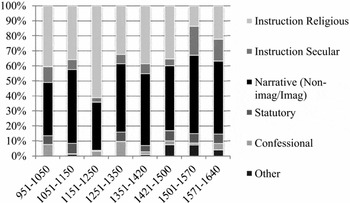
Data were retrieved from the LEON corpus, version 0.3 (Petré Reference Petré2013). Full quantitative analyses were carried out on the Middle English and Early Modern English subcorpora, covering the period 1150–1640. A small sample of thirteen instances from the late Old English period 1051–1150 (from Nicod (A), LS 22 [InFestisSMarie], LS 28 [Neot] and LS 5 [InventCrossNap]) was added to minimize the risk of overlooking important clues for interpreting the early Middle English period. LEON is a genre- and dialect-representative meta-corpus, a principled selection from other corpora, text editions and newly provided transcriptions from scanned manuscripts. Each period consists of 400,000 words. A full description of the corpus in its current form may be found at https://perswww.kuleuven.be/~u0050685/index.html#LEON. The corpus aims at improving genre and dialect balance over existing corpora, which should make cross-genre quantitative analysis across subperiods more reliable. The genre division is rendered in figure 1.
Genre distribution in LEON 0.3

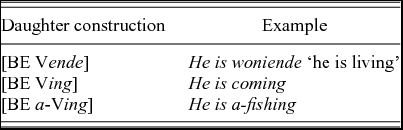
All those tokens were extracted that could potentially be seen as realizing the [BE Ving] construction, regardless of function. This includes both more adjectival-like and more verbal-like uses. From a formal point of view, [BE Ving] is considered to comprise the daughter constructions in table 1. They abstract away from dialect variation. For instance, in the North the present participle generally ended in Middle English in -and(e) rather than -end(e). This variant has been included in the daughter construction [BE Vende]. Other spelling variants such as -ind(e), -yng(e), -inge, -ig(e) or -yg(e) (macrons for nasals are transcribed as ~ in the corpus) have also been taken into account.
Daughter constructions of [BE Ving]

The three constructions in table 1 are considered a coherent set, because they behave similarly and go through similar developments. They may differ systematically from each other in a number of subtle ways, but the limited nature of the data makes it impossible to zoom in on this finer-grained level. Instances of the [BE on/in Ving] construction (e.g. he was on hunting) have been excluded. While they are generally believed to have contributed to the further development of [BE Ving], both formally and functionally, they are clearly different in consisting of the copula plus a preposition complemented by a verbal noun. They are still closely related to other combinations of preposition and verbal noun, such as be upon hunting or be at hunting or constructs such as to be in grete fering ‘in great fearing’ (c.1300. SLeg.Inf.Chr. [LdMisc 108]: 408), where the verbal noun is modified by an adjective. Generally, the boundaries with regular prepositional phrases are too unclear to enable a principled delimitation of this construction, at least not within the scope of this article (see Dal Reference Dal1952: 41–61 for a more detailed discussion). It is commonly assumed that the [BE a-Ving] construction developed out of the [BE on Ving] construction. Instances of [BE a-Ving] – no more than five of them were found – have still been included on the assumption that this spelling indicates that the former combination of a preposition on with a verbal noun had been reanalysed (or rather ‘neoanalysed’ in the sense of Traugott & Trousdale Reference Traugott and Trousdale2013) as a prefix a- plus participle. This may not be the case for each of them, but it proved impossible to distinguish between prepositional and non-prepositional readings on a principled basis.
All instances, 737 in total, have been categorized using the concepts introduced in section 4. Narrative instances, however, have not received a separate category, but have been included in the category ‘other/indeterminate’, because they have become very infrequent from the start of Middle English and probably had no part in the developments discussed in this article. This same category also contains hard-to-classify examples and borderline cases. Some instances are indeed very hard to interpret. For an example of such a hard-to-classify case, see my discussion of (21) below.
6 Analysis and results
In this section I provide more detailed qualitative and quantitative evidence that semanticization occurred during the Early Modern English period, and explain why it happened at that particular time. Section 6.1 gives an overview of the distribution of [BE Ving] across time. This is followed by a discussion of the preparatory stages to semanticization in Middle English (section 6.2) and an account of the process of semanticization itself (section 6.3).
6.1 Frequency overview of contexts of use
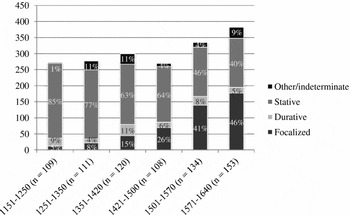
Figure 2 provides an overview of the major contexts of use outlined in section 4.2. The numbers on the y-axis represent the cumulative frequencies per million words of all instances of [BE Ving]. The percentages within each data point represent the frequencies relative to all instances of the particular period of that data point.
Frequencies of contexts of use of [BE Ving]

As figure 2 shows, frequencies per million words are more or less stable throughout Middle English. This observation is a confirmation of earlier studies. However, their conclusion that [BE Ving] did not really go through a development in Middle English must be qualified. The focalized context consistently increases, at the cost of the stative function. Statistical testing, using Kendall's tau-b, provides some interesting additional information. Kendall's tau-b method is a robust and widely used test for trend analysis, testing whether the increase in one type at the cost of one or more others is statistically significant (see, e.g., Agresti Reference Agresti2010: 196). If we apply Kendall's tau-b (using the R package, R Core Team 2013) on the whole series, the overall increase is, unsurprisingly, highly significant, with a tau value of 0.32, signalling a positive trend (on a scale between 0 and 1), and a p-value (signalling the probability of this trend being due to chance) of <0.001. More revealing, though, are the tau-b values for separate period pairs. Of these values, only the transition between periods 1421–1500 and 1501–1570 is significant (at a level of p<0.01), with a positive trend strength of tau = 0.17, and a p-value of 0.008. This transition, therefore, seems to be the most crucial one. The detailed analysis of the data below will further corroborate this finding.
Already at this point it should be emphasized that it is primarily the contexts of use that change. It is less clear in what way the constructional characteristics of [BE Ving] themselves change. In the remainder of this article I will argue that it is precisely this contextual (or co-textual) change which led to a functional change of [BE Ving] itself. Generally, the increase in use of [BE Ving] in particular contexts resulting in semanticization has been called pragmatic strengthening in grammaticalization theory (Traugott Reference Traugott1988; Hopper & Traugott Reference Hopper and Traugott2003). However, the frequency aspect visible in figure 2 has been largely ignored in this concept. A straightforward example is the development of a causal meaning ‘because’ out of a temporal meaning ‘after’ in the case of since. Grammaticalization in these cases has been explained as a natural effect of the way our cognition works. In the case of since, causality in the real world is mostly assumed to be a matter of sequentiality as well. Human minds are inclined to think spontaneously that B happened because of A when it happens right after A. In principle, such pragmatic reasoning may affect the semantics of time adverbs meaning ‘after’ at any time, which makes the timing of the shift unpredictable. However, this line of argumentation does not hold for the [BE Ving] construction. The shift from stativity – the lack of any progress – to progressiveness or ongoingness is arguably less spontaneous from a cognitive point of view than that from sequentiality to causality. It is therefore not expected to happen spontaneously, nor did it do so for that matter. Instead, the shift was made possible because the frequencies of actual contexts or environments for [BE Ving] changed. Eventually, this process made the focalized context or environment the predominant one, taking over this role from the stative one. Only then the semanticization of ongoingness became possible. Generally, the case of [BE Ving] suggests that a context of use in grammaticalization may cross a threshold of relative frequency if it becomes the predominant context. This finding may be a first step to operationalizing frequency as a factor in determining the timing of semanticization.
6.2 The preparatory stages
The possibility of verbal semantics from the start (see section 4.2) implied the potential of a focalized use. In a verbal reading, the clause containing [BE Vende] expresses an ongoing situation, rather than a purely adjectival state or nominal class. Even without dedicated syntactic structures, the context may express a single point in time, with which this ongoing situation overlaps, and which may be interpreted as a focalization point. Focalized contexts may indeed be found in the earliest data. An early Middle English example is given in (17).
-
(17) On þe time. þe ure lafdi seinte marie kennede . . . were herdes wakiende bi side þe buregh and wittende here oref. Ðo cam on angel of heuene to hem.
-
‘On the time that our Lady St Mary gave birth . . . were herds waking beside the city and watching their sheep. Then came an angel from heaven to them.’ (a.1225(?a.1200). Trin.Hom. [Trin-C B.14.52]: 31.436)
The participle wittende in (17) governs the direct object here oref ‘their sheep’. The temporal phrase ‘on the time that our Lady St Mary gave birth’ provides a general time frame with which the waking and watching are simultaneous. Together, these features suggest that the [BE Vende] construction here was understood as a periphrastic verbal construction expressing an activity rather than a copula plus adjective expressing a (temporary) property. Interestingly, the time adverb ðo ‘then’ with which the following sentence begins marks the topic time of a new event interrupting the activities of waking and watching. As such, this time adverb constitutes a focalized context for the [BE Vende] construction.
Examples like (17), then, have been classified as ‘focalized [BE Ving]’. Yet the interpretation that the waking and watching is ongoing during the arrival of the angel (the focalization point) may be reached through general pragmatic reasoning, given the sequence of the two sentences. There are no indications that ongoingness is part of the meaning of [BE Ving] itself. Focalized contexts are very rare. Also, the focalization point in these rare instances is never syntactically connected to the clause containing [BE Vende]. This lack of structured co-occurrence may have blocked the semanticization of the notion of ongoingness at this early stage.
Things change in the course of Middle English, when backgrounding adverbial clauses in general show a marked increase. Both Wårvik (Reference Wårvik and Jucker1995) and Brinton (Reference Brinton1996), among other studies, suggest that Middle English has a higher proportion of adverbial clauses than Old English, especially in the domain of temporal structuring of the narrative. Wårvik (Reference Wårvik and Jucker1995) provides quantitative evidence from a wide range of sources for the increase in when and related conjunctions in Middle English, and Brinton (Reference Brinton1996) provides additional evidence from Chaucer and Malory. Part of this increase might be explained as a result of when gradually replacing an equivalent subordinating conjunction from Old English, þonne ‘whenever’. Yet most of the increased frequency of when can better be explained as reflecting a shift from foreground marking by the Old English main clause time adverb þa ‘then’ to background marking: ‘there appears to exist an inverse relation between the frequency of þa adverbial and the frequency of temporal subordinate clauses introduced by þa conjunction, when and related conjunctions’ (Wårvik Reference Wårvik and Jucker1995: 354). While both studies focus on when, their argumentation suggests that other conjunctions with similar functions, such as as or while, would have increased as well. Other types of subordinate adverbial clauses seem to have increased as well. Killie & Swan (Reference Killie and Swan2009) provide evidence that adverbial -ing clauses over time have become less appositive and more subordinate, while van de Pol & Petré (Reference van de Pol and Petré2015) show that adverbial uses of absolutes – among other increasing uses – are much more frequent in English from the late Early Modern English period onwards than they are in Dutch, which is arguably more like the earlier stages of English in this respect.
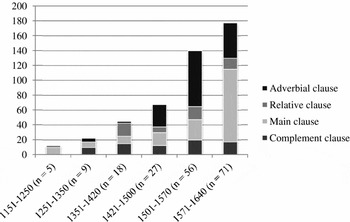
Figure 3 gives an overview of the various types of clauses in which focalized [BE Ving] is found. Previous studies have made contradictory claims on the role of clause type in the development of [BE Ving]. Strang (Reference Strang and Anderson1982: 442) argues that [BE Ving] is first strongly associated with (adverbial) subordinate clause use. Kranich objects that Strang's data are mainly derived from fiction, and observes that in the seventeenth-century multi-genre ARCHER corpus progressive [BE Ving] already occurs in main clauses 45 per cent of the time (Kranich Reference Kranich2010: 238). The overview in figure 3 actually shows that both Strang's and Kranich's claims turn out to be correct, but that Strang's hypothesis holds for an earlier stage than she herself recognized.
Clause type of focalized contexts, frequencies per million words

The increase in [BE Ving] in the period 1421–1570 in backgrounding adverbial clauses may be explained as a natural byproduct of the more general increase in adverbial clauses. [BE Ving] usually expresses backgrounded situations itself, and as such can be expected to keep up with the frequency of these adverbial clauses. When occurring in an adverbial clause, the main clause typically functions as a focalization point, providing a topic time at which the [BE Ving] situation is ongoing, as in (18).
-
(18) On a day sone aftyr, as þay wer yn þe see of Galyle fyschyng, Cryst come by hom, and callet hom.
-
‘On a day soon after, as they were fishing in the lake of Galilea, Christ came by them, and called them.’ (a.1500(a.1415). Mirk Fest. [GoughETop 4]: 6.18)
In addition to the type of clause, the types of verb found in focalized uses may also have played a role in the further development of [BE Ving]. Focalized contexts are typical of narrative texts. Narrative texts, in turn, often involve the directed motion of protagonists in pursuance of their goals. Therefore it comes as no surprise that, from the start, among the verbs most frequently found in focalized contexts there are many telic activity verbs. An example is given in (19).
-
(19) And as they were comynge homwarde, they founde themselfe vpon the ryver of gyronde.
-
‘And as they were coming homewards, they found themselves upon the river Gironde.’ (c.1489. Historie of the foure sonnes of Aymon: 145 [LEON])
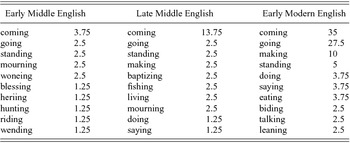
Table 2 gives an overview of the top ten most frequent participles for three stages in the development of focalized uses – spellings have been normalized. Each stage comprises two subperiods from the corpus. In each, coming and going are ranked 1 and 2 respectively. As well, first coming and then going also go through a marked increase over time – and note that this increase in going in Early Modern English predates the subsequent increase owing to the grammaticalization of [BE going to] as a marker of prospective aspect (see, e.g., Traugott Reference Traugott, Mukherjee and Huber2012: 235, where the first unambiguous examples of prospective use are dated to the beginning of the seventeenth century). Additionally, we find activity verbs like riding, wending ‘going’, or sailing, all of which occur in the context of goal-directed motion. In addition, while truly transitive verbs are missing in the first stage, they start to become more common in the second and third stages. The increasing frequencies of making and doing stand out in this respect. This confirms earlier literature (Ziegeler Reference Ziegeler1999) stating that the participle in the construction is becoming more verbal, and the subject more agentive.
Top ten most frequent participles over time (frequencies per million words)

6.3 Semanticization of the focalized function
The quantitative information collected so far provides the substance for understanding how the implicature of ongoingness was actualized in a semantic shift in the [BE Ving] construction. Both the clause type and verb type probably played a role in this semanticization process.
Specifically, [BE Ving] goes through a shift from expressing a ‘homogeneous state’ to an ‘ongoing activity at point X’. When used statively, all phases of the situation denoted by [BE Ving] are construed as identical. This homogeneity is shared by the copular [BE Adj] construction with non-participial adjectives (as in The troll is very calm ), which points to a mostly adjectival status of the participles at issue. Predication of a property of a non-agentive subject was probably the original function of such adjectival participles in predicative position. However, the increasingly high incidence of [BE Ving] in adverbial clauses syntactically connected to focalized contexts led to a semantic shift. The primary information conveyed was no longer that of predicating a property of a non-agent, but of giving information on what was going on when something else happened. With the focus shifted to that single point in time, the other phases of the situation expressed by [BE Ving] became deprofiled. This deprofiling, in turn, paved the way for the introduction of non-punctual situations whose phases could no longer be interpreted as identical to each other. Such situations are known as accomplishments. And indeed, the first transitive accomplishment verbs occur in the late Middle English period. An early example is given in (20).
-
(20) So the meanwhyle that thys knyght was makynge hym redy to departe, there com into the courte the Lady of the Laake. (a.1470. Malory Wks. [Win-C]: 65/12)
In an accomplishment such as ‘making yourself ready’, each phase of the event differs from the preceding phases. The knight might have been putting on armour, or merely a coat, but each action is different and brings him towards the end state of being ready to depart. A stative reading is no longer possible. As long as accomplishments were lacking in the [BE Ving] construction, there is no reason to assume that the semantic shift had taken place. The fact that the first accomplishments start appearing not long after the number of adverbial clauses containing [BE Ving] had drastically increased, is further evidence for the role played by this clause type.
The high frequency of telic activity verbs may have further facilitated this process of semanticization of ongoingness. Presumably, in an adjectival reading, the telicity of coming and going was not really construed as progressive. Instead, what was conveyed was that the end state was not present yet. From this point of view, in between stages were identical. This may be illustrated by an example like (21).
-
(21) Þe wordle þet is cominde ‘The world that is coming’ ((1340). Ayenb. [Arun 57]: 248)
(21) may just as well be paraphrased by the future world or, theoretically, the world that is future, which does not occur in English, however. While a stative reading is therefore possible, it is not hard to see how the telic semantics of coming and going have contributed to interpreting [BE Ving] as indicating a particular point along a line of progress towards the end state. In an example like (21), being a day away from the new world probably is a different experience from being a century away from it.
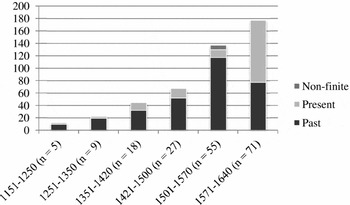
The evidence found so far strongly suggests that towards the end of the Middle English period, ongoingness became semanticized as a component of the lexical meaning of [BE Ving]. This semanticization primarily took place in subordinate clauses in narratives. The hypothesis of semanticization in narrative contexts can also account for changes in the distribution across tense. Figure 4 gives an overview of this changing distribution.
Tense of focalized [BE Ving], frequencies per million words

In the period 1571–1640, the frequency of the present tense all of a sudden explodes.Footnote 7 This expansion to the present tense may be a result of the explosion of main clauses (see figure 3). In the period 1571–1640, 75 per cent (30 out of 40) of the present-tense instances are main clauses, whereas this is only 29 per cent (9 out of 31) for the past tense. An example of a present-tense main clause is (22).
-
(22) Oh, sweet kisse! but ah, shes waking!
-
Lowring beautie chastens me:
-
Now will I for feare hence flee. (1591. Sidney, Astr. & Stella)
The transfer of focalized [BE Ving] from past-tense adverbial clauses to present-tense main clauses may be explained as follows. The increase in adverbial backgrounding clauses from late Middle English onwards was primarily a matter of past-tense narrative. Focalized [BE Ving] at this stage did not often occur in main clauses, past or present, because these usually lacked the proper combination of syntactically marked frame plus focalizing point typically found in the combination of adverbial backgrounding clause and foregrounding (focalizing) main clause. However, once ongoingness became part of [BE Ving] semantically and not merely contextually, [BE Ving] could be employed with progressive semantics in other clause types, such as main clauses both past and present. In the past tense, this did not lead to a marked increase in [BE Ving] in main clauses, because focalization points, or topic times, in past-tense narratives are generally made explicit. In the present tense, by contrast, the default focalization point or topic time is an ‘implicit now’. Prior to semanticization, the occurrence of [BE Ving] in present-tense main clauses is not expected, because the semantic component of ongoingness at that stage is only present in the linguistic context. The only linguistic context to be expected with some frequency in the present tense would be the time adverb now itself, making explicit the default topic time. It is noteworthy, then, that in three out of four present-tense instances predating the final 1571–1640 period, this time adverb now is indeed present. Once ongoingness is semanticized, an explicit topic time is no longer necessary, because the use of [BE Ving] evokes such a topic time (the implicit ‘now’) independently. Subsequently, explicit now is expected to be far less prominent in the period 1571–1640. This turns out to be indeed the case. Adverbs meaning ‘now’ (now, presently) occur in only 10 per cent of all present-tense instances from this period.
7 Discussion and concluding remarks
The analysis proposed in this article accounts for cases of semanticization which are hard to explain as the spontaneous result of our cognitive processing of the world. A key element in the explanation is the frequency of features of the construction's co-textual environment. Focalized [BE Ving], which combines imperfective aspectuality with an emphasis on a single focalization point, already increases during the Middle English period. However, at this point this increase is not compensated by a decrease in other uses of [BE Ving]. This suggests that ongoingness is at that point not yet an inherent property of [BE Ving]. Instead, the increase in its use is directly dependent on the changing textual structure in late Middle English more generally. This changing structure provides the proper environment for the start of the next stage in the development of [BE Ving]. Specifically, evidence was accumulated that adverbial clauses marking background information provide the proper syntactic niche, with the right pragmatic implications, for the establishment of [BE Ving]’s focalized or progressive semantics. Such an explanation also reconciles the data with Bybee's (Reference Bybee, Bybee and Noonan2001) conclusion that innovation is typical of main clauses. To the extent that progressivity is a byproduct of other changes in the language, its emergence constitutes a type of change that differs from changes resulting from Haspelmath's (Reference Haspelmath1999) maxim of extravagance, which underlies Bybee's conclusion. The precise relationship between the two types of change is an interesting topic for future research.
The data presented in this article may also contribute to our knowledge of how interaction between constructions and environmental co-texts may eventually lead to a wholesale typological shift. Recently, Los (Reference Los, Meurman-Solin, López-Couso and Los2012) has proposed that English went through a broad shift in the way narratives are structured. Old English grammatical structure was conducive to narratives in serial fashion, as if seen through the eyes of a protagonist experiencing events as bounded (one after another). This type of construal typically has adverbs meaning ‘then’ at the head of a clause, often with inversion of the subject. In Old English, the most typical adverb fulfilling this bounding function was þa. By contrast, Present-day English grammar provides more room for unbounded narrative, which is similar to a camera overlooking the whole scene, and seeing events as (partly) overlapping (Water was dripping down. The man started digging and the sand is caving in). The shift from bounded to unbounded is not yet well understood, and appears to involve a number of superficially local and unrelated changes. Los makes some suggestions as to how the progressive fits into this picture. Progressives anchor each event ‘to some point in time right at the beginning of the narration which is then implicitly maintained throughout the event’ (2012: 30). My findings explain how the use of the progressive directly relates to some of these other superficially local syntactic changes. Until now, it has been assumed that the critical turnover occurred in the sixteenth century. However, the critical changes reported on in this article occur before 1500. In particular, Middle English saw an increase in syntactic background marking through subordinate clauses introduced by when, while, as. More often than not, such clauses implied an overlap between the ongoing situation in the background and the foregrounded action. Shared backgrounding properties led to [BE Ving] becoming associated with these subordinate clauses. Along the way, the semantic idea of overlap, originally also only present contextually, was adopted together with the idea of ongoingness. This makes the development of [BE Ving] part of a larger process towards more unbounded construal.
More generally, the analysis has shed light on the role of the larger textual and constructional environment (see also Petré Reference Petré2014) and its frequency in the early stages of grammaticalization. The importance of contexts (or co-texts) of use as indices of change in grammaticalization research is well known (e.g. Traugott Reference Traugott, Mukherjee and Huber2012: 231–2), but less so is the idea that changes in the co-text may eventually push the construction towards grammaticalized status. From my analysis it appears that the semanticization (and subsequent grammaticalization) of [BE Ving] started off with a shift in preferred usage context. While more research is needed to turn this observation into a generalizable hypothesis, the complex and dynamic nature of the role played by frequency should not lead to the avoidance of researching this role. As such, I would like to amend the statement in (Traugott & Trousdale Reference Traugott and Trousdale2013: 11) that the notion of ‘sufficient frequency is not operationalizable’ to ‘not yet’.