INTRODUCTION
Harvested mollusk assemblages are frequently preserved in coastal and island environments and have been used to infer past subsistence strategies, resource manipulation, and paleoenvironmental and paleoecological conditions (e.g., Mannino et al., Reference Mannino, Thomas, Leng, Piperno, Tusa and Tagliacozzo2007, Reference Mannino, Thomas, Leng and Sloane2008; Colonese et al., Reference Colonese, Troelstra, Ziveri, Martini, Lo Vetro and Tommasini2009; Andrus, Reference Andrus2011; Prendergast et al., Reference Prendergast, Azzopardi, O'Connell, Hunt, Barker and Stevens2013, Reference Prendergast, Stevens, O'Connell, Fadlalak, Touati, Al-Mzeine, Schöne, Hunt and Barker2016). Shells are often preserved in so-called middens, which can be defined as ancient human garbage dumps with high concentrations of discarded foods (e.g., shells) and other remains accumulated throughout time. However, the study of archaeological shell concentrations can be challenging, because an array of natural and anthropogenic processes are involved in the formation of middens, and these processes are difficult to disentangle (Parker et al., Reference Parker, Yanes, Mesa Hernández, Hernández Marrero, Pais and Surge2020).
To properly interpret the stratigraphy and geochronology of mollusk shell assemblages, it is essential to quantify the scale of time averaging, or the mixing of remains of different ages occurring in the same stratigraphic layer (Kidwell and Bosence, Reference Kidwell, Bosence, Alison and Briggs1991; Kowalewski, Reference Kowalewski1996; New et al., Reference New, Yanes, Cameron, Miller, Teixeira and Kaufman2019; Parker et al., Reference Parker, Yanes, Mesa Hernández, Hernández Marrero, Pais and Surge2020). Failing to recognize time averaging can lead to the misinterpretation of ancient assemblages that may have the appearance of being isochronous while they are actually diachronous (Kidwell and Bosence, Reference Kidwell, Bosence, Alison and Briggs1991; Kowalewski, Reference Kowalewski1996; New et al., Reference New, Yanes, Cameron, Miller, Teixeira and Kaufman2019; Parker et al., Reference Parker, Yanes, Mesa Hernández, Hernández Marrero, Pais and Surge2020). There are various natural sedimentary processes that can lead to the mixing of noncontemporaneous remains in the same horizon. Some of these include changes in sedimentation (burial) rates, exhumation and reburial of older material, taphonomic pressures (decay rates), and mixing due to biological activity (Fürsich and Aberhan, Reference Fürsich and Aberhan1990; Kidwell and Bosence, Reference Kidwell, Bosence, Alison and Briggs1991; Kowalewski, Reference Kowalewski1996; Parker et al., Reference Parker, Yanes, Mesa Hernández, Hernández Marrero, Pais and Surge2020). In archaeological settings, anthropogenic factors can contribute to time averaging, including pit digging, trampling, and so on, which may lead to additional complexities when interpreting the environmental context of mollusk assemblages (Koppel et al., Reference Koppel, Szabó, Moore and Morwood2016; Parker et al., Reference Parker, Yanes, Mesa Hernández, Hernández Marrero, Pais and Surge2020).
The Mediterranean region is characterized by a long history of human occupation, and many of these coastal settlements have left an accessible harvested mollusk record, providing an opportunity to investigate human and environmental evolution over multimillennial timescales (Colonese et al., Reference Colonese, Mannino, Bar-Yosef Mayer, Fa, Finlayson, Lubell and Stiner2011). Archaeological mollusk assemblages have been extensively utilized in the last few decades as a credible tool to reconstruct the paleoclimate and associated human cultural or socioeconomic transitions (e.g., Colonese et al., Reference Colonese, Troelstra, Ziveri, Martini, Lo Vetro and Tommasini2009; Mannino et al., Reference Mannino, Thomas, Leng, Piperno, Tusa and Tagliacozzo2007; Prendergast et al., Reference Prendergast, Stevens, O'Connell, Fadlalak, Touati, Al-Mzeine, Schöne, Hunt and Barker2016; Yanes et al., Reference Yanes, Hutterer and Linstädter2018). The bulk of published work on shell middens has generally assumed that shells retrieved from the same horizon or close stratigraphic position were collected at equivalent times and therefore lump them together in the same age group. This hypothesis seems reasonable and is based on stratigraphic and archaeological evidence. Intriguingly, some recent studies (e.g., Koppel et al., Reference Koppel, Szabó, Moore and Morwood2016; Parker et al., Reference Parker, Yanes, Mesa Hernández, Hernández Marrero, Pais and Surge2020) have documented that in some cases, shell middens may exhibit multicentennial to multimillennial time averaging that cannot be detected based on stratigraphic position alone, reinforcing the complexity in geochronology and stratigraphy of harvested mollusk concentrations. The scarce number of studies that have examined the scale of time averaging in shell middens is in part explained because traditional graphite-target radiocarbon dating is rather costly and tedious. Recently, Bush et al. (Reference Bush, Santos, Xiaomei, Southon, Thiagarajan, Hines and Adkins2013) developed a new method, the carbonate-target radiocarbon dating method, which can be conducted at a much lower cost and more rapidly than the traditional graphite-target radiocarbon dating. Accordingly, we now have the logistic ability to measure the degree of time averaging in archaeological shelly accumulations by individually dating numerous shells retrieved from the same stratigraphic layer.
In NE Morocco, the coastal archaeological site of Ifri Oudadane embraces a Holocene record from 5700 to 11,000 cal yr BP that preserves the cultural transition from hunter-gatherers to a food production mode of life (Linstädter and Kehl, Reference Linstädter and Kehl2012; Morales et al., Reference Morales, Pérez-Jordà, Peña-Chocarro, Zapata, Ruíz-Alonso, López-Sáez and Linstädter2013). The site also contains rich concentrations of edible-size marine mollusk Phorcus turbinatus, as early humans incorporated marine resources into their diets through the practice of foraging throughout all cultural periods (Linstädter and Kehl, Reference Linstädter and Kehl2012; Hutterer et al., Reference Hutterer, Linstädter, Eiwanger and Mikdad2014; Yanes et al., Reference Yanes, Hutterer and Linstädter2018). The scientific community has proposed several hypotheses to explain the reasons behind this shift, including increases in population density, decrease in prey due to excessive hunting, and climate and environmental change among others (Weisdorf, Reference Weisdorf2005). The shells preserved throughout the stratigraphy at Ifri Oudadane offer an excellent opportunity to reconstruct paleoclimatic conditions during part of the Holocene in NE Morocco. This is because mollusk shells grow in a continuous accretionary fashion, and the oxygen isotope composition (δ18O) of the calcium carbonate can be used to infer the temperature during calcification if the water δ18O value is inferred independently or assumed to have a constant value (Grossman and Ku, Reference Grossman and Ku1986).
In this study, we use the carbonate-target radiocarbon dating approach to date numerous shells of the harvested marine gastropod P. turbinatus from the Ifri Oudadane site in NE Morocco to test the hypothesis that shells preserved jointly in the same cultural phase are indeed contemporaneous and exhibit minimal time averaging. This study assesses the structure (age distribution) and scale (range of age) of time averaging of harvested shells at the site. The dated shells are then calibrated to calendar age and those ages are compared with the calibrated ages of previously dated terrestrial archaeological remains in the site using the graphite-target radiocarbon method. Additionally, potential radiocarbon age differences between outer and inner aragonitic layers of the same shell are examined to test for potential radiocarbon offsets between shell layers. Finally, selected radiocarbon-dated shells were used to reconstruct submonthly Holocene sea-surface temperature (SST) data derived from oxygen isotope time-series analyses to test the hypothesis that the rise of food production in NW Africa coincides with climate and environmental change. This work illustrates the potential impacts of not sampling individual shells, which should be considered in future paleoclimatic and archaeological inferences using human-harvested mollusk concentrations.
MATERIAL AND METHODS
Geographic, archaeological, and chronological setting
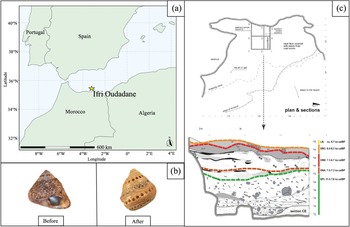
The archaeological site of Ifri Oudadane (Fig. 1a and b), located in NE Morocco (35.2151°N, 3.2543°W), is a coastal marble cliff rock shelter that is ~5 m high and ~15 m wide and is positioned ~50 m above the present-day shoreline (Linstädter and Kehl, Reference Linstädter and Kehl2012). This site was discovered in 2006 during roadwork, and since then, a number of excavations during the years 2006, 2007, 2010, and 2011 have retrieved archaeological remains (Linstädter and Kehl, Reference Linstädter and Kehl2012). The rock shelter itself formed as a result of high stand in sea level that ultimately exposed the rock and led to erosion generating the cavity of the cave (Linstädter and Kehl, Reference Linstädter and Kehl2012). The region is part of the Rif range, where there is active plate collision occurring that is likely the cause for sea level to be ~50 m below the present cavity of the cave (Michard et al., Reference Michard, Saddiqi, Chalouan and Frizon de Lamotte2008).
(a) Geographic location of Ifri Oudadane, NE Morocco. (b) Photograph of an archaeological Phorcus turbinatus shell from Ifri Oudadane. The shells are shown before and after sequential drilling for time-series isotopic analysis. (c) Schematic of the stratigraphy from Ifri Oudadane with the chronology for each cultural period from previously published radiocarbon dates (adopted from Yanes et al. Reference Yanes, Hutterer and Linstädter2018).

In previous studies, the chronology at Ifri Oudadane has been constrained from a total of 25 published radiocarbon dates from archaeological plant and vertebrate remains (Table 1), which suggests that the occupational period at the site spans from ~11,000 to ~5700 cal yr BP, which can be divided into two main cultural periods, the Epipaleolithic (EPI) and the Early Neolithic (EN) (Fig. 1c) (Linstädter and Kehl, Reference Linstädter and Kehl2012; Morales et al., Reference Morales, Pérez-Jordà, Peña-Chocarro, Zapata, Ruíz-Alonso, López-Sáez and Linstädter2013, Reference Morales, Pérez Jordà, Peña-Chocarro, Bokbot, Vera, Martínez Sánchez and Linstädter2016; Linstädter et al., Reference Linstädter, Broich and Weninger2016). The transition from the Epipaleolithic to the Early Neolithic can be distinguished by changes in manufacturing, decoration, and form present in pottery as well as the appearance of domesticated plants and animals (Linstädter and Kehl, Reference Linstädter and Kehl2012; Morales et al., Reference Morales, Pérez-Jordà, Peña-Chocarro, Zapata, Ruíz-Alonso, López-Sáez and Linstädter2013; Linstädter et al., Reference Linstädter, Wagner, Broich, Gibaja Bao and Rodríguez2015). The Early Neolithic phase is further subdivided into the Early Neolithic A (ENA), Early Neolithic B (ENB), and Early Neolithic C (ENC) (Fig. 1c). For the previously published radiocarbon dates there were 6 dates for the EPI layer, 5 for ENA, and 15 for ENB (Linstädter and Kehl, Reference Linstädter and Kehl2012; Morales et al., Reference Morales, Pérez-Jordà, Peña-Chocarro, Zapata, Ruíz-Alonso, López-Sáez and Linstädter2013; Linstädter et al., Reference Linstädter, Wagner, Broich, Gibaja Bao and Rodríguez2015). The Epipaleolithic (~7600 to ~11,000 cal yr BP) represents the hunting-gathering society before the transition to Neolithic innovations and food production (Zapata et al., Reference Zapata, López-Sáez, Ruiz-Alonso, Linstädter, Pérez-Jordà, Morales, Kehl and Peña-Chocarro2013; Linstädter and Kehl Reference Linstädter and Kehl2012). The Epipaleolithic layer exhibits ~100 cm of thickness and contains bones of wild animals as well as sparse lithic tools (Linstädter et al., Reference Linstädter, Wagner, Broich, Gibaja Bao and Rodríguez2015). The Neolithic layers are 1.5 m thick and contain ash lenses and charcoal, impressed pottery, and domesticated plants and animals (Morales et al., Reference Morales, Pérez-Jordà, Peña-Chocarro, Zapata, Ruíz-Alonso, López-Sáez and Linstädter2013). The oldest subdivision of the EN layer is the ENA, which spans from ~7000 to ~7600 cal yr BP (Linstädter and Kehl, Reference Linstädter and Kehl2012). The ENA layer is an ~20 cm thick layer that contains cardium-decorated pottery and domesticated ovicaprines (Linstädter and Kehl, Reference Linstädter and Kehl2012). The first domesticated crops appear in the ENA layer, which is the Epipaleolithic–Early Neolithic boundary, defined by a lentil dated to 7611 ± 37 cal yr BP (Morales et al., Reference Morales, Pérez-Jordà, Peña-Chocarro, Zapata, Ruíz-Alonso, López-Sáez and Linstädter2013). The dated lentil is also the oldest evidence of food production in all of North Africa (Morales et al., Reference Morales, Pérez-Jordà, Peña-Chocarro, Zapata, Ruíz-Alonso, López-Sáez and Linstädter2013). The ENB subdivision spans from ~6700 to ~7000 cal yr BP and is considered the main occupational period at Ifri Oudadane (Linstädter and Kehl, Reference Linstädter and Kehl2012). Variations in pottery can be seen between the ENA and the ENB (Linstädter and Kehl, Reference Linstädter and Kehl2012). The final subdivision is the ENC, spanning ~6300 to ~6600 cal yr BP. Late Neolithic deposits of Ifri Oudadane are not represented by a proper layer. One charcoal sample yielded a radiocarbon age of 5763 ± 80 cal yr BP (KIA 39296), which is consistent with the timing of the Late Neolithic phase in this site (Linstädter, Reference Linstädter2008).
Previously published graphite-target radiocarbon results (n = 25) from terrestrial plant and vertebrate remains retrieved from Ifri Oudadane site by Linstädter and Kehl (Reference Linstädter and Kehl2012), Morales et al. (Reference Morales, Pérez-Jordà, Peña-Chocarro, Zapata, Ruíz-Alonso, López-Sáez and Linstädter2013, Reference Morales, Pérez Jordà, Peña-Chocarro, Bokbot, Vera, Martínez Sánchez and Linstädter2016), and Linstädter et al. (Reference Linstädter, Broich and Weninger2016).

a Ref.: 1, Linstädter and Kehl, 2002; 2, Morales et al., Reference Morales, Pérez-Jordà, Peña-Chocarro, Zapata, Ruíz-Alonso, López-Sáez and Linstädter2013; 3, Linstädter et al. Reference Linstädter, Broich and Weninger2016; 4, Morales et al., Reference Morales, Pérez Jordà, Peña-Chocarro, Bokbot, Vera, Martínez Sánchez and Linstädter2016.
Since its discovery, Ifri Oudadane has been the focus of numerous studies over the past decade. Linstädter and Kehl (Reference Linstädter and Kehl2012) defined the archaeological sequence and examined the processes that may have formed the site. The presence of coprolites and calcite spherulites in the Early Neolithic layer reflect the penning of domesticated animals in the cave. Linstädter and Wagner (Reference Linstädter and Wagner2013) examined the pottery preserved throughout the stratigraphy to further define the cultural transition from the Epipaleolithic to the Neolithic by observing changes in manufacturing, decoration, and form in pottery remains. Zapata et al. (Reference Zapata, López-Sáez, Ruiz-Alonso, Linstädter, Pérez-Jordà, Morales, Kehl and Peña-Chocarro2013) studied the paleobotanical evidence to deduce how ancient human populations utilized their surroundings as well as if and how the environment changed throughout the occupational phase at Ifri Oudadane. Linstädter et al. (Reference Linstädter, Wagner, Broich, Gibaja Bao and Rodríguez2015) examined the lithic industry that was present at the site. Yanes et al. (Reference Yanes, Hutterer and Linstädter2018) investigated the season of shellfish harvest and noticed the apparent link between climate change and cultural transition by analyzing three shells. Finally, Hutterer et al. (Reference Hutterer, Schröder and Linstädter2021) analyzed the shellfish remains at the site to determine the usage of shellfish in diet; examine the temporal change in shellfish size; and assess the usage of shellfish for tools and ornaments.
Current climate, vegetation, and oceanographic conditions
In the present day, the climate in NE Morocco is Mediterranean type, with wet and mild winters, arid and hot summers, and a wet season between fall and spring (Morales et al., Reference Morales, Pérez-Jordà, Peña-Chocarro, Zapata, Ruíz-Alonso, López-Sáez and Linstädter2013). The vegetation in the area today is a maquia-type forest, which includes junipers (Juniperus sp.), pines (Pinus sp.), wild olive (Olea europaea), and Holm oaks (Quercus ilex) (Morales et al., Reference Morales, Pérez-Jordà, Peña-Chocarro, Zapata, Ruíz-Alonso, López-Sáez and Linstädter2013). Ifri Oudadane's surroundings have been subjected to depletion of natural resources and deforestation in the last few decades (Morales et al., Reference Morales, Pérez-Jordà, Peña-Chocarro, Zapata, Ruíz-Alonso, López-Sáez and Linstädter2013).
Ifri Oudadane is positioned on the coast of the westernmost portion of the Alboran Sea, which is connected to the Atlantic Ocean via the Strait of Gibraltar. Dense saline water from the Alboran Sea exits through the Strait of Gibraltar into the Atlantic Ocean, whereas less-dense water with lower salinity from the Atlantic enters the Mediterranean (Pierre, Reference Pierre1999; Bazzicalupo et al., Reference Bazzicalupo, Maiorano, Girone, Marino, Combourieu-Nebout and Incarbona2018). The inflow of the water with lower salinity from the Atlantic creates two gyres in the Alboran Sea (Pierre, Reference Pierre1999; Bazzicalupo et al., Reference Bazzicalupo, Maiorano, Girone, Marino, Combourieu-Nebout and Incarbona2018). Ifri Oudadane is situated near the westernmost gyre of the Alboran Sea. Shaltout and Omstedt (Reference Shaltout and Omstedt2014) reported SSTs from the Alboran Sea between 1982 and 2012 and observed that, on average, the annual SST, winter SST, spring SST, summer SST, and autumn SST were 18.6°C, 15.5°C, 18.0°C, 22.8°C, and 18.8°C, respectively.
The present environmental conditions at Ifri Oudadane and northwest Africa are dictated by several climate mechanisms, including the Intertropical Convergence Zone (ITCZ), the westerly winds, and the North Atlantic Oscillation (NAO) (Bazzicalupo et al., Reference Bazzicalupo, Maiorano, Girone, Marino, Combourieu-Nebout and Incarbona2018; Padgett et al., Reference Padgett, Yanes, Lubell and Faber2019). The seasonal migration of the ITCZ affects wind intensity in the area as well as the African monsoon rain (Bazzicalupo et al., Reference Bazzicalupo, Maiorano, Girone, Marino, Combourieu-Nebout and Incarbona2018). The westerly winds bring rainfall to northern Africa during the winter months (Bazzicalupo et al., Reference Bazzicalupo, Maiorano, Girone, Marino, Combourieu-Nebout and Incarbona2018). The sea level pressure gradient from Iceland to Azores, characterized by the NAO index, causes variations in storm intensity and the westerly winds (NOAA, 2012; Bazzicalupo et al., Reference Bazzicalupo, Maiorano, Girone, Marino, Combourieu-Nebout and Incarbona2018; Padgett et al., Reference Padgett, Yanes, Lubell and Faber2019). The mode of the NAO switches between positive and negative according to variations of pressure at sea level between the Azores high-pressure system and the Icelandic low-pressure system (NOAA, 2012; Parker et al., Reference Parker, Yanes, Mesa Hernández, Hernández Marrero, Pais and Surge2020). A high pressure difference between the Azores high-pressure system and the Icelandic low-pressure system results in a positive mode of NAO, leading to increased westerly winds and storms over northern Europe and Scandinavia. In contrast, a low-pressure difference between the Azores high-pressure system and the Icelandic low-pressure system results in a negative mode of NAO, leading to decreased westerly winds and storms over southern Europe and North Africa (NOAA, 2012).
Radiocarbon dating of marine shells
The new carbonate-target radiocarbon dating method was chosen to date a high number of shells because it is rapid and more cost-effective compared with the traditional graphite-target radiocarbon dating. The carbonate-target radiocarbon dating is approximately one-third the cost of traditional graphite-target radiocarbon dating. Moreover, for samples that are younger than 10,000 yr old, this method yields statistically indistinguishable results compared with the traditional graphite-target method (Bush et al., Reference Bush, Santos, Xiaomei, Southon, Thiagarajan, Hines and Adkins2013; Parker et al., Reference Parker, Yanes, Mesa Hernández, Hernández Marrero, Pais and Surge2020; Bright et al., Reference Bright, Ebert, Kosnik, Southon, Whitacre, Albano and Flores2021). To test the potential radiocarbon offsets within different layers of the same shell, three shells were selected to assess whether or not the outer and inner aragonitic portion of the same shell would yield statistically equivalent radiocarbon ages. In addition, a total of 34 archaeological P. turbinatus shells were individually dated to measure the scale (age range) and structure (age-frequency distribution) of time averaging.
Carbonate-target radiocarbon analyses were conducted at the W.M. Keck Carbon Cycle Accelerator Mass Spectrometer facility at the University of California, Irvine. For the analysis, 0.3 mg of cleaned shell material was ground into a fine powder; mixed with 5 mg of unbaked Alfa Aesar no. 40510, −325 mesh, 99.99% pure Nb; poured into the aluminum cathode target; and pressed for accelerator mass spectrometry measurement (Bush et al., Reference Bush, Santos, Xiaomei, Southon, Thiagarajan, Hines and Adkins2013).
Samples originating from a marine environment require an additional correction before they can be directly compared with terrestrial samples. Deep-ocean waters are isolated from the atmosphere, and with time their 14C content is depleted by radioactive decay with respect to the atmosphere (Stuiver and Braziunas, Reference Stuiver and Braziunas1993). The deep-ocean water eventually rises to the surface, and marine organisms end up capturing a 14C signal that is depleted with respect to the atmosphere. This process results in marine samples appearing to be older than contemporaneous terrestrial samples, which is known as the marine reservoir carbon effect (Stuiver and Braziunas, Reference Stuiver and Braziunas1993). Moreover, due to the complexity and spatial variability in oceanic circulation patterns, the reservoir effect can vary significantly from region to region. The regional offset from the average global marine reservoir correction is defined as (ΔR) (Stuiver and Braziunas, Reference Stuiver and Braziunas1993).
Radiocarbon ages were calibrated using CALIB 8.2 (Stuiver et al., Reference Stuiver, Reimer and Reimer2021) and the marine calibration curve Marine20 with a calculated ΔR (Stuiver and Braziunas, Reference Stuiver and Braziunas1993; Heaton et al., Reference Heaton, Köhler, Butzin, Bard, Reimer, Austin and Ramsey2020). Using the Marine Reservoir Correction Database from CALIB 8.2, sites (n = 6) were selected throughout the Mediterranean from Siani et al. (Reference Siani, Paterne, Arnold, Bard, Métivier, Tisnerat and Bassinot2000) and Reimer and McCormac (Reference Reimer and McCormac2002) to determine the ΔR (Stuiver et al., Reference Stuiver, Reimer and Reimer2021). The weighted mean ΔR was calculated based on the uncertainty in each data point (Bevington, Reference Bevington1969). The weighted mean ΔR and the associated uncertainty used for the correction were determined to be −89 ± 78. Based on Stuiver and Polach (Reference Stuiver and Polach1977), the samples were corrected for 13C fractionation. Calibrated radiocarbon ages are reported using a 2σ range in age, which provides a 95.4% probability that the ages fall within this range.
The uncalibrated radiocarbon ages of marine shells were used when evaluating the degree and structure of age mixing, because we are not interested in the actual age, but the age offsets, following previous procedures (Yanes et al., Reference Yanes, Kowalewski, Ortiz, Castillo, Torres and Nuez2007; Kowalewski et al., Reference Kowalewski, Casebolt, Hua, Whitacre, Kaufman and Kosnik2018; Parker et al., Reference Parker, Yanes, Mesa Hernández, Hernández Marrero, Pais and Surge2020). Radiocarbon ages were corrected for ΔR and calibrated to calendar years when comparing our results with previously published radiocarbon ages of terrestrial samples and when shells were used to infer SSTs (see additional justifications in the following sections).
Radiocarbon results are reported in years before present (yr BP), where 0 = 1950 CE. Uncalibrated radiocarbon ages are presented as “14C yr BP,” whereas calibrated radiocarbon ages are reported as “cal yr BP”.
Measuring the scale and structure of time averaging
To investigate the scale (age range) and structure (age-frequency distribution) of time averaging, we used uncalibrated rather than calibrated radiocarbon ages. Our goal here is to assess age offsets, ranges, and distributions of shell assemblages rather than establishing a calendar age. Because the calibration of radiocarbon ages to calendar years introduces errors, this part of the study was performed using uncalibrated ages only, following previously published work (Yanes et al. Reference Yanes, Kowalewski, Ortiz, Castillo, Torres and Nuez2007; Kowalewski et al. Reference Kowalewski, Casebolt, Hua, Whitacre, Kaufman and Kosnik2018; Parker et al. Reference Parker, Yanes, Mesa Hernández, Hernández Marrero, Pais and Surge2020).
Time averaging needs to be evaluated relative to the variability in shell age that would be expected based on the uncertainty that is associated with radiocarbon dating alone. This can be evaluated by a simple Monte Carlo simulation for each cultural period (Yanes et al., Reference Yanes, Kowalewski, Ortiz, Castillo, Torres and Nuez2007; Parker et al., Reference Parker, Yanes, Mesa Hernández, Hernández Marrero, Pais and Surge2020). The Monte Carlo simulation is used to define the scale of “artificial” time averaging, that is, what you would expect if all the shells were the exact same age, or effectively no time averaging. The Monte Carlo simulation estimates the apparent time averaging derived by uncertainty associated with radiocarbon dating imprecisions alone. This can then be compared with the observed range of radiocarbon values in each assemblage analyzed. The Monte Carlo simulation was carried out using the R statistical programming environment (R Core Team, 2013). In each of the Monte Carlo simulations, a number of values equal to the number of radiocarbon-dated specimens per cultural period (ENA = 4, ENB = 13, EPI = 17) were drawn at random from a normal distribution. The normal distribution for the simulation is equal to the mean radiocarbon age of the cultural period with a standard deviation that has been empirically derived to be 80 yr, which corresponds with the average observed analytical error. Next, the standard deviation was calculated from the randomly drawn values, and this process was conducted iteratively 10,000 times. This resulted in a distribution of standard deviations from 10,000 randomly selected values from a normal distribution. The assumption that errors should be normally distributed is reasonable, because errors associated with radiocarbon dating are expected to be distributed this way (Yanes et al. Reference Yanes, Kowalewski, Ortiz, Castillo, Torres and Nuez2007). In addition, according to the central limit theorem, when multiple sources of error are averaged, the combined errors will be normally distributed (Yanes et al. Reference Yanes, Kowalewski, Ortiz, Castillo, Torres and Nuez2007). Thereafter, the 95th percentile for the distribution of standard deviations was calculated. If the actual standard deviation for the cultural period exceeds the 95th percentile that was identified in the Monte Carlo simulation, this would indicate that the standard deviation in the cultural period should be greater than what would be expected based on analytical uncertainties, such as laboratory imprecision. Accordingly, radiocarbon ages from individuals in the same assemblage would indeed show real time averaging.
The age-frequency distribution or structure of time averaging was evaluated by constructing histograms with 50-yr bins of the uncalibrated radiocarbon ages of individually dated shells from each of the cultural phases (Fig. 2). The scale of time averaging was determined by measuring the range of ages for each of the cultural periods.
Histograms of age-frequency distributions for uncalibrated radiocarbon ages of archaeological Phorcus turbinatus shells. Each histogram depicts one of the three cultural periods (Epipaleolithic, Early Neolithic A, Early Neolithic B) present at Ifri Oudadane, NE Morocco. Histogram bin size = 50 yr.

Selection of shells for isotopic analyses and time-series sampling protocol
Mollusk assemblages were field collected during the 2011 excavation of Ifri Oudadane, and shells were shipped to the University of Cincinnati, where they were cleaned and prepped. Nine radiocarbon-dated archaeological shells were selected for sequential isotopic sampling along ontogeny to calculate SST at the time of a cultural transition in NE Morocco. Four shells were selected from the EPI phase, two from the ENA phase, and three from the ENB phase. Shells were first mechanically cleaned with tap water and a soft-bristle brush and then placed into a J.P. Selecta Ultrasonic bath for ~5 min to ensure that any remaining dirt was removed. This process was repeated as needed, after which the shells were left to dry for 24 h at room temperature.
Shells were sampled following standard procedures using archaeological P. turbinatus shells (Mannino et al., Reference Mannino, Thomas, Leng and Sloane2008; Colonese et al., Reference Colonese, Troelstra, Ziveri, Martini, Lo Vetro and Tommasini2009; Prendergast et al., Reference Prendergast, Azzopardi, O'Connell, Hunt, Barker and Stevens2013; Parker et al., Reference Parker, Yanes, Surge and Mesa-Hernández2017; Yanes et al., Reference Yanes, Hutterer and Linstädter2018). First, the outer aragonitic portion of the shell was removed using a Dremel® 4000 variable-speed rotary tool with a grinding attachment. Then, the inner aragonitic layer was sampled using a Dremel® 4000 variable-speed rotary tool with a 0.6 mm cutting attachment. Calcium carbonate aliquots were sampled sequentially in ~1 mm increments from the shell margin, which corresponds to the time of death, up the whirl along the growth direction, which depicts the earlier life of the organisms (Fig. 1b). About 30 carbonate aliquots were extracted from each shell, which then were isotopically analyzed.
Oxygen stable isotopic analyses
Calcium carbonate (aragonite) aliquots were analyzed for oxygen isotopic composition at the Light Stable Isotope Mass Spectrometry Laboratory in the Department of Geological Sciences at the University of Florida. Samples were analyzed using a Finnigan-MAT 252 Isotope Ratio Mass Spectrometer coupled with a Kiel III automated carbonate preparation device. Approximately 40–50 mg of carbonate powder from each archaeological shell was digested in 100% H3PO4 (specific gravity = 1.92) at 70°C for 10 min, and the CO2 gas was mass analyzed. Results from the analysis are reported in standard delta notation (δ18O) relative to Vienna Pee Dee Belemnite (VPDB) where values are reported in standard per mil notation:
 $$\delta ^{18}{\rm O} = [ {( {^{18} {\rm O}/^{16}{\rm O}_{{\rm sample}}/^{18}{\rm O}/^{16}{\rm O}_{{\rm standard}}} ) - 1} ]$$
Analytical precision was± 0.2‰ (2σ), based on repeated measurements of isotope standards NBS-19 (δ18O = −2.20‰ VPDB) and NBS-18 (δ18O = −23.01‰ VPDB) throughout runs.
Paleotemperature calculations
The measured δ18O values from archaeological shells were used to calculate SST at the time the biogenic carbonate precipitated using the following equation:
 $${\rm SST} \ ( {^\circ {\rm C}} ) = 20.6 - 4.34 \ast [ ( {\delta^{18}{\rm O}_{{\rm shell}}} ) - ( \delta ^{18}{\rm O}_{{\rm seawater}}\ndash 0.27) ]$$
This equation was first proposed by Grossman and Ku (Reference Grossman and Ku1986), but it contains an additional correction by Dettman et al. (Reference Dettman, Reische and Lohmann1999) for the conversion from Vienna Standard Mean Ocean Water (VSMOW) to VPDB. Each sampled shell yielded ~30 carbonate aliquots capturing the last year of the organism's life span.
The oxygen isotope composition (δ18O) of the surface seawater for the westernmost portion of the Alboran Sea has been measured by Pierre (Reference Pierre1999). Based on five measurements, Pierre (Reference Pierre1999) determined that average surface seawater δ18O value was +1.0‰ (VSMOW), ranging from +0.7‰ to +1.2‰. Thus, annual/seasonal variation in oxygen isotope values of seawater in the Mediterranean are up to ~0.5‰ (see also Prendergast et al., Reference Prendergast, Azzopardi, O'Connell, Hunt, Barker and Stevens2013). Martrat et al. (Reference Martrat, Grimalt, Shackleton, Abreu, Hutterli and Stocker2007) used multiple proxies (forams, alkenones, etc.) from a deep-sea core that suggested that δ18O values of seawater remained relatively constant throughout the Holocene in the western Alboran Sea. Based on these studies, we assumed a constant surface seawater δ18O value of +1.0‰ (VSMOW), and this value was adopted for paleotemperature calculations using equation 2 shown above. The shell δ18O values have an analytical precision of ± 0.2‰ (2σ) which is similar to ±0.6°C error in the SST calculations. In a recent publication, Mette et al. (Reference Mette, Whitney, Ballew and Wanamaker2018) showed that isotope records derived from single shells are not sufficient to provide robust estimates of proxy error. In addition, potential errors derived from seawater oxygen isotope variability should be considered (Prendergast et al., Reference Prendergast, Azzopardi, O'Connell, Hunt, Barker and Stevens2013). Taking these additional errors into account, the SST estimates presented here should exhibit a greater error up to ±1°C (Prendergast et al., Reference Prendergast, Azzopardi, O'Connell, Hunt, Barker and Stevens2013).
Finally, the degree of seasonality recorded in each measured shell was then calculated from the difference of the coldest and warmest temperature registered by each individual during its last year of growth. As demonstrated in Wanamaker et al. (Reference Wanamaker, Kreutz, Schöne and Introne2011), the amplitude of seasonality from shells should be calculated considering the same number of samples of the last year of growth to minimize biases in these estimates. In our study, the last year of growth was assumed based on the sinusoidal cycles in the isotope values of each shell and equivalent sampling resolution.
RESULTS
Radiocarbon ages of archaeological shells
Previously published radiocarbon ages are summarized in Table 1, whereas new radiocarbon dates from this work are summarized in Tables 2 and 3. The uncalibrated radiocarbon results of inner and outer aragonitic layers retrieved from the same shell resulted in statistically equal ages for EPI1 and EPI3. Interestingly, shell EPI2 showed inner and outer aragonitic ages with an ~200 yr offset (Table 3). Uncalibrated radiocarbon ages of dated shells ranged in age from ~586 14C yr BP for an Early Neolithic B shell (ENB1) to ~7560 14C yr BP for an Epipaleolithic shell (EPI17) (Tables 2 and 4).
New carbonate-target radiocarbon results from 34 Holocene harvested Phorcus turbinatus marine shells from the Ifri Oudadane site.

Carbonate-target uncalibrated radiocarbon dates of pure aragonite samples derived from the inner and outer portions of the same shell.

Summary of the uncalibrated radiocarbon ages from mollusk assemblages retrieved from three cultural phases at Ifri Oudadane site, combined with results from the Monte Carlo simulation.

After the marine reservoir effect correction and calibration of results to calendar years for comparison with other terrestrial remains that were dated by published work (see Table 5), the shells ranged in age from ~5580 to ~8190 cal yr BP.
Summary of the range of radiocarbon calibrated ages for each cultural phase separately (ENB, ENA, EPI) at Ifri Oudadane site from previously published work and the present study combined.

a Linstädter and Kehl, 2002; Morales et al., Reference Morales, Pérez-Jordà, Peña-Chocarro, Zapata, Ruíz-Alonso, López-Sáez and Linstädter2013, Reference Morales, Pérez Jordà, Peña-Chocarro, Bokbot, Vera, Martínez Sánchez and Linstädter2016; Linstädter et al. Reference Linstädter, Broich and Weninger2016.
Scale and structure of time averaging
To assess the scale (age range) and structure (age-frequency distribution) of time averaging, 13 and 20 shells were individually dated for the cultural periods ENB and EPI, respectively. Only four shells were dated for the ENA phase, because it is the thinnest layer, only ~20 cm thick, with lower abundance of shells. Uncalibrated radiocarbon ages for each cultural period (ENB, ENA, and EPI) are reported in Table 4. The shell assemblages exhibited multicentennial time averaging ranging from 310 to 1170 14C yr BP (Table 4). Shell assemblages from the ENB phase showed ages from 5860 to 6600 14C yr BP, that is, a total range of 740 yr. The mollusk assemblage from the ENA phase varied in age from 6440 to 6750 14C yr BP, with a total age range of 310 yr. Finally, the shell assemblage from the EPI phase displayed minimum and maximum ages of 6390 and 7560 14C yr BP, respectively, which results in an age range of 1170 yr. In Figure 2, age-frequency histograms show the structure of time averaging for each of the cultural periods separately.
The Monte Carlo 95th percentile results were 102.8, 128.2, and 106.4 for EPI, ENA, and ENB, respectively (Table 4). In all cases, the standard deviation exceeded the Monte Carlo 95th percentile, which suggests that the age ranges of these samples are beyond analytical error associated with radiocarbon dating.
Oxygen isotopes and SST calculations
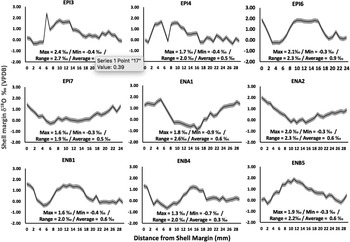
Oxygen isotopes and SST calculations results are summarized in Table 6. The nine shells that were selected for time-series isotopic analysis ranged in age from 6170 to 7930 cal yr BP. Calibrated radiocarbon ages are used here because our goal is to infer SSTs during calendar years and for comparison with other work. Figure 3 shows the submonthly δ18O values for each shell separately. Across all cultural periods, the δ18O values from the shells ranged from −0.4 ± 0.2‰ to 1.8 ± 0.3‰. The mean shell δ18O value of all analyzed shells was 0.5 ± 0.2‰. In Figure 4, the average δ18O values (n = ~30) per shell are plotted against calibrated radiocarbon ages to assess how δ18O values have varied throughout time.
Summary of nine archaeological shell δ18O values and calculated sea-surface temperature (SST) at Ifri Oudadane site.

Oxygen isotope values of nine radiocarbon-dated archaeological Phorcus turbinatus shells collected from Ifri Oudadane, NE Morocco. The envelopes surrounding the data correspond to an analytical error of ±0.2 ‰ (2σ).

Average observed δ18O values from nine archaeological Phorcus turbinatus shells collected from Ifri Oudadane, NE Morocco, compared with calibrated radiocarbon ages. Error bars represent the standard deviation in observed δ18O values for each shell.

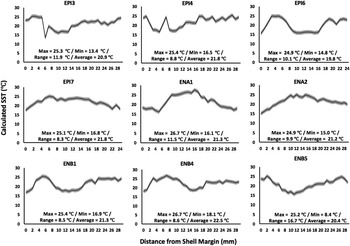
Figure 5 illustrates the calculated SSTs from each shell. The shells indicate that SSTs during the Early–Middle Holocene in NE Morocco varied from 15.9 ± 1.4°C to 25.6 ± 0.9°C.When all archaeological shells are combined, the average SST was 21.3 ± 0.8°C, that is, ~3°C warmer than today, on average. The average observed SST per shell can be plotted against calibrated radiocarbon ages to depict how SST has varied throughout time (Fig. 6).
Calculated sea-surface temperatures (SSTs) from nine radiocarbon-dated archaeological Phorcus turbinatus shells collected from Ifri Oudadane, NE Morocco. The envelopes surrounding the data correspond to an analytical error of ± 1°C.

Average annual sea-surface temperatures (SSTs) calculated from the oxygen isotope time series of nine radiocarbon-dated archaeological Phorcus turbinatus shells from Ifri Oudadane, NE Morocco. Error bars represent the standard deviations in SST data for each shell. The horizontal line represents the average annual temperature for the present day.

Submonthly SST time series per shell illustrate that measured specimens appear to have grown shell during summer and winter seasons. The magnitude of seasonality registered in each shell ranged from 8.3°C to 11.9°C, averaging 9.7 ± 1.3°C (Fig. 5, Table 6). This value is consistent with present-day amplitude of seasonality.
Shell ENB4 yielded the warmest mean annual temperature (~22.5°C), corresponding to the Early Neolithic B period, while shell EPI6 yielded the coolest mean annual temperature (~19.8°C), corresponding to the Epipaleolithic period (Figs. 5 and 6).
DISCUSSION
Time averaging of harvested marine mollusk shells
Based on the 34 radiocarbon-dated shells from the Ifri Oudadane archaeological site, we argue that some seemingly contemporaneous mollusk shells exhibit multicentennial time averaging beyond analytical error that ranged from 310 to 1170 yr. The scale of time averaging in archaeological settings is driven by multiple sedimentary and human processes operating simultaneously (Parker et al., Reference Parker, Yanes, Mesa Hernández, Hernández Marrero, Pais and Surge2020). For example, several studies have shown that low sedimentation rate leads to an increase in time averaging (e.g., Fürsich and Aberhan, Reference Fürsich and Aberhan1990; Kidwell and Bosence, Reference Kidwell, Bosence, Alison and Briggs1991; Kowalewski, Reference Kowalewski1996; Kidwell, Reference Kidwell1998; Parker et al., Reference Parker, Yanes, Mesa Hernández, Hernández Marrero, Pais and Surge2020), which is the most plausible scenario for the sediment succession at the rock shelter of Ifri Oudadane. Moreover, the human utilization of the site by deposition of archaeological material and year-round occupancy is likely to lead to increased time averaging. Indeed, Yanes et al. (Reference Yanes, Hutterer and Linstädter2018) showed that Ifri Oudadane was occupied year-round, which points to frequent input rate of shells leading to larger time averaging. Koppel et al. (Reference Koppel, Szabó, Moore and Morwood2016) showed that postdepositional anthropogenic disturbances can also lead to an increase in time averaging. In the case of Ifri Oudadane, Linstädter and Kehl (Reference Linstädter and Kehl2012) documented that some shells likely were trampled and reworked on the cave floor by either humans or animals before the shells were buried by sediments and sealed. Human trampling, building of fireplaces, digging of pits, and animal scavenging activities, among others, are likely to have occurred in the site, leading to some shell reworking postdeposition. The results presented here are consistent with some other studies on shell middens. For example, Parker et al. (Reference Parker, Yanes, Mesa Hernández, Hernández Marrero, Pais and Surge2020) dated numerous harvested mollusk shells from middens present at various sites in the Canary Islands and documented a multicentennial scale of time averaging in some cases in which remains that appeared to be contemporaneous actually were of different ages. Koppel et al. (Reference Koppel, Szabó, Moore and Morwood2016) examined shell middens with rich concentrations of charcoal and bivalves in northwest Australia, and their analyses demonstrated significant time averaging as well. All these studies and the present work emphasize that archaeological shell concentrations may exhibit multicentennial time averaging and call for precautions when examining the ages of these type of deposits.
While the Early Neolithic A layer has too small of a sample size (n = 4) to assess the age-frequency distribution of shells, a sufficient sample size was accessible for the Epipaleolithic (n = 17) and Early Neolithic B (n = 13) phases. In terms of the structure, or age-frequency distribution of the uncalibrated radiocarbon ages, both cultural phases showed a marked left-skewed distribution, that is, older age shells were more prominent, while the younger shells became less common (Fig. 2). In contrast, the majority of published studies on natural marine shelly assemblages have noted a consistent right-skewed distribution (e.g., Kowalewski et al., Reference Kowalewski, Goodfriend and Flessa1998; Kidwell et al., Reference Kidwell, Best and Kaufman2005), which indicates that younger shells are more prevalent in the stratigraphy, whereas the oldest shells are increasingly less abundant due to more prominent decay associated with longer residence time in the taphonomic (destructive) active zone. This taphonomic model does not seem to apply to the archaeological mollusk assemblages investigated here, suggesting that other processes rather than taphonomic decay are impacting these shell concentrations. Left-skewed age-frequency distribution of shelly accumulations could be explained by the human or animal footprint during site occupation at Ifri Oudadane. For example, humans and/or animals could bury slightly younger shells into older layers or depths in the profile without clear stratigraphic evidence of the process, resulting in a left-skewed age-frequency distribution.
The empirical data from the ENA phase at Ifri Oudadane have been critically debated, as they depict the oldest evidence for food and pottery production in the region. Zilhão (Reference Zilhão2014) argues that the definitive breakthrough of cereal cultivation in southern Spain and the region of Tangier, Morocco, did not occur until 200–300 yr later than the date documented at Ifri Oudadane. Furthermore, Zilhão (Reference Zilhão2014) questions that in loose sediments such as an “escargotière” (i.e., snail shell midden), age mixing is likely and therefore fine-stratigraphic studies would be impossible without a substantial number of radiocarbon dates. The results presented here seem to support Zilhão's (Reference Zilhão2014) point. Archaeological investigations of shell middens in general, and especially those focusing on the transition to food production, must therefore continue carefully in this region. Nevertheless, the archaeological record of Ifri Oudadane remains as a powerful and accessible piece of prehistory to further investigate the timing and reasons behind the rise of food production in the area.
It is important to review some of the assumptions and parameters that are made in the Monte Carlo simulation (Table 4). In all cultural phases, the actual standard deviations of the samples exceed the 95th percentile value of the 10,000 simulated Monte Carlo draws. It should be kept in mind that this is based on a calculation error of 80 for the standard deviation for all of the Monte Carlo draws. However, the ENA set of samples appears to have a calculation error higher than 80. With that being said, if a calculation error of 100 was used, the standard deviation of the ENA set would likely not exceed the Monte Carlo 95th percentile value. However, the other two sets of samples from the ENB and EPI phases have statistically larger standard deviations, and they would continue to exceed the Monte Carlo 95th percentile value, even when considering a greater analytical error of 100 yr.
Calibrated radiocarbon ages of archaeological shells were compared with published ages from Ifri Oudadane derived from terrestrial plant and vertebrate remains (Linstädter and Kehl Reference Linstädter and Kehl2012; Morales et al. Reference Morales, Pérez-Jordà, Peña-Chocarro, Zapata, Ruíz-Alonso, López-Sáez and Linstädter2013, Reference Morales, Pérez Jordà, Peña-Chocarro, Bokbot, Vera, Martínez Sánchez and Linstädter2016; Linstädter et al. Reference Linstädter, Broich and Weninger2016; Table 5). The new calibrated radiocarbon ages in this study from marine shells were mostly consistent with previously dated terrestrial remains. Interestingly, the shells retrieved from the upper Epipaleolithic phase showed slightly younger ages than anticipated. This incongruency calls for caution when assigning the age of an archaeological layer from ages derived merely from harvested shells, because processes like trampling, digging, and scavenging could potentially distort the stratigraphic position of shells (Koppel et al., Reference Koppel, Szabó, Moore and Morwood2016; Parker et al., Reference Parker, Yanes, Mesa Hernández, Hernández Marrero, Pais and Surge2020).
In this study, we dated the inner and outer aragonite layers of the same shell separately, using the carbonate-target radiocarbon method (Table 3). Our study showed that the inner and outer aragonite from the same shell yielded statistically equivalent age results in two out of the three shells that were dated. However, in EPI2, the inner and outer aragonite showed an ~200 yr offset between the layers. This observed ~200 yr offset may be explained by diagenetic alteration of the outer layer. High temperatures derived from cooking or burning activities (>300°C) may cause significant changes in the geochemistry of the shell (Milano et al., Reference Milano, Prendergast and Schöne2016, Reference Milano, Lindauer, Prendergast, Hill, Hunt, Barker and Schone2018). However, the shells analyzed here did not show visual evidence of heat exposure, and further research is needed to evaluate the potential effects of diagenetic alteration in radiocarbon results. This work illustrates that the rapid and more affordable carbonate-target radiocarbon method proved to be a valid and reliable tool for calculating the age of Holocene archaeological shells, in agreement with previous studies testing the validity of the method and successfully applying it (e.g., Kowalewski et al., Reference Kowalewski, Casebolt, Hua, Whitacre, Kaufman and Kosnik2018; New et al., Reference New, Yanes, Cameron, Miller, Teixeira and Kaufman2019; Parker et al., Reference Parker, Yanes, Mesa Hernández, Hernández Marrero, Pais and Surge2020; Bright et al., Reference Bright, Ebert, Kosnik, Southon, Whitacre, Albano and Flores2021).
Paleotemperature inferences from archaeological shells
The δ18O values along shell growth direction suggest that the analyzed archaeological shells of P. turbinatus exhibit submonthly resolution, and the quasi-sinusoidal trend suggests that specimens deposited shell relatively consistently during both winter and summer seasons (Fig. 3). The published literature has shown that about 1 mm of the shell seems to correspond to 2–4 weeks of the organism's life, which shows that Phorcus tracks submonthly SST at the sampling resolution employed, in agreement with other studies (e.g., Parker et al., Reference Parker, Yanes, Surge and Mesa-Hernández2017, Reference Parker, Yanes, Mesa-Hernández and Surge2020). Published studies from other regions in the Mediterranean suggest that Phorcus grow relatively continuously year-round, but growth rates seem to decrease or stop at SSTs above 25°C (Mannino et al., Reference Mannino, Thomas, Leng and Sloane2008; Colonese et al., Reference Colonese, Troelstra, Ziveri, Martini, Lo Vetro and Tommasini2009). However, Prendergast et al. (Reference Prendergast, Azzopardi, O'Connell, Hunt, Barker and Stevens2013) documented that P. turbinatus from Malta can grow shell at temperatures of 27°C. Thus, our P. turbinatus specimens from Morocco likely grew nearly year-round, with the possibility of some underestimation of the hottest parts of the year.
The measured δ18O values here ranged between −0.4 ± 0.2‰ and +1.8 ± 0.3‰ (Fig. 3, Table 6) and are generally consistent with δ18O values reported in other studies that have analyzed P. turbinatus shells throughout the Mediterranean, which have primarily focused on modern specimens for calibration purposes (Mannino et al., Reference Mannino, Thomas, Leng and Sloane2008; Prendergast et al., Reference Prendergast, Azzopardi, O'Connell, Hunt, Barker and Stevens2013) or on archaeological shells to identify seasons of harvest collection (Mannino et al., Reference Mannino, Thomas, Leng, Piperno, Tusa and Tagliacozzo2007; Colonese et al., Reference Colonese, Troelstra, Ziveri, Martini, Lo Vetro and Tommasini2009; Prendergast et al., Reference Prendergast, Stevens, O'Connell, Fadlalak, Touati, Al-Mzeine, Schöne, Hunt and Barker2016; Yanes et al., Reference Yanes, Hutterer and Linstädter2018).
Modern SSTs in the Alboran Sea range from 15.5°C in winter to 22.8°C in summer, with an average SST of 18.6 ± 3.0°C (Shaltout and Omstedt, Reference Shaltout and Omstedt2014). Calculated SSTs from archaeological P. turbinatus shells suggest that SSTs during the Early Neolithic in NE Morocco ranged from 15.9 ± 1.4°C to 25.6 ± 0.9°C, with a mean value of 21.3 ± 0.8°C. The results presented here suggest that winter temperatures seem to have remained relatively consistent to the present; however, summer temperatures seem to have been several degrees warmer than today. Due to warmer summer seasons, the average annual SSTs recorded in the shells are also warmer than modern (last few decades) instrument records. The observed warmer summer seasons between 6170 and 7930 cal yr BP could indicate that climate change occurred during the transition from hunting-gathering activities into a food production mode of life. These findings are consistent with previous evidence that correlated the appearance of domesticated plants in the site with gradually warming conditions (Yanes et al., Reference Yanes, Hutterer and Linstädter2018). The present study shows the apparent importance of warming summer temperatures in promoting prehistoric food production, which could have been a factor contributing to the rise of a food production mode of life in Northwest Africa.
Even though the results from this study from nine archaeological shells suggest a relatively consistent average annual SST from 6170 to 7930 cal yr BP of about 21°C (Fig. 6, Table 6), the coolest mean annual SST was obtained from one of the oldest shells (EPI6), dated to 7620 cal yr BP (19.8°C), whereas the warmest mean annual SST was retrieved from one of the youngest shells (ENB4), dated to 6680 cal yr BP (22.5°C) (Fig. 6, Table 6). Although the number of shells analyzed is not sufficient to draw definite conclusions, this apparent warming trend from the end of the Epipaleolithic into the Early Neolithic B is consistent with trends identified in other independent published proxies in Morocco (Cheddadi et al., Reference Cheddadi, Lamb, Guiot and Van Der Kaars1998) and the Alboran Sea (Cacho et al., Reference Cacho, Grimalt, Pelejero, Canals, Sierro, Flores and Shackleton1999; Martart et al., Reference Martrat, Grimalt, Shackleton, Abreu, Hutterli and Stocker2007; Bazzicalupo et al., Reference Bazzicalupo, Maiorano, Girone, Marino, Combourieu-Nebout and Incarbona2020). Martart et al. (Reference Martrat, Grimalt, Shackleton, Abreu, Hutterli and Stocker2007) examined deep-sea core ODP-977A and noted that alkenone-derived SSTs exhibited a warming trend from ~8200 to ~6800 cal yr BP. Cacho et al. (Reference Cacho, Grimalt, Pelejero, Canals, Sierro, Flores and Shackleton1999) examined alkenone-derived SSTs from deep-sea core MD952043 and reported a similar warming trend. In a recent publication, Bazzicalupo et al. (Reference Bazzicalupo, Maiorano, Girone, Marino, Combourieu-Nebout and Incarbona2020) studied the deep-sea core for Ocean Drilling Program Site 976 and reconstructed SSTs using planktonic foraminifera. Their results again showed a warming trend following the sudden decease in global temperature that occurred at 8200 cal yr BP, known as the 8.2 event. Their results indicate that the warmest temperatures occurred from 7700 to 5800 cal yr BP, with temperatures up to 23°C during summer and 16°C during winter, values consistent with results from this study.
All in all, the present and several previous paleoclimate studies in the western Mediterranean and NW Africa support a 2 to 3 degree warmer scenario during the Early–Middle Holocene than at present, following the 8.2 event. The fact that the detected warming conditions coincide with the first appearance of domesticated remains in NW Africa supports the hypothesis that warming conditions may have in part triggered the rise of food production in the area (Yanes et al., Reference Yanes, Hutterer and Linstädter2018).
The analyzed shells registered summer and winter temperatures throughout their lifespans (Fig. 5). These results show that the degree of seasonality has remained consistent between 6170 and 7930 cal yr BP, with an SST difference between summer and winter of 9.7 ± 1.3°C, on average. However, the degree of seasonality is slightly larger than what is seen in the modern-day SST instrument records, that is, 7.3°C (Shaltout and Omstedt, Reference Shaltout and Omstedt2014), which can be explained by several-degree warmer summers during the Early–Middle Holocene than today (Yanes et al., Reference Yanes, Hutterer and Linstädter2018). It is likely that a combination of factors played a role in the climate variability in the Alboran Sea during the Early–Middle Holocene. Lorenz and Lohmann (Reference Lorenz and Lohmann2004) suggest that orbital changes in insolation represent one of the primary drivers of SST variability in the Alboran Sea. Català et al. (Reference Català, Cacho, Frigola, Pena and Lirer2019) argue that orbital changes in insolation can only account for ~1.6°C of the 5°C or greater climate variability that is seen throughout the Holocene. Instead, Català et al. (Reference Català, Cacho, Frigola, Pena and Lirer2019) propose that mixing of water masses through the Straits of Gibraltar impact temperature changes in the area in combination with orbital changes in isolation. The mixing of water masses from the Atlantic Ocean through the Straits of Gibraltar following the 8.2 event or the last deglaciation could have potentially decreased the northward heat transport from the subtropical gyre, leading to an accumulation of heat that eventually entered into the Alboran Sea through the Straits of Gibraltar (Yanes et al., Reference Yanes, Hutterer and Linstädter2018; Català et al., Reference Català, Cacho, Frigola, Pena and Lirer2019).
CONCLUSIONS
New radiocarbon dates on 34 P. turbinatus shells retrieved from the Holocene archaeological succession of Ifri Oudadane, NE Morocco, reveal that these assemblages exhibit multicentennial time averaging beyond analytical error that were unclear by stratigraphic and archaeological position. This is likely due to low sedimentation rates and continuous site occupation by humans and domesticated animals. Interestingly, dated shells showed left-skewed distributions, indicating that older shells were more frequent than younger ones. This finding is in sharp contrast with natural marine shell beds, which consistently show a right-skewed structure in response to faster taphonomic decay of older shells.
This study calls for caution when assuming the age of harvested mollusk assemblages, and we advise individually dating numerous shells when possible. The present work also shows that dating shells alone may not be the best approach to understand the history of site occupation, because shells are too strongly affected by site-formation processes. We propose that directly dating artifacts and other food remains within an archaeological context is probably a more adequate approach to understand site occupation history.
Two out of the three shells tested exhibited indistinguishable ages between the inner and outer aragonite layers. Using this more affordable dating technique, we are able to date numerous specimens at low cost and gain new insights into the genesis and preservation of archaeological mollusk assemblages. Thus, we recommend radiocarbon dating each shell to constrain paleoclimatic information more robustly through time.
While the stratigraphy and chronology of harvested shelly assemblages may be difficult to understand, shells are powerful paleoclimate proxies when they are individually radiocarbon dated for finer chronological control. New oxygen isotope results from nine archaeological shells suggest that SSTs on the coast of NE Morocco during the Early Neolithic (between 6100 and 7600 cal yr BP) were ~2°C to 4°C warmer than at present. This apparently warmer scenario is consistent with the rise of a food production mode of life in NW Morocco, which could indicate a potential link between prehistoric food production and climate change; however, further studies in NW Africa are still needed to confirm this possibility.
Acknowledgments
Special thanks go to John Southon (University of California, Irvine) for assisting with radiocarbon analyses, Jason Curtis (University of Florida) for assisting with oxygen isotope analyses, and Arnie Miller (University of Cincinnati) for assisting with the Monte Carlo simulation. We also thank Abdessalam Mikdad from the Institut National des Sciences de l'Archéologie et du Patrimoine in Rabat, Morocco, and the Deutsches Archäologisches Institut, Bonn, Germany for long-term, amicable cooperative work and for providing site data. Special thanks go to editor Derek Booth, associate editor Louisa Bradtmiller, and reviewers Alan Wanamaker and Amy Prendergast for providing detailed and constructive comments that greatly improved the clarity and quality of this work.
Financial Support
Fieldwork was funded by the German Research Foundation (DFG) in the frame of the CRC 806 “Our Way to Europe.” Research with the mollusk samples was partially funded by National Science Foundation (NSF) grant no. 1802153 awarded to Y.Y. Additional support was provided by NSF/GSA Graduate Student Geoscience grant no. 12938-20 to W.S., which is funded by NSF award no. 1949901.