Diabetes mellitus is a metabolic disease resulting from a lack of insulin secretion, reduced insulin sensitivity, or both. Type 2 diabetes mellitus (T2DM) is the most common type of diabetes mellitus, globally affecting more than 415 million people (Ogurtsova et al., Reference Ogurtsova, da Rocha Fernandes, Huang, Linnenkamp, Guariguata, Cho and Makaroff2017). T2DM causes hyperglycemia as well as microvascular and macrovascular complications, thereby disrupting the functioning of many systems (Klein et al., Reference Klein, Krishnan, Glick and Smith2010; Okur et al., Reference Okur, Taspinar, Telli Atalay, Pasali Kilit, Toru Erbay and Okur2020; Orasanu & Plutzky, Reference Orasanu and Plutzky2009). One of the systems affected by T2DM is the musculoskeletal system. T2DM affects the connective tissue through various mechanisms and leads to numerous musculoskeletal system problems such as Dupuytren’s contracture, capsulitis of the shoulder, flexor tenosynovitis, carpal tunnel syndrome, Charcot arthropathy, and joint range of motion limitations (Arkkila & Gautier, Reference Arkkila and Gautier2003).
Regular exercise plays an important role in the control and prevention of complications caused by T2DM (Helmrich et al., Reference Helmrich, Ragland, Leung and Paffenbarger1991). In diabetic individuals, regular exercise improves glucose tolerance, increases insulin sensitivity, reduces HbA1C levels, and helps control weight and cardiovascular risk factors (Cade, Reference Cade2008; Colberg et al., Reference Colberg, Albright, Blissmer, Braun, Chasan-Taber, Fernhall and Sigal2010; Thompson et al., Reference Thompson, Arena, Riebe and Pescatello2013).
Kinesiophobia is defined as “an excessive, irrational, and debilitating fear of movement and activity resulting from a feeling of vulnerability due to painful injury or re-injury” (Bäck et al., Reference Bäck, Jansson, Cider, Herlitz and Lundberg2012). Kinesiophobia is associated with avoidance of physical activity and therefore has a negative impact on diabetes management (Vlaeyen et al., Reference Vlaeyen, Kole-Snijders, Boeren and Van Eek1995; Vlaeyen & Linton, Reference Vlaeyen and Linton2000).
Previous studies reported approximately 75% of individuals with T2DM have a specific musculoskeletal disorder (Mustafa et al., Reference Mustafa, Khader, Bsoul and Ajlouni2016; Williams et al., Reference Williams, London, Husni, Navaneethan and Kashyap2016). However, there are no studies that evaluated the levels of kinesiophobia of diabetics. We aimed to replicate and extend the extant findings on the association between T2DM on the frequency of musculoskeletal system disorders and kinesiophobia levels in an outpatient clinic population. Our hypothesis is that frequency of musculoskeletal system disorders and kinesiophobia levels is higher in type 2 diabetics than nondiabetics.
1. Method
1.1 Research Design
This case–control study was conducted in Dumlupinar University Evliya Celebi Training and Research Hospital between January and March 2016 in Turkey. Case–control studies help determine if an exposure is associated with an outcome. Therefore, the research design was preferred to determine the effect of T2DM on frequency of musculoskeletal system disorders and kinesiophobia levels. Individuals with T2DM and age-matched nondiabetic patients who presented to the internal medicine outpatient clinic were included in the study.
1.2 Participants
Altogether, 84 of 102 participants who met the inclusion criteria were being aged 18–65 years (mean age 51.27 ± 5.61 years; 68 women, 16 men), followed for T2DM for at least 5 years, and able to understand and respond to the questions asked. The control group included participants 18–65 years of age who had no diagnoses of diabetes mellitus or prediabetes. Eighteen participants were excluded due to missing data. The study group included 41 T2DM patients, and the control group included 43 nondiabetic individuals. There was no statically significant difference between groups in mean age and gender distributions (p > 0.05).
1.3 Procedure
The study was approved by the Dumlupinar University Clinical Research Ethics Committee and conducted in accordance with the principles of the Declaration of Helsinki (2008 revision). The participants were informed about the study and signed informed consent forms before their participation. Participants were informed that personal data would be kept confidential and participation in the study was voluntary.
1.4 Measurements
The patients self-reported their sociodemographics of age, height, weight, tobacco use, and diabetes duration. They also completed the Cornell Musculoskeletal Discomfort Questionnaire (CMDQ: Cornell University, n.d.) (to evaluate musculoskeletal system disorders) and the Tampa Kinesiophobia Scale (TKS: Vlaeyen et al., Reference Vlaeyen, Kole-Snijders, Boeren and Van Eek1995) (to assess fear of movement). We accessed the patients’ body mass index (BMI), plasma glucose levels, HbA1c levels data from their clinical files.
1.4.1 Cornell Musculoskeletal Discomfort Questionnaire
The CMDQ comprises 20 items to assess musculoskeletal system disorders in 20 body regions based on their frequency, severity, and to what extent they interfere with activity. Each region is scored between 0 and 90. Scores for each region are summed to obtain a total score. Higher scores indicate a greater impact of the musculoskeletal system disorder on the individual. In a previous study, the reliability of scores from the CMDQ ranged from 0.62–0.92 to 0.56–0.97, respectively (Erdinc et al., Reference Erdinc, Hot and Ozkaya2011).
1.4.2 Tampa Kinesiophobia Scale
The TKS is a scale comprising 17 questions to evaluate kinesiophobia (fear of movement). The scale uses a 4-point Likert-type scale (1 = Definitely disagree to 4 = Completely agree). Items 4, 8, 12, and 16 are reversed and the scores are added to obtain the total score, which ranges from 17 to 68. Higher scores indicate greater kinesiophobia. Yilmaz et al. (Reference Yilmaz, Yakut, Uygur and Uluğ2011) reported a test–retest reliability of 0.806 (95% CI = 0.720–0.867) for scores from the TKS.
1.5 Data Analysis
Statistical analyses were performed using SPSS 18.0 statistics software package. The Kolmogorov–Smirnov test confirmed normal distribution of the data. Independent samples t-test was used to compare the age and TKS scores of the groups, as they showed normal distribution. BMI, plasma glucose levels, HbA1c levels, and CMDQ subscores and total scores of groups did not show normal distribution. For that reason, we used the Mann–Whitney U test to compare the patients on the outcome variables. For differences in the frequency of musculoskeletal system disorders according to body region, we used the Pearson’s chi-square test. A p value < 0.05 was considered statistically significant.
2. Results
2.1 Descriptive statistics
The mean BMI value was over 30 kg/m2 in both groups, and it was significantly higher in the study group (p < 0.05). We found that 14.6% (n = 6) of the participants in the study group and 16.3% (n = 7) of those in the control group were active smokers. The mean diabetes duration in the study group was 9.71 ± 4.18 years. While 73.2% (n = 30) of the participants with T2DM were using oral antidiabetic drugs, 26.8% (n = 11) were using insulin. Statistical analysis of the participants’ descriptive data is shown in Table 1.
Comparison of descriptive data in patients with type 2 diabetes mellitus and nondiabetic controls

DM, diabetes mellitus; n, number; SD, standard deviation; p, level of significance; BMI, body mass index; HbA1c, glycated hemoglobin.
* Independent samples t-test.
# Mann–Whitney U Test.
2.2 Musculoskeletal conditions by body region
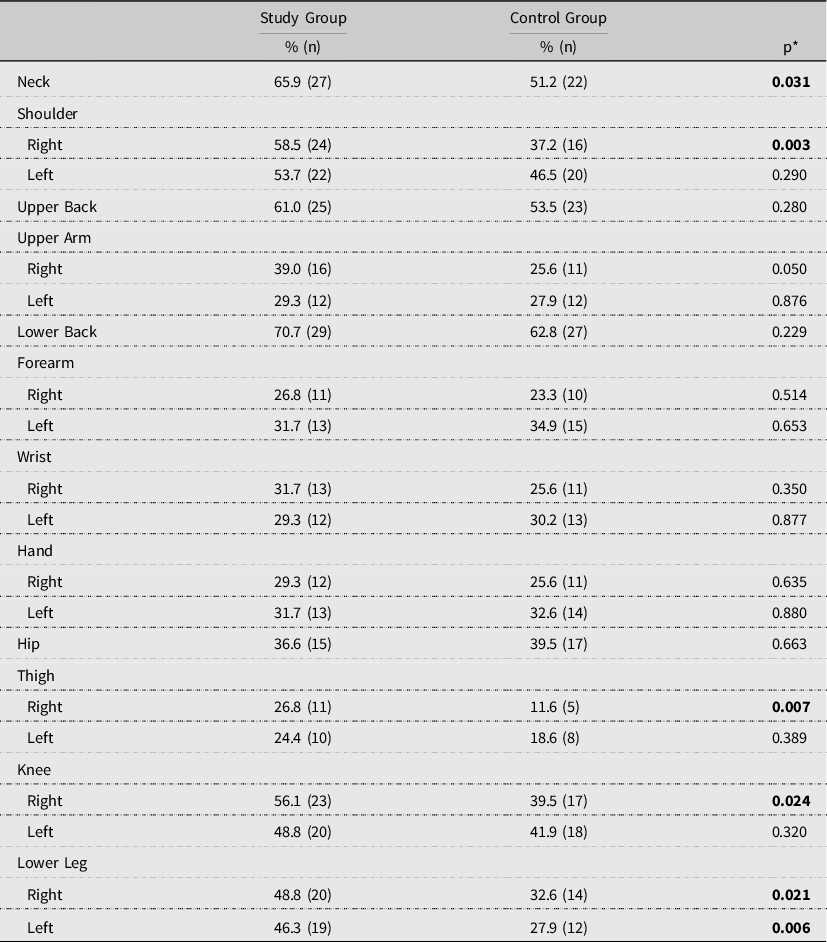
The distribution of musculoskeletal system disorders by body region is shown in Table 2. Musculoskeletal system disorders of the neck, right shoulder, right thigh, right knee, and right and left lower legs were significantly more common in the study group than in the control group (p < 0.05). Moreover, both groups showed a high frequency of musculoskeletal system disorders of the neck, back, low back, and knee.
Distribution and frequency of musculoskeletal disorders in patients with type 2 diabetes and nondiabetic controls

n, number of subjects; %, frequency; p, minimal significance.
* Pearson’s chi-square test.
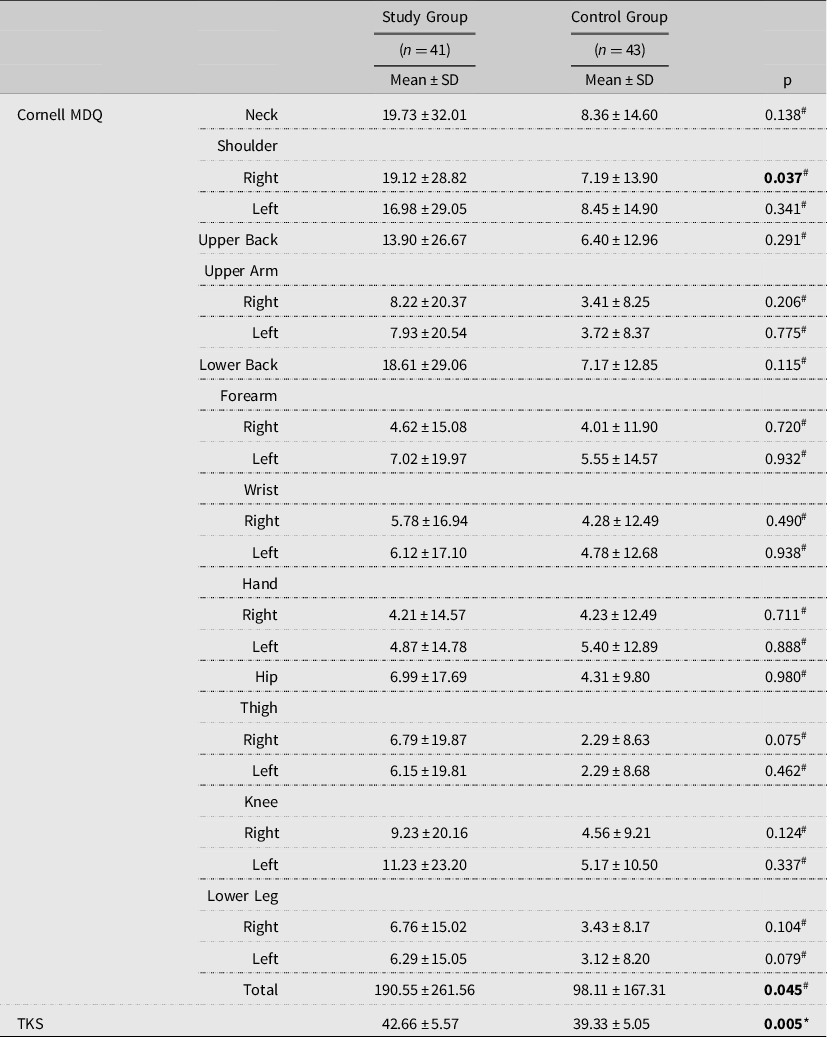
CMDQ and TKS results of the groups are given in Table 3. Analysis of the CMDQ parameters revealed significantly higher right shoulder and total scores in the study group (p < 0.05). Mean TKS scores of the participants in the study and control groups were 42.66 ± 5.57 and 39.33 ± 5.05, respectively (p = 0.05).
Comparison of Cornell Musculoskeletal Discomfort Questionnaire and Tampa Kinesiophobia Scale scores of patients with type 2 diabetes mellitus and nondiabetic controls

MDQ, musculoskeletal discomfort questionnaire; n, number of subjects; p, significance level; SD, standard deviation; TKS, tampa kinesiophobia score.
* Independent samples t-test.
# Mann–Whitney U Test.
3. Discussion
This study investigated the association between T2DM and musculoskeletal system disorders and kinesiophobia levels in an outpatient clinic sample. We found T2DM to be associated with a higher frequency of musculoskeletal system disorders and higher levels of kinesiophobia. As evidence, patients with T2DM exhibited more musculoskeletal system problems involving the lower extremities in particular.
Our findings are consistent with those of previous studies reported that musculoskeletal system disorders were more common in individuals with T2DM compared to nondiabetics (Mustafa et al., Reference Mustafa, Khader, Bsoul and Ajlouni2016; Williams et al., Reference Williams, London, Husni, Navaneethan and Kashyap2016). Diabetic cheiroarthropathy, Dupuytren’s contracture, trigger finger, adhesive capsulitis, diffuse idiopathic skeletal hyperostosis, neuropathic arthritis, carpal tunnel syndrome, reflex sympathetic dystrophy, and diabetic muscle infarcts are the most common musculoskeletal disorders seen in individuals with T2DM (Arkkila & Gautier, Reference Arkkila and Gautier2003; Crispin & Alcocer-Varela, Reference Crispin and Alcocer-Varela2003; Williams et al., Reference Williams, London, Husni, Navaneethan and Kashyap2016). Thus, our study also demonstrates that the prevalence and impact of musculoskeletal system-related disorders are higher in individuals with T2DM.
Epidemiological studies have pointed to personal, professional, and psychosocial problems associated with musculoskeletal system disorders (Shah et al., Reference Shah, Clark, McGill and Mueller2015). Although the exact etiology of T2DM-related musculoskeletal disorders is unknown, there is evidence suggesting that increased nonenzymatic glycosylation and abnormal glycogen storage in periarticular connective tissues cause changes in the connective tissue (Arkkila & Gautier, Reference Arkkila and Gautier2003). Poor metabolic control and the presence of microvascular complications are other potential mechanisms (Bhat et al., Reference Bhat, Dhar, Dar, Naikoo, Naqqash, Bhat and Butt2016). Limited joint mobility caused by T2DM leads to noninflammatory limitations in the hands, feet, and major joints (Arkkila & Gautier, Reference Arkkila and Gautier2003).
Shoulder problems are one of the common musculoskeletal system disorders in individuals with T2DM (Shah et al., Reference Shah, Clark, McGill and Mueller2015; Zreik et al., Reference Zreik, Malik and Charalambous2016). Loss of shoulder ROM and muscle strength are implicated as the main cause of shoulder problems in these patients. The underlying mechanism for this is believed to be the concentration of glucose and metabolic intermediate products to generate advanced glycation end products (AGEs) (Brownlee, Reference Brownlee1992; Shah et al., Reference Shah, Clark, McGill and Mueller2015). AGEs accumulate in low-protein tissues such as the skin and tendons and form cross-links. These cross-links make the tissues thicker, stiffer, and weaker, and consequently more susceptible to injury (Reddy, Reference Reddy2004; Shah et al., Reference Shah, Clark, McGill and Mueller2015). These structural changes affect joint movement and may lead to shoulder problems (Shah et al., Reference Shah, Clark, McGill and Mueller2015). We observed in our study that problems of the shoulder area were more common and had a greater impact on diabetics compared to nondiabetics.
Hand-related problems are the most common complaints among individuals with T2DM. Nearly half of patients with T2DM are reported to have multiple hand problems (Mustafa et al., Reference Mustafa, Khader, Bsoul and Ajlouni2016). The most common hand problems are diabetic cheiroarthropathy, Dupuytren’s contracture, flexor tenosynovitis, De Quervain’s tenosynovitis, carpal tunnel syndrome, and sclerodactyly (Bhat et al., Reference Bhat, Dhar, Dar, Naikoo, Naqqash, Bhat and Butt2016). However, the frequency and severity of hand- and wrist-related complaints were similar in the T2DM patients and nondiabetics in our study. We believe this may be related to the duration of diabetes and effective management of blood glucose levels. This finding may also be related to the fact that most of the study participants were obese and that hand- and wrist-related problems such as carpal tunnel syndrome are more common among obese individuals (Shiri et al., Reference Shiri, Pourmemari, Falah-Hassani and Viikari-Juntura2015).
Our results show that musculoskeletal disorders of the neck, back, and low back regions were most common and had the greatest impact in both groups. Animal studies have shown that T2DM leads to reduced water and glycosaminoglycan content in the intervertebral discs. These changes make the discs stiffer and more vulnerable to compression forces, which accelerate the development of discopathy (Fields et al., Reference Fields, Berg-Johansen, Metz, Miller, La, Liebenberg and Havel2015). In a study with a large number of participants, Molsted et al. reported that the frequency of low back pain was twice as high in individuals with T2DM than in nondiabetics. They stated that the main factor for this was not HbA1c, but BMI (Molsted et al., Reference Molsted, Tribler and Snorgaard2012). It was also reported in previous studies that pain and disability due to spinal problems were more common in obese individuals and increase further with higher BMI (Wertli et al., Reference Wertli, Held, Campello and Weiner2016). We believe that our findings may also be due to fact that both groups in our study included obese participants.
Our findings on gendered effects on pain disorders in the sample would be explained by the fact that women are at higher risk of developing chronic pain (Rollman & Lautenbacher, Reference Rollman and Lautenbacher2001). Therefore, the predominance of female participants in our study may explain the high prevalence of musculoskeletal pain in both groups. Musculoskeletal system disorders, primarily low back pain, are also more common in individuals who smoke (Shiri et al., Reference Shiri, Karppinen, Leino-Arjas, Solovieva and Viikari-Juntura2010). The participants’ smoking status may have led to this outcome.
We observed in this study that individuals with T2DM had higher levels of kinesiophobia than the nondiabetic participants. To our knowledge, this is the first study to investigate levels of kinesiophobia in individuals with T2DM. We believe that this increase in kinesiophobia is the result of musculoskeletal system disorders, which are more common in individuals with T2DM. Moreover, levels of kinesiophobia may have been higher among individuals with T2DM because their knowledge and experience suggest that recovery time after injury is longer due to their condition.
3.1 Limitations of the study and suggestions for further research
Our study has several limitations. The participants’ high BMI levels could be associated with their musculoskeletal system disorders and kinesiophobia levels. Thus, future studies should classify and evaluate participants according to BMI. Most of the participants in our study were female, which may have skewed the findings by sex. Therefore, the results of the study may not be representative of the experiences of male patients with type 2 diabetes. Additionally, this study did not include the diabetic foot examination, which is an important problem in patients with type 2 diabetes. Future studies should include diabetic foot examination to better understand the effect of T2DM on musculoskeletal disorders.
4. Conclusion
This study revealed that T2DM was associated with increased musculoskeletal system disorders and levels of kinesiophobia. Specifically, musculoskeletal system problems were more common in individuals with T2DM. It is important to indicate that T2DM is a major risk factor for musculoskeletal system disorders. Therefore, patients with T2DM must be evaluated for and informed about musculoskeletal system disorders in the early stage and rehabilitation programs should be designed accordingly. Moreover, psychosocial approaches to reduce kinesiophobia should be considered as part of multidisciplinary treatment programs.
Acknowledgments
None.
Financial support
This research received no specific grant from any funding agency, commercial, or not-for-profit sectors.
Conflicts of interest
None.