The determination of adequacy of the left ventricle to support the systemic circulation in a biventricular repair of various congenital cardiac malformations can be difficult. Several attempts have been made to quantify left ventricular adequacy in various conditions such as valvular aortic stenosisReference Rhodes, Colan, Perry, Jonas and Sanders1, Reference Colan, McElhinney, Crawford, Keane and Lock2 and more general left ventricular outflow tract obstruction.Reference Hickey, Caldarone and Blackstone3 At least one of these systems has been validated in a prospective manner,Reference Colan, McElhinney, Crawford, Keane and Lock2 although it is specific to aortic stenosis. Indeed, others have shown that such specific systems cannot be generalised to other types of lesions such as isolated aortic arch obstruction.Reference Tani, Minich, Pagotto, Shaddy, McGough and Hawkins4 In those cases, absolute volume measurements of the left ventricle as well as physiologic parameters such as the blood flow pattern in the ductus arteriosus are more important factors in determining left ventricle adequacy.
The initial decision to pursue either single ventricle palliation or biventricular repair is crucial. A biventricle repair that fails because of a left ventricle of insufficient size can only be converted to a single ventricle palliation with considerably increased risk.Reference Lofland, McCrindle and Williams5 Conversely, the pursuit of single ventricle palliation in a potentially adequate left ventricle can unnecessarily subject a patient to the morbidity of single ventricle physiology.
The hybrid procedure has been used extensively for palliation of single ventricle lesions such as hypoplastic left heart syndrome.Reference Akinturk, Michel-Behnke and Valeske6 Recently, a description of the hybrid procedure used as a “bailout” option after a failed biventricular repair in a patient with critical aortic stenosis was reported.Reference Pizarro, Bhat, Derby and Radtke7 Initial palliation with the hybrid procedure allows for the future choice of either biventricular or single ventricle repair without the initial use of cardiopulmonary bypass, and thus presents an attractive option for patients with a borderline left ventricle. Accordingly, the purpose of this study was to describe a series of patients with borderline left ventricular sizes who underwent initial hybrid palliation and to document short-term outcome following second-stage surgical repair.
Methods
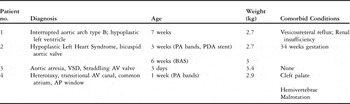
The Institutional Review Board of the University of California San Diego approved the study. Clinical data from four patients with various congenital cardiac malformations were reviewed. The diagnoses and demographic data are listed in Table 1. Transthoracic echocardiographic data were used to calculate adequacy scores based on three different scoring systems as follows:
Diagnoses and demographic data of patients at the time of the hybrid procedure.

AP = aortopulmonary; AV = atrioventricular; BAS = balloon atrial septostomy; PA = pulmonary artery; PDA = patent ductus arteriosus; VSD = ventricular septal defect
• Rhodes scoreReference Rhodes, Colan, Perry, Jonas and Sanders1: 14 (body surface area) + 0.943 (indexed diameter of aortic sinuses) + 4.78 (left ventricle to heart long axis ratio) + 0.157 (indexed mitral valve area) − 12.03.
• Colan scoreReference Colan, McElhinney, Crawford, Keane and Lock2: 12.16 (body surface area) + 0.59 (aortic annulus z-score) + 5.73 (left ventricle to heart long axis ratio) − 7.02.
• Congenital Heart Surgeons’ Society scoreReference Hickey, Caldarone and Blackstone3: The specific equation is not published. The score involves the variables of mitral valve annulus, minimum diameter of left ventricular outflow tract, and diameter of aortic arch. The score can be calculated at www.chss.org.
Each of the variables in the above equations was measured as specified in the original article for that particular equation. For the Congenital Heart Surgeons’ Society score, the online calculator was used to predict improved survival for either single ventricle palliation or biventricular repair.
Left ventricular volume was calculated using the Bullet method and indexed to body surface area.Reference Helak and Reichek8 Based on outcomes data showing uniform survival in patients with repair of aortic arch obstruction and a left ventricular volume of at least 20 millilitres per square metre, this number was used as a cut-off value for left ventricle adequacy in the varied diagnoses of this study.Reference Tani, Minich, Pagotto, Shaddy, McGough and Hawkins4
The hybrid procedure was performed in the catheterisation laboratory (stenting of the patent ductus arteriosus with or without balloon atrial septostomy) and in the operating room (placement of bilateral pulmonary artery bands).
Results
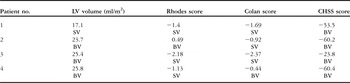
The results of the predictive equations for left ventricle adequacy and the calculated left ventricle volumes for each patient are presented in Table 2. In none of the four patients were the four measures unanimous in the recommendation to pursue either single ventricle palliation or biventricle repair, highlighting the “borderline” status of the ventricles. The left ventricle was “non-apex forming” in two patients (no. 1 and no. 2).
Results of calculations using the three scoring systems for LV adequacy and measurement of LV volume.

BV = biventricle; CHSS = congenital heart surgeons’ society; LV = left ventricle; SV = single ventricle
The resultant recommendation for either SV palliation or BV repair is listed under each value
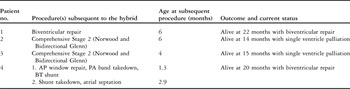
The clinical outcomes for the patients are presented in Table 3. All four patients survived the second-stage procedure with a mean follow-up of 18 plus or minus 3.9 months. Of the four patients, two went on to successful biventricle repair and two had successful single ventricle palliation operations.
Clinical course and outcomes of each patient.

AP = aortopulmonary; BT = Blaylock Taussig; PA = pulmonary artery
Patient no. 1 underwent the hybrid procedure at 7 weeks of age after a period of medical stabilisation due to comorbid conditions. At 6 months of age, the left ventricle was deemed to be adequate for an attempted biventricular repair. That conclusion was made based on an updated calculated left ventricular volume (measured by echocardiogram and by cardiac computed tomography) of 25 millilitres per square metre, as well as the absence of stenosis of both the mitral and aortic valves. The biventricular repair was successfully carried out and the patient has survived to the present time.
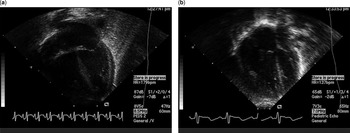
Patient no. 2 had an apparently mild form of hypoplastic left heart syndrome at birth. The atrial septum was left intact at the time of the hybrid procedure to encourage left ventricular growth. However, the patient had progressive respiratory distress over several weeks and cardiac catheterisation showed elevated left atrial pressure (mean = 18 millimetres of mercury). Following balloon atrial septostomy, the left ventricular volume decreased considerably to 15 millilitres per square metre (Fig 1). The patient subsequently underwent comprehensive stage 2 palliation (Norwood procedure and cavopulmonary anastomosis).
Transthoracic apical four-chamber views of patient no. 2 shortly after birth (a) and subsequent to balloon atrial septostomy at age 8 weeks (b).

Patient no. 3 underwent early palliation with the hybrid procedure and later required single ventricle palliation because of a straddling atrioventricular valve that precluded a safe biventricular repair in the context of the borderline left ventricle.
Patient no. 4 initially had bilateral pulmonary artery bands placed at 1 week of age. Subsequent repair of the aortopulmonary window and placement of a 4-millimetre Blalock–Taussig shunt was performed at 3 months of age. Reassessment at 8 months of age revealed interim growth of the left ventricle to a calculated volume of 30 millilitres per square metre and an adequate mitral valve annulus (z-score −1.6). Biventricular repair was successfully carried out with septation of the common atrium and takedown of the shunt.
Mitral and aortic valve measurements and corresponding z-scores were measured in all patients and used for the purposes of this study in the equations listed above. Clinical decision-making involved the use of these measurements in the context of the entirety of the data for each patient, but there were no specific cut-off values for valve size to ultimately determine left ventricular adequacy.
Discussion
This study describes the clinical course of these four patients and provides insight into several related areas. The hybrid procedure, which has good short-term results for a variety of lesions, is an effective palliation strategy in patients with borderline left ventricles.Reference Akinturk, Michel-Behnke and Valeske6, Reference Galantowicz and Cheatham9 The most attractive feature of this strategy is that a palliative procedure can be performed on a newborn without cardiopulmonary bypass. This palliation can last for at least several months in some patients and allows for further somatic growth and evolution of a patient’s cardiac anatomy and physiology. As was illustrated in two of the cases in this series, assessment of left ventricular adequacy weeks to months after the hybrid procedure is carried out can allow for a more definitive decision to pursue either single ventricle palliation or biventricular repair. Large-scale observational studies of outcomes of patients with critical aortic stenosis as neonates have shown that the failure of biventricular repair and immediate conversion to a single ventricle palliation significantly increases mortality.Reference Lofland, McCrindle and Williams5 Providing patients more time to grow, mature, and “declare themselves” as either one- or two-ventricle candidates may significantly reduce that risk.
The assessment of left ventricular adequacy in infancy remains difficult. Scoring systems developed for isolated aortic stenosis, such as the RhodesReference Rhodes, Colan, Perry, Jonas and Sanders1 and ColanReference Colan, McElhinney, Crawford, Keane and Lock2 scores, have shown effectiveness in predicting survival based on various anatomic features. Applicability of these scores is not intended for other, more complex lesions involving left ventricles of borderline size. The Congenital Heart Surgeons’ Society scoreReference Hickey, Caldarone and Blackstone3 and left ventricular volume measurementsReference Tani, Minich, Pagotto, Shaddy, McGough and Hawkins4 have been proposed to help quantify left ventricle adequacy in other lesions. Nevertheless, it is of interest to compare all the quantitative tools in this case series and find that in no patient was there uniformity among the four quantifiers in the recommendation to pursue either single ventricle palliation or biventricular repair. This most likely reflects the true “borderline” sizes of the left ventricles in the present series and highlights the difficulty in making a final clinical decision based solely on the results of these variables and scoring systems. This further argues for postponement, if possible, of the ultimate decision between one- and two-ventricle pathways in similar patients for whom the ventricles are truly borderline in size. The hybrid procedure is currently the best means of postponement in such cases, and may represent the preferred initial intervention in similar patients. Prospective trials using the hybrid to test outcomes in such patients are needed to confirm this idea.
Conclusions
The hybrid procedure can be safely performed and used in a variety of lesions with borderline left ventricles for temporary palliation. Determination of left ventricular adequacy is more easily made in some patients following this period of palliation. Published scoring systems used to determine left ventricular adequacy were shown to be disparate in the recommendations to perform either single ventricle or biventricular repair, highlighting the continuing clinical problem of determining left ventricular adequacy in diverse anatomical lesions.