Introduction
Serine proteases are the best-studied proteases and are present in viruses, prokaryotes and eukaryotes, suggesting their vital role in the survival of organisms (Applebaum, Reference Applebaum, Kerkut and Gilbert1986; Terra and Ferreira, Reference Terra and Ferreira1994). In insects, among serine proteases, trypsins and chymotrypsins are the most commonly reported enzymes acting in a wide range of physiological processes, including digestion, protein activation in the melanization cascade, antibacterial activity and insect immune response (Reeck et al., Reference Reeck, Oppert, Denton, Kanost, Baker, Kramer and Turk1999; Ma and Kanost, Reference Ma and Kanost2000). Some potent plant inhibitors specifically inhibit the normal functioning of these proteases.
These inhibitors, called protease inhibitors (PIs), may be synthesized constitutively during normal development or may be induced in response to herbivory or wounding (Koiwa et al., Reference Koiwa, Bressan and Hasegawa1997; Ryan and Pearce, Reference Ryan and Pearce1998). The PIs inhibit insect gut proteases by binding tightly to the active site, making complex formation essentially irreversible. The inability to utilize ingested protein and to recycle digestive enzymes results in a critical amino acid deficiency, which affects the growth, development and survival of the herbivore (Nanasahe et al., Reference Nanasahe, Doyle, Fitches and Gatehouse2008).
Phytophagous insects, particularly lepidopterans and dipterans, depend on serine proteases for digestion of food proteins. These proteases can serve as a major target for pest control by these enzyme inhibitors present ubiquitously in plants. Leguminous plants are a rich source of these PIs. Therefore, in the present paper, we reported the biopotency of partially purified pea PI against the melon fruit fly, Bactrocera cucurbitae (Coquillett) (Diptera: Tephritidae), a major pest of cucurbit crops. Fruit flies are among the most serious pests of fruits and crops, and the melon fruit fly B. cucurbitae (Coquillett) is an economically important pest of fruits and vegetables, especially cucurbits such as cucumber (Cucumis sativus L.), watermelon (Citrullus lanatus (Thunb.) Matsum. & Nakai), cantaloupe (Cucurbita pepo L.), bittermelon (Momordica charantia Descourt.) and zucchini (C. pepo) (Clausen et al., Reference Clausen, Clancy and Chock1965; White and Elson-Harris, 1992; Koyama et al., Reference Koyama, Kakinohana and Miyatake2004). It causes severe losses (up to 100% of crop loss) directly by damaging fruits and vegetables and indirectly through quarantine restrictions, hampering the international marketing of these agricultural products (Haq et al., Reference Haq, Cáceres, Hendrichs, Teal, Wornoayporn, Stauffer and Robinson2010a). Relying on conventional chemical control to manage tephritid pests (Roessler, Reference Roessler, Robinson and Hooper1989) has led to increasing environmental concerns and, therefore, alternative strategies have been sought (Haq et al., Reference Haq, Mayr, Teal, Hendrichs, Robinson, Stauffer and Hood-Nowotny2010b). Introducing the mechanism of producing specific PIs in desired plants as a defence response against the target pest is an alternative strategy when attempting to create biologically safe control measures.
Materials and methods
Sources of materials
Seed samples of garden pea (Pisum sativum L. (Fabaceae)) were procured from the local market for the extraction and partial purification of PI. Seeds were identified from the Department of Botanical and Environmental Sciences, Guru Nanak Dev University, Amritsar (India) with accession no. 0404/HRB.
Bovine serum albumin (BSA) was obtained from Loba (India). Bovine trypsin, N-α-benzoyl-dl-arginine-p-nitroanilide (BApNA), benzoyl-tyrosine-p-nitroanilide (BTPNA), succinyl-alanine-alanyl-prolyl-leucine-p-nitroanilide (SAAPLpNA), leucine-p-nitroanilide (LpNA) were obtained from Sigma-Aldrich (Delhi, India).
Partial purification
Dry peas soaked in 50 mm sodium acetate buffer (pH 4.9) overnight were on the next day filtered through multiple layers of surgical gauze (Ferrason et al., Reference Ferrason, Quillien and Gueguen1997). The filtrate was centrifuged at 8800 rpm for 30 min at 4 °C. The clear supernatant was stored at − 20°C as crude extract and tested for PI activity. The crude extract was further subjected to 0–80% direct ammonium sulphate saturation (kept overnight). The extract was centrifuged at 8800 rpm for 15 min at 4 °C. The precipitates obtained were collected by dissolving them in a minimal known volume of 50 mm Tris–HCl (pH 8.8). The dissolved fractions were dialysed in cold for about 96 h against 50 mm Tris–HCl. The dialysed partially purified PI from peas was stored at − 20 °C and was analysed for PI activity.
Protein estimation
Protein estimation was done in crude as well as partially purified preparations by the method of Lowry et al. (Reference Lowry, Rosebrough, Lewis and Randall1951) using BSA (Loba, India) as the standard, for preparing various test concentrations for bioassay and enzyme studies.
Trypsin inhibition assay
Trypsin residual activity was estimated by the hydrolysis of BApNA in the presence of the inhibitor (Paulino da Silva et al., Reference Paulino da Silva, Leite, Bloch and Maria de Freitas2001). The enzyme was pre-incubated with the partially purified inhibitor as well as with the crude extract for 15 min at room temperature in 50 mm Tris–HCl buffer (pH 8.2). The assayed residual activities were followed by the hydrolysis of 1 mm BApNA and the liberation of p-nitroaniline, which was measured at 410 nm. One unit of inhibitor activity corresponded to its amount that produced a decrease in absorption at 410 nm by 0.1 units in the inhibitor activity assay at 50% inhibition.
Insect rearing
The melon fruit fly was reared on natural food in the insect culture room/biological oxygen demand incubator with controlled temperature (25 ± 2 °C), relative humidity (70–80%) and photoperiod (10L:14D) (Gupta et al., Reference Gupta, Verma and Kashyap1978). Adult flies were provided 20% sugar solution and Protinex (Pfizer India) as food and pieces of pumpkin fruit, Cucurbita moschata (Duschesne ex Poir.) for oviposition.
Bioassays
About 100 gravid females were released in wire mesh cages provided with fresh pumpkin pieces for 8 h. The pumpkin pieces were removed at an appropriate time interval from the cages and dissected in saline water for harvesting the second-instar (64–72-h-old) larvae. The harvested larvae were transferred to culture tubes (25 mm diameter × 100 mm length) containing an artificial diet incorporated with various concentrations (namely 12.5, 25, 50, 100, 200 and 400 μg/ml) of partially purified PI. The artificial diet (control as well as treated) was prepared according to the standardized methodology given by Srivastava (Reference Srivastava1975). Observations were made for the larval survival, larval weight gain, mean relative growth rate (MRGR) and food assimilated after three time intervals (24, 48 and 72 h). There were six replications with 15 larvae in each replicate for each concentration, and each experiment was repeated twice.
The MRGR, which provides a measure of the rate of change in weight in units of mg/mg/day, was calculated according to the formula given by Martinez and van Emden (Reference Martinez and van Emden2001). Food assimilated with respect to the control was also assessed according to the formula given by Khan and Saxena (Reference Khan and Saxena1985).
Enzyme assays
The potential of partially purified pea PI in reducing the digestibility of the gut proteases of B. cucurbitae was ascertained by estimating the activity of larval gut trypsin-like enzymes with BApNA, chymotrypsin-like enzymes with BTPNA, elastase-like enzymes with SAAPLpNA and leucine aminopeptidase-like enzymes using LpNA as the substrate (Christeller et al., Reference Christeller, Laing, Shaw and Burgess1990, Reference Christeller, Laing, Markwick and Burgess1992). The activity of each enzyme was monitored for the three consecutive time intervals (24, 48 and 72 h) after feeding the second-instar larvae of the melon fruit fly on the artificial diet incorporated with four concentrations (namely 50, 100, 200 and 400 μg/ml) of partially purified PI from peas. The influence of partially purified pea PI was also investigated for its influence on the activity of some detoxification (esterases, acid phospatases, alkaline phosphatases and glutathione S-transferases) and antioxidant enzymes (superoxide dismutase (SOD) and catalase) in the second-instar larvae of B. cucurbitae to ascertain their role in counteracting metabolic stress produced by the ingestion of PIs. The larvae (64–72 h old) harvested from the pumpkin pieces were transferred to the artificial control diet as well as to the diet containing different concentrations of the partially purified PI, and enzyme activity was assessed after the three time intervals, i.e. 24, 48 and 72 h. Activity determination of esterases was based on the methodology outlined by Katzenellenbogen and Kafatos (Reference Katzenellenbogen and Kafatos1971). α-Naphthyl acetate (1 mm) was used as a substrate and 0.1 m sodium phosphate buffer (pH 6.5) as an extraction buffer. The activity of acid and alkaline phosphatases was assessed by the procedure given by McIntyre (Reference McIntyre1971) using the substrate 5 mm sodium α-naphthyl phosphate in 0.05 m acetate buffer (pH 5.0). However, acid phosphatases were extracted in 0.05 m acetate buffer (pH 5.0) and alkaline phosphatases were extracted in 0.05 m Tris buffer (pH 8.6). SOD was investigated by following the methodology provided by Kono (Reference Kono1978). Hydroxylamine hydrochloride (20 mm, pH 6.0) was used as a substrate solution and sodium carbonate buffer (50 mm, pH 10.0) as an extraction buffer. Catalase activity was determined by using 0.05% hydrogen peroxide (H2O2) as a substrate solution and potassium phosphate buffer (0.05 m, pH 7.0) as an extraction buffer, as described by Bergmeyer et al. (Reference Bergmeyer, Gawehn, Grassl and Bergmeyer1974). Glutathione S-transferase (GST) activity was obtained by using sodium phosphate buffer (0.1 m, pH 7.6) as an extraction buffer and 10 mm 1-chloro-2,4-dinitrobenzene in 95% ethanol as a substrate solution according to the methodology given by Chien and Dauterman (Reference Chien and Dauterman1991). Each experiment had six replications and was repeated twice.
Statistical analysis
Statistical analysis was performed using the SPSS 10.0 computer program. Results are expressed as means ± SE. Means were compared using one-way analysis of variance. Statistical differences were determined by Tukey's post hoc test. Means obtained for enzyme activities at all the three exposure intervals were compared for their significance by the t-test.
Results and Discussion
Bioassay
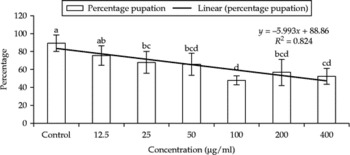
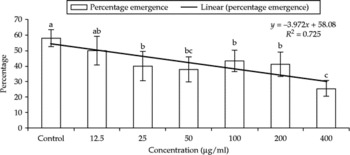
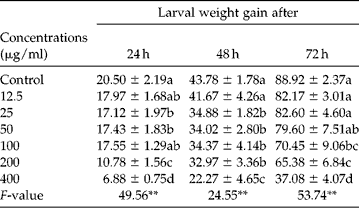
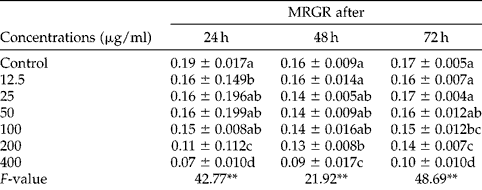
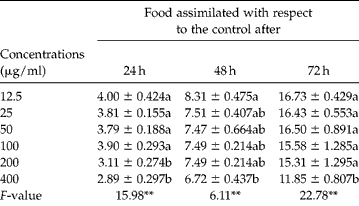
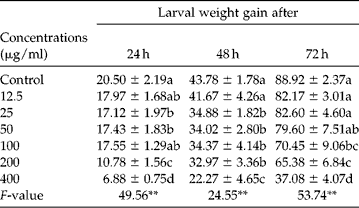
Inhibitory effects of PI partially purified from peas (Table 1) were observed on the larvae of B. cucurbitae. A reduction in the percentage of pupation and the percentage of adult emergence in the present study revealed this inhibitory influence on the survival of the melon fruit fly (Figs 1 and 2, respectively). These inhibitory effects were further manifested in the form of decreased larval weight, MRGR and food assimilated with respect to the control. Larval weight gain showed almost a consistent decrease with an increase in the concentration of partially purified PI from peas when observations were made after 24, 48 and 72 h (Table 2). Larval weight gain was inhibited maximally by 66.4% at the 400 μg/ml concentration after 24 h of treatment. The MRGR was not much affected at lower concentrations but decreased significantly (P< 0.01) at higher concentrations (Table 3). At the 400 μg/ml concentration, the decrease in MRGR was considerably greater after 24 h of treatment (63.2%), than after 48 h (43.7%) and 72 h (41.2%) of treatment. The food assimilated with respect to the control was higher at lower concentrations but declined significantly (P< 0.01) at the highest concentration of 400 μg/ml (Table 4). In a previous study, a black-eyed pea trypsin/chymotrypsin inhibitor (BTCI) reduced the larval growth of the cotton bollworm Anthonomus grandis Boheman, when the larvae were fed three different inhibitor concentrations (Franco et al., Reference Franco, dos Santos, Batista, Mendes, de Araujo, Monnerat, Grossi-de-Sá and de Freitas2003). At the lowest BTCI concentration (10 μm), no effect was observed when compared with control larvae. In the presence of an intermediate concentration (50 μm), a reduction of 12% in larval weight was observed. On the other hand, a larval weight reduction of 46% was observed at the highest BTCI concentration (100 μm). In another study, a pea inhibitor (PsTZ-20) induced significant mortality and growth inhibition of the pea aphid Acyrthosiphon pisum Harris (Rahbé et al., Reference Rahbé, Ferrasson, Rabesona and Quillien2003).
Partial purification of pea PI from the seeds of Pisum sativum L.

Effect of partially purified pea PI on the percentage of pupation of the melon fruit fly, when the second-instar larvae were fed on the treated diet. The bars represent means ± SE. Different letters indicate mean values that are significantly different (P< 0.05; Tukey's test).

Effect of partially purified pea PI on the percentage of emergence of the melon fruit fly, when the second-instar larvae were fed on the treated diet. The bars represent means ± SE. Different letters indicate mean values that are significantly different (P< 0.05; Tukey's test).

Effect of partially purified pea PI on larval weight gain of the second-instar larvae of Bactrocera cucurbitae
Mean values within a column followed by the same letter are not significantly different (P>0.05; Tukey's test).
** Significant at 1%.
Effect of partially purified pea PI on MRGR of the second-instar larvae of Bactrocera cucurbitae
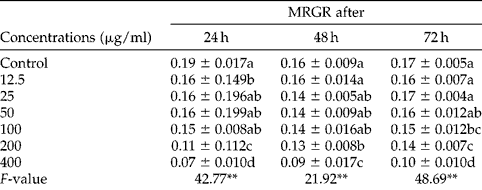
Mean values within a column followed by the same letter are not significantly different (P>0.05; Tukey's test).
** Significant at 1%.
Effect of partially purified pea PI on food assimilated with respect to the control in the second-instar larvae of Bactrocera cucurbitae
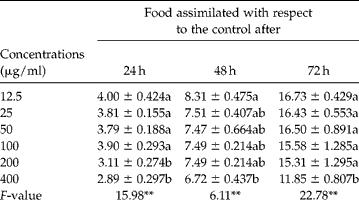
Mean values within a column followed by the same letter are not significantly different (P>0.05; Tukey's test).
** Significant at 1%.
Enzyme assays
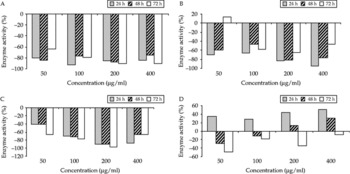
Midgut digestive enzymes can be targeted by plant proteinaceous inhibitors to interfere in normal food digestion and absorption in insect pests (Jongsma and Bolter, Reference Jongsma and Bolter1997). This was very much evident from the observations made on the proteolytic enzyme activity in the second-instar larvae of B. cucurbitae where the three endo-peptidases, i.e. trypsin, chymotrypsin and elastase, were inhibited at all the three time intervals (Fig. 3A–C).
Influence of partially purified pea PI on the activity of digestive enzymes (A, trypsin; B, chymotrypsin; C, elastase; D, leucine aminopeptidase) of second-instar (64–72 h old) Bactrocera cucurbitae larvae

However, in the case of chymotrypsin and elastase, the inhibition was less at lower concentrations and considerably greater at higher concentrations. Maximum inhibition of trypsin activity (92.6%) was observed at 100 μg/ml after 24 h of treatment (Fig. 3A). Chymotrypsin-like activity was maximally inhibited by 94.3% at the highest concentration of 400 μg/ml after the 24 h interval (Fig. 3B). Elastase-like activity showed a maximum decrease of 96.6% at the 200 μg/ml concentration at the 72 h treatment interval when compared with the control (Fig. 3C). The activity of an exopeptidase, leucine aminopeptidase, increased at the initial treatment interval but was inhibited after prolonged treatment (Fig. 3D).
The inhibitory activities of the BTCI towards serine protease from larvae and adult cotton boll weevil insect, A. grandis, were determined by in vitro enzyme assays (Franco et al., Reference Franco, dos Santos, Batista, Mendes, de Araujo, Monnerat, Grossi-de-Sá and de Freitas2003). The inhibitor was highly active against trypsin-like enzymes of A. grandis adults, resulting in a 90% inhibition at 14 μg/ml concentration. On the other hand, approximately 70% of chymotrypsin-like enzyme activity was inhibited in the gut of the larvae and adults of A. grandis at a concentration of 40 μg/ml.
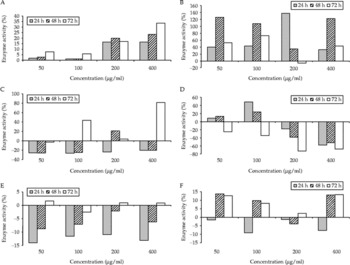
The antioxidant enzymes (Fig. 4A and B) assessed for their activity in the second-instar larvae of B. cucurbitae under the influence of partially purified pea PI showed a significant increase in SOD (Fig. 4A) and catalase activity at all the tested concentrations with an increase in the time interval (Fig. 4F). The induction in SOD was significantly greater at the higher concentrations of 200 and 400 μg/ml. At the 400 μg/ml concentration, a maximum increase was observed at 72 h where the activity increased to 36.48% when compared with 27.27% in the control. On the other hand, catalase activity was induced notably at all concentrations with maximum induction observed at 48 h of treatment with respect to the control (Fig. 4B). Felton and Summers (Reference Felton and Summers1995), suggested a quantitative relationship between SOD and catalase; SOD, which provides the first line of defence against toxicity from free radicals generated during metabolism (Paes et al., Reference Paes, Oliveria and Oliveria2001; Wang, Reference Wang2001), dismutates the free superoxide radical (O2) to H2O2, which, in turn, is eliminated by catalase.
Influence of partially purified pea PI on the activity of antioxidant enzymes (A, superoxide dismutase; B, catalase) and detoxification enzymes (C, esterase; D, glutathione-S-transferase; E, acid phosphatase; F, alkaline phosphatase) involved in growth and development of second instar larvae (64–72 h) of Bactrocera cucurbitae.

The enzymes esterase and GST have been associated with insecticide resistance in a number of insects where their functional role involves xenobiotic metabolism and sequestration (Oppenorth, Reference Oppenorth, Kerkut and Gilbert1985; Enayati et al., Reference Enayati, Ranson and Hemingway2005). In the present study, the activity of esterases showed a decrease at the initial treatment interval at all concentrations but was induced after prolonged treatment of 72 h, indicating an insignificant role of esterases in PI metabolism (Fig. 4C). Nevertheless, the activity of GST was induced at lower concentrations, but at higher concentrations, the activity decreased significantly when compared with the control, which could be due to the interference of the PI in the general metabolism of the insect, thereby affecting the synthesis of these enzymes (Fig. 4D).
Among the phosphatases, the activity of acid phosphatases was suppressed while that of alkaline phosphatases was induced at most of the exposure intervals (Fig. 4E and F). Phosphatases play an important role in the metabolism of nucleotides, carbohydrates, phospholipids and proteins (Rockstein, Reference Rockstein1956; Chaubey and Bhatt, Reference Chaubey and Bhatt1988). They have also been implicated in the development of resistance to insecticides (Oppenorth, Reference Oppenorth, Kerkut and Gilbert1985). The present findings clearly show that while proteases are the main target of PIs, activation of the other enzymes involved in detoxification and antioxidant mechanisms is also affected by the treatment. The decrease in MRGR and food assimilated could thus be attributed to the inhibitory effect of the PI on the gut enzymes, which are responsible for the assimilation of ingested food. Following inhibition, the target proteases can no longer cleave peptide bonds, which causes a detrimental disruption of dietary protein assimilation in herbivorous pests, leading to significant growth and developmental delays (Haq et al., Reference Haq, Atif and Khan2004).
Conclusion
The present findings, regarding retarded growth and development under the influence of partially purified pea PI and the inhibition of major serine proteases of the melon fruit fly, contribute towards the success of plant PIs in combating insect herbivory.
Acknowledgements
The grant received from the University Grant Commission (F. no. 34-472/2008 SR) is gratefully acknowledged.