Introduction
Poor eggshell quality is a significant problem in the poultry industry, negatively affecting the economic results of egg production, as well as decreasing the hatchability of eggs and increasing embryonic mortality (Hunton, Reference HUNTON2005). Protection of the embryo from the harmful influence of outside environmental factors, regulation of gas and water exchange, and serving as a Ca supply for embryonic development are the main functions of the eggshell (Narushin and Romanov, Reference NARUSHIN and ROMANOV2002). Eggshell quality is also an important concern for consumers, as strong resistance to breaking and lack of shell defects are essential for protection against the penetration of pathogenic bacteria into eggs. This is an especially crucial problem in the EU, where scale of egg production in cage systems is being gradually reduced, since it was reported that the total aerobic flora contamination of eggshells is significantly higher in eggs derived from the aviary housing system in comparison to the conventional or furnished-cage systems (De Reu et al., Reference DE REU, GRIJSPEERDT, HEYNDRICKX, ZOONS, DE BAERE, UYTTENDAELE and HERMAN2005). The results of a recent study (Samiullah et al., 2014) also demonstrated that the total microbial load of eggshells is lower for cage system eggs compared with free-range.
Eggshell quality has a huge impact on the profitability of egg production. The results of earlier studies demonstrated that eggs with shell defects account for 6-10% of all produced eggs, which causes significant economic losses at different stages of the egg production process and safety consequences for consumers (Roland, Reference ROLAND1988; Bain, Reference BAIN1997). Mabe et al. (Reference MABE, RAPP, BAIN and NYS2003) indicated that cracked or broken shells account for 80-90% of eggs that are routinely downgraded. One of the main concerns is the decrease of eggshell quality with hen age, since the incidence of cracked eggs can exceed even 20% at the end of the laying period (Nys, Reference NYS2001). This trend can be attributed, among others, to disorders of vitamin D3 metabolism in older hens (Bar et al., Reference BAR, VAX and STRIEM1999). For these reasons, there is still a high level of interest in studies on factors affecting eggshell quality, and efficient ways of improving eggshell indices are of critical importance for the poultry industry.
Many factors affect eggshell mineralisation and quality, including genetic, environmental and nutritional factors, as well as the health status of hens. Most studies on dietary effects on eggshell and bone quality in laying hens have focussed on macrominerals and vitamin D3. However, the results of some recent experiments have demonstrated that certain dietary levels and sources of certain microelements, mainly zinc and manganese, as well as diet supplementation with certain feed additives influencing the metabolic indices of the gastrointestinal tract, can beneficially affect the eggshell mineralisation process and eggshell quality. Thus, the aim of this article is to present and discuss the findings of current studies with laying experiments in which the effects of dietary factors that can beneficially affect eggshell quality have been evaluated, with special emphasis on the efficacy in this regard of certain microelements and feed additives.
Results of recent studies on the effect of nutrition on eggshell quality
calcium
Due to the specific chemical composition of eggshells (about 95% of the shell is calcium carbonate) and the dynamic run of the shell calcification process, the optimal supply of a hen's organism with Ca is the critical nutritional factor affecting eggshell quality. Results of many earlier experiments demonstrated that published values for Ca requirements of hens (NRC, 1994) are adequate for optimum shell formation and further increases in Ca dietary level above 3.6-3.9% usually have no positive influence on eggshell quality (Keshavarz, Reference KESHAVARZ2003; Pastore et al., Reference PASTORE, GOMES, ROSTAGNO, ALBINO, CALDERANO, VELLASCO, DA SILVA VIANA and ALMEIDA2012). In a recent study, Jiang et al. (Reference JIANG, CUI, SHI, KE, LUO and HOU2013) even reported that laying hens fed diets with high Ca concentrations (4.4%) experienced decreased eggshell quality (shell thickness) in comparison with a control group (3.7% Ca).
Many studies have reported the beneficial effect of replacing fine limestone with coarse limestone or oyster shell, both of which have higher retention times in the gizzard, are dissolved more slowly and thus supply the hen's organism more evenly with Ca along with maintaining an adequate Ca blood concentration also during the night, has been observed (Guinotte and Nys, Reference GUINOTTE and NYS1991; Koreleski and Świątkiewicz, Reference KORELESKI and ŚWIĄTKIEWICZ2004; Lichovnikova, Reference LICHOVNIKOVA2007). More recently Cufadar et al. (Reference CUFADAR, OLGUN and YILDIZ2011) investigated the effects of Ca dietary levels (3.0, 3.6, or 4.2% Ca) and limestone particle sizes (<2 mm, 2-5 mm, >5 mm) in moulted laying hens (76 weeks of age). The obtained results showed that medium or large particle sizes of limestone had a positive effect on eggshell (and tibia bone) breaking strength when the diet was low in Ca, but this effect was not found in hens fed with a normal or high Ca dietary content (Cufadar et al., Reference CUFADAR, OLGUN and YILDIZ2011).
phosphorus
The results of many studies indicated that dietary levels of 0.30-0.35% available P enables optimal eggshell quality, whereas too high a level of available P, above 0.40-0.45%, can interfere with intestinal Ca absorption, resulting in a reduction in eggshell quality (Hossain and Bertechini, Reference HOSSAIN and BERTECHINI1998; Usayran et al., Reference USAYRAN, FARRAN, AWADALLAH, AL-HAWI, ASMAR and ASHKARIAN2001; Waldroup et al., Reference WALDROUP, WATKINS and HELLWIG2005). Moreover, reduction of available P, even to 0.15-0.20% of the diet, had, in some experiments, no negative effect on eggshell quality measurements (Keshavarz, Reference KESHAVARZ2003), however such low dietary P levels may negatively affect egg production.
vitamin D3
Vitamin D3 is essential for proper Ca utilisation; therefore a sufficient dietary level is necessary for good eggshell quality. Some research findings have demonstrated that diet supplementation with an active metabolite of vitamin D3, i.e. 25-OH-D3, can positively affect eggshell quality (Bar et al., 1988). Since the ability to produce active metabolites of vitamin D3 is reduced in older hens, the beneficial effects of added dietary 25-OH-D3 can be significantly more pronounced in the second part of the laying cycle (Koreleski and Swiatkiewicz, 2005). However, the majority of studies did not show any significant influence of dietary 25-OH-D3 on eggshell quality (among others Keshavarz, Reference KESHAVARZ2003).
microelements
Most studies on nutritional effects on eggshell and bone quality in laying hens have focussed on the effects of dietary Ca, P, and vitamin D3. However, it is known that some enzymes, e.g. carbonic anhydrase, related to certain microelements are important in the mineralisation process, and in recent years there have been an increasing number of studies with laying hens on the relationship between microminerals and eggshell quality. Mabe et al. (Reference MABE, RAPP, BAIN and NYS2003) suggested that trace elements such as Zn, Mn and Cu, as cofactors of certain enzymes, could affect the mechanical properties of eggshells through exerting an influence on calcite crystal formation and modifying the crystallographic structure of eggshells.
Results of an early experiment with laying hens demonstrated that a dietary concentration of 28 mg/kg Zn was sufficient for good eggshell quality (Stahl et al., Reference STAHL, COOK and SUNDE1986); however, this finding was not confirmed by some subsequent studies. Mabe et al. (Reference MABE, RAPP, BAIN and NYS2003) reported the positive effect of basal diet (32.6 mg/kg Zn) supplementation with 60 mg/kg Zn on eggshell resistance in older hens (69 to 82 weeks of age), but in younger hens they observed no such effect. However, since a 60 mg/kg Mn and 10 mg/kg Cu were added in combination with Zn (Mabe et al., Reference MABE, RAPP, BAIN and NYS2003), it is not possible to conclude if this effect was due to Zn supplementation.
In an early experiment, Leach and Gross (Reference LEACH and GROSS1983) demonstrated that eggshells from hens fed a diet deficient in Mn are thinner and show alterations in shell ultrastructure in the mamillary layer and decreased contents of hexozamine and hexuronic acid in the organic matrix. Sazzad et al. (Reference SAZZAD, BERTECHINI and NOBRE1994) found that the content of Mn in a basal, corn-soybean diet (25 mg/kg) is sufficient for optimal laying performance in hens; however, eggshell thickness increased with increasing dietary supplementation of Mn until 105 mg/kg (25 mg/kg from the basal diet and 80 mg/kg from added MnO), without reaching a plateau. In an experiment by Fassani et al. (Reference FASSANI, BERTECHINI, DE OLIVEIRA, GONCALVES and FIALHO2000), increasing a Mn supplement (40-200 mg/kg) to the diet for layers in the second cycle of production linearly improved eggshell thickness and egg loss index. Results of a recent study with Hy-Line Grey layers by Xiao et al. (Reference XIAO, ZHANG, WU, ZHANG, YUE and QI2014) indicated that dietary Mn supplementation (100 mg/kg) positively affects eggshell quality, i.e. breaking strength, thickness, and fracture toughness, by increasing the synthesis of glycosaminoglycan and uronic acid in eggshell glands, as well as improving eggshell ultrastructure. However, Sazzad and Bertechini (Reference SAZZAD and BERTECHINI1998) found that increasing levels of dietary Mn (25, 50, or 75 mg/kg) had no effect on eggshell quality, which was contradictory to their previous findings (Sazzad et al., Reference SAZZAD, BERTECHINI and NOBRE1994). In general experimental data show that dietary Mn can improve the mechanical properties of eggshell, while the effects on eggshell weight or thickness are rather inconsistent. Discussing the effects of dietary levels of Zn and Mn, it should be also mentioned that in the UE the maximal concentrations of these trace elements in poultry diets were reduced by European legislation to 150 mg/kg (European Commission, 2003).
Results of several recent experiments have demonstrated that not only the level of microelements in a layer's diet but also their form (inorganic vs. organic complexes) may affect eggshell quality (Table 1). However, the results of studies comparing the efficacy of inorganic and organic sources in laying hens nutrition are inconsistent and in general inconclusive. Swiatkiewicz and Koreleski (Reference SWIATKIEWICZ and KORELESKI2008) found that substituting Zn and Mn oxides with amino acid complexes of these microelements alleviates the negative effect of hen age on eggshell quality, improving eggshell breaking strength in the late phase of the laying cycle (at 62 and 70 weeks of age), with no effect on the physical and geometrical parameters of tibia, ash content in tibia and in toes, eggshell percentage, thickness and density. Gheisari et al. (Reference GHEISARI, SANEI, SAMIE, GHEISARI and TOGHYANI2011) supplemented corn-soybean diet with Zn, Mn, and Cu amino acid complexes or sulphates (40, 40, and 7 mg/kg, respectively) and reported that eggshell thickness was higher by 3.8% in hens fed diet with organic microelements. Favero et al. (Reference FAVERO, VIEIRA, ANGEL, BESS, CEMIN and WARD2013) evaluated organic amino acid complexes of Zn, Mn, and Cu added to Cobb 500 breeder hen diets containing inorganic sulphates of these microelements. The results indicated that simultaneous diet supplementation with inorganic and organic forms of Zn, Mn, and Cu significantly increased eggshell quality, i.e. eggshell weight and thickness. It should be underlined that the effect of organic minerals corresponded to an improvement of eggshell weight by about 2% representing one third of the lost due to hen age between 35 to 62 weeks of age (7%) (Favero et al., Reference FAVERO, VIEIRA, ANGEL, BESS, CEMIN and WARD2013). In a recent experiment (Stefanello et al., Reference STEFANELLO, SANTOS, MURAKAMI, MARTINS and CARNEIRO2014), diet supplementation with increasing levels of Zn, Mn, and Cu had a positive influence on eggshell quality, i.e. shell breaking strength and thickness and reduced egg loss, however no significant differences between inorganic and organic sources (proteinates) were observed. Pekel et al. (Reference PEKEL, DEMIREL, ALP, KOCABAGLI and ACAR2012) found that an organic Cu source had no effect on the eggshell quality of laying hens fed a low-P diet supplemented with phytase. Similarly, the results of an experiment by Attia et al. (Reference ATTIA, ABDALAH, ZEWEIL, BOVERA, EL-DIN and ARAFT2011) showed that the substitution of organic Cu lysine for an inorganic Cu source (sulphate) had no beneficial influence on either the percentage and thickness of eggshells, or shell weight per unit of surface area in dual-purpose breeder hens.
Ma et al. (Reference MA, GU, LU, YUAN and ZHAO2014) reported that supplementation of late-phase layers’ diets with chromium propionate (600 μg/kg Cr) improved eggshell quality, measured as eggshell thickness. Results of a study with dual-purpose breeding hens (Attia et al., Reference ATTIA, ABDALAH, ZEWEIL, BOVERA, EL-DIN and ARAFT2010) demonstrated that the substitution of an organic selenium source (selenomethionine) for an inorganic (sodium selenite) did not affect such eggshell quality traits as shell percentage and thickness or shell weight per unit of surface area.
Results of selected studies with laying hens on the effects of dietary microelements on eggshell quality.

feed additives
Pre- and probiotics
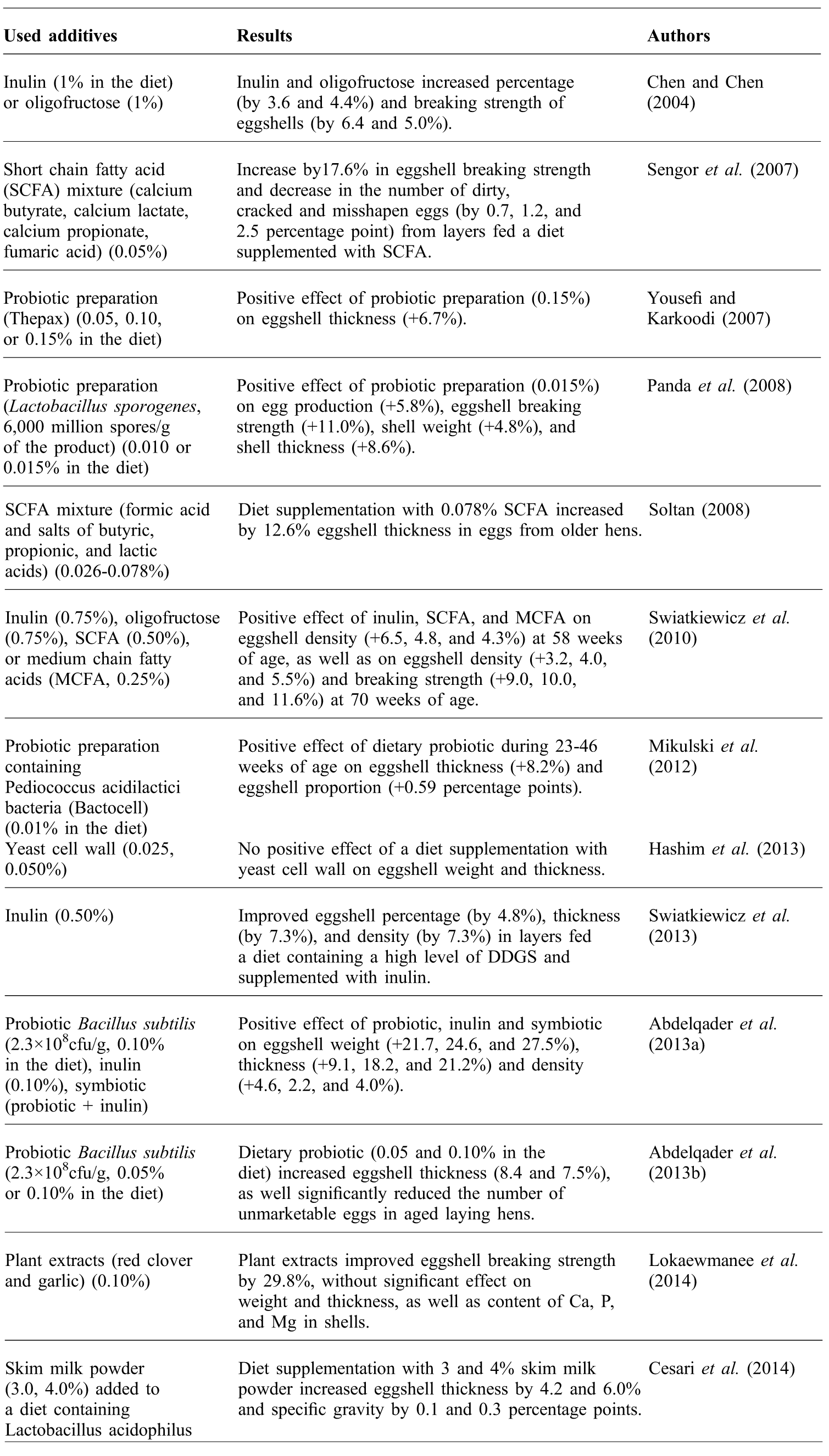
The results of several recent studies demonstrated that feed additives, mainly pre- and probiotics, as well as organic acids, may improve eggshell quality (Table 2), and this effect can be attributed mainly to increasing the availability of Ca and other minerals, as reviewed by Swiatkiewicz and Arczewska-Wlosek (2012). Chen and Chen (Reference CHEN and CHEN2004) reported that diet supplementation with 1% prebiotic fructans significantly increased eggshell percentage and breaking strength, as well as levels of crude ash, Ca and P in tibia bones. Positive effects of dietary inulin or oligofructose on certain eggshell quality indices (eggshell percent, density and breaking strength) were also found in aged hens by Swiatkiewicz et al. (Reference SWIATKIEWICZ, KORELESKI and ARCZEWSKA2010). More recently the same authors reported that dietary inulin positively affected eggshell quality (shell percentage, thickness and density) in older hens (50 weeks of age) fed diets containing high concentrations of DDGS (Swiatkiewicz et al., Reference SWIATKIEWICZ, ARCZEWSKA-WLOSEK, KRAWCZYK, PUCHALA and JOZEFIAK2013). In a recent study, Cesari et al. (Reference CESARI, MANGIAGIALLI, GIARDINI, GALIMBERTI, CARTER, GALLAZZI and TOSCHI2014) evaluated the influence of prebiotic (skim milk powder containing 54% lactose) added to a diet containing Lactobacillus acidophilus on the performance and egg quality of Hy-Line layers. The results proved the positive influence of prebiotics (3 or 4%) on eggshell quality, which could be due to the increased production of short-chain fatty acids in the intestine of hens fed with the combination of probiotic bacteria and lactose. However, Yildiz et al. (Reference YILDIZ, SACAKLI and GUNGOR2006) found no effect of dietary inulin on the weight, thickness and breaking strength of eggshells. Similarly, in a recent study with Japanese quails (de la Mora et al., Reference DE LA MORA, OROZCO-HERNANDEZ, DE JESUS RUIZ-GARCIA and DE LA PENA2014), diet supplementation with inulin did not affect eggshell quality, measured as shell ash and Ca content and shell percentage. The positive effect of prebiotics on eggshell quality parameters was also not observed in laying hens fed diets supplemented with yeast cell wall (Hashim et al., Reference HASHIM, FOWLER, HAQ and BAILEY2013).
The beneficial effects of the use of dietary probiotics in the nutrition of laying hens on eggshell characteristics have been found in some experiments (Yousefi and Karkoodi, Reference YOUSEFI and KARKOODI2007; Panda et al., Reference PANDA, RAMA RAO, RAJU and SHARMA2008; Mikulski et al., Reference MIKULSKI, JANKOWSKI, NACZMANSKI, MIKULSKA and DEMEY2012). More recently Abdelqader et al. (Reference ABDELQADER, IRSHAID and AL-FATAFTAH2013b) evaluated the influence of dietary inclusion of Bacillus subtilis (2.3×10⁸cfu/g of probiotic) on the performance and eggshell quality of aged laying hens (64 weeks of age). They found a positive effect of probiotics on egg production and eggshell quality, i.e. eggshell weight and thickness, as well reduced number of unmarketable eggs, compared with layers fed control diet. In a subsequent study, Abdelqader et al. (Reference ABDELQADER, AL-FATAFTAH and DAS2013a) determined the efficacy of the dietary inclusion of Bacillus subtilis and inulin, individually or in combination. The results showed a beneficial effect of diet supplementation with probiotic (0.10%), inulin (0.10%), or symbiotic on egg performance, eggshell quality, and calcium retention in aged hens. As the authors indicated, the improvements in performance and eggshell quality due to the use of pre- and probiotic in their study were directly related to the colonisation of beneficial microflora along with an increase in the villi-crypt absorptive area (Abdelqader et al., Reference ABDELQADER, AL-FATAFTAH and DAS2013a). The positive effects of prebiotics and probiotics on eggshell quality indices can probably be connected with the stimulation of mineral availability, which can be attributed in turn to such factors as the high solubility of minerals due to: the increased production of short-chain fatty acids by probiotic bacteria through an increased supply of prebiotic substrate; alteration of the intestinal mucosa and increase of the absorption surface by means of the beneficial effect of bacterial fermentation products on the proliferation of enterocytes; degradation of phytates by probiotic bacteria enzymes; increased expression of Ca-binding proteins; overall improvement of gut health (Scholz-Ahrens et al., Reference SCHOLZ-AHRENS, SCHAAFSMA, VAN DER HEUVEL and SCHREZENMEIR2001). However, several studies with layers failed to confirm the positive effects of dietary probiotics on eggshell quality (Yoruk et al., Reference YORUK, GUL, HAYIRLI and MACIT2004; Swiatkiewicz et al., Reference SWIATKIEWICZ, ARCZEWSKA-WLOSEK, KRAWCZYK, PUCHALA and JOZEFIAK2013).
Organic acids
Results of a study with aged breeder White Bovans hens demonstrated that diet supplementation with short-chain fatty acids (SCFA, 0.05% in the diet) improved eggshell breaking strength, as well as reducing the number of dirty, cracked and misshapen eggs (Sengor et al., Reference SENGOR, YARDIMCI, CETINGUL, BAYRAM, SAHIN and DOGAN2007). Soltan (Reference SOLTAN2008) reported that dietary SCFA (a mixture of formic acid and salts of butyric, propionic and lactic acids, 0.078% in the diet) increased eggshell thickness from hens at 70 weeks of age and reduced the number of broken eggs, with no effect on eggshell weight. The author stressed that the improvement in eggshell quality was related to an increase in Ca concentration in serum, which could be attributed to the beneficial effect of organic acids on Ca absorption. Swiatkiewicz et al. (Reference SWIATKIEWICZ, KORELESKI and ARCZEWSKA2010) observed a positive influence of dietary medium-chain fatty acids (MCFA), i.e., capric and caproic acid and, to a lesser extent, SCFA, on eggshell quality (eggshell percentage, density and breaking strength) in older hens (46-70 weeks of age). The authors attributed this effect to increased Ca and P availability, brought about by a decrease in pH in the upper part of the intestinal tract and the stimulating effect of organic acids on villus height. In contrast, Yesilbag and Colpan (Reference YESILBAG and COLPAN2006), in a study with Lohmann layers, found that dietary formic and propionic acids had no influence on eggshell thickness and eggshell breaking strength.
Essential oils and plant extracts
The results of a study with older laying hens (54 to 74 weeks of age) demonstrated that diet supplementation with a mixture of essential oils (oregano, laurel leaf, sage leaf, myrtle leaf, fennel seeds, and citrus peel oil) reduced the number of cracked or broken eggs by 15.5% (Cabuk et al., Reference CABUK, BOZKURT, ALCICEK, CATLI and BASER2006). Similarly, Kaya et al. (Reference KAYA, KAYA, CELEBI and MACIT2013) reported a beneficial effect of a dietary essential oil combination (sage, thyme, and mint extracts, 0.015 or 0.030%) on shell stiffness and shell weight. As well, Lokaewmanee et al. (Reference LOKAEWMANEE, YAMAUCHI, KOMORI and SAITO2014) found, in an experiment with Boris Brown layers, that dietary plant extracts (red clover and garlic, 0.10%) improved eggshell quality measured as eggshell breaking strength, and that these positive effects could be probably attributed to observed improvements in small-intestine histological parameters. Sharma et al. (Reference SHARMA, RAVIKANTH, MAINI, REKHE and RASTOGI2009) observed increased eggshell thickness (by 10.0%) and breaking strength (by 15.2%), as well as decreased number of eggs with shell defects (by 2.5 percentage points) in hens fed diet supplemented with herbal products. Correspondingly, Zhou et al. (Reference ZHOU, DENG, TAO, HU and HOU2009) reported improved eggshell breaking strength (by 19.3%) and tibia bone quality in aged hens fed a diet supplement with a mixture of traditional Chinese herbs, indicating that the mechanism of this positive effect of herbs was possibly associated with minimising structural bone loss and stimulating bone mineral absorption in osteoporotic layers, however the detailed composition of used herbs mixture was not shown. In contrast, several authors did not find any beneficial effect of dietary essential oils or herb extracts in terms of improvement eggshell quality (Bozkurt et al., Reference BOZKURT, KUCUKYILMAZ, PAMUKCU, CABUK, ALCICEK and CATLI2012; Swiatkiewicz et al., Reference SWIATKIEWICZ, ARCZEWSKA-WLOSEK, KRAWCZYK, PUCHALA and JOZEFIAK2013).
Results of selected studies with laying hens on the effects of feed additives on eggshell quality.
Conclusions
In summing up the literature data presented in this review article, it can be concluded that the efficacy, in terms of eggshell quality, of the layer diet supplementation with microelements and feed additives is not consistent and depends, among others, on such factors as the age and physiological stage of the hens, as well as the chemical form and composition of used additives. The results of some trials indicate, however, that eggshell quality may be beneficially affected in certain conditions by optimal level and form of manganese, as well as by pre- and probiotics, organic acids, and herb extracts. It should be also stressed that the observed improvement of eggshell quality is often of low magnitude, especially in young layers, so their use can be more economically justified in aged hens.