Introduction
The art and science of triage have evolved significantly since it was first conceived by Dominique Jean Larrey in Napoleonic times.Reference Skandalakis, Panagiotis, Zoras, Skandalakis and Mirilas 1 , Reference Munroe 2 Now, advancing into the 21st century, there are a number of triage instruments that have had their share of advocates, either across specific regions or more globally.Reference Lerner, Schwartz and Coule 3 Arguably, the iconic triage instrument that has established itself in many regions of the world and has oftentimes been the subject of scientific research is Simple Triage and Rapid Treatment (START) triage (JumpSTART in pediatric triage).Reference Arshad, Williams and Asaeda 4 - Reference Hong, Sierzenski, Bollinger, Durie and O’Connor 9 However, there is no triage instrument that can be considered fully validated.Reference Lerner, Schwartz and Coule 3 , Reference Jenkins, McCarthy and Sauer 10
The studies which have been conducted are based upon table-top exercises, drills, retrospective analysis, and an emergency department population evaluation.Reference Arshad, Williams and Asaeda 4 , Reference Sapp, Brice, Myers and Hinchey 5 , Reference Claudius, Kaji and Santillanes 7 - Reference Hong, Sierzenski, Bollinger, Durie and O’Connor 9 As a result, acknowledged subject matter experts were tasked by the American Medical Association (AMA; Chicago, Illinois USA), the American College of Emergency Physicians (ACEP; Irving, Texas USA), the National Association of Emergency Medical Technicians (NAEMT; Clinton, Mississippi USA), the American College of Surgeons (ACS; Chicago, Illinois USA), the National Association of Emergency Medical Services Professionals (NAEMSP; Overland Park, Kansas USA), and the National Native American Emergency Medical Services Association (NNAEMSA; Cherokee, North Carolina USA) to review all pertinent triage instruments and to make a recommendation. The goal of the review was to have experts determine which instrument should be adopted as a national mass-casualty triage guideline which theoretically would encourage consistency, improve communications, and enhance interoperability among communities. Through this consensus committee process, it was decided that no national or international triage instrument was sufficiently validated to serve as the national model.
Therefore, Sort, Assess, Life-Saving Interventions, Treatment, and/or Transport (SALT) triage was created by the committee as an amalgam of the optimum characteristics of all the triage systems reviewed, with the intention that it be adopted as the national triage system.Reference Lerner, Schwartz and Coule 3 However, this, too, became subject to scrutiny and consequentially, when both START and SALT were compared head-to-head, validation remained unproven because a thorough and prospective scientific study, during an actual disaster, has not been done.Reference Lee, McLeod and Van Aarsen 11 - Reference Jones, White and Tofil 19
Thus, at this juncture, where do professionals stand with regard to adopting a national standard for triage? More to the point, where does the next generation of health care providers stand? It is they who must set the course for, not only this nation, but for an integrated global response to catastrophic disasters. Global terrorism and climate change will add complexities to this challenge that was unheard of in the 20th century. Ever since 2001, American health care education has grappled with disseminating disaster medical education to its students. The gauntlet was thrown down in 2003 when the American Association of Medical Colleges (AAMC; Washington, DC USA) advocated for the inclusion of disaster education in medical school. 20 That objective has met with varying degrees of success over the past two decades as specific educational institutions have striven to meet the American Association of Medical Colleges’ challenge.Reference Owens, Buffington, Frost and Waldner 21 - Reference Kim, Shankel and Reibling 23 Nevertheless, the degree and the depth of these individual endeavors have been found to be wanting among all disciplines to this very day, as challenges blossom and new strategies and tactics are being developed to meet those challenges, triage included.Reference Lynch 24 - Reference Jasper, Wanner, Berg and Berg 31 In fact, in one study that examined disaster education among American medical schools, triage was the second most frequent topic taught (in only 10.3% of the 25.2% of the medical schools that completed the survey).Reference Smith, Levy, Hsu and Lee Levy 32
After about 10 years following the appearance of SALT triage, the authors’ perception is that this new triage system remains a distant “cousin” to START triage. With SALT, despite the addition of the “Gray” triage color for live victims with non-survivable conditions and the introduction of two more medical interventions (needle thoracostomy and antidote administration) to the two provided by START (clearing the airway and active bleeding cessation), it has not achieved its creators’ primary objective as the national standard for an all-hazards triage system.
At the same time, researchers must also acknowledge that present-day health care students (medical, nursing, and physician assistants) encompassing the highest degree of medical-ethical knowledge will, of necessity, be counseling local public health and educating the first responders in their community concerning the various aspects of disaster preparedness and response, including triage.
Not only is it a matter of educating health care students about triage, but it is also a matter of evaluating their sensibilities about “providing the greatest good for the greatest number” within their ethical framework and in light of 21st century threats and responses to those threats. Therefore, the objective of this study is to educate multi-disciplinary health care students about START and SALT, to document their preference between the two triage systems, and to identify any rationale behind those preferences.
Hypothesis
Interprofessional health care students would significantly prefer SALT over START triage due to the additional medical interventions and the “ethical” introduction of the “Gray” victim, thereby adding extra weight to the concept that SALT should become the national triage standard.
Methods
This cross-sectional study of health care and health-related students and residents from the University of Toledo (Toledo, Ohio USA) received approval from the Biomedical Sciences Institutional Review Board. All students had to be currently enrolled and in one of the following programs: medicine, nursing, physician assistant studies, pharmacy, or public health. Using the student enrollment, by discipline, the researchers sampled students to obtain accurate proportions of each to ensure a representative study sample. Residents-in-training had to be currently employed as such at the university. No exclusion criteria were included. Everyone had the right to not participate in both the training and survey completion.
During respective classes and lab sessions, students and residents received a 15-minute didactic presentation on triage that outlined START, JumpSTART, and SALT, including a discussion on the similarities and differences. Student attendance was taken beforehand by the class or lab instructor and these data were provided to the researchers. The presentation was scripted to ensure every participant received identical information. Each received START-JumpSTART and SALT algorithms at the beginning of the didactic presentation and for review when completing the anonymous and voluntary survey. The presentations were given by the researchers who have experience in medical education, as well as in prehospital care and disaster medicine.
The survey contained demographic information, including the following: gender, age, race, profession, and year of study. The two-page survey began by asking the participants to choose from the following two statements by circling: “I prefer the START triage method for my community” or “I prefer the SALT triage method for my community.” The term START in the survey was the abbreviated form of START/JumpSTART and done for the sake of simplicity. The students were verbally told that “START” in the survey applied to the START/JumpSTART algorithm in their handouts.
Participants were then asked to rank four reasons from one to four (one indicating most important and four indicating least important) for their choice, as provided, or they could add their own. The reasons for both START/JumpSTART and SALT were:
____ It is easier to learn.
____ It is easier to teach.
____ The number of patient triage categories is more logical, comprehensible, and consistent with traditional medical care.
____ The number and types of medical interventions are more appropriate in a disaster setting.
____ Another reason.
The chi-square test was used to statistically compare proportions and the expected and observed frequencies of triage method choice by gender. An alpha of .05 was used to determine statistical significance. Through sample size and power calculation, it was determined that a sample of 209 individuals would provide 80% power to detect a 10% difference in the proportion preferring SALT and those preferring START.
Results
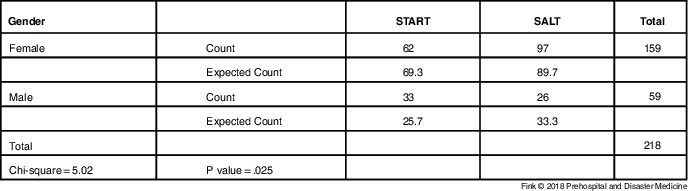
There were a total of 218 students and residents who received the training and all of them completed the subsequent survey. In this study, 123 (56.4%) preferred SALT and 95 (43.6%) preferred START (Table 1). When comparing preference by profession, most were equally divided except the physician assistant students, wherein 28 preferred SALT and six preferred START (P=.042). There was a statistically significant difference in the observed distribution versus expected distribution in START and SALT preference by gender (Chi-square=5.02; P=.025; Table 2). Females preferred SALT (61.0%) while males preferred START (55.9%).
Demographic Characteristics of Study Sample

Abbreviations: SALT, Sort, Assess, Life-Saving Interventions, Treatment and/or Transport; START, Simple Triage and Rapid Treatment.
Distribution of Triage Preference by Gender

Abbreviations: SALT, Sort, Assess, Life-Saving Interventions, Treatment and/or Transport; START, Simple Triage and Rapid Treatment.
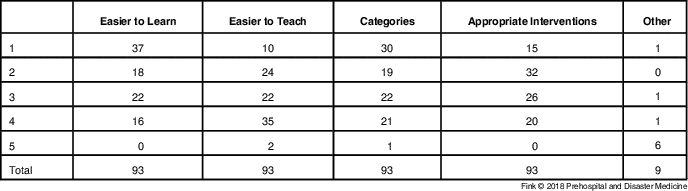
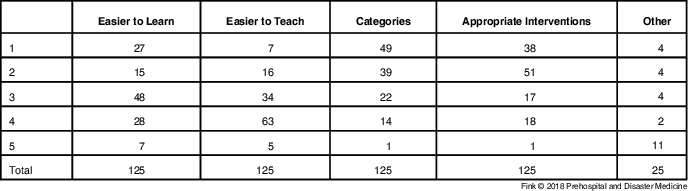
Among those who preferred START, START being easier to learn was the most important reason cited (Table 3). The number of patient triage categories being more logical, comprehensible, and consistent with traditional medical care was cited as the second most important reason. Among those who preferred SALT, the most important reason cited was that the number of patient triage categories seemed more logical, comprehensible, and consistent with traditional medical care (Table 4). In fact, for those who chose SALT, preferring five triage colors (Red, Yellow, Green, Gray, and Black) over START’s four was ranked as number one or two by a majority (88/125; 70.4%). Similarly, advocates of SALT ranked its four medical interventions as number one or two by virtually the same majority (89/125; 71.2%).
Ranking of START Triage Preferences

Abbreviation: START, Simple Triage and Rapid Treatment.
Ranking of SALT Triage Preferences

Abbreviation: SALT, Sort, Assess, Life-Saving Interventions, Treatment and/or Transport.
Discussion
Initially, SALT triage was created because of the deficiencies noted in pre-existing triage guidelines – specifically START triage. Despite its flaws, START triage, due to its ubiquity, may arguably be considered the gold standard. However, it can also be argued that its luster is somewhat tarnished for the following reasons:
1. It is not fully validated prospectively in an actual disaster;
2. It requires a second algorithm that addresses the pediatric population;
3. It does not address live victims with non-survivable injuries; and
4. It allows only two medical interventions.
The apparent flaws of START and the other triage systems instigated the creation of SALT. On its face, SALT has a framework that should make it a logical choice as the national triage model, as well as one that should have greater traction with health care students and professionals. The reasons include:
1. It is designed as an all-hazards tool;
2. It simplifies triage by having one algorithm for all ages;
3. It acknowledges that 21st century threats may be more effectively handled by a triage guideline that adds new medical interventions (antidotes and needle thoracostomy); and
4. It adds an additional color for expectant victims. Thus, in an ethical manner that is not addressed by START, it allows for palliative care for the dying without wasting limited life-saving resources.Reference Lerner, Schwartz and Coule 3
In this study, among an interprofessional group of health care students, only a statistically insignificant majority preferred SALT over START – a finding that just barely supports the authors’ hypothesis. However, given that the study population was primarily female, and more females preferred SALT than expected, gender is a confounding factor. Further, those favoring SALT appear, to an extent, to prefer this triage method due to the Gray/palliative care category. This is a study limitation as the students do not have the requisite field experience to know that palliative care may not be possible due to time limitations or potential on-scene dangers.
For those students who preferred START triage and integrating their data with their personal statements (Table 5), expediency seemed to be the theme that explains their preference of the START algorithm over SALT’s. For many communities, this may be the better decision since it addresses the basic responder with limited medical education and skills. However, for those who preferred SALT, the primary reasons were more consistent with 21st century realities. One reality is the necessity to meet the challenges of global terror and the ability to manage, during triage, the effects of blast trauma and nerve agent attacks. The second reality is the advent of the specialty of palliative medicine. Palliative care is fully addressed with SALT triage and is ethically compatible with current day-to-day medical care. Thirteen of the 22 personal statements listed under the SALT preference highlighted the “Gray” patient and palliative care.
Stated Reasons for Preferring START and SALT

Abbreviations: SALT, Sort, Assess, Life-Saving Interventions, Treatment and/or Transport; START, Simple Triage and Rapid Treatment.
Has START in the 21st century become outmoded? Using START, victims with non-survivable injuries can be either tagged “Red,” thereby receiving precious limited resources inappropriately, or tagged “Black” and be denied spiritual sustenance and palliative care. Either way, the ethical framework for either choice is subject to debate.
There were two findings that were statistically significant: female health care students and physician assistant students preferred SALT over START. The reasons behind these findings are obscure and require further research, especially since women and physician assistants will be assuming more of the health care responsibilities as the male-dominated physician cohort wanes.Reference Leong, Cangiarella and Fancher 33
Limitations
The authors have identified limitations to this study. First, the survey only dealt with an interprofessional group of health care students. This was purposeful since, to the authors’ knowledge, there has been no concerted attempt to analyze the millennial health care students’ thinking in light of present-day disaster threats, challenges, and opportunities, especially since they will be the next generation of health care leaders.
Second, there was no attempt to identify which students had any clinical exposure at the time of the survey. The authors did not believe this was an important detriment to the study since clinical exposures only dealt with one-on-one patient encounters, which may have no relevance to a mass-casualty incident.
Lastly, the education was essentially just-in-time education delivered in the course of the students’ programmed educational activities. This was done in order to survey the greatest number of students in the shortest amount of time, always at the discretion of the professor. In any case, just-in-time training is another means of education commonplace in disaster deployments. Ideally, a more intense delivery platform (table-top exercises and drills) would be preferable. However, this limitation highlights the inherent flaw in the nation’s inability to teach disaster concepts to the next generation of health care professionals. No formal disaster preparedness and response education exists within the interprofessional groups’ curricula. Repeating this study after a more in-depth approach would be advisable.
Conclusion
Among millennial health care students who received just-in-time training in SALT and START triage, more females preferred SALT and more males preferred START. It is unclear as to why these differences were observed. Nearly three-fourths of this population was female, though this is representative of the gender distribution at the university. The reasons behind the preference for SALT among the entire sample of females and males were related to providing more medical interventions and palliative care to specific victims. Among those who preferred START, expediency was important. Further research in this area may help to better explain these differences and provide more information on what health care students prefer as a standard triage method. Incorporating disaster concepts into the course of study for health care students may provide answers to the questions that were raised.