Introduction
Many species of the Lymnaeidae family can act as intermediate hosts in the Fasciola hepatica life cycle by ensuring larval development of the parasite. In Western Europe, the most common snail host is Galba truncatula (Taylor, Reference Taylor1965; Boray, Reference Boray1969; Torgerson & Claxton, Reference Torgerson, Claxton and Dalton1999). However, other lymnaeid species can also sustain larval development of F. hepatica. Among them, Lymnaea glabra (= Omphiscola glabra) was reported by our team to be a natural or experimental intermediate host of this digenean in central France (Abrous et al., Reference Abrous, Rondelaud and Dreyfuss1996, Reference Abrous, Rondelaud, Dreyfuss and Cabaret1998, Reference Abrous, Rondelaud, Dreyfuss and Cabaret1999, Reference Abrous, Rondelaud and Dreyfuss2000; Dreyfuss et al., Reference Dreyfuss, Vignoles and Rondelaud2003, Reference Dreyfuss, Vignoles and Rondelaud2005; Rondelaud, Reference Rondelaud2004). A literature review reveals two different modes of snail infection by F. hepatica. First, juvenile snails (shell height at exposure < 2 mm) were able to harbour larval forms of the digenean with cercarial shedding (Boray, Reference Boray1978), but snail mortality in experimentally infected groups was high with a low prevalence (generally < 20%) and a low parasite production, which did not exceed 50 cercariae for the snails with the highest shells (Busson et al., Reference Busson, Busson, Rondelaud and Pestre-Alexandre1982; Bouix-Busson et al., Reference Bouix-Busson, Rondelaud and Barthe1984, Reference Bouix-Busson, Rondelaud and Combes1985; Vignoles et al., Reference Vignoles, Dreyfuss and Rondelaud2002). Moreover, the shell growth of these juvenile snails during F. hepatica infection was limited ( < 6–7 mm: Bouix-Busson & Rondelaud, Reference Bouix-Busson and Rondelaud1986) in the field, so that these small individuals easily escaped detection in their natural habitats. Secondly, experimental co-infection of older L. glabra (4–6 mm) with F. hepatica and Paramphistomum daubneyi (both digeneans often developed in the same cattle in central France) resulted in successful infections with complete development of F. hepatica (Abrous et al., Reference Abrous, Rondelaud and Dreyfuss1996, Reference Abrous, Rondelaud, Dreyfuss and Cabaret1998). According to these authors, prevalence of F. hepatica infection remained low (13.6–17.2%) and a few cercariae (13–25/snail) were shed by snails with shell height 8.5–9.3 mm. Other experimental co-infections carried out by Dreyfuss et al. (Reference Dreyfuss, Novobilský, Vignoles, Bellet, Koudela and Rondelaud2007b) in two other L. glabra populations also resulted in low prevalence of infection (23.6–25.9%) and low cercarial production ( < 50 per snail), even if 112–136 free F. hepatica cercariae were found within the bodies of snails dissected at day 75 post-exposure (pe).
These two modes of snail infection by F. hepatica do not explain all cases of natural F. hepatica infections found in several L. glabra populations on acid soil. Dreyfuss et al. (Reference Dreyfuss, Vignoles and Rondelaud2003) reported natural F. hepatica infections in L. glabra populations living in walled gardens. This last finding raises a problem because no cattle or sheep herds were present near these gardens for at least 10 years. In these sites, only hares and rabbits, often infected by F. hepatica (Rondelaud et al., Reference Rondelaud, Vignoles, Abrous and Dreyfuss2001), were noted. Perhaps another mode of snail infection by F. hepatica exists in the case of L. glabra, as reported by Sanabria et al. (Reference Sanabria, Mouzet, Courtioux, Vignoles, Rondelaud, Dreyfuss, Cabaret and Romero2012) and Vignoles et al. (Reference Vignoles, Novobilský, Höglund, Kašný, Pankrác, Dreyfuss, Pointier and Rondelaud2014) for two lymnaeids living in Central and/or South America. By using two successive generations of Lymnaea viatrix ventricosa hatched from eggs laid by their F. hepatica-infected parents and, in turn, infected with the same digenean, Sanabria et al. (Reference Sanabria, Mouzet, Courtioux, Vignoles, Rondelaud, Dreyfuss, Cabaret and Romero2012) noted a progressive increase in cercarial production from parents to the F2 generation. In the same way, Vignoles et al. (Reference Vignoles, Novobilský, Höglund, Kašný, Pankrác, Dreyfuss, Pointier and Rondelaud2014) saw a progressive increase in prevalence and cercarial production in five successive generations of Lymnaea cubensis infected with Fascioloides magna, a species relatively close to F. hepatica. To verify the existence of this possibility in L. glabra infection by F. hepatica, seven successive snail generations (shell height, 4 mm), originating from two populations, were subjected to individual bi-miracidial infections. Resulting rediae and cercariae in the first six generations were counted after snail dissection at day 42 pe (at 20°C), while the dynamics of cercarial shedding was followed in the F7 generation.
Materials and methods
Snail collection
Two L. glabra populations, originating from central France, were used for these experiments. Parent snails from the first population were collected from a road ditch (46°34′49″N, 1°24′36″E) at Lande, commune of Thenay, department of Indre, while those from the second population came from another road ditch (46°4′26″N, 1°6′40″E) at Francour, commune of Saint Junien les Combes, department of Haute Vienne. Previous investigations on different monthly samples of 100 adult L. glabra (6 mm and more in height) each, collected over a period of 6 months before the beginning of experimental infections, demonstrated the absence of natural digenean infection in dissected snails for both populations of this lymnaeid. One hundred adult snails were also collected from each population and raised in the laboratory at 20°C according to the method of Rondelaud et al. (Reference Rondelaud, Fousi, Vignoles, Moncef and Dreyfuss2007). Seven successive snail generations (F1–F7) of each population, measuring 4 ± 0.1 mm in height, were used for experimental infections.
To compare the characteristics of F. hepatica infection in L. glabra with those found in a common intermediate host of this parasite, a wild population of G. truncatula was selected. This species was used in the present study because it is considered to be the main snail host of F. hepatica in Europe (Taylor, Reference Taylor1965; Boray, Reference Boray1969; Andrews, Reference Andrews and Dalton1999) and may be infected at any age (Gold, Reference Gold1980). These snails colonized a road ditch at Chézeau Chrétien (46°40′27″N, 1°21′21″E), commune of Chitray, department of Indre, central France. One hundred snails (shell height, 4 mm), belonging to the spring generation, were collected from this population.
The choice of 4-mm-high snails for L. glabra and G. truncatula infection with F. hepatica was based on the report by Gold (Reference Gold1980). According to this author, this shell height for G. truncatula infection with F. hepatica gave the best results in terms of prevalence and cercarial production.
Parasite egg collection
Several isolates of F. hepatica eggs were collected regularly from the gall bladders of naturally infected limousine cattle at the Limoges slaughterhouse. They were washed several times with spring water and immediately incubated in the dark at 20°C for 20 days (Ollerenshaw, Reference Ollerenshaw1971).
Experimental protocol
The susceptibility of L. glabra to F. hepatica miracidia was studied during seven successive snail generations (from F1 to F7) via an experimental protocol already used by Sanabria et al. (Reference Sanabria, Mouzet, Courtioux, Vignoles, Rondelaud, Dreyfuss, Cabaret and Romero2012) for F. hepatica. F2 snails originated from eggs laid by infected F1 individuals (50 snails in this case) between weeks 2 and 5 pe. A similar protocol was used for the F3, F4, F5, F6 and F7 generations. This protocol was chosen so that these descendants had a first (F2) or multiple contacts (the F3–F7 generations) with the parasite through their infected parents. To verify that snail resistance to infection did not change during these experiments due to snail breeding conditions in the laboratory, controls were seven other successive L. glabra generations originating from eggs laid by uninfected parents.
The aim of the first experiment was to determine the aptitude of each L. glabra population as a snail host for F. hepatica. Six groups of 50 snails each (one group per generation from F1 to F6), coming from parents infected with F. hepatica, and another seven groups (one group per generation from F1 to F7), originating from uninfected parents, were constituted for each population. Each snail was routinely subjected to two miracidia for 4 h at 20°C in 3.5 ml spring water. The choice of two miracidia per snail was based on the fact that a single miracidium (out of two) only developed in 75% of G. truncatula after exposure (Préveraud-Sindou et al., Reference Préveraud-Sindou, Dreyfuss and Rondelaud1994, 1995). Snails were then raised in groups of ten individuals in 14-cm Petri dishes (60 ml spring water) for 30 days, according to Rondelaud et al. (Reference Rondelaud, Fousi, Vignoles, Moncef and Dreyfuss2007). Snail food consisted of dried lettuce leaves and dead Molinia caerulea leaves, while several stems of live Fontinalis sp. ensured oxygenation of the water layer. Dissolved calcium in spring water was 35 mg/l. Water and food, if necessary, were changed every day. Petri dishes were placed in an air-conditioned room at 20°C with a natural photoperiod of 10 h light. At day 42 pe, surviving L. glabra were dissected under a stereomicroscope to detect the presence of F. hepatica larval forms within their bodies, and to determine the most developed stage (immature rediae, cercariae-containing rediae or free cercariae). The occurrence of cercarial shedding was also considered. Infected snails were then counted, taking into account snail generation and each developmental stage of larval development.
As cercarial F. hepatica shedding was noted in both L. glabra populations from F4 or F6 generations when descendants originated from parents already infected with this parasite (see table 1), a second experiment was carried out. Its aim was to determine the characteristics of F. hepatica infection in snails belonging to the F7 generation and compare them with those occurring in a common snail host of this parasite in Europe, G. truncatula. One hundred snails for the Lande population, 100 for that from Francour (both belonging to the F7 generation of L. glabra) and 100 G. truncatula were used. Snail exposure to miracidia and snail breeding during the first 30 days pe were similar to those in the first experiment. At day 30, each surviving snail was isolated in a 35-mm Petri dish containing 3.5 ml spring water, with pieces of dead grass, lettuce and spring moss. These Petri dishes were also placed at 20°C. Spring water and food, if necessary, were changed daily until snail death. When the first cercarial shedding occurred, surviving snails were subjected to a thermal shock every 3 days by placing their Petri dishes at 10–13°C for 3 h to stimulate cercarial exit (Sanabria et al., Reference Sanabria, Mouzet, Courtioux, Vignoles, Rondelaud, Dreyfuss, Cabaret and Romero2012). Cercariae were then counted and removed from Petri dishes. After death, shell height of each infected snail was measured using callipers. Cadavers of snails containing cercariae but without shedding (NCS snails) were routinely dissected under a stereomicroscope to count free rediae, intraredial cercariae and free cercariae. Cadavers of uninfected snails were also dissected to verify the absence of larval forms within their bodies.
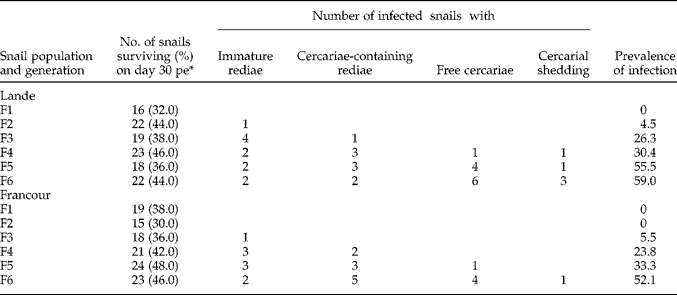
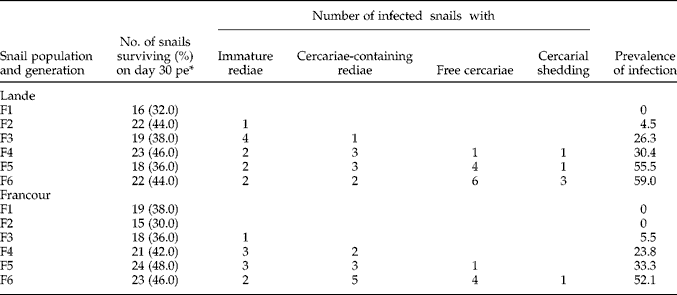
Several characteristics of F. hepatica infection in six Lymnaea glabra generations subjected to individual bi-miracidial exposures, raised at 20°C and dissected on day 42 post-exposure (pe) (first experiment). These descendants originated from eggs laid by their infected parents between weeks 2 and 5 of infection.
* 50 snails per population and generation on miracidial exposure.
Data analysis
The first two parameters calculated were snail survival at day 30 pe and prevalence of F. hepatica infection (calculated in relation to the number of snails surviving at day 30 pe). In both experiments, prevalence took into account the number of infected snails with or without shedding. For each parameter, differences were analysed using a χ2 test. In the second experiment, the other parameters were shell growth of cercariae-shedding (CS) and NCS snails (calculated using the difference between shell heights at exposure and at snail death), length of the prepatent and patent periods, and the total number of cercariae. Free rediae, intraredial cercariae, free cercariae and overall cercarial production counted in NCS cadavers were also considered. Individual values recorded for these last eight parameters were averaged and their standard deviations were calculated considering snail groups. One-way analysis of variance (ANOVA) was used to establish levels of statistical significance. Both types of analyses were calculated using Statview 5.0 software (SAS Institute Inc., Cary, North Carolina, USA).
Results
Propensity of L. glabra for F. hepatica infection
In the seven snail generations originating from uninfected parents and subjected to miracidial exposure, the percentage of surviving snails ranged from 26.0 to 38.0% at day 30 pe, regardless of snail generation. No larval forms of F. hepatica were found in these dissected snails (data not shown).
In the six snail generations coming from infected parents (table 1), survival rate at day 30 did not vary significantly with snail generation. In contrast, overall prevalence of F. hepatica infection significantly increased with increasing snail generation (population A (Lande): χ2= 18.85, P < 0.001; population B (Francour): χ2= 10.96, P < 0.05). Two differences between these snail populations can be noted. The first snail harbouring F. hepatica immature rediae was noted in the F2 generation for population A and in F3 for population B. Similarly, cercarial shedding was noted in the F4 for population A and in the F6 for population B. In each population considered separately, three successive generations of snails (population A) or four (B) were necessary to obtain the first cercarial shedding from an infected snail.
Characteristics of F. hepatica infection
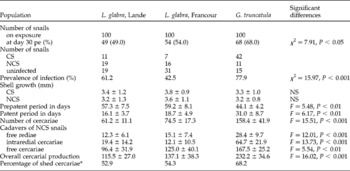
Table 2 gives the main characteristics of F. hepatica infection in the three groups of snails. Compared to G. truncatula, snail survival at day 30 pe, prevalence of F. hepatica infection, the patent period and the total number of cercariae were significantly lower in L. glabra, while the prepatent period was significantly longer. No significant difference between the two groups of L. glabra was found, regardless of the parameter considered. The shell growth of CS and NCS snails was similar and no significant difference between these rates was noted. In NCS snails, free rediae, intraredial cercariae and free cercariae of F. hepatica were significantly more numerous in G. truncatula than in L. glabra, and no significant differences between the two groups of the latter lymnaeid were noted. If the number of cercariae seen in CS snails was compared to overall cercarial production recorded in NCS snail bodies, the percentage of shed cercariae was also greater in G. truncatula than in the other lymnaeid (68% versus 52–54%).
Characteristics of F. hepatica infection in the F7 generation of Lymnaea glabra and in Galba truncatula subjected to individual bi-miracidial exposures and raised at 20°C (second experiment). CS, cercariae-shedding snails; F, value of ANOVA; NCS, snails containing F. hepatica cercariae but dying without cercarial shedding; NS, non-significant difference; P, probability; χ2, value of the χ2 test. Mean values are given with their standard deviations for nine parameters.

* Number of cercariae shed by CS snails/overall cercarial production in NCS snails.
Discussion
In the seven successive generations of descendants originating from eggs laid by uninfected parents, no parasite larval forms were found in surviving snails at day 42 pe. In contrast, in the seven generations of descendants coming from parents already infected by F. hepatica, their infection with the same digenean resulted in a progressive increase in prevalence and intensity of snail infection (tables 1 and 2). This last finding indicates a progressive and rapid adaptation of these two L. glabra populations to the parasite through several successive snail generations, as previously mentioned by Boray (Reference Boray1969) for several lymnaeid species. Similar results have already been reported for L. v. ventricosa infected by F. hepatica (Sanabria et al., Reference Sanabria, Mouzet, Courtioux, Vignoles, Rondelaud, Dreyfuss, Cabaret and Romero2012) through three successive generations, or for L. cubensis (Vignoles et al., Reference Vignoles, Novobilský, Höglund, Kašný, Pankrác, Dreyfuss, Pointier and Rondelaud2014) infected by F. magna through five successive generations, when the same protocol for snail infection was used. In view of these different results, this mode of snail infection via repeated contacts between the parasite and several successive generations of snails seems to be a general process for L. glabra populations when they are infected in the laboratory. However, this mode of snail infection would not concern all other lymnaeids because prevalence of F. hepatica infection and cercarial production under laboratory conditions were significantly lower in the F1 generation of G. truncatula than in their infected parents (Vignoles et al., Reference Vignoles, Rondelaud and Dreyfuss2003).
Compared to G. truncatula, prevalence of F. hepatica infection in both populations of L. glabra was significantly lower (table 2). As these values were observed in snails of shell height 4 mm, they cannot be compared with data reported in the literature for juvenile L. glabra measuring less than 2 mm at miracidial exposure (Busson et al., Reference Busson, Busson, Rondelaud and Pestre-Alexandre1982; Bouix-Busson et al., Reference Bouix-Busson, Rondelaud and Barthe1984, Reference Bouix-Busson, Rondelaud and Combes1985; Vignoles et al., Reference Vignoles, Dreyfuss and Rondelaud2002). The only data available for this comparison originated from experimental co-infections of 4-mm-high L. glabra with F. hepatica and P. daubneyi. In spite of this limit, prevalence of F. hepatica infection in the present study was greater than rates reported for the same digenean by Abrous et al. in 1996 (20.6%) and Dreyfuss et al. in 2007b (23.6–25.9%) in these snail co-infections. This difference may be explained by the number of F. hepatica miracidia used at exposure: two per snail in the present study, one (plus one of P. daubneyi) in the above reports. In contrast, the shorter patent period noted for our L. glabra agreed with values reported by Abrous et al. (Reference Abrous, Rondelaud, Dreyfuss and Cabaret1998) for other co-infections of L. glabra with the same digeneans. Longer prepatent periods and lower numbers of cercariae seen for CS snails as well as lower redial and cercarial burdens found in NCS L. glabra (table 2) may be explained mainly by the shell morphology of this lymnaeid. According to Germain (1930/Reference Germain1931) and Hubendick (Reference Hubendick1951), the L. glabra shell was narrower than that of G. truncatula (a mean of 4 mm for the last whorl instead of 5.5 mm, respectively, at the adult stage) so that the L. glabra body volume was less when snails of both species had the same shell growth during infection (table 2). Thus, F. hepatica redial and cercarial production in L. glabra would be lower and would need more time to differentiate. Parasite burdens found in NCS snails (table 2) ranged within the scale of values reported by Dreyfuss et al. (Reference Dreyfuss, Vignoles and Rondelaud2003, Reference Dreyfuss, Vignoles and Rondelaud2005) for natural L. glabra infections by F. hepatica in central France, but were lower than those reported by Dreyfuss et al. (Reference Dreyfuss, Novobilský, Vignoles, Bellet, Koudela and Rondelaud2007b) for experimental co-infections of this snail with F. hepatica and P. daubneyi. This difference can be explained by the progressive adaptation of L. glabra to this digenean over time, as demonstrated by Rondelaud (Reference Rondelaud2004) and Dreyfuss et al. (Reference Dreyfuss, Vignoles and Rondelaud2005) for natural infections of this lymnaeid in the field from the 2000s.
In the present study, each L. glabra population adapted to F. hepatica infection according to its own susceptibility and aptitude to sustain larval development of the parasite (table 1). Even if infectivity of F. hepatica miracidia, originating from French cattle, towards snails had increased from the 2000s (Dreyfuss et al., Reference Dreyfuss, Vignoles and Rondelaud2007a), the parasite seems to play a minor role in development of this snail adaptation. Two perhaps complementary hypotheses may be proposed for these changes in successive generations of infected L. glabra. The most likely explanation for this increase in prevalence of F. hepatica infection would be decreased genetic variation in host resistance through selection of snails with lowest resistance and/or a series of bottlenecks during the seven successive generations of snails. This first hypothesis was based on the protocol used for L. glabra in the present study, with the selection of descendants coming from already infected parents. However, another hypothesis, based on a progressive decrease in the number of the snail ganglionic neurons through the successive generations of infected snails originating from already infected parents, cannot be completely excluded. An argument supporting this last interpretation came from the report by Szmidt-Adjidé et al. (Reference Szmidt-Adjidé, Rondelaud, Dreyfuss and Cabaret1996) on the numbers of neurons in the cerebroid and pedal ganglia of F. hepatica-infected G. truncatula. According to these authors, each dorsal lobe of the cerebroid ganglia contained a mean of 307 neurons at day 60 pe in infected G. truncatula (instead of 584 per dorsal lobe in unexposed controls). In the same way, the mean numbers of neurons at day 60 were 98 and 440 per pedal ganglion in infected snails and controls, respectively (Szmidt-Adjidé et al., Reference Szmidt-Adjidé, Rondelaud, Dreyfuss and Cabaret1996). If this neuronal death also exists in the corresponding ganglia of infected L. glabra, these ganglia would gradually secrete a lower quantity of neuromediators through successive generations of infected snails, thus inducing a progressive change in the mechanisms of immune system response to the parasite and a progressive lifting of the bottleneck exerted by the snail on larval development of the parasite.
In conclusion, the infection of seven successive generations of 4-mm-high L. glabra, originating from parents already infected with F. hepatica, resulted in a progressive increase in the prevalence and intensity of F. hepatica infection over time. This mode of snail infection suggests an explanation for cases of fasciolosis occurring in cattle-breeding farms where paramphistomosis is lacking and G. truncatula is absent. Further studies are still necessary to determine if this mode may affect other lymnaeids living with G. truncatula and/or L. glabra in central France (Vareille-Morel et al., Reference Vareille-Morel, Dreyfuss and Rondelaud1999) or invasive snail species, such as Pseudosuccinea columella (Pointier et al., Reference Pointier, Coustau, Rondelaud and Théron2007), which colonize habitats in the field by displacing native snails and can be increasingly utilized by F. hepatica over time.
Acknowledgements
The authors thank Dr J. Cook-Moreau for revising the English text.
Conflict of interest
None.