


Introduction
The role of cognitive factors in chronic pain has been well documented, with cognitions shown to influence reported levels of pain, levels of disability and treatment outcomes (e.g. Flor and Turk, Reference Flor and Turk1988; Jensen, Turner, Romano and Karoly, Reference Jensen, Turner, Romano and Karoly1991; Turk and Rudy, Reference Turk and Rudy1992). Meta-analyses of randomized control trials conclude that cognitive and behavioural therapies are effective for chronic pain (Morley, Eccleston and Williams, Reference Morley, Eccleston and Williams1999; Eccleston, Williams and Morley, Reference Eccleston, Williams and Morley2009). Cognitive behavioural interventions help patients understand how maladaptive beliefs about pain affect emotions and behavioural responses and how these in turn influence the experience of pain.
Many tools have been developed to identify and measure maladaptive beliefs, both in chronic pain samples and other clinical and community samples. Most studies and tools have conceptualized maladaptive beliefs as predominantly verbal in nature. However, cognitive therapy manuals usually encourage clinicians to also enquire about non-verbal dimensions of thinking, such as visual images (e.g. White, Reference White2001; Turk, Meichenbaum and Genest, Reference Turk, Meichenbaum and Genest1983; Beck, Reference Beck1976).
Studies of visual imagery have contributed towards our understanding of several psychological disorders, including social phobia (Hackmann, Surawy and Clark, Reference Hackmann, Surawy and Clark1998), obsessive-compulsive disorder (de Silva, Reference de Silva1986; Rachman, Reference Rachman2007) and agoraphobia (Day, Holmes and Hackmann, Reference Day, Holmes and Hackmann2004). Characteristic mental images have also been noted in disorders such as depression (Patel et al., Reference Patel, Brewin, Wheatley, Wells, Fisher and Myers2007), body dysmorphic disorder (Osman, Cooper, Hackmann and Veale, Reference Osman, Cooper, Hackmann and Veale2004) and bulimia nervosa (Somerville, Cooper and Hackmann, Reference Somerville, Cooper and Hackmann2007). Research in this area is starting to integrate these image-based cognitions within models of the development and maintenance of disorders, which can then be used to inform imagery-based psychological interventions (Holmes, Arntz and Smucker, Reference Holmes, Arntz and Smucker2007).
Most current research on imagery in chronic pain has focused upon generating imagery to facilitate relaxation, rather than on working with spontaneously occurring mental images. In acute pain settings, guided imagery has been reported to be effective in reducing perioperative symptoms (Tusek, Church, Strong, Grass and Fazio, Reference Tusek, Church, Strong, Grass and Fazio1997), cancer pain (Sloman, Reference Sloman1995) and chemotherapy-related nausea (Troesch, Rodehaver, Delaney and Yanes, Reference Troesch, Rodehaver, Delaney and Yanes1993). There has also been some investigation of imagery as a coping response or distracter to experimentally induced pain in non-clinical samples (Fernandez and Turk, Reference Fernandez and Turk1989). There is currently little empirical evidence about the prevalence of spontaneous pain related mental images in chronic pain populations, the characteristics and functions of such images, or the potential for such images to be targets for psychological therapies. Jamani and Clyde (Reference Jamani and Clyde2008) present a conceptual paper and case study that begins to explore some of these questions, showing how imagery-based cognition in pain may be incorporated into cognitive behavioural models and developed as a potential treatment target.
In addition, Phillips (Reference Philips2011) reports an interview-based study in which chronic pain patients report vivid visual images in association with pain. In Phillips’ study, chronic and acute pain patients reported images related to memories, feared future catastrophe and anatomical substrates of pain. These images are described as producing an intense affective response for participants, including tearfulness, flushing and averting gaze. Participants gave ratings of emotions (anxiety, sadness, anger, happiness, calm) as well as pain, using numerical rating scales before and after voluntary image exposure. Participants’ ratings on these distress related emotions changed significantly following the exposure procedure; they also reported greater awareness of pain intensity. In addition, participants completed self-report measures of trauma symptoms, depression and anxiety. Whilst around one-third of the images reported in this study were related to a pain causing traumatic event (e.g. a road traffic accident), two-thirds were not trauma related. Level of trauma symptomatology was relatively low in this sample. Surprisingly, mean scores for the standardized depression and anxiety measures are not reported. It is clear, however that mental images related to the self in pain are associated with distress in this sample. Phillips describes the implications of these images as targets for cognitive behavioural treatment.
Carruthers et al. (Reference Carruthers, Miller, Morris, Evans, Tarrier and Whorwell2009) describe a study of 109 patients with Irritable Bowel Syndrome (IBS) undergoing hypnotherapy. In this study participants were asked if they had a mental image of their IBS, and they worked with a medical illustrator to produce these pictures. In this study 49% of the participants could report an IBS image, and these were also significantly associated with greater distress. Interestingly, those with mental imagery were more likely to respond to hypnotherapy intervention.
Finally, Berna et al. (Reference Berna, Vincent, Moore, Tracey, Goodwin and Holmes2011) report an interview-based study of 10 women with longstanding pelvic pain and significant distress. In their study, all 10 participants reported mental images. The content of these images suggests themes of threat and vulnerability, the relationship the person has with their pain, the sensory qualities of pain, the meaning of pain and the implications it has for the person. All these images are negatively valenced and strongly affective for participants. In addition, 8 of the 10 participants also described comforting or coping images, which they used purposively in response to pain and pain imagery. This study also showed that pain related verbal thoughts are strongly linked to the themes expressed non-verbally in the pain related mental images.
The current paper evaluates the presence of spontaneously occurring pain related mental imagery in persons with chronic pain and uses standardized self-report measures to determine whether those who report experiencing such images differ in terms of emotions, cognitions, physical disability and pain levels from those who report not experiencing such images. The study predicted that those who reported mental images of pain would have higher levels of anxiety, depression, maladaptive cognitions and physical disability than those who reported not experiencing such images. This study examines mental imagery in a broad sample of chronic pain patients and also employs a novel self-report method to determine presence or absence of mental imagery, using a postal questionnaire.
Method
Participants
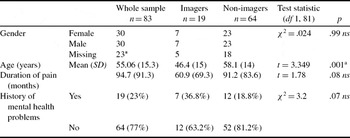
Participants were 83 attenders at an outpatient based interdisciplinary chronic pain clinic. The service sees patients from the age of 16 years upwards. The current study represents a heterogeneous sample of chronic pain patients, with pain arising from a number of different causes (e.g. musculoskeletal pain, chronic daily headache, neuropathic pain, arthritis) and in different locations of the body. Demographic characteristics of the sample, including, age, gender, duration of pain and self-reported history of mental health difficulties can be seen in Table 1.
Demographic Information

*an administrative problem led to a proportion of gender data not being recorded. aAlthough the imagery group were significantly younger, age is not correlated with any of the dependant variables. Analyses were performed with and without age as a covariate and the pattern of results was not affected by age.
Inclusion and exclusion criteria
All patients with a diagnosis of chronic pain who attended chronic pain service clinics were invited to take part, unless they met the exclusion criteria. Patients were excluded if they had pain from a malignant condition such as cancer or if they were not fluent in English. Those with a diagnosis of psychotic illness were also excluded, as these individuals may have a different perception of the mental images discussed in this study.
Ethical suitability
Ethical permission was granted by the local NHS Research Ethics Committee (Project reference number: 06/s1104/47) A University Ethics panel and the local Health Board Research and Development Department also approved the project.
Procedure
The questionnaire packs were piloted on five patients attending the clinical psychology service, from which it was estimated that it would take an average of 45 minutes to complete the questionnaire pack. Three hundred and fifty questionnaire packs were then sent to patients who attended the clinic. These packs contained information about the study and a stamped addressed envelope for their return. Eighty-three responses were received (a response rate of approximately 24%). The questionnaire packs contained the following measures:
Hospital Anxiety and Depression Scale (HADS; Zigmond and Snaith, Reference Zigmond and Snaith1983). This measure is widely used in physical health settings as it avoids somatic items that may reflect illness symptoms rather than genuine depressive or anxious symptoms (for example tiredness and changes in appetite). There are 14 questions, each scored from 0 to 3 depending on severity of symptomatology. A review by Bjelland and colleagues reports a cut off of ≥ 8 provides the best balance between sensitivity and specificity, giving both scales scores of approximately .80 for each of these parameters. The same review found Cronbach's alpha for the Anxiety subscale to vary from 0.68 to 0.93 (mean 0.83) and for the Depression subscale from 0.67 to 0.90 (mean 0.82) (Bjelland, Dahl, Haug and Neckelmann, Reference Bjelland, Dahl, Haug and Neckelmann2002).
Roland and Morris Sickness Impact Profile (R+M SIP; Roland and Morris, Reference Roland and Morris1983). This is a 24-item measure of physical disability in which respondents tick a sentence if it describes their activity, (e.g. “Because of my pain I lie down to rest more often”). Higher scores indicate greater physical disability. This scale was adapted from the original 136-item Sickness Impact Profile (Bergner, Bobbitt, Carter and Gilson, Reference Bergner, Bobbitt, Carter and Gilson1981), which was intended for those with back pain. The R+M SIP compares favourably to the original SIP and has been reported to be more sensitive to change (Deyo and Centor, Reference Deyo and Centor1986; Deyo, Reference Deyo1986). Jensen, Strom, Turner and Romano (Reference Jensen, Strom, Turner and Romano1992) provide evidence that the R+M SIP scale correlates well with the original SIP (r = .78) and is as temporally stable as the original SIP in chronic pain patients with pain in sites other than the lower back (1 month test – retest: r = .71).
McGill Pain Questionnaire (Short Form) (McGill-SF; Melzack, Reference Melzack1987). The Short Form of the McGill Pain Questionnaire correlates very highly (r = .70–.93) with the standard McGill Pain Questionnaire and has been adopted for clinical trials (Melzack, Reference Melzack1987; Sloman, Reference Sloman1995). The short form gives 15 words that may describe pain (e.g. throbbing, shooting, stabbing) and for each word respondents are asked to indicate whether this type of pain is non-existent, mild, moderate or severe. The words can be used to derive scores for the sensory and affective dimensions of pain. There is also a Likert type rating scale of current pain intensity from 1 – 5. Summing ratings for all words, plus the current intensity score, yields a total score, with higher numbers representing more intense and distressing pain.
Pain Related Control Scale (PRCS; Flor, Behle and Birbaumer, Reference Flor, Behle and Birbaumer1993). This scale measures an individual's beliefs about his/her ability to cope and divides into two factors: Resourcefulness (beliefs about the manageability and predictability of pain, perceived control and ability to cope) and Helplessness (locus of pain control and hopelessness). The two subscales were found to be valid and sensitive to change whilst being closely related to pain intensity and interference from pain experience (Flor et al., Reference Flor, Behle and Birbaumer1993). The scale has 15 questions, which are rated from 0 “no, not at all” to 5 “very much”. The scales have adequate reliability (Cronbach's α = .77–.83) and adequate test – retest reliability over a one-week period (r = .86–.88).
Pain Related Self Statement Scale (PRSS; Flor et al., Reference Flor, Behle and Birbaumer1993). This measures an individual's thoughts about pain and divides into two factors: Catastrophizing (anxious thoughts associated with loss of control, hopelessness and external locus of control) and Coping (thoughts of coping, predictability and internal control). Both of these subscales were demonstrated to be valid and sensitive to change, and closely related to pain intensity and interference from pain experiences (Flor et al., Reference Flor, Behle and Birbaumer1993). There are 18 questions that are rated from 0 “almost never” to 5 “almost always”. The scales have excellent reliability (Cronbach's α = .88–.92) and good test – retest reliability over a 1-week period (r = .87–.86).
Pain Anxiety Symptoms Scale (PASS; Roelofs et al., Reference Roelofs, McCracken, Peters, Crombez, Breukelen and Vlaeyen2004). The PASS is a 20-item scale measuring cognitive, emotional and behavioural responses to chronic pain. It consists of 4 subscales: Pain Related Fear; Cognitive Anxiety; Escape/Avoidance Behaviours; and Physiological Arousal. Respondents answer on a 6-point scale anchored from “never” to “always”; higher scores are indicative of higher levels of pain related anxiety. All subscales have satisfactory reliability (Cronbach's α = .73–.84; total scale = .92); in addition, the PASS has demonstrated good validity via correlations with other relevant measures.
Chronic pain imagery
The Vividness of Visual Imagery Questionnaire (Marks, Reference Marks1973) is the only standardized measure of visual imagery. However, it focuses upon vividness of intentionally generated images suggested by the interviewer, rather than examining the presence or content of spontaneously arising mental imagery. Similarly, there are other measures that measure the individual's propensity to use visual imagery such as the Spontaneous Use of Imagery Scale (SUIS: Reisberg, Pearson and Kosslyn, Reference Reisberg, Pearson and Kosslyn2003) and the Questionnaire upon Mental Imagery (Sheehan, Reference Sheehan1967). None of these measures explore the content of pain related mental imagery. Other studies that have explored mental imagery in either other psychological disorders or in pain have tended to use interview based methods to assess imagery. There is no currently standardized measure of mental imagery in pain.
Consequently, in the absence of a suitable standardized measure of spontaneously arising mental imagery, participants were simply asked to respond to the written question: “Some people report having mental images and/or pictures of their pain, do you have these?” Participants then circled either “yes” or “no”. Those participants who reported experiencing mental images of their pain were asked to describe these images in a free text box.
Results
Nineteen respondents (22.9%) reported having mental images of their pain; 12 of these did not have a history of mental health difficulties, whilst 7 of them reported such a history (χ2 = 3.2, df = 1, p = .07). It is clear that those who report pain related mental imagery are not simply those who have a history of mental health problems, a potential confounding variable in this novel area of study.
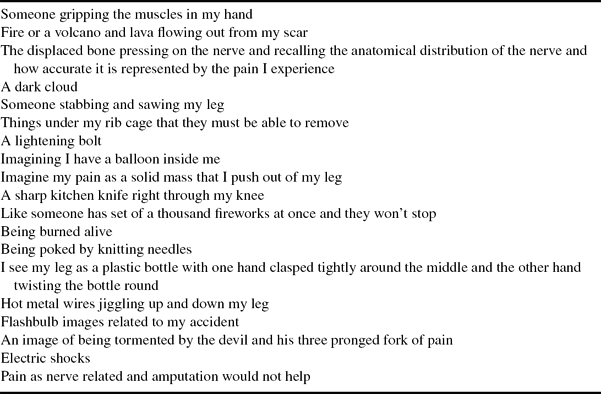
Participants’ descriptions of their mental images are outlined in Table 2. As can be seen, the types of images experienced seem very individual and idiosyncratic and do not easily form discrete categories.
Respondents’ description of mental images of their pain
Kolmogorov-Smirnov tests and exploratory data analysis indicated that the standardized measures data were sufficiently normally distributed to justify using parametric tests. Effect sizes were calculated using the Dunst guidelines for calculating Cohen's d (Dunst, Hamby and Trivette, Reference Dunst, Hamby and Trivette2004), and using the formula provided by Field for calculating r for General Linear Models (Field, Reference Field2005, p. 385).
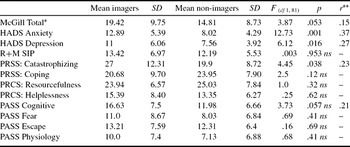
Table 3 outlines differences between those who reported pain related images (imagers) and those who reported no such images (non-imagers) on each of the measures of functional outcome. Whilst, technically, there is no statistically significant difference in self-reported pain severity between imagers and non-imagers, the value of p is close to the accepted cut-off of .05 (McGill-SF total for imagers was 19.4, relative to 14.8 for non-imagers, F = 3.87, df = 1,81, p = 0.053, r = .15). Intensity of pain is potentially a confounding variable in the current study, given that the pain imagery group do differ from the non-imagery group on this variable. In order to take a relatively conservative stance the analysis was conducted using ANCOVA to control for the effect of pain intensity on other functional outcomes.
Mean differences between imagers and non-imagers

(HADS = Hospital Anxiety and Depression Scale, R+M SIP = Roland Morris Sickness Impact Profile, PRSS = Pain Related Self Statements, PRCS = Pain Related Control Scale, PASS = Pain Anxiety Symptoms Scale). *All statistical tests are ANCOVA, with McGill Total as a covariate, apart from McGill Total itself. **r = effect size estimate: small = .10, medium = .30, large = .50 (Field, Reference Field2005, p.33).
Anxiety and depression
The mean HADS anxiety score for those who reported mental images of their pain (12.89, SD = 5.39) was significantly higher than for those who reported that they did not experience such mental images (8.02, SD = 4.29). Even when controlling for pain intensity, this difference is statistically significant and is of a moderate effect size (F = 12.73, df = 1,81, p = .001, r = .37), suggesting that those who report mental images of their pain also report significantly higher levels of anxiety than those who do not report having images of their pain.
Additionally, those who reported mental images were significantly more likely to score within the range considered to indicate possible clinical anxiety (a score of 8 or above) than those who reported not having such images (84% vs 53%, χ2 = 5.91, df = 1, p = .015).
The mean HADS Depression score for those who reported mental images of their pain was 11.0 (SD = 6.06) compared to 7.56 (SD = 3.92) for those who indicated that they did not experience such images. This result was statistically significant (F = 6.12, df = 1,81, p = .016) and represents a small to medium effect size (r = .27), suggesting that those who report mental images of their pain report higher levels of depression than those who do not report mental images of their pain.
Those who reported mental images were more likely to score within the range considered to indicate possible clinical depression (a score of 8 or above) than those who reported not having such images (73% vs 44%, χ2 = 5.25, df = 1, p = .022).
Disability
Those who reported mental images had a slightly higher mean score on the Roland and Morris Sickness Impact profile (mean: 13.42, SD = 6.97) than those who did not experience such images (mean: 12.19, SD = 5.53), although this was not statistically significant (F = .003, df = 1,81, p = .95).
Adaptive and maladaptive cognitions
Those reporting mental images of their pain had significantly higher mean scores on the PRSS Catastrophizing scale than those who did not report such images (mean imagers: 27.0, SD = 12.3 vs non imagers: 19.9, SD = 8.72; F = 4.45, df = 1,81, p = 0.038, r = .23). As can be seen in Table 3, there were no differences between the two groups on the scales of Coping, Resourcefulness or Helplessness.
Pain related anxiety
None of the subscales of the Pain Anxiety Symptoms Scale (PASS) showed any significant differences between the imagery and non-imagery groups. The subscale of “Cognitive Anxiety” did approach significance (F = 3.73, df = 1,81, p = .057, r = .21), which is coherent with the finding related to Catastrophizing.
Discussion
Those who reported mental images of their pain had significantly higher scores on measures of anxiety, depression and catastrophizing than those who reported not experiencing such images. These differences were present despite similar levels of physical disability between the two groups. The group differences were also present after statistically controlling for marginally higher pain intensity being associated with the presence of mental imagery.
There are a number of possible explanations for these findings. It is possible that people who are more distressed are more likely to generate images of their pain. Depression is known to cause people to spend longer ruminating on their predicament (Just and Alloy, Reference Just and Alloy1997) and spending time thinking about their pain may have made the imagers more likely to generate images of that pain. Rumination is also a key feature of pain catastrophizing and it is noteworthy that imagers were higher in catastrophizing than non-imagers. Alternatively, it is known that some individuals have more of a propensity toward experiencing visually based cognition over more verbal modalities (see for example Reisberg et al., Reference Reisberg, Pearson and Kosslyn2003). It may be that when people with this propensity for visual imagery develop chronic pain they are simply more inclined to generate mental images of this pain. This study suggests that the presence of these images may then dispose them towards greater distress. A third possibility is that both the increased distress and the disposition towards experiencing mental images are caused by an unmeasured third factor, possibly a personality variable. Of course, the current study cannot address these issues of causal direction and future research will be required to fully explore this novel clinical phenomenon. This study has shown, however, that chronic pain intensity, pain-related imagery, catastrophizing and distress are related in a substantial proportion of people with chronic pain.
Future studies might be able to determine whether the generation of mental images of pain precedes increased distress, or whether increased distress precedes the generation of mental images. It is likely to be difficult to determine this, as chronic pain patients would by their nature have experienced any such images and distress for some years and any responses as to which occurred first would be subject to retrospective bias.
However, given the possibility that the mental images may play a role in the maintenance of distress amongst some patients, it would seem reasonable to explore whether helping patients to become aware of, understand and perhaps manipulate their pain related mental images may have a role in reducing their distress. Thus, in addition to imagery based relaxation work, which serves to distract individuals from their pain (Main and Spanswick, Reference Main and Spanswick2000), there may be a role for interventions that focus upon pain related mental images. This may involve working to change image-based maladaptive cognitions in a similar manner to work undertaken to change verbally based maladaptive cognitions.
It is also likely (though not investigated by the present study) that these images may play a role in cueing avoidance behaviours. Greater awareness of images and their impact upon behavioural responses could help chronic pain patients to reduce unhelpful safety behaviours, as suggested by Jamani and Clyde (Reference Jamani and Clyde2008). Although these authors write from a cognitive modification perspective, it is also possible that mindfulness and acceptance based interventions in relation to chronic pain imagery could help chronic pain patients to develop the psychological flexibility necessary to fully engage in behavioural exposure to feared movements.
Future research would benefit from developing reliable and valid methods of measuring chronic pain imagery, based on a fuller description of the phenomenology of chronic pain imagery. Our research group has now completed two projects further exploring the phenomenology of chronic pain imagery (Gosden, Reference Gosden2008; Lonsdale, Reference Lonsdale2010). Manuscripts describing these promising results are currently in preparation. In addition, qualitative methods may be useful as a further step in this endeavour. Ultimately, research is needed to investigate the degree to which chronic pain imagery is a suitable target for cognitive behavioural treatment of chronic pain and pain related distress. Such research should attempt to address questions such as whether imagery modification is a useful addition to verbal cognitive modification strategies. As indicated, the function of pain related imagery in inhibiting behavioural flexibility is a further important dimension. Such questions are also shaped by the theoretical or conceptual frameworks adopted by researchers and clinicians and future research in this area would benefit from developing and articulating a workable and empirically based conceptual framework within which to understand chronic pain imagery, cognitive processes, distress and behavioural flexibility.
Limitations of the study
The questionnaire packs sent to participants took approximately 45 minutes to complete, which may have deterred some respondents. Whilst the 23% response rate is consistent with other surveys within health care settings (e.g. Harrison and Cock, Reference Harrison and Cock2004), it is possible that those who participated differed in some respects from those who did not take part. The study was unable to control for the use of medication by the participants, although most pain clinic patients take analgesic medication and some take psychiatric medication, primarily anti-depressants. The use of these pharmaceuticals may have influenced reported severity of pain and reported levels of anxiety and depression. All measures used within the study were self-report measures and thus open to biases. However, the main measures are widely used research tools with good evidence for their validity.
The measurement of chronic pain imagery in this study is at a preliminary stage of development. It is possible that many potential participants decided not to take part because the suggestion of pain related mental imagery may be misinterpreted as suggesting that their pain is “all in the mind”. This may reflect the relatively low response rate in the current study, suggesting that care must be taken in how far these results may be generalized to the larger population of chronic pain patients.
Pain patients may also find it difficult to readily distinguish between thoughts and images and so it is possible that the self-report postal questionnaire method is not the most reliable method of measurement. Furthermore, some of the descriptions in Table 2 appear more imagery-like than others. There remains a possibility that some of these imagery descriptions are simply metaphorical ways of describing pain rather than an actual intrusive image. Using a postal survey method makes it hard to fully disambiguate this. Future studies may need to continue to use interview-based methods whilst we refine our methods of assessing mental imagery.
Interestingly, in our subsequent studies (still using self-report postal survey methods) we have provided a slightly more detailed description of what is meant by pain-related visual imagery, as follows:
“We are particularly interested in finding out if you have a picture or a mental image of what your pain is like. A mental image is like having a picture in your head, which may include things you can imagine seeing, hearing or feeling. Do you ever have a mental image like this of your pain?”
In these studies we find around 40% of chronic pain patients report mental imagery (Gosden, Reference Gosden2008; Lonsdale, Reference Lonsdale2010). Finally, the link between visual imagery and emotions has been well established, and so the findings here may be interpreted as being relevant to visual images per se, rather than specifically being related to mental imagery of pain. As the current study did not measure other types of imagery, this cannot be ruled out, although our more focused exploration of pain related mental imagery suggests this as a promising line of further enquiry, consistent with the small literature that is developing in this area.
Strengths of the study
Although the assessment of chronic pain imagery was a non-validated single item question, all dependant variables were measured using well-standardized measures that have previously been validated within the chronic pain population. Finally, participants were recruited using very broad inclusion criteria, with few exclusions. This allows the results reported here to be possibly widely generalizable to heterogeneous populations of chronic pain patients.
Conclusions
The present study indicates that a substantial proportion of chronic pain patients experience pain-related mental images and that these individuals have significantly higher levels of anxiety and distress than other chronic pain patients. Whilst there could be several explanations for these findings, it is possible that interventions aimed at manipulating such images may help to reduce distress and increase behavioural flexibility amongst some individuals suffering from chronic pain.
Acknowledgements
We appreciate support from the Lothian Chronic Pain Service and statistical advice provided by Professor Dave Peck and Dr Emily Newman.



Comments
No Comments have been published for this article.