Introduction
With the World Health Association and the United Nations calling for a paradigm shift away from the medicalisation of human distress, new evidence about millions of people struggling to get off antidepressants, and ongoing debate about the value and safety of electroconvulsive therapy (ECT), it seems timely to discuss these two longstanding treatments offered to us by biological psychiatry's ‘medical model’ when we become sad or depressed.
Firstly, we acknowledge that treatments rest on, and are justified by, assumptions about the nature, and causes, of what is being ‘treated’. Advocates of so-called ‘antidepressant’ medications, and ECT, argue that the treatments work by correcting underlying biological dysfunctions. These hypothesised dysfunctions are proposed to be among the causes of the problematic cognitions, emotions and behaviour that are referred to as ‘symptoms’ and that form the criteria for diagnosing ‘mental disorders’ such as ‘Major Depressive Disorder’. We, and others, have provided detailed reviews of evidence demonstrating that no biological dysfunction that can be corrected by current treatments has been found, and explained how alternative mechanisms can account for apparent treatment effects including treatment-induced alterations to normal brain functions as well as placebo effects (Breggin, Reference Breggin2008; Fosse & Read, Reference Fosse and Read2013; Moncrieff, Reference Moncrieff2008; Moncrieff & Cohen, Reference Moncrieff and Cohen2005; Rasmussen, Reference Rasmussen2009; Read et al., Reference Read, Gibson, Cartwright, Shiels, Dowrick and Gabbay2015; Read, Kirsch, & McGrath, Reference Read, Kirsch and McGrath2019; Read & Sanders, Reference Read and Sanders2010; Speed et al., Reference Speed, Moncrieff and Rapley2014; Valenstein, Reference Valenstein1988).
Although most clinicians subscribe to a biopsychosocial model of mental disorder, the idea that treatments work by rectifying underlying biological dysfunctions relegates the role of social and psychological factors to secondary or indirect considerations, such as triggers of a supposed genetic predisposition. Although holistic care is important in general medicine, the primary focus is treating the physiological processes that give rise to symptoms and health risks (Moncrieff, Reference Moncrieff2020). Therefore, equating psychiatric conditions and treatments with medical ones implies the pre-eminence of biological factors. This is reinforced with psychiatric language. Depression, for example, is described as somehow causing abnormal feelings and behaviours, as if it were a physical condition, even though those same feelings and behaviours form the criteria for the diagnosis in the first place. For example, the American Psychiatric Association (2021a) proclaims:
Depression (major depressive disorder) is a common and serious medical illness that negatively affects how you feel, the way you think and how you act.
Until January 2021, the APA website advised:
Psychiatric medications can help correct imbalances in brain chemistry that are thought to be involved in some mental disorders. (APA, 2021b)
The idea that biological factors ‘cause’ depression, even if in conjunction with social circumstances, also presupposes that there is a mechanical and predictable relationship between biology and human feelings and actions that excludes the possibility of meaning and agency (Moncrieff, Reference Moncrieff2020). Hence viewing depression as a medical disorder that somehow originates in the brain and responds to brain-based interventions is fundamentally inconsistent with understanding it as a ‘normal’ human emotion, albeit sometimes extreme and disproportionate – that is as a meaningful reaction to depressing events and circumstances (Moncrieff, Reference Moncrieff2020).
Although we will focus on the failure to establish that antidepressants and ECT are effective or safe, we do so from the perspective that this approach, focussed as it is on decontextualised, pathologised individuals or brains, is flawed from the outset. For example, it cannot address the issues underlying women being about twice as likely as men to receive either ‘treatment’. We are not alone in calling instead for approaches that acknowledge the meaning of depression, and address the common social origins of misery and sadness (e.g. Brown & Harris, Reference Brown and Harris1978; Cromby, Harper, & Reavey, Reference Cromby, Harper and Reavey2013; Johnstone et al., Reference Johnstone, Boyle, Cromby, Dillon, Harper, Kinderman and Read2018; Puras, Reference Puras2019).
Antidepressants
Are antidepressants active placebos?
Certain drugs have been referred to as ‘antidepressants’ since the 1950s. Despite this appellation, it is not clear that they have any specific antidepressant effects. Hundreds of placebo-controlled trials suggest that antidepressants are marginally better than placebo at reducing depressive symptoms as measured by depression rating scales. Combining published and unpublished studies suggests an effect size of around 0.3 across different meta-analyses, which translates into a difference of around 2.0 points on the commonly used Hamilton Depression rating scale (HAM-D) (Hamilton, Reference Hamilton1960), which has a maximum score of 52 points. This has not been shown to be a clinically relevant difference (Leucht et al., Reference Leucht, Fennema, Engel, Kaspers-Janssen, Lepping and Szegedi2013; Moncrieff & Kirsch, Reference Moncrieff and Kirsch2015). Matching HAM-D scores against Clinical Global Impression scale scores (Guy, Reference Guy1976) suggests a difference of 8 points is required to indicate ‘mild clinical improvement’ and that a difference of 3 points and below does not register as indicating any change.
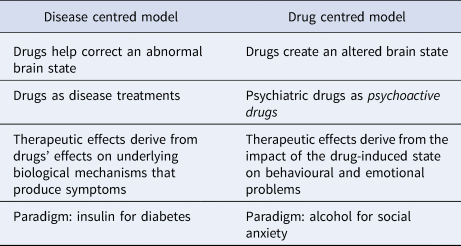
Moreover, the small difference between antidepressant drugs and inert placebo tablets does not confirm that the drugs have an antidepressant action. There are other explanations for these small differences. At present, most drugs are assumed to work according to a ‘disease-centred’ model of drug action, which proposes that they act on the biological processes assumed to underpin symptoms, in the same way as drugs do in most medical conditions, including non-curative, symptomatic treatments (such as salbutamol for wheezing). However, an alternative, ‘drug-centred’ model suggests that psychiatric drugs change mental states and behaviour through the modification of normal brain functions (Table 1). This model highlights that psychiatric drugs are psychoactive substances that alter normal thoughts, sensations, emotions and behaviours. These alterations, along with physical alterations, may unblind people in placebo-controlled trials. This may lead to amplified placebo effects among those taking active drugs, especially since several antidepressant studies show that people's beliefs about whether they are taking an active drug or a placebo have substantial effects on the outcome (Chen et al., Reference Chen, Papakostas, Youn, Baer, Clain, Fava and Mischoulon2011; Faria et al., Reference Faria, Gingnell, Hoppe, Hjorth, Alaie, Frick and Furmark2017). Consistent with this, it seems that almost any drug with psychoactive properties (one that produces noticeable mental alterations) has equivalent effects to antidepressants in depression, including benzodiazepines, stimulants, opiates, buspirone and antipsychotics (Moncrieff, Reference Moncrieff2008).
Alternative models of drug action (adapted from Moncrieff, Reference Moncrieff2009; Moncrieff & Cohen, Reference Moncrieff and Cohen2005)

The mental and behavioural alterations produced by antidepressants (and other psychiatric drugs and ECT) may also reduce or mask depressed feelings or other ‘symptoms’ of depression. Selective serotonin reuptake inhibitors (SSRIs) and some other antidepressants have emotion-numbing effects, which may lead to a reduction in the intensity of both depression and anxiety (Goldsmith & Moncrieff, Reference Goldsmith and Moncrieff2011; Price, Cole, & Goodwin, Reference Price, Cole and Goodwin2009; Read & Williams, Reference Read and Williams2018). Antidepressants with sedative properties, for example, such as the tricyclic antidepressants and some newer agents like mirtazapine, may help with insomnia or reduce anxiety or agitation, all of which feature in depression rating scales. The fact that differences from placebo are so small suggests these effects are not particularly useful, however.
Other artefacts may also account for the differences between drugs and placebos in randomised trials, such as selective publication (Turner, Matthews, Linardatos, Tell, & Rosenthal, Reference Turner, Matthews, Linardatos, Tell and Rosenthal2008), the conversion of continuous data into categorical outcomes (Kirsch & Moncrieff, Reference Kirsch and Moncrieff2007), and the fact that many participants in drug trials are already on medication, and are then withdrawn, leading to withdrawal effects and increased likelihood of unblinding in the placebo group (Hunter et al., Reference Hunter, Cook, Tartter, Sharma, Disse and Leuchter2015).
Antidepressants perform poorly in clinical practice
The majority of placebo-controlled trials have been conducted by the pharmaceutical industry, which has an investment in inflating results, but government-funded research also fails to confirm that antidepressants have beneficial effects. The massive sequenced treatment alternatives to relieve depression (STAR-D) study of gold-standard naturalistic antidepressant treatment produced dismal results. Although the original publication suggested reasonable remission rates of 37% at 12 weeks (Rush et al., Reference Rush, Trivedi, Wisniewski, Nierenberg, Stewart, Warden and Fava2006), the study has been criticised for the use of a secondary outcome measure, exclusion of early dropouts and numerous other protocol deviations (Pigott, Reference Pigott2015; Pigott, Leventhal, Alter, & Boren, Reference Pigott, Leventhal, Alter and Boren2010). A subsequent analysis found that only 108 participants out of a total of over 4000 recovered, remained well and completed the study, a figure that is still based on the secondary outcome (Pigott et al., Reference Pigott, Leventhal, Alter and Boren2010). For 14 years no data was published on the primary outcome measure, the Hamilton rating scale. When independent researchers eventually obtained the data it emerged that people given antidepressant treatment along with high-quality care showed a reduction in their scores of 6.6 points after 12 weeks (Kirsch, Huedo-Medina, Pigott, & Johnson, Reference Kirsch, Huedo-Medina, Pigott and Johnson2018). This is at the lower end of the range of change seen in people on placebo in meta-analyses of randomised trials (Gibbons, Hur, Brown, Davis, & Mann, Reference Gibbons, Hur, Brown, Davis and Mann2012; Kirsch, Moore, Scoboria, & Nicholls, Reference Kirsch, Moore, Scoboria and Nicholls2002; Sugarman, Loree, Baltes, Grekin, & Kirsch, Reference Sugarman, Loree, Baltes, Grekin and Kirsch2014) and roughly half that in randomised trials comparing different antidepressants (Rutherford, Sneed, & Roose, Reference Rutherford, Sneed and Roose2009). This suggests that the conditions of being in a randomised trial inflate drug effects and that, in real life, antidepressants are no better than placebos.
Do antidepressants correct an underlying biological abnormality?
Despite claims by professional organisations and the pharmaceutical industry that depression is due to a chemical imbalance that can be rectified by drugs (e.g. APA, 2021b), there is no evidence that there are any neurochemical abnormalities in people with depression, let alone abnormalities that might cause depression. Where differences between people with and without depression have been found, these are likely to be explained by prior use of antidepressants and other medications; but in most areas, no consistent differences have been found in any case (Moncrieff et al., Reference Moncrieff, Stockmann, Amendola, Hengartner and Horowitz2021). Although the public, internationally, continue to favour psycho-social explanations of depression (Hagmayer & Engelmann, Reference Hagmayer and Engelmann2014; Read et al., Reference Read, Cartwright, Gibson, Shiels and Haslam2014; Read et al., Reference Read, Cartwright, Gibson, Shiels and Haslam2015), an increasing proportion have been influenced to believe that depression is caused by a chemical imbalance (Pilkington, Reavley, & Jorm, Reference Pilkington, Reavley and Jorm2013), and across the world increasing numbers now take antidepressants (OECD, 2020; Olfson, Wang, Wall, Marcus, & Blanco, Reference Olfson, Wang, Wall, Marcus and Blanco2019). Seventeen per cent of the population of England were prescribed an antidepressant in 2018 (Taylor et al., Reference Taylor, Annand, Burkinshaw, Greaves, Kelleher, Knight and Marsden2019), and 14% of US adults by 2015 (Olfson et al., Reference Olfson, Wang, Wall, Marcus and Blanco2019). Yet the number of people requiring services or going onto long-term disability due to depression is increasing (Olfson et al., Reference Olfson, Wang, Wall, Marcus and Blanco2019; Viola & Moncrieff, Reference Viola and Moncrieff2016).
Antidepressants alter normal mental activity and behaviour
Besides the fact that millions of people are taking drugs with little demonstrable benefit, the dominance of the disease-centred model of drug action has inhibited research into the nature of the various antidepressant drugs. We, therefore, don't know the full implications and long-term consequences of taking these drugs. Like other psychiatric drugs, they are psychoactive substances that cross the blood-brain barrier and alter normal mental processes and behaviour by changing the normal functioning of the brain. Evidence suggests that SSRIs reduce the intensity of emotions, and produce apathy and demotivation, which are associated with impairment of sexual function (Goldsmith & Moncrieff, Reference Goldsmith and Moncrieff2011; Padala et al., Reference Padala, Padala, Majagi, Garner, Dennis and Sullivan2020; Read & Williams, Reference Read and Williams2018; Zahodne et al., Reference Zahodne, Bernal-Pacheco, Bowers, Ward, Oyama, Limotai and Okun2012). A drug-centred model suggests that we need to evaluate whether such changes might have worthwhile effects, when balanced against their likely negative impact and other adverse effects.
Adverse effects of antidepressants
Modern antidepressants are generally less toxic than their predecessors and therefore less likely to be used for self-poisoning or suicide, as older antidepressants frequently were (Henry & Antao, Reference Henry and Antao1992). Many have fewer adverse effects, but they are not innocuous. SSRIs cause sexual dysfunction in a large proportion of users, and more worryingly, some people report that this persists after stopping the drug (Bala, Nguyen, & Hellstrom, Reference Bala, Nguyen and Hellstrom2018). This is consistent with research with young animals finding that sexual behaviour is negatively impacted by previous use of SSRIs (Simonsen, Danborg, & Gotzsche, Reference Simonsen, Danborg and Gotzsche2016). The prevalence of persistent effects is unknown, but even if it is rare, it is a potential catastrophe given the huge numbers now using antidepressants, and the increasing number of younger users. That long-term antidepressant use may lead to persistent brain modifications is also evidenced by the prolonged and severe withdrawal state they can induce (Framer, Reference Framer2021; Hengartner, Schulthess, Sorensen, & Framer, Reference Hengartner, Schulthess, Sorensen and Framer2020).
It has been recognised since the 1990s that current antidepressants are associated with withdrawal effects (Haddad, Lejoyeux, & Young, Reference Haddad, Lejoyeux and Young1998), but this has only recently started to receive serious attention. A recent review suggests that around 56% of people experience withdrawal effects after discontinuing antidepressants, and for 46% of those the effects are severe (Davies & Read, Reference Davies and Read2019). In general, the longer someone takes an antidepressant, the more likely they are to experience a withdrawal reaction, and the more severe it will be (Horowitz & Taylor, Reference Horowitz and Taylor2019). The adverse effects of withdrawal can be so intolerable that some people trying to discontinue treatment have to reduce by tiny amounts over many years, and accumulating evidence suggests that the effects may even persist for months or years after the drugs are finally stopped (Framer, Reference Framer2021; Hengartner et al., Reference Hengartner, Schulthess, Sorensen and Framer2020).
The use of antidepressants also has potential negative psychological consequences. Since antidepressants are associated with beliefs that depression is caused by biochemical perturbations, their use may discourage people from addressing the circumstances that caused their depression in the first place, whether they be relationship problems, financial difficulties or something else. If people attribute their improvement to taking antidepressants, rather than recognising how they helped themselves, they will not develop confidence in their own resilience and abilities which is likely to make them more vulnerable to future episodes.
Research confirms that people may come to believe they need antidepressants to stay well, and therefore become fearful of stopping them, leading to ever-increasing numbers of long-term users (Eveleigh, Speckens, van Weel, Oude Voshaar, & Lucassen, Reference Eveleigh, Speckens, van Weel, Oude Voshaar and Lucassen2019; Maund et al., Reference Maund, Dewar-Haggart, Williams, Bowers, Geraghty, Leydon and Kendrick2019). The longer antidepressants are used, the greater their adverse effects, including the likelihood of severe and protracted withdrawal syndromes.
Electroconvulsive therapy
Correcting a biological deficit?
As is the case for antidepressants, the various biological deficits that are supposedly corrected by ECT have never been demonstrated. The earliest two claims about how ECT works, and what it was supposedly correcting, are interesting.
The first was a supposed ‘biological antagonism’ between ‘schizophrenia’ and epilepsy (Fink & Sackeim, Reference Fink and Sackeim1996). If you had one you couldn't have the other. While some doctors treated epilepsy by injecting the blood of ‘schizophrenics’ (Kalinowsky, Reference Kalinowsky1986), others were using various techniques, including insulin and eventually electricity, to induce seizures in ‘schizophrenics’.
The second claim was that ECT works because it causes brain damage, thereby erasing painful memories and/or simplifying thought processes. In Reference Freeman1941, Walter Freeman, who imported ECT to the United States, wrote, in a paper entitled ‘Brain Damaging Therapeutics’:
The greater the damage, the more likely the remission of psychotic symptoms…. Maybe it will be shown that a mentally ill patient can think more clearly and more constructively with less brain in actual operation (p. 83).
Another psychiatrist explained:
There have to be organic changes or organic disturbances in the physiology of the brain for the cure to take place. I think the disturbance in memory is probably an integral part of the recovery process. I think that it may be true that these people have for the time being at any rate more intelligence than they can handle and that the reduction in intelligence is an important factor in the curative process…. Some of the very best cures that one gets are in those individuals whom one reduces almost to amentia. (Myerson, Reference Myerson1942, p. 39)
These quotations concerned the use of ECT for ‘schizophrenia’, but the idea that the procedure worked in this way was also applied to depression, at least until the 1960s. The principle UK psychiatry textbook of the period attributed the effects of ECT to the ‘disruption by the fit and the subsequent period of amnesia of recently acquired morbid patterns of behaviour and reaction’ (Henderson & Gillespie, Reference Henderson and Gillespie1962, p. 335).
A neutral observer would assume that the effects on the brain of repeatedly passing sufficient electricity through it to cause seizures are likely to be negative. ECT advocates, however, tend to interpret abnormal brain changes caused by multiple electrocutions as beneficial, sometimes even linking them to reduced depression. They don't consider that the changes might be negative or might be characterised as brain damage. To do so would revert to the original 1940s theory that ECT works because it causes brain damage.
A similar line of argument was resurrected, 70 years later, by researchers who reported that ECT reduces the ‘functional connectivity’ of the brain (Perrin et al., Reference Perrin, Merz, Bennett, Currie, Steele, Reid and Schwarzbauer2012). Our neutral observer might assume the researchers would be concerned by this rather worrying side effect. Instead, they celebrated having discovered how ECT works. They posited a supposed ‘hyperconnectivity’ that somehow causes depression, and which is somehow corrected by ECT. Other ECT advocates, meanwhile claim to have found the opposite; that ECT works because it increases functional connectivity (Wei et al., Reference Wei, Bai, Chen, Ji, Hu, Xie and Tian2018).
Still other ECT proponents, meanwhile, acknowledge that we simply don't know what brain changes lead to the temporary lift in mood that some people experience, or what biological deficits are being corrected. Max Fink, a very famous ECT advocate, admitted, 83 years after the first ECT: ‘Studies to decode the mechanism by which such interventions improve serious illnesses are sorely needed’ (Fink, Reference Fink2021, p. 151).
A recent audit of 36 ECT patient information leaflets in England found that 22% acknowledged that it is not known how ECT works. Nevertheless, 78% claimed it corrects some deficit in the brain (Harrop, Read, Geekie, & Renton, Reference Harrop, Read, Geekie and Renton2021).
Freeman's old idea of ‘brain-damaging therapeutics’ does receive some support from contemporary evidence. A 2013 review concluded:
The temporarily improved scores on depression instruments following ECT reflect the combination of frontal and temporal lobe functional impairments and activation of the hypothalamic pituitary adrenal (HPA) axis and the mesocorticolimbic dopamine system. These effects as well as other detailed changes observed in structures such as the hippocampus appear consistent with those typically seen after severe stress-exposure and/or brain trauma. (Fosse & Read, Reference Fosse and Read2013, p. 6)
Furthermore, bilateral ECT causes more memory loss/brain damage than unilateral (Sackeim et al., Reference Sackeim, Prudic, Fuller, Keilp, Lavori and Olfson2007), and is more effective in the short-term (Read & Arnold, Reference Read and Arnold2017), suggesting that cognitive impairment and temporary ‘improvement’ result from the same brain process.
So, as is the case for ‘antidepressants,’ the story of ECT appears to be one of a biological intervention being claimed to correct biological deficits, but in reality having negative effects on healthy brains, some of which are misconstrued as signs of improvement.
Medical intervention or expectancy effect?
Like antidepressants, the story of ECT is also the story of the power of placebo effects (Lambourn & Gill, Reference Lambourn and Gill1978; Johnstone et al., Reference Johnstone, Deakin, Lawler, Frith, Stevens, McPherson and Crow1980; Rasmussen, Reference Rasmussen2009; Read & Bentall, Reference Read and Bentall2010; Ross, Reference Ross2006). Positive expectations affect prescribers as well as patients. They influence perceptions of recovery as well as recovery itself. Neurologist John Friedberg (Reference Friedberg1976, p. 31) pointed out that the rapid spread of ECT across Europe and the USA in the 1940s took place despite there being no studies comparing recipients and non-recipients, and that ‘the influence of ECT was on the minds of the psychiatrists, producing optimism and earlier discharges.’
The standard placebo in ECT studies, known as ‘sham ECT’ (SECT), is the administration of the general anaesthetic but not the electricity or subsequent convulsion. A review of the literature on placebo responses to ECT concluded: ‘Rigorously defined endogenously depressed patients did exceptionally well with sham ECT, just as well as with real ECT’ (Rasmussen, Reference Rasmussen2009, p. 59).
In the 84 years since the first ECT there have only been 11 randomised placebo-controlled studies (RCTs) for its target diagnosis, depression, all before 1986 (Read & Bentall, Reference Read and Bentall2010). A recent review, involving Dr Irving Kirsch, Associate Director of Placebo Studies at Harvard Medical School, highlighted the poor quality of the 11 studies (Read et al., Reference Read, Kirsch and McGrath2019, p. 64):
Only four studies describe their processes of randomisation and testing the blinding. None convincingly demonstrate that they are double-blind. Five selectively report their findings. Only four report any ratings by patients. None assess Quality of Life. The studies are small, involving an average of 37 people.
Furthermore:
Four of the 11 found ECT significantly superior to SECT at the end of treatment, five found no significant difference and two found mixed results (including one where the psychiatrists reported a difference but patients did not).’
No studies showed that ECT outperforms placebo beyond the end of the treatment period (Read et al., Reference Read, Kirsch and McGrath2019). Two of the least flawed studies reported follow up data. One produced a near-zero effect size (0.065) in favour of ECT (Johnstone et al., Reference Johnstone, Deakin, Lawler, Frith, Stevens, McPherson and Crow1980), the other a small effect size (0.299) in favour of SECT (Lambourn & Gill, Reference Lambourn and Gill1978).
Nevertheless, all five meta-analyses of these flawed studies somehow conclude that ECT is effective. They pay little or no attention to the shortcomings of the studies, fail to comment on the high response to sham ECT, and don't identify any evidence on long-term effects (Read et al., Reference Read, Kirsch and McGrath2019). The Food and Drug Administration (2020) in the US mandates that ECT machines have signs next to them stating: ‘The long-term safety and effectiveness of ECT treatment has not been demonstrated.’
The meta-analyses fail to identify any evidence that ECT prevents suicide, as often claimed. Numerous studies have found ECT recipients are more likely than other patients to kill themselves (Munk-Olsen, Laursen, Videbech, Mortensen, & Rosenberg, Reference Munk-Olsen, Laursen, Videbech, Mortensen and Rosenberg2007; Read, Bentall, Johnstone, Fosse, & Bracken, Reference Read, Bentall, Johnstone, Fosse, Bracken, Read and Dillon2013a). In a recent study 14 810 ECT patients were 16 times more likely to try to kill themselves than a matched control group of 58 369 (Peltzman, Shiner, & Watts, Reference Peltzman, Shiner and Watts2020). Even after controlling for ‘demographic, clinical, and service use characteristics,’ including psychiatric diagnoses and inpatient admissions, the ECT patients were 1.3 times more likely to have killed themselves (a non-significant difference). A study using the Danish National Patient Registry also found an increased risk of suicide in patients who received ECT compared to equally depressed non-ECT patients (Jorgensen, Rozing, Kellner, & Osler, Reference Jorgensen, Rozing, Kellner and Osler2020),
Another recent study, using the Swedish national registry, claimed its findings ‘support the continued use of ECT to reduce suicide risk in hospitalised patients who are severely depressed’ (Ronnqvist, Nilsson, & Nordenskjold, Reference Ronnqvist, Nilsson and Nordenskjold2021). The overall difference in suicides over 12 months between the ECT group (1.1%) and the non-ECT group (1.6%) was small. The difference was significant, but only for patients who were psychotic, not for those who were depressed but not psychotic. Nor did the difference hold for people under 45. Furthermore, at 3 months (at which point any difference might more reasonably be attributed to ECT than at 12 months) there had been no significant overall difference. More importantly, ‘Suicide was defined as death caused by intentional self-harm (ICD-10 codes X60-X80) or by an event of undetermined intent (ICD-10 codes Y10-Y35).’ Emails to the authors failed to determine how many of the events they counted as suicide had, instead, been ‘events of undetermined intent’.
The most recent study found that 1524 homeless US veterans who received ECT had made significantly more suicide attempts, at 30 days follow up, than 3025 matched homeless veterans who hadn't had ECT. The difference remained significant at 90 days and 1 year (Tsai, Peltzman, Watts, & Shiner, Reference Tsai, Peltzman, Watts and Shiner2021).
In the only recent meta-analysis, from the Institute of Psychiatry in London (Mutz et al., Reference Mutz, Vipulananthan, Carter, Hurlemann, Fu and Young2019), just one sham ECT study (Brandon et al., Reference Brandon, Cowley, McDonald, Neville, Palmer and Wellstood-Eason1984) contributed to their ‘network meta-analysis’ (involving comparisons of different types of treatments). Thus, after more than 80 years, only one placebo study was considered robust by the Institute. Strangely, another relatively high-quality study, the well-known Northwick Park study (Johnstone et al., Reference Johnstone, Deakin, Lawler, Frith, Stevens, McPherson and Crow1980), which found much smaller effects of ECT, was excluded because, according to the authors, it ‘cannot be obtained’. It had been published in the Lancet. Furthermore, the one study they did include (Brandon et al., Reference Brandon, Cowley, McDonald, Neville, Palmer and Wellstood-Eason1984) was classified, by the reviewers themselves, as having a ‘high risk’ of bias. Nevertheless, they announced that two of the four types of ECT they claimed to have assessed are more effective than placebo (and two are not), even though the only sham-ECT study they included assessed only one of those four types (bilateral ECT) (Read et al., Reference Read, Kirsch and McGrath2019, pp. 88, 89).
The 2019 review concluded:
Given the high risk of permanent memory loss and the small mortality risk, this longstanding failure to determine whether or not ECT works means that its use should be immediately suspended until a series of well designed, randomised, placebo-controlled studies have investigated whether there really are any significant benefits against which the proven significant risks can be weighed. (Read et al., Reference Read, Kirsch and McGrath2019, p. 64)
Esteemed British Clinical Psychologist, Professor Bentall (Reference Bentall2020) commented:
I believe that Read and his colleagues have done an important service in pointing out the parlous state of ECT research … ECT is a classic failure of evidence-based medicine.
A subsequent discussion regarding the ethics of ECT concluded:
Although most of the medical literature states that ECT is an effective and safe technique, there is no conclusive evidence of long-term effectiveness (González-Pando et al., Reference González-Pando, González-Menéndez, Aparicio-Basauri, Sanz de la Garza, Torracchi-Carrasco and Pérez-Álvarez2021).
The six defences against having no robust evidence
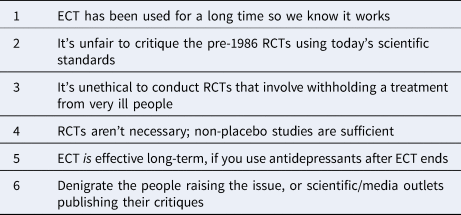
There are six standard responses used to try to counteract the absence of any robust evidence that ECT is better than placebo (Read, Reference Read2022) (see Table 2).
The six defences against the continuing absence of any evidence of efficacy from adequate randomised, placebo-controlled studies (RCTs) of ECT

The first is that it has been used for so long that it must be effective. Unfortunately, the history of psychiatry is littered with treatments considered, by intelligent, well-intentioned doctors, to be safe and effective, which turned out to be neither, such as lobotomies.
The second is that it is unfair to apply today's standards of evidence-based medicine to studies conducted 40 or 50 years ago. Perhaps so, but this acknowledges that there is no robust evidence It also begs the question: why have none been conducted since 1985?
The third defence, an attempt to answer the above question, is that it is unethical to conduct studies that withhold a treatment which we believe works from severely depressed, suicidal patients. Arguing that we can't find out whether X actually does work because withholding X is unethical because we believe it works, renders ECT proponents beyond the realms of normal science and evidence-based medicine. (It also implies that 39 colleagues, the authors of the 11 RCTs, who did engage in the scientific process, were unethical).
The fourth is to argue that RCTs aren't essential because other types of studies can be relied upon, such as comparisons with antidepressants or between different types of ECT, along with clinical impressions. The sham-ECT trials clearly demonstrate a powerful placebo effect, however, that will confound other types of evidence. Furthermore, a review of these non-placebo studies found that ‘89% produced no meaningful follow-up data beyond the end of treatment, and none investigated whether ECT prevents suicide.’ (Read & Arnold, Reference Read and Arnold2017).
The fifth is to acknowledge the absence of evidence of any benefits beyond the end of the treatment period but argue that this doesn't matter because you can maintain the short-term effects with antidepressants. The claim requires forgetting that ECT is primarily recommended for ‘treatment-resistant depression’, i.e. for people for whom the drugs have proved ineffective.
The sixth defence is to shoot the messenger. Researchers and ECT recipients who question the efficacy and highlight the adverse effects of ECT, are often publicly denigrated, by ECT advocates, as ‘anti-psychiatry ideologues’, ‘extremists’ ‘Scientologists’ and ‘non-medical zealots’, whose work is ‘biased polemics written masquerading as science’, ‘garbage’, ‘dangerous misinformation’ or part of a ‘guild war’ between professions. See, for example, comments from psychiatrists in response to Medscape's coverage of the Read et al. (Reference Read, Kirsch and McGrath2019) review (Vlessides, Reference Vlessides2020). The President and Chair of the International Society for ECT and Neurostimulation recently accused authors (including two ECT recipients) who had published some inconvenient findings (Read, Hancock, & Cunliffe, Reference Read, Hancock and Cunliffe2021a) of being ‘ideologically driven’, of ‘spreading misinformation’ and of having ‘questionable motives’ (Coffey & Kellner, Reference Coffey and Kellner2021).
The actual effects of ECT
The fact that the temporary lift in mood experienced by some ECT recipients is primarily a placebo effect, would not matter if it weren't for the fact that repeatedly passing sufficient electricity through the human brain to cause a seizure does have effects on the brain. As already discussed, these effects are sometimes acknowledged but presented not as damage but as a beneficial correction of an imagined pathology (Perrin et al., Reference Perrin, Merz, Bennett, Currie, Steele, Reid and Schwarzbauer2012). Many of the changes, however, are the same as those documented after brain trauma (Fosse & Read, Reference Fosse and Read2013, p. 6).
As well as the short-term memory loss, which is widely acknowledged, between 12% (Sackeim et al., Reference Sackeim, Prudic, Fuller, Keilp, Lavori and Olfson2007) and 55% (Rose et al., Reference Rose, Wykes, Leese, Bindmann and Fleischmann2003) of ECT recipients suffer persistent or permanent memory loss (typically defined as 6 months or longer) (Read & Bentall, Reference Read and Bentall2010; Read et al., Reference Read, Kirsch and McGrath2019). Even the American Psychiatric Association (2001) acknowledges that ‘ECT can result in persistent or permanent memory loss.’ One of the USA's two manufacturers of ECT machines recently filed for bankrupticy following ‘five lawsuits related to the company’s SpECTrum device, leading to the debtors being unable to obtain products liability insurance to cover the device’ (Mecta, 2021). Meanwhile British law firm, Freeths, is preparing multiople lawsuits on behalf of ECT patients (Freeths, 2021). The other USA manufacurer, Somatics, owned by psychiatrist Richard Abrams, recently added ‘permanent brain damage and permanent memory loss’ to its list of risks (Somatics, 2018). For example:
My long-term memory was destroyed. Memories of childhood friends, memories of major events I attended, memories of my training as a psychiatric registrar. I started struggling with simple spelling and calculations. …. I never told colleagues about this, as I felt ashamed. But I started talking to other people who had ECT and realised I am not alone. (Brink, Reference Brink2020)
Furthermore, ECT causes adverse psychological and emotional effects (Johnstone, Reference Johnstone1999; Wells et al., Reference Wells, Hancock and Honey2021). It also carries a small risk of mortality (Read et al., Reference Read, Bentall, Johnstone, Fosse, Bracken, Read and Dillon2013a, Reference Read, Kirsch and McGrath2019). A review of 82 studies found that one in 39 ECT patients (25.8 per 1000) experience ‘major adverse cardiac events’ (Duma et al., Reference Duma, Maleczek, Panjikaran, Herkner, Karrison and Nagele2019), the leading cause of ECT-related deaths.
The recent audit of information sheets in England found that people were not well informed about the risks of ECT. 28% failed to acknowledge the risk of long-term/persistent/permanent memory loss (Harrop et al., Reference Harrop, Read, Geekie and Renton2021) and none informed women and older people, the two demographic groups most likely to receive ECT, that they are at particularly high risk (Sackeim et al., Reference Sackeim, Prudic, Fuller, Keilp, Lavori and Olfson2007). Few leaflets presented clear information on mortality and cardiac risks (Harrop et al., Reference Harrop, Read, Geekie and Renton2021).
Two audits of how ECT is administered in England (Read, Harrop, Geekie, & Renton, Reference Read, Harrop, Geekie and Renton2018; Read et al., Reference Read, Hancock and Cunliffe2021a; Read, Harrop, Geekie, Renton, & Cunliffe, Reference Read, Harrop, Geekie, Renton and Cunliffe2021b) found inconsistent but generally poor practice, including little evidence of adequate assessment of cognitive damage. The more recent of the two concluded:
Given the apparent failure of current monitoring and accrediting of ECT clinics in England, by the Royal College of Psychiatrists' ECT Accreditation Service (ECTAS), an independent government-sponsored review is urgently needed.
A campaign for such a review (Johnstone & Cunliffe, Reference Johnstone and Cunliffe2020; Read, Reference Read2020) has broad support, including Mind (England's largest mental health charity), the Royal College of Nursing, the Association of Clinical Psychologists, Headway (the brain injury association), and cross-party MPs including Dr Rosena Allin-Khan, the Shadow Mental Health Minister.
Alternative approaches
We are suggesting that antidepressants and ECT can change an individual's mental state by modifying normal brain activity. In someone with depression, these mental changes are superimposed onto pre-existing depressed feelings, which may temporarily obscure them. Although this situation is routinely understood as an improvement of the depression itself, this is because the brain and mind-altering properties of these procedures are ignored. Temporarily dampening down depressed feelings with brain manipulations may sound helpful for some serious situations, but the long-term consequences of these interventions have not been adequately researched. Procedures that change normal brain functions should be expected to have adverse effects, some of which may be long-lasting, and this seems to be the experience of numerous people who undergo ECT or take antidepressants long-term. We need much more information on long-term consequences before we deem it safe to continue prescribing these techniques
Furthermore, believing you have a brain disease requiring medical intervention can be profoundly disempowering. It encourages people to view themselves as the victims of their biology, to adopt pessimistic views about recovery, increases self-stigma and discourages people from taking active steps to improve their situation (Deacon & Baird, Reference Deacon and Baird2009; Kemp, Lickel, & Deacon, Reference Kemp, Lickel and Deacon2014; Read, Haslam, & Magliano, Reference Read, Haslam, Magliano, Read and Dillon2013b). Amongst the general population and mental health professionals biological causal beliefs (genetic, biochemical imbalance etc.) about ‘mental health problems’ have been consistently linked to negative attitudes (Kvaale, Haslam, & Gottdiener, Reference Kvaale, Haslam and Gottdiener2013; Lebowitz & Ahn, Reference Lebowitz and Ahn2014; Loughman & Haslam, Reference Loughman and Haslam2018; Read et al., Reference Read, Haslam, Magliano, Read and Dillon2013b).
So, if antidepressants and ECT are not helpful and are potentially unsafe, how should we help one another when we feel depressed or distressed? Understanding depression and anxiety as emotional reactions to life circumstances, rather than the manifestations of supposed brain pathology, demands a combination of political action and common sense. There is longstanding evidence on how deprivation and social adversity make people vulnerable to depression (Bjorkenstam, Pebley, Burstrom, & Kosidou, Reference Bjorkenstam, Pebley, Burstrom and Kosidou2017; Brown & Harris, Reference Brown and Harris1978; Cacioppo, Hughes, Waite, Hawkley, & Thisted, Reference Cacioppo, Hughes, Waite, Hawkley and Thisted2006; Hoebel, Maske, Zeeb, & Lampert, Reference Hoebel, Maske, Zeeb and Lampert2017; Postmes, Wichmann, van Valkengoed, & van der Hoef, Reference Postmes, Wichmann, van Valkengoed and van der Hoef2018). Social prescribing is now a recognised intervention for depression, currently being tested in trials (Lewellyn, Reference Lewellyn2019). Psychotherapy (Cuijpers et al., Reference Cuijpers, Quero, Noma, Ciharova, Miguel, Karyotaki and Furukawa2021), cognitive therapy (Cuipers et al., Reference Cuipers, Berking, Andersson, Quigley, Kleiboer and Dobson2013; Wampold et al., Reference Wampold, Minami, Baskin and Callen Tierney2002), exercise (Schuch et al., Reference Schuch, Vancampfort, Richards, Rosenbaum, Ward and Stubbs2016) and mindfulness (Reangsing, Rittiwong, & Schneider, Reference Reangsing, Rittiwong and Schneider2021) have all been shown to be beneficial. However, helping someone in distress is not primarily a scientific activity - it is an essentially human one. Common sense suggests that the conditions needed to lead an emotionally balanced and fulfilling life, relatively free of major ongoing worry and distress, include a dependable income, housing, secure and rewarding employment, engaging social activities, and opportunities to form close relationships. Some people may need relationship counselling or family therapy, others support with employment or finances. People who feel severely depressed for a long time may simply need to be cared for, reassured with kindness and hope, reminded of times when they have felt good, and kept safe until they feel better, which they often do with time.
There is no scientific evidence for some of these suggestions. We learn how to support our fellow humans through our life experience, through being cared for ourselves, and sometimes through art and literature. Classifying anxiety, depression and other emotional reactions as mental diseases or disorders obscures the relation between our moods and our circumstances. It leads society to believe that social structures are unchangeable. Instead, we need to listen carefully to the message that people's emotional reactions convey, and endeavour to create a society in which all people can flourish. This approach to understanding and helping people with ‘mental health problems’ is increasingly endorsed by professionals and political bodies, as well as service user organisations. The United Nations Special Rapporteur, Dr Dainius Pūras, a Lithuanian psychiatrist, recently wrote:
Current mental health policies have been affected to a large extent by the asymmetry of power and biases because of the dominance of the biomedical model and biomedical interventions. This model has led … to the medicalisation of normal reactions to life's many pressures, including moderate forms of social anxiety, sadness, shyness, truancy and antisocial behaviour. (Puras, Reference Puras2019)
The World Health Organization (2021) echoed these sentiments in its ‘Guidance on Community Mental Health Services’ which argues that social determinants of mental health are being neglected, resulting in ‘an over-diagnosis of human distress and over-reliance on psychotropic drugs to the detriment of psychosocial interventions’. The document offers 22 examples of alternatives to drugs and electricity (Read, Reference Read2021).
Similarly, the British Psychological Society has published reports on depression (Bowden, Shankar, Cooke, & Kinderman, Reference Bowden, Shankar, Cooke and Kinderman2020) and mental health more generally (Cooke, Reference Cooke2017; Johnstone et al., Reference Johnstone, Boyle, Cromby, Dillon, Harper, Kinderman and Read2018) that suggest that brain-based understandings and treatments rest on false assumptions, and call for alternatives to uninformative and potentially stigmatising diagnoses, and for treatments that address the role of trauma, power structures and social adversity (Johnstone et al., Reference Johnstone, Boyle, Cromby, Dillon, Harper, Kinderman and Read2018; Read & Harper, Reference Read and Harper2020).
A plethora of international organisations representing people who have been harmed by psychiatric treatments, including ECT and antidepressants, also call for a different approach to understanding and treating depression. James Moore, founder of Mad in the UK (http://www.madintheuk.com) and the Let's Talk Withdrawal podcast (http://www.letstalkwithdrawal.com), came to realise that he had not been adequately informed about the risks and benefits of antidepressants, and was ‘coerced and led on a merry dance, ultimately to the detriment of my health, my confidence, my family and my social life’. He concludes:
Psychiatric drugs can't address isolation, poverty, inequality, racism, intolerance, hatred, bigotry, sexism, etc., but they can mask those things. Perhaps that is why they are so successful. The blame is placed on us, the patient, for being broken because it obviates the need for powers that be to take any action to address those underlying causes of distress and suffering (Moore, Reference Moore2018).
Financial support
This paper received no specific grant from any funding agency, commercial or not-for-profit sectors.
Conflicts of interest
JR has received royalties for: Read J, Dillon J (eds) (2013) ‘Models of Madness: Psychological, Social and Biological Approaches to Psychosis’, Routledge, which includes a chapter on ECT which he co-authored. He currently holds the unpaid positions of Chair of the International Institute for Psychiatric Drug Withdrawal [https://iipdw.org], and Member of the Board of Trustees of the Hearing Voices Network, England [http://www.hearing-voices.org]. In 2021 he received a fee from a law firm as an expert witness on an ECT case.
JM has received royalties for: Moncrieff, J. (2020) ‘A Straight Talking Introduction to Psychiatric Drugs' (2nd ed.) PCCS Books; Moncrieff, J. (2013) ‘The Bitterest Pills: The Troubling Story of Antipsychotic Drugs', Palgrave Macmillan; Moncrieff, J. (2009) ‘The Myth of the Chemical Cure: A Critique of Psychiatric Drug Treatment', Palgrave Macmillan; and Rapley, M., Moncrieff, J., & Dillon J. (eds.) 'Demedicalising Misery', Palgrave Macmillan. She is a co-applicant on the NIHR-funded REDUCE study of antidepressant discontinuation, and CI on the RADAR study of antipsychotic reduction She currently holds the unpaid positions of co-Chair of the Critical Psychiatry Network (www.criticalpsychiatry.co.uk) and Board Member of the Council for Evidence Based Psychiatry (http://cepuk.org).