Introduction
The Bronze Age of the Eurasian steppe, broadly associated with mobile or semi-mobile communities, can be seen as diverse in terms of material culture, architecture and burial practices. Following excavations and surveys conducted throughout the twentieth century, there is a robust body of primary research on settlements and cemeteries across the steppes, from the Volga to Siberia (Koryakova & Epimakhov Reference Koryakova and Epimakhov2007; Kuz'mina Reference Kuz'mina2007, Reference Kuz'mina2008). Dating has been based mostly on relative chronologies of ceramics and other aspects of material culture (Kuz'mina Reference Kuz'mina2007); discussion concerning absolute dating started to appear in the early twenty-first century (Chernykh et al. Reference Chernykh, Avilova and Orlovskaya2000). Broad cultural groupings were made primarily on the basis of relative dating. The most recognisably problematic of these, due to its extent and clear regional variants, was the Andronovo Culture, later refined to account for its diversity as the Andronovo ‘family of cultures’ (Koryakova & Epimakhov Reference Koryakova and Epimakhov2007: 123) or ‘cultural entity’ (Kuz'mina Reference Kuz'mina2007). More recently, with the broadening of post-Soviet scholarship, new studies have reframed the Andronovo narrative through further research, the application of new techniques and methodologies, and different approaches to analysis of basic evidence (Frachetti Reference Frachetti2008: 38).
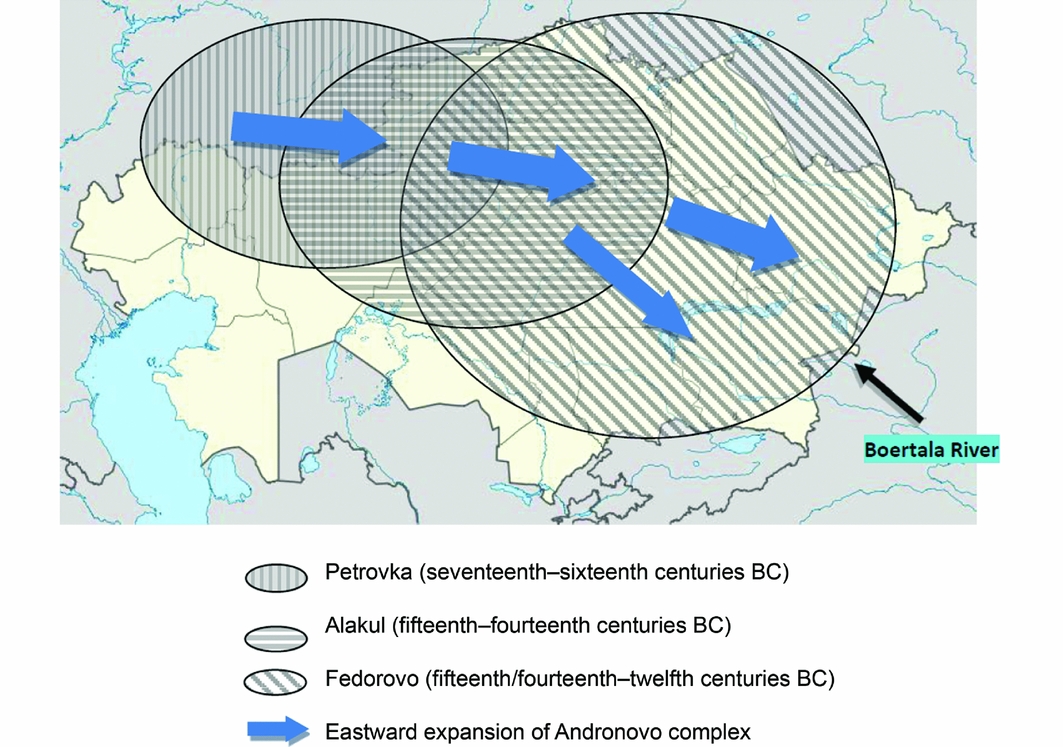
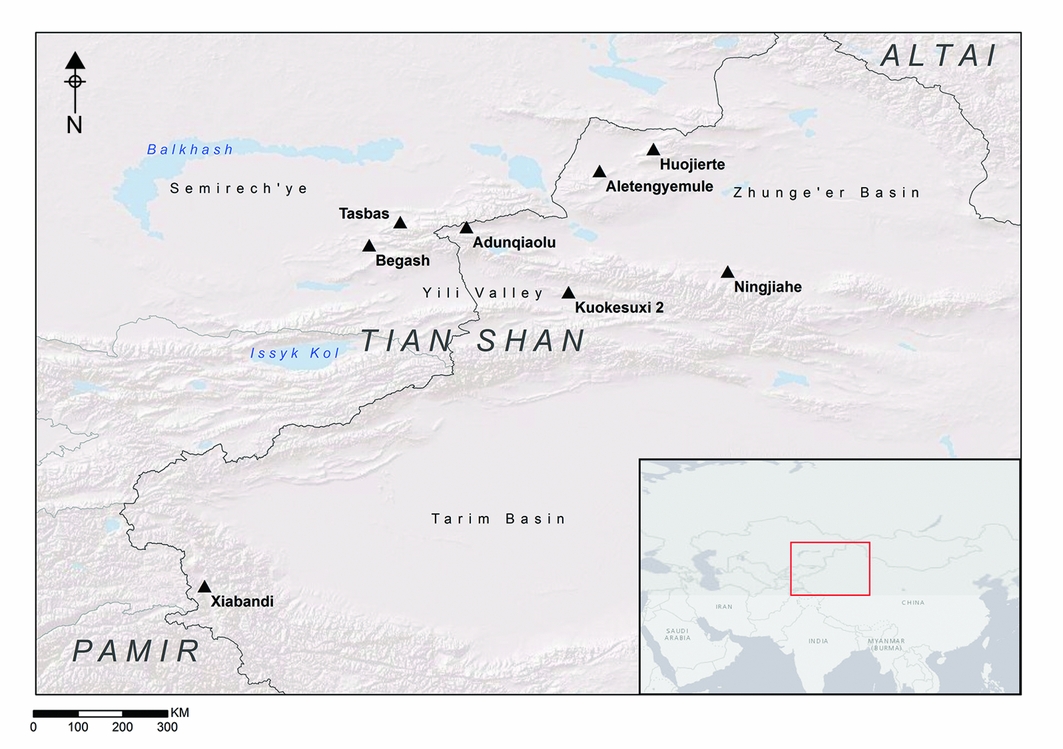
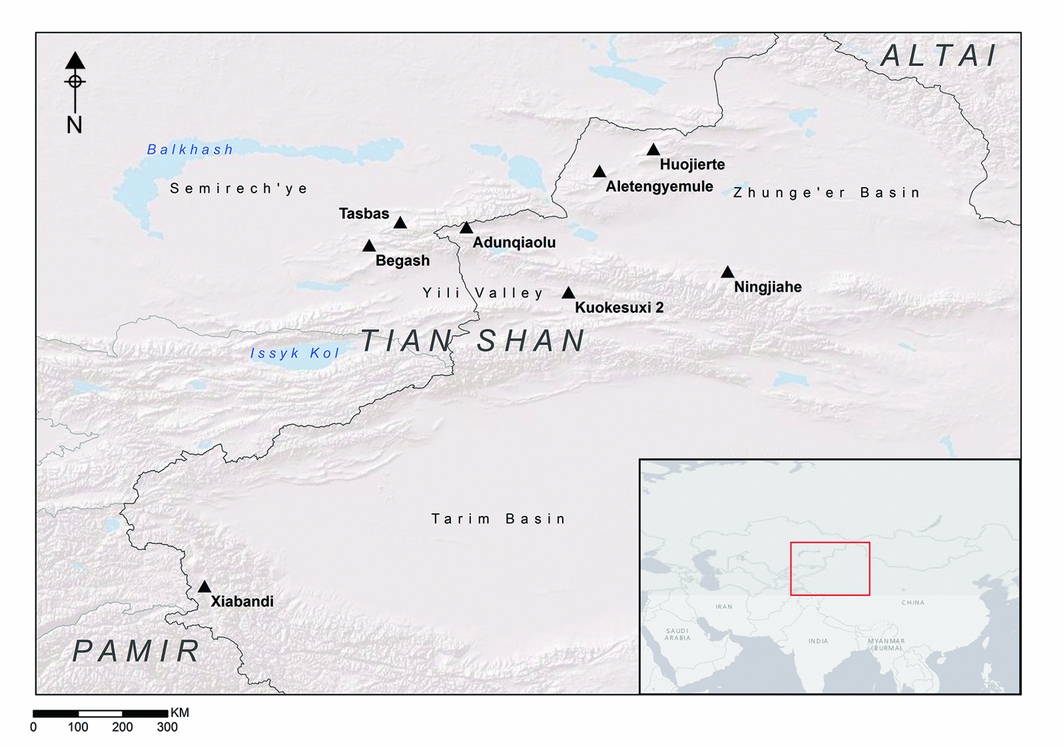
The spread of sites of broadly Andronovo affinity are now seen to extend beyond the Eurasian steppes into the mountain ranges that border western China, with evidence for the further spread of influence into Xinjiang through the distribution of metal artefacts (Kuz'mina Reference Kuz'mina2007, Reference Kuz'mina2008: 98–107). Until relatively recently, however, the Andronovo of the Chinese borderlands was placed at the late end of an eastward population movement associated with increasing reliance on pastoralism (Kuz'mina Reference Kuz'mina1986, Reference Kuz'mina and Linduff2004, Reference Kuz'mina2007, Reference Kuz'mina2008) (Figure 1). The new wave of research has opened both the chronological and economic arguments for this view to debate (Frachetti Reference Frachetti2008). It has been more recently shown that such sites extend over the border, and over the mountains, into western China, as illustrated by the site of Adunqiaolu in the Boertala Valley in the western Tianshan (Jia et al. Reference Jia, Betts and Wu2009). Other related sites have also been found along the Chinese side of the mountain rim, including several in the Yili Valley, which opens out into the Semirech'ye region of eastern Kazakhstan (Ruan Reference Ruan2013) (Figure 2).
Spread of the Andronovo cultural complex according to traditional chronology.

Map showing the distribution of sites of Andronovo affinity in western China and Semirech'ye (drawn by M. Spate).
Chronological issues
The Andronovo cultural complex has been subject to a long history of debate concerning its origins, its regional variants and, in particular, its chronology (cf. Koryakova & Epimakhov Reference Koryakova and Epimakhov2007: 123–27; Kuz'mina Reference Kuz'mina2007: 3–8). Disparities between radiocarbon dating and traditional forms of relative dating have been central to the discussion (Hanks et al. Reference Hanks, Epimakhov and Renfrew2007; Kuz'mina Reference Kuz'mina2007: 252; Chernykh Reference Chernykh2009). There are two key issues: dating of the various sub-traditions within the greater Andronovo phenomenon, and the nature of their interconnections. Specifically, do they represent a cultural spread that developed variations as it expanded, or individual regional developments that gradually assimilated some characteristics of their neighbours? The cultural spread model has been upheld particularly by Kuz'mina (e.g. Reference Kuz'mina and Linduff2004: 59). Others, such as Potemkina (Reference Potemkina1995a & Reference Potemkinab), present variants on this model, but still presume ethnic movements. Koryakova and Epimakhov (Reference Koryakova and Epimakhov2007: 151) see the ‘spread’ as a product of a combination of direct colonisation and assimilation of the local populations. Frachetti (Reference Frachetti2008: 174), working in the far south-east of the Eurasian steppe zone (in Semirech'ye), argues for local development and continuity, but in situations where local groups participated in wider networks of interaction that aided in the spread of disparate aspects of material culture across broad areas.
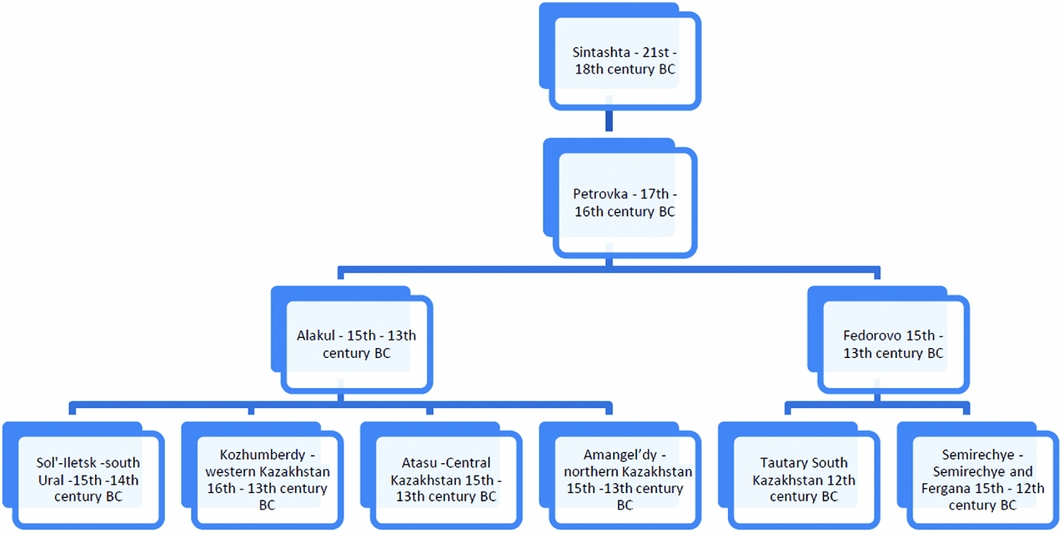
The question of dating has been inextricably linked to the models for cultural dispersal, particularly as relative dating has formed the major chronological basis. Kuz'mina's traditional model (Reference Kuz'mina2007: 585, map 1, 601, map 9), for example, has the Andronovo originally forming in the northern Eurasian steppe, east of the Ural Mountains. The Sintashta Culture (twenty-first to eighteenth centuries BC) was followed by the Petrovka Culture (eighteenth to sixteenth centuries BC) as the first direct ‘ancestor’ of the Andronovo. This then quickly expanded to the south-east. In the second stage of development, the Alakul’ and Fedorovo spread across the Eurasian steppe, entering the Tianshan Mountains in Xinjiang around the fourteenth century BC (Kuz'mina Reference Kuz'mina2007: 461–66) (Figure 3).
Traditional chronology and eastward spread of the Andronovo complex (Kuz'mina Reference Kuz'mina2007).

Despite arguments against the linear model of Andronovo expansion (Koryakova & Epimakhov Reference Koryakova and Epimakhov2007: 123–27; Frachetti Reference Frachetti2008), it is still widely employed. Using this model, archaeological remains along the south-eastern margin of the Eurasian steppe, which can be linked typologically to the Andronovo cultural complex, should not be interpreted as earlier than its final stage—around the fifteenth to thirteenth centuries BC. The western Tianshan region, containing the Yili and Boertala River valleys, is adjacent to Semirech'ye. The last stage of the Andronovo (the Semirech'ye variant) in this region is conventionally dated to the fifteenth to twelfth centuries BC (Kuz'mina Reference Kuz'mina2007: 465–66) (Figure 3).
Recent radiocarbon dates, however, do not concur with the established relative chronological sequence. For example, a series of 40 calibrated radiocarbon dates has revised the Bronze Age chronology for the southern Urals, with the major variants of the Andronovo cultural complex, Petrovka, Alakul’ and Fedorovo, occurring a few hundred years earlier than traditionally estimated (Hanks et al. Reference Hanks, Epimakhov and Renfrew2007). The study also showed parallel relationships for dating and cultural contexts between the Petrovka and Alakul’ cultures (Hanks et al. Reference Hanks, Epimakhov and Renfrew2007: fig. 4). It should be noted that no dates could be obtained for Fedorovo sites east of the Urals (Hanks et al. Reference Hanks, Epimakhov and Renfrew2007: 363). Recent work at the Kamennyi Ambar settlement site in the southern Trans-Urals steppe has provided a range of dates for the Sintashta period of 2050–1760 cal BC (68.2% confidence) and two for the Srubnaya-Alakul’ period of 2040–1770 cal BC (68.2% confidence) (Epimakhov & Krause Reference Epimakhov, Krause, Krause and Koryakova2013). Once again, it is shown that the Alakul’/Fedorovo period falls earlier than in the traditional chronology.
In northern Kazakhstan, researchers have obtained new radiocarbon samples from timber collected from previous excavations at the Lisakovsky cemeteries, attributed to subsets of the Andronovo: the Alakul’ and Fedorovo cultures (Panyushkina et al. Reference Panyushkina, Mills, Usmanova and Li2008). The dates suggest that the cemeteries were used by groups of Andronovo affinity around the eighteenth to seventeenth centuries cal BC—again, a few hundred years earlier than the traditional chronology. In western Siberia, radiocarbon dates have been obtained for three sites of Andronovo (Fedorovo) affinity: Stary Tartas 4, Sopka 2 and Tartas 1 (Molodin et al. Reference Molodin, Mylynikova, Novikova, Durakov, Koveleva, Efrmova and Soloviev2011). Results date the sites to around the eighteenth to fifteenth centuries cal BC. Researchers also pinpointed the fifteenth century cal BC as the latest date for the Andronovo complex in the Baraba forest steppe region of western Siberia (Molodin et al. Reference Molodin, Marchenko, Kuzmin, Grishin, Van Strydonck and Orlova2012a). In the upper valleys of Semirech'ye, over the mountains from western Xinjiang, the site of Begash is reported to contain material culture affiliated to the Andronovo complex (Frachetti & Mar'yashev Reference Frachetti and Mar'yashev2007), as does the nearby site of Tasbas (Doumani et al. Reference Doumani, Frachetti, Beardmore, Schmaus, Spengler and Mar'yashev2015). The Begash settlement in particular was occupied over several chronological phases. Phase Ib is associated with the Fedorovo period, with radiocarbon dates placing it from c. 1890–1690 cal BC. Calibrated dates for a house at Asi-2, also in Semirech'ye, categorised as Middle to Late Bronze Age, fall between c. 1640 and 1490 BC (Panyushkina et al. Reference Panyushkina, Chang, Clemens and Bykov2010).
New evidence cited above raises two key issues. Firstly, the new radiocarbon dates are both broadly consistent and also challenge the traditional chronology. Secondly, revision of the dates for the Petrovka and Alakul’ traditions, as identified by Hanks et al. (Reference Hanks, Epimakhov and Renfrew2007), contests the linear model of Andronovo expansion. The mechanisms by which the Andronovo population may have expanded into the eastern and south-eastern regions, and/or how Andronovo cultural traits diffused into new territories, is certainly more complex than previously thought. In a recent paper on migration, Frachetti (Reference Frachetti2011) succinctly outlined the current scholarly position regarding the Andronovo model of eastward movement. Other recent studies in the fields of physical anthropology and molecular biology examined cranial (Kiryushin & Solodovnikov Reference Kiryushin and Solodovnikov2011), dental (Zubova Reference Zubova2011) and palaeo-genetic (Molodin et al. Reference Molodin, Pilipenko, Romanaschenko, Zhuravlev, Trapezov, Chikisheva, Pozdnyakov, Kaiser, Burger and Schier2012b; Allentoft et al. Reference Allentoft, Sikora, Sjögren, Rasmussen, Rasmussen, Stenderup, Damgaard, Schroeder, Ahlström, Vinner, Malaspinas, Margaryan, Higham, Chivall, Lynnerup, Harvig, Baron, Della Casa, Dabrowski, Duffy, Ebel, Epimakhov, Frei, Furmanek, Gralak, Gromov, Gronkeiwicz, Grupe, Hajdu, Jarysz, Khartanovich, Khokhlov, Kiss, Kolar, Kriiska, Lasak, Longhi, McGlynn, Merkevicius, Merkyte, Metspalu, Mkrtchyan, Moiseyev, Paja, Palfi, Pokutta, Pospieszny, Douglas Price, Saag, Sablin, Shishlina, Smrčka, Soenov, Szeverényi, Tóth, Trifanova, Varul, Vicze, Yepiskoposyan, Zhitenev, Orlando, Sicheritz-Pontén, Brunak, Nielsen, Kristiansen and Willerslev2015) data. These demonstrate a high level of complexity associated with putative Andronovo population movements. It is, therefore, premature to draw any firm conclusions on the model of Andronovo expansion.
This brief summary shows that the first priority must be the establishment of a reliable chronology based on the absolute dating of securely stratified samples and contexts. Work is needed at the local level, before expansion of the study to the broader questions of cultural diffusion and population movements. The Adunqiaolu site discussed here is an example of such a regional study in western Xinjiang. Recent evidence from the Adunqiaolu excavation provides a preliminary but solid chronology for the site. This facilitates future research on the Andronovo cultural complex, both at its far eastern margins and more broadly.
Adunqiaolu
Adunqiaolu (N45° 01’28”, E80° 32’34”) is an occupation complex comprising structures and graves on a slope of the western Tianshan, in the Boertala Valley, approximately 40km north-west of Wenquan Township (Figure 2). Fieldwork has produced new evidence for the Andronovo cultural complex, with radiocarbon dates that indicate an early chronology for the eastern Andronovo. The field programme at Adunqiaolu and nearby areas included the excavation of residential structures and cemeteries, and intensive field survey along the headwaters of the Boertala Valley (Archaeological Institute of Chinese Academy of Sciences, Bortala Museum and Wenquan Bureau of Relics 2013).
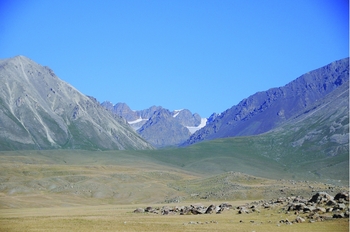
Adunqiaolu is situated in the upper reaches of the Boertala Valley, on an open slope below the foothills of the Alatao, one of the western ranges of the Tianshan Mountains (Figure 4). The extent of the site is limited by gullies and creeks to east and west; these divide the slope into sections ideal for herding animals. Adunqiaolu (‘horses like stones’ in the Mongolian language) is named after the unusual, glacially formed granite boulders strewn across numerous small hills. Four seasons of excavation (2011–2014) provide evidence for repeated use of the residential and mortuary sites over a long period.
Landscape of Adunqiaolu (photograph by A. Betts).

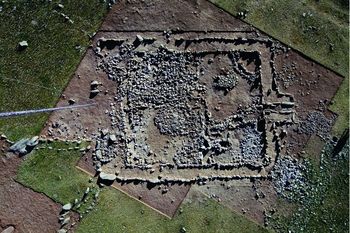
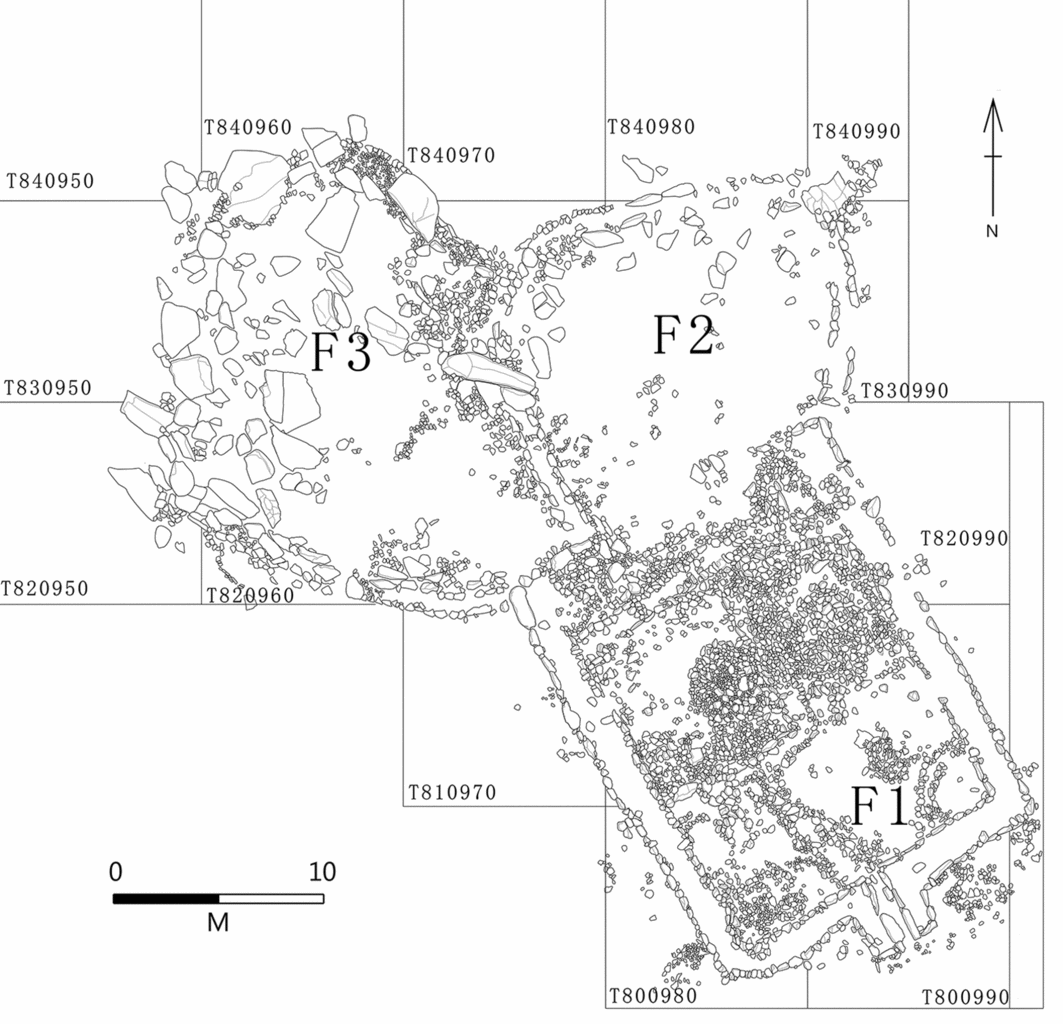
Small hills on the slope form an ideal location for dwellings, and 11 groups of ancient house sites have been recorded here. One group has been studied intensively. Here, traces of four habitation units built with double rows of stone slabs are progressively distributed along the slope, at an altitude of approximately 2300m asl. House F1 is the largest of these. It is regular in shape, with a rectangular enclosure of about 425m2 in area. A doorway on the south side is also framed with double lines of stone slabs (Figures 5 & 6). The double walls are 1.4–1.5m apart, which form a corridor surrounding the main structure. This was probably filled with some type of walling when the building was in use. Inside, the structure was divided by stone walls into four different sections; two sections in the north contain stone piles roughly square or circular in shape.
House F1 and edge of structures F2 and F3 (photograph by D. Cong).

Plan of F1, F2 and F3 (drawn by D. Cong).

House F1 is remarkable for its size and complex plan. It is semi-subterranean, cut into the slope of the hill so that the north end is around 1.5m deep, levelling out to around 0.7m at the entrance. The house is 22 × 18m in size, with an internal measurement of 18 × 14.6m (within the inner double wall). The stones used in the slab walls are large, with the single largest stone measuring about 3 × 1.5m. The house was designed symmetrically, and the internal divisions suggest different functional areas.
The stone piles found inside F1 (following the removal of the surface soil) post-date the occupation of the structure, some representing later burials. Beneath these, some planned design inside the house could be identified. Several layers of rocks in the north-east corner of the interior were set out in rough rows, aligned north–south. A large circular stone pile was set in the centre of the north-east subsection, while the main part of the north-west subsection appeared to consist of a rounded stone platform one layer of stones deep. Two square blocks of stones were set into the north-east and north-west corners. There were several pits inside the house, probably for storage. Sub-circular double rows of stones enclosed two corners while, from the centre of the interior, double rows of stone walls divided the house into two main south and north sections. Several subsections within the interior were also visible, with their limits defined by small stone piles or walls.
Structures F2 and F3 were constructed as extensions to house F1, joined on its northern side (Figures 5 & 6). F3 is attached to the wall of F1, while F2 seems to have encroached on the outer wall. The walls of both F2 and F3 were built with double rows of stones and the structures are irregular and polygonal in form. Structure F2 is more than 17m in length and approximately 14m at its widest point. Structure F3 is approximately 17.8m at its greatest extent. The gap on the west side of F3 was presumably once an entrance. Some faunal remains, potsherds, stone tools and patches of ash were recovered from the three structures.
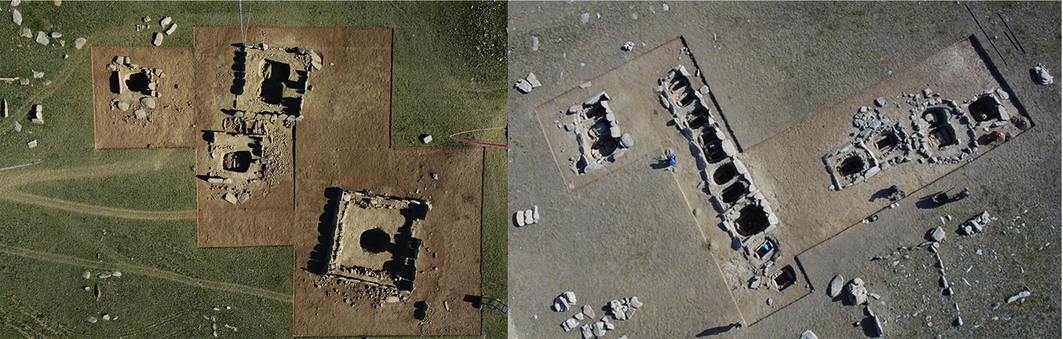
A number of cemeteries have been found on the slopes adjacent to the Adunqiaolu settlements, one around 2km south of F1, F2 and F3, and at a lower elevation of around 1800m asl. This cemetery is approximately 500m across and can be divided into three concentrations: north, central and south. More than 60 graves have been identified within the cemetery, marked by rectangular or square stone slab enclosures. Slab burials, generally square or rectangular in form, vary between each section. The north section contains the largest graves, formed by square enclosures (Figure 7, left). Stone slab enclosures and construction stones are generally smaller in the central and south sections. The south section also contains several smaller graves joined together in rows (Figure 7, right).
The north (left) and south (right) sections of the cemetery (photographs by D. Cong).

The largest stone slab enclosure (SM9) measures 9.9–10m across, with a near-square outline. In 2011 and 2012, nine graves were excavated; some contained two to three burials inside the structure. Although the Andronovo is typically characterised by a marked variety in grave forms, generally similar burials are also reported in the Semirech'ye region (Margulan Reference Margulan1998; Rogozhinskiy Reference Rogozhinskiy1999), and are also described by Kuz'mina (Reference Kuz'mina2007: 19–30).
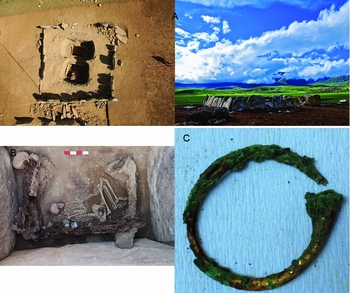
Grave SM4, located in the north section of the cemetery, is an enclosure with missing stones on the west side (Figure 8A). It surrounds two rectangular cist burials, SM4-1 and SM4-2, oriented east–west. The northern burial, SM4-1, had a cist built of four large slabs partly displaced by later disturbance. The gap between the cist and the wall of the burial pit contained fine gravelly soil. The cover stone comprised four large, thin stone slabs, sealed with approximately 30mm-thick mud plaster, known as a “clay coating” tradition among Semirech'ye burials (Kuz'mina Reference Kuz'mina2007: 29). The cist was lined with flat stone slabs and contained two different types of burial. Burnt human bone fragments were found on the floor, suggesting a cremation. There was also a large timber coffin built of thick wooden slabs (130–150mm diameter), partially preserved but badly decayed and damaged by the collapse of the cover stone. Five layers of timbers with tenon joints could still be clearly identified. The coffined body was a male adult of approximately 30 years of age. The skeleton was well preserved, lying on its left side facing north, partially flexed, with the head to the west (Figure 8B). A bronze earring with gold inlay (Figure 8C), a ceramic vessel and a sheep talus were placed beside the body. The trumpet-shaped earring is a well-known Andronovo style (Kuz'mina Reference Kuz'mina2007: 241); similar earrings have been reported in many places in the Eurasian steppe and northern China (Dangyu 2012).
A) enclosure tombs SM4 (left) and SM9 (right) (photographs by D. Cong); B) burial SM4-1 (photograph by P. Jia); C) trumpet-shaped gold inlaid bronze earring (photograph by D. Cong).

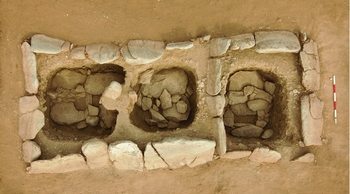
Grave SM50 is located in the south area of the cemetery. Burials were contained within a rectangular stone enclosure approximately 7.1m long and 2.8–3m wide. The stone-lined graves were smaller than those of SM4, with upright slabs leaning slightly inward. There were two sections in the enclosure, one of which, SM50-1, contained two burials (Figure 9). In SM50-1, cremated human bones were found at the base of both burial pits, each of which yielded a small broken pot. SM50-2 contained the skeleton of an adult female (aged approximately 25–30 years). She was placed on her left side, with legs flexed. The skull was missing, but the placement of the body suggests that she would have faced west. Infant skeletal elements (including a skull and ribs) placed alongside this adult suggest a mother-infant burial.
Enclosure tomb SM50-1 and SM50-2 (photograph by D. Cong).

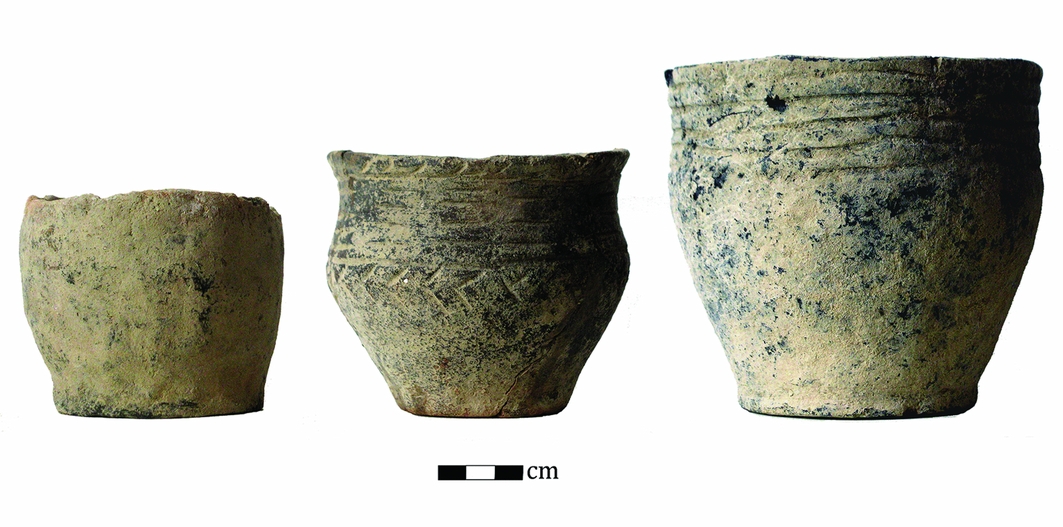
The cemetery yielded complete handmade, flat-based pottery vessels, comprising three main forms: small pots (40–80mm high) with a smooth profile; small (90mm high) semi-open jars with a pronounced shoulder; and small–medium (120–130mm high) open jars with a soft shoulder (Figure 10). While the small pots are primarily unadorned, the two jar forms consist of some decorated vessels showing a limited array of incised and stamped designs across the neck and shoulder. Potsherds found inside the domestic space of F1 represent containers roughly equal in size to the jars deposited in the nearby graves, but with more varied ornamentation. An assortment of stamps, incised geometric designs, fingernail depressions and applied coil bands make for a richly ornamented collection. On a stylistic basis, ceramics from Adunqiaolu cemetery and settlement are consistent with the eastern Fedorovo corpus of pottery. Comparative examples are documented in the Altai (Chernikov Reference Chernikov1960: tab. LIII; Sitnikov Reference Sitnikov, Kiryushina and Kungurova1998: figs 1 & 2), Sayan (Maksimenkov Reference Maksimenkov1978: figs 13 & 14), and Zhunge'er Mountains (Doumani Reference Doumani2014) of eastern Central Asia. Sitting at the easternmost extent of this vast geographic area, Adunqiaolu, with its large burial ground and settlement complex, represents one of the most comprehensive and well-preserved pottery collections of the eastern Fedorovo tradition.
Ceramic vessels from the Adunqiaolu cemetery (photograph by P. Doumani Dupuy).

Dating
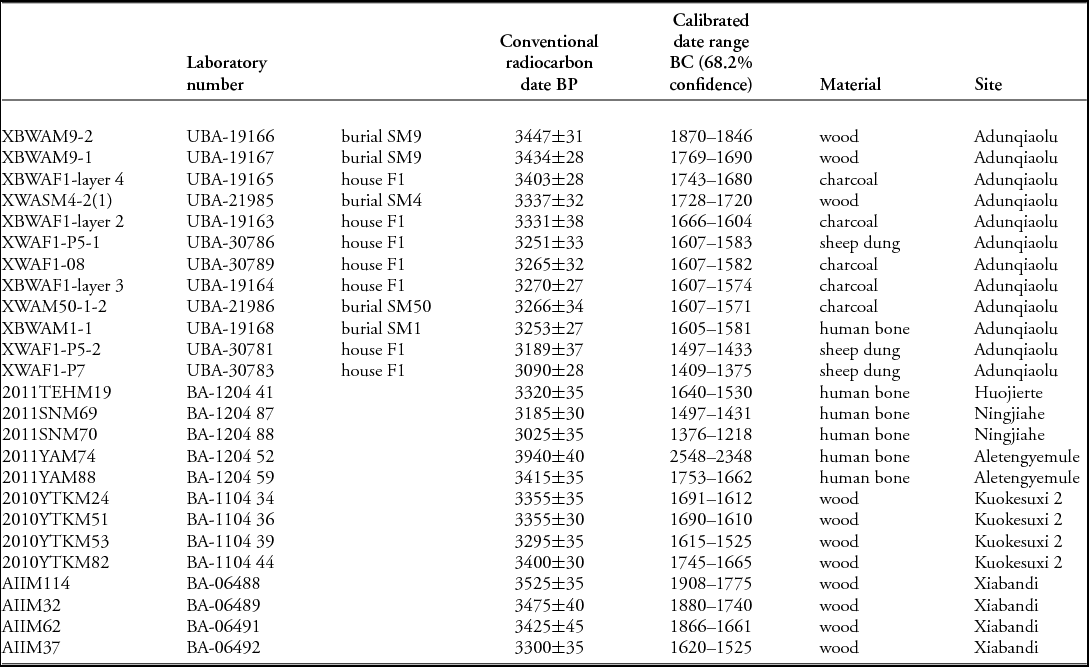
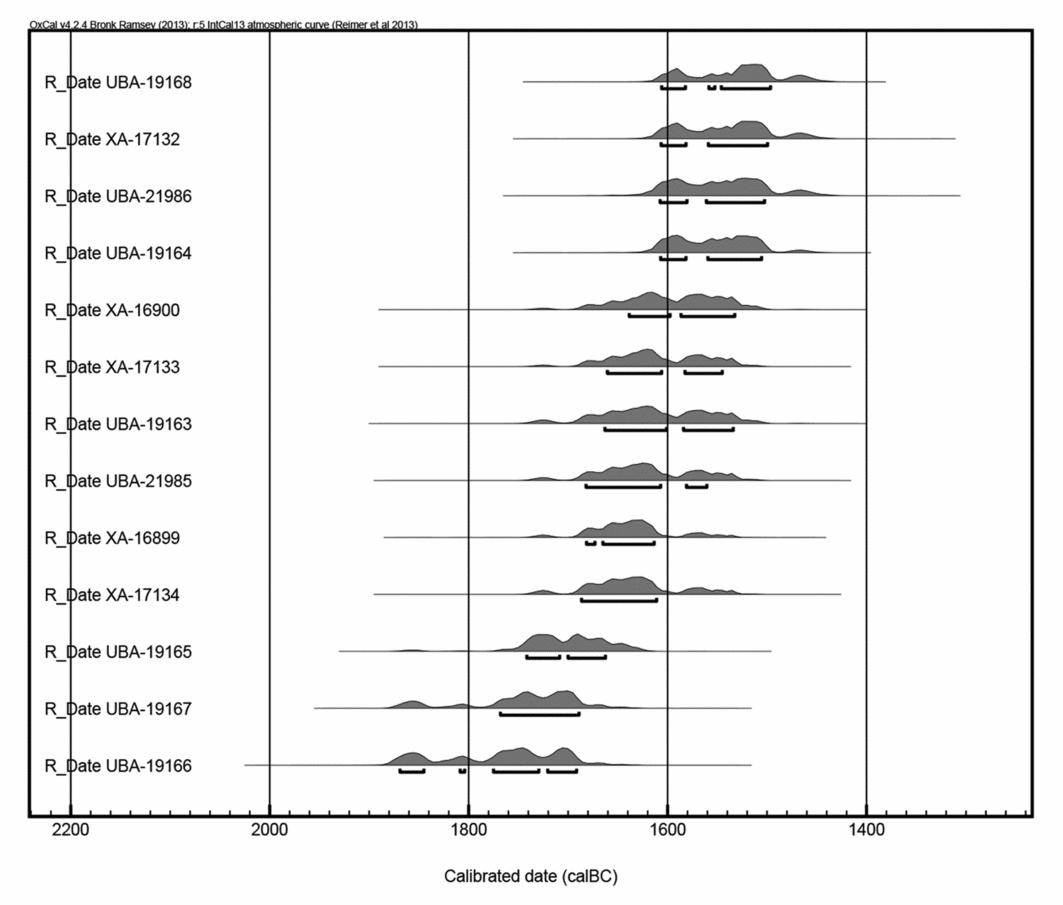
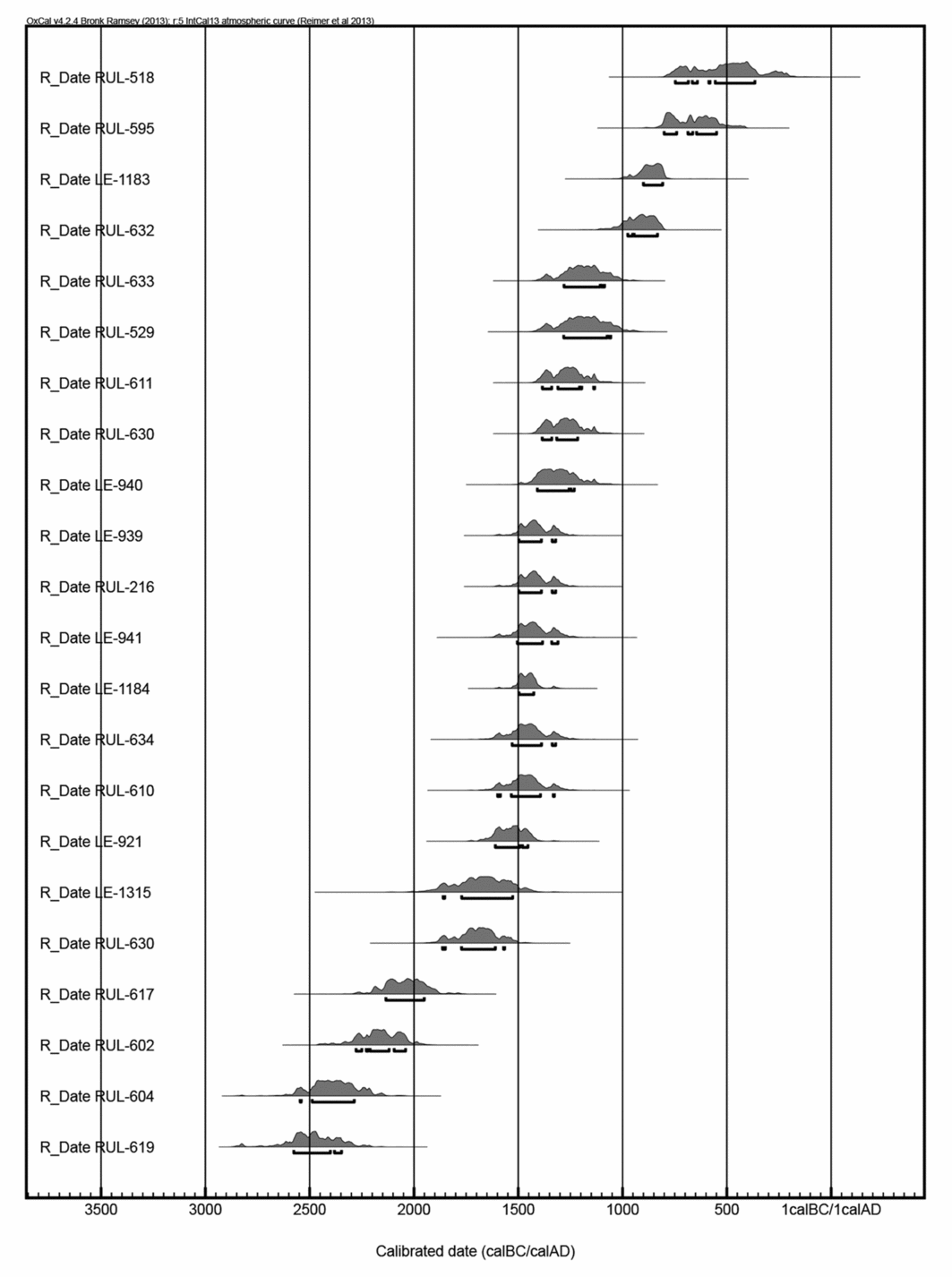
Twelve AMS 14C dates have been obtained from house F1 and the burials at Adunqiaolu (Table 1 & Figure 11). These show that the start of the early period at Adunqiaolu falls in the nineteenth century cal BC. In the traditional chronology, this is earlier than Petrovka, or even earlier than the late period of Sintashta. A number of radiocarbon dates are now available for sites of Andronovo type in western China, generally showing the same early ranges (Table 1).
AMS 14C dates for sites of Andronovo type in western China (dates other than Adunqiaolu after Ruan Reference Ruan2013). Dates calibrated in OxCal v4.2.4 using IntCal13 calibration curve (Bronk Ramsey Reference Bronk Ramsey2009; Reimer et al. Reference Reimer, Bard, Bayliss, Beck, Blackwell, Bronk Ramsey, Buck, Cheng, Edwards, Friedrich, Grootes, Guilderson, Haflidason, Hajdas, Hatté, Heaton, Hoffman, Hogg, Hughen, Kaiser, Kromer, Manning, Niu, Reimer, Richards, Scott, Southon, Staff, Turney and van der Plicht2013).

Adunqiaolu calibrated 14C dates (using OxCal v4.2.4 and IntCal13 calibration curve; Bronk Ramsey Reference Bronk Ramsey2009; Reimer et al. Reference Reimer, Bard, Bayliss, Beck, Blackwell, Bronk Ramsey, Buck, Cheng, Edwards, Friedrich, Grootes, Guilderson, Haflidason, Hajdas, Hatté, Heaton, Hoffman, Hogg, Hughen, Kaiser, Kromer, Manning, Niu, Reimer, Richards, Scott, Southon, Staff, Turney and van der Plicht2013).

For Adunqiaolu, the earliest date for F1 is the mid to late eighteenth century cal BC, followed by one in the mid to late seventeenth century cal BC. Three more dates on charcoal and carbonised sheep dung cluster together at the end of the seventeenth century cal BC. The latest two, again on carbonised sheep dung, date to approximately 100 years later. This range provides convincing evidence for occupation over two and half centuries of what should be considered regular use for F1. Excavations are ongoing and will reach earlier floor levels. Dates obtained for the burials follow a similar sequence. The earliest is SM9, with one timber (1) dating to the mid nineteenth century cal BC. This may be younger than it seems, as the sample was from mature timber. The second date from SM9 (also on timber), however, fits with the earliest range for F1 to the mid to late eighteenth century cal BC, as does the date from SM4 (4). Two more dates from SM50 (charcoal) and SM1 (human bone) closely match the middle phase of Adunqiaolu, in the late seventeenth century cal BC. Apart from one early outlier (BA-1204 52), dates from burials at other sites in the western Tianshan (e.g. Huojierte, Ningjiahe, Aletengyemule, Kuokesuxi 2) range from around the mid eighteenth to the mid fourteenth centuries cal BC, with a concentration around the seventeenth century cal BC. Those from the Pamir region (Xiabandi) are earlier still, generally dating to the nineteenth to eighteenth centuries cal BC.
It is clear that the dating for Adunqiaolu, and other sites in western Xinjiang, follows the new early absolute chronology discussed above, rather than the old one as defined by Kuz'mina (Reference Kuz'mina2007: 458–61); this largely relative chronology is several centuries later than the new radiocarbon dates for the eastern Andronovo. Kuz'mina herself acknowledges the problem of existing radiocarbon dates for most Eurasian sites of Andronovo type. They are mismatched to her relative chronology and generally exhibit wide ranges. When dates for the Fedorovo are calibrated (Figure 12), they show a range from c. 2000–500 cal BC. This can be attributed to a variety of causes, a central one being the definition of the Fedorovo. The presumed spread of this so-called type is up to 1000km across, while typological definitions of the Fedorovo can be ambiguous. We still do not know enough about the variability or chronology of its associated sites to make clear distinctions; the relationship between regional material assemblages remain unclear, beyond the knowledge that there are disparate distribution and technological patterns for metal artefacts, ceramics, burial practices and architectural styles. Recent studies of artefact production of Fedorovo affinity (e.g. Doumani Reference Doumani2014) show local variations in ceramic technologies for micro-regions, which contest the scholarly basis for conflating these communities into monolithic units of study. Further well-dated radiocarbon sequences will provide a more robust understanding of the far eastern Andronovo. This in turn will allow a re-evaluation of the cultural spread and, in particular, the arrival of sites of Andronovo type into China.
After Kuz'mina (Reference Kuz'mina2007: appendix 2). Calibrated Andronovo (Fedorovo) radiocarbon dates (using OxCal v4.2.4 and IntCal13 calibration curve; Bronk Ramsey Reference Bronk Ramsey2009; Reimer et al. Reference Reimer, Bard, Bayliss, Beck, Blackwell, Bronk Ramsey, Buck, Cheng, Edwards, Friedrich, Grootes, Guilderson, Haflidason, Hajdas, Hatté, Heaton, Hoffman, Hogg, Hughen, Kaiser, Kromer, Manning, Niu, Reimer, Richards, Scott, Southon, Staff, Turney and van der Plicht2013).

The Andronovo in the western Tianshan
Although excavation is still ongoing, the artefacts from Adunqiaolu, together with domestic and ritual architectural forms, suggest some cultural developments throughout its use. Early burials (e.g. SM4 and SM9) are characterised by large rectangular or sub-square stone slab enclosures containing only one or two burials, while the later enclosures are smaller and contain multiple burials. The burials excavated at Adunqiaolu revealed several features and evidence for burial rites that can be compared with the Andronovo cultural complex, specifically the Fedorovo and Semirech'ye groups (Kuz'mina Reference Kuz'mina2007: 23–30), while other features are locally distinctive. Inhumations tend to be flexed, placed on their side facing north with the head to the west. Burial practices include both cremation and inhumation, and mother-child burials are known. The general design of Adunqiaolu cists, with square or rectangular stone-fenced enclosures containing one or two, or several, burial pits, can be compared to burial types IV A and type VIII A, as categorised by Kuz'mina (Reference Kuz'mina2007: 611, fig. 1). The cremation and “clay coating” in grave SM4 is paralleled at Tasbas, in a burial dated to the mid third millennium cal BC (Doumani et al. Reference Doumani, Frachetti, Beardmore, Schmaus, Spengler and Mar'yashev2015: fig. 5). This indicates an early establishment of this tradition, much earlier than Kuz'mina's dating for the practice. Overall, however, the large dimensions and use of stone slabs to line grave bases are unknown in Semirech'ye, suggesting a locally distinctive character of Adunqiaolu ritual practices that still bear a relationship to a broader regional burial tradition.
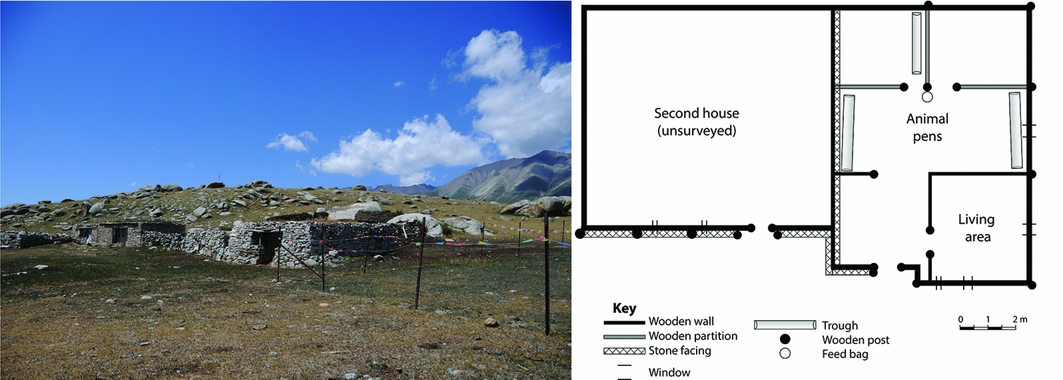
House F1 is of Andronovo type, broadly defined (Kuz'mina Reference Kuz'mina2007: 40–66) as a large rectangular semi-subterranean building of stone slabs, with a narrow corridor entrance and an as yet undetermined type of superstructure. At around 400m2 it is large, the more normal range falling between 100 and 300m2. Its internal divisions, although not unprecedented, are unusual; division into two sections is more common. Despite its elevation, the house was probably used in winter, as is its neighbouring modern counterpart (Figure 13, left). Gryaznov (Reference Gryaznov1953) suggests that such houses were used both for habitation and winter stabling. Modern parallels for this practice can be seen in the seasonal houses of the transhumant agro-pastoralist Gujjars and Bakkarwals in Jammu and Kashmir (Figure 13, right; Sharma Reference Sharma2009). These show several sub-divisions within the stabling area, which closely parallel the internal divisions of house F1. Sheep dung deposited in the interior of the house (Table 1) could be explained simply by its use for fuel, but may also suggest stabling.
Mongol winter camp immediately adjacent to house F1 (left) (photograph by A. Betts); plan of Gujjur house in lower summer pastures, Kashmir (right) (by J. Fraser, Kashmir Prehistory Project).

Although Kuz'mina's model of Andronovo expansion is the most strongly argued, there are several other variants (Frachetti Reference Frachetti2008: 36–43). These all, however, face similar issues of chronological irregularities and unconvincing evidence as new data emerge. The general model of expansion itself has also been challenged. For the western Tianshan, Frachetti argues for deep historical local continuity in Eurasian pastoralist landscapes (Frachetti Reference Frachetti2012), as evidenced by the sites of Tasbas, dated from the early third millennium BC (Doumani et al. Reference Doumani, Frachetti, Beardmore, Schmaus, Spengler and Mar'yashev2015), and Begash, from at least the mid third millennium BC (Frachetti & Mar'yashev Reference Frachetti and Mar'yashev2007). Nonetheless, Andronovo influence appears within the local development at Begash, and in the case of Adunqiaolu, it seems to arrive without antecedents. This, of course, does not preclude the presence of as yet undiscovered earlier sites in the Boertala Valley. Begash 1b, linked to the Fedorovo period, dates to between 1890 and 1690 cal BC (Frachetti & Mar'yashev Reference Frachetti and Mar'yashev2007), while Begash 2, assigned to the Atasu/Begazy-Dandybaevsky period, dates to 1625–1310 cal BC (68.2% confidence). The current full date range for occupation of Adunqiaolu house F1 is 1743–1375 cal BC (68.2% confidence). Dates from its cemeteries start at 1870 cal BC (68.2% confidence), strongly suggesting that Adunqiaolu was contemporaneous with Begash 1b and 2. The division between 1b and 2 at Begash is based on changing ceramic typology, but it is not yet possible to make this distinction at Adunqiaolu, due to insufficient data. It is possible, however, to suggest that the Bronze Age of Semirech'ye and the western Tianshan contained regional variation, as shown also in a detailed study by Doumani (Reference Doumani2014), and that Begash is generally, but not directly, culturally comparable to Adunqiaolu.
Summary
The new data from Adunqiaolu fit well into the emerging view of the eastern Andronovo as shown by Frachetti and Mar'yashev (Reference Frachetti and Mar'yashev2007), Hanks et al. (Reference Hanks, Epimakhov and Renfrew2007), Panyushkina et al. (Reference Panyushkina, Mills, Usmanova and Li2008) and Molodin et al. (Reference Molodin, Marchenko, Kuzmin, Grishin, Van Strydonck and Orlova2012a), and which is gradually gaining wider acceptance (e.g. Doumani Reference Doumani2014). The earlier chronologies for the putative eastward spread of the Andronovo are clearly challenged, although mechanisms behind the transmission of general cultural influences remain unclear. The revised chronology supports new hypotheses on the nature of cultural connections (Frachetti Reference Frachetti, Abraham, Gullapalli, Raczek and Rizvi2013: 292) that replace the earlier explanatory models of long distance migration supported by Kuz'mina (Reference Kuz'mina1986, Reference Kuz'mina1994, Reference Kuz'mina2007, Reference Kuz'mina2008) and others (e.g. Tkacheva & Tkachev Reference Tkacheva and Tkachev2008). The idea of ‘waves’ of eastward movement creating new regionalised ‘cultural clusters’ has been refuted, partly through emerging radiocarbon sequences as discussed above, but also through evidence for long-term localised regional development, such as that documented by Frachetti in Semirech'ye from at least the mid third millennium cal BC (Frachetti Reference Frachetti2008).
Sites of Andronovo type are now well documented in far-western China, in the western Tianshan, the Yili Valley and south into the Pamirs, which may be the easternmost limit of these cultural traits, although sites could exist farther east along the Tianshan, where a pattern of transhumant pastoralism is still practised today. Survey in the Boertala Valley has shown it to be remarkably rich in Bronze Age archaeological remains. The preliminary results from Adunqiaolu represent the beginning of an extensive research programme that will provide robust new models for the eastern Andronovo and will subsequently widen understanding of the Middle to Late Bronze Age in the Eurasian steppes.
Acknowledgements
The fieldwork project in the Boertala Valley was established in 2011. It is a collaboration between the Institute of Archaeology, Chinese Academy of Social Sciences (Beijing), the University of Sydney and Monash University. The Australian team are financially supported by the Australian Research Council (DP150100121), with additional support from the China Studies Centre, University of Sydney, and in affiliation with the Centre for Classical and Near Eastern Studies, University of Sydney.