
Introduction: a return to Denmark Street
In 2011, we published a paper in Antiquity on the Sex Pistols ‘graffiti’, made by the band's singer Johnny Rotten (aka John Lydon) on the walls of a former bedsit/studio to the rear of what is now a vintage guitar shop at 6 Denmark Street, London (Graves-Brown & Schofield Reference Graves-Brown and Schofield2011). A press release to accompany the publication compared the cultural significance of these artworks (as we will now refer to them, for reasons explained later) to early prehistoric cave art. The popular press had a field day. We describe and critically examine some of this coverage below. One of the authors (JS) appeared on the BBC early evening news and was featured on BBC Radio 4’s The Now Show; the other was invited to contribute an essay to The Guardian newspaper (Graves-Brown Reference Graves-Brown and Schofield2011), an essay that itself generated debate. At the time, we considered this a helpful airing of contemporary issues in cultural heritage management and archaeological debate, set within various contexts. These included the continuing emergence of contemporary archaeology as an increasingly significant subfield (after, for example, Graves-Brown Reference Graves-Brown2000; Harrison & Schofield Reference Harrison and Schofield2010); and English Heritage's (then) recently published Conservation Principles (2008) and the Council of Europe's (2005) ‘Faro’ Framework Convention on the Value of Heritage for Society. The latter clearly stated a preference for a heritage that is more inclusive, while identifying a forward- or future-oriented heritage as both preferable to and more socially relevant than the narrower and more expert-driven heritage still practised across much of Europe.
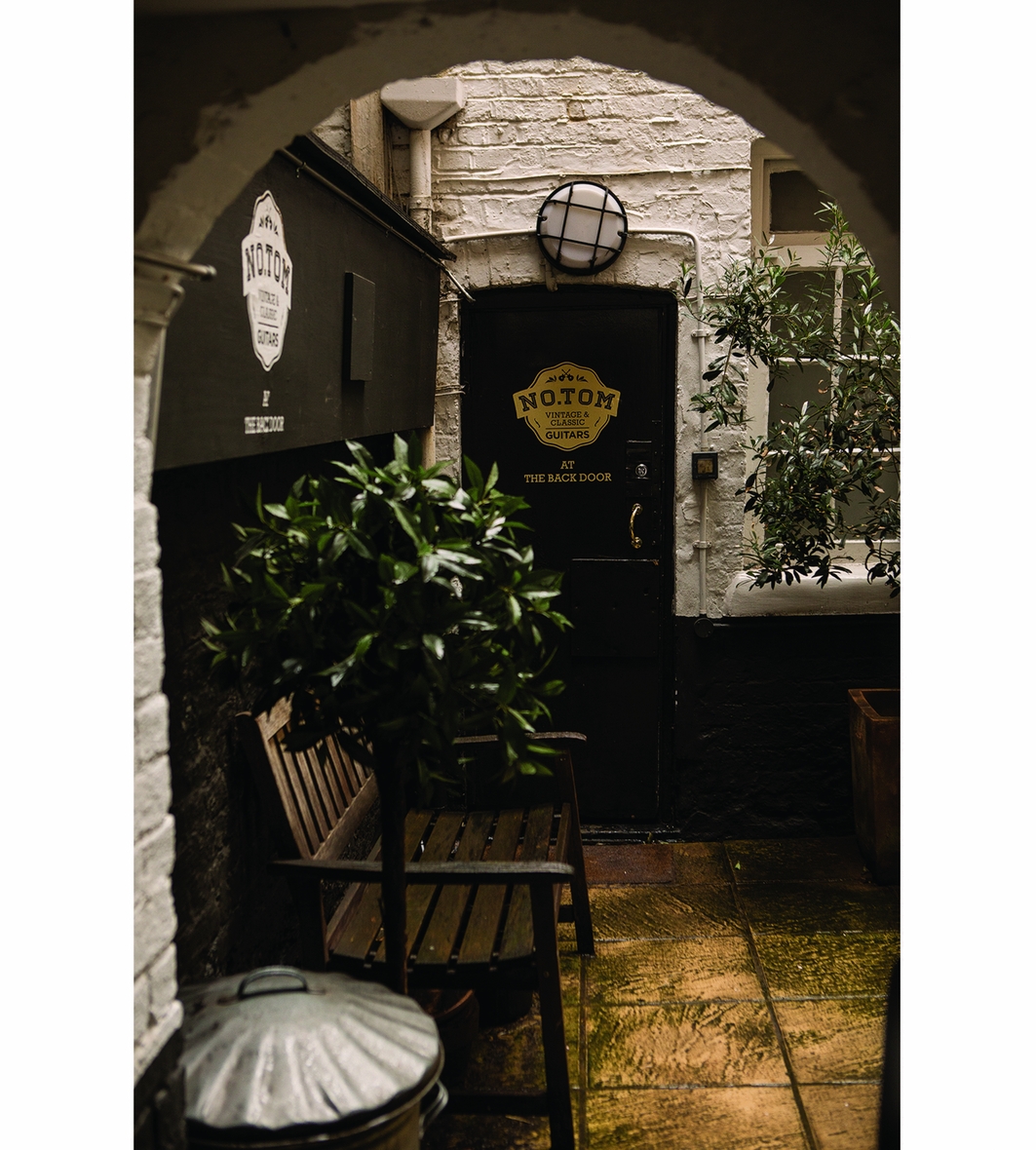
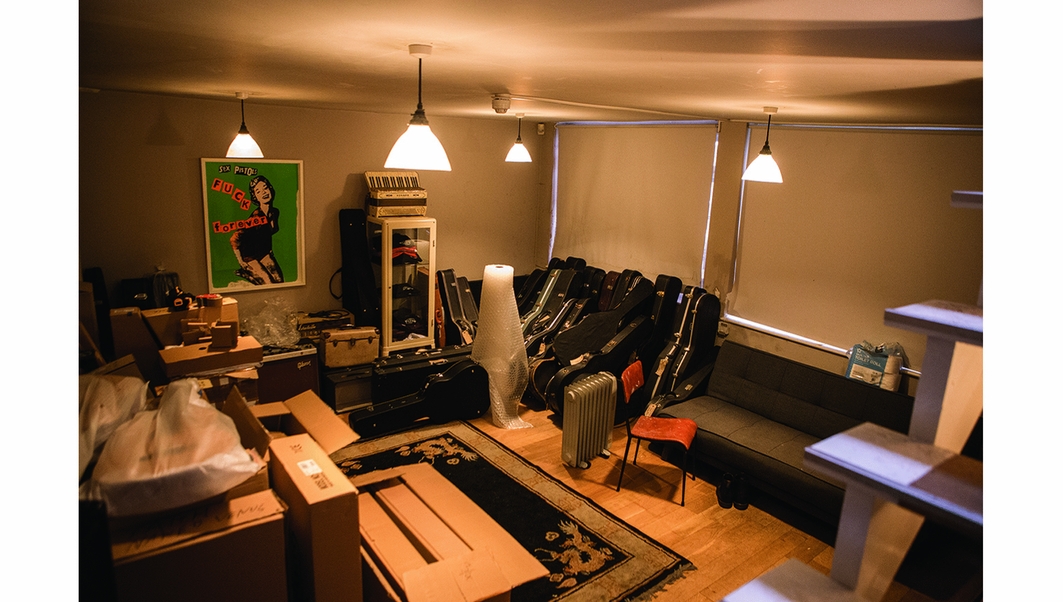
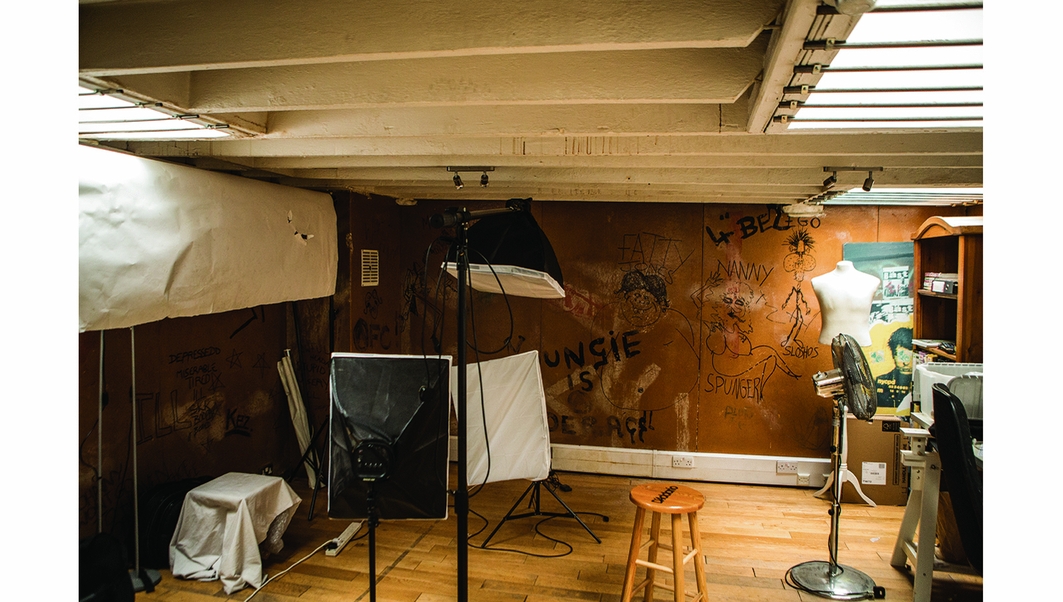
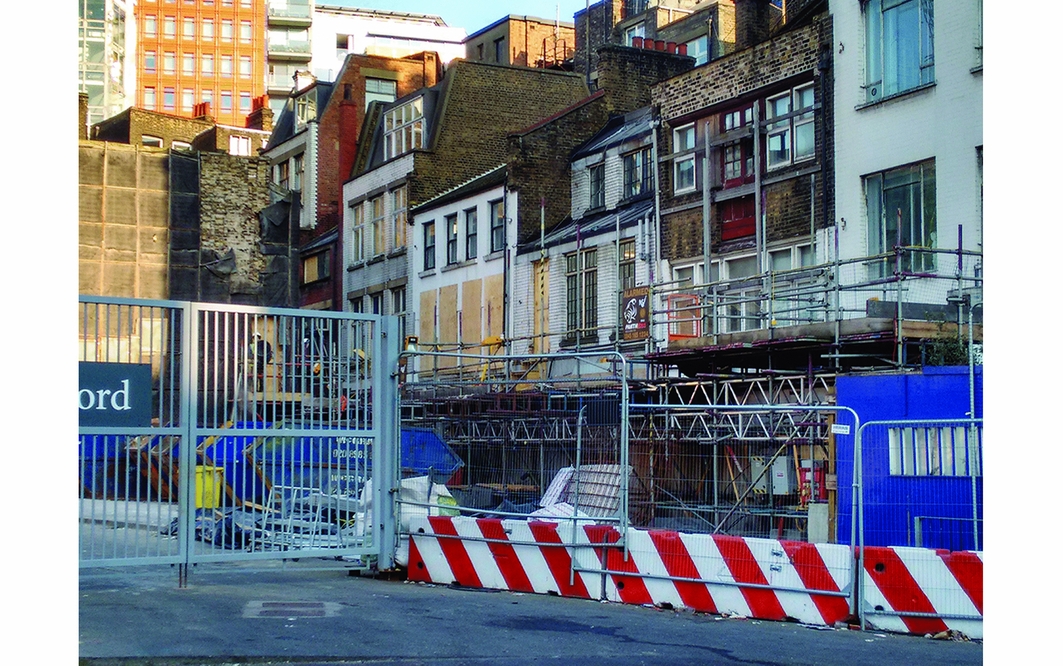
The issues revolving around these artworks (Figures 1–3) are now brought into sharper focus by five more recent developments. One is the recording of an interview by radio journalist Amy Zayed with John Lydon in late 2011 or early 2012 in which he comments directly on our research, and on the views expressed on the cultural significance of what we now believe is largely his own work. The precise content of this interview has only recently come to light. Second are current works and further proposals to redevelop the area of Denmark Street (Figure 4), which, as was stated in our previous paper, has a rich musical heritage (Graves-Brown & Schofield Reference Graves-Brown and Schofield2011: 1387). Third is the recent listing of the building at 6 Denmark Street at Grade II*. This designation by the government labels it as a ‘particularly important building of more than special interest’, and places it among the top 8 per cent of half a million listed buildings in England. While it would be inaccurate to claim that this listing is focused only around the building's punk associations, these are recognised as a significant part of the building's history and certainly add to the case. Fourth is the fortieth anniversary of punk; during 2016, a major ‘40 Years of Punk’ retrospective was organised for London alongside an exhibition at the British Library. As we will see, objections have been raised to both. Fifth is the continued and accelerated growth of interest in the heritage of popular music. Recent publications include both collections on the subjects of place and curation (Cohen et al. Reference Cohen, Knifton, Leonard and Roberts2014; Lashua et al. Reference Lashua, Spracklen and Wagg2014; Schofield Reference Schofield2014a), archiving (Baker & Collins Reference Baker and Collins2015), urban character as reflected by and through music-making (Schofield Reference Schofield, Lashua, Spracklen and Wagg2014b; Schofield & Rellensmann Reference Schofield and Rellensmann2015), and the materiality itself, in the form of objects (e.g. Graves-Brown Reference Graves-Brown2014, Reference Graves-Brown2015a), and buildings and places associated with music production and encounter (e.g. Cherry et al. Reference Cherry, Ryzewski, Pecoraro, Beaudry and Parno2013; Haslam Reference Haslam2015). Within this wider and ever expanding context of interest and cultural engagement, we will briefly reflect on the public response to the original publication and on John Lydon's own observations. We then consider the implications of this work, and the recent developments that encompass it, suggesting that on occasion, and arguably always, a more ‘punk’ approach to cultural heritage management might be appropriate, outlining also for the first time what such an approach might look like.
Entrance to the annex occupied by the Sex Pistols, at the rear of 6 Denmark Street. Image: Ian Martindale.

The ground floor of the annex, formerly the recording studio. Image: Ian Martindale.

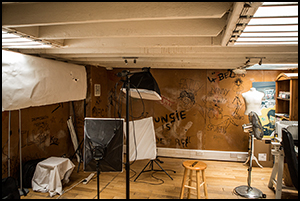
The upstairs living space, with artworks visible behind furniture and photographic props. Image: Ian Martindale.

St Giles development and the partially demolished Denmark Place in 2015, showing the north side rear of Denmark Street. Image: Paul Graves-Brown.

Media pro and anti
Much to our surprise, the University of York's press release accompanying the publication of our research in Antiquity led to coverage in the media from Romania to Colombia, mainly through press syndication. Most press coverage, including in popular newspapers The Daily Mail and The Telegraph was straight reportage, but The Times (2011) chose to attack our work in a stinging leader: “Would Johnny Rotten beam, or blush with embarrassment, to learn that graffiti he scrawled on a bedroom wall in 1977 are being assessed for their archaeological and cultural significance? In the scholarly journal Antiquity? By academics who see the wall as an ‘historic site’? Really?” While The Guardian’s Jonathan Jones (Reference Jones2011) began his article noting that “Comparing the scribblings of the Sex Pistols to cave art is a rotten attempt to drag archaeology into populist culture. Archaeologists should know better”.
The ‘antis’ fell into three camps: those akin to the above who deplored our casual comparison with Lascaux; those who thought (wrongly as it turns out—see below) that John Lydon would find our work absurd; and thirdly, those who thought we were wasting public money (e.g. “These academics are state-funded trollops for the socialists. Why should taxpayers have to fund their own destruction?”—reader comment, The Telegraph). What is intriguing is that the vituperation was by no means ubiquitous, even amongst comments in The Daily Mail and The Telegraph. Indeed, a number of readers offered more insight than the reportage: “Every cultural change that influences how whole generations think and act are important, and they are never thought to be so at the time; this has gone on throughout history” (reader comment, The Daily Mail). Another reader noted that: “Of course it should be saved in some manner. Graffiti is significant in itself, regardless of what the image or words say” (reader comment, The Telegraph). In the essay written for The Guardian newspaper, one of the authors of the original essay restated the artwork's cultural significance. Graves-Brown (Reference Graves-Brown and Schofield2011) asked:
Is the former silversmith's workshop at the rear of 6 Denmark Street as significant as the cave of Lascaux? Having visited both, I would say that each inspires a certain frisson, a feeling of visceral connection with past events. Although the comparison makes a good headline, I would be unwilling to judge which site is more important. More important to whom? Are events that occurred thousands of years ago automatically more important than what happened yesterday? And how do we decide? The ‘art’ of Lascaux is often held up as evidence of the progressive development of ‘modern’ humans. But punk, and the Sex Pistols in particular, represent a pivotal time in which this faith in human progress began to falter. In which the inevitable march of humanity into a bright future was replaced by the suspicion that there was ‘no future’. In a time when this latter view has considerable currency, the place where Lydon et al. formulated their nihilistic, and perhaps prophetic, world view could well be regarded as of considerable significance to us all.
Among the usual range of pro and anti opinions prompted by this essay, the commenter ‘Antiquarian’ remarked: “Is the cultural phenomenon of popular music culturally significant enough for preservation of its sites and if so, how do we decide what is significant?” (reader comment, The Guardian).
Overall, and on reflection, it was probably the Lascaux comparison that both fuelled the press coverage and the criticism, although we are not the first to compare ‘graffiti’ to cave art (Melly Reference Melly and Perry2015 [1976]). For example: “It is the height of absurdity to compare the visibly awkward caricatures of the Sex Pistols with the exquisite and timeless cave paintings from Lascaux, Altamira and other prehistoric sites. There is a palpable sense of deep spiritual awareness in the latter, whereas the former are crude, tasteless graffiti” (reader comment, The Telegraph). And perhaps this is the most important point in terms of press and public perception of the issues: that issues of motivation, cultural context and the accumulation of sufficient patina take the relative apportionment of social value almost beyond question. The point about punk, however, is that everything comes into question. Everything is challenged.
Five years on, in March 2016, a press release announced the Grade II* listing of 6 Denmark Street with a quote from the Tory government's heritage minister David Evennett: “As we celebrate 40 years of punk, I'm delighted to be granting further protection to these buildings, which acted as a home and studio to the Sex Pistols” (Historic England 2016). This generated further intensive media coverage. Only a week before, Malcolm McLaren's son, Joe Corré, had announced that he would, in the style of Bill Drummond's infamous money burning with the K Foundation (Smith Reference Smith2000), burn £5 million worth of punk memorabilia, stating: “Talk about alternative and punk culture being appropriated by the mainstream. Rather than a movement for change, punk has become like a fucking museum piece or a tribute act” (Jonze Reference Jonze2016).
The Times (2016), whose journalists had previously lambasted us, remarked in a leader that
Cynics might think that the cultural life of the capital would be better served by obliterating the band's artwork altogether [. . .] The naysayers would be wrong. Heritage is a succession of eras, and Soho has had many incarnations. In the 1960s and 1970s it was a centre of the music industry. The Sex Pistols were a short-lived but notorious part of it.
Virtually all other media reported the listing positively. Only novelist and theatre critic Christopher Hart, writing in The Daily Mail (Hart Reference Hart2016), found the listing exceptionable, attacking Historic England, the Heritage minister and ourselves:
And, of course, you can always find some twittish academic to lend his support—or, in this case, two for the price of one. Dr Paul Graves-Brown, of University College, London, and Dr Paul [sic] Schofield, of the University of York, have joined forces to acclaim the Sex Pistols’ graffiti as more important—and I'm not making this up, I swear—than the tomb of the Egyptian pharaoh Tutankhamun [. . .] All of which makes you wonder—are these cultural commissars and state-salaried guardians of our national heritage quite up to the job? Are they talking about the same Sex Pistols that many of us actually remember?
Again, many, if not most, members of the public commenting on media coverage viewed the listing positively. The fact that the press (with the exception of Mr Hart), particularly The Times, saw value in the listing suggests a shift in attitudes, perhaps precipitated by the official ‘endorsement’ of punk implied by the fortieth anniversary commemorations.
The Rotten response
Soon after the press coverage of the original Denmark Street publication in Antiquity in 2011, John Lydon and John Schofield were interviewed separately by radio journalist Amy Zayed for BBC Radio 6 News. A short piece was collated from the interviews. In the extended conversations with John Lydon, comments were made concerning the original research and the press coverage of it. Concerning the way his artworks were described (as ‘graffiti’ in the original essay), Lydon was unimpressed: “Damn liberty! How dare anyone call my artworks graffiti [. . .] It is very important that the word ‘graffiti’ be removed from the conversation”. They were instead, he said, artworks, “simulations of scenes that went on when we were rehearsing [. . .] Every time there was a row or a situation or a friendly get together, something would crop up in my mind and I'd either draw or write a song”. The artworks thus become even more closely entwined with the early social history of the band and the punk movement than we originally envisaged, arguably further enhancing their significance. And they draw in some of those characters whose stories have become interwoven with the band's history and folklore—John Tiberi, for example, depicted in the artworks as ‘Boggy’, and who Savage (Reference Savage1991: 309) referred to as an “Anglo-Italian with a face like a Red Indian [who] was immediately attracted by the Sex Pistols’ set-up”. And the character captioned “Caeseruice Jupits, Rome's only hero”, better known as Charles Shaar Murray, NME journalist from 1972–1986. For archaeologists, Lydon's comment resonates immediately with the way that prehistoric artworks might be interpreted, as ‘simulations of scenes’ or stories of everyday events.
There was an assumption (of ours, held also by many of the commentators) that Lydon would not share our view of the artworks’ cultural significance; that he would be unimpressed with our assessment of the art's value as ‘heritage’. Indeed, Lydon did refer in his interview to the ‘over-intellectualisation’ of this work, and our attempts to explain it all in a ‘trivial way’. As he says, “I am not one for the museums. I don't like my stuff ever to be viewed that way”. But he goes on to recognise how “there is a historical perspective to it”, and that “If somebody sees my artwork as valid that's fantastic to me. I am never ever going to shout them down on that”. Lydon does, therefore, appear to recognise the cultural value of these artworks. He also loved the idea that any preservation order placed on the building as a result would render this “the most awkward building in England”. And Glen Matlock seems to like the listing too; in an interview with the authors, he said that: “[the designation] is cool really. It was a punk place but it was lots [of other things] before then [. . .] It's about the whole place [Denmark Street], not only this building. [There is] loads of history. [It should be] cherished”. These views of band members rather contradict expectations, expressed most recently by Janet Street-Porter (Reference Street-Porter2016), who once interviewed the Sex Pistols in Denmark Street for London Weekend Television:
I am certain John is howling with laughter at the news that the flophouse where I filmed (where they recorded the demos for ‘Anarchy in the UK’ and ‘God Save the Queen’) is being turned into a listed building by Historic England because of its cultural significance.
Heritage: a punk manifesto
This is not the place to define precisely what a punk approach to heritage might look like. But we can outline some key areas that together characterise the way punk might contribute to thinking about heritage, thus shaping our engagement with it. Many definitions of punk exist, and studies in sociology (Beer Reference Beer2014) and archaeology (Caraher et al. Reference Caraher, Kourelia and Reinhard2014; Morgan Reference Morgan2015) highlight contributions to the field. Following Beer (Reference Beer2014), it is clear that the key points about punk were its ethos of DIY—that everyone and anyone could create and contribute—and its surprisingly inclusive view of difference and otherness. In spite of the occasional use of right-wing symbols (e.g. the Nazi armband worn by Jordan on Granada TV's So it Goes, and famously also by Siouxsie Sioux; for a broader discussion, see also Hebdige Reference Hebdige1979: 116–17), and the attempts of neo-Nazis to co-opt punk, the movement embraced ethnic and gender diversity. Punk's rejection of the ‘establishment’ is significant but by no means singular—the rock bands that the Sex Pistols claimed to despise had also been iconoclasts in their turn. Another characteristic of the punk approach to heritage, highlighted by Beer in his Punk sociology (2014: 55), is the ability to “spot norms and to challenge and question them, to play with them, and subvert them”. And this assumes a ‘fearlessness’, which was also a characteristic (Beer Reference Beer2014: 46).
From such an ideology flow ways in which we can encounter and experience the world, the need to question it, to challenge systems and the old world order, and to recognise the contributions that everybody makes to that world. It seems there are clear comparisons here to a recent document that attempts to reconfigure (and arguably modernise) heritage, both in its definition and its scope and purpose. The 2005 Faro Convention (Council of Europe 2005) defines heritage as a
group of resources inherited from the past which people identify [. . .] as a reflection and expression of their constantly evolving values, beliefs, knowledge and traditions. It includes all aspects of the environment resulting from the interaction between people and places through time.
For the Convention, ‘people’ very specifically means ‘everyone’, and ‘all aspects’ does mean ‘everything’. According to Faro, heritage can be whatever anybody wants it to be. How that then translates into practice is of course another matter (but see Council of Europe 2009 for some examples).
A version of what we might call ‘punk heritage’ therefore already exists in theory, and notably in documents such as the Faro Convention, with its core aim of promoting inclusivity and public participation at all levels of management and practice. Furthermore, the punk practice of challenging norms and conventions has a deeper history in archaeological and heritage debate. Less well established is what we might refer to as ‘punk heritage in practice’. This remains problematic given legislative constraints, and—to some degree—the resilience of old-school approaches and attitudes. In this case, the conundrum is acute. The ‘system’ provides opportunity for the building at 6 Denmark Street to be listed at Grade II*, but largely on the basis of its historical importance as a building type. Listing is a mandatory duty of the Secretary of State, who ‘must’ list buildings that meet the criteria. In our view, it is the punk associations that give this building significance, and a punk approach would be to have the option to not list something in spite of other cultural values. The system does not allow for such subversion. Perhaps (and ideally) it should, if such a system must exist at all.
Discussion
To consider the wider relevance of some of these principles, we should draw back from Denmark Street and its Sex Pistols associations to take a broader and more inclusive view of the contrasting role of heritage in politics and society. This is epitomised in events over the last few years. The destruction of temples in Palmyra by the so-called IS, and the earlier demolition of the Bamiyan Buddhas have been almost universally condemned as sacrilege, albeit with some comparison to acts of seventeenth-century puritans (e.g. McCauley Reference McCauley2015). Yet recent suggestions that Edinburgh might lose its World Heritage Site (WHS) status have led some to question whether this even matters (Black Reference Black2015; Brocklehurst Reference Brocklehurst2015). Comparing the city with Dresden, which lost its WHS status in 2009, Richard Williams (in Brocklehurst Reference Brocklehurst2015) remarks:
As far as I can see, about 90% of Edinburgh's tourists come during the festival and they come to see stand-up, they don't come to see architecture. We know from the example of Dresden that you can have Unesco status and lose it and still continue. Dresden still exists, people still visit it.
The whole question of heritage preservation in a changing world would seem to require serious reconsideration.
Comparing 6 Denmark Street with the iconic classical ruins of Palmyra would, no doubt, arouse the same ire as comparing it with Lascaux. Yet the street is historically important and has cultural value, not least for the survival of buildings and the persistence of memories related to its recent popular cultural heritage (Brown Reference Brown2015). Consolidated Developments Ltd, who are currently redeveloping the area, have recognised its significance, making allowances for Denmark Street's continuing role in ‘Tin Pan Alley uses’. This is defined in a Section 106 agreement as “specialist retailers focusing on the sale, making and repair of musical instruments and other music industry activities, including recording studios, artist management offices, music publishing houses and agents” (London Borough of Camden 2015: 30). The agreement goes on to state a requirement for site owners to perpetuate this usage effectively by only letting retail units for such purposes. The overall St Giles Project (Figure 4), of which this is a part, also includes a new arts/music venue. This leaves us, however, with the question: does the heritage of Denmark Street reside in its continuing use in the music industry, or in its past role within that industry? For heritage sites to have a sustainable future, we would suggest that they must have a life of their own (see Graves-Brown Reference Brown2015b), a proposition that could mean Tin Pan Alley giving up its status as a centre of music-making and production, and moving perhaps in an entirely new direction. John Lydon's comments (above) imply some disquiet about this. For us, the proposition seems quite ‘punk’ in its implications and counter to a conventional heritage viewpoint. But we consider it a view worthy of mainstream debate and consideration.
We should realise, however, that the recent past presents a particular set of problems for heritage preservation, as the furore around the Lascaux comparison makes clear. Popular controversy around Preston Bus station, Park Hill in Sheffield or the continuing debate around the Smithson's Robin Hood Gardens indicates that that which is recent cannot, in much popular imagination, be important. And, indeed, it is fair to say that none of us have the benefit of hindsight; will punk rock, in the long run, be seen as a crucial cultural turning point? Certainly, 40 years on, it is considered to have had influence in politics and popular culture (e.g. Adams Reference Adams2008). If so, 6 Denmark Street is a key landmark. Conversely, it might be seen as a brief blip in the bland process of cultural industrialisation. That said, modern heritage is not problematic for everyone. For example, in the MORI survey conducted for English Heritage (MORI 2000: 20), it was noticed how younger people take a broader (a more ‘punk’) view of heritage. On one question, 95 per cent of people aged between 16 and 24 agreed that it was important to preserve modern buildings for future generations, in comparison to 83 per cent of people over the age of 65.
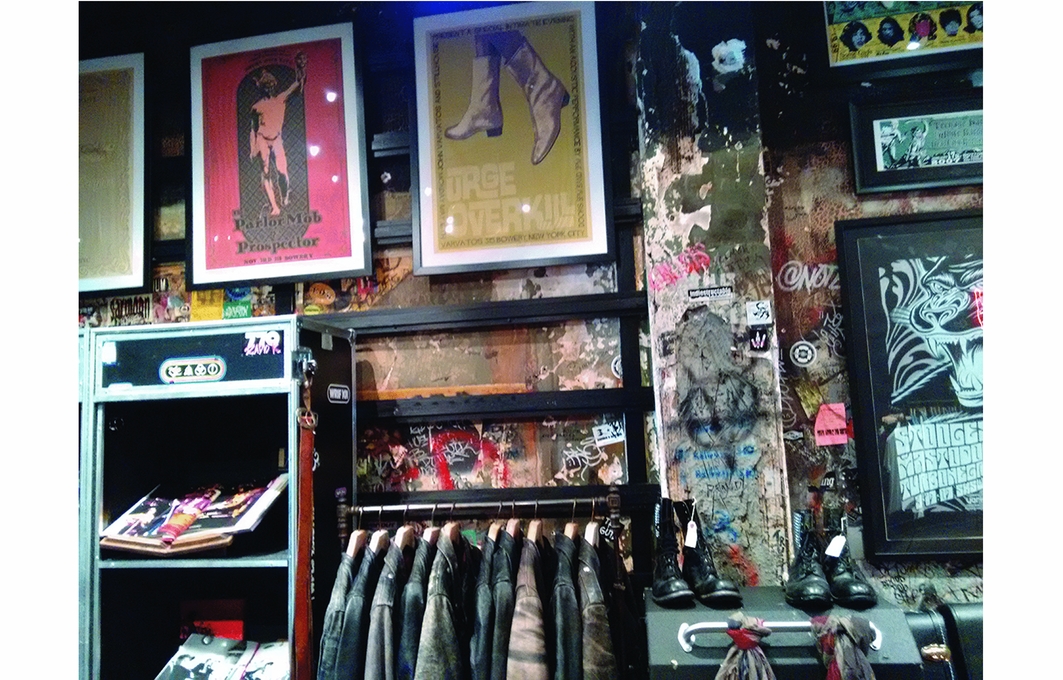
What antiquity lends to a site is both aura and rarity, if indeed there is not some mutuality between the two. Yet one can argue that 6 Denmark Street has rarity (as a punk place in a movement that was largely placeless), and arguably also aura. In this regard, the only other sites of similar note from this time might be the (just) surviving 100 Club in Oxford Street and the former CBGBs in the Bowery, New York. The latter is currently an upmarket clothes retailer where the owner, John Vavartos, has comprehensively preserved graffiti and other relics of the former club (Figure 5). With regard to Denmark Street in general, and number 6 in particular, the development plans are largely restorative, respecting the listed status of most of the buildings. For number 6, the plan mandates
Alterations to include the replacement of non-original windows with sliding sash casement windows, replacement of modern clay tiles with reclaimed natural slate, repair and refurbishment of existing brickwork and shopfront, replacement of front roof dormers in connection with the redevelopment of St Giles Circus site (London Borough of Camden 2015).
Preserved CBGB graffiti in the John Vavartos store at 315 Bowery, New York. In 2013, the building was added to the US National Register of Historic Places. Image: Paul Graves-Brown.

The Grade II* listing of number 6 raises some interesting questions. Consolidated Development's original plan (Sampson Associates 2013) was to convert the outbuilding containing the artworks into flats, but it is hard to see how this might be compatible with protection of the artworks. Their survival thus far has been something of a DIY effort—Glen Matlock confirmed to us that he had papered over them to protect them in the early 1980s, and they were subsequently uncovered (at Matlock's instigation), and protected with a coat of polyurethane varnish by fashion designer Agnes B, when her company occupied the building in the mid 2000s. Instead of a future as a bedsit or squat, maybe the building could become a kind of punk museum? Or would this represent the inappropriate fossilisation of an iconoclastic movement?
Conclusion
Currently, Denmark Street represents one small instance of the radical changes occurring to major cities such as London, Berlin and New York, which some refer to as ‘gentrification’ (for Berlin, see Schofield & Rellensmann Reference Schofield and Rellensmann2015). This is frequently justified in terms of promoting the needs of a creative class (Florida Reference Florida2002). On a small scale, Denmark Street's ‘Tin Pan Alley uses’ are being fostered in the belief that they form part of a creative economy that will replace older economic models. But is it possible to create bohemia artificially? Florida's influential views have been extensively criticised (see Peck Reference Peck2005; Krätke Reference Krätke2010), and as Keefe (Reference Keefe2009: 158) observes with regard to Manchester's Hulme bohemia, “Redevelopment of the collapsoscape cannot be forced”. He goes on to state how the semi-derelict ‘compost cities’ that promote new creativity cannot be synthesised or institutionalised by building an ‘arts centre’. In the DIY spirit of punk, we agree. The context that created the Sex Pistols (or for that matter the Rolling Stones, another group of Denmark Street alumni) cannot be industrialised, and, in any case, a new Denmark Street may be already nascent in Edgware or Guangdong. Crucially, a punk approach may not seek to instate any alternative systems, recognising the need to let the past take its chances in the present and the future.
The alternative, of course, is for number 6, and Denmark Street as a whole, to continue to become ‘heritage’, what Laurence Kirschel, the chairman of Consolidated, describes as “a living exhibit of British music history” (in Brown Reference Brown2015). But here, as Brown (Reference Brown2015) remarks, “campaigners and tenants talk darkly of the prospect of Denmark Street being ‘Disneyfied’ into a characterless tourist destination”. The owner of Macari's, one of the street's iconic music shops, tells Brown: “I'm not so stupid as to think that things don't change. But Denmark Street is unique and its spirit needs to be preserved”. Mick Brown himself concludes, “Perhaps blue plaques, a ‘rock'n’roll tattooist’ and the Chateau Denmark are preferable to total oblivion”. As proponents of ‘anti-heritage’, we are not sure such a future is worth having. A place such as this may or may not survive, but its fortunes ultimately should be determined, we think, by an approach grounded in punk principles and not the conventions of heritage practice. The building's future as a squat or some form of co-operative would seem appropriate if the spirit of punk is to remain within the fabric and spirit of the building. But in a sense, we do not really care, and are happy to accept that there is ‘no future’, unlike arch-punk John Lydon, who would be the first in line to view his artworks in museological context, and for whom 6 Denmark Street could, through this heritage designation, amusingly become ‘the most awkward building in England’.
Acknowledgements
We would like to take this opportunity to thank the many people with whom we have had such interesting and productive conversations on this topic since our original (2011) paper appeared, and in particular all of those who took the opportunity to comment online. We have very much enjoyed reading and thinking about these various comments. We would like to thank journalist Amy Zayed for her interest and for making the full recordings of her interview with John Lydon available to us. We would also like to thank Henry Raby-Smith of the ‘Save Tin Pan Alley’ campaign for his help, and Glen Matlock for agreeing to be interviewed. We are also grateful to Mark Edmonds, Colleen Morgan, Hilary Orange and two anonymous referees for helpfully commenting on a draft of this paper.