The new Formenlehre raises intriguing questions for analysis and interpretation. Together, the works of William E. Caplin, James Hepokoski and Warren Darcy help us to hear late eighteenth-century music anew, allowing instrumental works to stand in relief against a background of generic conventions and letting their themes and other sectional units emerge as tokens of standard functional types.Footnote 1 This is no small achievement, given the familiarity of much of the repertory and its centrality to concert programmes, CD catalogues and, of course, musicology. But the exact significance of these theoretical developments is as yet unclear. The theorists engage hardly at all with the burgeoning literature of recent decades that develops historicized understandings of late eighteenth-century music, such as topic theory, the history of aesthetics and criticism, analogies with the visual arts and the documentation of concert life.Footnote 2 And they have little to say about the practice of hermeneutics that has become so central to the discipline. Caplin is silent on the matter, while Hepokoski and Darcy offer only a preliminary mapping of the hermeneutic terrain. This article attempts to establish a dialogue between twenty-first-century music theory and historical modes of enquiry, adapting both Formenlehren to serve a historically oriented hermeneutics. The means of doing so is an analytical case study of the first movement of Haydn's Symphony No. 92 (1789).Footnote 3
The argument rests on an optimistic belief that a dialogue between the various discourses is possible in principle, and that the theorists' insights can sharpen understandings partly determined by historical investigations. Granted, theoretical and historical approaches are not straightforwardly compatible. The lengthy analytical discussion of the Symphony that follows is therefore intended to continue the process of reviewing and critiquing the Formenlehren that is already underway elsewhere by loosening them from their formalized, at times hermetic, early twentieth-century theoretical procedures and vocabularies.Footnote 4 Indeed, my approach is comparatively eclectic and avoids being theoretically systematic. Although I have separated the sections on hermeneutics from the analytical ones by subheadings, this should not be taken to imply – as theorists themselves sometimes do – that analysis stands outside the hermeneutic circle. From a historiographical point of view the article does not pretend to break new ground. Readers conversant with late eighteenth-century music aesthetics and reception may find the ‘historically informed’ interpretation of Symphony No. 92/i that finally emerges little more than a statement of the obvious, while students of Haydn's music will be unsurprised by the disruption that the movement causes to a priori assumptions and theoretical generalizations. (Other movements could have been chosen for this purpose, though Symphony No. 92/i is a particular tour de force.) The familiarity of these results is deliberate; my aim here is to achieve cross-fertilization between sub-disciplinary endeavours that have hitherto remained separate. There are, of course, modes of hermeneutic enquiry that do not rely on historical contextualization; they must be left for another day.
HERMENEUTICS AND SONATA THEORY
For Hepokoski and Darcy analysis and hermeneutics are distinct, the former being a necessary ‘first stage’ that must be achieved before the latter can take place effectively. On these terms, however, Elements of Sonata Theory (2006) deals almost exclusively with analysis. Although in an appendix they state that ‘all analysis should be directed toward the larger goal of a hermeneutic understanding of music as a communicative system’, they make only one significant foray into ‘post-analytical’ hermeneutics (near the end of their chapter 11, which deals with the recapitulation). The discussion there amounts to no more than a prolegomenon to the ‘larger system’ they claim to have in mind.Footnote 5 Nevertheless, they maintain that ‘a sonata is a metaphorical representation of a perfect human action’.Footnote 6 They locate this representation ‘primarily within eighteenth-century European conceptions of humanness’. Those conceptions are not explained, but the action is evidently dynamic and goal-directed (an impression reinforced by Hepokoski and Darcy's vocabulary throughout Elements of Sonata Theory), while ‘metaphor’ and ‘representation’ are closely connected with ‘narrative’:
A sonata is a linear journey of tonal realization, onto which might be mapped any number of concrete metaphors of human experience. Since a central component of the sonata genre is its built-in teleological drive – pushing forward to accomplish a generically predetermined goal – the sonata invites an interpretation as a musical narrative genre.Footnote 7
The story has a beginning (usually the ‘primary theme’), a middle and an end (the perfect authentic cadence in the tonic that effects ‘essential structural closure’). Thus ‘it is in the nature of the sonata to set up a quest narrative’.Footnote 8
Hepokoski and Darcy's aspirations to historical appropriateness and human significance cannot be faulted. Yet their conception seems needlessly restrictive. First and foremost, it limits the ‘metaphorical representation’ to something like mimesis. Temporal patterns in the sonata come to stand for sequences of events in the ‘linear journey’ because of some kind of similarity. Secondly, this approach restricts the signified itself to ‘action’ if it is to be regarded as ‘human’ in a late eighteenth-century sense. Hepokoski and Darcy do not specify the concept of ‘action’ with any precision, but in the context of the ‘quest narrative’ and ‘goal-directed’ drive, they seem to be thinking of a character's ‘deeds’ in a beginning-to-end story. Yet it is extremely difficult to find eighteenth-century critical accounts of the symphony as a narrative of action, let alone dynamic, goal-directed action: that was left to nineteenth-century commentators, not least when it came to Beethoven's ‘Eroica’ Symphony.Footnote 9 Finally, and unsurprisingly for a music theory textbook, this approach contains what Donald Francis Tovey would have called ‘fixed points’.Footnote 10 Despite their assertion of a fluid, ever-changing background of norms against which sonatas must be understood, Hepokoski and Darcy make a priori assertions about the nature of sonatas in general. Note the two subject–predicate formulations in the sentences quoted above (‘a sonata is …’). I want to take the analytical insights of the new Formenlehre in a different direction. I contend that, on late eighteenth-century terms, the human significance of Symphony No. 92/i is not given to us primarily by means of narrative. One cannot make transhistorical generalizations about what a sonata is, what it tells us, or how it does so.
SYMPHONY NO. 92/I: EXPOSITION
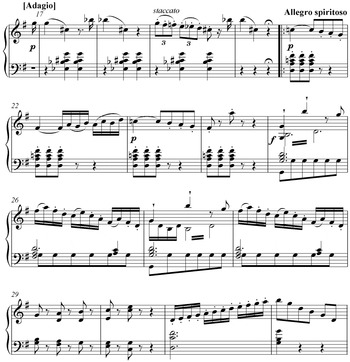
The most striking – even extraordinary – aspect of the movement is the continual recurrence of the ‘vamping’ four-bar opening phrase of the Allegro spiritoso (see Example 1, bars 21–24).Footnote 11 The phrase conveys a sense of immediate anticipation. The dominant seventh harmony, the diminished fifth unfolded three times in the melody, the formal position just after the end of the slow introduction, the repetitiveness that suggests both bustling action and overall stasis and the pause in bar 24 combine to ‘point’ to something significant to come. As Tovey explained, ‘To prolong a preparatory harping on the dominant of a new key is equivalent to working up to the entry of an important person in a drama’.Footnote 12 In these bars the ‘presentation’ of ‘ideas’ is insignificant in comparison with the establishment of the quick tempo, the four-bar unit and the implication of an imminent event likely to start with tonic harmony and in the same tempo and metre. This is an unusual gesture, notwithstanding Haydn's strategic play with first-movement Allegro openings in symphonies such as Nos 81, 86, 94 and 100 and in string quartets such as Op. 33 Nos 1 and 5 and Op. 50 No. 6. The Allegro spiritoso does not begin with ambiguous harmony or the wrong ‘intrathematic function’, as Caplin would call it (closing or medial rather than initiating).Footnote 13 Instead, part of the harmonic task of the slow introduction spills over, as it were, into the Allegro spiritoso. The augmented sixth at the end of the introduction is prolonged ‘too long’ and the dominant chord that ‘ought’ to have followed (with appropriate pause mark and an ensuing caesura) is displaced beyond the change of tempo.
Symphony No. 92/i, bars 17–32 (all reductions based on Critical Edition of the Complete Symphonies, volume 10, ed. H. C. Robbins Landon (Vienna: Universal Edition, 1965))

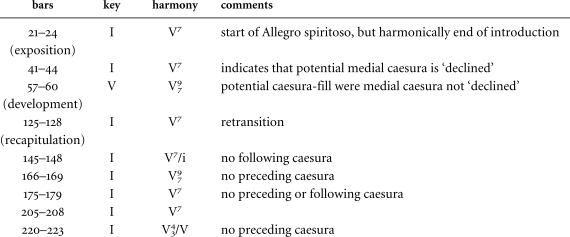
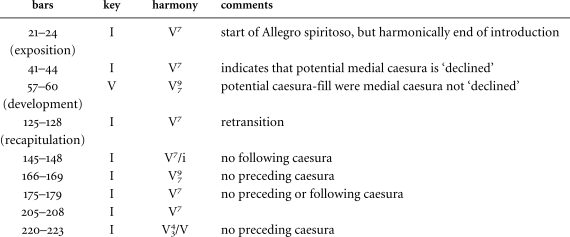
The four bars of vamping – henceforth ‘caesura prolongation phrase’ – recurs twice in the exposition, once at the end of the development and six times in the recapitulation, appearing in the tonic a total of nine times, almost always on dominant seventh harmony, and appearing once in the dominant key (see Table 1). These are not successive reiterations: each is followed by a substantial section of music. Caesuras are of course fundamental to the classical style, contributing to what Tovey and Charles Rosen call ‘drama’ or ‘articulation’.Footnote 14 Caesuras that follow phrases ending with dominant or dominant-seventh harmony imply that what follows will be significant and that the succeeding bars will be the start of a new section. They will probably express initiating function: the presentation of ideas rather than ‘continuation’, ‘development’, ‘spinning-out’, cadential gestures or the confirmation of a key through conventional formulae. In this movement there are far more caesuras than usual for a sonata allegro, and most are drawn out by the caesura prolongation phrase, which usually converts dominant harmony to dominant seventh before the music makes a further pause with still more intense implications. The movement continually sets up grand entrances.
Symphony No. 92/i: appearances of the ‘caesura prolongation phrase’
The recurrence of this familiar tag of the classical style stands in ironic contrast to the relative insignificance of what actually ‘enters’. The very first caesura, to be sure, sets up what at first glance is a typical expression of the interthematic function ‘main theme’.Footnote 15 The tutti at bar 25 (see Example 1) resolves the dominant-seventh chord conventionally to the tonic to begin an eight-bar sentence, the standard length for a main theme, which, as Caplin observes, is normally ‘tight-knit’ in its organization.Footnote 16 Yet, given its position in the movement and the portentousness of its preparation, one might expect something more interesting to be ‘presented’ by this theme. In a sentential theme it is normally the ‘basic idea’ (given twice in the presentation phrase) that can be regarded as the real ‘subject’ of the theme, and perhaps even of the movement: what the piece will be ‘about’. Here we would expect what Caplin calls a ‘characteristic’ melody (recognizable by a diversity of intervallic content and variety of durational patterning)Footnote 17 that would facilitate later differentiation of presentation from continuation and cadential functions. In this theme, however, the leap of a tenth in bar 25 has been anticipated in bar 24 (before the tonic harmony and the tutti), while the bustling arpeggios in bar 26 are conventional rather than characteristic. The appearance of characteristic melody in this movement may be better located at the start of the Allegro spiritoso than at the start of the main theme, despite the repetitive ‘vamping’ of the caesura prolongation phrase and the fact that its primary function is not presentation. Furthermore, in terms of harmony and duration, the four-bar presentation phrase of the main theme stands as an answer to the four bars of caesura prolongation, a meaning strengthened by the presentation's ‘exact’ rather than ‘statement-response’ repetition (to use Caplin's terms)Footnote 18: this exact repetition minimizes the presentation's own internal differentiation and encourages a hearing of the whole four bars of presentation as ‘response’. Indeed, in some respects bars 25–28 suggest continuation function as well as presentation, as both harmonic rhythm and (overall) surface rhythm are faster than in the preceding bars. Retrospectively, this interpretation becomes still more persuasive, as continuation function is not distinctly expressed at bar 29: notwithstanding a still faster harmonic rhythm, the surface rhythm slows at that point and there is no fragmentation of units. In terms of harmony, the cadential phrase starts as soon as the presentation has ended. The significance of the presentation phrase of bars 25–28 thus lies as much in the expression of the function ‘main theme’, the continuation of the four-bar hypermetre and the marking-out of time in advance of the cadence as it does in the actual presentation of ‘ideas’. Had the introduction ended conventionally with a dominant-seventh chord and this main theme entered immediately at the start of the Allegro spiritoso, a listener familiar with Haydn's symphonic style of the 1780s might find it rather bland.
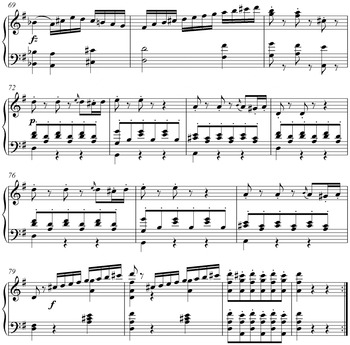
Despite the implications created by further caesuras, the rest of the exposition contains no other ‘theme’ as Caplin would normally understand this term in sonata first movements: that is, a succession of intrathematic functions in the order initiating–medial–closing, beginning and ending in the same key. There is little evidence of typical ‘subordinate-theme’ syntax: the same succession of functions, subordinate key, loose formal organization.Footnote 19 The closest the exposition comes to a second theme is with the two four-bar phrases of bars 72–79 (see Example 2). Here at last something ‘enters’ with apparently initiating function – a tune, indeed. Its rhetoric contrasts sharply with the rest of the Allegro spiritoso so far, in terms of melody, texture and articulation. There are several theme-like traits: the initial tonic harmony, the characteristic material of the opening two-bar unit, the varied repetition of that unit akin to the repetition of a basic idea in the presentation phrase of a theme, the regular phrase lengths and the harmonic progression of a perfect authentic cadence.Footnote 20 Indeed, the traditional ‘textbook’ theory of form would call this a ‘closing theme’, and Hepokoski and Darcy might call it ‘C’.Footnote 21 In a sense these bars provide a more satisfactory answer to the implications of the caesura prolongation phrase than does the main theme, for the melodic outline closes the interval of a tenth ( –
 ; bar 24) through contrary motion to an octave on the tonic (
 –
 ; bars 72–75) rather than moving by parallel motion to another tenth (
–
 ; bar 25). Yet this passage does not show enough internal functional differentiation to be considered a genuine theme in Caplin's terms. Its two phrases are identical and both use the harmonic progression of a perfect authentic cadence. The organization is too tightly knit for it to be classified as a subordinate theme.
Symphony No. 92/i, bars 69–82

Furthermore, the passage is not preceded by a caesura. In fact, it is not signalled in advance at all, its opening being elided with the final tonic of the perfect authentic cadence that finally confirms the dominant key. In other words, one of the few passages in the exposition that might be capable of a convincing ‘entrance’, and thus be worthy of preparation by means of formal articulation and harmonic implication, is instead comparatively unheralded. (This means also that the octave answer to the caesura prolongation phrase's tenth can be construed only by a long-range connection: the two intervals are not heard in direct succession.) Since the two phrases follow a perfect authentic cadence in the subordinate key and do not constitute a theme as such, the appropriate term for them is ‘codetta’ and the formal function they express is ‘postcadential’. Codettas in Caplin's sense usually come in groups: the initial codetta to a theme tends to be repeated exactly, before the units confirming the tonic chord are reduced in length (fragmentation and/or liquidation), as occurs here. Cadential harmonic progressions are often found in the first and second codetta of a series.Footnote 22 In this case, of course – the final paradox – there is no subordinate theme for the codetta to follow, only a cadence.
In short, the exposition plays a game with things-before and things-after, or what Caplin would call the functions ‘before-the-beginning’ and ‘after-the-end’.Footnote 23 What in functional terms should be the real ‘substance’ of the exposition – that which is prepared and followed – is relatively insignificant. The transferral of significance from the picture to the frame, as it were, is achieved partly through the repetition of the caesura prolongation phrase, but also in more subtle ways, such as the obscuring of presentation function in the main theme and the avoidance of characteristic melody. When at last something potentially new and melodically significant appears, it turns out in retrospect to be already ‘after-the-end’. It is notable that, in Schenkerian terms, neither the main theme nor the codetta either opens an interval of the tonic triad with an Anstieg (initial ascent) nor closes one down with a middleground structural descent. The main theme prolongs
via a neighbour  (bar 30, violins and first oboe; see Example 1). The imperfect authentic cadence that ends the main theme recaptures the
in bar 32. The codetta, by contrast, prolongs
, as though a middleground descent in the dominant had already occurred.
PHRASE STRUCTURE
Haydn's reputation as a composer of irregular phrase lengths is belied by this exposition. Four-bar units are ubiquitous and can be found even in passages that express formal functions such as continuation or transition. When this hypermetre is disrupted, a ‘correction’ is usually made to restore multiples of four bars at a higher level (see the eight-bar units at bars 49–56 and 65–72). Elision of phrases is avoided, save for that of the subordinate-key cadence with the first codetta (bar 72). In Haydn's sonata-form movements of the 1780s, the techniques of phrase extension and elision almost always contribute decisively to the ‘loosening’ of the organization of the transition, the subordinate theme or both. In this movement, by contrast, ‘default’ phrase lengths are found everywhere in the exposition, irrespective of local formal function. In particular, each four-bar caesura prolongation phrase re-establishes the hypermetre following the pause. Just as the caesura prolongation phrase itself gives the impression of both bustling and stasis, so the exposition as a whole combines frequent pauses with a relatively consistent hypermetre. Here is another paradox: despite its caesuras, the exposition tends towards a perpetuum mobile.
If formal functions are relatively undifferentiated within the Allegro spiritoso, a similar point could be made in comparing the Allegro spiritoso to the slow introduction. With the caesura prolongation phrase of bars 21–24, the function ‘before-the-beginning’ spills into the Allegro spiritoso and is reactivated at every subsequent caesura prolongation phrase; yet the actual slow introduction – the music that, in terms of tempo and character, really is ‘before-the-beginning’ – shows fewer discontinuities with the Allegro spiritoso than might be expected. Haydn's symphonic slow introductions are usually loosely organized, in contrast to the main themes of their ensuing Allegros, and often contain pauses, disruptions of metre, sharp contrasts in dynamics, texture, articulation and scoring, a minimum of characteristic material, regular phrase structure and prominent pedal points and sequences. Some of the introductions to the ‘London’ symphonies include ominous minor-key episodes and even resemble free fantasias. The introduction to Symphony No. 92/i avoids most of these features. It consists of five clearly articulated four-bar phrases. The topic here is minuet, albeit a slow one. The melody is symmetrical and uses characteristic material in a manner we might expect of the presentation phrase of a typical classical theme. There are specific parallels with the Allegro spiritoso too. The triple metre is shared,Footnote 24 and the descending motive in the first bar of the Allegro spiritoso is anticipated in bars 3–4 and 19 of the slow introduction. The introduction admittedly possesses one feature that marks its function as ‘before-the-beginning’: there are no authentic cadences, in either the tonic or any other key. Instead, three of the five phrases end on dominant harmony and two with augmented-sixth chords. All are followed by pauses, usually with rests in all parts. Yet in the end this fact only underlines how the functional distinctions between introduction and Allegro are eroded, since regular pauses on dominant harmony are precisely the salient feature of the Allegro spiritoso. Again, the movement sends ambiguous signals about its formal functions and sectional boundaries. This contributes to the impression that the movement is not primarily ‘about’ themes or, in particular, what those themes ‘present’.
MEDIAL-CAESURA STRATEGIES
The second and third caesura prolongation phrases in the exposition follow pauses that stand as candidates for what Hepokoski and Darcy would call the exposition's ‘medial caesura’. This is a pause following a cadence that typically occurs between one and three quarters of the way through a classical sonata exposition and that is followed by ‘S’ (for Caplin, the ‘subordinate theme’).Footnote 25 The medial caesura occurs in three harmonic types. For large-scale works the primary default option is a half cadence in the subordinate key; the secondary default (more common in shorter pieces) is a half cadence in the tonic; and the third option – relatively rare – is a perfect authentic cadence in the subordinate key. Hepokoski and Darcy's empirical observations show that the occurrence of each type is restricted to a certain region of the exposition: the first around the centre; the second earlier, though overlapping with the first; and the third later, though again overlapping with the first. Medial caesuras may be ‘declined’, in which case a cadence and pause are made but the following music turns out not to be a subordinate theme. For instance, the music may revert to the tonic, move to some other key or begin a further phase of instability akin to the transition section that preceded the caesura. Any subsequent ‘genuine’ medial caesura in the exposition will then be of a ‘later’ type. Each type, in other words, is normally available only once; if it does not occur during its characteristic region of the exposition, or if it is proposed but declined, then it will not occur at all.Footnote 26 Hepokoski and Darcy explain that an exposition might make an ‘early feint’ towards the tonic half-cadence option ‘only to renounce it or pass it by’ in favour of a later medial caesura that uses a half cadence in the dominant or a perfect authentic cadence in the dominant.Footnote 27 It is always possible that no fully realized medial caesura will occur in the exposition at all, resulting in a ‘continuous exposition’.Footnote 28 This category includes the so-called ‘three-part exposition’, as Jens Peter Larsen has called itFootnote 29 – one of Haydn's favoured procedures, in which a long, unstable, transition-like section finally makes a perfect authentic cadence in the subordinate key very near the end of the exposition and is followed by a short ‘closing theme’, or, in functional terms, a series of codettas.
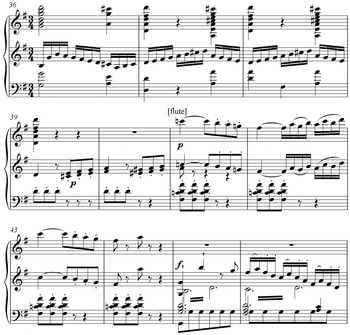
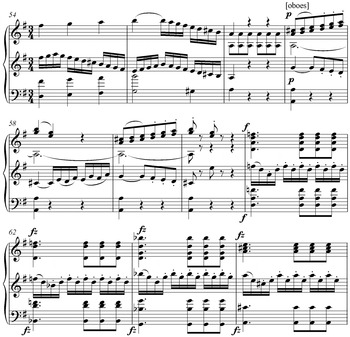
In Symphony No. 92/i there is an early cadence on the dominant in bars 36–39 (see Example 3) and a caesura. Although a dominant is applied to the dominant chord, the music here is ‘on’ rather than ‘in’ the dominant.Footnote 30 Despite the emphatic rhetoric (the repeated chords in bars 36–39) this is not a genuine modulation, but an intensified half cadence in the tonic.Footnote 31 The caesura prolongation phrase follows (bars 41–44), before the start of the main theme returns in the tonic (bar 45). The main theme is not restated in full at this point, but continues as a transition-like section, eventually modulating definitely to the dominant and making a half cadence in that key. Hepokoski and Darcy would call the first nineteen bars of the Allegro spiritoso (bars 21–39) a ‘grand antecedent’ and the music from bar 45 a ‘dissolving consequent’.Footnote 32 Until bar 40 the possibility of a genuine medial caesura is nevertheless still open.Footnote 33 (In general, no modulation is required in the case of an early tonic-half-cadence medial caesura: the subordinate theme may simply begin in the dominant key after the cadence on the tonic's dominant chord.) In this scenario, the hesitant gestures in bars 39 and 40 would constitute what Hepokoski and Darcy call ‘caesura-fill’ before the subordinate theme begins. That possibility is foreclosed by the dominant-seventh chord of bar 41, which alters C♯ back to C♮ and begins the repetition of the caesura prolongation phrase from the opening of the Allegro spiritoso.
Symphony No. 92/i, bars 36–46

The half cadence in the dominant in bars 55–56 (see Example 4) is a stronger candidate for medial caesura. Thereafter, the caesura prolongation phrase enters once again, but its meaning subtly differs from that of bars 41–44: the harmony is the dominant seventh of the dominant, D major, and thus the possibility of a genuine medial caesura is open for the full duration of the four-bar phrase (bars 57–60). Thus the phrase itself functions as potential ‘caesura-fill’. In bar 61 the dramatic entrance of a vigorous D minor tutti (a subordinate theme would have been in D major), with its fast passagework, sequential repetitions and lack of characteristic material, indicates the unambiguous declining of the proposed medial caesura. This passage recaptures the violin semiquavers of the pre-caesura music – the transition section – and continues the four-bar phrase rhythm and the three-quaver accompaniment rhythm of the caesura prolongation phrase. This is a more decisive gesture than the return to the start of the main theme at bar 45, not least because in that case the possibility of a genuine medial caesura was greater and was held open for longer.
Symphony No. 92/i, bars 54–64

At this point in the exposition there are two remaining possibilities regarding medial caesuras, given their ‘limited availability’: either a perfect authentic cadence will be made in the dominant and accepted as a medial caesura by an ensuing subordinate theme or no medial caesura will be made at all. As the foregoing analysis has indicated, the latter occurs. The tutti starting at bar 61 makes a perfect authentic cadence in the dominant in bars 71–72, but it is elided with the start of a codetta. One of the final ironies of this exposition is that, despite the abundance of caesuras and their lengthy prolongation, none is accepted as a ‘true’ medial caesura. The exposition stops and starts, but on Hepokoski and Darcy's theoretical terms must be classified as ‘continuous’.
Hepokoski and Darcy note that many of Haydn's continuous expositions are ‘grounded in gestures toward two-part expositions that are abandoned to pursue other structural paths’.Footnote 34 The rhythmic continuity between the caesura prolongation phrase and the D minor tutti connects the procedure in Symphony No. 92/i with a strategy that Hepokoski and Darcy call an ‘extreme case’ of the ‘bait-and-switch tactic’. A medial caesura is fully articulated before ‘the plug is pulled’ on the two-part exposition:
Such situations involve undermining the caesura-fill that follows the [medial caesura], thus refusing to permit the caesura-fill to rest or anchor itself with an S-theme on its other side. Instead, the fill is reinvigorated into an expanded Fortspinnung or ‘thematic’ modular chain that takes on a life of its own.
This reinvigoration ‘represents a change of mind after the fact’.Footnote 35 Nevertheless, despite the rhythmic continuity between prolongation phrase and tutti, the textural, harmonic and dynamic discontinuities at bars 60–61 distinguish this case from the description of ‘extreme bait-and-switch’, in that the caesura-fill is not so much ‘undermined’ as halted and swept aside. Moreover, in this continuous exposition ‘the degree toward which the jettisoned two-part proclivities remain perceptible through the continuous musical surface’ is not of primary interest, as the musical surface is clearly divided by caesuras into four parts: a grand antecedent, a dissolving consequent, a reinvigorated transition and a chain of codettas.Footnote 36
An understanding of the medial-caesura strategies in this exposition enables us to trace the progressive changes of meaning of the caesura prolongation phrase itself. On its first appearance (bars 21–24) it represents the displacement of the final chord of the introduction into the Allegro spiritoso; on its second (bars 41–44) it echoes that first appearance and draws the music back to the start of the main theme for the consequent to the grand antecedent, blocking the possible interpretation of the preceding bars as caesura-fill and ending the possibility of an early tonic-half-cadence medial caesura; on its third (bars 57–60) it is transposed to the dominant of the dominant and itself functions as potential caesura-fill, holding open the possibility of a dominant-half-cadence medial caesura for four bars. (For a summary, see Table 1.)
The caesura prolongation phrase is nevertheless an unlikely candidate for the third role it is made to play (its harmonic bearing notwithstanding). According to Hepokoski and Darcy, caesura-fill generally contributes to or channels the ‘energy-loss’ that occurs between the end of the vigorous transition and the start of the subordinate theme, the latter usually being soft.Footnote 37 Caesura-fill is often brief: a held note or a snatch of melody in just a single voice.Footnote 38 In Symphony No. 92/i, the repeated As in bassoons and horns in bar 56 are an example of this type. Sometimes, though, the caesura is widened further by ‘expanded caesura-fill’, which occupies ‘a space of nonmotion or relative stasis between the more active [transition] and [the subordinate theme]’. This calls for ‘more crafted material’ so that the listener encounters ‘a particularly elegant shaping of the caesura-moment (similar to the exquisite crafting of a corner of a prized eighteenth-century table)’. Or, as Hepokoski and Darcy also put it, the extended caesura ‘provides an opportunity for careful compositional fashioning, elegant or special effects, wit, or an exquisitely poised attenuation of previously gained energy combined with a psychological preparation for the S-to-come’.Footnote 39 The allusions here to detail, ornament and furniture conjure a semi-domestic, rococo, and perhaps feminine, sphere. This does not capture well the effect of bars 57–60 in Symphony No. 92/i. The admittedly ornamental quality of the counterpoint to the melody in contrary motion (oboes) is undermined by the repetitiveness of the phrase, which minimizes any sense that the passage is ‘highly crafted’. Although the caesura-fill contributes to ‘energy-loss’ in terms of dynamics and scoring, it does not do so in terms of phrase rhythm: in that regard it sustains the energy levels of the preceding tutti. And the now-familiar caesura prolongation phrase is not well understood as a detail to be savoured in isolation, for it possesses abundant contextual significance within the movement. At a local level, the continuing three-quaver accompaniment rhythm is an explicit link to the music immediately before and after the phrase. The phrase itself has appeared earlier, of course, with slightly different functional meanings. Since on both those occasions it was followed by the opening of the main theme, it has become a clear formal marker. At bars 57–60 a listener might reasonably infer that the exposition is, as Hepokoski and Darcy would put it, thematically ‘subrotational’ and has already reached the start of the third sub-rotation.Footnote 40
RECAPITULATION
For the purpose of the present argument, the main significance of the development section lies in the contrast of its construction to that of the exposition. Continuity is uppermost: there are few breaks in the texture, four-bar hypermetre is avoided, phrase extension and elision are common. At the end of the development, rather than a caesura after a cadence on vi or V/vi – the most common options for major-key sonata allegro movements at the time – there is a caesura after a chord of V43/V. The caesura prolongation phrase follows with its familiar harmony of V7, now with a function similar to that of a retransition following a more common caesura harmony.Footnote 41
‘Development’ as a formal function, however – represented by the procedures typically found in development sections – is not limited to the central section of the movement, but is found throughout the recapitulation, not even confined to what Rosen identifies as a ‘secondary development’ section near the beginning.Footnote 42 The techniques can be broadly grouped under Caplin's concept of the ‘loosening’ of the formal organization. Four-bar phrase rhythm is broken up (just as in the development section itself), there is far more chromatic harmony than in the exposition (often signalled clearly with a descending chromatic line in one part), the tonality is locally more unstable, fragmentation of motives is more systematic and there is greater variety and alternation of textures. In contrast to the development section, however, each musical ‘paragraph’ of the recapitulation stays in the tonic overall, and continuity is broken by the frequent caesuras.
The recomposition of this recapitulation is extraordinary even by Haydn's standards. It is by far the longest of the three parts of the Allegro spiritoso (the exposition is fifty-eight bars in length, the development forty-six, the recapitulation one hundred and four).Footnote 43 Apart from the first sixteen bars, which are almost identical to those of the exposition, there is little sense that the recapitulation as a whole moves in parallel with the exposition or that its greater length can be explained in terms of specific expansions or interpolations within the exposition's original plan, as is sometimes the case in Haydn.Footnote 44 After the retransition version of the caesura prolongation phrase, the recapitulation contains five further instances, whereas the exposition had only two. In the recapitulation, all are in the same key (the tonic), and all are on V7 chords, save the last, which is on V43/V. As in the exposition, most do not set up genuine ‘entrances’, though by this stage any expectation that they should is relatively weak. Nevertheless, on the face of it this scheme suggests redundancy. The exposition's three subrotations are answered by five in the recapitulation (see Table 1).
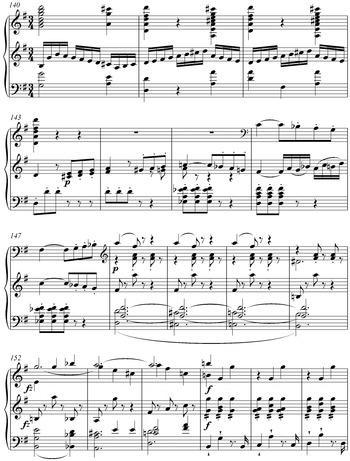
The recapitulation's first internal caesura prolongation phrase, at bars 145–149 (see Example 5), corresponds to that at bars 41–45 of the exposition (see Example 3), recapitulation and exposition being the same to this point. In the recapitulation, however, the phrase undergoes modal mixture, the descending motive of bar 145 acquiring a B♭ from the G minor scale and the V7 harmony alternating with diminished-seventh chords. No second caesura follows, as the phrase is elided with a sequential continuation based melodically on the final rising-tenth motive of the caesura prolongation phrase (bar 148). Fragmentation of motives from the caesura prolongation phrase has not occurred before, and the texture, with its soft dynamics, sustained string chords and increasingly independent part-writing (note the hints of suspension formulae in the woodwind in bars 152–154), is quite unlike anything in the movement to this point. Two further sequences follow (bars 155–158 and 159–165), the first using another version of the rising-tenth motive (now as a sixth), the second using the melody of the first bar of the exposition's codetta in an imitative texture. The combination of intensive fragmentation, contrasts in texture and dynamics, unstable harmony and a series of sequences is of course characteristic of development sections. Although Haydn often draws those techniques into his recapitulations, it is unusual for a characteristic idea first presented in the exposition's subordinate key to be given developmental treatment in a recapitulation before it has been first presented in the tonic in that recapitulation, as happens with the first bar of the codetta in the sequence of bars 159–165. This final sequence is elided with the recapitulation's second internal caesura prolongation phrase (bars 166–169), the phrase thereby losing its original function of prolonging a caesura, though on this occasion – in contrast to bar 148 – a caesura at least follows (bar 169). Again a ‘developmental’ continuation deploys sequence, fragmentation and even hemiola (bars 172–173), using a motive related to the rising tenth, but derived from the wind parts a few bars earlier (bars 167 and 169; compare with the exposition, bars 57 and 59). This phrase is elided with a transformed version of the caesura prolongation phrase (bars 175–179; not shown in Example 5), again without preceding caesura. This is the movement's first tutti statement of material from the caesura prolongation phrase. Its motive is given imitative treatment and thus lasts for five bars rather than four. Again, the texture is new. The end of the phrase is once more elided, this time with music from the development section itself that did not appear in the exposition (bar 180).
Symphony No. 92/i, bars 140–173


At last this passage dissolves into something familiar from the exposition – sequential passagework from the transition – and the recapitulation seems back on track as the transition music ‘drives’ (as Hepokoski and Darcy would have it) to a perfect authentic cadence in G major (bars 187–191), which is elided with a full statement of the exposition's codettas, now in the tonic (as in the exposition, this ‘entrance’ is ironically not preceded by the caesura prolongation phrase).Footnote 45 The form briefly comes into focus: at bar 200 the movement could be about to end if the recapitulation were to follow the final bars of the exposition exactly (though at seventy-three bars it would still be considerably longer). But the motive of the exposition's final codetta (bars 81–82) is fragmented, and the caesura prolongation phrase recurs yet again after a pause, its essential function thus restored. It is now extended by the repetition of the rising-tenth motive, echoing the earlier recapitulation statement after bar 145 and, indirectly, the one after bar 166 too. This passage could be regarded as the start of a coda to the movement as a whole, but only by default, so to speak (on the evidence of the perfect authentic cadence in bars 187–191). The return to distinctive procedures already encountered repeatedly in the recapitulation and nowhere else in the movement suggests that the recapitulation is not over after all, but is about to resume. The formal function of the passage is not distinguished as ‘after-the-end’, but seems merely the start of yet another subrotation.Footnote 46 The extension of the caesura prolongation phrase is not sequential on this occasion, and at bar 211 there is a strong implication that a tonic chord will follow in the next bar. Instead, the harmony turns to E flat major, with a sudden, vigorous tutti corresponding to the D minor tutti of the exposition (bar 61; see Example 4) that functioned as a means of declining the second proposed medial caesura. This section likewise implies an imminent close on a G major chord (bars 218–219), which again proves deceptive. This time the tonic chord is replaced by V43/V, which supports the final statement of the caesura prolongation phrase (bars 220–223), the first (and only) one not to be supported by V7 of the local tonic. The dominant-seventh harmony implied by the applied dominant is supplied instead by detached chords, and the codetta follows for a second time in G major, its first phrase this time stated only once, and the movement is brought to a swift conclusion.
Judged on the terms of a textbook account of the sonata recapitulation, this is a bewildering series of events. It is hard to discern a pattern as there are so many similarities and near-repetitions amongst them, while the overall strategy of the recapitulation is quite different from that of the exposition. An appeal to the ‘sonata principle’ as understood by critics such as Edward T. Cone and Charles Rosen is of little help. Since the recapitulation is so much longer than the exposition, even more unpredictable and in some ways more unstable, it is difficult to argue that it ‘resolves’ the tonal tensions of the exposition (the movement's ‘large-scale dissonance’), that, to use Rosen's formulations, it effects ‘the symmetrical resolution of opposing forces’ or that it records the composer's ‘sense of aesthetic balance’.Footnote 47 In fact, the sonata principle, which, as Hepokoski has shown, is sometimes stated loosely and applied indiscriminately,Footnote 48 is especially problematic in the case of movements with ‘continuous’ expositions. Without a clear division of the exposition into two halves, let alone a subordinate theme to ‘articulate’ that division, it is unclear what material needs to return in the tonic in order to effect ‘symmetrical resolution’. In Haydn's practice of the 1780s and 1790s it seems that the ‘basic idea’ found in the presentation phrase of the exposition's subordinate theme regularly recurs as the basic idea of a theme in the tonic in the recapitulation, but may receive a different continuation (‘theme’ here is used in Caplin's functional sense). The continuation phrase used in the exposition may be moved elsewhere in the recapitulation or omitted entirely. In the Allegro spiritoso, it is difficult to sustain any Rosen-like argument on the grounds of the sonata principle that anything, save perhaps the codettas, ‘must’ return in the tonic in the recapitulation. In particular, there is surely no ‘need’ to bring back the caesura prolongation phrase – which does not function as a basic idea in any presentation phrase – five times in the recapitulation to compensate for only one appearance outside the tonic in the exposition.Footnote 49 Neither is it obvious that the codetta ‘needs’ to be brought back in the tonic for a second time. The recapitulation is surely not an example of ‘symmetry withheld and then finally granted’, as Rosen would have it.Footnote 50 In terms of the sonata principle, it seems characterized rather by redundancy and asymmetry.
The sonata principle might conceivably be invoked to argue that at bar 200, after the perfect authentic cadence of bars 187–191 and the repetition of the exposition's codettas, something is still ‘missing’, since the dramatic D minor tutti of the exposition has not been heard again. It might be said that the recapitulation must therefore be ‘reopened’, as it were, and the theme ‘collected’ and stated in the tonic before the movement can end. Yet even this argument requires a good deal of special pleading. The tutti is not part of the presentation phrase of a theme, and in any case returns not on (let alone in) the tonic, but on an E flat major chord. It is unconvincing to say even that it is, in Cone's words, ‘brought into a closer relation with the tonic’, whatever that somewhat obscure formulation would mean in this case.Footnote 51 Haydn's own practice shows that there is no ‘need’ for a recapitulation to contain this type of material. The exposition of Symphony No. 85/i declines a proposed dominant-half-cadence medial caesura in a manner very similar to that of No. 92/i, with an unexpected, dramatic tutti in the dominant minor (in fact a near quotation of the opening of the ‘Farewell’ Symphony). This material recurs nowhere in the movement.Footnote 52 In Symphony No. 92/i the return of the tutti is a witty and enjoyable effect, but it is not ‘necessary’ and does not ‘explain’ the overall shape of the recapitulation.
These experiments with the sonata principle suggest that we should abandon attempts to explain why the recapitulation is the way it is, and admit that it might have been different.Footnote 53 Instead, we should attempt to describe how it is and how it relates to the rest of the movement. Three points can be made. First, like the exposition, the recapitulation is not primarily ‘about’ syntactically conventional ‘themes’ or what they ‘present’. Secondly, the recapitulation continues the exposition's functional transformations of the caesura prolongation phrase: it does not always serve even to prolong caesuras either before or after it, it can enter on a chord that completes a deceptive harmonic progression and it can be absorbed into broader ‘developmental’ processes and subjected to motivic fragmentation. Finally, the recapitulation adopts some of the development's greater continuity: phrase extension and elision and the general ‘loosening’ of the formal organization. Thus the recapitulation is not so much a setting-to-rights of problems created by the exposition as further, more intensive, exploration of some of the exposition's strategies. Its basic logic is that of surprise: it keeps the listener continually guessing.
HERMENEUTICS
In their chapter on ‘Foundational Considerations’, Hepokoski and Darcy explain how to listen to a late eighteenth-century sonata movement: ‘One should experience any sonata form with a strongly “directed” preparatory set, pressing forward conceptually and anticipating genre-defining events-to-come.’ Furthermore, ‘in performing or listening to any sonata-form exposition one should sense the broad drive of … generic vectors’.Footnote 54 Here they are speaking of the exposition's ‘trajectories’ from its beginning to its first perfect authentic cadence in the subordinate key (the point of ‘essential expositional closure’) and also from the start of the subordinate theme to that same cadence. In the second half of a sonata the main drive is to a perfect authentic cadence in the tonic near the end of the recapitulation, the point of ‘essential structural closure’, which ‘represents the tonal goal of the entire sonata form, the goal and cadential point toward which the trajectory of the whole movement had been driving’.Footnote 55 In their chapter on the recapitulation they reiterate that this is ‘the goal toward which the entire sonata-trajectory has been aimed’ and call it ‘the most significant event within the sonata’. ‘The broad trajectory of the sonata may be understood as an act of tonic-realization, a process of tonic-securing.’Footnote 56 This is the starting-point for the discussion of hermeneutics and ‘human action’ later in the chapter.
From the analysis above, it should be clear that the recapitulation of Symphony No. 92/i conspicuously lacks a sense of overall drive to its first perfect authentic cadence in the tonic on account of its many caesuras, repetitions and sub-rotations both before and after that first cadence. This fact does not in itself make the hermeneutics of Elements of Sonata Theory redundant, for Hepokoski and Darcy might understand this recapitulation as a ‘deformation’: ‘a stretching or distortion of a norm beyond its understood limits; a pointed overriding of a standard option’.Footnote 57 Since every sonata fashions a ‘pathway through pre-established, generically obligatory stations’,Footnote 58 the symphony could be understood as taking a deliberately eccentric path to its cadence, cunningly departing from the ‘built-in teleological drive’ that is essential to all sonatas before finally realizing its perfect authentic cadence in the tonic after all.Footnote 59 And since ‘sonata form can be understood as a metaphor for a generalized action involving different types of idealized mid- and late eighteenth-century personalities’,Footnote 60 a narrative interpretation in the terms of Elements of Sonata Theory might search for a personality distinguished by eccentricity. A person of this type might be absent-minded, obsessed by an idée fixe, clumsy, digressive, reaching a goal only by tumbling into it unexpectedly, before needlessly starting all over again. This is admittedly quite close to certain late eighteenth-century conceptions of the ‘humorist’, a term often applied to Haydn.Footnote 61 Over the eighteenth century, negative views of ‘humour’ based on theories of temperament were replaced, with the help of the cult of sensibility, by more indulgent notions of the natural humorist, unaffected and uncorrupted by society. ‘A man's humor came to be regarded as his human nature: an individual's unique characteristics, even if eccentric, were part of the natural man’, writes Gretchen Wheelock.Footnote 62 If humour is human nature, then the fact of deformation does not in itself prevent an interpretation of the movement as a narrative of human action in late eighteenth-century terms.
But any interpretation along these lines is likely to remain indefinite, as it is unclear exactly what norms are stretched or distorted and how. For late eighteenth-century sonata recapitulations, the background of norms and the hierarchy of defaults that, in Hepokoski and Darcy's theory, are supposed to guide the listener's expectations are much less clearly defined and differentiated than for expositions. That seven chapters of Elements of Sonata Theory are devoted to aspects of the exposition, one to the development and two to the recapitulation betrays the fact that there is simply less to say about the second half of a sonata movement from Hepokoski and Darcy's perspective. Haydn's recapitulations in particular are notoriously unpredictable, and especially so in movements with continuous expositions. The more experienced the listener in the style, then, the more that listener will recognize that under certain circumstances ‘all bets are off’. An experienced listener will be alert not only to the existence of generic norms as such, but also to the changing strength and definition of those norms at different places in a sonata form and in different contexts. In the recapitulation of Symphony No. 92/i the ‘preparatory set’ described by Hepokoski and Darcy and the predictive listening practice that it supports no longer generate precise expectations and clear meanings in the way they did for the exposition. Intertextual ‘paradigms’ are replaced by intratextual ones (the principle of sub-rotation, the caesura prolongation phrase as a sign for the start of a new sub-rotation). Although every work sets its own terms to some degree, of course, this movement draws attention to the process itself, and does so gradually and consistently as it unfolds. In a sense the replacement of one frame of reference by another is the movement's real ‘trajectory’.
At the outset of the Allegro spiritoso the music might be heard as a ‘metaphor for action’ in a narrative sense. But over the course of the movement, as the caesura prolongation phrase is detached from its original function and made to perform other roles, as the question of what counts as ‘thematic’ becomes ever more salient and as the recapitulation grows to outsized dimensions while keeping the listener guessing and failing to ‘tell a story’ coherently, one increasingly hears ‘materials’: things manipulated rather than just given. The movement conspicuously separates formal functions from the particular notes that express them, and shows how a single group of notes can serve as the tokens of several functional types. In other words, it gradually becomes clear that it was not in the nature of certain gestures that they had to serve a particular purpose; they were used for that purpose. Something has done the using, and one could say that this thing – an ingenious human mind – is the missing theme: what the piece is ‘about’.Footnote 63 Thus, despite Hepokoski and Darcy's designation of exposition, development and recapitulation as discrete ‘action spaces’,Footnote 64 the human significance of an unusual recapitulation need not be understood as a non-normative action against a background of normative action. In this recapitulation, the primary mode of signification is indexical: on a good hearing the recapitulation stands as the effect of a human cause.
Whereas one would be hard pressed to find a late eighteenth-century description of a symphony as a narrative of human action, by the 1780s and 1790s references to symphonies – Haydn's above all – as products of a great mind (genius) were commonplace. English reviewers of the symphonies performed at Haydn's London concerts were interested not just in the feelings aroused by the music but specifically in Haydn's ability to manipulate those feelings: the evidence of a genius at work.
Is it not wonderful that to souls capable of being touched by music, HAYDN should be an object of homage, and even of idolatry; for like our own SHAKSPEARE [sic], he moves and governs the passions at his will.Footnote 65
It is a sublime composition – as much from the rich variety of the subject as the grandeur with which it is managed.Footnote 66
And the verbs in the following excerpts (‘shewed’, ‘exhibited’, ‘proved’, ‘exhibited’, ‘bespoke’; all here italicized) reveal contemporary reviewers treating symphonies as indices of genius.
A new Overture, composed for the occasion by Haydn, shewed that the genius of this great master of harmony is yet in full vigour.Footnote 67
Of the instrumental pieces, though all excellent, nothing occurred that could bear any comparison with the new overture of HAYDN, which exhibited all the fire and perfection of his genius.Footnote 68
The new grand Overture of HAYDN was a composition of very extraordinary merit; and proved that his genius, active as it has been, is as vigorous and fertile as ever.Footnote 69
It would be highly improper to pass over the excellence of HAYDN'S new Concerto [Symphony], which exhibited all the fire of his bold imagination.Footnote 70
The first movement of the OVERTURE bespoke the style and fancy of HAYDN in notes, which no other genius ever could so combine.Footnote 71
The examples could be multiplied. Although the genre and readership of the newspaper reports from which these quotations are gleaned admittedly did not facilitate narrative criticism of instrumental music, these excerpts confirm that, for late eighteenth-century listeners, the symphonies were significant as evidence of artistic genius. This genius need not be associated with the representation of dynamic, goal-directed action or, for that matter (under circumstances of deformation), a failure of such action.
To put it another way, the interpretation advanced here reflects an alternative side to the late eighteenth-century concept of the humorist: the artist detached and ironically distanced from the composition. Christian Friedrich Michaelis's well-known explanation of humour (Laune) in music (1807) could apply directly to Symphony No. 92/i:
Music is humorous if the composition betrays more the disposition [Laune] of the composer than the strict application of an artistic system. The musical ideas are extremely peculiar and unusual; they do not follow one another in the manner one might expect, say, on the basis of certain conventions or according to the natural progressions of harmony or modulation. Instead, these ideas surprise us through turns of phrase and transitions that are entirely unexpected, or by wholly new and unusually juxtaposed figures. … The humorous composer distinguishes himself by means of unusual ideas that cause one to smile; he sets himself above and beyond the ordinary.Footnote 72
As Mark Evan Bonds points out, ‘the formulation here is significant: humor “betrays” (verräth) the presence of the composer within the work’.Footnote 73 This is yet another verb that treats music as an index of the human.
It is my contention that, despite two centuries and a cultural gulf, the new Formenlehre enables us to formulate more precisely and insightfully than before the ‘conventions’, the ‘natural progressions’ and ‘the ordinary’ to which Michaelis alludes, the form that the ‘peculiar’ and the ‘unusual’ take in Haydn and the meaning of the ‘surprises’ he springs. Furthermore, the theories can help us to grasp how the music might be thought to be ‘betraying’, ‘showing’ or ‘exhibiting’ something about ‘humanity’ conceived in late eighteenth-century terms. In order to reach this point, however, I have sought to modify the terms on which the Formenlehren – particularly Elements of Sonata Theory – present themselves. The approach taken here requires willingness to switch between theories as occasion seems to demand; scepticism concerning the strict separation of analysis and hermeneutics and stipulation of the order in which they must be executed; openness to the possibility that sonata movements may refer to the ‘human’ by means other than narration; and acceptance of the limitations of analysis in terms of generic norms and deformations. In short (despite the impression given by my subheadings, perhaps), I have aimed to show that technical analysis and historically informed interpretation should proceed in tandem, the latter tacitly informing the questions posed and answered by the former.