


INTRODUCTION
Within political organizations, strong disagreements about how to achieve shared goals are common. For example, Presidents often appoint agency heads with very different beliefs about how to achieve agency goals than career bureaucrats (Heclo Reference Heclo1974). Legislators often disagree strongly about the likely efficacy of new programs that are proposed by federal agency heads (Carpenter Reference Carpenter2001, Chap. 4). And party leaders and activists often disagree about the likely political consequences of different tactics, e.g., the recent battles between Speaker Boehner and the Tea Party caucus over a government shutdown (Draper Reference Draper2014).
Despite the frequency of “belief conflicts,” their consequences have received little attention in the literatures on political agency and bureaucratic politics. The typical model considers an agent who has both different goals and superior information than his principal, and analyzes how he can exploit his information to achieve his goals at the principal's expense (Moe Reference Moe, Gibbons and Roberts2013). Such models have produced important insights about when Congress will delegate policymaking to the bureaucracy (Epstein and O’Halloran Reference Epstein and O’Halloran1999; Huber and Shipan Reference Huber and Shipan2002) and how the civil service should be designed (Gailmard and Patty Reference Gailmard and Patty2007). However, they cannot be used to study open belief conflicts because, by construction, any belief conflict cannot be open—if the principal knew the agent's beliefs, she could infer the information that led to them, use it to revise her own beliefs, and eventually eliminate their disagreement.
In this article we develop a principal-agent model of policymaking in a political organization to study belief conflicts. At the heart of our analysis is a simple idea: what makes belief conflicts different from goal conflicts is that beliefs can change systematically with learning, while goals do not. In particular, individuals might be persuaded to revise their beliefs in light of their experiences with actually implementing policies. When strategic political actors anticipate this, it can influence their policy decisions in subtle and surprising ways.
In the model a principal repeatedly chooses policy, but is uncertain about which one will most effectively achieve her goals. Her choices must be implemented by an agent, whose effort increases the chance that an effective policy will succeed, but is wasted on an ineffective policy. As in the existing literature, we assume the agent cannot be directly monitored or controlled by the principal. In contrast to the existing literature, we assume that he shares the principal's goals, and is no better informed about how to achieve them. Instead, he disagrees about which policy is most likely to achieve those goals in the sense of heterogeneous prior beliefs (Morris Reference Morris1995). Because this assumption is an important point of departure from the existing literature, we briefly defer an in-depth discussion of its meaning and import.
The following running example illustrates the idea. Suppose a city is trying to combat a wave of violent crime but city officials disagree about its underlying cause, and thus the best policy response. The mayor (the principal) thinks the main cause is a concentration of violent criminals, and wants to magnify the department's efforts to solve violent crimes and get perpetrators off the streets. The police chief (the agent) thinks that petty crime and general disorder have caused the community to disengage, thereby encouraging all crime, i.e., he believes in “broken windows policing” (Wilson and Kelling Reference Wilson and Kelling1982). He wants to refocus the department's energies on maintaining order by punishing and preventing misdemeanors.
An immediate insight that emerges from the model is that the mayor faces an agency problem with her police chief, even though they have exactly the same goal of reducing crime. The reason is that the police chief disagrees that “more of the same” will do the job. Consequently, he will likely be demoralized, and work with less intensity, if denied the chance to implement a new policy that he believes is more likely to be successful.
How should the principal manage her agent in the face of a belief conflict? In a private firm she could impose her desired policy, but also use tools from classical principal-agent theory, such as closer monitoring, a bonus for a good outcome, and a threat of termination for a bad one. But these tools are often very costly, unavailable, or ineffective in political organizations because of civil service protections and political considerations (Brehm and Gates Reference Brehm and Gates1999; Lewis Reference Lewis2008). Instead, principals must mainly motivate through their policy choices. It turns out, however, that the effect of those choices on the agent depends crucially on whether or not the organization can learn by observing policy outcomes.
When learning is impossible, the principal's policy choices in the face of a belief conflict exhibit a type of “coping” behavior (Wilson Reference Wilson1989). Because neither inputs (the agent's effort) nor outputs (success or failure) can be observed, the principal must make decisions that cope with disagreement without trying to resolve it. In the model, the principal copes by deferring to the agent and selecting his desired policy whenever his beliefs are stronger than her own, reasoning that the agent's greater motivation will outweigh the cost of an inferior policy. Importantly, the principal does not defer because she thinks that the agent's beliefs reflect superior information, as in classical political agency models.
If the principal and agent can observe policy outcomes and learn from them, however, the principal can do more than just cope. She can experiment with policies—try one out, but discard it for an alternative if it fails. She can also try to persuade the agent to agree with her through her policy choices. The model with learning produces three main results.
First, we show that introducing the ability to learn by observing policy outcomes is enough to increase the agent's effort—even if the principal completely ignores those outcomes in her decisions. With learning, the agent values his own effort more because it also makes policy outcomes more informative about the efficacy of the organization's policy. This helps the agent decide how hard to work in the future. To understand this effect, consider two possible approaches the police chief could take if allowed to implement “broken windows policing” ; he could implement the policy haphazardly, or be sure to put in extra time, effort, and manpower. If broken windows fails to produce results in the former case, it might be because it was inadequately implemented. But if it fails in the latter case, this is stronger useful evidence that it is probably not that effective.
Second, we show that experimenting isn’t just good for finding better policies, as in Callander (Reference Callander2011)—it's also better for motivating the agent. The reason is that experimenting ties the organization's future policies to the results of the agent's effort, which motivates him to work harder. If the mayor in the example says, “we’ll try broken windows today, but do something different tomorrow if it doesn’t work,” this raises the stakes over its initial success, and motivates the police chief to work harder to ensure that success. Surprisingly, experimenting better motivates the agent even when it is with the policy he opposes; he never sabotages that policy by withdrawing his effort to ensure failure and a policy change.
Finally, we show that the potential for learning causes the principal to defer more to the agent. This occurs because learning makes it doubly important to motivate the agent: more effort produces both a higher chance of success if the chosen policy is effective, and speeds learning about whether that policy is effective.
In fact, learning makes the agent's effort triply valuable because it also reduces future belief conflicts (Smith and Stam Reference Smith and Stam2004). This insight produces our most striking result: the principal sometimes defers to the agent even when she is already sure that the policy he favors is ineffective. In other words, the mayor might allow the police chief to implement broken windows even expecting it to fail. The reason is that she expects failure despite the chief's high effort to effectively persuade him that his pet policy doesn’t work. This strategy of “deferring to persuade” can’t occur in classical political agency models because the only reason the principal defers is to exploit the agent's superior expertise.
Summarizing, our analysis makes several contributions. First, it begins to identify the differences between conflict over goals and conflict over beliefs in political organizations. Second, it provides new insights about a variety of managerial techniques that have been extensively discussed in both the political science and public administration literatures; we show motivational benefits to measuring performance, encouraging experimentation, and deferring to subordinates. Third, it generates new empirical implications about management patterns in political organizations; after presenting the model we discuss how to test them using data from “performance measurement” initiatives in the U.S. federal bureaucracy. We also discuss how the model can shed further light on how Presidential appointments impact bureaucratic morale and performance (Lewis Reference Lewis2008). Finally, our analysis contributes to a growing literature on policy experimentation in political environments. When concluding we discuss several avenues for future work across political science enabled by the model.
Belief Conflicts and Learning
The interaction between belief conflicts, learning, and policymaking has long been of interest in the public policy literature. Sabatier (Reference Sabatier1988) [building on seminal work by Heclo (Reference Heclo1974)] placed elite “belief systems” about causal effects at the heart of his influential theory about how “advocacy coalitions” generate policy change, arguing that “much of the policy debate can be understood as disputes over the validity of . . . causal theories” (p. 157). This work spawned several decades of research on policy learning and change (Weible, Sabatier, and McQueen Reference Weible, Sabatier and McQueen2009); Hall (1993), for example, studies how high unemployment and stagnating growth in 1970s Britain discredited Keynesian policies among politicians on both sides of the ideological spectrum who were “seeking solutions to Britain's economic problems.”
Only half of these ideas, however, have thus far been incorporated into formal political science. Callander (Reference Callander2011) and Callander and Hummel (Reference Callander and Hummel2014) study learning about the spatial location of policies through experimentation, either by a single actor or two competing actors. Volden, Ting, and Carpenter (Reference Volden, Ting and Carpenter2008) analyze how a group of actors with different ideologies—such as states or municipalities—learn about the quality of policies through experimentation. Neither considers how conflicting beliefs affect this process.
This gap in the literature is rooted in the methodological traditions of both political science and economics. In political science, conflicts are customarily thought to result from different economic interests (Bartels Reference Bartels2008) or political ideologies (Abramowitz and Saunders Reference Abramowitz and Saunders2008). In economics and formal political science, there are many models with differences in beliefs, but they are nearly always modeled as arising from differences in information. This is referred to as the common priors assumption, because individuals are assumed to “begin the game” in some hypothetical prior condition in which they share common beliefs about all the relevant uncertainty in the world. Each then receives some “private information,” known only to themselves, that causes those beliefs to diverge (Morris Reference Morris1995). While there are many arguments in the literature both for and against the common priors assumption,Footnote 1 the key practical limitation of such models is that they cannot be easily used to study open belief conflicts. The reason is that knowledge of a belief conflict in a fully rational model with common priors causes individuals to infer each other's information, revise their own beliefs in light of that information, and eventually come to agreement.Footnote 2
Rather than discard rationality and introduce a host of additional complications, in this article we study belief conflicts simply and transparently by discarding the common priors assumption. That is, we assume outright that the principal and the agent disagree because they have heterogeneous prior beliefs about which policy is most likely to be effective for achieving their goals. They are fully aware of each others’ beliefs,Footnote 3 and do not infer anything from just the fact that those beliefs differ. While this approach is unorthodox, it nevertheless has a long history in formal modeling, beginning with Arrow (Reference Arrow1964) and continuing through to the present (Minozzi Reference Minozzi2013; Van den Steen Reference Van den Steen2010b).
As in the present study, a growing subset of this literature studies how belief conflicts interact with learning (Che and Kartik Reference Che and Kartik2009; Smith and Stam Reference Smith and Stam2004; Van den Steen Reference Van den Steen2010a ; Yildiz Reference Yildiz2004). An important common insight is that individuals with belief conflicts think they can persuade each other by taking actions that will produce more information, each expecting it to prove that they were right. An example is Smith and Stam's (Reference Smith and Stam2004) pathbreaking study of bargaining and fighting between two states that disagree about their relative strength. Because “the act of waging war reveals information about the relative strengths of each side,” the two parties “fight to resolve their difference of opinions” about who is stronger (p. 783). They continue to fight until enough information has been revealed, and “each side's beliefs converge sufficiently, that they can agree to a settlement” (p. 787).
Public Administration and Bureaucratic Politics
While our model is general to many types of political organizations, an important application is to the study of bureaucracy.
Our assumption that the agent shares the principal's goals is supported by a vast literature in bureaucratic politics and public administration that studies the intrinsic motivation of bureaucrats to carry out their tasks (Brehm and Gates Reference Brehm and Gates1999). Many sources for this motivation have been documented. The agent may like to serve the public good, and think that achieving the principals's goals would do so; this “public service motivation” (PSM) has been studied extensively in public administration (Perry and Hondeghem Reference Perry and Hondeghem2008). The agent may have been actively socialized to share those goals, as is common in “mission driven organizations” (DiIulio Reference DiIulio1987; Goodsell Reference Goodsell2011; Kaufman Reference Kaufman1967), or he may view his “role” as serving his political superiors (Golden Reference Golden2000; Wilson Reference Wilson1989). Theory and data also support the proposition that intrinsically motivated individuals will sort into public organizations (Besley and Ghatak Reference Besley and Ghatak2006; Perry, Hondeghem, and Wise Reference Perry, Hondeghem and Wise2010), and once hired, be assigned to carry out tasks they care about (Brehm and Gates Reference Brehm and Gates1999; Prendergast Reference Prendergast2008).
Two key takeaways from the literature on intrinsic motivation are that it matters in explaining how hard bureaucrats work (Perry, Hondeghem, and Wise Reference Perry, Hondeghem and Wise2010), and that direct mechanisms of control such as monitoring, rewards, and sanctions, matter much less; either because they are unavailable (Lewis Reference Lewis2008), or ineffective (Brehm and Gates Reference Brehm and Gates1999; Durant et al. Reference Durant, Kramer, Perry, Mesch and Paarlberg2006). We contribute to this literature by separating the agent's motivation to achieve the principal's goals from his potentially differing beliefs about how to do so (Boardman and Sundquist Reference Boardman and Sundquist2008). Such disagreements are well documented by case studies of federal management and surveys of political elites (Golden Reference Golden2000; Heclo Reference Heclo1977; Sabatier and Hunter Reference Sabatier and Hunter1989). This separation immediately yields an underappreciated insight: intrinsic motivation alone doesn’t solve agency problems, because it does a principal little good to have an agent who shares her goals but disagrees strongly about how to achieve them. We can then derive new results about how an intrinsically motivated agent is influenced by his environment—specifically, the presence of performance information about policy outcomes (Moynihan Reference Moynihan2008) and the propensity of managers and political principals to experiment and defer.
Given the need to explore our new assumptions about belief conflicts, we do not directly consider how external political factors (such as elections or separation of powers) create or influence those conflicts. Nevertheless, our study is motivated by the broader perspective that “to understand issues of control and oversight over an organization . . .one must understand issues of compliance within an organization” (Brehm and Gates Reference Brehm and Gates1999, 2). This perspective is shared by many recent works in bureaucratic politics; Gailmard and Patty (Reference Gailmard and Patty2007) and Lewis (Reference Lewis2008) both study how decisions by the politicians affect bureaucratic performance, while Huber and McCarty (Reference Huber and McCarty2004) consider the reverse. While we mostly analyze a single principal and agent, we also begin to move toward this larger goal by considering a variant in which the principal is appointed by another player, and discuss how it sheds light on the impact of Presidential appointments on bureaucratic performance (Lewis Reference Lewis2008).
MODEL
The model is a game of repeated policy choice and implementation played between a principal and an agent. They seek to achieve a shared organizational goal in each of two periods t ∈ {1, 2}. For simplicity, we assume that the outcome in each period yt is either success (yt = 1) or failure (yt = 0).
Player 1 is the principal; in each period she publicly chooses a course of action or policy
xt
from the set X = {a, b}. This can be thought of as her choice about how the organization will pursue a goal. Player 2 is the agent; in each period he implements the principal's policy with unobservable effort et
∈ [0, 1]. (As in Bueno De Mesquita and Stephenson (Reference Bueno De Mesquita and Stephenson2007), the agent chooses how much effort to put into implementing the policy, rather than the policy itself.) Effort is costly for the agent, and this cost takes the form
 $- \frac{( e^{t}) ^{2}}{2\lambda},$
where λ is bounded between
 $\underline{\lambda}$
and
 $\bar{\lambda}$
.Footnote
4
The value of λ determines the agent's willingness to expend costly effort to achieve the organization's goals and thus captures the strength of his intrinsic motivation.
For simplicity we assume that the players place equal weight on payoffs in each period. The players’ two-period payoffs are thus as follows:
 $$\begin{equation*}
\begin{array}{clc}y^{1}+y^{2}\text{} & & \left( y^{1}-\frac{\left( e^{1}\right) ^{2}}{2\lambda}\right) +\left( y^{2}-\frac{\left( e^{2}\right) ^{2}}{2\lambda} \right) \\[15pt]
\text{(Principal)} & & {\text{(Agent)}} \end{array}
\end{equation*}$$
These assumptions best capture environments where goals must be achieved repeatedly over time, such as minimizing the level of a pollutant or reducing crime. However, our insights about how disagreement and learning affect policy choices clearly extend to settings where the future is more important than the present, such as a trial or pilot project.
How Successes Occur
Intuitively, the success or failure of a policy depends both on whether it is fundamentally well suited to achieve the intended goal, and on how well it is implemented. To capture these intuitions, we assume that nature initially draws a state ω = {a, b} determining which of the two policies is the correct one to achieve the goal. In both periods, the probability that the correct policy (xt
= ω) succeeds is equal to the agent's effort et
, while the incorrect policy
 $( x^{t}\not=\omega )$
always fails. Thus, more effort produces a higher chance of success, but only when exerted on the correct policy. Our assumptions are standard in the economics literature on learning through experimentation (Bergemann and Hege Reference Bergemann and Hege2005; Keller, Rady, and Cripps Reference Keller, Rady and Cripps2005); their main property is that choosing well and exerting effort are complementary to achieving success, i.e., both are necessary inputs.
A policy problem that might take this form is identifying the root cause of severe smog in a municipality; city bureaucrats could be uncertain about whether the smog is predominantly caused by emissions from refineries or emissions from automobiles. To improve air quality they must both correctly identify the root cause, and expend effort effectively regulating it.Footnote 5
Modeling Disagreement
To model disagreement we assume that the players have heterogeneous prior beliefs about the probability distribution over ω. Specifically, each player i has their own prior θ
i
that ω = a, i.e., that a is the correct policy, and by implication their own prior 1 − θ
i
that ω = b. The principal initially believes that a is more likely to be correct
 $( \theta _{1}\ge \frac{1}{2} )$
, while the agent believes that b is more likely to be correct
 $ ( \theta _{2}\le \frac{1}{2}\iff 1-\theta _{2}>\frac{1}{2})$
. They know each others’ prior beliefs (in the sense of common knowledge) and fully understand the nature of their disagreement. In the smog example, the principal could be a city manager who believes that existing evidence points to refineries as the root cause, while the agent is a city bureaucrat charged with implementing the policy who believes that automobiles are the more likely cause.
Observing Outcomes
We solve and compare two variants of the model. In the first variant policy outcomes are never observed, and disagreement persists unchanged throughout the game. We call this the No Learning Benchmark because it captures policymaking environments where outcomes cannot be reliably measured, and/or circumstances are changing too rapidly, for learning to occur. The second variant is the Game with Learning. In it, both players observe whether the first-period policy succeeded or failed (i.e., the value of y 1) prior to making their decisions in the second period. This allows them to learn from the initial outcome before making their subsequent policy decisions.
COPING WITH DISAGREEMENT
We first solve the No Learning Benchmark, in which policy outcomes can’t be observed. Since choices and outcomes in the first period have no effect on beliefs in the second, the principal must choose policies that cope with disagreement without trying to resolve it.
Each period is identical and so can be solved in isolation. We first consider the agent's choices. For the organization to succeed the agent must exert high effort, but that effort only “makes a difference” if the principal has chosen the correct policy. Formally, the agent's expected payoff to exerting effort et to implement policy xt = a is equal to θ2 et − (et )2/2λ, where θ2 is his subjective prior belief that a is the correct policy.Footnote 6 (The expression is identical for xt = b, but substituting in the agent's belief 1 − θ2 that b is the correct policy.) His optimal responses to the principal's policy choices are thus as follows.
Observation 1 The agent's effort e*(xt ) and utility U*2(xt ) for each policy xt ∈ {a, b} are
 $$\begin{eqnarray*}
e^{\ast}\left( x^{t}\right) &=&\left\lbrace \begin{array}{l@{}l}
\lambda \theta _{2} & \text{if}\, x^{t}=a \\[6pt]
\lambda \left( 1-\theta _{2}\right) & \text{if}\, x^{t}=b \end{array}\right. \,\,\,
\begin{array}{l||}\\
\\
\end{array}\\
U_{2}^{\ast}\left( x^{t}\right) &=&\left\lbrace \begin{array}{l@{}l}\frac{\lambda}{2}\left( \theta _{2}\right) ^{2} & {\rm if}\ x^{t}=a \\[6pt]
\frac{\lambda}{2}\left( 1-\theta _{2}\right) ^{2} & {\rm if}\ x^{t}=b \end{array}\right.
\end{eqnarray*}$$
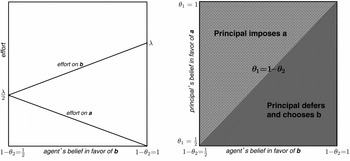
The left panel of Figure 1 depicts how much effort the agent would exert on each policy as a function of his beliefs. On all figures, the x axis illustrates the strength of the agent's belief 1 − θ2 that his desired policy b is correct; moving right along the x axis causes the agent's beliefs to diverge from those of the principal, and θ2 to decrease.
The No Learning Benchmark

Figure 1 illustrates that the agent sharing the principal's goals is not enough to ensure that he works hard to achieve them (Brehm and Gates Reference Brehm and Gates1999). While higher intrinsic motivation λ does induce more effort in our model (Besley and Ghatak Reference Besley and Ghatak2006), high effort also requires that the agent believe the principal chose correctly. The reason is that he has no interest in wasting his effort on an ineffective policy.
The agent's disagreement about the right policy thus creates a managerial dilemma. If the principal imposes the policy she believes in (a), the agent will be less motivated, thinking his effort would be wasted. If she instead defers to the agent by choosing the policy he believes in (b), then this will better motivate him—but from the principal's perspective, there are better than even odds that this extra motivation is useless. Either resolution entails a cost, either in terms of choosing well or in terms of motivating the agent (Van den Steen Reference Van den Steen2009).
The following observation characterizes how the principal copes with this disagreement.
Observation 2 In the unique equilibrium of the No Learning Benchmark, the principal defers to the agent and chooses policy x* = b in both periods if and only if the agent's belief that b is correct is stronger than her own belief that a is correct, i.e., 1 − θ2 ⩾ θ1. Otherwise, she imposes policy x* = a in each period.
The right panel of Figure 1 shows the principal's policy choice x* as a function of the players’ beliefs. The y axis illustrates the strength of the principal's belief θ1 that her desired policy a is correct; moving up along it causes the principal's beliefs to diverge from the agent's.
The principal thus defers to the agent whenever the agent's belief in favor of policy b is sufficiently strong. But the rationale is very different than in classic political agency models, in which deference is used to exploit the agent's superior expertise and improves policy outcomes despite his differing preferences (Moe Reference Moe, Gibbons and Roberts2013). In our model, the agent has the same preferences as the principal but differing beliefs, and the principal does not ascribe the difference to superior expertise. She defers simply because she has no other good option. She needs the agent to work, can’t force him to do so, and concludes that more effort on an inferior policy is a better bet than less effort on a superior policy. Disagreement and deference are thus pure cost, in that the principal would prefer if she could just choose a, and the agent agreed that it was right (i.e., θ1 · 1 > max {θ1θ2, (1 − θ1)(1 − θ2)} for all θ2).
THE GAME WITH LEARNING
We now consider the Game with Learning, in which the actors can observe and learn from policy outcomes. We first analyze how this learning will occur.
Learning by Doing
When the players can observe whether the initial policy succeeded or failed before making decisions in the second period, they will update their beliefs about which policy is the right one using Bayes’ rule. But exactly how this updating will occur depends crucially on how hard the agent worked; failure is a more informative signal that the initial policy was incorrect if it was implemented with high effort. To see this intuitively, recall the pollution example. Suppose that regulations are imposed on refineries, but the effects on smog are minimal. This failure provides indirect evidence that automobiles are actually the root cause, but that indirect evidence is stronger if the bureaucrat vigorously enforced regulations on refineries than if he weakly enforced them.
To see this mathematically, suppose the principal initially chooses policy x
1 = a, and the agent implements it with effort e
1. If a succeeds (y
1 = 1), then updating beliefs is simple. Since only the correct policy can succeed under our assumptions, both the principal and the agent agree after success that a is definitely the correct policy. If a fails, however, it could either be because it was incorrect, or because it was inadequately implemented. Each player i then computes a posterior belief that a failed despite being correct equal to
 $ h( e^{1},\theta _{i}) =\frac{\theta _{i}( 1-e^{1})}{\theta _{i}( 1-e^{1}) +( 1-\theta _{i})}<\theta _{i}$
. This is player i's prior assessment θ
i
(1 − e
1) of the probability a was correct but still failed, divided by the unconditional probability of failure. This posterior is lower than the prior θ
i
, so failure is always a negative signal. However, how much lower depends on how much effort e
1 the agent put in: the harder he worked, the more both players ascribe failure to the policy being incorrect rather than poorly implemented.
Principal's Strategies
When policy outcome can be observed, the strategies available to the principal also become more complicated, because she can base the second-period policy on the first-period outcome. In theory this allows for even pathological strategies such as switching from the initial policy only if it succeeds. However, it turns out that such strategies will never be used in equilibrium; the reason is that success persuades both players that the initial policy was correct. We can thus restrict attention to two types of strategies: ones where the principal rigidly implements the same policy in both periods regardless of the outcome, and ones where she experiments with the initial policy, i.e., sticks with the policy if it succeeds, but abandons the policy if it fails.Footnote 7
Observation 3 A pure strategy for the principal in the Game with Learning consists of a first-period policy x 1, and a second-period policy x 2(x 1, y 1) for each first-period policy x 1 and outcome y 1. In a pure strategy equilibrium, on each possible policy x 1 the principal either
-
• rigidly implements x 1, i.e., chooses it in both periods regardless of the first-period outcome (x 2(x 1, y 1 = 1) = x 2(x 1, y 1 = 0) = x 1).
-
• experiments with x 1, i.e., chooses it again in the second period if it succeeds (x 2(x 1, y 1 = 1) = x 1) but switches to the alternative if it fails
 $( x^{2}( x^{1},y^{1}=0) \not=x^{1})$
.

Note that the principal can’t directly base her decision to experiment on how hard the agent worked because his effort is unobservable. Instead, in equilibrium the principal's strategy must be optimal given her equilibrium belief about how hard the agent worked.Footnote 8
LEARNING, EXPERIMENTATION, AND DEFERENCE
We now present results from the Game with Learning, focusing on three questions. First, how does the presence of “performance information” —that is, the ability to observe policy outcomes—directly affect the agent's incentives? Second, how does the agent respond when the principal also uses that information in her decisions by experimenting with policies? Finally, when will the principal defer to the agent, and why? To clarify the exposition, mathematical details are relegated to a main Appendix (in-print) and a supplemental Online Appendix. The main Appendix contains proofs of Propositions 1 and 2, while the Online Appendix contains the general equilibrium characterization and remaining proofs.
Learning
A principal who rigidly implements policies ignores performance information in her decisions. Thus, by comparing the agent's effort in this case to his effort in the No Learning Benchmark, we can isolate how that information directly affects the agent. The reason there is any effect at all is twofold. First, the agent would like to learn whether the initial policy was incorrect in order to avoid wasting his costly effort in the future. Second, he can influence that learning through his initial choice of implementation effort. To see how the agent will choose that effort we analyze his optimization problem, working backwards.
Suppose the principal's strategy is to rigidly implement policy a (i.e., x 1 = a, x 2(a, 1) = x 2(a, 0) = a).Footnote 9 Then the agent anticipates that his future effort on a will be based on his posterior belief that a was correct after observing its outcome, i.e., e 2 = λh(θ2, e 1). His two-period expected utility as a function of his first-period effort e 1 is then
 $$\begin{eqnarray}
&&-\frac{\left( e^{1}\right) ^{2}}{2\lambda}+\theta _{2}\left[ e^{1}\left( 1+ \frac{\lambda}{2}\right) \right.\nonumber\\
&&\left.+\left( 1-e^{1}\right) \left( \lambda h\left( e^{1},\theta _{2}\right) -\frac{\lambda h^{2}\left( e^{1},\theta _{2}\right)}{2}\right) \right]\nonumber\\
&& +\,\left( 1-\theta _{2}\right) \left( -\frac{\lambda h^{2}\left( e^{1},\theta _{2}\right)}{2}\right).
\end{eqnarray}$$
The first term is his first-period cost of effort. The second term is his two-period expected utility if a is correct, which he thinks is true with probability θ2. With probability e
1 policy a succeeds, he gets 1 in the first period, the principal sticks with a, and he gets
 $\frac{\lambda}{2}$
in the second period. With probability 1 − e
1, a fails despite being correct, he mistakenly revises his posterior belief downward to h(e
1, θ2), the principal sticks with a, and he gets
 $\lambda h( e^{1},\theta _{2}) -\frac{\lambda h^{2}( e^{1},\theta _{2})}{2}$
in the second period. The third and final term is his two-period expected utility if a is incorrect, which he thinks is true with probability 1 − θ2; a will fail for sure in the first period, the principal will stay with it, it will again fail for sure in the second period, and he pays the cost of his wasted effort λh(e
1, θ2).
Equation (1) is complicated, but a little algebraic manipulation yields a simpler expression:
 $$\begin{equation}
{\underbrace{\left( \theta _{2}e^{1}- \frac{\left( e^{1}\right) ^{2}}{2\lambda}\right)}_{\text{first-period payoff}}}+{\underbrace{\frac{\lambda}{2}\theta _{2}\left[ e^{1}+\left( 1-e^{1}\right) h\left( e^{1},\theta _{2}\right) \right]}_{\text{second-period payoff}}}.\end{equation}$$
The first term is the agent's first-period expected payoff as a function of his initial effort e 1, and is identical to his per-period payoff in the No Learning Benchmark. The second term is his expected future payoff as a function of his initial effort. The key insight is that this term is increasing in effort e 1. The reason is that more initial effort makes the first-period policy outcome more informative, resulting in more learning. This benefits the agent in the second period by allowing him to better calibrate his effort, i.e., to work hard if the policy is the correct one and avoid wasting effort if it is not. Formally, e 1 + (1 − e 1)h(e 1, θ2) is the agent's expected posterior belief that a is correct when it is actually correct. This expression captures how accurate the agent's future beliefs will be after observing the initial outcome.
The presence of a “learning premium” to first-period effort in the Game with Learning produces the following result, which is proved in the main Appendix.
Proposition 1 When the principal rigidly implements some policy x ∈ {a, b}, observing outcomes strictly increases both the agent's first-period effort, and the probability of success in both periods, relative to the No Learning Benchmark.
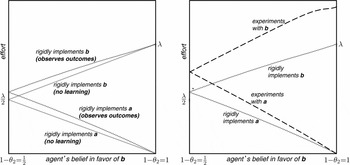
The left panel of Figure 2 illustrates how introducing the ability to observe outcomes and learn from them better motivates the agent in the first period.
Effect of Observing Outcomes and Experimenting on the Agent's Effort

Discussion
One of the most important developments in public management over the last several decades has been the push for performance information by governments across the globe. Reform proponents have drawn on the simple logic of classical principal-agent theory in economics: if we “better assess what government does and how well it does it . . . it will be easier to hold public administrators accountable for their performance” (Kettl Reference Kettl2005).
Research in bureaucracy and public administration, however, provides little evidence that performance information can be effectively used this way. Public managers lack the freedom to promote accountability with high-powered incentives, and politicians seem to choose not to (Pollitt Reference Pollitt2006). Bureaucrats appear to respond mainly to intrinsic rewards, which can be “crowded out” by extrinsic ones (Georgellis, Iossa, and Tabvuma Reference Georgellis, Iossa and Tabvuma2011). And manipulating extrinsic rewards generates many unintended consequences. Bureaucrats inefficiently reallocate effort from unmeasured goals to measured ones (Bevan and Hood Reference Bevan and Hood2006)—termed the “multi-task problem” in principal-agent theory (Holmstrom and Milgrom Reference Holmstrom and Milgrom1991)—and manipulate the performance information itself (Heinrich Reference Heinrich2007; Milgrom and Roberts Reference Milgrom and Roberts1988).
Our model captures the more empirically supported idea that “the most likely users [of performance measures] appear to be the agents themselves” (Moynihan, Pandey, and Wright Reference Moynihan, Pandey and Wright2012). In our model, an intrinsically motivated agent uses what he learns from outcomes to allocate effort more efficiently, by working harder when he learns that the policy is likely to be effective, and working less when he learns that it is not. The principal thus benefits from the information even when she ignores it in her own decisionmaking; the agent's greater efficiency increases the chance of success in both periods relative to the No Learning Benchmark.
In capturing this rationale for performance information, the model also generates a new and empirically testable implication—that introducing such information better motivates the agent. The reason is that the harder the agent works to implement a policy, the more its outcome reflects its underlying quality, and the more the agent learns from observing it. Ergo, the more valuable is his effort, and the more effort he puts in.
Experimentation
A principal who experiments with policies is one whose decisions are directly informed by policy outcomes—she sticks with the initial policy if it succeeds, but abandons it for the alternative if it fails. The information contained in policy outcomes therefore directly aids her “search” for the best policy (Callander Reference Callander2011).
Experimentation, however, also has a more subtle and previously overlooked property: it indirectly empowers the agent to influence the principal's policy choices. The reason is that by working hard he can increase the chance of a success, and therefore the chance that the principal will stick with the initial policy. Alternatively, by withdrawing his effort from the initial policy he can “sabotage” it—that is, intentionally increase its chance of failure—which will cause the principal to abandon it (Brehm and Gates Reference Brehm and Gates1999).Footnote 10
How will the agent respond when the principal experiments with a policy, rather than rigidly implements it? Suppose the principal experiments with policy a (i.e., x 1 = a, x 2(a, 1) = a and x 2(a, 0) = b). Analyzing the agent's two-period expected utility as a function of his first-period effort e 1 yields an expression that is analogous to Equation (2) (details are in the main Appendix):
 $$\begin{eqnarray}
&&{\underbrace{\left( -\frac{\left( e^{1}\right) ^{2}}{2\lambda}+\theta _{2}e^{1}\right)}_{\text{first-period payoff}}}\nonumber\\
&&\quad+\,{\underbrace{{\underbrace{\frac{\lambda}{2}\left( 1-\theta _{2}\right) \left[ 1-h\left( e^{1},\theta _{2}\right) \right]}_{\text{learning term}}}+{\underbrace{\frac{\lambda}{2}\theta _{2}e^{1}}_{\text{policy influence term}}}}_{\text{second-period payoff}}}. \nonumber\\
\end{eqnarray}$$
As in Equation (2), the expression is divided into first- and second-period terms, and the first-period terms are identical. But because the principal experiments, the second-period term has two subterms: a learning term that represents how the agent's initial effort affects his future utility directly through his own learning, and a policy influence term that represents how his initial effort affects his future utility indirectly through the principal's policy choices.
The learning term has properties that are similar to the agent's expected second-period utility when the principal rigidly implements a.Footnote
11
The policy influence term
 $\frac{\lambda}{2}\theta _{2}e^{1}$
, however, only appears when the principal experiments. The key insight is that this term is always increasing in effort. Intuitively, this means that from the agent's perspective, working harder initially always has a beneficial effect on the principal's future choices. Experimenting thus incentivizes the agent to work harder initially than does rigid implementation. This result is perhaps not so surprising for the policy that the agent initially believes in (b), since failure will cause a switch to the policy he opposes (a). But it also holds for the policy he opposes (a), even though simply withdrawing his effort would induce certain failure and a switch to the policy he believes in (b). We state the formal result in the following proposition.
Proposition 2 For any initial beliefs of the agent, the principal elicits more first-period effort by experimenting with either policy x 1 ∈ {a, b} than by rigidly implementing it.
The right panel of Figure 2 illustrates the effect by comparing the agent's first-period effort on each policy when the principal experiments with it vs. rigidly implements it.
Preferences versus Beliefs
Why does experimenting better motivate the agent, even when it is with a policy he opposes? To clarify, it is helpful to contrast with a version of the model where the agent's opposition to policy a is rooted in preferences rather than beliefs.Footnote 12
Suppose the agent agreed about the probability θ1 that a was the best policy to achieve the principal's goals but simply had his own different goals; specifically, his own intrinsic values π a < π b for exerting effort on each policy, with a preference for b. The agent's two-period expected utility for implementing policy x 1 = a would then be
 $$\begin{eqnarray}
&&{\underbrace{\left( -\frac{\left( e^{1}\right) ^{2}}{2\lambda}+\pi _{a}e^{1}\right)}_{\text{first-period payoff}}}\nonumber\\
&& +
\left\lbrace \begin{array}{l@{}l}\frac{\lambda}{2}\pi _{a}^{2} & {\rm if\ principal\ rigid} \\
\frac{\lambda}{2}\pi _{b}^{2}{\underbrace{-\frac{\lambda}{2}\theta _{1}e^{1}\cdot
\left( \pi _{b}^{2}-\pi _{a}^{2}\right)}_{\text{policy influence term}}} & {\rm if\ principal\ experiments} \end{array} \right. . \nonumber\\
\end{eqnarray}$$
As in the baseline model, experimenting introduces a policy influence term into the agent's first-period objective function. But in contrast, that term would actually be decreasing in effort. In other words, if the agent's opposition to policy a were rooted in preferences rather than beliefs, he would sabotage a policy experiment with a by withdrawing some of his effort to increase the chance of failure and a policy change.
This sharp distinction between preferences and beliefs arises because an ineffective policy doesn’t need to be sabotaged to fail; policy change will happen without the agent's help. Rather, sabotage only “works” on an effective policy that could have achieved the principal's goals with enough effort. When the agent shares those goals (as in the baseline model) this means that sabotage would only make a difference exactly when the policy is correct, and the agent wouldn’t want it to switch from it.Footnote
13
When the agent doesn’t share those goals, whether the policy is correct for the principal is irrelevant to him; his net benefit
 $\frac{\lambda}{2}( \pi _{b}^{2}-\pi _{a}^{2})$
from inducing failure and a policy change is always the same.
Discussion
An influential alternative to the “reward-and-sanction” school of performance information argues that such information aids public managers in their search for the most effective policies (Moynihan Reference Moynihan2008; Simon Reference Simon1947). These arguments have been especially influential in the United States: the idea of explicitly treating “policies as experiments” with the intent to “learn from them” dates back at least to Great Society-era social engineering (Campbell Reference Campbell1969), was a key element of the nearly decade-long Clinton administration reform initiative to “reinvent government” (Aberbach Reference Aberbach2000; Osborne Reference Osborne1992), and is now codified in the Interior Department's official “adaptive management” policies for resource management (Lee Reference Lee1993; Office of Environmental Policy and Compliance 2008).
None of these previous discussions, however, consider how experimentation might affect the incentives of agents who are charged with actually implementing policy. This is surprising because nearly any policy must be carried out by lower-level subordinates. Our analysis demonstrates both why there is an effect—because tying future policy choices to previous outcomes lets the agent influence policy choice through his effort—and that the direction of the effect depends crucially on whether conflict is rooted in preferences or beliefs.
An additional implication of our model is that there can be motivational benefits to arrangements that commit principals to experiment with policies, by forcing, encouraging, or selecting them to be responsive to negative policy outcomes. In the Online Appendix, we formally show that such institutions can benefit the principal: this is the case when her belief in favor of the optimal initial policy is too strong to credibly abandon it after failure, but ex ante she would like to “tie her hands” to better motivate the agent.Footnote 14
What might some such arrangements be in practice? A blunt one is to directly legislate trigger mechanisms that make a “pre-negotiated commitment . . . specifying what actions will be taken if monitoring information shows x or y” (Nie and Schultz Reference Nie and Schultz2012). This was recently proposed during policy debates on health careFootnote 15 and national security (Gates Reference Gates2014, 375). A more flexible one is to impose costs on decision makers—not for failure, but for sticking with policies after failure.Footnote 16 The Compstat program developed in New York City for analyzing high-frequency crime data furnishes an example: as originally conceived, the program's central component was a weekly meeting in which “trouble arose” for precinct commanders not when “crime numbers on their watch went up,” but instead when they “didn’t have a plan to address the problem” (Maple Reference Maple1999).
A final possibility is to simply select individuals to make policy decisions whose intrinsic beliefs are more amenable to experimentation. In the Online Appendix we show that a principal with strong beliefs is sometimes better off appointing an individual with weaker beliefs, i.e., a “moderate,” to make policy decisions in her place. Such an individual will be more willing to abandon the initial policy after failure, and thereby better motivate the agent. This insight provides a new perspective on some of the trade-offs facing U.S. Presidents in their attempts to influence federal agencies through appointments (Lewis Reference Lewis2008). In particular, it suggests a novel reason why “stressing loyalty and ideology above all else” (Moe Reference Moe1985, 258) appears to demoralize rank-and-file bureaucrats (Golden Reference Golden2000). Because of their extreme beliefs, such appointees not only select policies the bureaucrats disagree with, but also rigidly implement those policies even after apparent failures. We return to this idea when discussing applications to the U.S. federal bureaucracy.
Deference
Finally, we consider the principal's decision to defer to the agent in the Game with Learning. A principal who defers gives the agent's desired policy b a chance to succeed, despite her own skepticism that it is the right policy. What drives her decision to do so?
In the No Learning Benchmark, the principal defers as a second-best coping strategy given her irresolvable disagreement; when the agent's beliefs are stronger than her own, she calculates that more effort on an inferior policy is a better bet than less effort on a superior policy. In the Game with Learning, however, much more can happen. She could rigidly implement policy a, given the strength of her belief in its favor, or experiment with a, hoping that success will persuade the agent that it is right. Alternatively, she could defer to the agent and rigidly implement b, given the strength of his belief, or experiment with b, hoping that failure will persuade him that it is wrong.
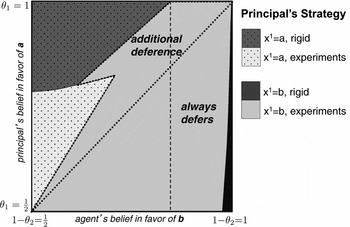
These possibilities result in a complicated set of equilibrium policy choices by the principal. Figure 3 depicts these choices as a function of the players’ initial beliefs.Footnote 17 The fill of each region indicates the principal's first-period policy choice—in the dotted regions the principal imposes x 1 = a, while in the solid regions she defers and chooses x 1 = b. The darkness of the shading indicates whether the principal is responsive to failure—in the darkly shaded regions she rigidly implements the first-period policy, while in the lightly shaded regions she experiments. Despite the complexity of the principal's choices, we can extract two insights about her decision to defer.
Principal's Policy Choices in the Game with Learning

Proposition 3 In the first period of the Game with Learning, the principal defers for a larger set of initial beliefs than in the No Learning Benchmark.Footnote
18
Moreover, when the agent is both sufficiently motivated
 $( \lambda > \hat{\lambda})$
and believes strongly enough in b (1 − θ2 is sufficiently high), the principal always defers and selects policy x
1 = b regardless of her own beliefs.
Compared to the No Learning Benchmark, the principal thus defers more often (i.e., for a larger set of initial beliefs). In addition, when the agent's beliefs are sufficiently strong and he is sufficiently motivated, then the principal always defers even when she is already sure that b is the wrong policy.
Why does the principal defer more in the Game with Learning? As in the No Learning Benchmark, the principal can always elicit more effort from the agent by simply deferring; he will always work harder on policy b because he thinks that his effort is more likely to produce success. In the Game with Learning, however, the agent's effort is more valuable: more effort makes the initial policy outcome more informative, which results in better future decisions by both the principal and the agent. Combining these two effects tilts the scales towards deference.
This explanation, however, presents a puzzle. If the additional deference in the Game with Learning is due to the informational benefits of the agent's effort, why does the principal still defer when she already thinks she knows that a is the right policy? The reason is that the target of that additional information is sometimes the agent himself. The principal sometimes defers to persuade the agent through failure that his beliefs were wrong, so that he will work harder on policy a in the future. This can be an effective way of managing their disagreement because allowing the agent an opportunity to prove that b is the right policy strongly motivates him, and makes failure all the more persuasive when it (from the principal's perspective) inevitably occurs. The alternative—forcing the agent to implement policy a immediately—is less effective because he will exert low effort on a, failure will most likely result, and it will (slightly) reinforce the agent's initial belief that a is wrong.Footnote 19
Discussion
In an extensive formal literature in bureaucratic politics, principals defer, delegate, or give discretion to agents with differing preferences to use their (or encourage them to acquire) superior expertise.Footnote 20 Across multiple models, two implications have emerged as “the cornerstones of the modern field [of public bureaucracy]” (Moe Reference Moe, Gibbons and Roberts2013, 21): the ally principle, which states that deference is less likely the further are the agent's preferences from the principal's, and the uncertainty principle, which states that deference is more likely “the more uncertain and complex [is] the policy area.” Both of these principles, in general, fail to hold in our model.
The failure of the ally principal can be seen in Figure 1 (for the No Learning Benchmark) and Figure 3 (for the Game with Learning). As the agent's beliefs diverge from the principal's because he is increasingly sure that b is right, the principal defers more (i.e., for a larger set of principal beliefs). This occurs because the principal in our model can’t simply walk away from the agent; even if she ignores his beliefs, she still needs him to implement her decisions. This captures an important aspect of real-world policymaking that is assumed away in most classical models: politicians (and their appointees) will always need lower-level subordinates to carry out their policies. As the model clearly shows, it actually matters what these subordinates think even when they lack superior information, because what they think affects how well they do their jobs.
The uncertainty principle actually holds in the No Learning Benchmark; the principal defers for a larger set of agent beliefs when she is less sure that a is right (θ1 closer to
 $\frac{1}{2}$
). However, it fails in the Game with Learning. When the agent's beliefs are sufficiently strong, the principal defers regardless of her own (un)certainty. This crucial difference arises because the principal only defers in the canonical framework to benefit from the agent's information. When she is already certain about which policy is right, she has no reason to defer. But in our model, generating more information can also help the agent learn about which policy is right. This yields a surprising new reason to defer, even when doing so requires choosing (what the principal thinks is) the wrong policy: allowing the agent to implement that policy and watch it fail can more effectively “teach” him to share the principal's beliefs.
In addition to these differences, our model produces a new testable implication that has not been previously considered: introducing effective performance measurement (i.e., moving from the No Learning Benchmark to the Game with Learning) should also increase deference. Our model speaks to the effects of performance information because learning comes from implementing policies and observing outcomes, rather than “drawing a costly signal” about the state, as in most political agency models with endogenous information acquisition (e.g. Gailmard and Patty Reference Gailmard and Patty2007). Suggestively, the combination of performance measurement and deference resembles the core principles of the National Performance Review, a Clinton-administration management initiative that combined performance measurement with the directive that “decision-making power should be decentralized, giving lower-level employees more authority to make decisions” (Aberbach Reference Aberbach2000).
Finally, the benefits of exercising broad deference to subordinates are often extolled by practitioners. NYPD commissioner William Bratton describes a management style in which he “pick[ed] good people,” “turned responsibility back onto the worker,” and “let them do their jobs” (Bratton Reference Bratton1998, 127). But the canonical formal model for studying principal-agent relationships has forced our understanding of these benefits into the narrow confines of asymmetric expertise versus control, and forced out many factors that commanded the attention of early bureaucracy and public administration scholars (and contemporary “informal” organizational theorists): instilling culture, gaining trust, building consensus, and teaching (Heclo Reference Heclo1977; Kaufman Reference Kaufman1967; Reference Kaufman1981). Like most formal models, our contribution to this list is incremental but nevertheless important: a principal sometimes defers to teach, because teaching sometimes requires letting an agent make mistakes.Footnote 21
APPLICATION: THE U.S. FEDERAL BUREAUCRACY
We now apply our model to the U.S. federal bureaucracy. We first discuss how repeated efforts to enhance performance measurement have produced data that could be used to test some of our predictions. We then discuss how both the model and extensions can shed light on Presidential “politicization” and bureaucratic performance.
Performance Measurement in U.S. Government
Since the early 1990s, there have been three major initiatives to enhance performance measurement in federal agencies: the Government Performance and Results Act of 1993 (Long and Franklin Reference Long and Franklin2004), former Vice President Gore's “National Performance Review” (NPR) (Thompson and Riccucci Reference Thompson and Riccucci1998), and the Bush-era Program Assessment Rating Tool (PART) (Lewis Reference Lewis2008). The federal government has collected voluminous survey data tracking the consequences of these reforms. Since 2002 the Office of Personal Management (OPM) has administered frequent surveys of federal employees across agencies and ranks that track key variables in our model: effort, intrinsic motivation, and managerial styles.Footnote 22 The Government Accountability Office (GAO) has also conducted three cross-agency surveys of federal managers since 2003, measuring both whether federal agencies have introduced useful performance data, and whether it is actually used to guide agency decisionmaking.Footnote 23 This survey data can be used to paint a picture across agencies and time about when performance measurement was introduced, and the consequences of doing so for employee effort and managerial practices.
One set of predictions that can be tested is the collection of organizational changes that occur when moving from the No Learning Benchmark to the Game with Learning: effort, experimentation, and deference to subordinates should all increase. This transition can be measured in the data using the perceptions of managers and subordinates as to when effective performance measures were introduced. The second prediction that can be tested is the effect of experimentation on bureaucratic morale: subordinates should be more motivated in agencies where managers use performance data in decisionmaking, i.e., experiment. Some evidence already exists from the Clinton-era NPR reforms, which explicitly combined performance measurement with a directive to “give lower-level employees more authority to make decisions” (Aberbach Reference Aberbach2000). An important component of these reforms was “reinvention labs” in which agencies could receive rule waivers for experimental projects spearheaded by low level bureaucrats. A 1996 GAO study found that these labs had significantly improved agency effort, morale, and performance (U.S. Government Accountability Office 1996).
Presidential Appointments and Bureaucratic Performance
How Presidents choose their appointees to the executive branch has been long debated in the literature. In a provocative essay that set the terms of the debate, Moe (Reference Moe1985) argued that Presidents would inevitably continue politicizing agencies by filling their ranks with loyal and ideologically like-minded appointees, even at the cost of “neutral competence” (Heclo Reference Heclo1977). Recent empirical work has cast doubt on this contention. Lewis (Reference Lewis2008) finds both that the number of political appointees is not secularly increasing, and that the complexity of an agency's tasks reduces politicization. This suggests that Presidents do indeed perceive, and react to, “trade-offs between policy influence and agency performance” (Lewis Reference Lewis2011, 50).
Whether and how such trade-offs also affect the ideology of appointees is less well understood. The appointments extension of the model discussed when analyzing experimentation suggests that Presidents may sometimes prefer appointees with more moderate beliefs than their own, to better motivate rank-and-file bureaucrats. Consistent with this conjecture, Bertelli and Grose (Reference Bertelli and Grose2011) find that Presidents do not actually appoint ideological “clones”; executive department heads are significantly more moderate than their appointing presidents. But many other factors examined in the literature can account for this finding, e.g., the budgetary and advice and consent powers of the Senate (Bertelli and Grose Reference Bertelli and Grose2011; McCarty Reference McCarty2004) and external interest group behavior (Bertelli and Feldmann Reference Bertelli and Feldmann2007; Gailmard and Patty Reference Gailmard and Patty2013).Footnote 24 Here we discuss some suggestive evidence that the sorts of managerial factors captured by our model also play a role, by revisiting a case study examining President Reagan's experience managing the Environmental Protection Agency (EPA) (Golden Reference Golden2000).
President Reagan's first choice to run the EPA was an archetypal appointee of the “administrative presidency” : Anne Gorsuch, a conservative ideologue who “shared the president's environmental policy agenda” and “convictions about the negative impact that environmental regulations had on economic growth” (Golden Reference Golden2000, 120). Unsurprisingly, her tenure was marred by a crisis of morale; careerists reacted like the agent in our model not with “deliberate foot-dragging or sabotage,” but rather a severe waning of “commitment,” “enthusiasm,” and voluntarily effort. Despite Gorsuch's apparent success shifting policy (Wood and Waterman Reference Wood and Waterman1991), she resigned after 22 months amid controversy and Congressional hearings, and was replaced by former EPA head and Nixon appointee William Ruckelshaus. Golden (Reference Golden2000) describes the revolution in agency morale after Ruckelshaus’ return; he was “regarded as a savior” by EPA bureaucrats who “wanted to work for him.” Notably, rather than returning to an aggressive politicization strategy once the crises subsided, President Reagan continued to appoint moderate EPA heads for the remainder of his tenure.
While the episode suggests that internal managerial factors may influence even aggressively ideological Presidents, it remains unclear what about Ruckelshaus better motivated EPA bureaucrats. It was likely not “going native”; Ruckelshaus remained a committed conservative and was opposed by environmental groups. He did, however, have a notably respectful, “open” and “data driven” management style. Interpreted through the lens of the model, what may have been motivating about Ruckelshaus was not his ideological moderation per se, but his less rigid beliefs that allowed him to manage experimentally and responsively (Dobel Reference Dobel and Cooper1992, 251). As would be necessary for our logic to apply, Ruckelshaus was given considerable discretion by the White House, and was “free to set the agency's internal agenda” (Golden Reference Golden2000, 138). Finally, the ostensibly liberal bureaucrats under him faithfully implemented even his conservative policy initiatives like cost-benefit analysis; in their own words, this was because “career staff recognize that we don’t always know the right thing to do,” and that “long-standing agency policy may be wrong” (Golden Reference Golden2000, 143).
More broadly, the idea that “management suffers . . .when government is run by a transient group of strangers” is a perennial concern of public administration scholars (Heclo Reference Heclo1977). But why it suffers, and how that influences political decisions, has received little attention (Lewis Reference Lewis2011, 60). Our model provides a new way of examining this (re)emerging question. One reason performance suffers is that appointees and bureaucrats have different beliefs about how to “get things done.” It can suffer more when appointees impose their will and bureaucrats “go into hiding.” It can recover when they find ways to work together despite their disagreements, by trying to “educate” each other and “bring [each other] along, irrespective of their politics” (Starobin Reference Starobin1995).
Extending the model could therefore help answer many open questions about conditions under which Presidential appointments enhance or degrade agency performance. How does the tenure length of appointees, or their insulation from the executive and legislative branches, enhance or impede the ability and willingness of appointees and bureaucrats to “educate each other” and improve performance? Do the short tenures of political appointees diminish their ability to do so, or actually enhance their incentives to effect an enduring change in bureaucratic beliefs? Do electoral expectations influence Presidents’ decisions to try and make appointments that persuade, rather than control? Answering these open questions would shed further light on Presidential appointment decisions.
CONCLUSION
In the study of bureaucratic relationships, the idea that policymakers are uncertain about how to achieve their goals has long been central. However, the literature has largely focused on only one aspect of this uncertainty—that an agent may have superior information about the consequences of different policies. As argued by Moe (Reference Moe, Gibbons and Roberts2013), this consensus has been “empowering,” but also “constraining”: by pushing the study of bureaucratic politics “away from other avenues that, even if potentially productive, are not compatible with the accepted way of thinking about things,” it has resulted in “a kind of path dependence . . . that makes certain kinds of progress more difficult to achieve.”
In this article, we attempt to break this path dependence by considering a radically different aspect of bureaucratic relationships—that principals and agents might openly disagree about how to achieve shared goals. To explore its implications, we develop two models of policy choice and implementation—one in which policy outcomes cannot be observed, and another in which they can. The progress made in doing so is threefold. First, we find that the ability to observe and learn from policy outcomes improves the efficiency and motivation of agents, even when principals ignore the information in their choices. Second, we find motivational benefits to experimenting, and show that they are specific to disagreements rooted in beliefs rather than preferences. Finally, we show that belief conflicts can produce a sometimes-extraordinary degree of deference driven by the desire to persuade.
Stepping back from the study of bureaucracy, our model illustrates some incentives specific to belief conflicts and learning that are relevant to many additional questions across political science. We give three examples as suggestions for future research.
First, a burgeoning literature studies the organization and decision making of terrorist groups using classical principal-agent models (e.g., Bueno de Mesquita (Reference Bueno de Mesquita2008); Shapiro and Siegel (Reference Shapiro and Siegel2007)). However, for reasons articulated by Shapiro (Reference Shapiro2013), the assumptions of our model are arguably an even better fit in this setting than in public bureaucracies. A perverse sort of intrinsic motivation is necessary to recruit terrorist “agents” for poorly paid and highly dangerous work, and it is risky for leaders to monitor these agents too closely. Direct mechanisms of control like punishment can backfire and result in defections, or even violent reprisals. Most importantly, terrorist organizations are riven by belief conflicts, in particular, about the political consequences of violent versus nonviolent tactics.Footnote 25 Do terrorists choose tactics with an eye toward what the observed political repercussions will “teach” competing factions, difficult-to-control operatives, and potential sympathizers about how to most effectively pursue their aims? Do shifting strategies help motivate rank and file operatives even when they are otherwise counterproductive?
Second, a large literature studies how public opinion constrains the foreign policy decisions of chief executives (Aldrich et al. Reference Aldrich, Gelpi, Feaver, Reifler and Sharp2006). If such constraints on the public's “agent” (Ashworth Reference Ashworth2012) are due to differences in beliefs, then a model like ours may shed light on how chief executives cope with them. For example, it may sometimes be rational for executives to pursue what they believe to be bad policies so failure will persuade the public to agree with them.Footnote 26 Documentary evidence suggests that the Johnson administration's decision to halt bombing and pursue a “peace offensive” during the Vietnam War in 1965 was driven by such motives. Despite little confidence that the peace initiative would succeed, the administration gave it “the old college try.” Their primary motive was to persuade the “73% of the American public eager for a cease-fire” that peace was futile, as well as “Fulbright . . .the New York Times, all these people thinking there could be peace if we were only willing to have peace.” The amount of effort expended on peace was also understood to be a “crucial element” of the persuasiveness of failure: the administration sought to show that “we have explored fully every alternative” and “left no door to peace untried” (Dallek Reference Dallek1996, 152–3).
Finally, pilot experiments to test new programs have become increasingly common and influential with governments, the media, and the public (Rogers-Dillon Reference Rogers-Dillon2004). However, their political uses and consequences have received little attention. A purely technocratic view of pilot experiments would interpret them as sincere efforts to learn about policies’ effectiveness. A purely political view would interpret them as cynical attempts to manipulate the beliefs of other political actors by the policies’ supporters and beneficiaries (Rogers-Dillon Reference Rogers-Dillon2004). Our model suggests that pilot experiments may be understood as a sort of biased and belief-driven political entrepreneurship. By proposing to “experiment with new programs or . . . innovations,” policy-motivated actors with genuinely strong beliefs may be seeking to produce persuasive evidence that “convince[s] diverse coalitions of organized interests . . . of the value of their ideas” (Carpenter Reference Carpenter2001, 30). As Carpenter (Reference Carpenter2001) demonstrates in his influential study of the 19th century U.S. Postal Service, this sort of experimentation-as-entrepreneurship by early agency heads was important in the development of bureaucratic autonomy. A model of pilot experimentation based on belief (and preference) conflicts could generate new insights about how and when such programs are used, and their political role in policymaking and institutional development.
SUPPLEMENTARY MATERIAL
To view supplementary material for this article, please visit http://dx.doi.org/10.1017/S0003055415000568.
APPENDIX
We first derive Equations (2) and (3); for simplicity denote θ for θ2, e for e 1, and h( · ) for h(e, θ). Rearranging the “long form” in Equation (1) when the principal rigidly implements a yields
 $$\begin{eqnarray*}
&&\left( -\frac{e^{2}}{2\lambda}+\theta e\right) +\frac{\lambda}{2}\theta e\\
&&\quad+\, \lambda \left( \theta \left( 1-e\right) h\left( \cdot \right) -\frac{1}{2}\left[ \theta \left( 1-e\right) +\left( 1-\theta \right) \right] h^{2}\left( \cdot \right) \right).
\end{eqnarray*}$$
Now from the definition of h( · ) we have [θ(1 − e) + (1 − θ)]h
2( · ) = θ(1 − e)h( · ); substituting and simplifying yields
 $( -\frac{e^{2}}{2\lambda}+\theta e) +\frac{\lambda}{2}\theta e+\frac{\lambda}{2}\theta ( 1-e) h( \cdot ) ,$
and then Equation (2).
To derive Equation (3), first write the analog to Equation (1) when the principal experiments with rather than rigidly implements a:
 $$\begin{eqnarray*}
&&-\frac{e^{2}}{2\lambda}+\,\ \theta \left[ e\left( 1+\frac{\lambda}{2} \right) +\left( 1-e\right) \left( -\frac{\lambda}{2}\left[ 1-h\left( \cdot \right) \right] ^{2}\right) \right]\\
&&+\left( 1-\theta \right) \left( \lambda \left[ 1-h\left( \cdot \right) \right] -\frac{1}{2}\lambda \left[ 1-h\left( \cdot \right) \right] ^{2}\right) .
\end{eqnarray*}$$
To see this, recall that failure results in a switch to b, and that the agent's posterior belief that b is the best policy after a fails is 1 − h( · ). Rearranging then yields
 $$\begin{eqnarray*}
&&\left( -\frac{e^{2}}{2\lambda}+\theta e\right) +\frac{\lambda}{2}\theta e+\lambda \left( \left( 1-\theta \right) \left[ 1-h\left( \cdot \right) \right] -\frac{1}{2}\left[ \theta \left( 1-e\right) \right.\right.\\
&&\quad\left.\left.+\left( 1-\theta \right) \right] \left[ 1-h\left( \cdot \right) \right] ^{2}\right)
\end{eqnarray*}$$
Similar to above, observe that [θ(1 − e) + (1 − θ)][1 − h( · )]2 = (1 − θ)[1 − h( · )]. Substituting and simplifying then yields Equation (3).
Proof of Propositions 1 and 2
Consider the function U(e, θ, η1, η2)
 $$\begin{eqnarray*}
&& = \left( \theta e-\frac{e^{2}}{2\lambda}\right)+\frac{\lambda}{2} \\
&&\times\left( \begin{array}{c}\left( 1-\eta _{1}\right) \theta ^{2}+ \\[8pt]
\eta _{1}\big(\left( 1-\eta _{2}\right) \cdot \theta \left[ e+\left( 1-e\right) h\left( e,\theta \right) \right] +\eta _{2}\cdot \left( 1-\theta \right) \left[ 1-h\left( e,\theta \right) \right] +\eta _{2}\theta e\big) \end{array} \right).
\end{eqnarray*}$$
It is simple to verify from the definitions that U(e
1, θ2, 0, 0) is the agent's two-period expected utility when the principal rigidly implements a in the No Learning Benchmark (NLB), U(e
1, θ2, 1, 0) when she rigidly implements a in the Game with Learning (GWL), and U(e
1, θ2, 1, 1) when she experiments with a in the GWL (analogous expressions for b involve substituting 1 − θ2 for θ2). Now denote the agent's optimal effort given each objective function
 $e^{\ast}( \theta ,\eta _{1},\eta _{2}) =
{\arg \max}_{e\in [ 0,1]} ( U( e,\theta ,\eta _{1},\eta _{2}) )$
. In Lemma 1 in the Online Appendix we prove that e*(θ, η1, η2) is unique and ∈ (0, 1) ∀(θ ∈ (0, 1), η1, η2) when
 $\lambda < \bar{\lambda}\approx 0.68466$
.
Now the derivatives of both θ[e + (1 − e)h(e, θ)] and (1 − θ)[1 − h(e, θ)] with respect to e are equal to θ[1 − h(e, θ)]2, which is > 0 ∀θ ∈ (0, 1). (To verify use that
 $\frac{\partial h}{\partial e}=-\frac{\theta ( 1-\theta )}{( 1-\theta e) ^{2}}$
,
 $( 1-e) \frac{\partial h}{\partial e}=-h( \cdot ) [ 1-h( \cdot ) ]$
, and
 $-( 1-\theta ) \frac{\partial h}{\partial e}=\theta [ 1-h( \cdot ) ] ^{2}$
). Applying this yields that
 $\frac{\partial ^{2}U( e,\theta ,\eta _{1},0)}{\partial \eta _{1}\partial e}=\frac{\lambda}{2}\theta [ 1-h( e,\theta ) ] ^{2}$
and
 $\frac{\partial ^{2}U( e,\theta ,1,\eta _{2})}{\partial \eta _{2}\partial e}= \frac{\lambda}{2}\theta$
. Intuitively,
 $\frac{\partial ^{2}U( e,\theta ,\eta _{1},0)}{\partial \eta _{1}\partial e}$
is the increase in the marginal benefit of effort going from the NLB to the GWL, and
 $\frac{\partial ^{2}U( e,\theta ,1,\eta _{2})}{\partial \eta _{2}\partial e}$
is the increase in the marginal benefit of effort when the principal goes from rigidly implementing to experimenting. Since both cross partials are strictly positive when θ ∈ (0, 1), Theorem 1 of Edlin and Shannon (Reference Edlin and Shannon1998) (see Ashworth and Bueno de Mesquita (Reference Ashworth and de Mesquita2006)) implies that e*(θ2, 1, 0) > e*(θ2, 0, 0) ∀θ2 ∈ (0, 1)—the agent works harder on a in the GWL (Proposition 1)—and e*(θ2, 1, 1) > e*(θ2, 1, 0) ∀θ2 ∈ (0, 1)—the agent works harder on a when the principal experiments (Proposition 2). Finally, by symmetry these results also apply to x
1 ∈ b.
To see that going from the NLB to the GWL increases the probability of success in both periods (Proposition 1), first observe that the first-period increase follows immediately from the agent's greater effort. The expected second-period probability of success in the GWL (from the principal's perspective) is θ1 · λ[e
1 + (1 − e
1)h(e
1, θ2)], which is equal to the probability of success θ1 · λθ2 in the NLB when e
1 = 0, and is (already shown to be) increasing in e
1.
 $\blacksquare$






Comments
No Comments have been published for this article.