Introduction
In 2010, there were 35.6 million people with dementia worldwide, of which 1.1 million persons in Italy (Prince et al., Reference Prince, Bryce, Albanese, Wimo, Ribeiro and Ferri2013). New estimates for the global prevalence and numbers of persons affected with dementia foresee that 48.1 million people will be affected with dementia in 2020 and 90.3 million in 2040 (Prince et al., Reference Prince, Bryce, Albanese, Wimo, Ribeiro and Ferri2013). The 2011 criteria developed by the National Institute on Aging and the Alzheimer's Association proposed three stages of AD, i.e. preclinical AD, mild cognitive impairment (MCI) due to AD, and dementia due to AD (Albert et al., Reference Albert2011; McKhann et al., Reference McKhann2011; Sperling et al., Reference Sperling2011), suggesting that the disease begins before the development of symptoms and that new instrumental diagnostic procedures may have the potential to identify brain changes in this preclinical phase. Therefore, increasing attention is being paid to the identification of individuals at risk for AD at the earliest possible stage, detecting early and subtle symptoms of cognitive decline before functional activities result significantly affected. Early detection of AD symptoms can avoid misdiagnosis and early neuropsychiatric comorbidities, addressing also reversible causes of cognitive decline, producing symptomatic benefits for some patients that may result in an improved functional status (Leifer, Reference Leifer2003; Chang and Silverman, Reference Chang and Silverman2004), and allowing rapid access to innovative treatments in clinical trials (Aisen et al., Reference Aisen2011; Panza et al., Reference Panza, Logroscino, Imbimbo and Solfrizzi2014).
Although the identification of AD or MCI due to AD may be very difficult in primary care setting, recent findings from population-based studies suggested that the proposed addition of biomarkers to the clinical diagnosis of MCI may be largely valid also in the community setting (Petersen et al., Reference Petersen2013). GPs have a central role in AD detection, because they represent the first step in the patient and caregiver referral pathway for diagnosis and follow-up (Downs, Reference Downs1996; Wilkinson et al., Reference Wilkinson, Stave, Keohane and Vincenzino2004; Villars et al., Reference Villars2010). In the first stage of diagnosis, the so-called trigger phase (Buntinx et al., Reference Buntinx, De Lepeleire, Paquay, Iliffe and Schoenmakers2011), GPs have to alert the family members of the early AD signs to reduce the time between symptoms recognition and physician consultation in older individuals. In contrast with this role, findings from the Facing Dementia Survey suggested that a time period of about one year (47 weeks) was needed to have the first clinical evaluation after symptom onset and nearly two years (20 months) elapsed between symptoms onset detection and the diagnosis of AD (Bond et al., Reference Bond, Stave, Sganga, O'Connell and Stanley2005).
At present, an increasing body of evidence exists on the topic of GPs’ approaches to diagnosing and disclosing dementia to patients and their family members in the United States (Rubin et al., Reference Rubin, Glasser and Werckle1987; Carter et al., Reference Carter, Rose, Palesch and Mintzer2004; Teel, Reference Teel2004; Hinton et al., Reference Hinton, Franz, Reddy, Flores, Kravitz and Barker2007), Australia (Bowers et al., Reference Bowers, Jorm, Henderson and Harris1990; Bowers et al., Reference Bowers, Jorm, Henderson and Harris1992; Brodaty et al., Reference Brodaty, Howarth, Mant and Kurrle1994; Hansen et al., Reference Hansen, Hughes, Routley and Robinson2008; Beer et al., Reference Beer2009; Wijeratne and Harris, Reference Wijeratne and Harris2009; Murphy et al., Reference Murphy2014), Canada (Allen et al., Reference Allen, Ferrier and Sargeant2005), Ireland (Cahill et al., Reference Cahill, Clark, Walsh, O'Connell and Lawlor2006; Reference Cahill, Clark, O'Connell, Lawlor, Coen and Walsh2008; Moore and Cahill, Reference Moore and Cahill2013), Sweden (Olafsdóttir et al., Reference Olafsdóttir, Foldevi and Marcusson2001; Moore and Cahill, Reference Moore and Cahill2013), the Netherlands (van Hout et al., Reference van Hout, Vernooij-Dassen, Poels, Hoefnagels and Grol2000a; Reference van Hout, Vernooij-Dassen, Bakker, Blom and Grol2000b), Germany (Kaduszkiewicz et al., Reference Kaduszkiewicz, Bachmann and van den Bussche2008a; Reference Kaduszkiewicz, Wiese and van den Bussche2008b), the United Kingdom (Wolff et al., Reference Wolff, Woods and Reid1995; Turner et al., Reference Turner2004; Iliffe and Wilcock, Reference Iliffe and Wilcock2005; Iliffe et al., Reference Iliffe, Wilcock and Haworth2006; Ahmad et al., Reference Ahmad, Orrell, Iliffe and Gracie2010), France (Lahjibi-Paulet et al., Reference Lahjibi-Paulet, Dauffy Alain, Minard, Gaxatte, Saint-Jean and Somme2012), Greece (Prokopiadou et al., Reference Prokopiadou2015), Italy (Pucci et al., Reference Pucci2004), and across Europe (Iliffe et al., Reference Iliffe, De Lepeleire, Van Hout, Kenny, Lewis and Vernooij-Dassen2005; De Lepeleire et al., Reference De Lepeleire2008; Robinson et al., Reference Robinson, Vellas, Knox and Lins2010). The main critical points faced by GPs concerned difficulties in recognizing early signs and symptoms of AD (Downs, Reference Downs1996; Wilkinson et al., Reference Wilkinson, Stave, Keohane and Vincenzino2004; Villars et al., Reference Villars2010), perceived as a consequence of a lack training both during and after medical schools. Difficulties in disclosing the diagnosis to the patient or family (Olafsdóttir et al., Reference Olafsdóttir, Foldevi and Marcusson2001; Cahill et al., Reference Cahill, Clark, Walsh, O'Connell and Lawlor2006), therapeutic nihilism (Koch and Iliffe, Reference Koch and Iliffe2010a; Moore and Cahill, Reference Moore and Cahill2013), and system- related difficulties as lack of resources and the financial constraints at health system levels (Koch and Iliffe, Reference Koch and Iliffe2010b) were also revealed. Although some findings on Italian GPs were from studies conducted on different European countries (Iliffe et al., Reference Iliffe, De Lepeleire, Van Hout, Kenny, Lewis and Vernooij-Dassen2005; De Lepeleire et al., Reference De Lepeleire2008; Koch and Iliffe, Reference Koch and Iliffe2010a; Robinson et al., Reference Robinson, Vellas, Knox and Lins2010), at present, there was only one study evaluating the level of knowledge on diagnosis and management of early stage of AD in Italian primary care (Pucci et al., Reference Pucci2004). The findings of the report of Pucci and colleagues (Reference Pucci2004) were similar to those of other studies showing that dementia was often unrecognized in a primary care setting (Iliffe et al., Reference Iliffe, De Lepeleire, Van Hout, Kenny, Lewis and Vernooij-Dassen2005; De Lepeleire et al., Reference De Lepeleire2008; Robinson et al., Reference Robinson, Vellas, Knox and Lins2010), suggesting that particular attention should be given to dementia in continuing medical education (CME) program for Italian GPs. In the last decade, there was no further study examining the GPs’ general level of knowledge in Italy, suggesting us to perform the present study to provide indicators for educational and health policy planning and to implement new randomized controlled trials (RCTs) of educational interventions for GPs, We hypothesized that the year of graduation or other GPs’ characteristics (i.e. years of birth, years of graduation, and sex) may affect their awareness of the need of a better management of early stage of dementia or their ability to make an early diagnosis and subsequent management of AD. The aim of the present study was first to detect the GPs’ general level of knowledge about the early diagnosis of AD and subsequent care in Apulia region, Southern Italy. Second, we explored the GPs’ perception about their knowledge and training on diagnosis and management of AD patients taking into account GPs’ characteristics.
Methods
Participants
The present survey was carried out between 2 April and 8 July 2011 on a convenience sample of voluntarily participating GPs selected by the specialists in charge of outpatient Alzheimer's Evaluation Units (UVAs) in Apulia, Italy. The UVAs are tertiary care centers, directed by geriatricians, neurologists or psychiatrists, dedicated to diagnose and assess the severity of AD and to establish the appropriate therapy, to enable family support services and to ensure the provision of drugs for free and dedicated services within the National Health System (NHS). GPs, having direct and regular contacts with older people and their families, basing on their presumptive diagnosis may address the patient to the nearest UVA. The patient and his family are free to choose the UVA deemed more appropriate, although the referral to the closest UVA is generally encouraged. We organized three training meetings addressing the general level of knowledge about the early diagnosis of dementia and AD and subsequent care in primary care in Apulia, Italy, in three main areas corresponding to the Northern, Central, and Southern part of the region. All UVAs belonging to the areas involved in the survey attend each meeting and to each UVA is required to indicate at least five GPs. The present sample is represented by the GPs participating at one of the three training meetings. At the beginning of each meeting, two questionnaires specifically designed to evaluate GPs’ views on early AD diagnosis, their attitudes towards dementia, and their knowledge of the disease were administered.
GPs’ questionnaires
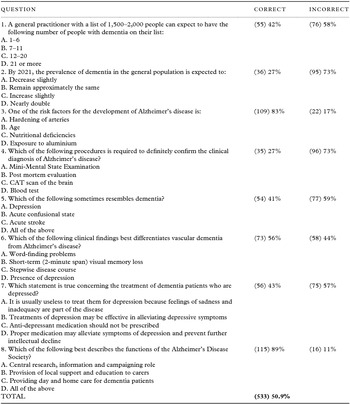
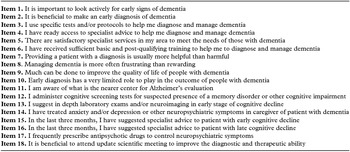
Two questionnaires [GP-Knowledge and GP-QUAD] were designed on the basis of a questionnaire used in a national study of dementia services of the National Audit Office conducted in the United Kingdom (Ahmad et al., Reference Ahmad, Orrell, Iliffe and Gracie2010), which is the same questionnaire used by the Audit Commission (Anderson, Reference Anderson2000), and derived from an earlier United Kingdom trial (Turner et al., Reference Turner2004), to measure GPs’ attitudes, practice, confidence, and knowledge about caring for patients with dementia. These two questionnaires resulted from the expansion, the restructuring, and the adaptation to specific characteristics of the Italian NHS of the questionnaires used in the United Kingdom studies (Turner et al., Reference Turner2004; Ahmad et al., Reference Ahmad, Orrell, Iliffe and Gracie2010). The sample of GPs evaluated in the present study was the same for both questionnaires. However, while in the GP-QUAD sex, year of birth, year of graduation, specialty, and other characteristics of the respondent GPs were required, the GP-Knowledge questionnaire was completely anonymous because it touched sensitive issues as personal training level and specific knowledge of dementia. The GP-Knowledge is an 8-item multiple-choice questionnaire testing GPs’ expertise about AD incidence, prevalence and risk factors, differential diagnosis and available treatments. Each of the eight questions uses a 4-point multiple-choice scale with only one correct answer. One point is attributed to correct answers and points are summed up to create an unweighted overall score (Table 1). The GP-QUAD is an 18-item questionnaire that required an answer on three possibilities for each question (Yes; No; I don't know) (Table 2). It was aimed to value the GPs’ attitudes, awareness, and practice regarding early diagnosis of dementia.
Numbers and percentages of general practitioners participants (n = 131) giving correct answers to the General Practitioner (GP)-Knowledge questionnaire

Correct answers: 1C; 2C; 3B; 4B; 5A; 6C; 7B; 8D.
General practitioners’ attitudes to early diagnosis and management of Alzheimer's disease/dementia [General Practitioner-QUestionnaire on Awareness of Dementia (GP-QUAD)]

Statistical analysis
The GPs baseline characteristics and answers to GP-Knowledge and GP-QUAD questionnaires were reported as frequency and percentage. Continuous variables are reported as mean and standard deviation (SD). Subgroup analyses were performed on the GP-QUAD answers according to sex and to graduation year stratification in four groups (graduated before 1980, graduated between 1980 and 1984, graduated between 1985 and 1989, and graduated after 1989). Differences in percentages between groups were assessed using Pearson χ2 test. To give insight into the complex dependence structure among all questionnaire items and to better investigate whether sex, birth, and graduation years (i.e. supplementary variables) were associated with a specific set of all items, MCA (Greenacre, Reference Greenacre1984) was further performed on GP-QUAD only. Supplementary variables have no impact on the computation of latent components. They were projected onto the solution space afterwards. MCA was based on the Burt matrix with an adjustment of inertias (Greenacre, Reference Greenacre1993) and analysis was performed treating both “NA” and “I don't know” (i.e. missing) categories as belonging to only one category. The statistical significance threshold was set at 0.05. All analyses are performed using SAS Statistical Package Release 9.1 (SAS Institute, Cary, NC, USA).
Results
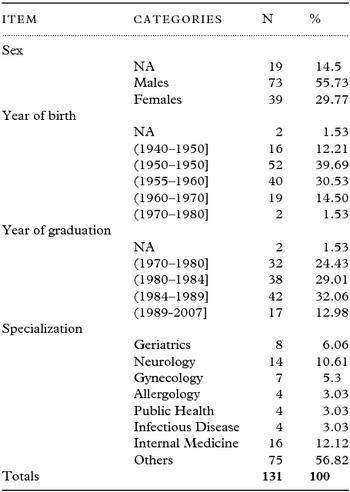
During the meetings, a sample size of 131 GPs from the entire population of 2,498 GPs working in Apulia region for the NHS completed both the questionnaires. The characteristics of our sample, deducted from responders’ information items required in the GP-QUAD, are summarized in Table 3. Sex distribution was 56% males, 30% females, with 14% of data missing. The mean and SD for age were 55 ± 5 years, and the time period during which the largest proportion of responders (32%) was graduated was 1980–1985. In the present survey, we used a volunteer sampling to select the participating GPs. For this reason, our sample was younger (p < 0.0001) and females were more frequent (p = 0.007) compared with the age and sex distribution of GPs in Apulia. Instead, no difference in the years of graduation (p = 0.36) between the present sample and the whole population of GPs in Apulia was found.
Overall characteristics of general practitioners participants (n = 131)

Certificate of specific training for GPs in general medicine was possessed by 12% of the sample. This diploma was acquired by attending three-year training course in General Medicine and from 1995 this diploma was required to be a GP working for the Italian NHS. The other participants had different or no specialization because they started to work as GPs before 1995. Overall, 79% of GPs had a specialization (12% in internal medicine, 11% in neurology, 6% in geriatric medicine, 5% in obstetrics and gynecology, 3% in allergy and immunology, 3% in public health and preventive medicine, 3% in infectious diseases, and 36% in other medical fields). Data were missing for 21% of the sample.
The items 4, 5, and 7 of the GP-Knowledge questionnaire evaluated the general level of GPs’ knowledge about the detection of early stage of AD. To the participants was asked: “Which of the following procedures is required to definitely confirm the clinical diagnosis of AD?“(item 4). The correct answer: “Post mortem evaluation” (B) was chosen by 27% of our sample, while 47% answered: “Mini-Mental State Evaluation (MMSE)” (A). The answer: “CAT scan of the brain” (C) was chosen by 17% of the sample, while 9% of participants gave no answer (Table 1). To the participants was also asked: “Which of the following sometimes resembles dementia?” (item 5). The correct answer: “Depression” (A) was chosen by 41% of our sample, while 54% answered: “All of the above” (D), including in the conditions that can mimic dementia also acute stroke and acute confusional state. No answer was given by 3% of participants (Table 1). Finally, to the participants was asked: “Which statement is true concerning the treatment of dementia patients who are depressed?” (item 7). Correct answer: “Treatments for depression may be effective in alleviating depressive symptoms” (B) was chosen by 43% of our sample, while 51% answered: “Proper medication may alleviate symptoms of depression and prevent further intellectual decline” (D). The answers: “It is usually useless to treat them for depression because feelings of sadness and inadequacy are part of the disease” (A) and “Antidepressant medication should not be prescribed” (C) were chosen both by 1% of the sample. No answer was given by 4% of participants (Table 1).
No statistically significant differences between four groups of graduation years were found for all items not supporting the hypothesis that the year of graduation may affect GPs’ awareness on early AD diagnosis, their attitudes towards dementia, and their knowledge of the disease. In particular, awareness of GPs of the need of a better management of early stage of AD was tested with items 3, 12, and 15 of the GP-QUAD. Furthermore, the 53% of our sample did not use specific tests or protocols to diagnose and manage dementia (item 1), or did not administer cognitive screening tests to make a prompt diagnosis of memory disorder or other cognitive impairment (item 12). In the last three months, the 44% of the sample declared that they did not send patients with early cognitive impairment to specialist advice at tertiary referential UVA (item 15). GPs’ perception about their knowledge and training was tested analyzing item 6 of the GP-QUAD that specifically asked whether the basic and post-qualifying training received was sufficient to diagnose and manage dementia. The training was considered inadequate by 55% of participants, while the 38% was satisfied. The 4% of the sample answered: “I don't know”, whereas 3% of GPs provided no response. No statistically significant differences between four groups of graduation years were found also for item 6 (p = 0.56). Furthermore, on the basis of the analysis of items 1, 2, 4, 5, and 7 of the GP-QUAD, the year of graduation may not influence the ability of GPs to make an early diagnosis of AD. There were no statistically significant differences among the four groups of years of graduation either in the belief that early diagnosis may have an impact on patient well-being (items 1 and 2), in the effectiveness of working relationships established with specialist services (item 4, p = 0.98), in evaluation of specialist services accessibility and quality (item 5, p = 0.32), and in the belief that sharing the diagnosis with the patient was beneficial (item 7, p = 0.22). Comparing GPs for other characteristics (sex, date of birth, qualification achieved), no statistically significant differences in all items were found. However, female GPS were more likely to consider their training insufficient (58%) compared to males (53%) on the recognition of early signs and symptoms of AD (item 6, p = 0.01). were less likely to suggest specialist advice in late stage of cognitive impairment (item 16, p = 0.008), and to prescribe antipsychotic drugs to control NPS (item 17, p = 0.003).
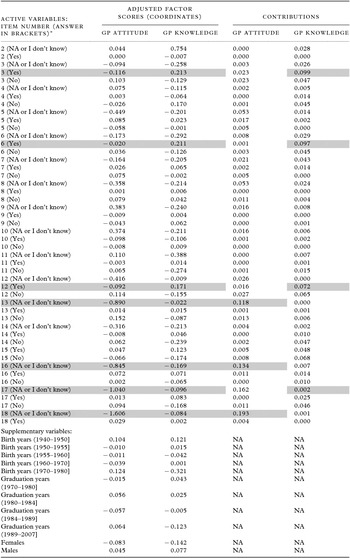
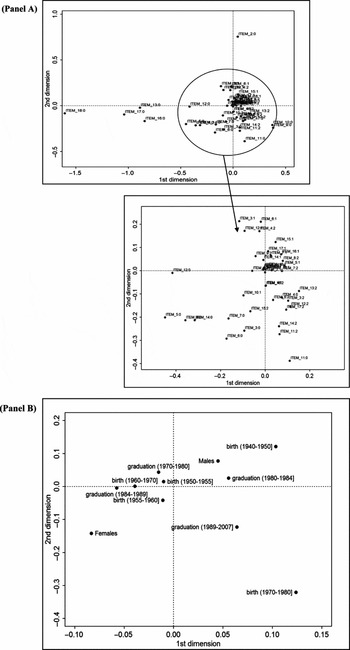
Multiple correspondence analysis for GP-QUAD
The first two dimensions explained 26.1% and 20.1% of the inertia (for a total of 46.2%), obtained with the Greenacre correction formula. The adjusted factor scores (for both active and supplementary variables) and contributions (for active variables only) were reported in Table 4. As shown, the first latent component (X) was mainly defined by a linear combination of items 13, 16, 17, and 18 (and missing categories contributed the most). Thus, this dimension could be interpreted as the GP level of attitude to take advantage in attending updates and correctly suggesting specialist advice, appropriate laboratory exams and prescribing drugs (“GP attitude”) (negative coordinates are referred to a worse attitude levels, whereas positive coordinates are referred to a better attitude levels). Conversely, the second latent component (Y) was mainly defined by a linear combination of items 3, 6, and 12 (and the “Yes” category contributed the most). Thus, this dimension could be interpreted as the level of knowledge of post-qualified GPs about tests and/or protocols that can be useful to diagnose and manage dementia (“GP knowledge” (negative coordinates are referred to a worse knowledge levels, whereas positive coordinates are referred to a better knowledge levels). The projections of the items (i.e. active variables) and the GPs’ characteristics (i.e. supplementary variables) on the first two latent components were graphically reported in Figure 1 (Panel A and B, respectively). Each plot was divided into four parts by the set of dimensions, so that a total of four quadrants were defined (i.e. dashed line at X = 0 and Y = 0). GPs with a good level of attitude in attending updates, correctly suggesting both specialist advice and appropriate laboratory exams and prescribing drugs, with a post-qualification and a good level of knowledge about tests and/or protocols useful to diagnose and manage dementia were represented in the first quadrant (upper right). GPs with a poor level of attitude in attending updates, correctly suggesting both specialist advice and appropriate laboratory exams and prescribing drugs, but with a post-qualification and a good level of knowledge about tests and/or protocols useful to diagnose and manage dementia were represented in the second quadrant (upper left). GPs with a poor level of attitude in attending updates, correctly suggesting both specialist advice and appropriate laboratory exams and prescribing drugs and without a post-qualification and a poor level of knowledge about tests and/or protocols useful to diagnose and manage dementia were represented in the third quadrant (lower left). GPs with a good level of attitude in attending updates, correctly suggesting both specialist advice and appropriate laboratory exams and prescribing drugs but without a post-qualification and a poor level of knowledge about tests and/or protocols useful to diagnose and manage dementia were represented in the fourth quadrant (lower right). Looking at the Figure 1, Panel B, the following profiles can be evidenced within each quadrant: male GPs born between 1940 and 1950 and graduated between 1980 and 1984 (i.e. the oldest GPs) were represented into the first quadrant. GPs born between 1950 and 1955 and between 1960 and 1970 and graduated between 1970 and 1980 were represented into the second quadrant. Female GPs born between 1955 and 1960 and graduated between 1984 and 1989 were represented into the third quadrant. GPs born between 1970 and 1980 and graduated between 1989 and 2007 (i.e. the youngest GPs), were represented into the fourth quadrant.
Adjusted factor scores (for both active and supplementary variables) and contributions (for active variables only) on the first two components, general practitioner (GP) attitude e GP knowledge, which explained about 46.2% of the total inertia in the Multiple Correspondence Analysis (MCA) on General Practitioner-QUestionnaire on Awareness of Dementia (GP-QUAD)

*The Item 1 of the GP-QUAD was not considered for MCA as all GPs provided the same answer (i.e. “Yes”); NA: contribution not available (for supplementary variables only).
Multiple correspondence analysis on general practitioner-questionnaire on awareness of dementia (GP-QUAD). Projections on the first two dimensions [first dimension interpreted as general practitioner (GP) attitude e the second dimension interpreted as GP knowledge] for items (panel A) and supplementary variables (panel B). The proportion of explained inertia was corrected using Greenacre formula.

Discussion
The main findings of the present study suggested that GPs demonstrated difficulties in recognizing key symptoms of early diagnosis of AD. GPs’ lack of awareness of the need of a better management of early stage of AD emerged because specific screening tests or protocols to diagnose and manage dementia were used by only 53% of participants. In the last three months, the 44% of the sample declared that they did not send patients with early cognitive impairment to specialists at tertiary referential UVA. Finally, the training on the recognition of early signs and symptoms of AD was considered inadequate by 55% of participants. No statistically significant differences were found comparing the years of graduation, while females were more likely to consider their training insufficient (58%) compared to males (53%). Female GPs were less likely to prescribe antipsychotic drugs to control NPS and suggest specialist advice in late stage of cognitive impairment. MCA performed on GP-QUAD suggested two dimensions explaining 26.1% (items 13, 16, 17, and 18 interpreted as “GP attitude”) and 20.1% (items 3, 6, and 12 interpreted as “GP knowledge”) of the inertia for a total of 46.2%,
Narrative (Iliffe et al., Reference Iliffe2009) and systematic (Koch and Iliffe, Reference Koch and Iliffe2010b) reviews were recently conducted on the role of GPs in AD diagnosis and caring for people with dementia. In 2009, Iliffe and colleagues (Reference Iliffe2009) updated the 2006 systematic review carried out for the guidelines from the National Institute for Clinical Excellence and Social Care Institute for Excellence (NICE/SCIE, 2006) suggesting earlier recognition of people with dementia syndrome as a shared responsibility between generalist and specialist disciplines, without population screening in primary care. More recently, a systematic review identified barriers to recommended diagnosis and management of dementia in primary care including lack of support, time and financial constraints, stigma associated with diagnosis, diagnostic uncertainty, insufficient knowledge or experience, and difficulties disclosing the diagnosis (Koch and Iliffe, Reference Koch and Iliffe2010b). The present findings confirmed the overall conclusions on Italian GPs coming from studies conducted on different European countries (Iliffe et al., Reference Iliffe, De Lepeleire, Van Hout, Kenny, Lewis and Vernooij-Dassen2005; De Lepeleire et al., Reference De Lepeleire2008; Robinson et al., Reference Robinson, Vellas, Knox and Lins2010) claiming that early or “timely” (De Lepeleire et al., Reference De Lepeleire2008) diagnosis of dementia is often unrecognized in a primary care setting. In particular, the IMPACT survey on 250 generalists and 250 specialists from 5 European countries suggested that although there were more similarities than differences on late signs of AD between generalists and specialists in Germany, UK, and Italy, some differences existed regarding early signs of AD (Robinson et al., Reference Robinson, Vellas, Knox and Lins2010).
The present findings were in agreement with those of another study conducted in Italy in 2004 showing that 75.8% of GPs did not know that temporal disorientation is most likely to occur earlier in AD than inability to recognize a family member, the name of common objects, or space orientation (Pucci et al., Reference Pucci2004). In the present study, Italian GPs showed an insufficient knowledge of formal screening tools for dementia with the exception of MMSE confirming a study conducted in the United States in which most of GPs conducted “informal screening” for dementia through the evaluation of patient's hygiene, behavior and cognitive functions observed during a clinic visit (Carter et al., Reference Carter, Rose, Palesch and Mintzer2004). Nevertheless, it seems very important for GPs to be aware of early detection issues of AD, given that a memory complaint expressed to the GP may be a risk factor for AD (Coley et al., Reference Coley, Ousset, Andrieu, Matheix Fortunet and Vellas2008). Therefore, some studies have focused on the need to improve the quality of dementia screening in primary care (Trenkle et al., Reference Trenkle, Shankle and Azen2007; Milne et al., Reference Milne, Culverwell, Guss, Tuppen and Whelton2008). Furthermore, the 50% of GPs of our sample declared poor knowledge about the tertiary care centers to which refer their patients in suspicion of cognitive decline, so supporting the data of the IMPACT survey where less than half of GPs stated that they knew who to contact for AD-related advice (Robinson et al., Reference Robinson, Vellas, Knox and Lins2010). Finally, about a half of GPs in the present sample expressed limited confidence in the pharmacological management of NPS typical of late stages of AD. However, the 65% of GPs also declared that prescribed regularly antipsychotic drugs to control NPS in demented patients, and this finding was lower than the 80% showed in the Italian sample of the IMPACT survey and then the average value of other European countries involved in this large study (74%) (Robinson et al., Reference Robinson, Vellas, Knox and Lins2010).
Our findings coming from the GP-QUAD clearly showed that GPs perceived a lack of confidence in their diagnostic skills as a consequence of an inadequate basic and post-qualifying training received. On the contrary, Pucci and colleagues (Reference Pucci2004) showed that Italian GPs in 2004 perceived themselves to have adequate knowledge on AD even if the objectively measured knowledge was slight, suggesting that these GPs were over-confident in their ability to diagnose and treat AD. In the present study, respondents were more realistic in their ability to estimate their own abilities and these contrasting findings may be explained by the fact that in Italy only in the last decade there has been an increase of the awareness on AD as a medical, familial, and social problem. In our sample of GPs, the overall level of knowledge on AD did not seem to be influenced by the graduation year in agreement with the study of Pucci and colleagues (Reference Pucci2004). These findings from Italian GPs were conflicting with those of similar studies conducted in the United States (Rubin et al., Reference Rubin, Glasser and Werckle1987) and the United Kingdom (Turner et al., Reference Turner2004; Ahmad et al., Reference Ahmad, Orrell, Iliffe and Gracie2010) suggesting that confidence in diagnosing dementia was significantly greater in older graduated reflecting their increased experience in managing patients with AD (Rubin et al., Reference Rubin, Glasser and Werckle1987; Turner et al., Reference Turner2004; Ahmad et al., Reference Ahmad, Orrell, Iliffe and Gracie2010). These conflicting results probably reflected the fact that in the United Kingdom (Turner et al., Reference Turner2004; Ahmad et al., Reference Ahmad, Orrell, Iliffe and Gracie2010) and United States (Rubin et al., Reference Rubin, Glasser and Werckle1987) from a greater number of years there was a clear perception of AD as a disease in which early diagnosis and timely treatment must be mandatory. This hypothesis seems to be supported also by the fact that a low percentage of our GPs identified the lack of a disease-modifying treatment for AD as a primary disincentive to early diagnosis, in contrast with the study of Carter and colleagues (Reference Carter, Rose, Palesch and Mintzer2004) in which limited treatment options represented for the 47% of the GPs the main barrier to diagnosing AD in an early stage.
Our findings contrasted with those of the two studies from the United Kingdom using the GP questionnaire on which we based our two assessing tools and suggesting that more recent graduates were more likely to believe that early diagnosis of dementia can have a positive impact on patients’ well-being and were less likely to exhibit pessimism about currently available treatments (Turner et al., Reference Turner2004; Ahmad et al., Reference Ahmad, Orrell, Iliffe and Gracie2010). Conversely, in the present study no significant differences between recent and older graduates groups were detected. Probably, in the United Kingdom, GPs graduated before 1990 have had the opportunity to clash with treatment failures and difficulties of managing patients with AD during their longer experience. In the United Kingdom, the Department of Health launched a national dementia plan on dementia in 2009, while a comprehensive national dementia plan has been issued in Italy only in October 2014 (http://www.alzheimer-europe.org/Policy-in-Practice2/National-Dementia-Plans).Therefore, the awareness of the AD in Italy as a growing medical and social problem is much more recent, and the GPs graduated before 1984 did not have a significantly greater experience than their colleagues graduated after 1984. Interestingly, we graphically evidenced four distinct GP profiles: the oldest and male GPs, GPs born between 1950 and 1955 and between 1960 and 1970 and graduated between 1970 and 1980, female GPs born between 1955 and 1960 and graduated between 1984 and 1989, and the youngest GPs. For the oldest and male GPs, there was a direct relationships between the two identified dimensions (GP attitude and GP knowledge) showing that an increase in GP level of attitude to take advantage in attending updates and correctly suggesting specialist advice, appropriate laboratory exams and prescribing drugs was linked to an increased level of knowledge of post-qualified GPs about tests and/or protocols that can be useful to diagnose and manage dementia. These findings suggested that positive attitudes of GPs towards dementia may determine a more comprehensive knowledge of the disease and can facilitate communication with patients and relatives as well. Similarly, a more positive attitude towards psychiatric conditions may facilitate the assessment and treatment of NPS in dementia.
We must also acknowledge a number of limitations of the present survey. Our study was conducted only in one Italian region, while a national study would also allow for exploration of regional differences. The present survey was limited by the need to respect the privacy policies requiring that the GP-Knowledge was completely anonymous as it was designed to assess the personal knowledge and expertise. Given that the GP-Knowledge was completely anonymized, we performed MCA only on the GP-QUAD. The willingness to participate might represents a limitation in percentage reported, and opinion surveys may ask questions that can be interpreted differently by different responders. In the present survey, we used a volunteer sampling to select the participating GPs. For this reason, our sample is younger and females are more frequent compared with the age and sex distribution of GPs in Apulia. This was probably due to a major propensity of the younger female GPs to be more ready to cooperate to the project. Therefore, the present findings should be treated with some caution given also the relatively small sample enrolled. Similarly, the sample of GPs selected from the specialists working in the UVAs with the incentive to participate in the training meetings, and the fact that the questionnaires were presented at an information session specifically targeting early diagnosis and care of dementia and AD may have introduced some selection biases and our group may not be representative of the broader population of GPs. However, the present findings are similar to those from other studies using different recruiting strategies (Carter et al., Reference Carter, Rose, Palesch and Mintzer2004; Lahjibi-Paulet et al., Reference Lahjibi-Paulet, Dauffy Alain, Minard, Gaxatte, Saint-Jean and Somme2012). Finally, the multiple-choice format may have constrained responses to some questions and prevented the acquisition of detailed ad verbatim data. Moreover, the GP-Knowledge questionnaire, evaluating GPs’ expertise about AD epidemiology, differential diagnosis, and available treatments, was based on relatively dated clinical information given that the original version of this tool was published over ten years ago (2004) (Turner et al., Reference Turner2004), introducing possible limitations for the evaluation of some items, such as diagnostic procedures and criteria that may have been partially modified in recent years.
In conclusion, the present study pointed out some problems of Italian GPs in diagnosing early AD. These unfavorable views of primary care performances in the diagnosis and management of dementia should be set against positive evidence of GP engagement in redesigning dementia services, with educational interventions in improving detection and management of dementia in primary care (Downs et al., Reference Downs2006; Iliffe et al., Reference Iliffe2012; Edwards et al., Reference Edwards, Voss and Iliffe2013), also in collaboration with secondary and tertiary care centers (Greaves and Jolley, Reference Greaves and Jolley2010). Training programs have been developed in most European countries, and relevant educational projects now exist for GPs (Cherry et al., Reference Cherry, Hahn and Vickrey2009; Tsolaki et al., Reference Tsolaki2010). A RCT investigating the effects of three educational interventions on GP knowledge, clinical practice and outcomes for carers, found that decision support software and practice-based workshops significantly increased the detection rate of dementia (Downs et al., Reference Downs2006). However, the tailored educational intervention for primary care of a recent RCT conducted among GPs, the EVIDEM-ED (Evidence Based Interventions in Dementia–Early Dementia Diagnosis & Management in Primary Care) trial, did not show any improvement both in the documentation of clinical management of patients with dementia and in case identification (Wilcock et al., Reference Wilcock2013). On the other hand, a recent RCT demonstrated similar effectiveness of post-diagnosis dementia treatment and coordination of care by tertiary care centers compared with GPs (Meeuwsen et al., Reference Meeuwsen2012), and similar results could be obtained also for early diagnosis of AD. Therefore, it is essential to clearly define the role of primary care providers and to improve their knowledge about the disease and related guidelines (Werner, Reference Werner2007). Even if the evidences are still controversial, an accurate training and clear and validated guidelines covering all aspects of AD care should improve the ability of GPs to have an early diagnosis and to manage multidisciplinary care both in the early and advanced stages of the disease.
Conflicts of interest
None
Description of authors’ roles
F. Veneziani supervised the data collection and wrote the paper. F. Panza designed the study, supervised the data collection and wrote the paper. V. Solfrizzi supervised the data collection and wrote the paper. Capozzo collected data and wrote the paper. M. R. Barulli collected data and wrote the paper. A. Leo collected data and wrote the paper. M. Lozupone collected data and wrote the paper. A. Fontana carried out the statistical analysis and wrote the paper. S. Arcuti carried out the statistical analysis and wrote the paper. M. Copetti was responsible for the statistical design of the study and for carrying out the statistical analysis and wrote the paper. V. Cardinali collected data and wrote the paper. A. Grasso collected data and wrote the paper. M. Tursi collected data and wrote the paper. A. Iurillo collected data and wrote the paper. D. Seripa supervised the data collection and wrote the paper. B. P. Imbimbo supervised the data collection and wrote the paper. G. Logroscino designed the study, supervised the data collection and wrote the paper.