Although externalizing symptoms are common sequelae experienced by youth exposed to destructive (i.e., hostility, distress, and disengagement) interparental conflict, the magnitude of the risk is typically modest and, in some studies, negligible (Harold, Elam, Lewis, Rice, & Thapar, Reference Harold, Elam, Lewis, Rice and Thapar2012; Harold & Sellers, Reference Harold and Sellers2018; Jouriles, Rosenfield, McDonald, & Mueller, Reference Jouriles, Rosenfield, McDonald and Mueller2014). Thus, identifying child attributes that account for the heterogeneity in their vulnerability to externalizing problems has been a scientific priority over the past two decades. Despite the progress made in identifying child characteristics (e.g., temperament and autonomic nervous system functioning) that moderate associations between interparental conflict and children's behavior problems (e.g., El-Sheikh & Erath, Reference El-Sheikh and Erath2011; Obradovic, Bush, & Boyce, Reference Obradović, Bush and Boyce2011; Pauli-Pott & Beckmann, Reference Pauli-Pott and Beckmann2007), far less is known about the molecular genetic sources of variability in children's vulnerability to interparental conflict. To address this significant gap, our first objective in this paper was to examine whether the prospective association between interparental conflict and youth externalizing problems varied significantly as a function of a set of genes encoding for the regulation of dopaminergic pathways. In the context of the documented significance of emotion dysregulation processes as mechanisms of risk experienced by children from high-conflict homes, our decision to focus on dopaminergic genes as moderators was guided by their established roles in organizing affective and motivational responding to socialization experiences (Moore & Depue, Reference Moore and Depue2016; Schriber & Guyer, Reference Schriber and Guyer2016; Tielbeek et al., Reference Tielbeek, Johansson, Polderman, Rautiainen, Jansen, Taylor and Viding2017).
However, identifying the genetic contributors to the multifinality in risk associated with interparental conflict is the first, not last, step in the research process. As a critical complementary direction, we also sought to advance an understanding of how and why dopaminergic genes may modulate associations between interparental conflict and children's externalizing symptoms. Therefore, consistent with the multiple-levels-of-analysis theme on emotion dysregulation and emerging psychopathology in this Special Issue, our second aim was to examine whether a key index of emotion dysregulation in the context of the family accounts for the role of dopaminergic genes in modulating youth vulnerability in high-conflict homes. Guided specifically by emotional security theory (Davies & Cummings, Reference Davies and Cummings1994), we specifically test the hypothesis that children's emotional insecurity in the interparental relationship is a mediating mechanism accounting for why the strength of interparental conflict as a predictor of youth externalizing symptoms varies as a function of the dopamine genotypes.
Dopamine Genes as Moderators of Interparental Conflict
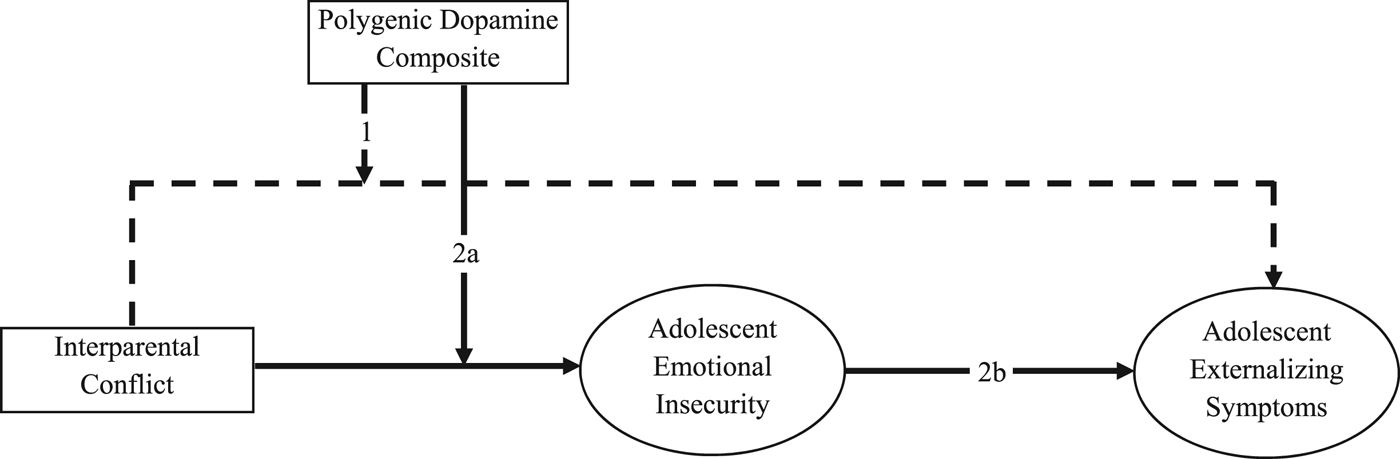
As a framework for organizing our multivariate aims, Figure 1 provides a conceptual depiction of the mediated moderation hypotheses derived from our multiple-levels-of-analysis framework of emotion dysregulation. As shown in Path 1 of the figure, our goal was to test the hypothesis that the prospective relationship between interparental conflict and externalizing symptoms is significantly stronger for youth with alleles that collectively confer lower dopamine tone in the mesolimbic and mesocortical pathways. Through its dopaminergic projections connecting the midbrain (e.g., ventral tegmental area) with regions of the limbic system (e.g., basal ganglia, amygdala, nucleus accumbens, hippocampus, and hypothalamus; Tielbeek et al., Reference Tielbeek, Johansson, Polderman, Rautiainen, Jansen, Taylor and Viding2017), the mesolimbic pathway is implicated in the regulation of motivational processes, attention, and processing and reactivity to emotionally significant cues, including rewarding and aversive stimuli (Gatzke-Kopp, Reference Gatzke-Kopp2011; Muda et al., Reference Muda, Kicia, Michalak-Wojnowska, Ginszt, Filip, Gawda and Majcher2018). Of relevance to emotion dysregulation processes, hypodopaminergic tone in this pathway has been associated with proneness to hyperactivity, inattention, negative emotionality, and delay discounting (e.g., Beauchaine, Neuhaus, Zalewski, Crowell, & Potapova, Reference Beauchaine, Neuhaus, Zalewski, Crowell and Potapova2011; Beauchaine, Zisner, & Sauder, Reference Beauchaine, Zisner and Sauder2017; Laasko et al., Reference Laakso, Wallius, Kajander, Bergman, Eskola, Solin and Hietala2003). In projecting from the ventral tegmental area to the prefrontal cortex, dopamine deficiency in the mesocortical pathway is associated with impairments in the regulation of emotions and impulses, including the operation of executive functions that involve decision making, planning, working memory, and effortful control (Smilie & Wacker, Reference Smillie and Wacker2014; Tielbeek et al., Reference Tielbeek, Johansson, Polderman, Rautiainen, Jansen, Taylor and Viding2017). In underscoring the relevance of these pathways for sensitizing children to socialization experiences, low dopamine levels in mesocortical and mesolimbic circuits have both been associated with greater sensitivity to environmental stimuli and greater emotion dysregulation in adverse socialization contexts (see Moore & Depue, Reference Moore and Depue2016).
A conceptual model examining youth emotional insecurity as a mediator of a polygenic dopamine composite in the association between interpersonal conflict and externalizing symptoms.

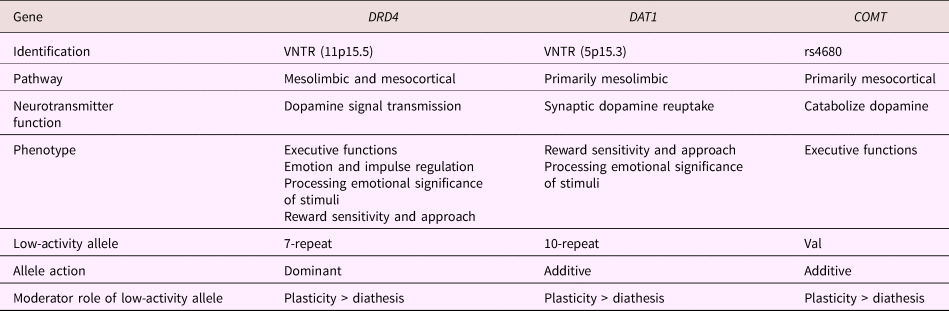
In building on this literature, we created a polygenic composite of low dopamine activity from three genes that collectively modulate dopamine levels in the mesocortical and mesolimbic pathways and are documented moderators of environmental susceptibility: (a) the dopamine receptor D4 (DRD4), (b) the dopamine active transporter (DAT1 VNTR); and (c) the catechol-O-methyl transferase (COMT) gene (see Table 1 for a synopsis). First, D4 receptors are densely expressed in both the mesolimbic (e.g., amygdala, hippocampus, and hypothalamus) and mesocortical (e.g., prefrontal cortex) regions of the brain (McGeary, Reference McGeary2009; Smith, Reference Smith2010; Turic, Swanson, & Sonuga-Barke, Reference Turic, Swanson and Sonuga-Barke2010). Because the 7-repeat allele of DRD4 encodes for dopamine receptors that are significantly less sensitive than other variants of the gene, it results in weaker dopaminergic signaling (Levitan et al., Reference Levitan, Masellis, Lam, Kaplan, Davis, Tharmalingam and Kennedy2006; Turic et al., Reference Turic, Swanson and Sonuga-Barke2010). Second, in contrast to the DRD4, the DAT1 VNTR polymorphism regulates the expression of DAT1 largely in the mesolimbic pathway (Bilder, Volavka, Lachman, & Grace, Reference Bilder, Volavka, Lachman and Grace2004). The 10-repeat allele of the DAT1 gene is additively associated with greater DAT1 density and ultimately diminished dopaminergic transmission through its more effective reuptake of dopamine in the synapse (Felten, Montag, Markett, & Walter, Reference Felten, Montag, Markett, Walter and Reuter2011; Garcia-Garcia, Barcelo, Clemente, & Escera, Reference Garcia, Barcelo, Clemente and Escera2010). Third, in complementing the DAT1, the COMT gene programs the expression of COMT and its function of catabolizing dopamine primarily in the mesocortical pathway (Bilder et al., Reference Bilder, Volavka, Lachman and Grace2004; Moore & Depue, Reference Moore and Depue2016). Relative to the Met allele, the Val variant of the COMT gene is additively associated with greater COMT enzyme activity and, as a result, lower levels of dopamine in the mesocortical circuit (Frigerio et al., Reference Frigerio, Ceppi, Rusconi, Giorda, Raggi and Fearon2009; Lackner, Sabbagh, Hallinan, Liu, & Holden, Reference Lackner, Sabbagh, Hallinan, Liu and Holden2012).
A synopsis of the characteristics of three dopamine-related genes in the polygenic composite

Although no studies have specifically examined whether the strength of interparental conflict as a predictor of children's externalizing problems varies as a function of dopamine-related genes, there are bases for expecting that dopamine genes will moderate the risk associated with interparental conflict. Findings from the only investigation to examine the interaction between interparental relationships and dopamine alleles revealed that adolescent perceptions of interparental positivity were stronger predictors of their lower threat appraisals for carriers of the 7-repeat allele of DRD4 (Schlomer, Fosco, Cleveland, Vandenbergh, & Feinberg, Reference Schlomer, Fosco, Cleveland, Vandenbergh and Feinberg2015). Moreover, several theoretical frameworks have proposed DRD4, DAT1, and COMT genes are key factors underpinning children's reactivity to socialization contexts (e.g., Belsky & Pluess, Reference Belsky and Pluess2009; Gatzke-Kopp, Reference Gatzke-Kopp2011; Moore & Depue, Reference Moore and Depue2016). In support of these theories, research has shown that associations between the quality of rearing environments and youth externalizing symptoms are magnified for carriers of the DRD4 7-repeat allele (e.g., Bakermans-Kranenburg & van IJzendoorn, Reference Bakermans-Kranenburg and van IJzendoorn2011; Janssens et al., Reference Janssens, van Den Noortgate, Goossens, Verschueren, Colpin, De Laet and van Leeuwen2015), the 10-repeat variants of DAT1 (e.g., Boardman et al., Reference Boardman, Menard, Roettger, Knight, Boutwell and Smolen2014; Weeland, Overbeek, de Castro, & Matthys, Reference Weeland, Overbeek, de Castro and Matthys2015), and the COMT Val alleles (Hygen et al., Reference Hygen, Belsky, Stenseng, Lydersen, Guzey and Wichstrøm2015; Nobile et al., Reference Nobile, Rusconi, Bellina, Marino, Giorda, Carlet and Battaglia2010).
Precisely characterizing the form of moderating effects of dopaminergic genes is a key undertaking in the literature. In early work, empirical evidence for the moderating role of hypodopaminergic genetic alleles were commonly interpreted as supporting diathesis-stress models (see Belsky & Pluess, Reference Belsky and Pluess2009). In these models, alleles associated with low dopamine are regarded as vulnerability factors that potentiate the risk posed by forms of family adversity and, as such, confer no tangible benefits in socialization contexts. However, according to differential susceptibility theory, many dopamine-related genes may operate as “plasticity” or “susceptibility” factors rather than diatheses or risk conditions (Belsky & Pluess, Reference Belsky, Pluess and Cicchetti2016). Consistent with diathesis-stress models, differential susceptibility theory proposes that children with dopaminergic susceptibility alleles will exhibit greater psychological problems when exposure to stressful family events is high. However, because “susceptibility” is defined as greater plasticity in a “for better or for worse” fashion, differential susceptibility theory maintains that children with the “susceptibility” alleles also profit disproportionately more from supportive parenting contexts.
Although it is important to note that some Gene × Environment (G × E) studies have identified dopaminergic genes as diatheses in models of socialization risk (Davies, Cicchetti, & Hentges, Reference Davies, Cicchetti and Hentges2015; Haeffel et al., Reference Haeffel, Getchell, Koposov, Yrigollen, De Young, Klinteberg and Grigorenko2008), empirical findings more consistently favor the differential susceptibility conceptualization of DRD4, DAT1 VNTR, and COMT as plasticity rather than risk alleles (Bakermans-Kranenburg & van IJzendoorn, Reference Bakermans-Kranenburg and van IJzendoorn2015; Belsky & Pluess, Reference Belsky, Pluess and Cicchetti2016; Boyce, Reference Boyce2016; Pluess, Reference Pluess2017; Weeland et al., Reference Weeland, Overbeek, de Castro and Matthys2015). In accord with both differential susceptibility and diathesis-stress models, children with the hypodopaminergic alleles for DRD4 (i.e., 7-repeat), DAT1 (i.e., 10-repeat), and COMT (i.e., Val) have been documented to exhibit more externalizing symptoms than their counterparts who are not carrying these alleles in contexts of high environmental adversity (e.g., Bakermans-Kranenburg & van IJzendoorn, Reference Bakermans-Kranenburg and van IJzendoorn2011; Hygen et al., Reference Hygen, Belsky, Stenseng, Lydersen, Guzey and Wichstrøm2015; Janssens et al., Reference Janssens, van Den Noortgate, Goossens, Verschueren, Colpin, De Laet and van Leeuwen2015; Schwab-Reese, Parker, & Peek-Asa, Reference Schwab-Reese, Parker and Peek-Asa2017; van IJzendoorn & Bakermans-Kranenburg, Reference van IJzendoorn and Bakermans-Kranenburg2006; van Leeuwen et al., Reference van Leeuwen, Janssens, van Assche, van Den Noortgate, Verschueren, Colpin and Goossens2015). However, in supporting differential susceptibility theory over diathesis-stress frameworks, these same studies have shown that children carrying these dopaminergic alleles also evidenced significantly better functioning (i.e., lower externalizing symptoms) than their counterparts without the alleles when exposed to supportive socialization climates. Thus, we utilized these findings as a base for hypothesizing that the hypodopaminergic polygenic composite of DRD4, DAT1, and COMT will serve as a plasticity factor moderating the association between interparental conflict and children's externalizing problems in a for better and for worse fashion consistent with differential susceptibility.
Mechanisms Underpinning Dopaminergic Genes as Moderators of Interparental Conflict
Delineating the nature of the moderating effect of dopamine genes is an important condition to understanding how it may serve as a source of heterogeneity in the externalizing sequalae experienced by youth from high-conflict homes. However, it is the first, not the last, step in advancing a multiple-levels-of-analysis, process model of interparental conflict. Thus, another critical aim in this study was to understand how and why dopamine genes may moderate children's susceptibility to interparental conflict. As shown in Paths 2a and 2b in Figure 1, we address this gap by examining whether youth insecurity mediates the moderating effects of the polygenic composite in the pathway between interparental conflict and their externalizing symptoms. As a prevailing explanatory model, emotional security theory (EST) proposes that children's insecurity in the interparental relationship mediates their vulnerability to interparental conflict (Cummings & Miller-Graff, Reference Cummings and Miller-Graff2015; Davies & Cummings, Reference Davies and Cummings1994). According to EST, recurrent exposure to angry, aggressive, and uncooperative conflicts between parents undermines their goal of preserving a sense of security and safety in subsequent interparental interactions. Signs of insecurity are manifested in three domains of children's responses to interparental conflict: (a) emotional reactivity, characterized by intense, prolonged experiences of distress; (b) negative family representations, reflected in children's negative appraisals of the relational meaning and consequences of the conflict for the family; and (c) regulation of exposure to parent affect, as manifested in heightened efforts to reduce threat accompanying the conflicts by actively avoiding or intervening in the conflict. The tripartite class of insecure response processes is specifically proposed to coalesce into a pattern of emotion dysregulation that reflects a disproportionate allocation of psychobiological resources toward immediate personal safety. Thus, prolonged concerns about safety and security are proposed to increase children's psychological problems by increasing defensive processing in subsequent interpersonal settings, challenging the integrity of stress-sensitive physiological systems, and undermining the successful pursuit of other important developmental (e.g., affiliation or exploration) goals (Davies, Martin, & Sturge-Apple, Reference Davies, Martin, Sturge-Apple and Cicchetti2016). In support of EST, several multimethod longitudinal studies have documented emotional insecurity as a mediator of children's vulnerability to interparental conflict, with externalizing symptoms identified as a highly prevalent product of the unfolding cascade (see Cummings & Miller-Graff, Reference Cummings and Miller-Graff2015).
Why might youth emotional insecurity mediate the moderating role of the hypodopaminergic genetic profile in associations between interparental conflict and their externalizing symptoms? As denoted in Table 1, low dopamine activity in the mesocorticolimbic complex is associated with alterations in emotion reactivity, regulation, and processing; reward sensitivity; and the operation of executive functions involving planning, working memory, and problem solving (Smilie & Wacker, Reference Smillie and Wacker2014; Tielbeek et al., Reference Tielbeek, Johansson, Polderman, Rautiainen, Jansen, Taylor and Viding2017; Turic, Swanson, & Sonuga-Barke, Reference Turic, Swanson and Sonuga-Barke2010). Low dopaminergic tone is specifically associated with impulsivity to environmental stimuli, reward sensitivity, poor self-control, and difficulties regulating negative affect (Beauchaine et al., Reference Beauchaine, Zisner and Sauder2017). In further contextualizing this affectively impulsive and labile pattern, the neurobiological model of environmental reactivity proposes that individuals with low dopaminergic tone are more reflexively reactive to both supportive and aversive environmental stimuli (Moore & Depue, Reference Moore and Depue2016). Thus, lower levels of dopamine activity may sensitize children to interparental conflict in a “for better or for worse” manner. On the dark side of the differential susceptibility equation, this yields the hypothesis that children carrying genetic alleles conferring low dopaminergic tone will experience disproportionately higher levels of insecurity than their peers without the alleles when faced with high levels of interparental conflict. In a corresponding fashion, the bright side of the differential susceptibility equation generates the prediction that children with a hypodopaminergic genetic profile will also evidence substantially lower levels of emotional insecurity than their counterparts when they are exposed to more constructive interparental conflicts (e.g., positive affect, support, and problem solving).
Adolescence as a Sensitive Period for the Operation of Dopamine Activity and Insecurity
We specifically examined whether children's emotional insecurity mediated the role of the dopamine composite as a moderator of interparental conflict and their externalizing symptoms during the early and middle adolescence period based on several developmental considerations. Documented increases in dopamine transporter and D4 receptor expression in animal studies highlights adolescence as a potential sensitive period for dopaminergic sensitivity (Tielbeek et al., Reference Tielbeek, Johansson, Polderman, Rautiainen, Jansen, Taylor and Viding2017). In accord with this work, evidence supports the notion that genetic susceptibility to socialization contexts becomes particularly pronounced during adolescence through dopamine pathways regulating the processing of social–emotional stimuli. Although the early half of adolescence is associated with gradual increases in the effortful, top-down regulation of emotions and impulses, it also ushers in a period of more accelerated neural and behavioral reactivity to both rewarding and threatening (e.g., angry faces) emotional cues (Forbes, Phillips, Ryan, & Dahl, Reference Forbes, Phillips, Ryan and Dahl2011; Schriber & Guyer, Reference Schriber and Guyer2016). Thus, in the context of a highly reactive developmental period for reflexively processing and responding to socioemotional cues, the preexisting sensitivity conferred by dopamine alleles may increase differential susceptibility in a way where associations between family climate and adolescent functioning are amplified in a for better or for worse manner (Schriber & Guyer, Reference Schriber and Guyer2016). In keeping with this literature, EST proposes that, relative to younger children, adolescent concerns about their insecurity may be magnified by their heightened sensitivity to adult problems and relationship processes, stronger impulses to become involved in conflicts, and their longer exposure to interparental conflict (Davies, Martin, et al., Reference Davies, Martin, Sturge-Apple and Cicchetti2016; Fosco & Grych, Reference Fosco and Grych2010; Vu, Jouriles, McDonald, & Rosenfield, Reference Vu, Jouriles, McDonald and Rosenfield2016). In accord with this developmental proposition, research has shown that the prospective association between interparental conflict and emotional insecurity is stronger for adolescents relative to preadolescent children (Cummings, Schermerhorn, Davies, Goeke-Morey, & Cummings, Reference Cummings, Schermerhorn, Davies, Goeke-Morey and Cummings2006). Finally, with the increasing developmental demands for autonomously regulating emotions in conjunction with pronounced sensitivity to emotion-laden contexts and heightened negative affect and emotional lability, early adolescence is commonly regarded as a key period for exploring the implications of emotion dysregulation (e.g., emotional insecurity) for the development of psychopathology (Davies, Martin, et al., Reference Davies, Martin, Sturge-Apple and Cicchetti2016; McLaughlin, Hatzenbuehler, Mennin, & Nolen-Hoeksema, Reference McLauughlin, Hatzenbuehler, Mennin and Nolen-Hoeksema2011).
The Present Study
In summary, little is known about the role of genes in modulating the risk associated with youth exposure to interparental conflict. Thus, as shown in Path 1 of Figure 1, we addressed this significant gap by examining whether the role of interparental conflict as a predictor of adolescent externalizing symptoms varies as a function of a polygenic dopamine composite (i.e., DRD4, DAT1, or COMT). Guided by differential susceptibility theory, we specifically tested whether the relation between interparental conflict and externalizing symptoms is magnified for youth carrying low dopamine activity alleles in a way that reflects relatively more vulnerability in the face of high interparental adversity and relatively less vulnerability in more supportive interparental contexts. As further illustrated by Paths 2a and 2b in Figure 1, our second aim was to break new ground by examining whether adolescent emotional insecurity, as an emotion dysregulation process, mediates the moderating role of the hypodopaminergic genetic composite in the model adolescent of vulnerability to interparental conflict.
To provide a rigorous test of our hypotheses, our multimethod, multi-informant prospective approach examined whether the interaction between interparental conflict and the polygenic dopamine composite predicted greater adolescent externalizing symptoms by increasing their emotional insecurity. Following quantitative recommendations (Cole & Maxwell, Reference Cole and Maxwell2003; Maxwell & Cole, Reference Maxwell and Cole2007), we conducted a fully-lagged autoregressive design for testing the mediated moderation model. More specifically, we utilized three annual measurement occasions to examine whether the interaction between the Wave 1 assessment of interparental conflict and the dopamine composite predicted youth externalizing symptoms at Wave 3 through its association with their emotional insecurity at Wave 2, after controlling for Wave 1 insecurity and externalizing symptoms assessments. Moreover, because sensitive tests of differential susceptibility hinge on capturing both supportive and adverse environmental contexts (Belsky & Pluess, Reference Belsky and Pluess2009), our observational assessment of interparental conflict was designed to index both constructive and destructive properties of the interactions. Finally, to ensure that the findings were not artifacts of demographic third variables, we followed previous procedures of specifying annual household income and adolescent gender as covariates in the model (e.g., Davies, Hentges, et al., Reference Davies, Hentges, Coe, Martin, Sturge-Apple and Cummings2016).
Method
Participants
Data for this study were drawn from a longitudinal project on family relationship processes and adolescent development. Participants in the larger study consisted of 320 families with adolescents who were recruited through local school districts and community centers in a moderately sized metropolitan area in the Northeastern United States and a small city in the Midwestern United States. Given our focus on interparental conflict, families were only included in this paper if mothers, fathers, and adolescents had regular contact with each other as a triad, as defined by an average of 2 to 3 days per week during the previous year. This criterion resulted in the exclusion of 41 families, yielding a sample of 279 families for this paper. Adolescents were in seventh grade at Wave 1 and, on average, 13.0 years old (SD = 0.24; range 12 to 14). Girls comprised 51% of the sample. Median household income of the families was between $55,000 and $74,999 per year. Median education level of mothers and fathers was some college education. Most parents (i.e., 86%) were married at the outset of the study. For racial background, 73% of adolescents identified as White, followed by smaller percentages of African American (17%), multiracial (8%), and other races (2%). In terms of US ethnicity designations, 7% of youth were Latino. Adolescents lived with their biological mother in most cases (94%), with the remainder living with an adoptive mother or stepmother (3%), or a female guardian (4%). Children also lived with their biological father in most cases (79%), with the remainder of the sample living with either an adoptive father or stepfather (16%), or a male guardian (5%). The longitudinal design of the study consisted of three annual measurement occasions. Data were collected between 2007 and 2011. Retention rates were 93% across each of the two contiguous waves of data collection.
Procedures and measures
At each of three waves of data collection, families visited the laboratory twice at one of two data collection sites. Laboratories at each site were designed to be comparable to each other in size and quality and included (a) an observation room that was designed to resemble a living room and equipped with audiovisual equipment to capture family interactions, and (b) interview rooms for completing confidential interview and survey measures. Teachers also completed survey measures of adolescent psychological adjustment at the first and third waves. The study was approved by the institutional review board at each research site. Families and teachers were compensated monetarily for their participation. Families were paid between $125 and $155 per visit depending on the wave. Teachers were paid $25 at each wave.
Interparental conflict
At Wave 1, mothers and fathers participated in an interparental interaction task in which they discussed two common, intense interparental disagreements that they viewed as problematic in their relationship. Following similar procedures in previous research (Du Rocher Schudlich, Papp, & Cummings, Reference Du Rocher Schudlich, Papp and Cummings2004), each parent was asked to independently select the three most problematic topics of disagreement in their relationship that they felt comfortable discussing. Couples were provided with a list of common disagreements to use as a guide in the selection process. After this procedure, partners conferred to select two topics from their lists that they both felt comfortable discussing. The couples subsequently discussed each topic for 7 min while they were alone in the laboratory room. Trained coders rated videotaped records of the interparental interactions using 14 dimensional scales from the System for Coding Interactions in Dyads (Malik & Lindahl, Reference Malik and Lindahl2004). Each System for Coding Interactions in Dyads scale is rated along a 5-point scale ranging from 1 (very low) to 5 (high). Raters separately coded mothers and fathers on the three destructive dimensions of conflict: verbal aggression, defined as the level of hostile or aggressive behaviors and verbalizations displayed by each individual; negativity and conflict, reflected in the level of tension, frustration, and anger displayed by each partner during the interactions; and coerciveness, characterized by the use of harsh or threatening methods to control or influence the partner. To provide a balanced assessment of supportive as well as harsh indices of interparental conflict, coders also separately rated mothers and fathers on three dimensions of constructive ways of handling disagreements: support, assessing the extent to which each parent validates, listens, and makes efforts to understand the perspective of the partner; problem-solving communication, defined by the degree to which partners openly, directly, and constructively express their viewpoints, effectively and cooperatively identify the nature of the problem, and generate productive solutions to the issue; and positive affect, indexed by the level of positive, warm displays reflected in tone of voice (e.g., happy, cheerful, and satisfied), behaviors (e.g., physical affection, and laughter), and facial expressions (e.g., genuine smiles). Finally, at a dyadic level of analysis, coders rated negative escalation, defined as the degree to which the couple as a unit reciprocates and escalates expressions of anger, hostility, and negativity; and cohesiveness, characterized by mutual support, caring, closeness, and harmony between parents. All of the constructive ratings were reverse scored, so their scaling was consistent with the destructive forms of interparental conflict. Interrater reliability coefficients were calculated based on coders’ independent ratings on 20% of the interactions. The resulting intraclass correlation ranged from .72 to .92 across codes (Mean ICC = .86). The 14 observational ratings were summed together to form a single composite of interparental conflict (α = 0.94).
Dopamine genotype
Trained experimenters obtained DNA samples from the adolescents through whole saliva collected using the Oragene DNA collection kits at Wave 3 (DNA Genoteck Inc., Ontario, Canada). DNA was purified from .5 ml of Oragene DNA solution using the DNA genotek protocol for manual sample purification with prepIT-L2P. Sample concentrations were determined using the Quant-iT PicoGreen dsDNA Assay Kit (P7589, Invitrogen). DNA was whole-genome amplified using the Repli-g kit (Qiagen, Catalog No. 150043) per the kit instructions. Amplified samples were subsequently diluted to a working concentration.
Genotyping was performed using established protocols. DRD4 exon 3 VNTR length was determined by polymerase chain reaction amplifying DNA with primers DRD4 F3 (50 CGGCCTGCAGCGCTGGGA30) and DRD4 R2 D4 (50 CCTGCGGGTCTGCGGTGGAGT30) on a MasterCycler Gradient (Eppendorf, Inc). Using a CEQ8000 (Beckman Coulter, Inc.), the resulting products were analyzed for length. The DAT1 VNTR was genotyped using the primers TGTGGTGTAGGGAACGGCCTGAG and CTTCCTGGAGGTCACGGCTCAAGG (Barr et al., Reference Barr, Xu, Kroft, Feng, Wigg, Zai and Nöthen2001; Vandenbergh et al., Reference Vandenbergh, Persico, Hawkins, Griffin, Li, Jabs and Uhl1992), with fragments analyzed on a 3130xl Genetic Analyzer (Applied Biosystems). Finally, genotyping for the COMT Val158Met (rs4680) was conducted with the TaqMan SNP Genotyping Assay C__25746809_50 (Applied Biosystems). Assay specific reagents were combined with TaqMan Genotyping Master Mix (4371353, Applied Biosystems) and amplified per kit instructions followed by end-point fluorescence detection on a Tecan M200 with allelic determinations made using JMP 8.0 (SAS).
Human DNA from cell lines were purchased from Coriell Cell Repositories for each genotype and used as control samples. All control samples were genotyped in duplicate for quality control. Any study samples that were not genotyped to a 95% confidence level or greater were repeated under the same procedures for a maximum of four times. If the null result persisted, then a genotype for the individual was treated as missing. Call rates based on the 198 teens who provided saliva samples were 97%, 100%, and 100% for DRD4 exon 3 VNTR, DAT1 VNTR, and COMT Val158Met, respectively. Guided by research indicating the 7-repeat (7-R) allele of the DRD4 is associated with diminished efficiency of dopamine receptors (Belsky & Pluess, Reference Belsky and Pluess2009), allelic variation in the DRD4 exon 3 VNTR was coded based on the (1) presence or (0) absence of the 7-R variant. Based on studies linking the number of 10-repeat (10-R) alleles of the DAT1 3’ UTR VNTR with progressively lower dopamine levels in the synaptic cleft (Mill, Asherson, Browes, D'Souza, & Craig, Reference Mill, Asherson, Browes, D'Souza and Craig2002; Rommelse et al., Reference Rommelse, Altink, Arias-Vásquez, Buschgens, Fliers, Faraone and Oosterlaan2008), the DAT1 genotype was quantified as (2) two copies of the 10-R, (1) one copy of the 10-R, and (0) no copies of 10-R. Finally, for the COMT Val158Met gene, previous research has shown that the number of Val (i.e., G) alleles is associated with progressively lower dopamine levels in the prefrontal cortex (Camara, Rodriguez-Fornells, , & Münte, Reference Camara, Rodriguez-Fornells and Münte2010; Frigerio et al., Reference Frigerio, Ceppi, Rusconi, Giorda, Raggi and Fearon2009). Accordingly, the COMT genotype was coded as (2) Val/Val, (1) Val/Met, and (0) Met/Met. Genotype distributions for DRD4 (33% 7-R present; 67% 7-R absent), DAT1 (53%, 41%, and 6% of the two, one, and zero copies of the 10-R allele), and COMT (29% Val/Val, 46% Val/Met, and 26% Met/Met). All three genotype distributions were in Hardy–Weinberg equilibrium (all ps > .45). Following a candidate gene approach, we aggregated the three dopamine gene variables into a single composite (range = 0 to 5) designed to more powerfully and parsimoniously index genetic variation in dopamine levels in the brain.
Adolescent insecurity in the interparental relationship
At Waves 1 and 2, adolescents completed four subscales from the Security in the Interparental Subsystem (SIS) survey to assess their emotional insecurity in the interparental relationship (Davies, Forman, Rasi, & Stevens, Reference Davies, Forman, Rasi and Stevens2002). First, the SIS emotional reactivity subscale is designed to assess multiple prolonged fearful distress reactions to conflict (e.g., nine items; “When my parents argue, I feel scared.”). Second, the SIS destructive family representations subscale indexes negative appraisals of the impact of interparental conflict for the family (e.g., four items; “When my parents have an argument, I wonder if they will divorce or separate.”). Third, the seven items on the avoidance subscale reflect youth tendencies to minimize their salience and exposure to parents during conflicts (e.g., “I keep really still, almost as if I was frozen.”). Fourth, the SIS involvement subscale contains six items that assess adolescent efforts to regulate the course of interparental conflicts by intervening (“I try to solve the problem for them.”). Alpha coefficients ranged from 0.73 to 0.89 for the four subscales across Waves 1 and 2. The validity of the SIS subscales is supported by previous research (e.g., Davies et al., Reference Davies, Forman, Rasi and Stevens2002; Davies, Sturge-Apple, Bascoe, & Cummings, Reference Davies, Sturge-Apple, Bascoe and Cummings2014). The four SIS subscales were specified as indicators of latent constructs of emotional insecurity at Waves 1 and 2.
Adolescent externalizing symptoms
Parents, teachers, and children completed assessments of youth externalizing problems at Waves 1 and 3. First, mothers and fathers completed the externalizing symptoms scale (e.g., “Lying or cheating” and “Gets in many fights”) from the Child Behavior Checklist (Achenbach, Reference Achenbach1991). Alpha coefficients for the parent-report measures across the two waves ranged from .90 to 0.91. Maternal and paternal reports of externalizing symptoms were averaged together to obtain a single, parsimonious parent-report measure at each wave (scale-level α = 0.81 at Wave 1 and 0.80 at Wave 3). Second, we obtained teacher reports on the five-item conduct problems subscale (e.g., “Often fights with other youth or bullies them” and “Often lies and cheats”) of the Strengths and Difficulties Questionnaire (SDQ; Goodman & Scott, Reference Goodman and Scott1999) and the three-item behavioral competence subscale of the Teacher's Rating Scale of Child Actual Behavior (TRSCAB; Harter, Reference Harter1988). To maintain consistency with the SDQ conduct scale, items on the TRSCAB behavioral competence subscale (e.g., “The child often gets in trouble because of the things he/she does”) were scaled so that higher scores reflect more externalizing problems. Internal consistencies for the two scales ranged from 0.71 to 0.93 across the waves. The two teacher-report measures were standardized and averaged together at each measurement occasion to obtain a single teacher-report measure of externalizing symptoms at Waves 1 (scale-level α = 0.80) and 3 (scale-level α = 0.83). Third, adolescents completed the child self-report version of the conduct problems subscale (five items; e.g., “I fight a lot”) from the SDQ (Goodman & Scott, Reference Goodman and Scott1999). Internal consistency for the measure was 0.64 at both waves. Previous research supports the validity of each of the scales derived from the Child Behavior Checklist (e.g., Achenbach, Dumenci, & Rescorla, Reference Achenbach, Dumenci and Rescorla2003), the TRSCAB (e.g., Cole, Gondoli, & Peeke, Reference Cole, Gondoli and Peeke1998), and the teacher and child versions of the SDQ (e.g.., Goodman, Reference Goodman1999). Parent-, teacher-, and child-report measured symptoms were specified as indicators of a latent construct of externalizing symptoms at each wave.
Covariate: Demographic characteristics
Two covariates were assessed: (a) adolescent gender (0 = Male; 1 = Female) and (b) parent report of annual household income based on a 13-point ordinal scale ranging from 1 (<$6,000) to 13 ($125,000 or more).
Results
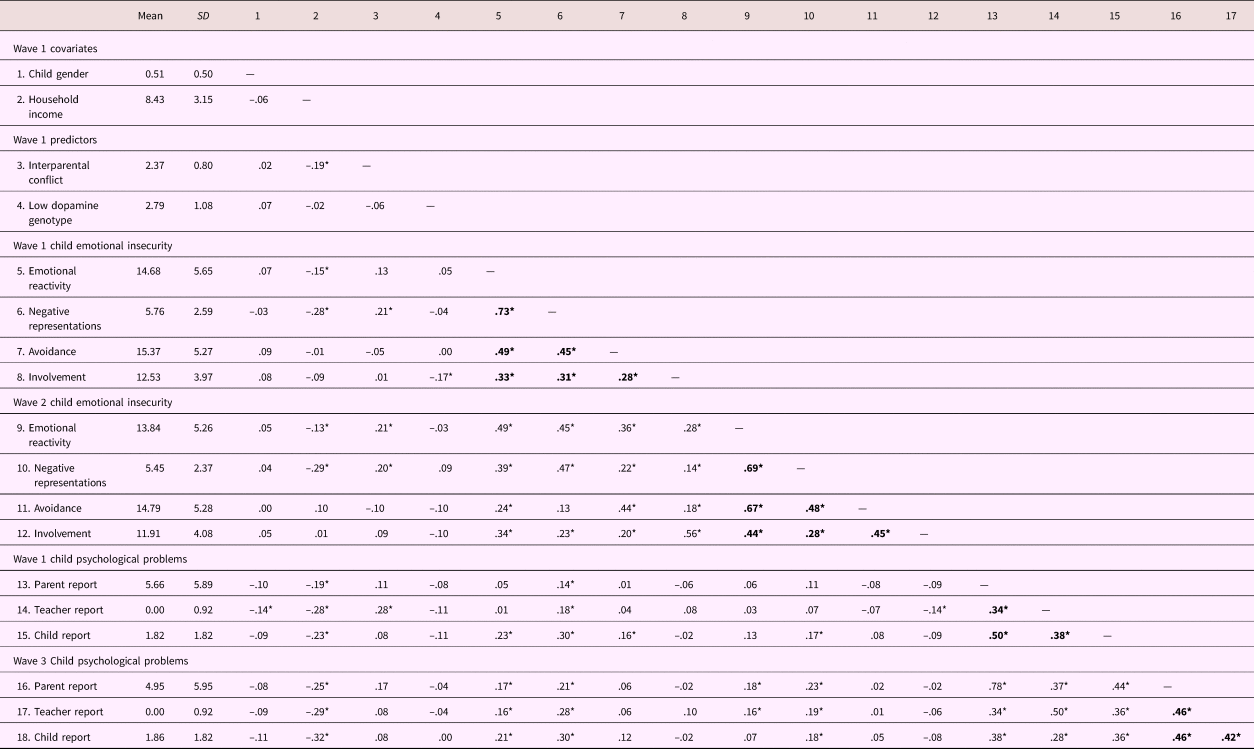
Table 2 provides the means, standard deviations, and correlations among the covariates and primary variables in the analyses. We found no evidence for the existence of gene–environment correlations. More specifically, the polygenic dopamine composite was unrelated to interparental conflict, r = –.06, p = .41. In addition, a series of analyses of variance examining each of the three genotypes as predictors of interparental conflict were all nonsignificant, all ps > .23. As denoted by the bolded coefficients in the table, correlations among the indicators of the higher order constructs of adolescent emotional insecurity and externalizing problems within each wave were generally moderate to strong in magnitude (Mean r = .45).
Means, standard deviations, and correlations among the primary variables in the study

Note: Correlations among indicators of latent constructs are in boldface. *p < .05.
Data in our sample were missing for 14.0% of the values. To test of whether data for the primary variables were missing completely at random (MCAR), we examined the patterns of missing data using Little's MCAR test (Little, Reference Little1988; Schlomer, Bauman, & Card, Reference Schlomer, Bauman and Card2010). Because the findings indicated that the data were MCAR (χ2 = 588.44, df = 542, p = .08) and the amount of missing data was under 20%, we followed quantitative recommendations by estimating missing data using full-information maximum likelihood (see Schlomer et al., Reference Schlomer, Bauman and Card2010). All primary analyses were conducted using structural equation model (SEM) analyses with Amos 25.0 software (Arbuckle, Reference Arbuckle2017).
Prior to conducting our primary analyses, we also tested for measurement invariance of the two latent constructs (i.e., externalizing symptoms and insecurity) by comparing the fit of a model in which indicators of each latent variable over time were constrained to be equal with a model in which the factor loadings were permitted to vary freely across the waves. Based on analytic recommendations (e.g., Dimitrov, Reference Dimitrov2010; Schwartz et al., Reference Schwartz, Des Rosiers, Huang, Zamboanga, Unger, Knight and Szapocznik2013), at least two of the following three conditions must be satisfied to accept the constrained model over the free-to-vary model: (a) the chi-square difference is nonsignificant; (b) decrease in comparative fit index (CFI) is no more than .01; and (c) increase in root mean square error of approximation (RMSEA) is no more than .01. Although the difference in chi-square was significant between the two models (Δχ2 = 14.61, df = 5, p = .01), the other two conditions for supporting measurement invariance were satisfied: ΔCFI = .007 and Δ RMSEA = .004. Therefore, we adopted the more conservative and parsimonious approach of using the constrained measurement model in all primary analyses.
Primary Analysis I: Does the dopamine genotype moderate interparental conflict?
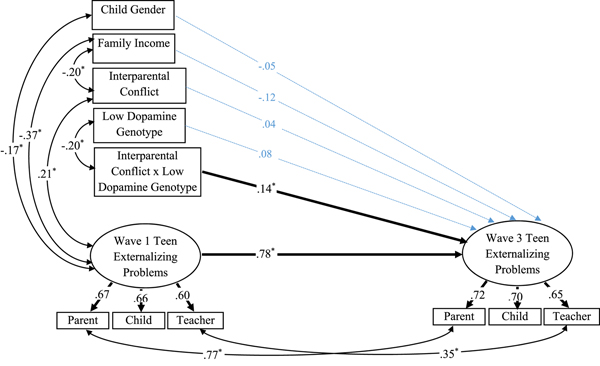
To test the dopamine genotype composite as a moderator of the association between interparental conflict and externalizing symptoms, our SEM analysis depicted in Figure 2 examined whether the cross-product of the centered variables of Wave 1 interparental conflict variable and the polygenic dopamine composite predicted the multi-informant latent construct of children's externalizing symptoms at Wave 3 after specifying Wave 1 interparental conflict and the dopamine composite as predictors. In reflecting the autoregressive part of the model, we controlled for children's externalizing symptoms at Wave 1 in the prediction of their Wave 3 externalizing problems. Because correlational results in Table 2 revealed that child gender and family income were associated with some assessments of externalizing problems, we included these two variables as covariates in the analysis. Correlations were also specified among all exogenous variables in the model and between residual errors of the same manifest indicators of adolescent externalizing psychological problems across time to account for stability in measurement error for each indicator. However, for clarity of presentation, only significant correlations are depicted in the figure.
An autoregressive structural model examining the interaction between interpersonal conflict and a low dopamine composite in predicting their externalizing symptoms over a 2-year period. *p < .05.

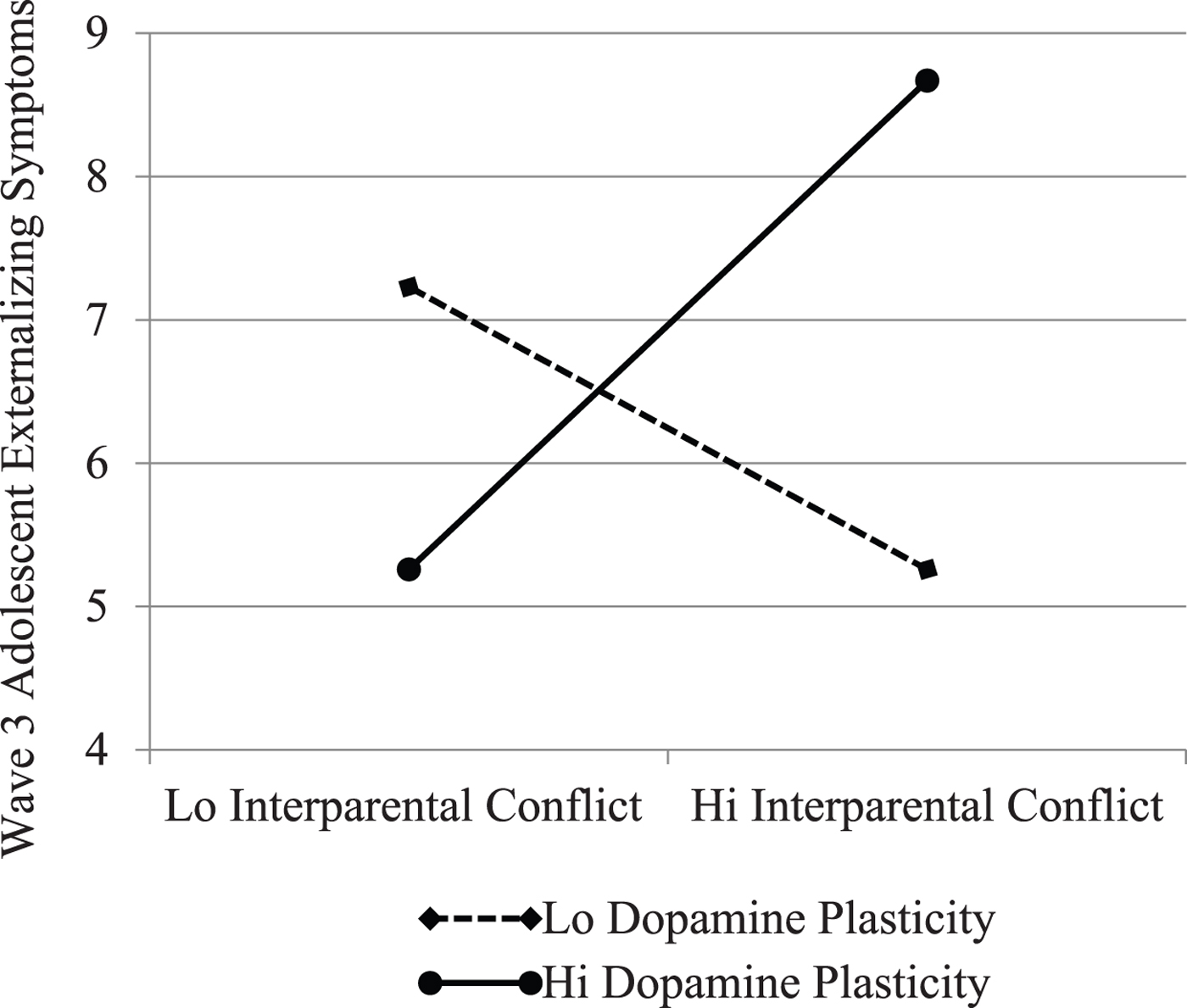
The resulting model, which is depicted in Figure 1, provided a good representation of the data, χ2 (27, N = 279) = 31.30, p = .26, RMSEA = .02, CFI = .99, and χ2/df ratio = 1.16. Although interparental conflict, lower family income, and child gender (i.e., being a boy) were significantly correlated with Wave 1 externalizing symptoms, none of the predictors were significantly related to externalizing symptoms at Wave 3. However, the interaction between interparental conflict and the polygenic dopamine composite significantly predicted change in externalizing symptoms from Waves 1 to 3 even after inclusion of structural paths involving the other predictors and covariates, β = .14, p = .02. Consistent with statistical recommendations (Del Giudice, Reference Del Giudice2017; Roisman et al., Reference Roisman, Newman, Fraley, Haltigan, Groh and Haydon2012), we calculated graphical plots and simple slope analyses at +/–2 SD from the mean of interparental conflict to capture a relatively comprehensive range of the proposed predictor (i.e., 95%). As shown in Figure 3, the graphical plot revealed a disordinal interaction, reflecting a crossover of the two regression lines. Simple slope analyses revealed that Wave 1 interparental conflict significantly predicted Wave 3 adolescent externalizing symptoms at high (+1 SD) levels of the hypodopaminergic composite, b = 1.06, p = .03. In contrast, interparental conflict was not associated with Wave 3 externalizing problems at low levels (–1 SD) of the composite, b = –0.62, p = .16.
A graphical plot of the interaction between interpersonal conflict and the dopamine gene composite at Wave 1 predicting subsequent change in adolescent externalizing problems from Waves 1 to 3.

Although the disordinal (i.e., crossover of regression lines) form of the interaction in Figure 3 appears to be consistent with differential susceptibility, inspection of graphical plots and simple slopes does not provide a sufficient test of whether the moderating role of the dopamine genotype corresponds more closely with differential susceptibility or diathesis-stress theories (Roisman et al., Reference Roisman, Newman, Fraley, Haltigan, Groh and Haydon2012). Therefore, following analytic guidelines (Del Giudice, Reference Del Giudice2017; Roisman et al., Reference Roisman, Newman, Fraley, Haltigan, Groh and Haydon2012), we calculated the proportion affected (PA) index. The PA is the index of choice in testing differential susceptibility because, unlike other tests, it is not dependent on sample size or the designated range of interest for the environmental predictor (e.g., 1 or 2 SD for the interparental conflict variable). The PA index is defined as the proportion of children within the hypothesized “for better” region in differential susceptibility theory or, more specifically, children who were below the point along the interparental conflict variable in Figure 3 where the two regression slopes intersect. PA indices above .16 are regarded as providing support for differential susceptibility, whereas values on these two indices that fall at or below .16 are interpreted as yielding evidence for diathesis-stress (Del Giudice, Reference Del Giudice2017; Roisman et al., Reference Roisman, Newman, Fraley, Haltigan, Groh and Haydon2012). The resulting PA value of .33 fell within the boundaries supporting differential susceptibility theory.
Primary Analysis II: Emotional insecurity as a mediator of dopamine gene moderation
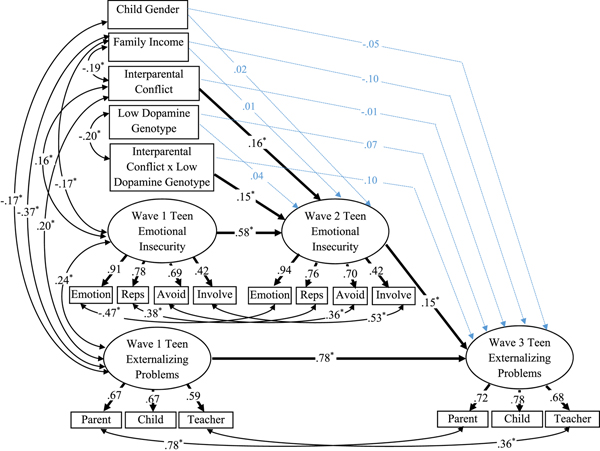
To examine why the dopamine genotype moderated interparental conflict and youth externalizing symptoms, we conducted another SEM analysis testing adolescent emotional insecurity in the interparental relationship as a mediator of the prospective pathway between the Interparental Conflict × Dopamine Genotype interaction and their externalizing symptoms at Wave 3 (see Figure 4). Therefore, in addition to specifying the same structural paths in the analyses depicted in Figure 2, we estimated paths between all the predictors and covariates and the latent construct of youth emotional insecurity at Wave 2 after controlling for the autoregressive path of emotional insecurity at Wave 1. To test the second link of the proposed mediational chain, we specified a structural path running from Wave 2 adolescent insecurity and their externalizing symptoms at Wave 3. As with our first primary analysis, we also estimated correlations between: (a) exogenous variables in the model and (b) residual errors of the same manifest indicators of latent constructs across time to account for stability in measurement error for each indicator. For clarity, only significant correlations are displayed in Figure 4, depicting model results.
An autoregressive structural equation model examining youth emotional insecurity as a mediator of the interaction between interpersonal conflict and a low dopamine genotype composite in predicting their externalizing symptoms over a 2-year period. Emotion, emotional reactivity. Reps., negative family representations. Avoid, avoidance. Involve, involvement. *p < .05.

The resulting model, which is shown in Figure 4, provided a satisfactory fit with the data, χ2 (121, N = 279) = 223.94, p < .001, RMSEA = .06, CFI = .93, and χ2/df ratio = 1.85. Interparental conflict at Wave 1 significantly predicted Wave 2 youth insecurity even after controlling for Wave 1 insecurity and the other predictors and covariates, β = .16, p = .01. Of more direct relevance to our mediated-moderation hypotheses, the interaction between interparental conflict and the polygenic dopamine composite was a significant predictor of Wave 2 youth insecurity, β = .15, p = .02. Adolescent emotional insecurity at Wave 2, in turn, was related to their externalizing symptoms at Wave 3 even after inclusion of the other predictors, covariates, and autoregressive paths, β = .15, p = .006. In further support for mediated moderation, bootstrapping tests of the indirect path involving the Interparental Conflict × Dopamine Genotype interaction, adolescent emotional insecurity, and externalizing symptoms was significantly different from 0, 95% confidence interval [.01, .31].
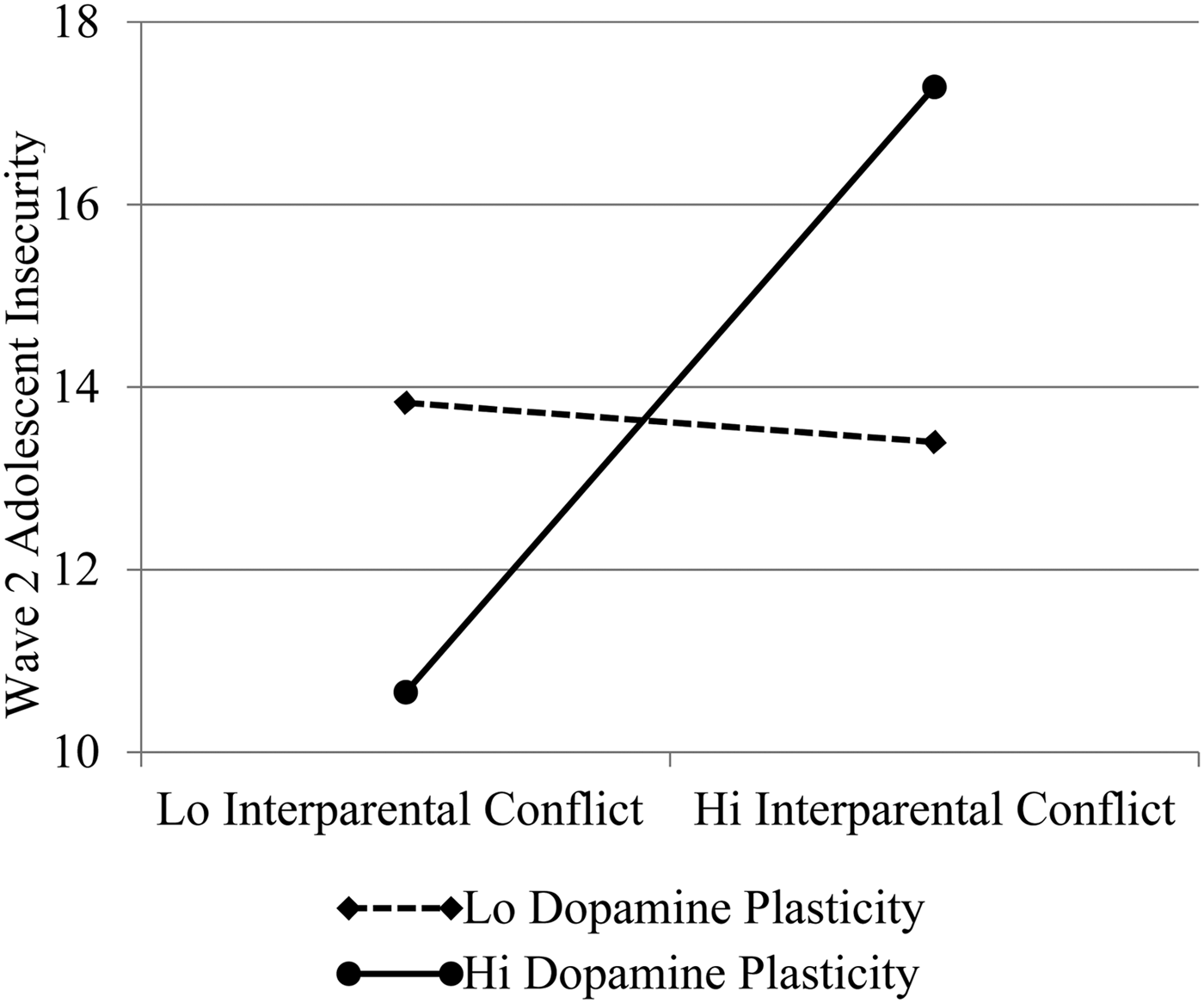
Mediated-moderation hypotheses would be further supported if the moderating role of the dopamine genotype were comparable in form for the proposed mediator (i.e., insecurity) and outcome (i.e., externalizing symptoms). Thus, to examine the similarity of the interactions, we used the same procedures employed for characterizing the interaction for the prediction of externalizing symptoms. First, as Figure 5 shows, the graphical plot of the association between Wave 1 interparental conflict (at +/–2 SD around the mean) and Wave 2 youth insecurity at high and low levels of the hypodopaminergic composite revealed a disordinal interaction that was similar in form to the externalizing symptoms findings. Second, in further accord with the externalizing symptoms results, the simple slope analyses indicated that interparental conflict significantly predicted adolescent insecurity at Wave 2 when the hypodopaminergic genetic composite was relatively high (+1 SD), b = 2.07, p = .002. but not low (–1 SD), b = –0.13, p = .81. Third, following a roughly similar pattern to the follow-up analyses for externalizing symptoms, the PA index was .45 in the interaction predicting youth insecurity and also substantially exceeded threshold (i.e., .16) for supporting differential susceptibility over diathesis-stress.
A graphical plot of the interaction between interpersonal conflict and the dopamine gene composite at Wave 1 predicting subsequent change in adolescent emotional insecurity from Waves 1 to 2.

Post hoc analyses: Parsing the specific genetic sources of moderation
Because the moderating role of our polygenic composite may reflect the potential operation of one or two dopamine genes, our aim in post hoc analyses was to more precisely pinpoint the gene or genes underlying the documented susceptibility of children with genes conferring low dopamine activity. Therefore, we conducted additional SEM analyses to examine whether the prospective association between Wave 1 interparental conflict and youth externalizing symptoms at Wave 3 was moderated by variation in the DRD4 (7-R present versus 7-R absent), DAT1 (two, one, and zero copies of the 10-R allele), and COMT (two, one, or zero copies Val) genotypes. Model specifications were identical to the analyses in Figure 2 except that the polygenic dopamine composite was replaced by each of the specific genotypes in three successive models. The resulting models provided a good representation of the data: χ2 (27, N = 279) = 30.72, p = .28, RMSEA = .02, CFI = .99, and χ2/df ratio = 1.14 for DRD4; χ2 (27, N = 279) = 29.84, p = .32, RMSEA = .02, CFI = .99, and χ2/df ratio = 1.11 for DAT1; and χ2 (27, N = 279) = 37.78, p = .08, RMSEA = .04, CFI = .98, and χ2/df ratio = 1.40 for COMT. Inspection of the structural paths revealed that the Interparental Conflict × Genotype interaction did not significantly predict externalizing symptoms for the DAT1, β = –.01, p = .81, or COMT, β = .05, p = .41, analyses. However, in the remaining SEM model, the interaction between interparental conflict and the DRD4 genotype was a significant predictor of youth externalizing symptoms at Wave 3 even after controlling for Wave 1 adolescent problems, interparental conflict, the DRD4 genotype, and the two covariates, β = .16, p = .005.
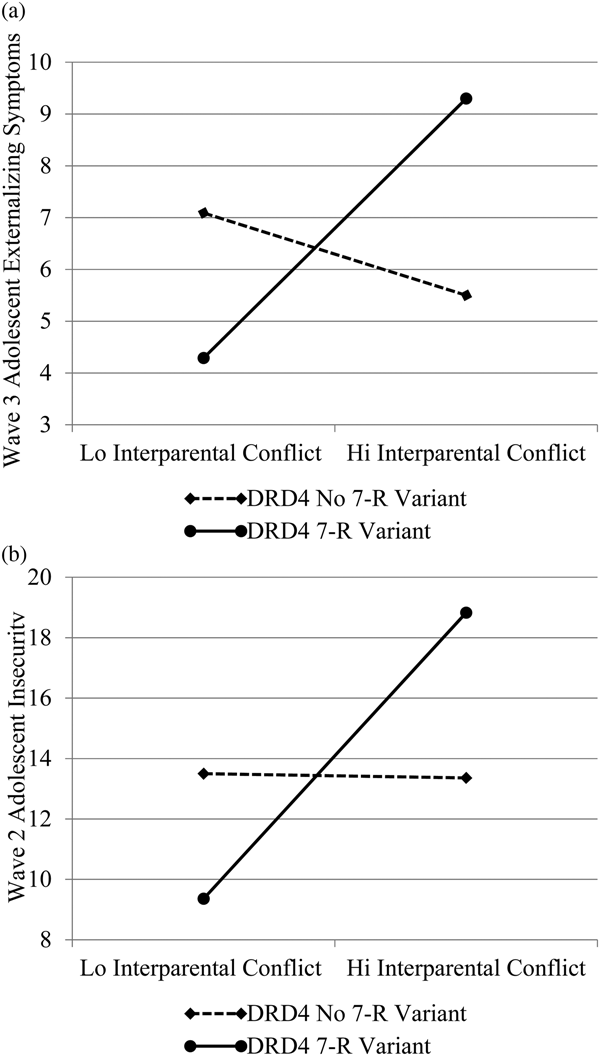
Consistent with the moderating effects for the polygenic dopamine composite, the graphical plot revealed a disordinal interaction (see Figure 6a). Simple slope analyses indicated that Wave 1 interparental conflict predicted Wave 3 externalizing symptoms for teens who carried the putative susceptibility variant (7-repeat) of DRD4, b = 2.62, p = .009. In contrast, there was no significant association between interparental conflict and externalizing problems for teens who did not carry the 7-R variant, b = –0.50 p = .18. Following the same pattern of results for the broader dopamine composite, the PA value of .40 for the moderating role of DRD4 decidedly favored the operation of differential susceptibility over diathesis-stress.
A graphical plot of the interaction between interpersonal conflict and DRD4 in predicting subsequent change in (a) adolescent externalizing symptoms from Waves 1 to 3, and (b) adolescent insecurity from Waves 1 to 2.

To test whether youth concerns about emotional security accounted for why interparental conflict was a stronger predictor of externalizing for carriers of 7-repeat variant of DRD4, we conducted another SEM analysis that was identical to the model depicted in Figure 4 except that DRD4 was utilized as the genetic variable in place of the polygenic composite. The model fit the data well, χ2 (121, N = 279) = 200.29, p < .001, RMSEA = .05, CFI = .95, and χ2/df ratio = 1.66. The interaction between interparental conflict and the DRD4 genotype significantly predicted adolescent insecurity at Wave 2 after specifying interparental conflict, the DRD4 genotype, Wave 1 insecurity, and the two covariates as predictors, β = .20, p = .002. The graphical plot, depicted in Figure 6b, revealed a disordinal interaction that was similar in form to the model of youth externalizing symptoms shown in Figure 6a. Simple slope analyses indicated that interparental conflict at Wave 1 was a significant predictor of youth insecurity at Wave 2 for DRD4 7-repeat carriers, b = 2.96, p < .001. In contrast, interparental conflict was unrelated to Wave 2 insecurity for adolescents without the 7-R variant of the gene, b = –0.04, p = .93. Consistent with the results of DRD4 as a moderator of externalizing symptoms, the PA index of .42 reflected that the form of moderating effects of DRD4 in the prediction of youth insecurity supported differential susceptibility over diathesis-stress.
Discussion
Inspired by the Special Issue emphasis on a multiple-levels-of-analysis approach to understanding emotion dysregulation and developmental psychopathology, our goal in this paper was to test the value of integrating molecular genetic models into process-oriented models of youth reactivity to interparental conflict. As a first step toward this aim, we specifically examined whether a polygenic dopamine composite consisting of DRD4, DAT1, and COMT moderated adolescent vulnerability to interparental conflict. Consistent with hypotheses, our observational measurement of interparental conflict was a significantly stronger predictor of increases in externalizing symptoms over a 2-year period for adolescents who scored higher on the hypodopaminergic polygenic composite. Toward further advancing an understanding of the interplay between interparental conflict and dopaminergic genes, our second aim was to examine whether the genetic moderation of risk was explained, in part, by youth emotional insecurity in the interparental relationship, a key index of emotion dysregulation in the context of the family (Cummings & Miller-Graff, Reference Cummings and Miller-Graff2015). Results of our autoregressive mediated-moderation analyses showed that adolescent emotional insecurity mediated the moderating role of the hypodopaminergic composite in the association between interparental conflict and their externalizing problems. Post hoc analyses designed to parse the specific genetic sources of moderation revealed that adolescent genetic susceptibility to interparental conflict was largely attributable to allelic variation in the DRD4 gene.
Although neurobiological models have repeatedly conceptualized low dopaminergic tone as magnifying associations between family contexts and children's behavioral problems, theoretical frameworks have differed in how they have interpreted the nature of the moderation (Del Giudice, Ellis, & Shirtcliff, Reference Del Giudice, Ellis, Shirtcliff, Laviola and Macrì2013). On the one hand, conceptualizations rooted in diathesis-stress frameworks posit that dopamine genes act as diatheses that amplify offspring vulnerability to family adversity without conferring any developmental benefits in more benign rearing contexts. On the other hand, genetic models rooted in differential susceptibility theory have proposed that alleles linked with low dopamine activity are plasticity factors that sensitize children to both adverse and supportive environments (Belsky & Pluess, Reference Belsky, Pluess and Cicchetti2016). Simple slope analyses of the significant G × E interaction in our moderator analyses revealed that interparental conflict only predicted subsequent increases in externalizing symptoms for youth who exhibited elevated scores on the hypodopaminergic genetic composite. The follow-up graphical plot and quantitative analysis (i.e., PA index) offered stronger support for the differential susceptibility formulation of genetic moderation over the diathesis-stress model. Specifically, the disordinal nature of the interaction in the graphical plot indicated that individuals carrying genetic alleles associated with lower dopamine tone evidenced relatively greater externalizing symptoms when exposed to destructive interparental conflict and relatively fewer externalizing symptoms in the face of constructive conflicts. The PA index of .33 further indicated that 33% of the sample of adolescents fell on the “for better” side of the equation, where children with genetic alleles conferring low dopaminergic activity evidenced lower externalizing symptoms than their counterparts who scored low on the genetic composite. Thus, our results extend the growing support for differential susceptibility theory in other socialization contexts by demonstrating for the first time that dopamine-related genes also serve as plasticity factors in the association between interparental conflict and youth externalizing symptoms (e.g., Bakermans-Kranenburg & van IJzendoorn, Reference Bakermans-Kranenburg and van IJzendoorn2011, Reference Bakermans-Kranenburg and van IJzendoorn2015).
Rooted in conceptual frameworks on the dopaminergic underpinnings of individual differences in emotion regulation and dysregulation (e.g., Carver, LeMoult, Johnson, & Joorman, Reference Carver, LeMoult, Johnson and Joormann2014; Moore & Depue, Reference Moore and Depue2016), our next analytic step was to move beyond cataloguing genetic moderation to address the process-oriented aim of examining the affective mechanisms accounting for why genetic alleles encoding low dopamine activity increase children's susceptibility to interparental conflict. In drawing from EST, we hypothesized that hypodopaminergic genetic dispositions sensitize youth to the quality of interparental conflicts by increasing the reactivity of a goal system that is designed to preserve a sense of safety and security. According to the theory, repeated exposure to destructive interparental conflict progressively undermines children's ability to achieve a sense of security. Consistent with broader conceptualizations of emotion dysregulation, signs of insecurity were reflected in intense, prolonged experiences of distress, negative family representations, and extensive efforts to regulate parental interactions through behavioral involvement and avoidance in conflicts. Protracted emotional insecurity, in turn, is proposed to increase children's psychological problems. However, in addressing how emotional security may operate in diverse ways for different children from high-conflict homes, a key research priority in EST is to identify the physiological and behavioral characteristics of children that may increase or dampen their sensitivity to interparental interactions (Cummings & Miller-Graff, Reference Cummings and Miller-Graff2015).
In advancing this generation of research, the results of our mediated-moderation analyses indicated that adolescent emotional insecurity mediated the interaction between interparental conflict and the dopamine composite in predicting subsequent increases in their externalizing symptoms. Interparental conflict was a significant predictor of greater emotional insecurity only for youth who were high on the hypodopaminergic genetic composite. Insecurity, in turn, predicted subsequent increases in adolescent externalizing symptoms 1 year later. The findings further showed that the pattern of moderation for the dopamine composite was comparable for emotional insecurity and externalizing symptoms. Therefore, consistent with the differential susceptibility obtained in the externalizing symptoms results (Belsky & Pluess, Reference Belsky, Pluess and Cicchetti2016), the graphical plot and PA index (i.e., .45) indicated that low dopamine was a plasticity factor. Children with lower dopamine activity specifically evidenced more insecurity than those with higher dopamine activity at high levels of interparental conflict, but also relatively lower vulnerability to insecurity than their counterparts at low levels of interparental conflict.
The mediated-moderation findings also raise important questions about how diminished dopamine activity sensitizes adolescents to interparental conflict in a for better or for worse manner. At a broad level, dopaminergic activity is proposed to confer heightened susceptibility by shaping how individuals filter, process, and react to a variety of environmental cues (Del Giudice et al., Reference Del Giudice, Ellis, Shirtcliff, Laviola and Macrì2013). According to several neurobiological models, brain regions within the mesolimbic system (e.g., ventral striatum, amygdala, hypothalamus, and bed nucleus of the stria terminalis) play a significant role in processing the emotional significance of stimuli, including the valuation of its aversive and rewarding properties (Moore & Depue, Reference Moore and Depue2016; Schriber & Guyer, Reference Schriber and Guyer2016). As possible mechanisms underpinning the bright side of the moderating effects, the tendency for low dopamine tone to be linked with greater behavioral sensitivity to rewards and extraversion may increase their likelihood of profiting in more supportive interparental contexts, as indexed in our study by lower insecurity and externalizing symptoms (Beauchaine et al., Reference Beauchaine, Zisner and Sauder2017; Gatzke-Kopp, Reference Gatzke-Kopp2011; Moore & Depue, Reference Moore and Depue2016; Salamone, Correa, Farrar, Nunes, & Pardo, Reference Salamone, Correa, Farrar, Nunes and Pardo2009). For example, children with low dopamine activity may benefit more from positive interparental interactions due to their higher engagement and interest in social interactions. Likewise, although more speculative within a small and inconsistent corpus of research, the neurobiological model of environmental reactivity proposes that the low dopamine tone may be part of a broader neurobiological system that is calibrated to be highly reactive to both threat and reward (see Moore & Depue, Reference Moore and Depue2016).
Given that our polygenic composite was designed to capture individual differences in dopamine across both the mesolimbic and the mesocortical pathways, it is also possible that the differential susceptibility findings in the present study was the result of the dual operation of low dopamine activity across both systems. For example, high sensitivity to positive social stimuli characteristic of low dopaminergic tone in the mesolimbic system may selectively amplify children's sensitivity to positive features of interparental conflict. In support of this possibility, Schlomer et al. (Reference Schlomer, Cleveland, Vandenbergh, Feinberg, Neiderhiser, Greenberg and Redmond2015) reported that adolescent perceptions of positivity were associated with lower appraisals of conflict as threatening only for DRD4 7-repeat carriers. As a result, it may specifically account for why youth with more hypodopaminergic alleles may evidence disproportionately lower levels of insecurity and externalizing symptoms when exposed to relatively higher levels of constructive conflict between parents. By contrast, low dopamine levels in the mesocortical system may selectively account for why these same children evidence substantially higher vulnerability to insecurity and externalizing symptoms when faced with high levels of destructive interparental conflict. For example, research has shown that childhood adversity significantly predicted a specific dimension of impulsivity characterized by difficulties regulating negative emotions only for college students carrying low dopamine alleles (Carver et al., Reference Carver, LeMoult, Johnson and Joormann2014). Thus, through its phenotypical links with executive function impairments and difficulties regulating emotions, diminished dopaminergic tone in the mesocortical system may specifically potentiate insecurity (e.g., emotional reactivity or impulses to intervene) in contexts of high interparental adversity and, in turn, increase adolescent risk for externalizing symptoms (Richards et al., Reference Richards, Vásquez, Von Rhein, Van der Meer, Franke, Hoekstra and Hartman2016; Smilie & Wacker, Reference Smillie and Wacker2014; Tielbeek et al., Reference Tielbeek, Johansson, Polderman, Rautiainen, Jansen, Taylor and Viding2017).
In delineating the specific operation of the individual genes as moderators, our post hoc analyses further revealed that the differential susceptibility effects were primarily attributable to the DRD4 gene. Whereas COMT and DAT1 polymorphisms failed, in isolation, to moderate youth susceptibility to interparental conflict, the 7-repeat allele of the DRD4 gene was identified as a plasticity allele in the associations between interparental conflict and externalizing symptoms, with emotional security serving as a mediator of the DRD4 moderation. These findings correspond with the larger literature on dopamine genes. Although some studies find support for the hypothesis that the Val allele of COMT and the 10-repeat allele of DAT1 operate as sources of differential susceptibility, the findings in the broader literature are not always consistent. For example, Belsky et al. (Reference Belsky, Newman, Widaman, Rodkin, Pluess, Fraley and Roisman2015) designated COMT and DAT1 as second-tier plasticity candidates. Moreover, discrepancies exist across and even within labs regarding whether the DAT1 plasticity allele is the 10-repeat (e.g., Bakermans-Kranenburg & van Ijzendoorn, Reference Bakermans-Kranenburg and van IJzendoorn2011; Belsky & Beaver, Reference Belsky and Beaver2011; Richards et al., Reference Richards, Vásquez, Von Rhein, Van der Meer, Franke, Hoekstra and Hartman2016) or 9-repeat variant (e.g., Belsky et al., Reference Belsky, Newman, Widaman, Rodkin, Pluess, Fraley and Roisman2015; Sonuga-Barke et al., Reference Sonuga-Barke, Oades, Psychogiou, Chen, Franke, Buitelaar and Miranda2009) of the gene.
In contrast, literature reviews and meta-analyses have repeatedly documented that the 7-repeat allele of DRD4 is among the most robust genetic plasticity factors in the literature (Belsky & Pluess, Reference Belsky, Pluess and Cicchetti2016; Boyce, Reference Boyce2016; Pluess, Reference Pluess2017; Weeland et al., Reference Weeland, Overbeek, de Castro and Matthys2015). Although any interpretation of these findings is highly speculative at this early stage of research, it is possible that the DRD4 gene is a more robust moderator of environmental input due to its prevalence in multiple dopaminergic pathways. Whereas the COMT enzyme and DAT1 are largely expressed in mesocortical and mesolimbic systems respectively, DRD4 is broadly expressed in both dopaminergic circuits. Thus, DRD4 may underpin a more expansive set of endophenotypes (e.g., heightened striatal reactivity to reward and right temporal lobe reactivity to aversive stimuli) and phenotypes (e.g., extraversion, delay discounting, emotion dysregulation, and inhibitory control difficulties) that collectively lay the foundation for greater sensitivity to both positive and negative environmental input (e.g., Carver et al., Reference Carver, LeMoult, Johnson and Joormann2014; Gehricke et al., Reference Gehricke, Swanson, Duong, Nguyen, Wigal, Fallon and Moyzis2015; Moore & Depue, Reference Moore and Depue2016; Richards et al., Reference Richards, Vásquez, Von Rhein, Van der Meer, Franke, Hoekstra and Hartman2016). Given that we also selected the three genes based on their different functions within dopaminergic circuits, a complementary explanation is that the unique role DRD4 plays in signaling between neurons relative to COMT and DAT1 may account for its robust moderating effects. Thus, delineating the phenotypes and endophenotypes underlying the moderating role of the DRD4 gene is an important direction for future research (Moore & Depue, Reference Moore and Depue2016).
Several limitations in this study also merit discussion for a balanced interpretation of the findings. First, caution should be exercised in generalizing the findings to other populations beyond our community sample that largely consisted of White and middle- or working-class families. For example, powerful tests of differential susceptibility theory hinge on obtaining adequate representation of both supportive and negative rearing environments. Thus, at-risk or clinical samples where rearing environments may be skewed toward overrepresentation of environmental adversity may yield different forms of genetic moderation that more closely resemble diathesis-stress models of emotion dysregulation and its sequelae (Beauchaine & Gatzke-Kopp, Reference Beauchaine and Gatzke-Kopp2012). Second, although our use of multiple methods, informants, and levels-of-analysis within a longitudinal design increased the rigor of our study, our specific assessment of emotional insecurity as a mediator of the G × E findings was based solely on a single informant and method (i.e., youth self-report). In building on the demonstrated value in this Special Issue of using multimethod approaches to assess emotion dysregulation, future research would profit from diversifying assessments of youth emotional security. Third, although our moderator effects closely corresponded with differential susceptibility theory, our findings do not definitively rule out the operation of alternative mechanisms. Differential susceptibility theory assumes that the stronger association between environmental quality and youth psychological functioning is due to their heightened constitutional sensitivity to the environment. However, evocative processes may also underpin the moderating effects. For example, according to the biosocial development model, lower dopamine in the mesolimbic system increases the likelihood of reciprocal escalating bouts of hostility and coercion between parents and children, which, through negative reinforcement contingences, lay the foundation for behavior problems (Beauchaine, Gatzke-Kopp, & Mead, Reference Beauchaine, Gatzke-Kopp and Mead2007).
In conclusion, our integration of genetic formulations of differential susceptibility theory and emotional security theory was designed to advance the knowledge base on emotion regulation and dysregulation at several levels. To address the paucity of research on the role of genes as moderators of the risk posed by interparental conflict, our first aim was to examine whether three dopaminergic genes (i.e., DRD4, DAT1 VNTR, and COMT) collectively and individually served as plasticity factors in the association between interparental conflict and youth externalizing symptoms. Consistent with hypotheses, the results indicated that individuals who were carrying genetic alleles associated with lower dopaminergic tone evidenced lower and higher levels of externalizing problems than their peers under respective exposures to constructive and destructive interparental conflict. In addressing calls in the literature for deeper process-oriented analyses of G × E effects, mediated-moderation analyses supported the hypothesis that emotional insecurity was a functional carrier of the susceptibility experienced by adolescents with a hypodopaminergic genetic profile. Post hoc tests further revealed that allelic variation in the DRD4 gene was the primary source of moderation for the polygenic composite. At a substantive level, these findings not only help to address calls in the G × E literature for deeper process-oriented analyses of genetic moderation but also advance prevailing theories of interparental conflict and their aim of identifying the genetic bases of individual differences in children's adaptation and adjustment in high-conflict homes (Davies, Sturge-Apple, & Martin, Reference Davies, Sturge-Apple, Martin, Landale, McHale and Booth2013; Schlomer et al., Reference Schlomer, Fosco, Cleveland, Vandenbergh and Feinberg2015). Finally, although any definitive recommendations for clinical practice and public policy will hinge on replicating the results, our identification of genetic moderation and the emotional mediators of susceptibility may eventually advance and refine targets of treatment and therapeutic tools for optimizing the adjustment of children who are highly susceptible to family conflict (Cicchetti & Toth, Reference Cicchetti and Toth2009).
Acknowledgments
We are grateful to the children, parents, and school staff who participated in the project and to the project personnel at the University of Rochester and the University of Notre Dame.
Financial support
This research was supported by the National Institute of Mental Health Grant 2R01 MH57318.