Many students of international relations have argued that international laws and institutions can ameliorate the conflict-producing properties of international anarchy. They hope by consequence that such arrangements may help states achieve mutually beneficial forms of cooperation, and thereby attain and fortify peace among them. For these students, international law and institutions “matter” in world politics insofar as they can constrain otherwise independent states to eschew proscribed forms of behavior.
However, in recent years institutionalists have had to confront the argument that even a high level of compliance by states with international rules is not in fact evidence of the latter's efficacy or independent effects on state behavior.Footnote 1 States may adhere to such rules not because they are constrained to do so, but rather because they construct and sign only those accords that stipulate behaviors that the signatories prefer to pursue even in the absence of their external obligations. In other words, both the content of those obligations and compliance with them may be endogenous to the preferences of the states that construct the laws and institutions in question.
Simmons has put forward an important reply to this critique, in an analysis of international legal prohibitions on state application of restrictions on foreign exchange transactions undertaken to accommodate current account transactions between the late-1960s and the late-1990s.Footnote 2 She finds that states that were adherents during that period to Article VIII of the Articles of Agreement of the International Monetary Fund (IMF), which prohibits such restrictions, were less likely to impose them than were states that belonged to the IMF but had not made such a commitment. In conducting this analysis, Simmons attempts to confront the anti-institutionalist challenge by including a wide range of macroeconomic control variables that reflect on the decision calculus of state leaders concerning the desirability of openness in foreign exchange markets.
The problem, we suggest below, is that such macroeconomic indicators do not fully capture the range of pressures on the preferences of state leaders. While leaders may be “pushed” into certain policy stances by international economic considerations, they are also “pulled” into certain stances by the demands of their domestic constituencies. By consequence of this incomplete specification of state preferences, we cannot judge whether Article VIII adherents have been less likely than nonadherents to impose restrictions because of the adherence of the former to Article VIII, or because the former have stronger preferences than do the latter for open exchange markets.
Compliance with International Law and the Problem of National Preferences
To complement Simmons's analysis of the effects of Article VIII, and to confront directly the issue of law and endogenous state preferences, we propose to consider a type of political change in a state that is likely to represent the coming- into-effect of new domestic preferences about foreign-exchange and capital-market openness. That political change, we suggest, is a relative shift in the left-right orientation of the party in control of the executive branch of the national government. In particular, we suggest that, other things being equal, a leftward shift in a government's partisan placement is likely to result in a set of official policy views that are less hospitable to an open foreign exchange market, notwithstanding international legal commitments on this matter that were made by a previous government.
We base this argument on the widespread finding in the field of comparative political economy that party systems in most advanced industrial countries and in many developing countries are grounded in significant measure on class divisions. Differences across countries in labor markets and levels of international economic integration may modify the impact of partisan orientation on macroeconomic policies. However, in general, left-leaning parties promote the interests of their core working-class constituents through expanded government spending, taxation on higher-income earners, and monetary expansion, while right-leaning parties generally promote the interests of capital owners by seeking to pursue restraint in fiscal and monetary policy.Footnote 3 The policy orientation of left-leaning parties toward macroeconomic expansionism may create a higher risk of current account deficits and currency depreciation. State responses to address those two problems are constrained if currency markets must be relatively free of government restrictions, as required by Article VIII. By consequence, then, of the fundamental macroeconomic preferences of left-leaning parties, such parties may be expected to have a lower commitment to international economic openness in financial matters, and to international rules that promote such openness.Footnote 4
Data and Methods
Rigorous testing of the relationship between national preferences and state behavior is fraught with methodological difficulties. The most basic of these difficulties lies in the measurement of the preferences themselves. While there are ample theoretical reasons for believing that “leftward” or “rightward” political orientations are directional categories that have relatively consistent meanings across countries, previous research in this area has been stymied by the difficulty of making cross-national comparisons of the degree of partisanship that characterizes the specific location of a party on the left-right continuum. Making such comparisons requires a cardinal partisanship scale that would allow parties in one country to be positioned relative to parties in other countries, or, in other words, a partisanship scale that transcends the particularities of separate domestic regimes.
Attempts to construct such scales have been made on the basis of cross-national public opinion surveys, such as the Eurobarometer and World Values Survey, on the basis of expert opinion surveys, and on the basis of factor analysis of party platform elements.Footnote 5 However, the richness of the data required to perform such analyses has forced researchers to focus their data collection efforts on relatively small country samples that are strongly skewed toward the Organization for Economic Cooperation and Development (OECD). These data thus represent an inadequate means by which to test the efficacy of a causal variable—Article VIII acceptance—which varies primarily amongst countries that are not a part of the OECD.
Partisanship data for a far broader sample of country-years is provided by the Database of Political Institutions (DPI), which records the left-right orientation of the party heading the executive branch for 182 countries since 1975.Footnote 6 However, in contrast to the more detailed measures developed for OECD countries, the DPI data set makes no attempt to develop a cardinal scale that would be applicable across such a wide range of countries. Instead, parties that differentiate themselves along economic lines are coded either as “left,” “right,” or “center” on the basis of party names (for example, a party with the term ‘socialist’ in its name is assumed to be left-wing) and a variety of secondary sources. Parties that do not differentiate themselves along economic lines are placed in a fourth, residual category. The simplicity of this coding scheme allows the DPI data to cover a far wider range of countries but renders cross-national comparisons difficult. While it is relatively straightforward to determine that party A is to the left of party B on the political spectrum defined by the domestic regime in which they are competing, there is no good reason to believe that such categories have consistent meanings across countries. In fact, what counts as “left” in one country might be considered “center” or even “right” in another country. Because there is no Archimedean point from which to judge the positions of all parties simultaneously, treating any one of the DPI categories as a simple predictor of financial openness or Article VIII compliance would be highly problematic.
The solution we propose to this problem is to abandon the attempt to measure absolute position on a single, global, cardinal scale. Instead, we characterize our central causal variable as the presence or absence of relative partisan shifts. We treat the DPI categories of “left,” “right,” and “center” as representing ordinal values that are comparable within countries, but not across countries. We then use particular events of policy change to define “landmark” reference points on the political spectrum in each country and measure partisanship as relative shifts subsequent to each landmark.
More specifically, we code orientation for each party in our data set as −1 if DPI categorizes them as “left,” +1 if DPI categorizes them as “right,” and 0 if DPI categorizes them as “center,” or if they do not differentiate themselves along economic lines. We then code governmentit as the orientation of the party heading the executive branch in country i and year t. Finally, we code shiftleftit equal to 1 if governmentit < governmentiu (where u is the year of our “landmark” event) and 0 otherwise, and similarly code shiftrightit equal to 1 if governmentit > governmentiu and 0 otherwise. By using simple dichotomous indicators for the presence or absence of such shifts, we seek to remain agnostic about the scale on which the shifts are occurring, while still capturing information about the direction of the shifts.
This of course still leaves open the question of what relevant “landmarks” on the political spectrum could be used to judge such relative shifts. We propose two separate specifications, which correspond to the two main observable implications of our theory. In the first specification we set u equal to t − 1, effectively treating each country-year as the relevant landmark for the subsequent country year. We accomplish this through a first differences specification, of the form:

where Y it is the level of financial openness adopted by country i in year t; ΔY it = Y it − Y it−1, X it is a vector of control variables; and ΔX = X it − X it−1. We thus seek to predict year-to-year changes in openness on the basis of year-to-year changes in X and the presence or absence of year-to-year rightward shifts in the partisan orientation of the executive branch. In addition to matching the functional form of our hypothesis, the first differences specification also has the added benefit of automatically controlling for any confounding factors that are constant within countries. Note that in this specification, each observation of openness Y it−1 serves as a landmark baseline against which to judge Y it, just as each observation of governmentit−1 serves as a landmark baseline against which to judge the presence or absence of shiftrightit. Thus, even if we do not know that the category of “right” in one country represents the same absolute position on the political spectrum as the category of “right” in another country, we can still be confident in judging whether a relative shift has occurred, and even if we remain agnostic as to the cardinal size of the shift, we can still be confident in judging its presence or absence and make statistical predictions on that basis.
The second specification uses a similar logic in defining relative partisan shifts but transports this logic to a separate empirical domain: treaty compliance. Here, we follow Simmons as well as Simmons and Hopkins in specifying a logistic regression of the form:

where the dependent variable restrictit is a dichotomous indicator of whether current account restrictions were imposed in a given country-year, and art8it is a dichotomous indicator of whether Article VIII obligations have been accepted for a given country-year, and X it is a vector of control variables. For this specification, rather than setting u equal to t−1, we set u equal to the year Article VIII was signed by a particular country. shiftleftit thus treats the moment of Article VIII acceptance as the landmark baseline against which to judge the presence or absence of a relative partisan shift. This essentially renders shiftleftit as an interaction term with art8it, which equals 0 for all country-years prior to the signing of Article VIII, 0 for all country-years subsequent to the signing of Article VIII for which the party heading the executive is not positioned to the left of the party in power when Article VIII was signed, and 1 for country years subsequent to the signing of Article VIII for which the party heading the executive is to the left of the party in power when Article VIII was signed. This term thus represents the ideal test of whether shifts away from the configuration of national preferences that produced the original decision to sign Article VIII serve to condition the probability of compliance with the treaty.
For both specifications we use the same set of control variables, the only exception being those variables that are constant within countries and therefore automatically drop out of the first differences specification. First, we include every macroeconomic variable from Simmons, which is used as a predictor of Article VIII acceptance or restriction behavior. These are exchange rate flexibility, trade dependence, gnp per capita, gdp growth, reserves/gdp, reserves volatility, balance of payments/gdp, terms of trade volatility, imf surveillance, use imf credits, universality of article viii, and regional restrictions.Footnote 7 Second, we include three dichotomous indicators of regime characteristics that may make frequent partisan shifts in the executive branch more or less likely. military equals 1 if a uniformed military officer heads the executive branch, term limitations equals 1 if the executive's maximum term of office is constitutionally limited, and parliamentary equals 1 if the country has a parliamentary system in which the legislature can recall the leader of the executive branch. To control for duration dependence, the logit specification also includes a term counting the number of years since the last restriction, along with squared and cubed transformations of this term, as recommended by Carter and Signorino.Footnote 8 Financial openness, the dependent variable in the first specification, is measured using the Chinn-Ito KAOPEN index for the period 1970–97.Footnote 9 Data on restriction activities, the dependent variable in the second specification, is taken directly from Simmons for the period 1967–97.Footnote 10
Within these temporal bounds, we face a substantial degree of missing data. Especially problematic in this regard are the data for our partisan shift variables, which are only available beginning in 1975. To avoid the biases that may result from simple listwise deletion, we fill in missing cells using multiple imputation.Footnote 11 We generate five multiple-imputed data sets for each of our two specification forms, including all of the variables from each specification along with country fixed effects in our imputation models. By jointly analyzing each set of five, we can incorporate the uncertainty associated with the imputation into our estimates of causal effects.
The final methodological hurdle concerns the possibility of selection bias. As von Stein argues, a standard logistic regression that treats restrictions as the dependent variable, and Article VIII acceptance as an independent variable, may overstate the significance of the treaty's effect if states are self-selecting into signing.Footnote 12 The problem is that countries that experience an event, such as the signing of Article VIII, may be systematically different from countries that do not experience the event, making naive comparisons between these two groups inherently problematic. Even if the relevant control variables are included in the model, nonlinearities in their effects that correlate with the selection process may still bias our causal inferences.Footnote 13 We agree with Simmons and Hopkins that the best solution to this difficulty is not to rely on the dubious distributional assumptions that underlie Heckman-style selection models, but rather to pursue nonparametric matching approaches.Footnote 14
Matching procedures control for bias on observables by seeking balance on covariates that may influence the propensity to have received a treatment. In other words, we can use our covariates to estimate each observation's probability of having received the treatment (for example, shiftleftit), and then limit our comparisons to pairs of observations that had similar probabilities of receiving the treatment, even though one in fact did and the other did not. This allows us to create treatment and control groups that more closely approximate the experimental ideal of random assignment even though our data is observational.
Our central task here is to assess the impact of domestic preferences—measured as relative partisan shifts—on compliance with Article VIII. Thus our matching analysis must account for two stages of self-selection. First, we must account for self-selection into making an Article VIII commitment, and second we must account for the probability of experiencing a relative shift to the left after committing to Article VIII. As a robustness check on our results, we estimate a matching analysis that accounts for both of these stages of selection. To do so, we first restrict our sample to those cases that are capable, in principle, of receiving the treatment (that is, shiftleftit) by restricting the sample to Article VIII signatory country-years. We then perform matching within this reduced sample to achieve balance on all the covariates that may influence selection into Article VIII and all the covariates that may influence selection into leftward partisan shifts (that is, all our economic and regime variables).
While Simmons and Hopkins rely on nearest-neighbor propensity score matching, other research has indicated that matching on propensity scores alone may actually exacerbate imbalances across treatment and control groups for certain variables—depending on the distribution of these variables and the coefficients estimated by the matching model.Footnote 15 We therefore rely instead on an evolutionary search algorithm known as “genetic matching.” This technique produces optimally balanced samples by searching over a vector of parameterized weights that are applied to each of our covariates and the overall propensity score, and finding the set of weights that, when used to draw treatment and control groups, minimizes the maximum imbalance amongst the full set of covariates.Footnote 16 In this way, we hope to guard our causal inferences against the threats posed by selection bias, while at the same time providing direct leverage on the question of whether treaty compliance is endogenous to state preferences.
Results
Our first task in evaluating the impact of preference shifts on monetary openness is to determine whether the dummy variables derived from the DPI codings for “left” and “right” parties are valid indicators of a change in a country's partisan orientation. In order to ensure that these measures adequately capture the variation described by the more nuanced left-right scales, we correlate the DPI dummy variables for “left” and “right” parties with the more complex indices described above. Specifically, we examine two continuous partisanship scales constructed on the basis of mass surveys,Footnote 17 two scales constructed on the basis of expert surveys,Footnote 18 and three scales constructed through factor analysis of issue variables coded from party platforms.Footnote 19 The correlations between the DPI dummies and the other indices range from 0.6 to 0.8, with the vast majority falling between 0.7 and 0.8, values that are remarkably strong given that we are calculating correlations between dichotomous variables and continuous scales. These analyses thus clearly indicate that—while admittedly crude—the DPI dummy variables are measuring the same left-right variation captured by the more nuanced but less widely available indices.
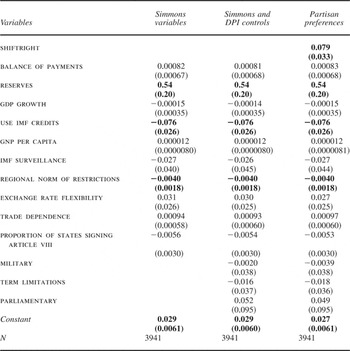
Our second task is to demonstrate that relative shifts in the partisan orientation of the executive branch actually reflect changes in the strength of preference for monetary openness. To test this conjecture, we use the first differences specification described above. The dependent variable in this model is the relative change in capital openness for each country during a particular year as measured by the Chinn-Ito KAOPEN index.Footnote 20 The key independent variable is a relative shift toward the right in the government in power. The results, reported in Table 1, are strongly consistent with our contention that relative partisan shifts in the executive branch cause a change in leadership preferences regarding capital openness. The coefficient for our shiftrightit variable is 0.079 (p < .02), indicating that a governmental shift to the right is associated with significant increases in the Chinn-Ito openness index. The average within-country standard deviation of KAOPEN in our sample is 0.34, meaning that a rightward shift in partisanship results in a 0.25 standard deviation increase in KAOPEN. Given the conservativeness of this test of partisan shifts (our model has no lagged effects), this suggests a fairly substantial impact of party preferences on capital openness, comparable to the estimated impact of the use of IMF credits—one of Simmons's most important variables.
Impact of partisan shifts on capital openness

Notes: Robust standard errors in parentheses. Coefficients statistically significant at 0.05. Level marked in bold. DPI = Database of Political Institutions.
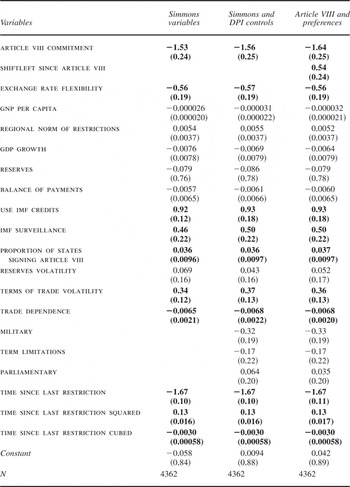
Our third and final task is to demonstrate that relative shifts in the partisan orientation of the executive branch serve to condition compliance with Article VIII. Rather than recording shifts from the previous year—as was the case in our analysis of financial openness—in this instance we record shifts to the left relative to the government that initially made a commitment to Article VIII. Since shiftleftit is coded relative to the signatory government, it is—in effect—an interaction term. The variable takes on a value of 1 if the state has made an Article VIII commitment and the government has subsequently shifted to the left. The results, reported in Table 2, are strongly supportive of both the original findings by Simmons, and of our conjectures regarding partisan shifts. The coefficient for art8it is −1.64 (p < .01), indicating that states that sign on to Article VIII commitments are significantly less likely to restrict capital markets so long as the government in power does not shift to the left. Consistent with our findings regarding capital openness, the coefficient for a governmental shift to the left is 0.54 (p < .03), indicating that a relative shift to the left increases the incidence of current account restrictions even after states have committed to Article VIII.
Partisan shifts, Article VIII commitments, and current account restrictions

Notes: Robust standard errors in parentheses. Coefficients statistically significant at 0.05. Level marked in bold. DPI = Database of Political Institutions.
The critical test for Article VIII as a constraint comes by testing the impact of Article VIII after the government in power has shifted to the left relative to the initial signing party. We test this hypothesis by evaluating the joint significance of the art8it and shiftleftit variables. The results indicate that the coefficient for the impact of an Article VIII commitment after the government has shifted to the left is −1.10 (p < .01). Thus, even after the government's preferences have shifted away from monetary openness, an Article VIII commitment significantly reduces the probability that a government will restrict capital markets. While the impact of Article VIII is reduced by shiftleftit, the treaty retains about two-thirds of the effect that occurs upon signing. This result provides powerful evidence that the act of committing to Article VIII actually constrains governments from restricting capital markets—even governments that did not initially sign the treaty, and governments that do not have as strong a preference for monetary openness as the signatory government.
Recall from above, however, that the effects estimated in Table 2 may be subject to selection biases. As a robustness check, we therefore perform a matching analysis using the genetic optimization procedure described above. The algorithm assesses balance between treatment and control groups using paired t-tests for the dichotomous covariates and univariate bootstrap Kolmogorov-Smirnov tests for the continuous covariates. While no methodological consensus exists in the matching literature as to the level of balance required for reliable causal inferences or the proper tests for judging whether such balance has been achieved,Footnote 21 these tests indicate that the genetic algorithm achieves dramatic improvements in balance for each of our covariates. After the matching procedure, none of the covariates indicated statistically significant differences in their distributions.
Although the genetic matching algorithm produced well-balanced treatment and control groups, in an abundance of caution, we estimate treatment effects with a bias-adjusted matching estimator. Abadie and Imbens note that matching estimates include a conditional bias term that can erode relatively slowly with sample size. We therefore report their “bias-adjusted” estimate of causal influence.Footnote 22 This bias adjustment is performed on the duration variables (that is, time since last restriction) since these time effects were highlighted by Simmons and Hopkins as the greatest source of model dependence.Footnote 23 This procedure yields an average treatment effect on the treated (ATT) for shiftleftit on capital account restriction of 0.078. This treatment effect is strongly statistically significant (p < .01) even when we rely on the more conservative Abadie-Imbens standard errors. This result is strongly consistent with the results reported above, indicating that the effects of preference shifts estimated in Table 2 are robust against concerns about selection bias.
But how substantively large are these effects? Based on the logit coefficients in Table 2, we estimated the probability of monetary restrictions under three conditions: (1) a state that had not signed Article VIII, (2) a state that had signed but had not undergone a governmental shift to the left, and (3) a state that had signed and then experienced a shift to the left. The predicted probabilities and 95 percent confidence intervals around the predictions are displayed in Figure 1. Clearly, the probability of monetary restrictions during any given year by states that have not signed Article VIII is quite high at 59 percent. Not surprisingly, states that commit to Article VIII are much less likely to restrict their capital markets. The predicted probability of such a restriction is 22 percent. Thus Article VIII successfully operates as a screen that signals a government's desire to maintain open capital markets. Consistent with the concerns discussed above, we see that compliance with Article VIII commitments is reduced once we have a shift in government away from a preference to comply with the treaty. States that have undergone a shift to the left after signing have an estimated annual 33 percent probability of restrictions. Nonetheless, consistent with Simmons as well as Simmons and Hopkins, we find that the probability of monetary restrictions remains substantially lower for states that have committed to Article VIII, even if the government in power is politically to the left of the government that initially signed the treaty.Footnote 24 Specifically, the risk of monetary restrictions under these circumstances is cut in half relative to a state that has never signed Article VIII.
Domestic preferences and capital restrictions

Conclusion
We believe that the analysis in this article provides a rigorous test of the claim that international institutions constrain states to behave in ways that they otherwise would not, taking into account what may reasonably be seen to be changes in the preferences of signatory-states. The evidence we have gathered is consistent with the view that committing to Article VIII ties governments to a commitment mechanism that restricts to a significant degree the freedom of choice of subsequent governments. However, changes in the apparent preferences for capital openness of signatories that shifted to the left reduce to some degree the constraining effects of Article VIII. Committing to Article VIII thus appears to serve as both a screen that signals to international markets, and as a constraint that binds the hands of subsequent governments. While we do see some slippage in the knots, the treaty appears to bind even governments that are less likely to have made the initial commitment.