Introduction
It is now widely accepted that climate change is happening in northern latitudes, that the rate of change there is about twice as fast as further south, and that there will be particular challenges to Arctic residents and particularly indigenous peoples such as the Sámi (ACIA 2005; Solomon Reference Solomon, Qin, Manning, Chen, Marquis, Averyt, Tignor and Miller2007). Continuing changes in the onset of spring and autumn may affect the future seasonal balance of pastures used by reindeer (Rangifer tarandus) (Tømmervik and others Reference Tømmervik, Høgda, Riseth, Karlsen and Wielgolaski2005; Riseth and others Reference Riseth, Lie, Holst, Karlsen and Tømmervik2009), while changes in snow depth, distribution and consistency will affect the movement of reindeer and their access to winter forage (Heggberget and others Reference Heggberget, Gaare and Ball2002; Callaghan and others Reference Callaghan, Johansson, Heal, Sælthun, Barkved, Bayfield, Brandt, Brooker, Christiansen, Forchhammer, Høye, Humlum, Järvinen, Jonasson, Kohler, Magnusson, Meltofte, Mortensen, Neuvonen, Pearce, Rasch, Turner, Hasholt, Huhta, Leskinen, Nielsen and Siikamäki2004). Snow hardness, snow depth and animal mobility are also factors affecting Rangifer selection of feeding areas (Collins and Smith Reference Collins and Smith1991). Late autumn or early winter temperatures fluctuating around 0°C, wet snow or rain and thaw-freeze events in winter can form a thick layer of icy snow on vegetation, blocking access to forage for most of the winter (Reimers Reference Reimers1982; Helle and Säntii Reference Helle and Säntii1982; Aanes and others Reference Aanes, Sæther and Øritsland2000; Kumpula and Colpaert Reference Kumpula and Colpaert2003; Kohler and Aanes Reference Kohler and Aanes2004; Helle and Kojola Reference Helle and Kojola2008), and can also affect plant performance the following summer (Bokhorst and others Reference Bokhorst, Bjerke, Bowles, Mellillo, Callaghan and Phoenix2008; Reference Bokhorst, Bjerke, Tømmervik, Callaghan and Phoenix2009). Moreover, such a persistent layer is also believed to promote mould growth on winter reindeer pastures. The mould may produce a series of secondary metabolites known to have toxic effects on mammals (Kumpula and others Reference Kumpula, Parikka and Nieminen2000).
A literature with a broader focus on how climate change may affect reindeer and reindeer herd management is emerging (Moen Reference Moen2008; Reinert and others Reference Reinert, Aslaksen, Eira, Mathiesen, Reinert, Turi, Agder, Lorenzoni and O'Brien2009; Riseth and others Reference Riseth, Lie, Holst, Karlsen and Tømmervik2009; Lundqvist Reference Lundqvist2009). However, most studies of high winter mortality of reindeer and caribou are related to rather extreme events which produce thick ice layers or unusually deep snow, whereas the effect of more moderately varying snow conditions on reindeer has not been so thoroughly studied (Heggberget and others Reference Heggberget, Gaare and Ball2002), but some exceptions can be found (for example Pruitt Reference Pruitt1959; Reference Pruitt1979; Skogland Reference Skogland1978; Kumpula and Colpaert Reference Kumpula and Colpaert2003; Reference Kumpula and Colpaert2007). This lack of scientific focus stands in marked contrast to the traditional ecological knowledge (TEK) of indigenous peoples such as the Sámi and other northern residents, whose survival in severe sub-Arctic conditions depends upon their adaptive skills (Eira Reference Eira and Hansen1994; Redman Reference Redman1999). The long northern winter and its harsh selective forces have promoted an extensive and detailed knowledge of snow and ice conditions and their effects, some of which are reflected in indigenous languages, such as the numerous Sámi words for ‘snow’ (Nielsen and Nesheim Reference Nielsen and Nesheim1979; Eira Reference Eira1984; Jernsletten Reference Jernsletten and Gaski1997), and a terminology connected to the long term success of reindeer related activities in all seasons (Helander-Renvall Reference Helander-Renvall2007).
To understand and predict the scope and intensity of impacts of probable future changes in climate, a coordinated, multi-approach response is required (Callaghan Reference Callaghan2004). TEK has a potential key role in this response (Huntington and others Reference Huntington, Callaghan, Fox and Krupnik2004). Scientists may have various attitudes to TEK (Rist and Dahdouh-Guebas Reference Rist and Dahdouh-Guebas2006) and a particular challenge is to develop a framework that allows different forms of knowledge to interact in a complementary fashion (Hobson Reference Hobson1992; Forbes and others Reference Forbes, Bölter, Müller-Wille, Hukkinen, Müller, Gunslay and Konstantinov (editors)2006). TEK is defined as ‘a cumulative body of knowledge and beliefs, handed down through generations by cultural transmission, about the relationship of living beings (including humans) with one another and with their environment’ (Berkes and others Reference Berkes, Folke and Gadgil1993). TEK is interdisciplinary (Berkes Reference Berkes2008), and its meaning is related to the context (Hornborg Reference Hornborg, Descolla and Palsson1996; Helander-Renvall Reference Helander-Renvall2007). Further, TEK is suitable for adding a local area dimension to point based meteorological data (Helander and Mustonen Reference Helander and Mustonen2004). Linguistic methods can be used to secure more detailed information on the ecological adaptation and overall management of reindeer herding, especially when the approach is emic, that is taking place from within a culture. Languages, such as Sámi, contain systems of culture based classifications (Lévi-Strauss Reference Lévi-Strauss1966; Basso Reference Basso1996) and provide information on ecological and climate related conditioning of the adaptation strategies in reindeer herding. It is expected that when traditional concepts are introduced into a scientific framework, the richness of the language will enhance the tools for understanding natural conditions and how they might influence adaptive strategies (Krupnik and others Reference Krupnik, Huntington, Koonooka and Noongwook2004; Magga Reference Magga2006). A new study of Sámi reindeer herders’ ecological knowledge and terminology illustrates this. By interviews and participant observation, mainly with regard to grazing conditions and their use of managed forests during the winter, Roturier and Roué (Reference Roturier and Roué2009) found that whereas the western use of the word ‘pasture’ is often associated with a specific plant community, the Sámi herders’ understanding of the culturally specific word in their language: guohtun includes several aspects of the grazing situation, among them the effect of snow on grazing.
Our approach is based on importing TEK into an existing scientific framework while maintaining the identity of the TEK. The joint Nordic research programme, ‘Snow and ice’ (Schiermeier Reference Schiermeier2006), funded by the Nordic Council of Ministers and headed by the former Nordic Sámi Institute, was designed to seek such exchange of knowledge between Sámi reindeer herders and a multidisciplinary team of scholars with a basis in the humanities, the natural and social sciences and Sámi language. This collaboration between reindeer herders and experts on economics, snow physics, ecology, remote sensing, meteorology and linguistics aimed at enriching our understanding of changes in snow and ice conditions. The programme builds on the complementary skills and approaches of all the participants. For example, the experiments and models of the scientists employed to predict future changes are combined with the in-depth knowledge of the Sámi on the landscape scale patterns of past and present snow conditions and their relevance to reindeer herding.
Our project builds on a few earlier studies conducted in this field (for example Jernsletten Reference Jernsletten and Gaski1997; Østbye and Mysterud Reference Østbye and Mysterud1984), and especially on those of the Swedish botanist, Olof Eriksson, who, in the 1970s, pioneered cooperation with a group of Sámi TEK holders, including our partner Gustav Labba. Eriksson (Reference Eriksson1976) demonstrated connections between the density and hardness of various snow types, mainly using Sámi concepts. However, these earlier studies were outside the context of climate change. The overall objective of this paper therefore, is to communicate new results gathered during the first two years of the ‘Snow and ice’ project and to discuss how TEK can enrich scientific studies of climate change issues. Thematically, we examine firstly field observations of snow and ice conditions, secondly the importance of the first durable snow, and thirdly long term changes in snow and ice conditions.
Methods and material
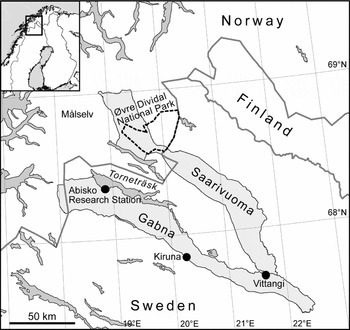
Sápmi (Sámiland) covers northern and middle Norway, northern Sweden, northenmost Finland and Kola Peninsula in Russia. Our study area comprises the grazing land of two Sámi herding communities (formally Sámi villages) Gabna and Saarivuoma, stretching from Vittangi, not far from the Swedish-Finnish border, in the southeast, westwards to the area around Torneträsk, a large lake adjacent to the Swedish-Norwegian border, and northwards through the Øvre Dividal National Park in Norway (Fig. 1).
Study area.

In the period from April 2006 to April 2007, the ‘Snow and ice’ project arranged four field workshops in the Abisko area, northern Sweden. Each workshop was of 2 or 3 days duration, and a team of 5–9 scientists and 4–10 herders participated in each. The focus was mainly on the relationships between reindeer herders, reindeer and pasture landscapes in late autumn, late winter and spring, and how to link TEK with natural scientific measurements and social science perspectives the better to understand changing conditions. By recording the herders’ descriptions of snow and ice conditions and their choices of herding strategies under specific field conditions and making scientific measurements of different types of snow and ice, the workshops created a good platform for integrating TEK with science to address the three objectives of the study.
Our main TEK material is oral accounts of lifelong experiences provided by herders from the Gabna and Saarivuoma, supplemented by literature (for example Turi Reference Turi1966; Ryd Reference Ryd2007). We think that transparency is important to strengthen the position of TEK, and we have chosen to make our research process as transparent as possible by naming the key TEK holders and focusing on their particular contributions without making them responsible for the whole paper as authors (compare Huntington Reference Huntington2006). In the field, the herders described their own pasture land, their understanding of how different snow and ice conditions affect reindeer grazing, and their pool of strategies to control reindeer herds and their grazing. The fact that three of the participating scientists also have TEK of Sámi reindeer herding and are native Sámi language speakers facilitated communication. The older herders also described their observations of major changes in climate, snow types and pasture conditions, and these were compared with meteorological data collected at the Abisko Scientific Research Station (for example Callaghan and others Reference Callaghan, Bergholm, Christensen, Jonasson, Kokfelt and Johansson2010) and other published data. The following procedure was followed in field and during the treatment of the collected material.
1. The herders described 18 uniform snow categories and 8 stratified snow profile types using Sámi terms at 28 locations expected to have different snow types and grazing conditions (compare Pruitt Reference Pruitt, Olson, Hastings and Geddes1984) and the scientists performed measurements of snow properties (for example depth, hardness, temperature, layer characterisation, weight and density) in the same locations. These were located in pine forest, mountain birch woodland, as well as on open ridges and mountain heaths.
2. A ramsonde driving a ram penetrometer vertically into the snow pack was used to quantify its hardness (McClung and Shaerer Reference McClung and Shaerer1993) in all 28 locations including the same locations at which snow density measurements were carried out. The ram resistance (RR) parameter is the resistance provided by the snow pack while the ram (hammer) goes through. The integrated ram hardness index (IRH), which is RR times the snow depth, is the total amount of work (number of blows) needed to force the ram through the snow pack. The level of the hammer in the instrument can also be changed and this is especially needed when working with softer types of snow. IRH is considered an appropriate index of forage availability (Tucker and others Reference Tucker, Mahoney, Green, Menchenton and Russel1991; Vistnes and others Reference Vistnes, Nellemann, Jordhøy and Strand2004). The measurements (n = 240) were performed with the recommended 5–10 replications (Colbeck and others Reference Colbeck, Akitaya, Armstrong, Gubler, Lafeuille, Lied, McClung and Morris1998). Ramsonde penetrometers are often used in studies concerning reindeer ecology (Tucker and others Reference Tucker, Mahoney, Green, Menchenton and Russel1991; Nellemann Reference Nellemann1996; Nellemann and others Reference Nellemann, Jordhøy, Støen and Strand2000). However, because of the ram's large mass (1.17 kg), and the total weight of the instrument (2.12 kg), it is not well suited for very soft snow (Pruitt Reference Pruitt2005) where the crucial factor is not hardness, but depth (Heggberget and others Reference Heggberget, Gaare and Ball2002).
3. 30 snow samples were weighed to determine the bulk density and thickness of different layers from 21 locations. One to three measurements were made per profile, depending on the thickness, which was measured with a folding ruler. The densities used for calculations in stratified profiles are averages of each of the layers. All measurements (hardness parameters and density) from one site were first averaged and subsequently used in the statistical analysis for all the snow types/profiles/sites included in this study.
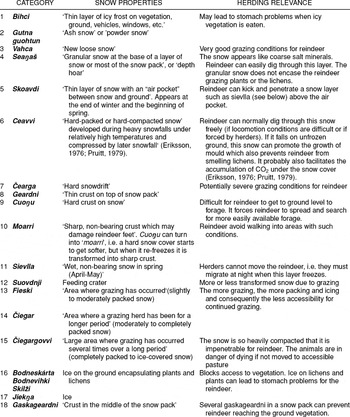
4. Herders’ classification and descriptions of snow types (Table 1) were used to organise the material from the scientific measurements. The North Sámi (the major Sámi language) names are used throughout the text, with translations in parenthesis. The spelling of Sámi words follows new North Sámi orthography (Sammallahti Reference Sammallahti1989).
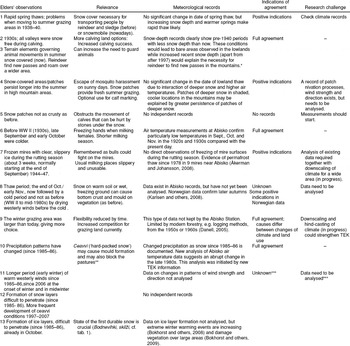
Sámi snow categories used in our fieldwork and their relevance for reindeer herding. Main informants: Nils Tomas Labba, Gustav Labba (Saarivuoma). Erik Anders Niia, Håkan Kuhmunen (Gabna).

Results
Local variations in snow and ice conditions
In the field, the herders demonstrated two issues of great importance for understanding the relationships between snow, ice and reindeer pasture conditions. The first was the connection between topography and local variations in pasture conditions, and the second was how the continuous dynamics of changes in the snow pack respond to continuous changes in the weather (Jernsletten Reference Jernsletten and Gaski1997). A list of core Sámi categories for types of snow, mainly those presented by our herder participants, is presented in Table 1.
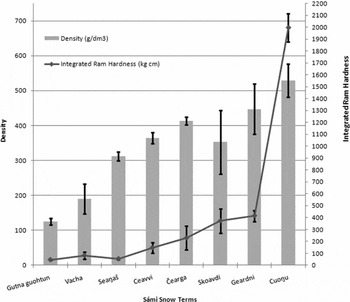
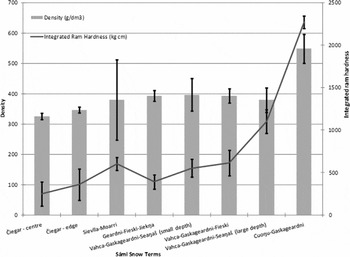
Herders’ snow categories could further be classified as new, light types of snow (1–3), snow transformed by wind and weather (4–11) or by grazing, digging and trampling (12–15), and snow types affected by ice formation (16–18). Each type defined has relevance for herding. New and loose unstratified snow types (gutna guohtun and vahca) display low values for both snow density (<200 g/dm3) and integrated ram hardness (IRH) whereas older and transformed/firmer snow shows higher values (>350 g/dm3); see Fig. 2. For the stratified profiles (Fig. 3), however, the density did not vary so much, while the IRH showed increased values depending of the grade of stratification and number of layers.
Uniform snow types (Sámi snow categories). Relationship between the density (g/dm3) and the Integrated Ram Hardness (IRH) (kgcm). This relationship was almost significant (R2 = 0.47, P = 0.06). Values are means +/- SE.

Stratified snow profiles (Sámi snow categories). Relationship between the density (g/dm3) and Integrated Ram Hardness (IRH) kgcm). Values are means +/- SE. This relationship was found to be significant (IRH: R2 = 0.85, P = 0.001).

Among the uniform snow types in Fig. 2, the most easily penetrable ones are (2), (numbers refer to Table 1), gutna guohtun (‘ash snow’, or ‘powder snow’) and (3) vahca (‘new loose snow’), while (6) ceavvi (‘compact snow’) requires more force, (7) čearga (‘hard snow drift’) and (8) geardni (‘thin top crust’) require even more force, and (9) cuoᵑu (‘hard crust’) requires most force. On the other hand, types of snow in late winter and early spring, such as (10) moarri (‘sharp, non-bearing crust’), (11) sievlla (wet, non-bearing spring snow), the latter being presented as a profile in Fig. 3, and (5) skoavdi (‘air pocket between ground and spring snow’ for example sievlla), have intermediate hardness. Information from the Sámi explained that loose snow provides optimal grazing conditions, while compact types of snow provide difficult grazing conditions. The crusty types (geardni and cuoᵑu) present various difficulties, whereas spring snow (sievlla and skoavdi types) could only be penetrated with the use of very much energy. Note also that the penetrability of čiegar (‘area where a grazing herd has been for a period’) varies from low in the centre to medium at the edges (Fig. 3).
Regression analysis on uniform snow types, mainly unstratified, reveals that density can explain much of the variation in the values of both hardness parameters (RR: R2 = 0.57, p = 0.03; IRH: R2 = 0.47, p = 0.06); hence this indicates that snow depth is not important for the IRH. Analysing this further, the snow depth was not significantly correlated with IRH (R2 = 0.45, p = 0.07) and RR (R2 = 0.44, p = 0.08).
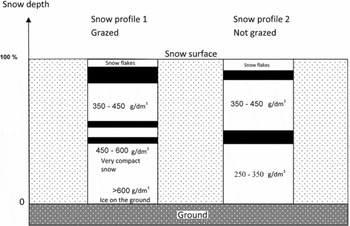
Some strata in the stratified snow profiles shown in Fig. 3 are transformed by weather and others by reindeer trampling or grazing, or even a combination. We found that loose snow types such as vahca (‘new loose snow’) with a bottom layer of seaᵑaš (‘granular snow’ or ‘depth hoar’ formed by recrystallisation of vapour driven by strong temperature gradients in the snow pack) have high permeability, whereas the occurrence of gaskageardni (‘mid-crust’) and fieski/čiegar (‘transformed snow due to grazing and trampling’) in the snow pack clearly reduces penetrability (Fig. 3). For instance, the ram went straight through soft gutna guohtun snow, whereas 38 blows were required to penetrate the snow pack and reach the ground in the cuoᵑu-gaskageardni profile. Also to be mentioned is that the total depth of the stratified snow profiles of the type gaskageardni influences the IRH significantly (Fig. 3). Regression analysis shows very high correlation between density and both hardness parameters (RR: R2 = 0.89, p = 0.000; IRH: R2 = 0.85, p = 0.001). The snow depth for the stratified snow parameters was not significantly correlated with the snow hardness parameters RR and IRH (R2 = 0.01, p = 0.85; R2 = 0.105, p = 0.43). Two profiles (Fig. 4), situated just a few metres apart, illustrate the effects of grazing on snow profiles described in Fig. 3.
Comparison of snow profiles. Grazed (left) and ungrazed (right).

The height difference at the surface due to the wind is affected by local variations in the landscape. The upper layers of profiles 1 and 2 are also induced by climatic events like wind and heavy snowfall (development of ceavvi (packed snow) and ‘rain-on-snow’ events leading to development of gaskageardni (ice crust). The lower layers of profile 1 (grazed) are compacted icy snow (čiegargovvi) with high densities (>450g/dm3) and ice (jiekᵑa) with densities of >600g/dm3. In contrast, the lower levels of profile 2 (not grazed) are dominated by looser snow (seaᵑaš) which showed reduced densities (<350g/dm3). While the upper layers of both profiles have been exposed to similar forces, the lower layers have developed differently because only one of them (profile 1) has been influenced by grazing.
The first durable snow: effects and herding strategies
Our informants told us that the weather conditions around the first major snowfall of the season are crucial determinants of the properties of the snow pack, and therefore grazing conditions, for the rest of the winter. An ideal situation is when such durable snow is dry and falls on frozen ground. Wet conditions, on the other hand, form an ice layer that sticks to the ground (‘bottom crust’) and poses a relatively persistent problem that remains until sufficient solar radiation is absorbed to melt the crust. This is feared and well understood by Sámi, as described by a Sámi author in a book originally published in 1910:
towards the end of the rutting season it is generally thawing (. . .) there is bare ground in some places, and in other places the snow is left lying, and when it freezes, then that snow is turned to ice, as it is called, bodneskardan [bottom crust], and it remains all through the winter just as it is at the time when the last thawings stop and the cold comes. But if the thaws do not spoil the snow, then it will be a good winter, unless there comes very deep snow, for the reindeer can get to the mosses [lichens] even if the snow is fairly deep, if only there is a clean bottom, that is, no ice on the bottom. And it is at this time that the Lapps [Sámi] are afraid [wondering] what the winter will be (Turi Reference Turi1966 [1910]: 53–54).
In addition to ice (like bodneskárta, bodnevihki, skilži, see Table 1) formed by transformation of the first durable snow, the formation of mould on winter pastures in early winter is also feared by reindeer herders. Nils Tomas Labba demonstrated in the field changes in vegetation due to mould formation. Reindeer herders regard yellowish colouring of the muzzle hairs of free-ranging reindeer in late autumn and early winter as a sign of mould formation (Helle Reference Helle1980; E. A. Niia, personal communication, 2006). Our informants told us that losses of reindeer in winter due to mould and the subsequent reduction or collapse of calf production in spring were experienced in Saarivuoma in the winters of 1972–1973, 1988–1989 and 1989–1990.
Another observation by Nils Tomas Labba (personal communication, 2006) was that skilži conditions (an ice layer encapsulating plants and lichens, see Table 1), may lead to stomach problems for reindeer. White frost (bihci) on vegetation (see Table 1) may have the same effect (Bror Labba, personal communication, 2007). Our informants told us that on pastures with soft snow the reindeer are allowed to choose their grazing freely, whereas on pastures with firm snow and ice herders need to employ a more active herding strategy by limiting the choices of the animals, for instance by letting strong animals crush ice layers so that weaker ones gain access to grazing. Under even more difficult conditions, the herd must be free to search for grazing over a larger area, be moved to another area, or be given supplementary feed. If necessary, weak animals are slaughtered.
The snow and ice conditions in the winter of 2006–2007 were severe for most of the the reindeer in Sweden (SOU 2007:60). Owing to ‘rain-on-snow’ from the end of November and in early December (Riseth and others, Reference Riseth, Lie, Holst, Karlsen and Tømmervik2009; SMHI Reference SMHI2006a, Reference SMHI2006b) the feared bottom crust blocked access to the vegetation and most reindeer herding communities became dependent on supplementary feeding for the survival of their reindeer (SOU 2007:60). Some of the northernmost villages, among them our partners in Saarivuoma, did not follow the usual practice of moving down to the forested wintering area, but remained in the sub-alpine area where grazing conditions were acceptable throughout the winter. After having tried forested areas, our partners in Gabna ended up with the same solution as Saarivuoma.
Long-term changes in snow and ice conditions
Elderly Sámi herders have clear memories of environmental changes back to the 1930s. Gustav and Nils Tomas Labba (personal communications, 2006) reported the following observations of changes.
The thaws in 1938–1940 were very rapid, causing problems in moving the reindeer to the summer grazing areas (observation 1; observation numbers refer to comparisons between TEK and scientific observations listed in Table 2). During the spring migration, there used to be so many bare areas in the lowlands that the herd had to be watched even at night to prevent it spreading out too much. In the 1930s, all valleys were snow free during the calving (observation 2). Terrain elements that previously governed animal movements in summer are now being covered by snow even in summertime, forcing the reindeer to find new passes in the mountains and to move over a wider area (observation 3). Snow-covered areas and snow patches persist further into the summer in the high mountains (observation 4) and do not become as crusty as before (observation 5). During a warm period, it is difficult for the reindeer to escape to snow patches to avoid mosquitoes and other insects because the snow is soft. This has affected the movement of the reindeer so that females and calves have problems finding each other. Calves that lose contact with their mothers often die.
Comparison of observations made by elderly and middle-aged Sámi herders from Saarivuoma (Nils Tomas, Gustav, Laila and Agneta Labba, Bror Labba) and Gabna (Erik Anders Niia and Håkan Kuhmunen) together with meteorological data collected at the Abisko Scientific Research Station (latitude 68.35° N, longitude 18.82° E), supplemented by other scientific observations.

*Applies to 2 and 3.
**Applies to 10, 11, and 12.
***Applies to 11, 12, and 13.
In the 1930s, late September and early October were colder (observation 6). The mires were frozen during the rutting period (observation 7), and male reindeer that fought during the rut could break the mire ice, but females were not able to do so. Normally, there was a thaw at the end of October or the beginning of November. Nowadays, this thaw is followed directly by a cold period and not, as before, by westerly winds that dried the ground before the cold began (observation 8). The winter grazing area was larger than today, giving more choice (observation 9).
Precipitation patterns have changed since 1985–1986 (observation 10) with warm winds from the west in early and mid winter (observation 11), forming snow (observation 12) or ice (observation 13) layers that are difficult for the reindeer to penetrate.
Comparisons of Sámi observations with those from the Abisko Scientific Research Station (Alexanderson and Eriksson Reference Alexanderson and Eriksson1989; Christensen and others Reference Christensen, Johansson, Åkerman, Mastepanov, Malmer, Almer, Friborg, Riborg, Crill and Svensson2004; Kohler and others Reference Kohler, Brandt, Johansson and Callaghan2006; Åkerman and Johansson Reference Åkerman and Johansson2008; Callaghan and others Reference Callaghan, Bergholm, Christensen, Jonasson, Kokfelt and Johansson2010) reveal connections between different types of knowledge that are not always fully commensurate (Table 2).
The juxtapositions include memories versus records, and observations over time from large areas versus point and time restricted measurements. Therefore we need to rely more on assessments than on exact comparisons. With these limitations, the table nevertheless shows full agreement or positive indications between herders’ observations and meteorological records for more than half of the observations by elderly Sámi herders. Among the particularly interesting observations, (11) and (12), point to gaps in the measurements and analyses carried out at Abisko and elsewhere. On a more general level it is remarkable that most of the herders’ observations in Table 2 are changes that are still little focused upon by scientists. However, records do exist at Abisko for the majority of these changes.
Discussion
Local variations in snow and ice conditions
We have compared our results in Fig. 2 (uniform snow types) with the results of Eriksson (Reference Eriksson1976). Eriksson provided statistics on the density and hardness of uniform snow types, but not on their interrelationships. In a diagram Eriksson (Reference Eriksson1976: 15) showed a near linear relationship between density and hardness. Both factors increased from low values for (1) newly fallen snow via (2) old snow to (3) ceavvi (‘compact snow’), (4) čearga (‘hard snow drift’) and (5) cuoᵑu (‘hard crust’). Cuoᵑu displayed greater variation for both factors, and (6) seaᵑaš (‘granular snow’) deviated having rather low to intermediate hardness and intermediate to high density. Our results confirm Eriksson's findings by documenting the relationship between density and hardness for unstratified snow types.
For the harder top layers, such as ceavvi (‘compact snow’), čearga (‘hard snow drift’) and cuoᵑu (‘hard crust’), our data do not give clear indications concerning to what extent transformation processes actually take place. This is not surprising since the penetrometer parameters do not provide information on the permeability of each of the layers, only of the total snow pack. As for wind hardened snow, Collins and Smith (Reference Collins and Smith1991) found that reindeer trampling easily fractures this snow. Experiments using heart rate telemetry show that compared to loose snow, denser snow and compact snow increase the energy expenditure of caribou by factors of two and four, respectively (Fancy and White Reference Fancy and White1985).
Sámi TEK on hard snow types states that the digging strategy used by reindeer depends on the constraints of the surrounding snow for their movement, that is an energy rationalising behaviour (Kumpula and others Reference Kumpula, Lefrere and Nieminen2004). However, when necessary, herders can force reindeer to dig if the profile gives access to the pasture (N. T. Labba and others, personal communications, 2006). For the cuoᵑu-gaskageardni profile, however, the IRH and RR parameters showed relatively small increases compared with the other cuoᵑu or hard crusty types, while the IRH showed a huge difference for this type of profile compared with other profiles (Fig. 3). This is also consistent with the traditional knowledge that reindeer do not try to dig through hard crusty snow but seek pasture elsewhere (Table 1). Moreover, Sámi herders also note that all types of profile containing gaskageardni are among the profiles with the highest IRH (Fig. 3). They are therefore among the least accessible to reindeer.
There is great variability in penetrability for the categories vahca-gaskageardni-fieski-seaᵑaš depending on how many layers of gaskageardni included in the profile, and how firm are the different layers (Fig. 3). The penetrability of the snow seems to be mainly determined by the content of the snow profile, that is the snow categories included within it (compare Table 1). Hence snow depth seems to have little influence on the IRH. This underlines the severity of an increasing occurrence of ‘rain-on-snow’ events (Putkonen and Roe Reference Putkonen and Roe2003).
In tundra regions, reindeer generally will not crater through snow layers exceeding an IRH of 105kgcm (Thing Reference Thing1977; Collins and Smith Reference Collins and Smith1991). Skogland (Reference Skogland1978) reported that wild mountain reindeer abandoned craters at an IRH of more than 570kgcm. The tolerance level, however, was usually 230–320kgcm, depending on snow depths. Comparing this information with Figs. 2 and 3, most of the profiles we measured are not accessible by voluntary digging which is also in accordance with the information given by the Sámi reindeer herders in the field. Further, we should note the herding strategy option in that, the snow types čearga (‘hard snow drift’) and ceavvi (‘compact snow’) can be cratered by herded reindeer thus accessing pastures beyond the tolerance level of their wild congeners, but the use of energy could be large. In March/April, short wave sun radiation will soften the hard snow crusts during the day and hence the reindeer can kick through hard and crusty layers of snow and ice (Skogland Reference Skogland1978).
Adopting a different strategy to our use of the ramsonde penetrometer, Pruitt (Reference Pruitt1979) measured the hardness of the basal layer, the surface, and the ‘hardest layer more than halfway between the substrate and the top of the snow cover’ (Pruitt Reference Pruitt1979: 273), as well as the thickness of these layers and of the total snow pack. He introduced the Väriö Snow Index (VSI) and tested his measurements and the calculated VSI on reindeer grazing behaviour, during one season from October to April, finding good reflection of all parts of the season except the spring when the snow eroded from the bottom due to higher surface layer temperatures. In view of the limitations that our study did not cover all parts of the season and contained fewer measurements than Pruitt (Reference Pruitt1979), we find good indications that using the ramsonde penetrometer may provide equally good results with an easier procedure, also taking into account that it also mirrors well the effect of warm soil creating sievlla or skoavdi in spring and the important effect of mid-crusts (gaskageardni). As an alternative to the use of penetrometer a simplified procedure for measuring hardness; using fist, hand, finger, pencil and knife as tools (Østbye and Mysterud Reference Østbye and Mysterud1984) also should be explored and compared to reveal its potential in collaborative work with TEK.
The first durable snow: effects and choice of herding strategy
Scientists have discussed both potential problems created by the early winter. These are bottom crust and mould formation. As regards bottom crust, Kumpula and Colpaert (Reference Kumpula and Colpaert2003) maintained that a hard snow or ice layer that hampers foraging throughout the winter is probably more important than actual snow accumulation in open, high pasture areas. Mould formation occurs especially after mild, rainy autumns when the soil does not have time to freeze before the snow falls (Eriksson Reference Eriksson1976; Pruitt Reference Pruitt, Olson, Hastings and Geddes1984). Kumpula and Colpaert (Reference Kumpula and Colpaert2003) found as a pattern that a thick snow layer on unfrozen soil in early winter could occur especially in woodland areas, and that it could promote mould growth caused by microfungi that can produce mycotoxins harmful to animals. Observed symptoms in animals in northern Finland in the winter of 1996–1997 seemed similar to those known to be caused by mycotoxins, and the researchers found that these connections should be studied in more detail (Kumpula and others Reference Kumpula, Parikka and Nieminen2000). Mould formation may be one reason for significant losses of reindeer in winter and the subsequent collapse of calf production in spring, which has been reported to happen once or twice in a decade (Helle Reference Helle1980). Our informant, Nils Tomas Labba (personal communication, 2006) holds that mould formation has become more frequent in recent decades (Table 1). The stomach problems that have been attributed to ice-encapsulated vegetation may be related to ruminal acidosis, a serious condition well known by veterinary science when supplementary feed contains excessive starch (Rehbinder and Nikander Reference Rehbinder and Nikander1999; Oksanen Reference Oksanen2001), but it has so far not been recorded as an outcome of ice-encapsulated vegetation (Birgitta Åhman and Terje Josefsen, personal communications, 2007). According to old records of herder knowledge, mould on lichens can also cause violent diarrhoea in reindeer (Itkonen Reference Itkonen1948). These ailments emphasised by the TEK in our project should be studied in more detail as a cooperative project between TEK and veterinary science.
The currently available set of reindeer movement strategies is part of TEK which, for Saarivuoma, seems to be based on experience from the catastrophic winter of 1972–1973 (Villmo Reference Villmo1973) when ice formed on the ground on the winter pastures already in October and November, and grazing conditions in both the Norwegian and Swedish parts of the area were severe right up to late December due to temperatures around 0°C and frequent ‘rain-on-snow’ events. Both the ordinary coastal-lowland winter pastures in Sweden and the low to middle alpine pastures in Norway were unavailable for large parts of the winter (Villmo Reference Villmo1973). This led to severe grazing problems for the four northernmost Sámi Villages in Sweden (including Saarivuoma and Gabna), and more than half of the stock was lost (Villmo Reference Villmo1974). The remainder of the reindeer survived in high mountain areas in Norway where the ground cover conditions were better (N.T. and G. Labba, personal communications, 2006). This example shows that adaptation strategies used several decades ago can be reused in response to current and future serious winter pasture conditions. Indeed, an increasing frequency of more or less difficult winter conditions since the early 1990s has made the use of mountain areas a more relevant strategy, and in the 1990s such areas have been used to some degree approximately every other year just before 2000 and for part of the winter in most years since 2000. This strategy is an option as the necessary land still is accessible.
Long-term changes in snow and ice conditions
Some of the gaps in scientific measurements and analyses are relevant to the Sámi, and Table 2 gives some guidance on issues that should be given higher priority, for example how changes in late autumn and early winter precipitation and temperature patterns influence winter pasture conditions. Krupnik and others (Reference Krupnik, Huntington, Koonooka and Noongwook2004) found that scientists and TEK-holders tend to differ in what they observe. While scientists are inclined to focus on indicators that can be consistently measured, local people are more disposed to pay attention to shifts, changes and unusual events in climate and snow and ice conditions. Similarly, observation has a special status in the Sámi reindeer herding community, including ‘reading nature’, that is ‘observing and evaluating pastures and weather, snow and ice, and the sequence of changes involved, which determine access to nutrients and the behavior of reindeer’ (Heikkilä Reference Heikkilä, Forbes, Bölter, Müller-Wille, Hukkinen, Müller, Gunslay and Konstantinov2006: 86).
One example in Table 2 is the herders’ observation of a long term change in the wind direction (observation 11). This has changed the snow conditions from fairly loose snow (vahca) to hard packed snow (ceavvi) difficult for the reindeer to penetrate. The explanation for this awareness seems to be that observations made by herders of the wind direction are integrated in their knowledge of how to orientate themselves in their surroundings (Nutti Reference Nutti2007). Our finding that the majority of the herders’ observations are changes that are still little focused upon by scientists requires a shift in the attention of scientists working in Sápmi to emphasise analysing data that are relevant to the Sámi.
A related issue is the distinction regarding observation and interpretation in research, focused upon by Johannes (Reference Johannes and Inglis1993); while scientific measurements may be perceived as very objective and accurate, their interpretation in research can be subjective. Observation (10) illustrates a related aspect as the herders’ observation of wind pattern changes made Abisko researchers reconsider the analysis of existing temperature data and led them to discover previously unidentified patterns; thus, herders’ observations changed the focus of the scientists thereby advancing data analysis. Gearheard and others (Reference Gearheard, Pocernich, Stewart, Sanguya and Huntington2009) similarly found that increased variability in wind and weather conditions, particularly since the 1990s, registered by the Inuit at Clyde River, Nunavut, could not be detected in local weather station data. The authors suggested three possible explanations for the discrepancy underlining the need for research to look behind the basic observations (Huntington and others Reference Huntington, Callaghan, Fox and Krupnik2004; Gearheard and others Reference Gearheard, Pocernich, Stewart, Sanguya and Huntington2009). In parallel with Abisko researchers’ learnings from Sámi herders’ observations Boulder researchers revealed changes in weather persistence taking Inuit observations as their point of departure (Weatherhead and others Reference Weatherhead, Gearheard and Barry2010).
Implications for management and adaptation
Throughout Sápmi, it is an established strategy to let the reindeer scatter during difficult late winter grazing conditions when the alternative would be supplementary feeding. When reindeer herding is based on seasonal migrations, as the upland Sámi herding communities in Sweden as well as in Finnmark and Sør-Trøndelag in Norway, this can also include deviations from the ordinary land use pattern (I. E. Danielsen, personal communication, 2009). Turi (Reference Turi2008) provided similar accounts to those from Saarivuoma from the Nenets reindeer herders in Yamal, Siberia. In a wider context, the example also illustrates that reindeer management needs flexibility to adapt to climatic variability (Reinert and others Reference Reinert, Aslaksen, Eira, Mathiesen, Reinert, Turi, Agder, Lorenzoni and O'Brien2009; Roturier and Roué Reference Roturier and Roué2009), which for this region could have been seriously constrained by the Norwegian-Swedish reindeer pasturing convention (Tømmervik Reference Tømmervik, Broderstad, Niemi and Sommerseth2007; Riseth and Oksanen Reference Riseth, Oksanen, Broderstad, Niemi and Sommerseth2007), but still is kept intact. As changes in land use patterns is one of the most relevant adaptations to climate change (Riseth and others Reference Riseth, Lie, Holst, Karlsen and Tømmervik2009), there are good arguments for increasing land use flexibility in space and time.
Conclusions and recommendations
Local variations in snow and ice conditions
Our studies revealed remarkable agreement between scientific measurements, of snow density and hardness, and Sámi terminology as used by our informants, thus reinforcing and extending earlier documentation provided by others. Furthermore, our findings that all profile types that include gaskageardni (mid-crust) are among the least accessible ones for reindeer is of particular interest for climate change problems, adding to our understanding of the seriousness of the increasing occurrence of ‘rain-on-snow freezing’ events and focussing attention for assessments of future changing snow conditions.
The first durable snow: effects and choice of herding strategy
Our workshops focused on the relationships between landscape, herding strategies and snow and ice conditions. The conditions under which the first durable snow falls are crucially important TEK, but, with a few exceptions, they do not seem to be much discussed by scientists. Remarkably, our first workshop promoted unplanned interaction on mould formation, which is considered a neglected problem in reindeer management and may be a factor leading to ‘unknown losses’ of reindeer calves. As the problems associated with mould formation seem to be increasing as a result of climate change, this should be explored through cooperation between TEK and veterinary science. Other assessments should be made to explore scientifically the implications for ecosystems and reindeer grazing of possible future changes in the characteristics of the landscape during the period of the first durable snow.
Long-term changes in snow and ice conditions
The Abisko meteorological records supported or confirmed many of the long term observations by Sámi herders. Our results also confirm that, by ‘reading nature’ (Heikkilä Reference Heikkilä, Forbes, Bölter, Müller-Wille, Hukkinen, Müller, Gunslay and Konstantinov2006), TEK-holders tend to observe a greater range of changes than do scientists and also that scientists do not realize the importance of some changes. However, the measurements made by scientists have high quality with measured uncertainties, and can be generalised over large areas while being projected into the future.
Overall evaluation
Future challenges for reindeer herding adaptations to climate change are large, and successful adaptation will depend on a number of factors including the stored and operative TEK, which can be utilised to handle situations which to some extent resemble earlier ones given that there is also sufficient flexibility. Predicting those situations and their consequences are particular strengths of the science approach. Recent studies aiming to reconcile the approaches of TEK and science can be seen as a new paradigm under development, to which our efforts will contribute. Further, it is both remarkable and important that although meteorological phenomena are recorded in both knowledge systems, Sámi and Inuit observations by ‘reading nature’ have guided researchers in Abisko and Boulder, respectively, to interpret their data in new and creative ways.
A challenge for scientists as ‘outsiders’ is to interpret the meaning of reality as indigenous groups perceive it. In our case, several factors contributed to bridge the gap between different knowledge systems. Firstly, our group of researchers included persons with dual competence. Secondly, the Abisko research station has a century long history as a serious neighbour, and moreover all participating researchers had at least some knowledge of Sámi culture. Thirdly, we met in the field, that is within the herders’ home range, and fourthly our encounters were repeated allowing for the growth of mutual trust. One thing is to realise in theory the imperative of including local and/or indigenous people in the overall design and conduct of research related to their ecological views and subsistence activities. To practice it, requires care and sensitivity, and perhaps foremost; the time required for the exercise.
Acknowledgements
This study could not have been conducted without the enthusiastic cooperation of members of the Saarivuoma and Gabna Sámi villages, particularly Nils Tomas and Gustav Labba, Erik Anders Niia and Håkan Kuhmunen. We are very grateful to them for explanations and discussions, both in the field and at meetings. We also thank our colleague Stein Rune Karlsen for help with some of the graphics. This study has been part-funded by the Nordic Council of Ministers through the ‘Snow and ice’ project, the Norwegian Research Council through the Phenoclim project (NORKLIMA programme), the IPY core project PPS Arctic (grant 176065/S30) and the FRIMUF programme, as well as grants from the Swedish Space Board (Dnr 81/06) and the Reindeer Management Agreement (15/08, 14/09 and 10/10). TVC's participation was facilitated by funding from the Leverhulme Trust (UK) (grant F/00 118/AV). The contributions by TVC and CJ also form part of the fully endorsed and Abisko led IPY project ENVISNAR, Environmental baselines, processes, changes and impacts on people in sub-Arctic Sweden and the Nordic Arctic Regions: IPY Project Number 213. The authors are also grateful for the very valuable comments and suggestions from two anonymous referees which brought substantial improvements to the manuscript.