1. Introduction
In 1957, Britain’s Ministry of Transport underwent an ambitious project to redesign and homogenize all of their road and motorway signs (Lund, Reference Lund2003). A committee chaired by Sir Colin Anderson hired Jock Kinneir in 1958 as the lead designer who was accompanied by Margaret Calvert, a fellow designer who was responsible for the design of pictographs and assisted Kinneir with the development of the new typeface: Motorway (Lund, Reference Lund2003). The implementation of this new Motorway typeface started a major controversy between serif (viz., David Kindersly) and non-serif (viz., Kinneir) typographers (Lund, Reference Lund2003).Footnote 1 Although the use of serifs is of interest, our motivation relates to the portion of the controversy that focused on letter case. More specifically, the debates and experiments surrounding the introduction of a mixed or sentence case (SC), namely, the capitalization of the first letters of certain words and sentences (e.g., “Stop” and “No right on red”).
In an attempt to settle the debate, a set of experiments at the Road Research Laboratory were held in 1961 to determine what kind of typeface led to the most optimal legibility (Lund, Reference Lund2003). In the first experiment, four variations of typefaces were examined: (1) the Kinneir Motorway Alphabet (sans-serif and mixed-case), (2) the Motorway Alphabet condensed (sans-serif and mixed-case), (3) the Kindersley typeface (serif and block capitalized), and (4) the Edward Johnston inspired typeface (sans-serif and block capitalized; Lund, Reference Lund2003). The aim of this work was to determine which typeface could be read at the furthest distance (i.e., the distance threshold). Hence, they had the participants sit still as a car, mounted with a road sign, approached them (Lund, Reference Lund2003). On the basis of this work, they concluded that Kindersley’s blocked typeface was legible at the furthest distance (with, however, Kinneir’s performing almost as well). Nonetheless, this finding was later attributed, primarily, to a failure to account for the size of the lettering and other possible confounding variables (Lund, Reference Lund2003). After having run the experiment a couple more times, however, they were unable to determine if any single typeface was significantly more legible at a further distance (Lund, Reference Lund2003).
2. Letter case
2.1. Letter case and legibility
There are a few published studies that have examined differences in distance thresholds (or, relatedly, size thresholds) with respect to the legibility of text written in lower-case (LC) versus upper-case (UC) formats. Eighty-nine years ago, Tinker (Reference Tinker1932; N = 6) measured the distance from participants’ eyes (along a sliding carriage) at which either words or the letters in a set of non-words printed on cards could be read. Results indicated that stimuli printed in UC could be apprehended about 68 cm farther away on average than the same stimuli in LC.
Fast-forwarding to 2007, Arditi and Cho (Reference Arditi and Cho2007) (N = 7) also provided evidence for a UC legibility advantage in terms of lower size thresholds (i.e., enhanced acuity) for UC words. They concluded that, even though words in LC have more distinctive ascending and descending shapes than words in UC (which necessarily have blocked shapes), at a fixed font size UC words are, in general, visually larger than the corresponding LC word forms. Most recently, Pušnik, Možina, et al. (Reference Pušnik, Možina and Podlesek2016; N = 50) measured recognition thresholds for bolded three-letter words (in terms of the presentation time needed to report them back correctly) in either LC, UC, or SC in one of five font styles presented in one of the four corners of the display. As well, the absolute size of each word was adjusted to be the same for each case. Their results (see also Pušnik, Podlesek, et al., Reference Pušnik, Podlesek and Možina2016) indicated that recognition thresholds were lowest for UC (149 ms), followed by SC (158 ms), then LC (161 ms).
2.2. Letter case and reading speed
There has also been some work examining whether text can be read faster in LC/SC or fully blocked UC. Ninety-three years ago, Tinker and Paterson (Reference Tinker and Paterson1928) “attacked” this question by having 320 participants read 30-word paragraphs in either SC (which they referred to as LC) or UC formats for 1¾ min per format. They found that 2.2 (or 13.4%) more paragraphs were read for SC than for all capitals. However, Smith (Reference Smith1969) found no difference across two separate groups of n = 15 participants in the amount of time that a 150-word paragraph was read in either SC (53.01 s) or UC (53.38 s) font. Moreover, Phillips (Reference Phillips1979; N = 227) found a disadvantage for place names in all LC, but not for those in SC, in a visual search task (with a 1 min time limit per page of 20 names).
In 2007, Arditi and Cho (Reference Arditi and Cho2007) (N = 7) also provided some evidence for faster reading speeds for UC words but only when text size was quite small (with this UC advantage disappearing at larger text sizes). Most recently, though, a clear advantage in reading sentences for SC over UC was demonstrated by Perea et al. (Reference Perea, Rosa and Marcet2017). They had 20 participants read 120 sentence frames (half in SC and half in UC for each participant) presented in a mono-spaced font to control for the horizontal spacing (and, hence, the overall distance being traversed by the eyes) across case formats. To ensure that participants read for comprehension, sentences were followed by a yes-no question on 20% of the trials (with mean accuracy on these questions being 92%). Results showed faster overall reading times for sentences in SC (2052 ms) than for UC (2147 ms; a 4.4% advantage). Moreover, eye-tracking data was also obtained and revealed that the mean number of fixations was slightly, but significantly, less for SC (9.04) than for UC (9.36) with specific target words being more likely to be re-fixated when in UC. Such data prompted Perea et al. (Reference Perea, Rosa and Marcet2017; p. 34) to conclude that “one potential explanation is that the initial familiarity check (i.e., the stage which initiates a forward saccade) takes into account the match between the abstract lexical representations and the visual input” with words in the “usual” LC being more familiar. Such familiarity checks could be assumed to “be used to predict when a word’s meaning is imminent” (Perea et al., Reference Perea, Rosa and Marcet2017; p. 34).
2.3. Letter case and lexical access
A few researchers have also examined the effect of letter case on lexical decision-making (i.e., is a single presented letter string a word or non-word?). Note that the theoretical importance of such work has mainly been centered on the fact that most models of word recognition assume either no role for letter case or that case has been abstracted away prior to lexical access (e.g., Dehaene et al., Reference Dehaene, Cohen, Sigman and Vinckier2005). In this work, however, an LC advantage in mean correct response times (RTs) has invariably been found, that is typically larger for low-frequency words than for high-frequency words (Exp. 1 and 4 of Mayall & Humphreys, Reference Mayall and Humpherys1996; Exp. 2 of Perea & Rosa, Reference Perea and Rosa2002). Nonetheless, a similar LC advantage across both low- and high-frequency words was observed by Paap et al. (Reference Paap, Newsome and Noel1984) and also very recently by Vergara-Martínez et al. (Reference Vergara-Martinez, Perea and Leone-Fernandez2020).
Importantly, in Vergara-Martínez et al. (Reference Vergara-Martinez, Perea and Leone-Fernandez2020), both RT distributions and ERP components were also analyzed. With respect to the former, an effect of letter case that was present across all distributional quantiles (even the earliest one) suggested that the LC advantage in lexical decision “occurs in early encoding stages rather than during the lexical-semantic stages” (Vergara-Martínez et al., Reference Vergara-Martinez, Perea and Leone-Fernandez2020, p. 5). With respect to the ERP measures, letter-case based differences in wave forms were present as early as 100 ms after presentation of the stimulus and lasted until about 250 ms, at which point effects of word frequency became clearly evident until about 400 ms. Such results again suggested an early visual-perceptual (i.e., pre-lexical) locus for the effect of letter case that Vergara-Martínez et al. (Reference Vergara-Martinez, Perea and Leone-Fernandez2020) attributed to potential effects of perceptual expertise (i.e., familiarity) with LC visual word forms. One caveat to such an interpretation, though, is the clear enhancement of letter-case effects for low-frequency words in Mayall and Humphreys (Reference Mayall and Humpherys1996) and Perea and Rosa (Reference Perea and Rosa2002; see Table 1 of Perea et al., Reference Perea, Rosa and Marcet2017) which does not seem to be consistent with a pre-lexical locus for such effects. Nonetheless, as discussed by Vergara-Martínez et al. (Reference Vergara-Martinez, Perea and Leone-Fernandez2020), it could be possible within a hierarchical interactive-activation model of word processing for word frequency at the word level of the hierarchy to affect the lower letter (or even feature) identification levels, given the presence of both feed-forward and feedback activation between levels.
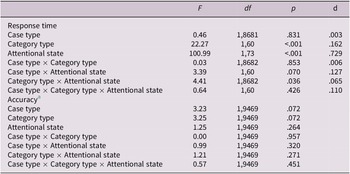
Linear mixed model results for Experiment 1

a No available method for calculating effect sizes comparable to either d or η 2 for generalized linear mixture models involving the binomial link function is currently available.
2.4. Letter case and semantic access
One issue with lexical decision, however, is that full semantic access to the meaning of a word is not technically required given that it is possible to respond “yes” to a word on the basis of an overall feeling of visual familiarity (Mayall & Humphreys, Reference Mayall and Humpherys1996; Perea et al., Reference Perea, Fernández-López and Marcet2020). Because of this, an interpretation of the LC advantage in such a task in terms of facilitated access to the corresponding lexical representation is never fully warranted. Moreover, in applied sense (viz., road signs), it is indeed the access to semantic-based representations that are actually of main concern.
The only research that has examined the effect of LC versus UC on lexico-semantic access was performed by Mayall and Humphreys (Reference Mayall and Humpherys1996). In their work, across a number of experiments (with Ns = 24, 16, and 32, in Exp. 1, 2, and 3, respectively), participants semantically classified visually presented words as representing examples of one of two possible categories (e.g., living or non-living things). Words were presented in both LC and UC as well as in alternating mixed case (MC; e.g., “FoRmAt”). Although the results involving MC have some relevance to the present work (and see some very recent work by Perea et al., Reference Perea, Fernández-López and Marcet2020, comparing MC and UC words in both lexical decision and semantic classification tasks), it is the LC versus UC effects that are of main concern to the current work. In this regard, an LC over UC speed advantage in mean correct RTs was present in all three experiments of Mayall and Humphreys (Reference Mayall and Humpherys1996; see Table 1 of Perea et al., Reference Perea, Rosa and Marcet2017). As discussed by Perea et al. (Reference Perea, Fernández-López and Marcet2020), no effect of letter case on semantic classification would have been expected if letter case effects in lexical decision tasks were solely due to visual familiarity.
3. Mind wandering
Thus far, the perceptibility and processing of words and sentences in LC and UC text has been assessed. However, the question of what case is most optimal for the processing of road signs has not yet really been assessed. This is a difficult question to answer, especially in the case of dynamically perceived road signs. Moreover, most people who drive can confirm that, on occasion, their focus of attention shifts from the driving to irrelevant thoughts (Burdett et al., Reference Burdett, Charlton and Starkey2016). Hence, to begin to understand how to optimize the textual processing of road signs, one must also consider the cognitive processes that limit semantic processing while driving (viz., mind wandering).
3.1. Mind wandering and performance
Mind wandering can be defined as a deviation in attentiveness away from a task and towards unrelated sensations or thoughts (Smallwood & Schooler, Reference Smallwood and Schooler2015). Often, this deviation represents an attentional shift from an external task (e.g., driving, reading) to internally generated thoughts (e.g., “How will my interview go? What is it with those Kardashians?”). This internal and stimulus-independent thought generation is what Smallwood and Schooler (Reference Smallwood and Schooler2015) termed self-generated thought. In other words, mind wandering represents a self-induced distraction from a task.
Mind wandering is a highly common and frequent daily occurrence. Indeed, based on evidence from event sampling, Killingsworth and Gilbert (Reference Killingsworth and Gilbert2010) reported that, on average, people spend approximately 50% of their time mind wandering. This is a concerning statistic given that mind wandering is a very effective way of compromising task performance (Mooneyham & Schooler, Reference Mooneyham and Schooler2013). Fairly recently, Mooneyham and Schooler (Reference Mooneyham and Schooler2013) reviewed the evidence demonstrating the presence of performance costs while mind wandering for both reading and various other tests of cognitive ability.
3.2. Mind wandering and reading
With respect to reading, a number of studies by Smallwood, Schooler, and colleagues have clearly demonstrated both item-level comprehension deficits as well as sentence-level propositional model-building deficits under mind wandering (Mooneyham & Schooler, Reference Mooneyham and Schooler2013) with the latter assumed to impair the “ability to detect meaning-related violations within the text” (p. 12). When people engage in mind wandering while reading, the eyes continue to scan the text nonetheless (Smallwood, Reference Smallwood2011). Mindless reading, as Smallwood (Reference Smallwood2011) describes it, arises from a decoupling (i.e., a detachment) of superficial (e.g., scanning text) and higher-order cognitive processes (e.g., semantic processing).
3.3. Mind wandering and driving
The performance of a highly learned skill such as driving does not require one’s full attention providing “more room” for other things such as listening to the radio, talking to a passenger, or getting lost in thought (He et al., Reference He, Becic, Lee and McCarley2011). In this vein, He et al. (Reference He, Becic, Lee and McCarley2011; see also Martens & Brouwer, Reference Martens and Brouwer2013; Yanko & Spalek, Reference Yanko and Spalek2014) tested the effects of mind wandering on driving performance and gaze (i.e., size of the visual field) in a simulated environment by instructing the participants to press a button on the steering wheel every time they realized that they were experiencing mind wandering. He et al. (Reference He, Becic, Lee and McCarley2011) found that although lateral control remained stable under mind wandering, longitudinal control decreased slightly under mind wandering (participants slowed down). As well, they found that the participants’ field of view narrowed under mind wandering. In other words, the drivers failed to scan and monitor their environment.
Recently, Geden et al. (Reference Geden, Staicu and Feng2018) examined the combined effects of mind-wandering and perceptual load (i.e., the amount of extraneous visual information) on driver distraction and vehicular control in a simulated driving environment. These researchers found enhanced mind-wandering under low perceptual load (i.e., reported on 50% versus 41% of mind-wandering probes under low and high perceptual loads, respectively). They also found that under high perceptual load conditions, participants tended to slow down but less so, here, when engaged in mind-wandering.
Hence, such research indicates that mind wandering is just as common while driving (for which some degree of constant attention is required) as while not driving. While driving, it can interfere with both the perception of the environment and control of the vehicle. Moreover, there has been some evidence that textual processing is shallower when mind wandering, which then has potential relevance to the processing of road signs.
4. Driving
4.1. Attention
Much of the work studying the influence of cognitive factors while driving has focused on either key driver performance measures (e.g., speed, locational stability, and scanning behavior) or the ability to perceive and react to potentially adverse driving events. Given that inattention/distraction is often a key factor in vehicular collisions, a lot research has been directed at studying its effect on driving (Qin et al., Reference Qin, Li, Chen, Bill and Noyce2019; Regan et al., Reference Regan, Hallett and Gordon2011). External sources of distraction while driving include cell phone usage, adjusting vehicular devices, conversations, and salient environmental stimuli (Qin et al., Reference Qin, Li, Chen, Bill and Noyce2019). The key internal sources of distraction are inattentional blindness and mind wandering (Qin et al., Reference Qin, Li, Chen, Bill and Noyce2019; Qu et al., Reference Qu, Ge, Xiong, Carciofo, Zhao and Zhang2015).
Importantly, with relevance to the current work, a study by Marciano and Yeshurun (Reference Marciano and Yeshurun2015) provided support for a correspondence between the findings of controlled laboratory studies and more real-life-based driver simulation studies. In this work, perceptual load levels at both task-relevant central and task-irrelevant peripheral regions were manipulated. Analogous to findings in the lab using letter stimuli, driving-related performance measures (i.e., speed and detection of critical events) were affected by higher levels of peripheral load but mainly when central perceptual load was low rather than high.
4.2. Road signs
Some recent work involving the perception of pictorial road signs indicates that when not specifically fixated on (i.e., by turning the head or eyes), laterally positioned signs can easily be missed in the periphery (Costa, Bonetti, et al., Reference Costa, Bonetti, Vignali, Lanteri and Simone2018). In this work, common Italian road sign were displayed for 500 ms on a screen to side of a central fixation point at various eccentricities. Identification of signs was only at about 80% for the smallest eccentricity that was examined (i.e., 1.1 degrees horizontally) and dropped off quite rapidly after that. In some further work by Costa, Simone, et al. (Reference Costa, Simone, Vignali, Lanteri and Palena2018), the eyes of participants on an actual driving route were monitored. They found that only 25% of the traffic signs on the side of the road were actually fixated. For the ones that were fixated on, median first-fixation distance was 51 m (less than half of what is recommended in road regulations) with the median fixation duration being 133 ms. A second psychophysical lab-based study by Costa, Simone, et al. (Reference Costa, Simone, Vignali, Lanteri and Palena2018) indicated that the presentation duration, at a distance of 50 m, required to achieve 75% accuracy for such road signs was 35 ms.
Beyond that of the Road Research Laboratory in the 60s, no work involving the processing of text on road signs has been attempted. The only potentially relevant work was that performed by Shinar and Vogelsang (Reference Shinar and Vogelzang2013). They presented traffic signs in the middle of a computer screen and measured both comprehension accuracy and the time taken to comprehend each sign. Sign were presented in standard symbolic form, with symbol and text, or text only (e.g., “railroad crossing”). Accuracy was approximately doubled and comprehension time halved for both the symbol-plus-text and also the text-only conditions.
Hence, in general, inattention is regarded as a key factor affecting driving performance. Some research that examined attentional-based phenomena both in the lab and while driving has found results to be comparable in both settings. Finally, very little research related to the processing of text on road signs (especially under compromised attentional conditions) has been performed.
5. This study
In this study, the effect that letter case had on the processing in two lexical-based, semantic cognitive tasks was examined under both attentive and more nonattentive mind-wandering states. As well, the encoding and subsequent memory for words presented in either type of letter case was also studied. First, the effect of letter case on the semantic processing of singly presented words was examined using a semantic category decision task akin to that used by Mayall and Humphreys (Reference Mayall and Humpherys1996). In this task, a word was presented in either SC or UC and participants were required to decide whether the word referred to either a living or non-living thing. Here, SC (i.e., LC but with the initial letter capitalized) was used instead of pure LC given its use within Kinneir’s Motorway typeface. As well, to simulate the effects of reading road signs while driving, the words were only briefly presented (i.e., 500 ms) in one of four random positions off to the sides of the visual display.
Second, with the same set of participants, the effect of case on the semantic processing of sentences was examined using a sentence judgment task. In this task, a sentence was presented in either SC or UC and participants were required to decide whether the sentence was either sensical or nonsensical. Sentences were presented for 2000 ms, now, in the center of the display. To our knowledge, this is the first time such a sentence-level, semantic task has been used to examine the effect of letter-case manipulations. For both the semantic category decision task and the sentence judgment task, a facilitating effect of SC over UC (i.e., faster and/or more accurate responding) was expected to be found based on previous research (c.f., Mayall & Humphreys, Reference Mayall and Humpherys1996, and Perea et al., Reference Perea, Rosa and Marcet2017, respectively).
As mentioned, also of interest was a comparison of performance under attentive and more nonattentive mind-wandering states. Typically, the effects of mind wandering during reading have been studied by periodically probing participants as to whether they are currently on- or off-task (Mooneyham & Schooler, Reference Mooneyham and Schooler2013). In the current work, mind-wandering states were induced by dramatically increasing the length of time between the trials (to 10 s Instead of 2 s) in half of the experimental blocks. For these more-lengthy inter-trial-interval (ITI) periods, participants were also asked to try, as best they could, to pay attention to their breath. As opposed to strict mindfulness techniques which involve actively trying to avoid mind-wandering (which can inhibit what is known as the default mode network [DMN] that is presumed to underlie mind wandering), the present instructions could be regarded as being more in the vein of non-directive meditation activities which are known activate the DMN (Xu et al., Reference Xu, Vik, Groote, Lagopoulos, Holen, Ellingsen, Håberg and Davanger2014). Note that rather than probing whether participants were naturally in a nonattentive, mind-wandering state or not, the current manipulation represents an attempt to increase the likelihood that participants would be in such a state when the imperative word/sentence stimulus arrives.
Under such conditions, performance would likely be expected to be compromised in general (i.e., slower and/or less accurate). Moreover, given that around 40–50% of the time individuals are likely to be in a mind-wandering state while driving (which continually involves processing upcoming road-sign information), the extent to which any differences in the perception of text presented in SC versus UC might then be further affected by the attentive state of the individual is of key interest in the current work. In this regard, according to the hierarchical model of reading described by Smallwood (Reference Smallwood2011), successful reading is viewed as an interaction (i.e., coupling) between both top-down (i.e., working and long-term memory) and bottom-up (i.e., perception of lexical information and syntax) cognitive processes. In mind-wandering states, top-down and bottom-up processes can decouple resulting in more superficial bottom-up processing that is likely to be benefitted more by the enhanced familiarity and distinctive word shape information provided by LC. Hence, such a view would lead to the expectation that any observed processing advantage of SC over UC would be even more likely to occur when individuals are in a more non-attentive, mind-wandering state.
Finally, the effect of case on the encoding and memory for words was examined using a recognition memory task. In this task, a word was presented in either SC or UC and participants were required to decide whether they had previously seen that word while they were performing the first task. Words were presented in the center of the display and, now, remained until the memory response was made. Although this could be regarded as being somewhat of an “add-on” task, to our knowledge, this is the first time memory for words presented in difference letter cases has ever been tested (rendering this latter work fully exploratory in nature).
6. Method
6.1. Participants
One hundred and four undergraduates signed up to participate in the study for course credit. Of the 104 participants, 80% (n = 83) reported that they were female (with 1 preferring not to disclose). Second, under handedness, 91 participants reported that they were right-handed, 10 participants that they were left-handed, and 3 participants that they were ambidextrous.
The average age of the sample was 20.30 years old (SD = 4.37), which included three participants that did not report their age. Third, under English language proficiency, 76 participants reported that “English is my native language,” 26 participants that “English is not my native language, but I am very proficient in it,” and 2 participants that “English is not my native language, but I am somewhat proficient in it.” Note that in the following analyses, it is the data for the 76 native language speakers only that will be considered for analysis.
6.2. Procedure
The experiments were programmed in Gorilla (Anwyl-Irvine et al., Reference Anwyl-Irvine, Massonié, Flitton, Kirkham and Evershed2019) and run online. The participants first read an informed consent form that highlighted the purpose of the study, compensation, right to withdraw, potential risks, and confidentiality. They were then asked to indicate their age, gender, handedness, and if English was their native language (although they were told that they had the right to leave demographic answers blank). Finally, upon completion, participants were presented with a debriefing form containing contact information and the purpose of the study. All data collected was confidential and all participant data was anonymized.
6.2.1. Experiment I: Category decision task
In this experiment, participants were presented with single stimulus words randomly placed in the middle of one of four sections of their computer screens (top right, top left, center right, or center left). Words were presented in 28-point Open Sans font (the default font in Gorilla). On each trial, participants were presented with a blank screen for either 2 s or 10 s (depending on the block of trials), then a stimulus word for 500 ms, followed by another blank screen that remained until a decision had been made. The category decision was to be completed via the use of the participant’s keyboard (the “Q” and “P” keys) and they were urged to respond as quickly and accurately as possible.
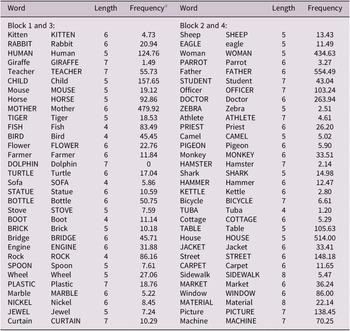
Participants were asked to decide whether the word they were shown represented a living thing or a non-living thing. The list of 64 target words used is provided in Table A1 of the Appendix. Half of the words referred to living things (e.g., “Kitten,” “Athlete”) and the other half referred to non-living things (e.g., “Stove,” “Market”). The mean word length and frequency was 5.8 and 83.70, respectively, for the living things and 5.8 and 47.9, respectively, for the non-living things (although note that the mean word frequency for the living things is 54.8 when excluding the two very high frequency words “Mother” and “Father”). A list of 42 filler words (half living and half non-living) that were deemed to be analogous to the target words were then chosen.
Each participant had to complete four blocks of category decision trials (preceded by 10 practice trials for which corrective feedback was provided). Each block contained 32 target words and 10–11 filler words. Across the first two blocks (1 and 2), in a random fashion half of the words (64 target and 21 filler in total) were presented in SC and the other half in UC. Across the last two blocks (3 and 4), the 64 target stimulus words remained the same as in Blocks 1 and 2, respectively, although their case type was reversed (with 21 new filler words used, half in SC and half in UC). As well, in the two middle Blocks 2 and 3, the 10-s Blank screen between trials was used and, in order to further stimulate mind-wandering, participants were asked to concentrate on their breath for the duration of the initial blank screen (while waiting for the stimulus word to appear). In Blocks 1 and 4, participants were simply asked to complete the category decision task and the initial blank screen was presented for only 2 s Before each stimulus word. Therefore, with respect to the initial duration (i.e., attentional state) manipulation, an ABBA design was followed. Such a design allowed for the more standard 2-s Initial duration period to be used when the participants first started the task while also controlling for potential practice effects by having them finish off the task with this same initial duration period. Before moving forward to Experiment II, participants took a short break.
Participant RT and accuracy were analyzed according to a 2
 $ \times $
2
 $ \times $
2 (case type
 $ \times $
category type
 $ \times $
attentional state) repeated-measures ANOVA experiment analyzed using linear and generalized (i.e., binomial-based) linear mixed models in SPSS with both the participants and the words specified as random effects (Judd et al., Reference Judd, Westfall and Kenny2012). To ensure model convergence (and, hence, validity of the resultant model fits), the model was first run with all possible random effects included and then re-run with only those random effects included that were significantly different from 0. In the first fixed factor of the design (case type), the stimulus word was presented in either SC (e.g., “Guitar”) or UC (e.g., “GUITAR”). In the second factor (category type), the stimulus word was either a living thing (e.g., “HORSE” or “Horse”) or a non-living thing (e.g., “GUITAR” or “Guitar”). In the third factor (attentional state), the presentation time of the initial blank screen was either 2 s (attentive state) or 10 s with concentration on breath (i.e., the mind-wandering state).
6.2.2. Experiment II: Sentence judgment task
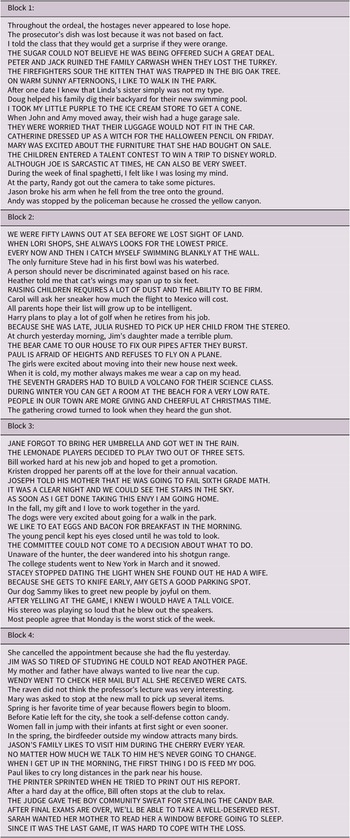
In this experiment, participants were presented, as on road signs, with single stimulus sentences in a “stacked” fashion (i.e., split up over two or more rows) within a “box” (i.e., no actual sides were shown) in the center of their screen (see Fig. 1). The sentences were shown in 28-point Open Sans font and the size of the box was 15% of the height and the length of the screen, respectively (i.e., a 2.25% chunk of the total screen area). On each trial, participants were presented with a blank screen for either 2 s or 10 s (depending on the block of trials), then a stimulus sentence for 2000 ms, followed by another blank screen until the sentence judgment had been made. The response was to be made via the use of the participant’s keyboard (the “Q” and “P” keys) and they were urged to respond as quickly and accurately as possible. Participants were asked to judge whether the sentence was sensical or nonsensical. Sentences were those used in the classic reading span task (Daneman & Carpenter, Reference Daneman and Carpenter1980) with a full listing of them provided in Table A2 of the Appendix. The mean word length of those sentences was 12.5 words.
Examples of sentences presented in Experiment II.

Each participant had to complete four blocks of 20 sentence judgment experimental trials (preceded by four practice trials for which corrective feedback was provided). Across the four blocks, in a random fashion half of the 80 target sentences were presented in UC and the other half in SC. Note that in this experiment, unlike Experiment I, sentences were not repeated. Hence, the case type for each of the sentences was switched across two halves of the participant sample. Lastly, this experiment also followed an ABBA design. In Blocks 2 and 3, participants completed the sentence judgment trials under a wandering state (initial 10-s Blank screen with breath monitoring). In Blocks 1 and 4, participants completed the sentence judgment trials under an attentive state (initial 2-s Blank screen). Before moving forward to Experiment III, participants took a short break.
Participant RT and accuracy were again analyzed according to a 2
 $ \times $
2
 $ \times $
2 (case type
 $ \times $
sentence type
 $ \times $
attentional state) repeated-measures ANOVA analyzed using linear and generalized (i.e., binomial-based) linear mixed models in SPSS with both the participants and the sentences specified as random effects (Judd et al., Reference Judd, Westfall and Kenny2012). Again, only those random effects that were significantly different from 0 were included. In the first fixed factor of the design (case type), the stimulus sentence was presented in either SC or UC. In the second factor (sentence type), the stimulus sentence was either sensical (e.g., “JOHN CROSSED THE STREET” or “John crossed the street”) or nonsensical (e.g., “JOHN CROSSED THE MORNING” or “John crossed the morning”). In the third factor (attentional state), the presentation time of the initial blank screen was either 2 s (attentive state) or 10 s with concentration on breath (i.e., the mind-wandering state).
6.2.3. Experiment III: Recognition memory task
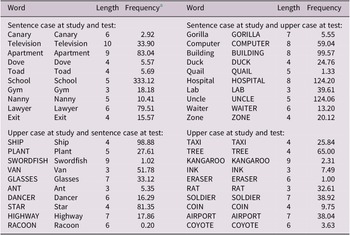
In this experiment, participants were presented with single stimulus words in 28-point Open Sans font in the center of their computer screens. Words were preceded by a blank screen for either 2 s (i.e., no 10 s Mind-wandering manipulation was used here) and remained on the screen until a decision had been made. The memory response was made via the use of the participant’s keyboard (the “Q” and “P” keys) and they were urged to respond as quickly and accurately as possible. Participants were asked to decide whether the word they were shown was one of the words they had seen in the initial semantic categorization task or not. The list of 40 words taken from the list of filler words in the first experiment for use as memory stimuli in this final experiment is provided in Table A3 of the Appendix. Their mean word length and frequency was 5.5 and 42.36, respectively.
Each participant had to complete four blocks of 20 recognition memory trials (preceded by 4 practice trials for which corrective feedback was provided). Half of the words were the “old” filler words presented throughout the blocks in Experiment I. The other half represented “new” living and non-living things. With respect to the “old” words, half were presented in the same case (i.e., SC or UC) as their initial presentation in the first block, the other half had their initial case type reversed.
Participant accuracy to the “old” words only were analyzed according to a 2
 $ \times $
2(case type
 $ \times $
same/different as previous case type) repeated-measures ANOVA analyzed using a generalized (i.e., binomial-based) linear mixed model in SPSS with both the participants and the words specified as random effects (Judd et al., Reference Judd, Westfall and Kenny2012). Again, only those random effects that were significantly different from 0 were included.
7. Results
The anonymized, raw data and SPSS syntax for all of the following analyses are openly available at https://osf.io/3r2vz/?view_only=e3833b3f9fed45ec98d8da16cbec70e2.
7.1. Experiment I: Category decision task
Two participants were dropped from the Experiment I analyses due to relatively low accuracies of 65% and 66% (with the mean accuracy of the remaining 74 participants being .951, SD = .052, Min = .727, Max = 1.000). Only non-practice trials to target (i.e., not filler) words were analyzed. All remaining cases were kept for the accuracy analyses. However, only RTs for correct responses were examined. As well, any RTs shorter than 200 ms or longer than 7 s Were eliminated (1.0%) followed by a trimming of any RTs that were 3 SDs above each participants’ mean correct RT (1.5%). The total number of observations was 8,894 for the RT analyses and 9,447 for the accuracy analyses. This provided approximately 4500 observations per cell for the main effects, 2250 per cell for the two-way interactions, and 1125 per cell for the three-way interaction. Hence, for the seven effects being analyzed, the number of available observations were either 3 times higher, 1.5 times higher, or .70 times lower than the 1600 per condition recommended by Brysbaert and Stevens (Reference Brysbaert and Stevens2018, p. 16) to provide adequate power (i.e., .80) to detect a very small effect of d = .1Footnote 2.
Statistical test results for this first experiment are provided in Table 1 Footnote 3. The RT results indicated that correct responses to the names of living things were significantly faster than to the names of non-living things (972 versus 1026 ms, respectively). As well, responses with the shorter 2-s ITI were significantly faster than those with the longer 10-s ITI (882 versus 1118 ms, respectively). The differences in the speed of correct responses to the names of living things compared to non-living things were significantly greater for the shorter 2-s ITI (851 versus 912 ms, respectively) than for the longer 10-s ITI (1094 versus 1141 ms, respectively). On the other hand, no main effect or interaction involving letter case was significant for correct RTs. Given the key nature of the interaction of letter case with attentive state, even though it was not significant, the RT and accuracy results for the four corresponding cells are provided in Fig. 2 for completeness. For the accuracy outcome, none of the effects were significant at the .05 level.
Mean correct response times and accuracy in Experiment I to respond to words printed in either sentence case or upper case under 2-s (attentive) and 10-s (mind-wandering) inter-trial-interval conditions (error bars are 95% confidence intervals; Cousineau & O’Brian, Reference Cousineau and O’Brien2014)

7.2. Experiment II: Sentence judgment task
Six participants had to be dropped from the Experiment II analyses due to very low accuracies of 30–54% (with the mean accuracy of the remaining 70 native English-speaking participants being .822, SD = .098, Min = .600, Max = .975). Only non-practice trials were analyzed. All remaining cases were kept for the accuracy analyses. However, only RTs for correct responses were examined. As well, any RTs shorter than 200 ms or longer than 12 s were eliminated (0.6%) followed by a trimming of any RTs that were 3 SDs above each participants’ mean correct RT (0.8%). The total number of observations was 4551 for the RT analysis and 5600 for the accuracy analysis. This provided approximately 2275 observations per cell for the main effects in the RT analysis, 1138 per cell for the two-way interactions, and 568 per cell for the three-way interaction. Hence, for analyses of the RT interactions in this experiment, the number of observations was below the 1600 per condition recommended by Brysbaert and Stevens (Reference Brysbaert and Stevens2018, p. 16) to provide a power level of .80 to detect an effect of d = .1Footnote 4.
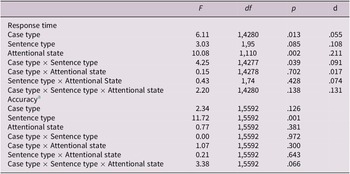
Statistical test results for this second experiment are provided in Table 2. For RT, letter case was significant (2717 versus 2761 ms for SC and UC, respectively). As well, correct responses with the shorter 2-s ITI were significantly faster than those with the longer 10-s ITI (2649 versus 2826 ms, respectively). Letter case also interacted with sentence type (2667 versus 2754 ms, respectively, for SC and UC sensical sentences but 2774 versus 2768 ms, respectively, for SC and UC nonsensical sentences). Hence, SC and UC were equally fast for nonsensical sentences (t[2328] = 0.11, p < .915, for the simple effect of case) but SC led to quicker responses to sensical sentences (t[64] = 3.22, p < .002, for the simple effect of case). Mean correct RTs and the corresponding accuracies for the eight cells of this design are plotted in Fig. 3. In Fig. 3, for sensical sentences some suggestion of a larger effect of case with the larger 10-s ITI than with the smaller 2-s ITI was present but this potential effect was not significant (t[2214] = 0.83, p < .405, for the simple interaction of case and attentional state). For the accuracy outcome, responses were significantly more accurate for sensical sentences than for nonsensical sentences (.873 vs. .770, respectively). No other main effect or interaction was significant for accuracy.
Linear mixed model results for Experiment 2

a No available method for calculating effect sizes comparable to either d or η 2 for generalized linear mixture models involving the binomial link function is currently available.
Mean correct response times and accuracy in Experiment II to respond to sensical and nonsensical sentences printed in either sentence case or upper case under 2-s (attentive) or 10-s (mind-wandering) inter-trial-interval conditions (error bars are 95% confidence intervals; Cousineau O’Brian, Reference Cousineau and O’Brien2014)

7.3. Experiment III: Recognition memory task
Ten participants had to be dropped from the Experiment III analyses due to very low accuracies of below 50% (with the mean accuracy of the remaining 66 participants being .771 SD = .120, Min = .525, Max = .975). Only non-practice trials for “old” word stimuli were analyzed. The total number of observations for this accuracy analysis was 2642. This provided approximately 1320 observations per cell for the main effects and 660 per cell for the two-way interactionFootnote 5.
Statistical test results for this second experiment are provided in Table 3. Neither the main effects nor the interaction were significant at the .05 level for recognition memory accuracy. Nonetheless, for “old” words presented in SC in Experiment III, recognition accuracy was .756 for words also presented in SC in Experiment I (i.e., same case) and .752 for words previously presented in UC (i.e., different case). For “old” words presented in UC in Experiment III, recognition accuracy was .823 for words also presented in UC in Experiment I (i.e., same case) and .752 for words previously presented in SC (i.e., different case).
Linear mixed model results for Experiment 3

8. Discussion
In this study, semantic judgments of single words and sentences presented in both SC and UC were made under conditions of both attentive and more nonattentive mind-wandering states. With respect to the word task, regardless of attentive state, semantic judgments of single words did not seem to be systematically affected by the letter case of the presented word. Such a result is not consistent with Mayall and Humphreys’ (Reference Mayall and Humpherys1996) findings. Hence, in line with a number of views of the lexical processing of text (e.g., Dehaene et al., Reference Dehaene, Cohen, Sigman and Vinckier2005), no evidence that the nature of the visual word form, in terms of letter case, differentially affects semantic access to the meaning of words was obtained here.
Such results are also consistent with recent work by Perea et al. (Reference Perea, Fernández-López and Marcet2020) demonstrating that the speed of lexico-semantic access (as indexed by a semantic word classification task analogous to the one used in the current Experiment I) was the same for words presented in all UC (e.g., LATERAL) versus fully mixed upper and lower cases (e.g., LaTeRaL). Although lower and upper same-case words were not specifically contrasted in that work, the lack of an effect of MC implies that case is not relevant to such judgments. Conversely, in a corresponding lexical decision task run by Perea et al. (Reference Perea, Fernández-López and Marcet2020), MC words served to slow down “word” responses but speed up “nonword” responses. On the basis of such findings, Perea et al. (Reference Perea, Fernández-López and Marcet2020) concluded that the lowered visual familiarity associated with the words presented in MC likely served induce a bias in favour of nonword (i.e., “no”) responses in lexical decision whereas in the semantic classification task visual familiarity was not relevant.
With respect to the comparison of lower and upper case in lexical decision, as mentioned earlier, an LC advantage for words (but no case effect for nonwords) was present in the work of Vergara-Martínez et al. (Reference Vergara-Martinez, Perea and Leone-Fernandez2020). Moreover, Perea et al. (Reference Perea, Marcet and Vergara-Martinez2018) also observed an LC advantage in lexical decision but only for words that are typically displayed in LC (which they referred to as “molecule” words). This finding prompted Perea et al. (Reference Perea, Marcet and Vergara-Martinez2018) to conclude that “the typical letter-case configuration modulates the identification of common words” (p. 103). Finally, some evidence for the influence of case on lexical access itself was recently provided by Labusch et al. (Reference Labusch, Kotz and Perea2022) who showed that the processing of German nouns in a semantic categorization task (i.e., “Is this word an animal name – yes or no?) was quicker for words presented with the initial letter capitalized. Importantly, the German language requires the capitalization of all nouns, unlike the English or French language, for example, which only require capitalization at the start of a sentence or for formal nouns (hence, “sentence case”). Hence, on the basis of this result, it can be conjectured that the effect of visual word form on lexical access may depend on the reader’s native language. One account for such their results proposed by Labusch et al. (Reference Labusch, Kotz and Perea2022) was that visually presenting words in their most familiar form “would produce a greater level of activation in the orthographic lexicon” (p. 900) which would then put into question the notion of case-invariant orthographic representations.
In this vein, in the current work, the processing of sentences showed an SC (i.e., LC with the first letter of the first word capitalized) advantage for RT. However, such an advantage was evident mainly for correctly recognizing that sentences made sense suggesting that such responding likely benefitted from the enhanced familiarity and distinctive word shape information provided by SC. Such an advantage did not seem to extend to judgments of nonsensical sentences presented in SC. The presence of a letter-case effect for sensical sentences is consistent with the notion that the validation of sentential information can be influenced by the perceived processing fluency. That is “experienced ease of processing (i.e., fluency) is typically associated with truth …, so that when the processing of information is experienced as fluent, it might be judged as true even when it is not” (Weil & Mudrik, Reference Weil and Mudrik2020). As noted earlier in the Introduction, the use of SC could affect perceived processing fluency by facilitating the familiarity check that is used to move the eyes from the currently fixated word to the next word (Perea et al., Reference Perea, Rosa and Marcet2017), hence, resulting in a potential bias towards “yes” responses. Importantly, though, the current results suggest that although such a bias might indeed then be facilitating the responding to sensical sentences, it does not seem to engender much interference with the “no” responses. That is, any potential effects of letter case on processing fluency simply seem to be nullified in the responding to nonsensical sentences.
Alternatively, another influential model of sentence comprehension is the Resonance-Integration-Validation (RI-Val) model (O’Brian & Cook, Reference O’Brien and Cook2016; Weil & Mudrik, Reference Weil and Mudrik2020) that involves three overlapping stages of processing. The first is the resonance stage whereby the textual information is assumed to passively activate their corresponding concepts in long-term memory (and all related ones). In the second integration stage, the activated components are linked. In the third validation stage, the formed linkages are checked against previous knowledge in long-term memory for conceptual matches and mismatches (e.g., “macadamia are nuts” and “macadamia are berries,” respectively; Weil & Mudrik, Reference Weil and Mudrik2020). Matches indicate that comprehension has occurred and mismatches indicate that more processing is needed. If the goal is actually to validate the sentence itself, a clear mismatch could be assumed to be enough to reject the validity of the sentence.
Regarding the influence of letter case within such a theoretical framework, given that the latter two stages operate on conceptual entities only, the visual word form (i.e., case) would have to be assumed to directly affect the initial resonance stage of the RI-Val model. Namely, the use of SC/LC might serve to enhance the effectiveness of the resonance process, which would then also serve to affect the processing in the two subsequent stages given that they depend on the results of that first stage. Moreover, given that the nature of the sentences used here contain much more matching than mismatching elements (i.e., they contain multiple propositions many of which are still matching even in the nonsensical sentences), any enhancements in the effectiveness of the resonance process would then be more likely affect “yes” judgments than “no” judgments.
With respect to the 2- versus 10-s ITI manipulation, responding was quite slowed overall in both the semantic category and the sentence verification tasks when the 10-s ITIs were used indicating that being in a more nonattentive, potentially mind-wandering state, when the text stimulus is presented serves to affect the speed of processing of that text. Moreover, note it was not likely the case that participants were simply missing the stimuli in such conditions because, if so, it would have been response accuracy that would have been most affected by the attentional state manipulation. On the other hand, however, the advantage of SC over UC that was evident in the responding to sensical sentences did not turn out to be statistically larger for the 10-s ITI (i.e., nonattentive, mind-wandering) condition in comparison to the 2-s ITI condition (c.f., the simple interaction of case and attentional state that was tested). Certainly, if mind-wandering states serve to induce a greater decoupling of more bottom-up visual processes with more top-down semantic processes the effect of such decoupling (either on perceived processing fluency or the effectiveness of the resonance process in the RI-Val model) was expected to be less evident for text presented in SC/LC given it’s enhanced visual familiarity and more distinctive shape. Nonetheless, it is important to note that in Fig. 3 the effect of letter case on the responding to sensical sentences is indeed larger for the 10-s ITI than for the 2-s ITI (albeit not enough to be significant in the face of the RT variability associated with the sentence judgments).
Finally, recognition memory did not seem to differ for single words presented in SC or UC at “study.” Nonetheless, although not significant, there was a tendency for enhanced memory for words presented in UC both at “study” and “test.” It occurs to us that such a finding is somewhat consistent with the perceptual legibility work that has been done showing a UC advantage for single words, given that all of that work involves reporting back what was perceived and, hence, involves some memory. Given the exploratory nature of this last experiment, it might be worth trying to replicate such results within a more controlled, focused, and powerful designFootnote 6.
One potential limitation of the study is that the results pertain only to the font style (or typeface) employed here. Although there has been some recent work that has examined the effects of both letter case and different kinds of typefaces on recognition thresholds for three-letter words (Pušnik, Možina et al., Reference Pušnik, Možina and Podlesek2016; Pušnik, Podlesek, et al., Reference Pušnik, Podlesek and Možina2016), typeface has not yet manipulated in experiments focusing on the lexical and semantic processing of typed verbal material in different letter cases (with the recent work by Perea et al., Reference Perea, Rosa and Marcet2017, and Vergara-Martínez et al., Reference Vergara-Martinez, Perea and Leone-Fernandez2020, presenting stimuli in Courier typeface only). A second potential limitation is the use of a sample of undergraduate students in the current work. The main difference between such a sample and one from the general community that would be most relevant to the present work is the fact that university students could probably be regarded as being more expert readers. Hence, the extent to which our results might generalize to samples of individuals who do not spend as much time reading is still an open question.
9. Conclusion
Although words in UC have been associated with legibility advantages in previous work under very small or very fast presentation conditions, there was no advantage in this current work for either SC or UC with respect to accessing the semantics of single words presented with sufficient apprehension time. Nonetheless, consistent with the findings of a number of other researchers, a processing advantage for sentences presented in SC was observed in this study. This was especially the case for the more realistically valid sensical sentences (where nonsensical ones are rarely encountered by those other than copy editors).
In conclusion, although visual word form manipulations involving case type do not seem to affect semantic access for isolated words, they do seem to affect the more complex conceptual validation processes underlying the semantic processing of sentential information. Whether the current results reflect differences across case type in either processing fluency or the effectiveness of an initial resonance stage of processing cannot be determined from this work, however.
With respect to the use of SC/LC versus UC on road signs, although the current work could be regarded as being highly relevant to the study of the textual processing of words and sentences across letter-case types in general, aspects of the current design were specifically invoked (i.e., the presentation locations and duration of the words in Experiment 1, the box-like form of the presentation of the sentences in Experiment 2, and the manipulation of attentional states) to help ensure that the current results would indeed be relevant to the issue of which case type might be best to use on road signage. In this regard, although we would probably not advocate a wholesale change to SC on such signs based on the current results, we would conclude that the use of SC should work just as well (and, perhaps, even a bit better) than UC.
Data availability statement
The anonymized, raw data and SPSS syntax for all of the reported analyses are openly available at https://osf.io/3r2vz/?view_only=e3833b3f9fed45ec98d8da16cbec70e2.
Appendix
Words used in Experiment I

Sentences used in Experiment II

Note. The case type shown here was reversed for half of the participants.
“Old” words used in Experiment III