Since 1993, Chinese cadres have been officially divided into two categories: leading and non-leading cadres (feilingdao ganbu 非领导干部). The Chinese Communist Party (CCP) has explored many innovative ways to use the non-leading cadre system to cope with problematic aspects of China's cadre personnel management system, especially problems caused by the rigid policies for managing the leading cadre corps. However, in the study of the Chinese bureaucracy, attention is given overwhelmingly to the management of leading cadres, that is the leaders of the party-state at various levels as well as executives of local agencies. Systematic studies of the management of non-leading cadres are far from sufficient. In addition, published laws, rules and regulations related to cadre personnel management provide only general guidelines on the management of non-leading cadres and offer little information about how these policies and regulations are implemented.Footnote 1
The lack of information regarding the management of the non-leading cadre system is puzzling, given the important role the non-leading cadres play in China's cadre personnel management system. To begin with, non-leading cadres comprise the bulk of the cadre corps in terms of numbers. In fact, according to one account, in 2007, non-leading cadres with approved establishment quotas (bianzhi 编制) accounted for over 70 per cent of the entire cadre workforce below the provincial/ministerial level in party-state organizations.Footnote 2 In the United States, senior civil servants (7,794 in September 2014), whose positions are at grades 15–18, account roughly for 0.05 per cent of the whole federal civil service (about 2 million).Footnote 3 In this light, it seems that China has a far larger number of leading cadres (30 per cent). However, it is important to point out that this 30:70 ratio refers to the number of cadres in Party and state organizations only and excludes those in other types of public sector organizations such as state-owned enterprises and social institutions. To the best of our knowledge, there are no accessible statistics on the ratio of non-leading cadres to the entire cadre workforce. Regardless, it is inconceivable that the CCP would have no method of managing non-leading cadres, given their high ratio in China's party-state organizations.
Moreover, the non-leading cadre system has always been an integral part of the governance system, as is evident from the fact that many non-leading cadres are listed in various local nomenklatura, even down to the grassroots (town/township) level of administration. Additionally, as will be shown later, many non-leading cadres are in reality core or reserve cadres at the same level or next-higher level of the cadre leadership corps. The non-leading cadre system clearly has intrinsic value and must serve some significant functions within the Chinese party-state bureaucracy. The first objective of this paper, therefore, is to provide an overview of the origin, importance and strength of the non-leading cadre system.
The second objective of this paper is to demonstrate the contribution of the non-leading cadre system to the Chinese party-state bureaucracy. After China opened its market to the West in 1978, the CCP began to reform its personnel management system, gradually building up experience in this area. Nevertheless, Chinese officials acknowledge that in those early years they had difficulty dealing with certain problematic aspects of cadre personnel management.Footnote 4
The problem is not that there are too many cadres. According to one account, China's net public employment is actually below, or about one-third of, the international norm.Footnote 5 The problem has at least three facets. First, there are too few professional “talents” (i.e. highly skilled, talented cadres). Second, there are too few administrative levels, which means opportunities for promotion are severely limited. Third, the rules and regulations regarding quotas in all work units are excessively rigid. The paper's empirical analysis shows how the non-leading cadre system's pragmatic operation deals with these problematic aspects in China's cadre personnel management system in the face of the inability or reluctance of the Chinese bureaucracy to apply stringent standards in sanctioning inappropriate, incoherent or abnormal personnel management practices.
The third objective of this paper is to hypothesize that China's regime resilience can be attributed in part to the highly flexible and fluid use of the non-leading cadre system in the Chinese bureaucracy. This paper shows how politically and administratively important the non-leading cadre system is to the party-state, enhancing as it does the party-state's administrative adaptability while fostering cohesion among the elite cadre workforce. Although the non-leading cadre system seems to have established redundancy in the cadre workforce, which some may regard as a deficiency in an efficient bureaucracy, this paper shows that redundancy can be seen as a positive feature in certain circumstances. Furthermore, the ways in which non-leading cadres are used create mobility between the two statuses (i.e. between non-leading and leading cadres), providing flexibility, which the different levels of the party-state bureaucracy can then leverage to develop their own measures for solving their own problems. Through the non-leading cadre system, the Chinese bureaucracy at each level can operate “defectively without doing critical injury” to the overall cadre personnel management system. In essence, the non-leading cadre system can be considered as a workforce that has grown to be redundant but is necessary for regime stability.Footnote 6 In this regard, it is hard to find equivalents of China's non-leading cadre system in the civil service systems in the West because the West lacks China's unique blending of Party and state administrative apparatus.
Without doubt, the non-leading cadre system not only addresses, for example, motivation problems but also increases the vitality of the bureaucratic system, thereby improving regime governance. As mentioned above, flexible use of the non-leading cadre system contributes to regime resilience and stability, at least in the short term. Yet, it must be pointed out that the lack of clear and consistent policies for managing the non-leading cadre system is likely to give rise to systemic policy incoherence and contradiction at each administrative level. In the longer run, these issues will need to be tackled if the robustness of the party-state bureaucracy and regime stability are to be maintained. The paper concludes by examining the question of the durability of the non-leading cadre system and how it sheds light on China's reform and transition. It also considers the prospects and challenges involved in rationalizing China's cadre personnel management system.
This study adopts documentary analysis and face-to-face interviews with Chinese officials as its main method of data collection. In addition to using official documents that are publicly accessible, we examined some documents that are only published internally, such as local nomenklatura lists. We also conducted 12 interviews with five central officials between 2014 and 2016. These were bureau-level officials from the Central Organization Department (COD) (one official), the-then Ministry of Personnel (MOP) (two officials), and the Central Establishment Commission (CEC) (two officials).Footnote 7 Researchers' access to central leaders and internal Party documents is often limited. In this regard, this study provides uniquely valuable information on the non-leading cadre system and the challenges facing the Chinese bureaucracy in dealing with it.
The Policy Origin of the Non-leading Cadre System
Policies regarding the non-leading cadres can be found in several Party and state documents. The 2005 Civil Service Law includes general guidelines on the recruitment, appraisal, selection and transfer of the non-leading cadre corps. The 2006 Establishment and Management Interim Method for Non-leading Posts in the Category of Comprehensive Administration within the State Civil Service provides general guidelines regarding setting up non-leading posts in the category of comprehensive administration. The 2014 Regulations on the Selection and Promotion of Party and Government Leading Cadres briefly cover two aspects, namely that non-leading cadres at or above the county level shall be managed by referring to the Regulations (Article 4) and that there is a requirement of a year in service before a non-leading cadre can be appointed to a position at or above the county and section level (Article 8[3]).Footnote 8
Non-leading cadre posts in the category of comprehensive administration within the state civil service system include counsels (xunshiyuan 巡视员), deputy counsels, researchers (diaoyanyuan 调研员), deputy researchers, section chiefs (zhuren keyuan 主任科员), deputy section chiefs, section personnel (keyuan 科员) and clerks (banshiyuan 办事员).Footnote 9 The posts of counsels and researchers were in place in the Party bureaucracy in as early as the 1950s.Footnote 10 Examples abound: counsels appeared, for example, in the Jilin provincial nomenklatura promulgated on 7 May 1957. Counsels and researchers appeared in the Guizhou provincial nomenklatura (1984), the nomenklatura of the People's Bank of China (1984) and the Commercial Bank of China (1986).Footnote 11 In 1984, Guangxi province had a total of 8,300 advisors (guwen 顾问), and they were assigned to the posts of counsels, researchers and supervisors to serve both local governments and the Party bureaucracy.Footnote 12 Many local nomenklatura – for example, the nomenklatura of Hetian 和田 county (2004) in Xinjiang province, Xin 新 county (2005) in Henan province and Wangcheng 望城 county (2009) in Hunan province – have also included other equivalent non-leading cadre posts, such as organization officers, coordination officers, confidential officers and secret-code inspectors, in their lists. Service institutes and state-owned enterprises also developed lists of non-leading posts for categories other than comprehensive administration. For example, Party schools are categorized as service institutes, and some have established the non-leading posts of united front officers and political instructors. Likewise, many banks, which are categorized as a type of state-owned enterprise, have established the non-leading posts of bank supervisory chief, bank supervisor and bank inspector.
Nevertheless, it would be misleading to equate non-leading cadres to bureaucrats and leading cadres to politicians, as commonly understood in Western contexts. As Ezra Vogel has indicated, China has a highly politicized bureaucracy in which politicians are simultaneously bureaucrats: there is no sharp line between politicians and civil servants.Footnote 13 In reality, non-leading cadres can in some instances be members of leading groups of local party-state bureaucracies and thus hold substantive leadership power. For example, the top post of an office in a township or a village is often filled by an office-level (guji 股级) clerk. Although the position of clerk is non-leading, the cadre holds de facto power as a leading cadre at this particular level of administration.
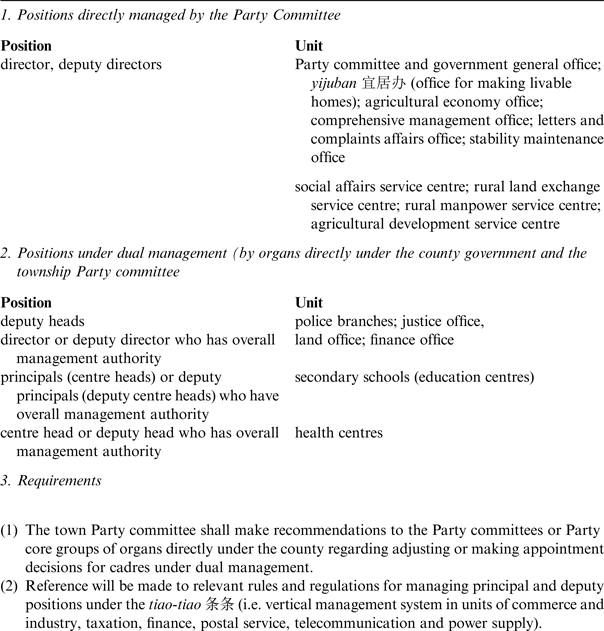
Many local Party organizations have put their office-level cadres in their nomenklatura. In other cases, local governments simply develop their own office-level nomenklatura. For example, in Zhen'an 镇安 township, in Yun'an 云安 county, Guangdong province, almost all key non-leading cadres in the township government were included in the job-title list published in 2010 (see Appendix).
Available national statistical information shows that in 2007, non-leading cadres comprised about 4.8 million (over 70 per cent) of a 6.8 million cadre workforce in party-state organizations (see Figure 1). Non-leading cadre corps have always been highly concentrated in grassroots-level Party and government offices and organizations. The actual number of non-leading cadres must have exceeded 4.8 million because this figure does not include personnel who work in service institutes and enterprises, or who are employed through special policy schemes (see below) and who take up non-leading positions without an approved establishment quota in their work units. A long-serving senior cadre in the Central Organization Department estimated that in 2015 about 75 per cent of the cadre workforce had taken up non-leading posts in various capacities in the Chinese party-state bureaucracy.Footnote 14
Estimated Number of Non-leading Cadres in 2007

Policy Strengths of the Non-leading Cadre System
Chinese cadre personnel management has three basic functional components: the entry, the management and the exit aspects of the cadre workforce. This part of the article assesses the policy strengths of the non-leading cadre system in all three aspects and shows how its day-to-day operations improve the adaptability of the party-state bureaucracy. The paper also explores how the system deals with problems relating to these three components.
How cadres enter the civil service
Article 64 of the Civil Service Law continues the nomenklatura practice of allowing cadres to change positions within administrative units of the state or to move to an enterprise or service institute without taking an examination. The same article provides, in fact, an authorized “shortcut” whereby work units can bypass the staffing quotas by routing cadres to non-leading posts.
Article 13 of the 1993 Provisional Regulations on State Civil Servants and Article 21 of the 2005 Civil Service Law limit the posts for which an examination is required to those below the level of section chief. This “restriction” leaves plenty of space for the adoption of policy-based methods of increasing the hiring of cadres into the party-state bureaucracy.
The first policy-based method of increasing the hiring of cadres is the hiring of demobilized soldiers. Providing demobilized soldiers with employment has a welfare and patronage component to it. The practice is most concerned with social stability. Although no statistical data are available to indicate the split of hiring into the leading and non-leading posts, our interviewees estimated that “in provincial- and municipal-level governments, about 20 per cent of the demobilized soldiers were deployed to non-leading posts in 2015. For county- or lower-level governments, the percentage can easily go up, in some cases to 40 per cent. For town- or township-level governments, it could well be, in some extreme cases, above 50 per cent.”Footnote 15
Each provincial-level government has an office for settling demobilized soldiers. Very often, local governments are given a higher number of demobilized soldiers to settle than permitted by the quotas allocated by Beijing. In those instances, the local governments will resort to a number of coping strategies. The most preferred way is to deploy the soldiers to non-leading posts either in service units or other non-state units (such as people's congresses, people's political consultative conferences, democratic organizations), because unlike state units, non-state units are able to get around staffing quotas by routing all demobilized soldiers first to non-leading posts. Alternatively, the local offices of demobilized soldiers can arrange for the soldiers to take up a non-leading post at the office rank, which is lower than the soldiers' personal rank. There is a hidden rule in the Chinese bureaucracy that these types of appointments will not count against official allocation quotas.Footnote 16
The second policy-based method of increasing the hiring of cadres is the hiring of specially selected graduates (xuandiaosheng 选调生, hereafter XDS). In this scheme, the non-leading cadre system is used to build up the third echelon of the Party leadership corps. Every XDS is both a civil servant and a member of the reserve cadres. This method is designed to identify reserve cadres at source. This is known in Chinese as the “talent source project” (yuantou gongcheng 源头工程) and refers to the direct recruitment of outstanding graduates (assessed in terms of academic credentials), politically loyal graduates (assessed in terms of Party membership; reserve Party membership is also counted) and graduates who have been student cadres in institutions of higher education.
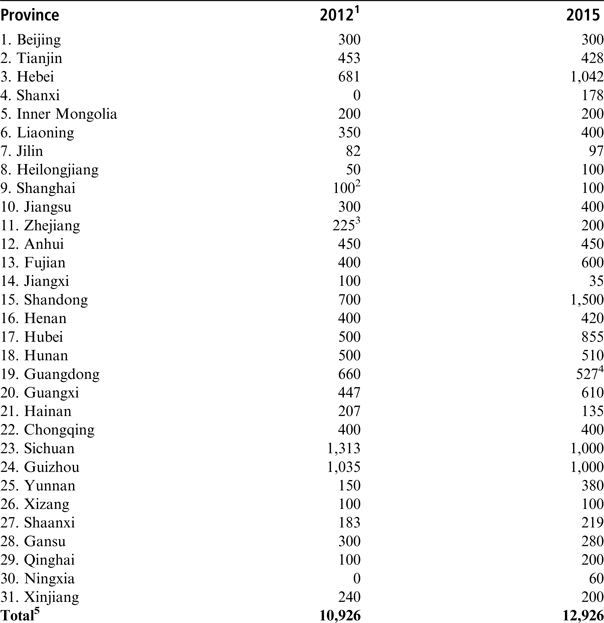
The data on XDS cadres show that they numbered approximately 200,000 by 2012. Provincial-level governments recruited at least 10,926 in 2012 and 12,926 in 2015 (see Table 1).Footnote 17 The Central Party first began recruiting XDS cadres in 2016, hiring 83.Footnote 18 When those numbers are compared to the entire cadre workforce, the number of XDS recruited each year seems small.
Targeted Number of XDS in 2012 and 2015

Sources:
The data were compiled in July 2013 and in December 2015, and are drawn from interviews and various sources, including the provincial websites for examinations (kaoshiwang), specially selected students (xuandiaosheng) and employment (jiuyewang) statistics.
Notes:
1In 2012, Shanxi and Ningxia did not recruit any XDS; 2Shanghai developed its own scheme, namely, yumiao xuanmiao jihua (the scheme to nurture and select young talent) on the basis of the national xuandiaosheng framework; 3public information was not available. A bureau-level cadre in Zhejiang provided the number in an interview conducted in June 2013; 4public information was not available. A bureau-level cadre in Guangdong provided the number in an interview conducted in October 2015; 5the total numbers in 2012 and 2015 are based on interviews and public information. The actual numbers are larger than the estimates presented here because many provincial governments and State Council agencies have requested that universities create similar schemes to recruit and educate selected candidates. The numbers recruited under these university- and agency-specific schemes are not accessible.
Putting aside the small number of XDS hired each year, this scheme serves at least three important functions in China's cadre personnel management system. First, it provides enormously attractive channels through which to recruit outstanding young talent into the cadre workforce. A young university graduate with an undergraduate degree will first be deployed to a section member position; with a master's degree, to a deputy section chief position; and with a doctoral degree, to a section chief position. Those who pass the probation period will subsequently be given substantive power and authority in their position. This is what is commonly referred to by Chinese officials as “sprinting with small steps” (xiao bu kuai pao 小步快跑) – in other words, a massive shortcut to a promotion.Footnote 19
Second, the scheme strengthens governance of grassroots-level governments by providing them with capable cadres. Consider Shaanxi province's “Yan'an city XDS growing plan,” which was introduced in 2008. The plan states that from 2008 to 2017, at least two members of the leading groups in all county and district governments and one-third of the leading groups of all town and township governments in Yan'an 延安 city are to be drawn from cadres who joined the government through the XDS scheme. Third, the scheme allows local governments to develop and adjust their manpower plans for specific types of organizations, in alignment with particular policy objectives.Footnote 20 For example, instead of deploying XDS recruits to grassroots-level governments, some localities deploy them to the people's courts, the people's procuratorates and public security offices. They may designate certain positions for female XDS, and they may use the scheme to take in graduates from local universities instead of using graduates selected exclusively from universities under other national programmes (such as the “985” or “211” projects).
How cadres are managed
The non-leading cadre system facilitates administrative discretion in the management aspects of the Chinese bureaucracy in at least four important ways.
Adapting to job needs
Some agencies of the State Council make use of the non-leading cadre system to establish both full- and part-time secretaries (mishu 秘书) to serve state leaders and ministers.Footnote 21 For example, in 2009, the General Office of the State Council had a total of 203 non-leading cadres, despite having a staffing quota of 143 non-leading cadre posts. A quarter of these cadres served as secretaries and were tasked with arranging duty trips, conducting research, writing speeches and reports for state leaders, organizing meetings with state leaders from overseas countries, and the like. In the same year, the Public Security Ministry deployed 85 non-leading cadres to work overseas and sent another 52 to Hong Kong and Macau to undertake special duties, although the ministry's staffing quota for non-leading cadres was only 41. In a similar vein, the Foreign Affairs Ministry, the National Security Bureau, the Hong Kong and Macau Affairs Office, the Science and Technology Ministry and the Overseas Chinese Office all deployed non-leading cadres to work in embassies, consulate offices, outpost offices and international organizations outside of China.
County-level governments nowadays widely use the non-leading cadre system to meet the requirement that a certain percentage of their workforce, proportionate to the size of the population and the administrative establishment quotas, must undertake anti-corruption work. At all street- or village-level administrations, there is at least one full-time cadre responsible for discipline inspection. Three full-time cadres are supposed to be allocated to all county-level discipline inspection offices. In order to meet this requirement, county governments have to redeploy staffing quotas from other agencies and consequently have to massively expand the number of non-leading cadres.Footnote 22
Sharing leadership power and responsibility
There are no hard and fast rules for including cadres in the leadership groups of state and Party units. Work units in different localities may have their own conventions and practices. The inclusion of non-leading cadres in leadership groups appears to be a common practice for all Party and state units at or below the provincial governments nowadays.
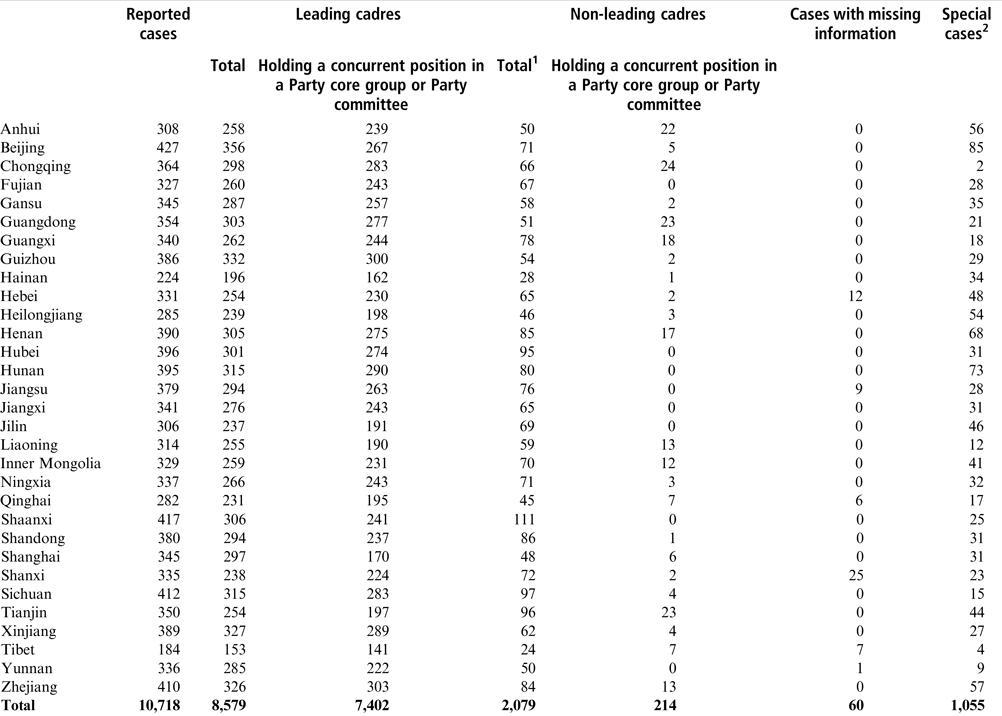
Table 2 presents the numbers of leading and non-leading cadres in the leadership groups of the constituent departments of all provincial-level governments in China in 2015. There were 10,718 reported cases. The table shows that approximately one-fifth (2,079) of the members of leadership groups were non-leading cadres. In the leadership groups of the constituent departments of 12 provincial governments, over 20 per cent (from 21 to 28 per cent) of the members were non-leading cadres. More importantly, non-leading cadres were also appointed to concurrent positions as members of Party core groups or Party committees. There were 214 cases of this reported.
Numbers of Leading and Non-leading Cadres in the Leadership Groups of Constituent Departments of All Provincial Governments in China in 2015

Sources:
Provincial government websites 2015.
Notes:
1The actual number must have exceeded 2,079, given that information was unavailable for certain areas; 2special cases refer to a situation in which a non-leading cadre has returned to a leading cadre post after serving in a non-leading post for some years. These cases do not include normal lateral or upward promotion from a non-leading position to a leading position.
These figures show that the non-leading cadre system is an integral part of regime governance. Since some non-leading cadres are members of the leadership groups, they actually become core or reserve cadres at the respective level in the cadre leadership corps. They take up duties and responsibilities and exercise power and authority in exactly the same way as their leading-cadre counterparts.
Motivating and disciplining the cadre workforce
Former personnel minister Zhao Dongwan 赵东宛 reckoned in 1993 that the non-leading cadre system was designed mainly to deal with the problem of motivating the cadre workforce.Footnote 23 A retired Party official who took part in the drafting of the Civil Service Law further elaborated the rationale behind the system: “In the past, a cadre's grade would largely determine the salary level and the accompanying fringe benefits one could receive. After the 1982 reform, a cadre's salary level and other fringe benefits would follow closely one's position. Hence, only a promotion could elicit a salary raise and other fringe benefits.” Seen in that light, the non-leading cadre system was by default designed to raise cadres' salaries and provide them with fringe benefits without their having to receive a promotion first. It was meant originally to enhance individual cadres' job commitment and motivation, not to be a system for cadre deployment per se.Footnote 24
What started as a way to motivate individual cadres was extended as a way to raise the commitment and enthusiasm of cadres for carrying out the policy of “direct provincial administration of county government” (shengguanxian 省管县) and for achieving outstanding performances in raising the economies in their jurisdictions. In 2005, Guangdong became the first province to raise a cadre's administrative grade without changing the cadre's post (jiudi tiba 就地提拔). The jiudi tiba method has drawbacks, however: it is a method of promotion to a non-leading post that has no publicly accessible law or rules and regulations to support it. One interviewee explained that “this has been a ‘custom-based practice’ to circumvent staffing-level restrictions, and further, because it does not occur in full view, there is no need to find establishment quotas that these county secretaries can fill in deputy bureau-level posts.”Footnote 25
The non-leading cadre system can also be used to discipline the broader cadre workforce. It was widely reported in early 2016 that ten provincial-level cadres were demoted to non-leading posts.Footnote 26 These demotions were described as “steep-cliff” types (duanyashi jiangzhi 断崖式降职), meaning that those who were demoted would probably be unable to rebuild their careers. For example, it took Liu Lizu 刘礼祖, former vice-chairman of the Jiangxi Provincial Committee of the Chinese People's Political Consultative Conference, 36 years to achieve his provincial deputy-level appointment, but he was demoted to a section-level non-leading post within a year or two, and remained in that position at the time of writing.
Breaking through establishment quota restrictions
Concurrent appointments, which are a common feature in modern bureaucracy, give the Chinese party-state bureaucracy the flexibility to use either leading or non-leading cadres, or a mixture of both (for example, a non-leading cadre might take up a substantive leading post) for job deployment. Figure 2 provides examples of the two kinds of concurrent appointments for leading and non-leading cadres, respectively.
Concurrent Appointments of Leading and Non-leading Cadre System

In general, gaopei 高配 refers to a staffing situation in which a cadre takes up a post at a higher rank, and the cadre's own personal rank is raised accordingly. Dipei 低配 refers to a situation in which a cadre takes up a post at a lower rank, and the cadre's own personal rank remains unchanged. Both gaopei and dipei are common practices within the Chinese bureaucracy.Footnote 27
In theory, gaopei is a mission-based arrangement designed to recognize the importance of certain portfolios and types of organizations in the party-state bureaucracy. Dipei is a person-specific arrangement to motivate as well as to make use of the talents of non-leading cadres by deploying them to take up a lower-level substantive leading post. All gaopei and dipei leading and non-leading cadres are reserve cadres under the nomenklatura authority of either the same-level or next higher-level Party committees via their organization departments. Gaopei and dipei are two management tools that give the party-state bureaucracy the flexibility it needs to achieve its goals without appearing to exceed its staffing limitations.
In practice, however, interchangeable use of gaopei and dipei is common.Footnote 28 Political and law agencies have made use of both methods to showcase the agencies' importance for regime stability. For example, many localities reported making gaopei arrangements so that they could place non-leading cadres in leading positions in police branch offices, detention centres, traffic control teams, and as judges and procurators at the county level.Footnote 29 As a corollary measure, non-leading cadres are assigned to chief positions to handle citizen complaints at various levels. For example, in Henan province, 665 heads of complaints stations in villages were raised to deputy section chiefs between 2007 and 2013 via gaopei.Footnote 30
How cadres exit the civil service
Although neither the Civil Service Law nor the 2014 Working Regulations have provided permanent employment for all cadres, cadres at all levels have de facto lifelong employment. The large number of graduates from higher institutions of all kinds creates huge pressure on the Chinese party-state bureaucracy to create job vacancies every year. Further, within the bureaucracy, there is a strong need for upward mobility and for the filling of certain policy-specific quotas, including, for example, young, female and minority cadres in leading groups of work units at each administrative level. To cope with all these challenges, the party-state bureaucracy has established the principle of “turning leading into non-leading cadres” (shigaifei 实改非, hereafter referred to as SGF) to make it possible to meet all these competing needs by adjusting the overall composition of its cadre workforce.
No national public data are accessible to ascertain the degree of implementation of the SGF scheme, but it is a widely recognized practice, particularly at or below the provincial level. Our data collected in 2012 show that Jiangling 江陵 county in Hubei had set a quota of 130 SGF positions (the number of SGF positions is determined by the total number of non-leading cadres in a workplace).Footnote 31 By 2015, this number had risen to 179, a 38 per cent increase.Footnote 32 In 2014, there were about 2,854 county-level governments in China. If each of those has at least a few dozen SGF positions, the impact on cadre personnel management cannot be underestimated.
Although there are local variations, the general practice in most localities is to apply the SGF scheme to male cadres who have achieved a bureau-level rank and have reached the age of 58, a division-level rank and the age of 50, or a section-level rank and the age of 40. For female cadres, the SGF scheme can be applied to those who have achieved a bureau-level rank and have reached the age of 55, a division-level rank and the age of 48, or a section-level rank and the age of 40. A note must be made here that the lower the administrative level of a unit, the greater the deviation can be from this general practice.Footnote 33
There are at least three kinds of SGF schemes. The first is same-level redeployment (tongji gairen 同级改任). In tongji gairen, a leading cadre will be redeployed to a same level non-leading post. The second is lower-level redeployment (xiaji gairen 下级改任). In xiaji gairen, a leading cadre will be redeployed to a next lower level non-leading cadre post. The third is change-of-term-of-office redeployment (huanjie gairen 换届改任). Huanjie gairen takes place only when there is a change in the length of term of office, while the first two kinds of SGF take place every year.
A Framework for Understanding the Non-leading Cadre System
Article 3 of the 1993 Establishment Method for Non-leading Posts in the State Civil Service stipulates: “The establishment of non-leading posts is based on job needs. All non-leading posts are substantive (shizhi 实职). But these posts have no administrative power or responsibility attached to them.” One interpretation of this policy design is that non-leading posts are “redundant” – that is, without these positions, the bureaucracy would not lose its core functions. Article 3 of the 2006 Interim Method stipulates: “A non-leading cadre can be put in charge of leadership work after he or she is delegated this power by relevant authorities at upper levels or entrusted with authority from same-level leadership groups.” This provision offers broad authority to turn non-leading cadres into leading cadres. In addition, the non-leading cadre system provides agencies with the flexibility to deliver public services and allows them to move officials around according to need.
It has been shown that the non-leading cadre system is an integral part of the governance system. In actual operation, many non-leading cadres have become core or reserve cadres of the same-level or next higher-level cadre leadership corps despite the fact that they are categorized as non-leading cadres and therefore lack administrative power and responsibility. Many non-leading cadres are as important as their counterpart leading cadres, are listed in pertinent nomenklatura and are managed by Party organizations.
Way down the administrative hierarchy, the highly integrative feature of cadre personnel management seems to be a commonality. A cadre in a town or township government usually takes on multiple roles by, for example, being a member of the Party committee while also holding various administrative and political posts, such as accountant, secretary and the like. Some cadres are deployed on a “political track” as political officers (ganshi 干事) in charge of more than one duty in, for example, Party affairs, women's affairs, family planning and stability maintenance. Some cadres become town or township heads or deputy heads while also undertaking tasks on the “administrative track” as office assistants (zhuli 助理), with more than one portfolio in industry, rural and city development, education, health, civil affairs, environmental protection, work safety and the like. Although this phenomenon bears some resemblance to the paradoxical situation of having widespread use of non-leading cadres at almost every administrative level despite the system's lack of a regulatory framework to guide that use, the former cannot fully explain the latter. The following part of the paper attempts to make sense of the situation.
The Politics of Redundancy
The Chinese party-state bureaucracy has to deal with two main issues in its efforts to achieve regime resilience. The first is how to support a nationwide administrative apparatus that can meet competing social needs and demands. Resources have always been scarce. At all levels, the bureaucracy has struggled to meet the demands placed on it. The second issue is how to sustain political hegemony and regime stability. Because the regime is authoritarian, administrative rationales have always had to be in line with political expediency. Politics always takes precedence, in contradiction to the notion of a Weberian-style rule-based administration. Importantly, the non-leading cadre system is a means of balancing these two concerns.
Inconsistent with the statutory requirement of developing clearly defined roles, administrative duties and responsibilities for civil service appointments, the practices of gaopei and dipei create the administrative anomaly whereby a cadre can be simultaneously a leading and non-leading cadre in actual operation. Similarly, all XDS cadres have a dual identity as both civil servants and Party reserve cadres, something not easily understood by people unfamiliar with a system such as China's that has a high degree of unification of politics and administration. Inconsistent implementation such as deployment to a non-leading post without filling a quota slot is now common in cadre management. These practices might seem positively nonsensical to people outside China and yet most can be traced back to the historical iteration of the policies on cadre management themselves.
Over the last few decades, China has evolved a basically customary, highly informal personnel management system, with rules and regulations based on custom and norms as opposed to formal, statutory language. The result is that when local governments implement, for example, the SGF scheme, they are unguided by clear, adequate authority, and so the practices across localities are diverse and incoherent.
Although the 2005 Civil Service Law seemed to strive to develop a law-based administration, it was in fact a throwback to the cadre personnel management system. The general idea is that if the reform problems are perceived as “home grown,” the solutions must be too. Party and government officials pointed to similar, cognate legislative guidelines put in place prior to the 2005 Civil Service Law. Adaptation to local situations in order to preserve their conventional cadre personnel management practices is strongly preferred, which means that policy choices, such as concurrent gaopei and dipei arrangements or the establishment of sequences of non-leading posts that differ from the category of comprehensive administration in the civil service, will be maintained. Further, the belief is that now is not the time to deal with issues on which no consensus is likely to be reached in the near future (for example, the age range of the SGF scheme, particularly for female cadres).Footnote 34
Against this backdrop, the non-leading cadre system can be conceptualized as a stratagem for ratifying the politics of redundancy, reflecting a long-held traditional mindset and way of handling matters that underlies China's customary and highly informal cadre personnel management. Regulations put in place in 1993 and 2006 clearly embrace a high degree of role and responsibility redundancy as well as policy ambiguity in duty and power between leading and non-leading cadres. Only with this high degree of redundancy and policy ambiguity can the laws both be practicable and make it easy to import and apply the capacity for mobility between the status of leading and non-leading cadres. “Capacity for mobility” can be loosely defined here as the capacity to shift roles and responsibilities, and to substitute requisite power and authority, between leading and non-leading cadres. The design is intended to assure that leading and non-leading cadres can assist one another in daily administration.Footnote 35 The practice of leading and non-leading cadres sharing leadership power and responsibility in leadership groups, as illustrated above, is a good example of this mutual support. Relying on duplication and overlap of roles and responsibilities between leading and non-leading cadres, the laws permit a high degree of policy flexibility, which allows agencies to (re)compose their leadership groups in alignment with local situations.
With this built-in capacity for mobility, the non-leading cadre system provides governments at different levels with a means to explore and create measures to cope with cadre personnel management problems particular to their own circumstances. Socio-political resources, working cultures, leadership and management styles, composition of cadre workforce and the like all affect how well the party-state bureaucracy at any given level or locale is able to use the non-leading cadre system to make ends meet. As shown in Table 2, 2015 saw 1,055 cases of non-leading cadres transferring to leading cadre posts after serving in non-leading posts for some years. This shows an effective use of the “revolving door” (xuanzhuanmen 旋转门) to convert non-leading cadres back into members of leadership groups when needed.
As a result of building up and using this capacity to move between leading and non-leading cadre roles, the non-leading cadre system has been able to address the issue of rigidity in China's cadre personnel management system. The purpose of mobility is to promote vitality and liveliness in the cadre workforce and to keep the exit unimpeded. In a way, the non-leading cadre system is tackling one of the most difficult issues facing the Chinese party-state bureaucracy at every level, namely, how to remove a large number of ceilinged cadres in order to make way for young, talented people and assure a smooth leadership transition within the cadre workforce.
The legislative thinking behind the Civil Service Law shows that many problematic aspects of the Party's cadre personnel management system and, by extension, the non-leading cadre system should be handled incrementally.Footnote 36 The main rationale for an incremental approach to reform is that it could be politically costly to implement comprehensive, fully fledged reform in personnel management without knowing the full impact on the cohesion of the cadre workforce.
Its size, establishment, and practices and functions in the Chinese bureaucracy prove that the non-leading cadre corps is an integral and important part of the cadre personnel management system. At or below the provincial-level government, a substantial number of non-leading cadres are either core or reserve cadres. Any attempt to reform the cadre personnel management system must be careful not to antagonize this large pool of cadres. Non-leading cadres who have proven ability, requisite expertise, seniority, practical experience and personal networks are important assets of the party-state bureaucracy. It would also be risky to sideline altogether the non-leading core or reserve cadres at each administrative level. Unless those non-leading core or reserve cadres can be brought into the leadership crops, a deep rift may be created. Even SGF cadres who are no longer core or reserve cadres should be given an attractive package so that they will willingly step down from their leadership positions and not scuttle the reform processes.
The current approach to making changes in cadre personnel management is to ground any experiments with reform measures in the continued use of the basically customary and highly informal rules and regulations that presently guide the cadre personnel management system. Because different localities have developed, and will continue to develop, their own particular ways of managing their cadre workforce, divergent practices across localities are inevitable. Yet, while this lack of standardization is acknowledged, the non-leading cadre system continues to be widely used by the party-state bureaucracy because it is conducive to the cohesion of the cadre workforce.
Durability of the Non-leading Cadre System: Prospects and Challenges
It has been shown that the implementation of the non-leading cadre system in China has had both self-reinforcing and self-undermining impacts on regime governance. The non-leading cadre system has developed a “fit-for-purpose” management approach that enables governments at different levels to nurture the delicate processes of problem solving particular to their circumstances. Yet, the system has clearly not complied with the provisions of the Civil Service Law that govern it. For example, gaopei and dipei arrangements do not strictly follow Articles 40 (on management jurisdictions), 41 (on establishment quotas) or 63 (on exchange) of the law.
Party and government officials know there is a problem with inconsistencies in the policies, regulations and implementation of the non-leading cadre system. But the raison d’être of the non-leading cadre system is to support rule by the Party. The non-leading cadre system is not designed to establish a Weberian type of rule-based administration. Instead, it is intended to reinforce the conventional, customary and highly informal cadre personnel management practices. A caveat must be made here that Chinese reformers have strived to deal with the problematic aspects of cadre personnel management as far back as 1984, when they first began to establish a modern Chinese civil service system. Through all the various rules, regulations and laws in civil service and cadre personnel management, Party and government officials have explored various approaches to reforming the cadre personnel management system. However, one principle seems not to waver: the entrenched belief that “the law should not comment on the Party” (fabu yandang 法不言党). Any inconsistency between the Party and the law is to be dealt with incrementally. Any personnel reform steps must be taken in large measure within the boundaries of the cadre personnel management system. As long as the cadre personnel management system is in force, it will overshadow and restrain any attempt to reform the party-state bureaucracy. Under these circumstances, the non-leading cadre system must immerse itself in the cadre personnel management system. Putting aside the deficiencies in implementation, the non-leading cadre system is likely to endure and to support the development of an agile and resilient personnel management system, at least in the short to medium term.
Acknowledgement
This study is funded by the Ministry of Education of Singapore (MOE Academic Research Fund Tier 2 Grant, MOE2015-T2-2-074) and the National Research Foundation of Korea Grant (NRF-2011-330-BOO194). We sincerely thank the two institutions for their generous financial support. We also thank the editors and anonymous reviewers for their helpful comments on the first draft of this article. Last but not least, our gratitude goes to the Chinese officials who agreed to be interviewed for this study.
Biographical notes
Hon S. Chan is professor at the department of public policy, City University of Hong Kong. His major research interests cover public sector personnel management, performance measurement, civil service reforms, comparative institutional and policy capacity studies and environmental policies.
Jie Gao is assistant professor at the department of political science, National University of Singapore. Her current research focuses on cadre evaluation and management, performance measurement in public sector organizations, citizen satisfaction surveys and work safety management in China.
Appendix Job Title List of Cadres Managed by the Party Committee of Zhen'an Township, Yun'an County, Guangdong Province