1. Introduction
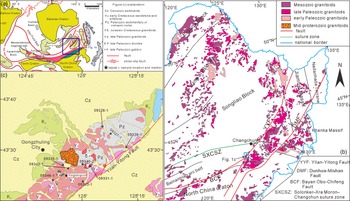
The study area in NE China is in the eastern Central Asian Orogenic Belt (CAOB) and the eastern part of the northern margin of the North China Block (Fig. 1a, b; Wu et al. Reference Wu, Sun, Ge, Zhang, Grant, Wilde and Jahn2011; Zhou & Wilde, Reference Zhou and Wilde2013; Liu et al. Reference Liu, Li, Feng, Wen, Neubauer and Liang2017). The CAOB is composed of several convergent plate margins and has undergone multi-stage accretionary processes related to subduction of the Palaeo-Asian oceanic plate during Palaeozoic time and subduction of the Palaeo-Pacific oceanic plate during Mesozoic time (Wu et al. Reference Wu, Sun, Ge, Zhang, Grant, Wilde and Jahn2011; Wilde, Reference Wilde2015). There has long been a controversy about the location and timing of the final closure of the Palaeo-Asian Ocean in NE China (Xu et al. Reference Xu, Pei, Wang, Meng, Ji, Yang and Wang2013; Wang et al. Reference Wang, Xu, Pei, Wang, Li and Cao2015 b), and whether subduction occurred unidirectionally towards the south (Jian et al. Reference Jian, Liu, Kroner, Windley, Shi, Zhang, Zhang, Miao, Zhang and Tomurhuu2010; Cao et al. Reference Cao, Xu, Pei, Wang, Wang and Wang2013) or bidirectionally (Xiao et al. Reference Xiao, Windley, Hao and Zhai2003; Eizenhöfer et al. Reference Eizenhöfer, Zhao, Zhang and Sun2014; Yuan et al. Reference Yuan, Zhang, Xue, Lu and Zong2016). There are several main perspectives about the timing of the final closure of the Palaeo-Asian Ocean in NE China: the Middle Devonian (Xu et al. Reference Xu, Zhao, Wang, Liao, Luo, Bao and Zhou2015), the early–middle Permian (Feng et al. Reference Feng, Liu, Zhong, Jia, Qi, Wang and Yang2010), the Early Triassic (Cao et al. Reference Cao, Xu, Pei, Wang, Wang and Wang2013), the Late Triassic (Xin et al. Reference Xin, Ren, Peng and Sun2011), the middle Mesozoic (Nozaka & Liu, Reference Nozaka and Liu2002) or the late Permian – Early Triassic (Xiao et al. Reference Xiao, Windley, Huang, Han, Yuan, Chen, Sun, Sun and Li2009; Xu et al. Reference Xu, Pei, Wang, Meng, Ji, Yang and Wang2013). Therefore, NE China is an ideal area to study these complex arc–continent collisions and the different source regions involved in the generation of the arc magmatism.
Overview of the study area. (a) Simplified geological map showing the location of NE China, modified after Zhang et al. (Reference Zhang, Wu, Wilde, Zhai, Lu and Sun2004). (b) Distribution of granitoids and tectonic units of NE China, modified after Wu et al. (Reference Wu, Zhao, Sun, Wilde and Yang2007), Zhang et al. (Reference Zhang, Zhao, Ye, Liu and Hu2014) and Wang et al. (Reference Wang, Tong, Zhang, Li, Huang, Zhang, Guo, Yang, Hong, Donskaya, Gladkochub and Tserendash2017). (c) Distribution of granitoids and sampling locations in the Gongzhuling area, SW Jilin Province, NE China.

Lithium (Li) isotopes are strongly fractionated during low-temperature geological processes, and they can therefore be useful tracers in relatively low-temperature geological environments, including seafloor alteration (Chan et al. Reference Chan, Alt and Teagle2002) and the weathering of continental crust (Rudnick et al. Reference Rudnick, Tomascak, Njo and Gardner2004; Penniston-Dorland et al. Reference Penniston-Dorland, Bebout, Pogge von Strandmann, Elliott and Sorensen2012; Sauzéat et al. Reference Sauzéat, Rudnick, Chauvel, Garçon and Tang2015). In the circulation of crustal and mantle material in a subduction zone, the relative mass difference of up to 16 % of Li isotopes makes them ideal tracers for studying various geological processes in the subduction zone (Wang et al. Reference Wang, Xu, Pei, Wang and Li2015 a). However, almost no effective fractionation of Li isotopes occurs during magmatic processes above 900 °C, which means they can be used to trace magma source regions (Tomascak et al. Reference Tomascak, Tera, Helz and Walker1999; Teng et al. Reference Teng, McDonough, Rudnick and Walker2006; Marks et al. Reference Marks, Rudnick, McCammon, Vennemann and Markl2007). The weathered continental upper crust has light δ7Li values (δ7Li = −5.0 ‰ to 5.0 ‰; Teng et al. Reference Teng, McDonough, Rudnick, Dalpé, Tomascak, Chappell and Gao2004; Sauzéat et al. Reference Sauzéat, Rudnick, Chauvel, Garçon and Tang2015), whereas the lower crust shows large variations in δ7Li values (δ7Li = −14.0 ‰ to 14.3 ‰; Teng et al. Reference Teng, Rudnick, McDonough, Gao, Tomascak and Liu2008). However, the reasons for the heterogeneity of the δ7Li values in the lower continental crust are still debated, and possible factors include mantle source, upper-crust assimilation, isotopic diffusion or metamorphic dehydration (Teng et al. Reference Teng, Rudnick, McDonough and Wuc2009; Rudnick & Gao, Reference Rudnick, Gao, Holland and Turekian2014). It has been suggested that juvenile lower crust and the underlying mantle source region should have uniform Li isotopic compositions (Tomascak et al. Reference Tomascak, Tera, Helz and Walker1999; Teng et al. Reference Teng, McDonough, Rudnick and Wing2007). Kinetic isotopic fractionation, involving the different diffusion rates of 6Li and 7Li, is the commonly given reason for the highly heterogeneous δ7Li values observed in the lower crust (Teng et al. Reference Teng, Rudnick, McDonough, Gao, Tomascak and Liu2008; Qiu et al. Reference Qiu, Rudnick, McDonough and Bea2011). However, we note that a reasonable interpretation of the geological processes involving the Li isotopes of magmatic rocks has been hampered by inadequately integrating the Li isotopic data with petrological and geochemical data (Parkinson et al. Reference Parkinson, Hammond, James and Rogers2007; Krienitz et al. Reference Krienitz, Garbe-Schonberg, Romer, Meixner, Haase and Stroncik2012). Such an integrated approach is essential to relate the combined petrological, geochemical and isotopic data to distinct sources of the various magmatic rock types.
The oxygen fugacity of magma reflects the redox state of magma and directly controls the crystallization sequence, composition and petrogenesis of magma. Together with temperature, pressure and melt composition, oxygen fugacity also controls the fluid composition, which has an impact on mineralization. This is particularly obvious in porphyry copper (gold) deposits. Arc magmas in subduction zones are generally considered to be water-rich and oxidized, and highly oxidized magma has the potential to assimilate sulfates during ascension (Sillitoe & Thompson, Reference Sillitoe and Thompson2010). There are a number of porphyry Cu–Au–Mo deposits related to oxidized calc-alkaline granitoids (Shen et al. Reference Shen, Hattori, Pan, Jackson and Seitmuratova2016; Shu et al. Reference Shu, Chang, Lai, Hu, Wu, Zhang, Wang, Zhai and Zhang2019) in the CAOB. The study of our samples in the eastern CAOB can further evaluate the relationship between fO2 and mineralization. At present, the calculation of the oxygen fugacity of magmatic rocks is mainly determined by the variable valence elements in minerals, by using the relationship between Fe3+/Fe2+ and temperature in the melt (Blevin & Chappell, Reference Blevin and Chappell1992) or by using the Ce4+/Ce3+ ratio of zircon (Ballard et al. Reference Ballard, Palin and Campbell2002). In our research, the oxygen fugacity is calculated by using the zircon Ce or Eu anomaly and zircon Ti temperature. However, the fO2 values generated by the above methods can be scattered. We identify the possible causes and compare the oxygen fugacity values calculated by several different methods created by Smythe & Brenan (Reference Smythe and Brenan2016) and Loucks et al. (Reference Loucks, Fiorentini and Henríquez2020).
In this paper, we present new geochronological, petrological, geochemical, zircon Hf isotopic and whole-rock Li isotopic data for the middle–late Permian magmatic rocks in the Gongzhuling area, southwestern Jilin Province, NE China. Our aim was to identify the source characteristics of a typical magmatic suite, using zircon Hf isotopes, zircon oxygen fugacity and geochemical data for the Gongzhuling area during the middle–late Permian tectonic evolution of NE China, as well as test the effectiveness of Li isotopes in magma petrogenesis.
2. Geological setting
NE China is generally considered to comprise six microcontinental blocks: the Erguna and Xing’an blocks in the northwest, the Songliao Block in the centre and the Jiamusi Massif, Khanka Massif and Nadanhada Terrane in the southeast (Fig. 1b; Wu et al. Reference Wu, Sun, Ge, Zhang, Grant, Wilde and Jahn2011). The southward and northward subduction of the Palaeo-Asian oceanic plate induced the amalgamation of multiple terranes during Palaeozoic time, as evidenced by the E–W-striking Carboniferous–Permian intrusive magmatic belts along two sides of the Solonker Suture Zone (Ruzhentsev & Pospelov, Reference Ruzhentsev and Pospelov1992; Chen et al. Reference Chen, Jahn and Tian2009). The northwestward subduction of the western Pacific oceanic plate was accompanied by continental margin accretion during the Mesozoic–Cenozoic period, intense Mesozoic volcanic and intrusive activity, and the production of large volumes of alkaline basalt in Cenozoic time (Wang & Mo, Reference Wang and Mo1995; Wu et al. Reference Wu, Jahn, Wilde and Sun2000).
Voluminous Palaeozoic and Mesozoic granitoids and coeval mantle-derived mafic intrusions occur in NE China, including those along the suture zones between different blocks (Fig. 1b; Jahn, Reference Jahn2000; Zhang et al. Reference Zhang, Wu, Wilde, Zhai, Lu and Sun2004; Wang et al. Reference Wang, Tong, Zhang, Li, Huang, Zhang, Guo, Yang, Hong, Donskaya, Gladkochub and Tserendash2017). Most of the Palaeozoic and Mesozoic granitoids in NE China are I- and A-types with low initial 87Sr/86Sr values (0.6919–0.7116), high ϵNd(t) and ϵHf(t) values, and young Nd and Hf TDM ages (1265–643 Ma; Wu et al. Reference Wu, Jahn, Wilde and Sun2000), and many previous researchers have indicated that the source areas of these granitoids contain large proportions of juvenile crustal material (Wu et al. Reference Wu, Jahn, Wilde and Sun2000; Jahn et al. Reference Jahn, Wu, Capdevila, Martineau, Zhao and Wang2001, Reference Jahn, Capdevila, Liu, Vernon and Badarch2004; Kovalenko et al. Reference Kovalenko, Yarmolyuk, Kovach, Kotov and Larin2004; Chen & Arakawa, Reference Chen and Arakawa2005; Wang et al. Reference Wang, Xu, Pei, Wang and Li2015 a). It has been proposed, therefore, that there was extensive crustal growth in this region during Mesoproterozoic and Neoproterozoic times (Sun et al. Reference Sun, Tang, Xu, Li and Zhao2017).
The Gongzhuling area is located in southwestern Jilin Province, south of the Solonker–Xra Moron–Changchun Suture and north of the Bayan Obo–Chifeng–Kaiyuan Fault (the northern boundary fault of the North China Craton), on the SE margin of the Songliao Block (Fig. 1a). The Xra Moron–Changchun Suture is considered to represent the final closure zone of the Palaeo-Asian Ocean, as well as the youngest amalgamation of the North China Block and the Khanka Massif in the eastern CAOB (Zhang et al. Reference Zhang, Zhao, Ye, Liu and Hu2014; Xu et al. Reference Xu, Zhao, Wang, Liao, Luo, Bao and Zhou2015). The study area is situated in a Palaeozoic accretionary belt (Zhang et al. Reference Zhang, Zhao, Ye, Liu and Hu2014; Ma et al. Reference Ma, Ma, Chen, Chen, Li, Zhou and Yang2020), termed the Liaoyuan Terrane (Wu et al. Reference Wu, Sun, Ge, Zhang, Grant, Wilde and Jahn2011) or Liaoyuan Accretionary Belt (Li et al. Reference Li, Liu, Dong, Xu, Wen, Wang, Wang and Gao2021), allegedly the eastern extension of the Bainaimiao accretionary arc belt accreted to the northern margin of the North China Craton from late Silurian to Early Devonian times by arc–continental collision (Fig. 1b; Zhang et al. Reference Zhang, Zhao, Ye, Liu and Hu2014). Previous results show that the granitoids in this area were emplaced mainly in three distinct stages: Permian to Early Triassic (285–245 Ma), Late Triassic to Middle Jurassic (210–155 Ma) and Early Cretaceous (135–100 Ma) (Wu et al. Reference Wu, Sun, Ge, Zhang, Grant, Wilde and Jahn2011; Ma et al. Reference Ma, Chen, Zhao, Qiaio and Zhou2019). The host rocks are mainly metamorphosed (greenschist to lower-amphibolite facies) and deformed Palaeozoic sedimentary and volcanic rocks (Shao & Tang, Reference Shao and Tang1995; Zhang et al. Reference Zhang, Zhao, Ye, Liu and Hu2014). Some early Palaeozoic hornblende gabbro, quartz diorite and tonalite (Zhang et al. Reference Zhang, Zhao, Ye, Liu and Hu2014; Ma et al. Reference Ma, Ma, Chen, Chen, Li, Zhou and Yang2020) and Mesoproterozoic granitoids have recently be identified from this area (Li et al. Reference Li, Liu, Dong, Xu, Wen, Wang, Wang and Gao2021).
3. Sample descriptions
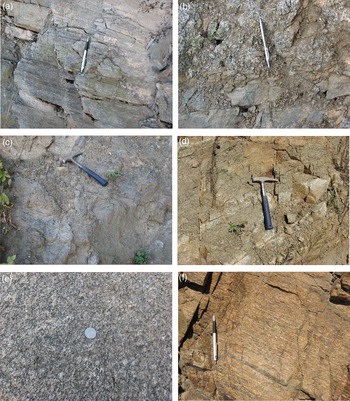
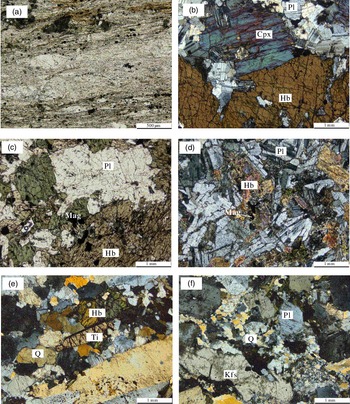
Collected from east of Gongzhuling City (Fig. 1c), the Gongzhuling dacite tuff samples (09326-1 and 09327-1) are grey (Fig. 2a) with crystal pyroclasts (∼20 % plagioclase, ∼5 % K-feldspar, ∼3 % quartz) and lithic fragments (∼5 %) cemented by volcanic ash (Fig. 3a).
Photographs of outcrops showing different rock types of the Gongzhuling intermediate–felsic rocks. (a) Dacite tuff (43° 34.81′ N, 125° 06.23′ E). (b) Pyroxene diorite (43° 27.14′ N, 125° 54.86′ E). (c) Pyroxene diorite (43° 26.55′ N, 124° 56.19′ E). (d) Diorite (43° 27.28′ N, 125° 00.24′ E). (e) Quartz monzodiorite (43° 24.11′ N, 124° 52.13′ E). (f) Biotite syenogranite (43° 30.58′ N, 125° 12.17′ E). Length of pen for scale is 15 cm; length of hammer for scale is 50 cm; diameter of coin for scale is 2.5 cm.

Photomicrographs showing typical textures of the Gongzhuling intermediate–felsic rocks. (a) Dacite tuff (09326-1). (b) Pyroxene diorite (09335-1). (c) Diorite (09331-1). (d) Diorite (09340-2). (e) Quartz monzodiorite (09346-1). (f) Biotite syenogranite (09328-1). Cpx – clinopyroxene; Hb – hornblende; Pl – plagioclase; Ti – titanite; Kfs – K-feldspar; Q – quartz; Mag – magnetite.

Samples of pyroxene diorite (09335-1 and 09343-1; Fig. 2b, c), diorite (09331-1 and 09340-2; Fig. 2d), quartz monzodiorite (09346-1; Fig. 2e) and biotite syenogranite (09328-1; Fig. 2f) were collected from southeast of Gongzhuling City where these rocks had been intruded into the Mesoproterozoic, early Palaeozoic or Devonian–Carboniferous metamorphosed volcanic–sedimentary rocks (Fig. 1c). The igneous rocks are grey to dark green, and coarse grained in texture (Fig. 3b, c). The dioritic rocks are equigranular, and the biotite syenogranite is hypidiomorphic (Fig. 3b–f). The pyroxene diorites are composed of clinopyroxene (25–30 %), hornblende (25–35 %) and plagioclase (35–45 %). The diorites consist mainly of hornblende (35–50 %), plagioclase (35–45 %), biotite (5–8 %), quartz (∼1 %) and titanite (∼1 %). The quartz monzodiorite is composed mainly of plagioclase (45–55 %), hornblende (10–15 %), K-feldspar (15–20 %) and quartz (5–8 %). The biotite syenogranite consists mainly of K-feldspar (35–45 %), quartz (25–30 %), plagioclase (15–20 %) and biotite (8–10 %). Main accessory minerals are apatite, titanite, epidote, zircon and magnetite (Fig. 3e).
The clinopyroxenes and hornblendes in these rocks are typically euhedral, suggesting early crystallization; grains of magnetite are commonly enclosed in the hornblende (Fig. 3c, d), also suggesting an earlier phase than the hornblende. The plagioclases are commonly euhedral to subhedral, suggesting later crystallization than the clinopyroxene (Fig. 3b). Quartz is mostly interstitial to the earlier crystallized feldspar and hornblende, indicating its late-stage crystallization. The euhedral wedge shapes of the titanite indicate its early crystallization (Fig. 3e).
4. Analytical methods
4.a. Zircon U–Pb dating and trace-element analyses
Zircons from eight rock samples (09326-1, 09328-1, 09331-1, 09333-1, 09335-1, 09340-2, 09343-1 and 09346-1) were selected for U–Pb dating. Zircon grains were separated from the fresh rock samples by traditional crushing, heavy liquid and magnetic methods, and the grains were then manually handpicked under a binocular microscope. Zircons were attached to an epoxy base and polished to expose the cores of the grains. Photomicrographs and cathodoluminescence (CL) images were used to assess the interior structures of the zircons for in situ U–Pb dating, Lu–Hf isotope analyses and zircon trace-element analyses.
Zircons U–Pb and trace-element analyses were conducted using laser ablation inductively coupled plasma mass spectrometry (LA-ICP-MS) with a 193 nm laser at the State Key Laboratory of Geological Processes and Mineral Resources, China University of Geosciences, Wuhan, China. The U–Pb dating experiments were performed on an Agilent 7500a ICP-MS (Agilent Technology, Yokogawa, Japan) coupled with a 193 nm ArF excimer laser denudation system (GeoLas 2005, Coherent Lambda Physik GmbH, Gottingen, Germany). The techniques we used have been described by Liu et al. (Reference Liu, Hu, Zong, Gao, Gao, Xu and Chen2010). Locations for the U–Pb analyses were selected on the basis of CL images and photomicrographs. Reference zircon 91500 was selected for age calibrations. GEMOC GJ-1 reference zircon (thermal ionization mass spectrometry (TIMS) U–Pb age = 608.5 ± 0.4 Ma; Jackson et al. Reference Jackson, Pearson, Griffin and Belousova2004) was used as a monitor of data quality. The weighted mean 206Pb–238U ages of reference zircons 91500 and GJ-1 were 1061 Ma and 606 Ma, respectively (online Supplementary Material Table S1), which are identical to those in the TIMS method (Jackson et al. Reference Jackson, Pearson, Griffin and Belousova2004). The instrument was optimized with standard glass NIST SRM 610, and this glass was also used as a reference for calibration of the trace-element contents. 29Si was used as an internal standard. Calculations of the trace-element concentrations were conducted using ICP-MS DataCal software (Liu et al. Reference Liu, Hu, Gao, Günther, Xu, Gao and Chen2008). The zircon age calculations and concordia diagrams were made using Isoplot 3.0 (Ludwig, Reference Ludwig2003). Common Pb was corrected according to the method proposed by Andersen (Reference Andersen2002).
4.b. Whole-rock major- and trace-element analyses
Whole-rock major- and trace-element analyses were performed at the Institute of Geology and Geophysics, Chinese Academy of Sciences, Beijing, China and at the State Key Laboratory of Geological Processes and Mineral Resources, China University of Geosciences, Wuhan. X-ray fluorescence was employed for the major-element analyses using fused glass discs of the sample powders. The analytical errors were less than 1 %. Sample powders for trace-element analyses were dissolved in a diacid (15 mol L−1 HNO3 + 29 mol L−1 HF) high-pressure vessel at 200 °C for four days and then dried. The dried powder was digested with HNO3 at 150 °C for one day and then diluted to 50 ml with 1 % HNO3 for analysis determined by ICP-MS. Chinese national standards GSR-1 (granite) and GSR-3 (basalt) were used for monitoring and analysis. Except for P2O5 (5 %), the analysis errors for the major elements are within 1 %, while such errors for most trace elements (including rare earth elements (REEs)) are within 10 %.
4.c. Zircon Lu–Hf isotopic analyses
In situ zircon Lu–Hf isotope analyses were conducted at the Institute of Mineral Resources, Chinese Academy of Geological Sciences, Beijing, China, using a Finnigan Neptune multicollector ICP-MS (MC-ICP-MS) coupled to a New Wave U P213 laser ablation system. The Hf isotope analyses were carried out beside the analytical points used for U–Pb dating with an ablation spot of 55 μm in diameter, and He was used as the carrier gas with a flow rate of 0.8∼0.9 L min−1. The reference zircon GJ-1 was used for calibration. Isobaric interference of 176Lu on 176Hf was adjusted according to the measurement of the 175Lu value. The 176Yb/172Yb and mean βYb values were obtained during laser ablation on the same analytical spots as used for Hf isotope analyses, which allowed for correction of the interference of 176Yb on 176Hf (Wu et al. Reference Wu, Yang, Xie, Yang and Xu2006).
4.d. Whole-rock Li isotope analyses
The separation of lithium for isotope analyses was performed by inorganic solvent-free two-step liquid chromatography in the ultra-clean laboratory of the University of Science and Technology of China, Hefei, China, following the method described by Gao & Casey (Reference Gao and Casey2012). All the separation processes were assessed using ICP-MS analyses to ensure high Li yields (>99.8 %) and low Na/Li values (<0.5). After the rock samples were dissolved by acid mixture of concentrated HF–HNO3–HCl, approximately 200–5000 ng Li was loaded onto the column with Bio-Rad AG50W X12 resin. The matrix was then eluted with 0.2 N HCl solution to ∼80 ml. The collected lithium was dried and treated with 2 % nitric acid in a 50–100 ppb solution for analyses of the isotope compositions on a Neptune MC-ICP-MS. Collection of 6Li and 7Li was made with two Faraday cups (L4 and H4). The total procedural blank of the column procedure was not more than ∼0.03 ng Li. In comparison to the 200–5000 ng Li of the samples, the procedural blank correction is insignificant at the uncertainty level reached. The Li isotopic compositions are presented as δ7Li = ((7Li/6Li)sample/(7Li/6Li)standard − 1)) × 1000 compared with the L–SVEC lithium isotopic standard (Flesch et al. Reference Flesch, Anderson and Svec1973; Magna et al. Reference Magna, Wiechert, Grove and Halliday2006; Jeffcoate et al. Reference Jeffcoate, Elliott, Kasemann, Ionov, Cooper and Brooker2007; Simons et al. Reference Simons, Harlow, Brueckner, Goldstein, Sorensen and Hemming2010). According to the results, the reference samples were +4.3 ± 0.2 ‰ for BHVO-2 (three samples) and +7.0 ± 0.1 ‰ for AGV-2 (two samples), which were all within the uncertainty range of the previous published data (Rudnick et al. Reference Rudnick, Tomascak, Njo and Gardner2004; Magna et al. Reference Magna, Wiechert, Grove and Halliday2006; Simons et al. Reference Simons, Harlow, Brueckner, Goldstein, Sorensen and Hemming2010).
5. Results
5.a. Zircon U–Pb ages
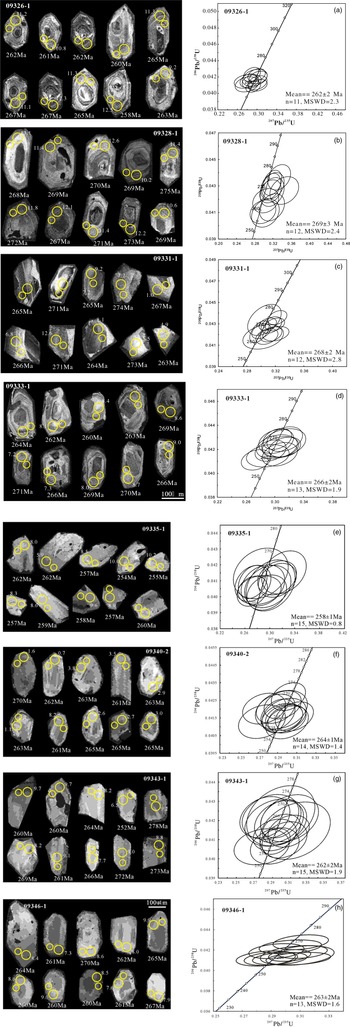
Most of the zircons are euhedral, stubby prisms in CL images that are 60 to 300 μm, and the crystals have tapered terminations and clear oscillating zoning (Fig. 4), indicating a magmatic origin (Pupin, Reference Pupin1980). Zircons without visible inclusions were selected for U–Pb isotopic dating. The Th and U contents and the U–Pb isotope values are presented in online Supplementary Material Table S1 and shown on concordia diagrams (Fig. 4). The zircons have a wide range of U concentrations from 51 to 2178 ppm (online Supplementary Material Table S1), and most of the Th/U values of individual zircon grains are between 0.3 and 1.0 (online Supplementary Material Table S1), indicating a magmatic origin for the analysed zircons (Kirkland et al. Reference Kirkland, Smithies, Taylor, Evans and McDonald2015).
Cathodoluminescence images of representative zircons and U–Pb concordia diagrams for the zircons from intermediate–felsic rocks in the Gongzhuling area. The small yellow circles are U–Pb dating spots and the large circles represent locations of Hf isotopic analyses. The data beside the large circles are ϵHf(t) values.

As shown in Figure 4a–h, the analytical spots yielded well-defined 206Pb–238U concordant ages, which we consider to be emplacement ages. The 206Pb–238U ages of 11 analysed zircons from the dacite tuff (09326-1, Fig. 4a) range from 258 ± 2 to 267 ± 2 Ma (1σ), with a weighted mean 206Pb–238U age of 262 ± 2 Ma (MSWD = 2.3, 2σ). Analyses of 12 zircons from the biotite syenogranite (09328-1, Fig. 4b) yielded 206Pb–238U ages ranging from 261 ± 3 to 275 ± 2 Ma (1σ), with a weighted mean 206Pb–238U age of 269 ± 3 Ma (MSWD = 2.4, 2σ). For diorite sample 09331-1 (Fig. 4c), 12 analyses of zircons yielded 206Pb–238U ages ranging from 264 ± 2 to 274 ± 2 Ma (1σ), with a weighted mean 206Pb–238U age of 268 ± 2 Ma (MSWD = 2.8, 2σ), and for diorite sample 09333-1 (Fig. 4d), 13 analyses yielded 206Pb–238U ages between 260 ± 2 and 271 ± 2 Ma (1σ), with a weighted mean 206Pb–238U age of 266 ± 2 Ma (MSWD = 1.9, 2σ). For pyroxene diorite sample 09335-1 (Fig. 4e), 15 analyses of zircons yielded 206Pb–238U ages ranging from 254 ± 3 to 265 ± 4 Ma (1σ), with a weighted mean 206Pb–238U age of 258 ± 1 Ma (MSWD = 0.8, 2σ). Diorite sample 09340-2 (Fig. 4f) yielded 14 zircon 206Pb–238U ages ranging from 261 ± 2 to 270 ± 2 Ma (1σ), with a weighted mean 206Pb–238U age of 264 ± 1 Ma (MSWD = 1.4, 2σ). The 15 analysed zircons from pyroxene diorite sample 09343-1 yielded 206Pb–238U ages between 257 ± 2 and 267 ± 4 Ma (1σ), with a weighted mean 206Pb–238U age of 262 ± 2 Ma (MSWD = 1.9, 2σ) (Fig. 4g). For quartz monzodiorite sample 09346-1, 13 zircon analyses yielded 206Pb–238U ages ranging from 260 ± 3 to 270 ± 3 Ma (1σ), with a weighted mean 206Pb–238U age of 263 ± 2 Ma (MSWD = 1.6, 2σ) (Fig. 4h). These dating results show that the dacite tuff and the intermediate–felsic intrusions in the Gongzhuling area were formed during middle–late Permian (269–258 Ma) time.
5.b. Major and trace elements
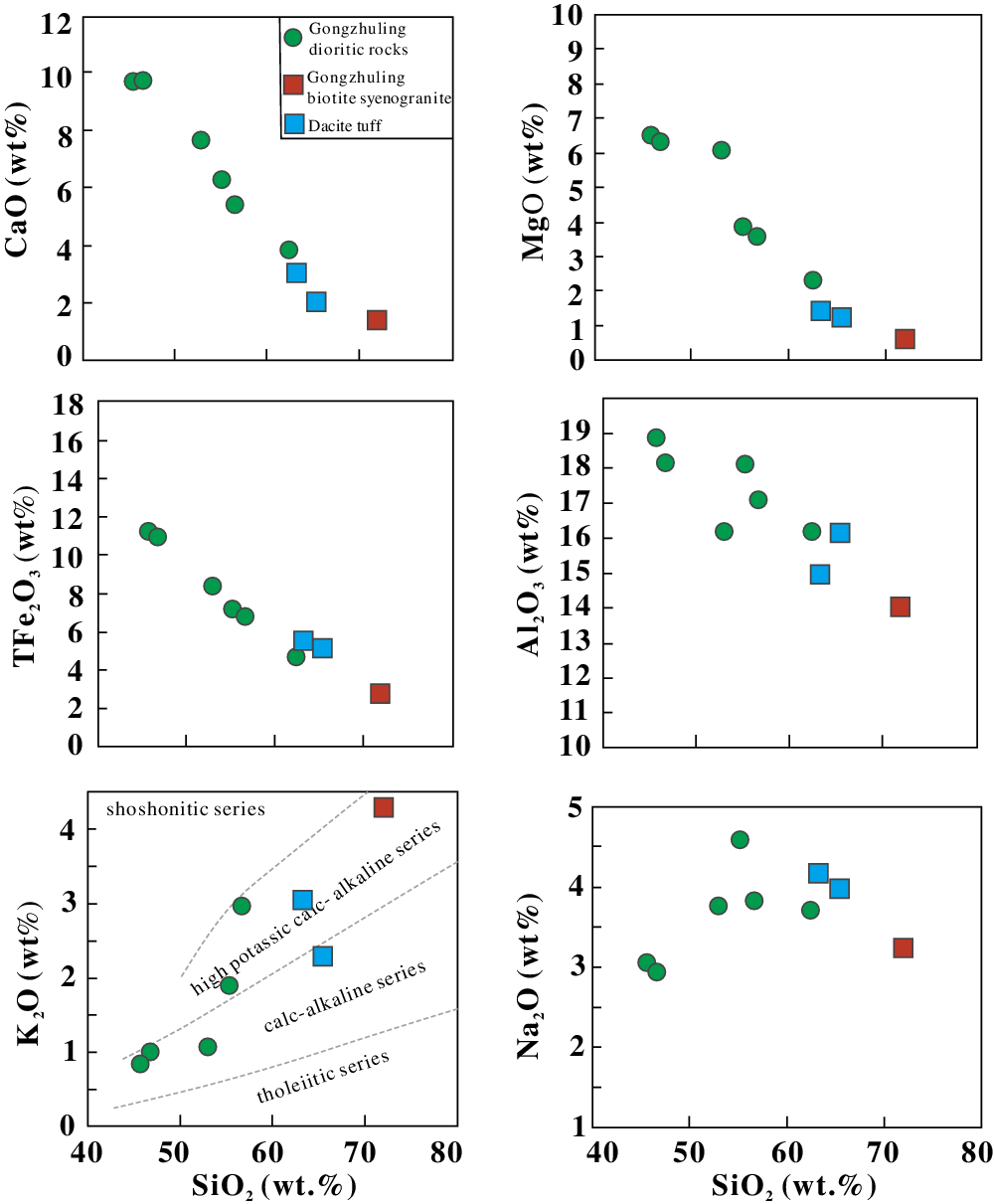
The major- and trace-element compositions of the intermediate–felsic Permian intrusions are given in online Supplementary Material Table S3. They have a wide range of compositions, with SiO2 = 45.7–71.9 wt %, Al2O3 = 14.1–18.9 wt %, total Fe2O3 = 2.7–11.2 wt % and MgO = 0.6–6.5 wt %, and relatively high contents of Na2O (3.0–4.6 wt %). Al2O3, Fe2O3, MgO and CaO decrease with increasing SiO2 on Harker diagrams (Fig. 5), whereas K2O increases with increasing SiO2. Most of the samples plot in the medium- to high-K field on the K2O versus SiO2 diagram (Fig. 5).
Harker diagrams for the intermediate–felsic rocks in the Gongzhuling area.

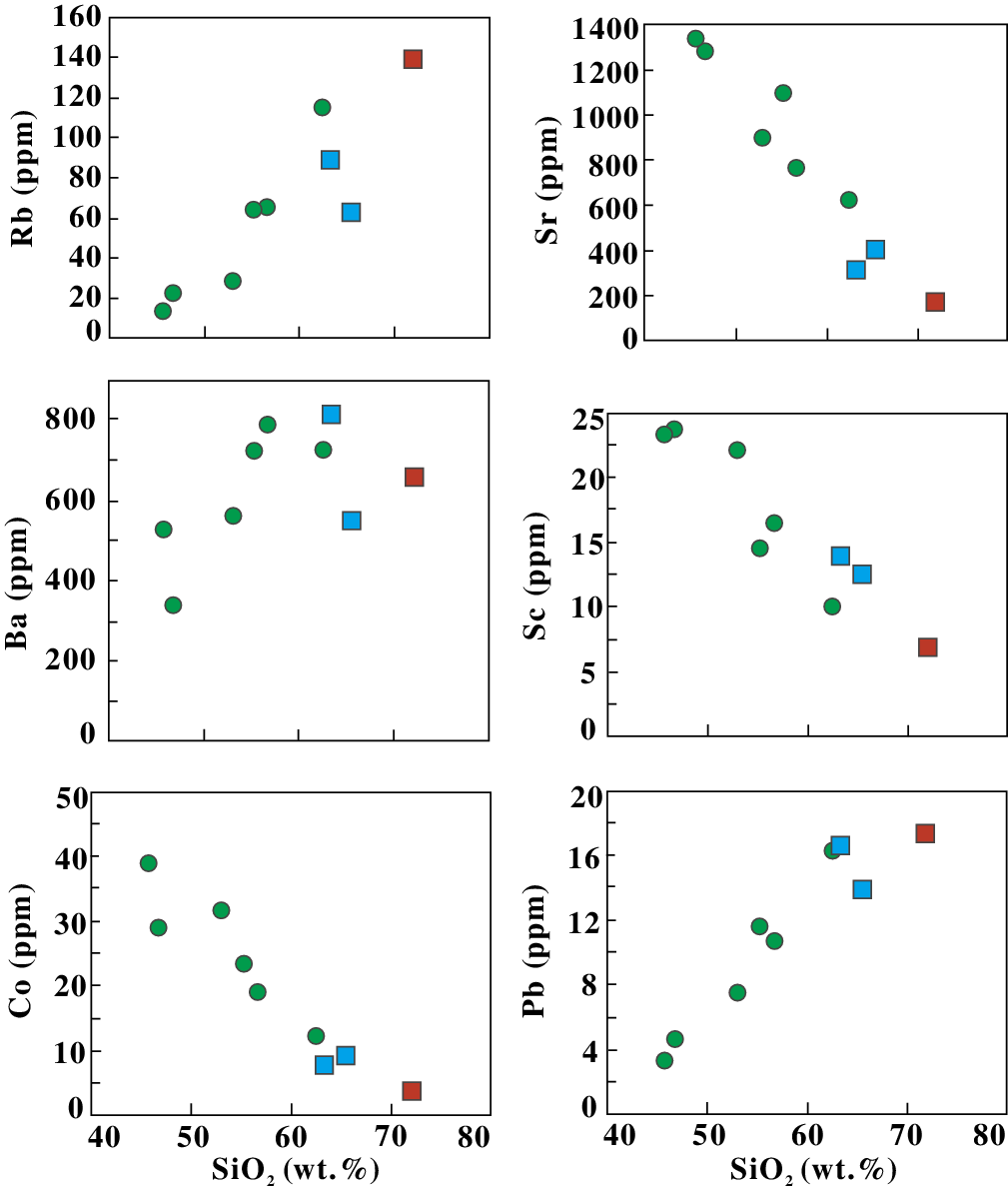
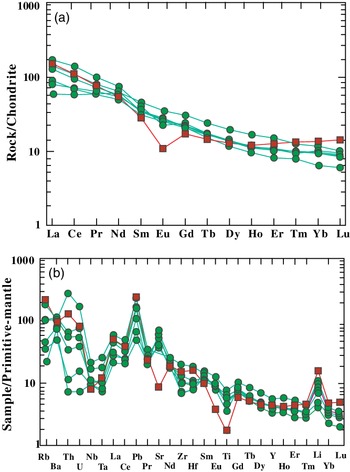
With regard to their trace-element contents (Fig. 6), Sr shows a negative correlation with SiO2. Chondrite-normalized REE patterns of the intrusions show they are enriched in light REEs (LREEs) with values of LaN/YbN ranging from 5.1 to 22.0. They show slightly negative Eu anomalies, only biotite syenogranite showing a distinct Eu anomaly (Eu/Eu* = 0.5; Fig. 7a). In a primitive mantle-normalized trace-element diagram, all the samples show enrichments in large-ion lithophile elements (LILEs) (e.g. Rb, Sr, Ba and Pb). They have obvious negative anomalies of the high field strength elements (HFSEs) of Ti, Nb, Ta, Zr and Hf, which are the features of subduction-related rocks (Hawkesworth et al. Reference Hawkesworth, Hergt, Ellam and McDermott1991; Fig. 7b). The depletion of the HFSEs Nb and Ti in our samples suggests that the enriched feature is subduction-related (Thirlwall et al. Reference Thirlwall, Smith, Graham, Theodorou, Hollings, Davidson and Arculus1994).
Plots of selected trace-element contents versus silica contents for the intermediate–felsic rocks in the Gongzhuling area.

(a) Chondrite-normalized REE and (b) primitive-mantle-normalized trace-element variation diagrams for the middle–late Permian intermediate–felsic rocks in the Gongzhuling area. Chondrite and primitive mantle values are from Boynton (Reference Boynton1984) and Sun & McDonough (Reference Sun, McDonough, Saunders and Norry1989), respectively.

5.c. Lu–Hf and Li isotopic compositions
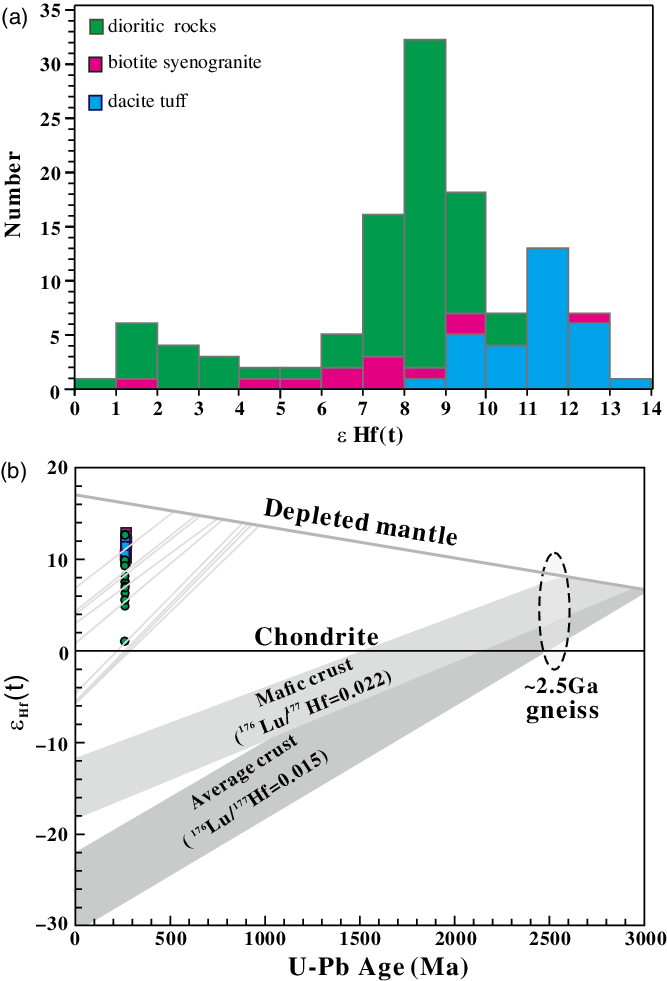
The zircon Lu–Hf isotopic data are listed in online Supplementary Material Table S4 and plotted in Figure 8. The Hf isotope analyses for 15 zircon grains from the dacite tuff (09326-1) yielded ϵHf(t) values ranging from 8.4 to 12.5. Fifteen zircons from the biotite syenogranite (09328-1) yielded ϵHf(t) values of 9.9 to 13.1. The zircons from the dioritic specimens (09331-1, 09333-1, 09335-1, 09340-2, 09343-1, 09346-1) yielded ϵHf(t) values of 0.7 to 13.1 (Fig. 8b). The calculated depleted mantle Hf model ages (TDM2) of all the samples range from 458 to 1251 Ma (online Supplementary Material Table S4).
Zircon Lu–Hf isotopes of the Gongzhuling middle–late Permian magmatic rocks. (a) Histogram of ϵHf(t) values. (b) ϵHf(t) versus U–Pb zircon ages.

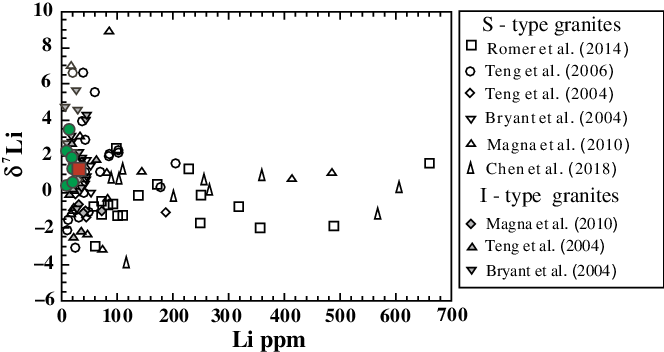
The Li isotopic compositional data are listed in online Supplementary Material Table S5 and shown in Figure 9. The samples have variable Li contents that range from 7.5 ppm to 28.6 ppm. The middle–late Permian biotite syenogranite (09328-1) has Li = 30.7 ppm and δ7Li = +1.28. The middle–late Permian diorites (09331-1, 09333-1 and 09340-2) have Li = 13.5–19.4 ppm and δ7Li = +1.4 to +3.5. The middle–late Permian pyroxene diorites (09335-1 and 09343-1) have Li contents of 9.6 and 8.0 ppm and δ7Li values of +2.4 and +0.4, respectively. The middle–late Permian dioritic rock (09346-1) has Li = 19.4 ppm and δ7Li = +0.61. As shown in Figure 9, the Li contents and δ7Li values of our samples are similar to those of typical I-type granites (Bryant et al. Reference Bryant, Chappell, Bennett and McCulloch2004; Teng et al. Reference Teng, McDonough, Rudnick, Dalpé, Tomascak, Chappell and Gao2004; Magna et al. Reference Magna, Janoušek, Kohút, Oberli and Wiechert2010), but they differ from S-type granites (Bryant et al. Reference Bryant, Chappell, Bennett and McCulloch2004; Teng et al. Reference Teng, McDonough, Rudnick and Walker2006; Magna et al. Reference Magna, Janoušek, Kohút, Oberli and Wiechert2010; Romer et al. Reference Romer, Meixner and Forster2014; Chen et al. Reference Chen, Gu, Chen, Sun and Chen2018), which usually feature higher Li and lower δ7Li values.
Plot of δ7Li versus Li for the intermediate–felsic rocks in the Gongzhuling area. Also shown for comparison are data for global S- and I-type granites.

6. Discussion
6.a. Petrogenesis of the middle–late Permian magmatic rocks
The Gongzhuling intermediate–felsic intrusions are high-K and calc-alkaline with Mg no. values of 31.3–59.1. They share features with continental-arc magmas, such as their calc-alkaline compositions, enrichments in LILEs (e.g. Rb, Sr and Ba) and depletions in HFSEs (e.g. Nb, Ta, Zr and Hf) (Claeson & Meurer, Reference Claeson and Meurer2004).
We believe that magma mixing was involved in the formation of the dioritic rocks (samples 09331-1, 09333-1, 09340-2 and 09346-1). The reasons include: (1) Their Mg no. values (49.6–59.1) are higher than those of experimental basalt melts with the same SiO2 contents (Mg no. <42; Rapp & Watson, Reference Rapp and Watson1995). This precludes partial melting of the lower crust as the sole source of these intrusive rocks, because mixing with a high-Mg mantle-derived mafic magma is required. (2) Their zircons have variable Hf isotopic ratios (although they have roughly the same U–Pb ages; Fig. 8), and this is seen in many other plutons formed through magma mixing processes (Kemp et al. Reference Kemp, Hawkesworth, Paterson and Kinny2006). (3) The negative correlation between SiO2 and Sr (Fig. 6) suggests that the high LILE contents (e.g. Sr = 627–1340 ppm) were inherited from mafic magmas derived from a metasomatized mantle, as crust-derived melts typically have a low Sr content (< 300 ppm; Rapp & Watson, Reference Rapp and Watson1995). As the heavy REE (HREE) depletion with respect to medium REEs (MREEs) exhibited by the granodiorites of the study is not as prominent as in melts derived from thickened eclogitic lower crust, which feature higher Sm/Yb ratios (Rapp & Watson, Reference Rapp and Watson1995), our samples are not likely to be the partial melts of thickened eclogitic lower crust. The linear relationships between SiO2 and Ba, Sr and Rb are indicative of magma mixing or fractionation of biotite instead of intensive plagioclase crystallization, as was proved by weak Eu anomalies. Mixing between granitic and mafic magmas can produce hybrid magmas whose data points plot continuously between the two end-members (Gerdes et al. Reference Gerdes, Wörner, Finger, Franke, Haak, Oncken and Tanner2000; Chen & Arakawa, Reference Chen and Arakawa2005; Janoušek & Moye, Reference Janoušek, Moye, Janoušek, Bonin, Collins, Farina and Bowden2020).
The most mafic sample (pyroxene diorite 09343-1) cannot represent a primary basaltic magma derived from the melting of the mantle wedge, because its MgO content (6.51 wt %) is lower than that of typical primitive arc basalt (9.86 wt %; Sisson & Grove, Reference Sisson and Grove1993). However, our samples of pyroxene diorite underwent minor crustal contamination, as they show small variations (up to four ϵHf units) in ϵHf values (online Supplementary Material Table S4). The end-member of a basaltic melt could be represented by the olivine gabbros (273 Ma) that occur in the adjacent region, and which have ϵHf(t) = +5.6 to +14.6 and ϵNd(t) = +0.9 to +6.8 (Li et al. Reference Li, Guo, Li and Zhao2010; Guo et al. Reference Guo, Li, Fan, Li, Zhao and Huang2015), and were considered to be derived from a metasomatized mantle wedge. However, there is a lack of Palaeozoic primitive arc basalts related to subduction in NE China owing to post-orogenic unroofing and erosion (Guo et al. Reference Guo, Li, Fan, Li, Zhao and Huang2015), and thus the only way to evaluate the geochemical features of the mantle source is by estimating the compositions of the parental magmas of these mafic intrusions.
The mantle source was a mantle wedge that had been enriched in trace elements. The olivine gabbros in the region are enriched in LILEs (e.g. K, Rb, Sr, Ba and Pb) and LREEs, and depleted in HFSEs (e.g. Nb and Th) (Li et al. Reference Li, Guo, Li and Zhao2010; Guo et al. Reference Guo, Li, Fan, Li, Zhao and Huang2015) and have depleted Sr–Nd–Hf isotopic features, similar to our dioritic samples. The negative correlation between SiO2 and Sr (Fig. 6) of our dioritic samples suggests that the high contents of LILEs (e.g. K, Rb, Sr and Ba) stemmed from the metasomatized mantle, because crust-derived melts typically have a low Sr content (<300 ppm; Rapp & Watson, Reference Rapp and Watson1995). This inference is supported by the negative anomalies of HFSEs (e.g. Nb, Ta, Zr and Hf) in the intrusive rocks (Fig. 8b). The mantle source was isotopically depleted, because ϵHf (260 Ma) values (+0.7 to +13.1) are positive. The decoupling of depleted Hf isotopes and enriched elemental signatures indicates that partial melting of the mantle wedge occurred shortly after its metasomatism so that the accumulation of radioisotopes was insufficient. Basaltic magma with depleted isotopic characteristics would have been formed by partial melting of the newly enriched mantle wedge above the subducted slab (Chen & Arakawa, Reference Chen and Arakawa2005). The young Hf TDM2 model ages (TDM2 = 0.46∼1.2 Ga; online Supplementary Material Table S4) should be the formation age of the juvenile arc basalt.
Although the middle–late Permian Gongzhuling intermediate rocks exhibit a wide range of geochemical compositions, the overall trends of the dioritic rocks on Harker diagrams are regular (Figs 5, 6), reflecting a genetic link within these rocks. This inference is further supported by their similar REE patterns (Fig. 7a) and spider diagrams (Fig. 7b). Most of the samples show clear linear relationships between SiO2 and CaO, MgO, TFe2O3, Al2O3, Rb, Ba, Sc, Sr, Co and Pb (Figs 5, 6), indicating the significant role of fractional crystallization in the evolution of the magma. CaO, MgO and TFe2O3 show a negative correlation with SiO2 (Fig. 5), indicating that pyroxene, amphibole and other ferromagnesian phases underwent significant fractionation, which is consistent with the negative correlation between SiO2 and the contents of Co and Sc (Fig. 6).
The biotite syenogranite (sample 09328-1) could represent crust-derived melts rather than the differentiation of dioritic melts via fractionation of ferromagnesian minerals such as pyroxene and hornblende. The Sr content of the biotite syenogranite is 176 ppm, similar to that of the melts of the lower crust (Petford & Gallagher, Reference Petford and Gallagher2001), and much lower than the dioritic intrusions (Sr = 627–1340 ppm; online Supplementary Material Table S3). The granite has a low Mg no. value, is enriched in LREEs and LILEs, and depleted in HFSEs (Nb, Ta and Ti; Fig. 7), which suggests the parental magma was produced by the partial melting of crustal material. To determine whether the biotite syenogranite was fractionated from the dioritic rocks, we conducted a test based on the Rayleigh fractionation law (Rollinson, Reference Rollinson1993) using trace elements (e.g. Sr, Rb and Ba). The biotite syenogranite shows negative Eu anomalies (Eu/Eu* = 0.5) and enrichments in LREEs compared with MREEs ((La/Sm)N = 5.09), suggesting significant fractionation of hornblende and plagioclase. We find that 10 % fractionation of the assemblage Hb (15 %) + Pl (50 %) + Kfs (35 %) from the most evolved dioritic sample (09333-1) could have formed the biotite syenogranite, based on the Rb and Ba contents (online Supplementary Material Table S3). However, this is at odds with the Sr data for the biotite syenogranite, as the fractionation assemblage would have led to a substantially higher Sr content in the residual magma than that found in the actual biotite syenogranite (online Supplementary Material Table S3). We conclude, therefore, that the biotite syenogranite is more likely to represent a partial melt of the lower crust rather than the fractional crystallization of the dioritic magma. Considering the highly depleted ϵHf(t) values of the biotite syenogranite (+10 to +13) and its enrichment in LILEs, we propose that the lower-crustal source was dominated by depleted arc basalts. The crustal source could have been a juvenile (Neoproterozoic) underplated arc basalt, and this is supported by the young TDM2 model ages (TDM2 <1.2 Ga; online Supplementary Material Table S4) given by the zircon Hf isotopic data.
6.b. Li isotopic composition of the source region
Previous research has shown the potential use of Li isotope studies in tracking crust–mantle evolution, as the weathered upper crust is characterized by light Li isotopic compositions (δ7Li = −5.0 ‰ to 5.0 ‰; Teng et al. Reference Teng, McDonough, Rudnick, Dalpé, Tomascak, Chappell and Gao2004), while the heavy Li flows into the ocean via rivers. Lithium can be fractionated during hydrothermal alteration or surface weathering because 7Li is preferentially partitioned into the fluid phase during surface processes (Wunder et al. Reference Wunder, Meixner, Romer and Heinrich2006). There is a fixed Li isotopic fractionation between the newly formed clay minerals and seawater (Δseawater–clay mineral ≈ 16−19 ‰) during alteration (Chan et al. Reference Chan, Alt and Teagle2002). Clay minerals tend to extract more 6Li than 7Li from the seawater in low-temperature alteration, leading to altered oceanic crust with heavy Li isotopic compositions (δ7Li = +7 to +14 ‰; Berger et al. Reference Berger, Schott and Guy1988; Chan & Kastner, Reference Chan and Kastner2000; Vigier et al. Reference Vigier, Decarreau, Millot, Carignan, Petit and France-Lanord2008). The subsequent subduction of the altered oceanic crust transports some of the heavy Li into the source of arc magmas by the release of fluids, which was considered short-lived in the early stage of subduction (John et al. Reference John, Gussone, Podladchikov, Bebout, Dohmen, Halama, Klemd, Magna and Seitz2012). According to previous models (Zack et al. Reference Zack, Tomascak, Rudnick, Dalpe and McDonough2003; Elliott et al. Reference Elliott, Jeffcoate and Bouman2004), Marschall et al. (Reference Marschall, Pogge von Strandmann, Seitz, Elliot and Niu2007) predicted that the fore-arc mantle wedge is enriched in Li and has distinctly higher δ7Li values than average mantle does. δ7Li values are controlled mainly by the source region, and barely affected by such factors as metamorphic events, crustal anatexis and magmatic crystallization (Tomascak et al. Reference Tomascak, Tera, Helz and Walker1999; Teng et al. Reference Teng, McDonough, Rudnick, Dalpé, Tomascak, Chappell and Gao2004, Reference Teng, McDonough, Rudnick and Walker2006; Magna et al. Reference Magna, Wiechert, Grove and Halliday2006; Wunder et al. Reference Wunder, Meixner, Romer and Heinrich2006).
The complexity of dehydration and metamorphism of the subducted slab adds to the controversy about Li isotopic fractionation. On the one hand, Zack et al. (Reference Zack, Tomascak, Rudnick, Dalpe and McDonough2003) believed that there is strong Li isotopic fractionation during the process of low-temperature dehydration melting of the slab in the early stage of subduction, using the open-system Rayleigh fractionation model. In the existing data of rock samples, only the δ7Li value of alpine eclogite in an orogenic belt is smaller than that of the upper continental crust, indicating that the subducted plate lost heavy Li in the process of metamorphism and dehydration (Zack et al. Reference Zack, Tomascak, Rudnick, Dalpe and McDonough2003). On the other hand, Dohmen et al. (Reference Dohmen, Kasemann, Coogan and Chakraborty2010) maintained that Li is removed from the fluid to mantle mainly by diffusion when the pressure–temperature exceeds the Li-rich mineral (e.g. chlorite, serpentine, talc) stability region, and the relationship between Li isotopic diffusion rate and temperature is: lgDLi = −5.92(±1.0) − 1.2847 × 10⁴/T(K). Li+ and Mg2+ have a similar ionic radius, and Li+ can replace Mg2+ in olivine, enstatite and diopside (Chan et al. Reference Chan, Edmond, Thompson and Gillis1992), thus extracting Li from subduction fluid. Li has a fast and slow diffusion rate in different positions of the lattice, since Li in experimental olivine (800–1200 °C, 100 KPa, fO2 ≈ WM buffer) was supposed to partition between an octahedrally coordinated Mg site (LiMe) and an unoccupied octahedral interstitial site. Li occupies the two different positions, and during diffusion the concentrations of Li in the two sites interact with each other by a homogeneous exchange reaction (LiMe = VMe + Lii; Lii, Dohmen et al. Reference Dohmen, Kasemann, Coogan and Chakraborty2010). The diffusion of 6Li is 3 % faster than that of 7Li in basaltic and rhyolitic melts (Richter et al. Reference Richter, Davis, Depaolo and Watson2003). Thus, the diffusion can lead to significant Li isotopic fractionation under the condition of high temperatures of 800−1200 °C. However, according to Teng et al. (Reference Teng, McDonough, Rudnick and Wing2007), the Li isotopes hardly change during metamorphic dehydration, because the Li isotopic change of the Onawa metapelites is insignificant (∼3 ‰) in the process of contact metamorphism with the calculated fractionation factor αfluid/rock of 1.000∼1.004. More experiments are needed to verify the fractional calculation of Li isotopes in the subduction process. The accurate calculation of the release depth of Li in the fore-arc region and the behaviour of Li in the mantle wedge are yet to be studied.
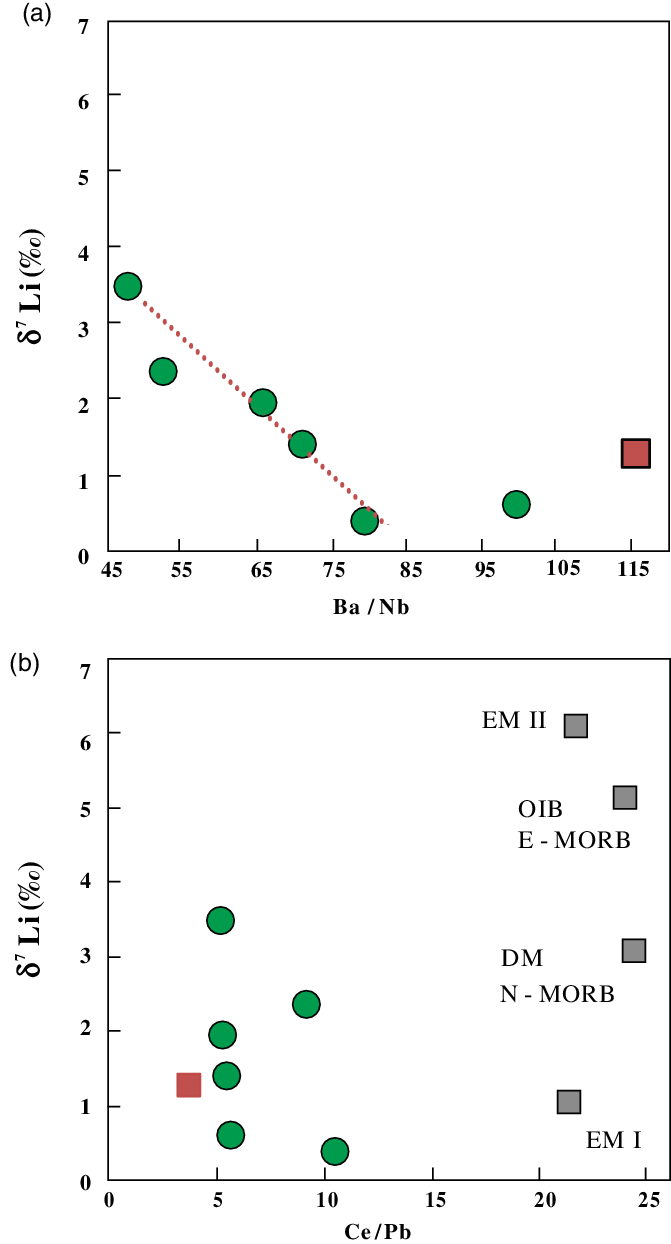
Petrological observations (no low-temperature hydrothermal altered minerals) and low loss on ignition (LOI) values (0.68–1.6 %; online Supplementary Material Table S3) indicate the Gongzhuling dioritic intrusions and biotite syenogranite underwent hardly any fluid alteration at or near the surface, and this is supported by no correlation between LOI and δ7Li values or Ba/Nb values. The Ba/Nb values can indicate the degree of slab-derived metasomatism or lower-crust dehydration melting, as Ba is fluid-active whereas Nb is fluid-inactive, and lower-crust dehydration melting results in the depletion of LILEs (Rb, Ba and K), U and Pb, and enrichment of Th and Nb in magmatic rocks (Yogodzinski et al. Reference Yogodzinski, Lees, Churkova, Dorendorf, Wöerner and Volynets2001; Bourdon et al. Reference Bourdon, Eissen, Monzier, Robin, Martin, Cotton and Hall2002). The difference in coordination numbers among coexisting phases is the dominant factor controlling kinetic Li isotopic fractionation, as 6Li has priority in the lattice site with the higher coordination number (Sartbaeva et al. Reference Sartbaeva, Wells and Redfern2004; Wunder et al. Reference Wunder, Meixner, Romer and Heinrich2006; Magna et al. Reference Magna, Novak, Cempirek, Janoušek, Ullmann and Wiechert2016), so that 6Li replaces Mg in octahedrally coordinated clinopyroxene (Halama et al. Reference Halama, John, Herms, Hauff and Schenk2011; Cahalan et al. Reference Cahalan, Kelly and Carlson2014; Sun et al. Reference Sun, Gao, Xiao, Gu and Casey2016). Therefore, kinetic fractionation results in significant Li isotope fractionation at high temperatures (800∼1200 °C), and, for magma, the more mafic, the lower the δ7Li values. The negative correlation between δ7Li and Ba/Nb of the dioritic rocks (R2 = 0.79; Fig. 10a) reveals that the samples were mainly derived from dehydration melting of the mafic lower crust, because during dehydration melting, δ7Li values increase but Ba/Nb decreases. The whole-rock geochemical data for the Gongzhuling intermediate rocks suggest that the magmas were mainly formed by melting of a juvenile lower crust, as discussed above. Therefore, dehydration melting processes had influenced the Li isotopic compositions of our samples.
Lithium isotopes versus trace-element compositions of the intermediate–felsic intrusive rocks in the Gongzhuling area. Also shown are mean compositional values for mantle end-members mid-ocean ridge basalt (MORB) and ocean island basalt (OIB) from Sun & McDonough (Reference Sun, McDonough, Saunders and Norry1989), Armienti & Gasperini (Reference Armienti and Gasperini2007) and Nishio et al. (Reference Nishio, Nakai, Ishii and Sano2007); subduction zone arc volcanic rocks from Miller et al. (Reference Miller, Goldstein and Langmuir1994) and Pearce et al. (Reference Pearce, Baker, Harvey and Luff1995). DM – depleted mantle; EM – enriched mantle.

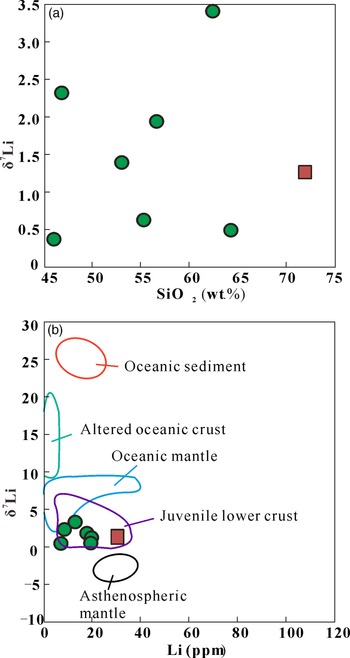
The average Li contents of the upper crust, lower crust and mantle are 30.5, 13 and 1–2 ppm, respectively (Teng et al. Reference Teng, Rudnick, McDonough, Gao, Tomascak and Liu2008; Sauzéat et al. Reference Sauzéat, Rudnick, Chauvel, Garçon and Tang2015). As shown in Figure 9, the Li concentrations in the Gongzhuling middle–late Permian intermediate intrusions exhibit a narrow range from 8.0 to 19.4 ppm with an average of 14.6 ppm (online Supplementary Material Table S5), similar to the average Li content of the lower continental crust (∼13 ppm; Teng et al. Reference Teng, Rudnick, McDonough, Gao, Tomascak and Liu2008). Enriched mantle (EM) I-type melts usually have relatively small δ7Li values (mean δ7Li = +2.7 ‰), possibly because of the recycling of subducted sediments (Zack et al. Reference Zack, Tomascak, Rudnick, Dalpe and McDonough2003). EM II-type melts usually have high δ7Li values (δ7Li = +6.3 ‰), as oceanic crust absorbs heavy Li from seawater during low-temperature alteration (Magna et al. Reference Magna, Janoušek, Kohút, Oberli and Wiechert2010). The melting of an enriched mantle wedge metasomatized by slab-released fluids can lead to heavy δ7Li signatures. The lower continental crust contains variable δ7Li values of between –17.9 ‰ and +15.7 ‰ (Teng et al. Reference Teng, Rudnick, McDonough, Gao, Tomascak and Liu2008). The δ7Li values in the Gongzhuling magmatic intrusions range from +0.4 to +3.5 ‰ with a mean of 1.6 ‰, similar to that of the juvenile lower crust (Li = 7.1∼37.2, δ7Li = +0.8∼+6.6 ‰; Tian et al. Reference Tian, Hou, Tian, Zhao, Hou, Li, Zhang, Hu, Mo and Yang2018; Fig. 11b), thus precluding their direct derivation from the mantle wedge, as lithium does not fractionate during the formation and differentiation of basaltic magma (Tomascak et al. Reference Tomascak, Tera, Helz and Walker1999).
Plots of (a) δ7Li versus SiO2 and (b) δ7Li versus Li for the intermediate–felsic rocks in the Gongzhuling area. Data for mantle end-members are from Krienitz et al. (Reference Krienitz, Garbe-Schonberg, Romer, Meixner, Haase and Stroncik2012) and data for juvenile lower crust are from Tian et al. (Reference Tian, Hou, Tian, Zhao, Hou, Li, Zhang, Hu, Mo and Yang2018). Data for altered oceanic crust are from Chan et al. (Reference Chan, Edmond, Thompson and Gillis1992), Ryan & Langmuir (Reference Ryan and Langmuir1987), Chan & Edmond (Reference Chan and Edmond1988), Moriguti & Nakamura (Reference Moriguti and Nakamura1998) and Zack et al. (Reference Zack, Tomascak, Rudnick, Dalpe and McDonough2003).

Wall-rock assimilation or contamination may also change the Li concentration and δ7Li values in the dioritic melts. However, since the δ7Li values of our samples show no correlation with indices of crustal assimilation such as LREE/Pb (Ce/Pb, Fig. 10b), upper-crust assimilation had very little effect on the Li isotope values. As the weathered upper crust has small δ7Li values (δ7Li = 0.6 ± 0.6 ‰; Sauzéat et al. Reference Sauzéat, Rudnick, Chauvel, Garçon and Tang2015), upper-crust contamination will result in decreasing Ce/Pb values with decreasing δ7Li. Since our two dioritic samples (09333-1 and 09335-1) have high δ7Li values (+2.36 ‰ and +3.49 ‰) and low Ba/Nb values (52.5 and 47.8), they were the least affected by upper-crustal assimilation and surface processes.
6.c. Oxidation conditions of the magmas
Porphyry copper deposits usually occur in continental-arc settings (Shu et al. Reference Shu, Chang, Lai, Hu, Wu, Zhang, Wang, Zhai and Zhang2019). Recent research has indicated a close relationship between mineralization and the oxidation state of arc magma, so that Cu–Mo-bearing granitoids indicate oxidized conditions whereas W–Sn deposits indicate more reducing conditions (Ballard et al. Reference Ballard, Palin and Campbell2002; Mungall, Reference Mungall2002; Mengason et al. Reference Mengason, Candela and Piccoli2011). The oxidation state of magma is very important for Cu–Mo mineralization. Experiments show that sulfur mainly exists in the form of S6+ and forms a large amount of SO42− when fO2 is high in the system during partial melting. Most sulfur exists in the form of sulfate in magma of over ΔFMQ+1.5 (Jugo et al. Reference Jugo, Wilke and Botcharnikov2010). In addition, the solubility of sulfate is over ten times higher than that of sulfide (Sun et al. Reference Sun, Huang, Li, Hu, Zhang, Sun, Zhang, Ding, Li, Zartman and Ling2015). In the process of partial melting, chalcophile elements such as Cu are incompatible and can enter the melt phase in large quantities (Richards, Reference Richards2003). High fO2 can bring massive sulfide during partial melting into the magmatic system to provide material preparation for mineralization. When oxygen fugacity is low during partial melting, S mainly exists as S2− and sulfide solubility is very low. In this case, Cu, Au and Mo will preferentially enter sulfide and it is difficult for them to enter the melt phase. A large quantity of Mesozoic porphyry Cu–Mo deposits have been identified in the eastern CAOB, and the ore-forming rocks associated with fertile Mo deposits are all with high oxidation states (Ce4+/Ce3+ >100; Shu et al. Reference Shu, Chang, Lai, Hu, Wu, Zhang, Wang, Zhai and Zhang2019). However, our studied Palaeozoic rocks are not linked to porphyry Cu–Mo deposits, possibly owing to the low to intermediate oxygen fugacity of the magma.
Highly resistant to weathering and alteration, zircon is capable of preserving its physical and chemical characteristics of formation in the deep crust because of its high closure temperature (Hoskin & Schaltegger, Reference Hoskin and Schaltegger2003); thus, zircon is an ideal mineral for calculating melt oxygen fugacity. The magma fO2 was calculated after Smythe & Brenan (Reference Smythe and Brenan2016) with the formula:
 $$\begin{gathered}{\text{ln}}\left[ {\frac{{x_{c{e^{4 + }}}^{melt}}}{{x_{c{e^{3 + }}}^{melt}}}} \right] = \frac{1}{4}{\text{ln}}f{O_2} + \;\frac{{13136( \pm 591)}}{T} - 2.064( \pm 0.011)\frac{{NBO}}{T}\; \\ - 8.878( \pm 0.112)\cdot{x{\text{H}}_{\text{2}}}{\text{O}} - 8.955( \pm 0.091) \\\end{gathered}$$
 $${\left[ {{{x_{c{e^{4 + }}}^{melt}} \over {x_{ce^{3 +} }^{melt}}}} \right]} = {[ {{{{\sum {C{e_{zircon}} - ( {\sum {C{e_{melt}}*D_{Ce^{3 +} }^{zircon/melt}} } )} }} \over {\sum {C{e_{melt}}*D_{C{e^{4 + }}}^{{{zircon} \over {melt}}} - \sum {C{e_{zircon}}} } }}} ]*1.04877}$$
The partition coefficients of
 $D_{C{e^{3 + }}}^{zircon/melt}$
and
 $D_{C{e^{4 + }}}^{zircon/melt}$
were calculated by the lattice strain model (Blundy & Wood, Reference Blundy and Wood1994). The NBO/T (the ratio of non-bridging oxygens to tetrahedrally coordinated cations) was calculated following the formula:
 $${\rm{NBO}}/{\rm{T}} = (2{\rm{A}} - 4{\rm{\Sigma}} {{\rm{M}}^{{\rm{IV}}}})/{\rm{\Sigma}} {{\rm{M}}^{{\rm{IV}}}}$$
ΣMIV is the number of bridging oxygen bonds in the Si (Al, Ti, P, Fe)−O tetrahedron; A stands for anion, and 2A is the sum of anion bonds (including oxygen ion bonds and effective anion bonds of volatile components); (2A − 4ΣMIV) is the number of non-bridging oxygen bonds in the melt; (2A − 4ΣMIV)/ΣMIV is the number of non-bridging oxygen bonds of each quaternary coordinated cation. The corresponding cation moles (mol) and anion moles (mol) of each component in the melt were obtained by analysing major-element percentage values. Then the molar values M(IV)3+ of trivalent cations (Al3+, Fe3+) with tetrahedral coordination were judged: when ΣM3+ > ΣM+ + 2ΣM2+ + 4Ti, M(IV)3+ = ΣM+ + 2ΣM2+ + 4Ti; when ΣM3+ < ΣM+ + 2ΣM2+ + 4Ti, M(IV)3+ = ΣM3+, where M+ = K + Na + P (mol). Molar values of quaternary coordinated cations ΣMIV were calculated by: ΣMIV = Si + P + M(IV)3+. Anion bond number A was calculated by: A = O + 1/2(OH + F) (Mysen et al. Reference Mysen, Virgo and Seifert1982).
XH2O (mole fraction of water dissolved in the melt) of our samples was calculated by means of the thermodynamic method (Nicholls, Reference Nicholls1980), combined with the temperature, pressure and f H2O of magma at the crystallization of zircon. The NBO/T and XH2O values are listed in online Supplementary Material Table S2.
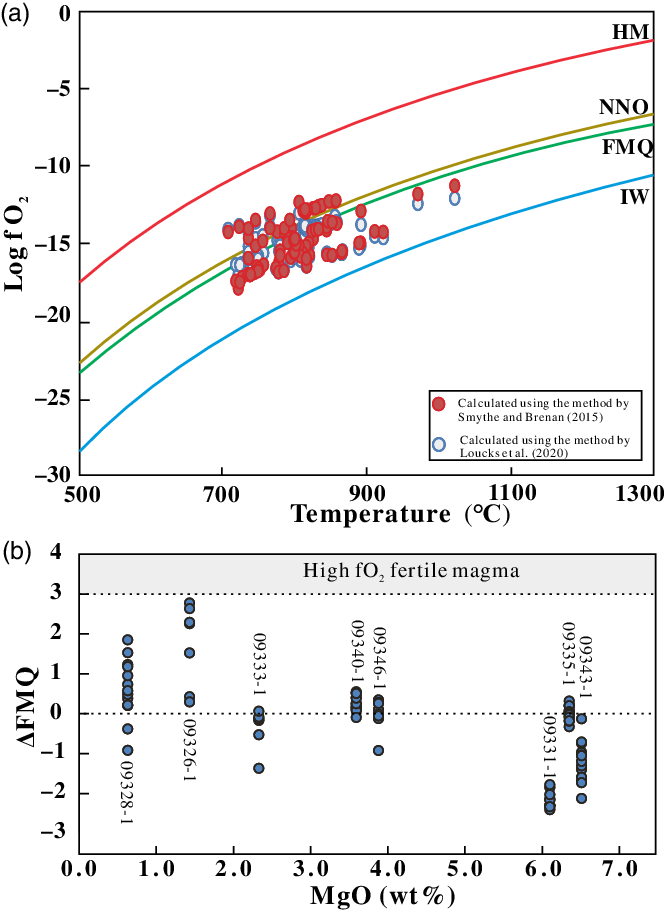
The absolute oxygen fugacities of the analysed zircons, presented as fO2, as well as trace-element concentrations, are listed in online Supplementary Material Table S2. The values of fO2 were estimated using the zircon/melt Ce anomaly (CeN/CeN*) and the zircon Ti thermometer, as in the method described by Smythe & Brenan (Reference Smythe and Brenan2016). The calculated fO2 values were from FMQ−2.2 to FMQ+2.6 (online Supplementary Material Table S2; Fig. 12a), showing a low to intermediate oxidation state for these magmas. Also shown for comparison were fO2 values calculated using the method described by Loucks et al. (Reference Loucks, Fiorentini and Henríquez2020) (online Supplementary Material Table S2; Fig. 12a). Previous research shows that the large porphyry copper deposits in the CAOB are characterized by oxygen fugacity values of early primary magma over ΔFMQ+3.0, which is a common feature of typical arc magmas (Kelley & Cottrell, Reference Kelley and Cottrell2009; Shen et al. Reference Shen, Hattori, Pan, Jackson and Seitmuratova2016; Li et al. Reference Li, Yang, Cao, Lu and Sun2019).
Zircon oxygen fugacities. (a) Oxygen fugacity versus Ti-in-zircon temperature plot for the Gongzhuling magmatic rocks. The HM, FMQ, NNO and IW buffers are from Myers & Eugster (Reference Myers and Eugster1983) and O’Neil & Pownceby (Reference O’Neil and Pownceby1993). (b) ΔFMQ versus MgO plot. Data area for oxidized fertile magma is from Li et al. (Reference Li, Yang, Cao, Lu and Sun2019).

The varied fO2 of each sample may be the results of pretulite (Sc3+ + P5+ ⇔ Zr4+ + Si4+), brabantite (Ca2+ + (U, Th)4+ + 2P5+ ⇔ 2Zr4+ + 2Si4+), ximengite-type (Bi3+ + P5+ ⇔ Zr4+ + Si4+) and various REE3+−P (e.g. (Al, Fe)3+ + 4(Y, REE)3+ + P5+ = 4Zr4+ + Si4+) substitution reactions, which generate uneven distributions of trivalent REEs in zircon and large variations of HREEs (Breiter et al. Reference Breiter, Förster and Škoda2006; Yang et al. Reference Yang, Lin, Hao, Zhang, Hu and Ni2016). As discussed above, the partition coefficient of
 $D_{C{e^{3 + }}}^{zircon/melt}$
was constrained by partition coefficients for other REEs using the lattice strain model (Blundy & Wood, Reference Blundy and Wood1994), and these substitution reactions in zircons may cause variations in the values of fO2.
The varied low-intermediate redox states (FMQ–2.2 to FMQ+2.6) of the Gongzhuling intermediate–felsic intrusions may imply effects of fractionation crystallization on magma fO2. Samples with higher MgO content have lower values of fO2 (with 09331-1 = ΔFMQ−2.4 ∼ ΔFMQ−1.8, 09335-1 = ΔFMQ−0.3 ∼ ΔFMQ+0.3, 09343-1 = ΔFMQ−2.1 ∼ ΔFMQ−0.1; Fig. 12b). While samples with lower MgO contents have higher values of fO2 (Fig. 12b). The lattice sites of olivine and clinopyroxene tend to incorporate divalent iron during early fractional crystallization, thus leading to increased concentration of Fe3+ in the residual magmatic system (Cottrell & Kelley, Reference Cottrell and Kelley2011). Furthermore, there is a clear positive correlation between the water content and fO2 in the primary melt, which was recorded by an Fe2+-reduction trend coinciding with decreasing H2O content in melt inclusions (Kelley & Cottrell, Reference Kelley and Cottrell2012). Our more felsic samples contain a higher water content with higher fO2 (more hornblende fractionation; online Supplementary Material Table S2), and this is consistent with the above observation.
The samples have undergone minor crustal contamination, which would dramatically change the magma fO2, as incorporating reduced crustal materials (e.g. organic carbon) would cause fractionation of primary magnetite, haematite and anhydrite in the magma (Rowins, Reference Rowins2000). However, we did not observe these minerals in our samples. This was also supported by the small variations (up to four ϵHf units) in ϵHf values of the most mafic sample (09343-1). Furthermore, the δ7Li values of our samples show no correlation with indices of crustal assimilation such as LREE/Pb (Ce/Pb; Fig. 10b); thus, the upper-crust assimilation had very little effect.
Previous researchers have suggested that the participation of Fe3+-rich oxidized subduction sediments could control the oxidation state of typical continental-arc magmas above the FMQ buffer zone (Mungall, Reference Mungall2002; Kelley & Cottrell, Reference Kelley and Cottrell2009). The reasons for our samples being reduced to moderately oxidized are as following. Firstly, the mantle source was not metasomatized by oxidized sediments, as indicated by the Li isotopes, and modification of the mantle wedge by slab-derived fluids may not indicate a high oxidation state, because the V/Sc-inferred values of fO2 of the arc magma sources are lower than the FMQ buffer zone, as suggested by Lee et al. (Reference Lee, Leeman, Canil and Li2005). Secondly, the mantle source of the Gongzhuling intrusions was metasomatized shortly before partial melting and may have lacked long-time auto-oxidation processes (3FeO + H2O = FeO × Fe2O3 + H2; Kelley & Cottrell, Reference Kelley and Cottrell2009). Furthermore, there may lack an intracrustal increase in oxygen fugacity that could be acquired in the lower-crustal source region through the crystal fractionation of minerals which prefer ferrous over ferric iron during fractionation, such as Fe-rich garnet (Tang et al. Reference Tang, Erdman, Eldridge and Lee2018). This is consistent with the absence of large porphyry copper polymetallic deposits in the Gongzhuling area, as porphyry deposits typically form in the thickened arc crust of a continental margin, as was the case for the fertile magma systems of the western CAOB and the Andes (Sillitoe & Thompson, Reference Sillitoe and Thompson2010; Shen et al. Reference Shen, Hattori, Pan, Jackson and Seitmuratova2016).
6.d. Genetic model and tectonic implications
As discussed above, the middle–late Permian magmatic rocks in southwestern Jilin Province consist of a rock assemblage of dacite tuff, dioritic rocks and biotite syenogranite with SiO2 contents of 45.7 to 71.9 wt % and calc-alkaline affinities. The above features are similar to those of continental-arc magmatic rocks (Murphy, Reference Murphy2006). The presence of hornblende and biotite indicates that the parental magma was water-rich (Ridolfi et al. Reference Ridolfi, Renzulli and Puerini2010). Moreover, our samples are all enriched in LILEs and depleted in HFSEs, with positive δ7Li and ϵHf(t) values. Such geochemical compositions indicate that the source regions have been metasomatized by slab-released fluids shortly before partial melting (Grove et al. Reference Grove, Elkins-Tanton, Parman, Chatterjee, Müntener and Gaetani2003; Krienitz et al. Reference Krienitz, Garbe-Schonberg, Romer, Meixner, Haase and Stroncik2012).
The CAOB was formed by the amalgamation and consolidation of multiple terranes as a result of the subduction of the Palaeo-Asian oceanic plate during Palaeozoic time (Xiao et al. Reference Xiao, Windley, Hao and Zhai2003; Jahn et al. Reference Jahn, Capdevila, Liu, Vernon and Badarch2004), but the timing and location of the terminal closure of the Palaeo-Asian Ocean remain debated (Xiao et al. Reference Xiao, Windley, Hao and Zhai2003; Wilde, Reference Wilde2015). Zircon U–Pb dating revealed the crystallization ages of the Gongzhuling intermediate–felsic magmatic rocks at 269–258 Ma, which coincides with the ages of a series of Palaeozoic magmatic rocks along the Xra Moron–Changchun Suture Zone. Calc-alkaline I-type granitoids with the same age as the Gongzhuling magmatic rocks are common in the eastern areas of China on both sides of the Xra Moron–Changchun Suture Zone, such as in the Hunchun area, the Liaoyuan Terrane and the Wudaogou and Daheshen regions (Zhang et al. Reference Zhang, Zhao, Song and Yang2007, Reference Zhang, Zhao, Ye, Liu and Hu2014; Yu et al. Reference Yu, Men, Chen, Zhao, Liang, Chen and Pang2008, Reference Yu, Ge, Yang, Zhao, Zhang and Su2014; Ma et al. Reference Ma, Chen, Zhao, Qiaio and Zhou2019). This implies that the location of the final closure of the Palaeo-Asian Ocean in NE China occurred along the Xra Moron–Changchun Fault (suture zone), and not the Kaiyuan Fault (Yuan et al. Reference Yuan, Zhang, Xue, Lu and Zong2016). The E–W-striking magmatic belts along both sides of the Solonker–Xra Moron–Changchun Suture Zone probably mark the terminal bidirectional subduction of the Palaeo-Asian oceanic lithosphere, with southwards subduction beneath the North China Block and northwards subduction beneath the amalgamated blocks of NE China (Zhang et al. Reference Zhang, Zhao, Ye, Liu and Hu2014). The subsequent Early Triassic development of high-Sr/Y adakitic magmatic activity within the suture zone is considered to have resulted from crustal thickening caused by the amalgamation of the North China Block and the combined NE China blocks (Cao et al. Reference Cao, Xu, Pei, Wang, Wang and Wang2013). In addition, metamorphism of the Hulan Group at c. 250 Ma was related to the amalgamation of the North China Block and the combined NE China blocks along the Solonker–Xra Moron–Changchun Suture Zone, providing further evidence for the timing of the final closure of the Palaeo-Asian Ocean (Wu et al. Reference Wu, Zhao, Sun, Wilde and Yang2007).
Our samples, together with the aforementioned magmatic rocks that crop out along the Xra Moron–Changchun Suture Zone, indicate that Andean-type magmatism was still active during middle–late Permian time, but the lack of deep-marine Triassic sediments within the eastern CAOB precludes the closure of the Palaeo-Asian Ocean as being as late as the Triassic Period (JBGMR, 1988; Xiao et al. Reference Xiao, Windley, Hao and Zhai2003). Therefore, the middle–late Permian Gongzhuling dacite tuff and intermediate–felsic intrusive rocks may represent the final stage of arc magmatism (269–258 Ma) in response to the southward subduction of the Palaeo-Asian oceanic plate beneath the North China Block.
6.e. Constraints on basement compositions and crustal growth of the Liaoyuan Accretionary Belt
The Liaoyuan Accretionary Belt (Liaoyuan Terrane) is separated from the northern margin of the North China Craton by the E–W-trending Kaiyuan Fault (the northern margin fault of the North China Craton). It was considered the eastern extension of the Bainaimiao arc belt, but Nd–Hf isotopic compositions of early Palaeozoic arc-related magmatic rocks show that its basement compositions are very different from the western part of the Bainaimiao arc belt (Zhang et al. Reference Zhang, Zhao, Ye, Liu and Hu2014). Recently, a Mesoproterozoic granitoid pluton with a zircon U–Pb age of c. 1.40 Ga has been identified from the Liaoyuan Accretionary Belt, indicating the existence of Precambrian microcontinental fragments in this area (Li et al. Reference Li, Liu, Dong, Xu, Wen, Wang, Wang and Gao2021). The c. 1.40 Ga granitoids exhibit positive ϵHf(t) values of +3.31 to +11.1 and old two-stage model ages (TDM2) of 1480 Ma to 2128 Ma, indicating the existence of some Palaeoproterozoic crustal materials beneath the Liaoyuan Accretionary Belt.
Our new zircon Hf isotopic analytical results of continental-arc-related dacite tuffs and intermediate–felsic intrusions including those emplaced into the c. 1.40 Ga granitoids in the Liaoyuan Accretionary Belt show that all these Permian magmatic rocks are characterized by high positive zircon ϵHf(t) values of +0.7 to +13.1 and young Hf TDM2 model ages of 1.2−0.46 Ga. The above zircon Hf isotopic compositions are similar to those of the late Palaeozoic – early Mesozoic intrusive rocks in middle Jilin Province with εHf(t) of +0.23 ∼ +10.37 and Neoproterozoic Hf model ages (Cao et al. Reference Cao, Xu, Pei, Wang, Wang and Wang2013). These Hf isotopic compositions indicate that although some Palaeoproterozoic crustal materials exist beneath the Liaoyuan Accretionary Belt as suggested by the c. 1.40 Ga granitoids, the Palaeoproterozoic crustal materials are rare in the Liaoyuan Accretionary Belt and its crustal growth occurred mainly during the Neoproterozoic period.
7. Conclusions
-
(1) The middle–late Permian intermediate intrusive rocks in the Gongzhuling area of NE China were formed by the mixing of mantle-derived mafic magmas and lower-crust-derived felsic magmas. The biotite syenogranite in the Gongzhuling area was formed by partial melting of the underplated arc basalt of Neoproterozoic age.
-
(2) The mantle source was isotopically depleted, as revealed by highly positive ϵHf(t) values (+0.7 to +13.1), and it had been metasomatized by Li-rich fluids released from subducted oceanic crust.
-
(3) The low-intermediate oxidation states revealed by zircon trace-element concentrations suggest a relatively reduced source for these continental-arc magmas, lacking a lower-crust increase in fO2 acquired through fractionation of high-pressure minerals.
-
(4) The positive zircon ϵHf(t) values (+0.7 to +13.1) and young Hf TDM2 model ages (1.2−0.46 Ga) of the Permian granitoids indicate that the Palaeoproterozoic crustal materials are rare in the Liaoyuan Accretionary Belt and its crustal growth occurred mainly during the Neoproterozoic period.
Supplementary material
To view supplementary material for this article, please visit https://doi.org/10.1017/S0016756822000711
Acknowledgements
This work was supported by the National Natural Science Foundation of China (41725011, 41920104004), the National Key Research and Development Programme of China (2018YFC0603802) and the Science and Technology Foundation of the Guangxi Province (2018GXNSFAA138063). We thank Y. L. Xiao, Z. C. Hu, K. J. Hou and H. Li for technical support during the Li isotope, LA-ICP-MS U–Pb, in situ Lu–Hf and major- and trace-element analytical work.
Funding
National Natural Science Foundation of China, Grant/Award Number: 41725011, 41920104004; National Key Research and Development Programme of China, Grant/Award Number: 2018YFC0603802; Science and Technology Foundation of the Guangxi Province Award Number: 2018GXNSFAA138063. Authors’ contributions: Chang-Jian Chen and Shuan-Hong Zhang designed this study and wrote the manuscript.
Conflicts of interest
None.