Son preference leading to sex-selective abortion and excess male births is well documented in a number of Asian countries, including China (Hesketh, Reference Hesketh2006). Here the sex ratio at birth (SRB), defined as the number of male births for every 100 female, started to rise about 25 years ago, as sex-selective technology became available. In 1980 the SRB was 106, and it was 111 by 1990, 117 by 2001, peaking at 121 in 2005 (Zhu et al., Reference Zhu, Li and Hesketh2009), with a slight downturn to 119 by 2010 (National Census Bureau, 2011). This represents by far the highest sex ratio in the world and translates into around one million excess male births every year. The high SRB has only recently started to impact the all-important reproductive age group, but the sex ratio in this age group will rise sharply over the next two decades. While the sex ratio is very well documented, there has been little exploration of the awareness and views of Chinese people about the high sex ratio, and its impacts on society. This research was carried out to explore awareness of the high sex ratio and its consequences among a cross-section of young Chinese adults.
The study was conducted from November 2009 to October 2010, and was part of a large multidisciplinary study exploring the effects of demographic change on the lives of Chinese people. Sex ratio figures were used for the 15–20 age group from the 2005 National Intercensus Survey (Zhu et al., Reference Zhu, Li and Hesketh2009), so already affecting the reproductive age group by 2010. Three provinces were then selected to represent the range of sex ratios in this age group. The provinces were: Zhejiang with a sex ratio of 108, Yunnan with a ratio of 112 and Guizhou with 119. One urban district and one rural county in each province were included in the study. Local sex ratios at these sites were equivalent to the provincial averages.
A purposive sample of individuals of reproductive age (aged 18–39) was generated to achieve a minimum target of 2400 individuals in each province, and to include a range of socioeconomic backgrounds. At urban sites (districts) between 20 and 30 work units were purposively selected to include government and private sector companies, shops, hotels and educational establishments. At rural sites (counties) between 40 and 60 villages were randomly selected to achieve the sample size, and all residents within the age range were invited to participate.
The self-completion questionnaire was developed specifically for the survey, based largely on the results of a previous qualitative study. It covered a wide range of issues relating to gender preference and the sex ratio and its effects. It was piloted, modified and finalized according to feedback. Here perceptions of gender balance in society and its effects are reported on. In urban areas questionnaires were administered in work unit meeting rooms, and in rural areas in village halls. All respondents gave written informed consent. Anonymity and confidentiality were assured.
Questionnaires were completed by 7435 respondents: 2442 (33%) in Zhejiang, 2502 (34%) in Guizhou, and 2491 (34%) in Yunnan. Forty-six per cent were urban residents and 53% were female. The mean age was 28.7 years. In rural areas 12% were educated to age 16, compared with 66% in urban areas. Fifty-five per cent were married, and 44% had children.
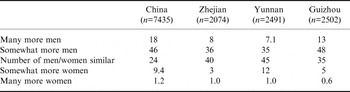
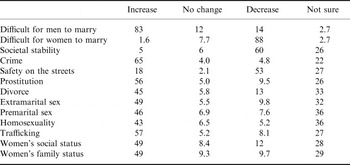
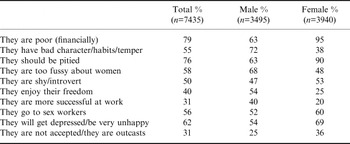
Respondents were asked what they thought was the gender balance among young adults in China, and in their home province (Table 1). Overall 64% think there are more men in China, but importantly 36% don't. In Guizhou, where the sex ratio is highest, residents are more likely to think it is high. The majority (58%) said they had learnt the sex ratio was high from the media. Only 5% of Zhejiang residents and 12% of Yunnan residents had noticed gender imbalance in their own communities, but in Guizhou 51% were aware of excess men locally. Of those who thought there were excess men (n=4802), the overwhelming majority thought the cause was son preference (91%) combined with easy access to sex-selective abortion (66%). Respondents were asked their views on the effects of excess men on society. A range of options based on the theoretical literature was provided (Table 2). Finally, responses to an open question about views and feelings towards older men who have not married were collated and coded. The top ten responses are shown in Table 3.
Perceived gender balance in China and the three provinces by percentage

Stated problems caused by excess men in society by percentage

Characteristics of men who don’t get married by gender

To the authors' knowledge, this is the first study to investigate the opinions of ordinary Chinese people about the effects of high sex ratios. There are limitations. Clearly one urban and one rural location in each province cannot be representative of the socioeconomic and cultural diversity of these provinces as a whole. In addition, the sampling procedure may have led to oversampling of those with greater awareness of the high SRB and its effects leading to overestimates. But this study succeeds in presenting a snapshot of views of the general population in three Chinese provinces with differing sex ratios. It shows that the majority of the sample are aware of the problem of excess males, the cause (son preference and sex-selective abortion) and that there are considerable negative consequences, both for society and for the excess unmarriageable men. On a more negative note over a third of the respondents were totally unaware of the issue. Only in Guizhou, and predominantly in rural Guizhou, did a majority say they were actually aware of gender imbalance in their own communities. This is largely a consequence of disproportionate out-migration of rural women who, because of the overall shortage of women, are more easily able to marry into a higher socioeconomic class and away from their poor villages. The way in which a high SRB combined with out-migration of women in parts of rural China is already resulting in profoundly skewed sex ratios has been documented elsewhere (Zhou et al., Reference Zhou, Wang, Li and Hesketh2011).
The views of the respondents about the effects of high sex ratios showed remarkable understanding of the potential problems. One of the problems with the literature in this area is that because sex ratios of the level currently seen in China are unprecedented, the literature is largely theoretical and speculative. It is based mainly on studies from societies where the sex ratio is only marginally skewed and on the behaviour of young unpartnered men from varying cultures (Barber, Reference Barber2000). There are a number of hypotheses: for example, in societies with high sex ratios unmarriageable men will be prone to psychological problems and sexual frustration, leading to aggression and violence, more crime and consequent societal instability. Empirical support for this prediction comes from cross-cultural studies showing that the overwhelming majority of violent crime is perpetrated by young, unmarried, low-status males (Barber, Reference Barber2000). Most of the respondents agreed with statements that high sex ratios would lead to more crime, less safety on the streets and societal instability. The latter has been described as a particular concern for China, because of the sheer numbers of unmarried men who it is feared will become bound together in an outcast culture, turning to antisocial behaviour and organized crime, and threatening societal stability (Zeng et al., Reference Zeng, Tu, Gu, Xu, Li and Li1993). But there is no evidence yet for this. In rural Guizhou, where the adult sex ratios are very high, largely, as noted above, because of out-migration of women, crime levels are reported to be unchanged over time (Zhou et al., Reference Zhou, Wang, Li and Heskethin press).
Over half of the respondents concur with the hypotheses that high sex ratios are beneficial for women's social and family status. Much writing on sex ratios focuses on improvements in women's status, as women become a more valuable commodity (Stone, Reference Stone, Shackleford and Buss2007). Because women generally prefer long-term monogamous relationships (Schmitt, Reference Schmitt2005), it is predicted that in high sex ratio societies monogamy will be more prevalent, with less premarital and extramarital sex and lower divorce rates (Pedersen, Reference Pedersen1991). Most of the respondents, in contrast, thought these would increase. But it is also hypothesized that this increase in value of women could have adverse effects on women, especially in rural society, with benefits accruing to men, like fathers, husbands, traffickers and pimps (Hudson & Den Boer, Reference Hudson and Den Boer2002). It is noteworthy that most of the respondents identified increases in trafficking and prostitution, both of which have already been partially attributed to high sex ratios in China (Tucker et al., Reference Tucker, Henderson, Wang, Huang and Parish2005). It is perhaps not surprising that respondents attributed the known phenomena of increasing divorce, pre- and extramarital sex and prostitution to high sex ratios; in the context of rapid socioeconomic and cultural change, it is very difficult to isolate the influence of rising sex ratios.
Responses to the open question about unmarriageable men showed that most women pitied them, and most men were judgmental. The pity is not surprising in a society where getting married and having children is still an expectation (Hesketh, Reference Hesketh2006). Indeed, these men have long been called guang gun meaning ‘bare branches’, which in itself implies pity. Women tended to assume these men were very poor, confirming the view in present day China that men need to have money, and usually a home, before getting married. Judgemental views expressed included that these men are of bad character and habits, too fussy about women and not accepted in society. Overall the lot of the guang gun is regarded as very grim.
The high levels of awareness of high sex ratios and their potential consequences should help to reduce the sex ratio, and they may help to explain the recent slight downturn in sex ratio. However, because the high-SRB cohorts have yet to reach reproductive age, the problem of high sex ratios in the reproductive age group will worsen over the next two decades, with the potential for the problems raised by the participants in this study.
Acknowledgment
This study was funded through a grant from the Economic and Social Research Council.