INTRODUCTION
Part of learning a language is learning its words. Some words, like concrete nouns, denote referents in the observable or tangible world. Children attend to objects from a young age (Spelke, Reference Spelke and Yonas1988), and, after the naming explosion, they are quick to map novel labels onto concrete objects (Carey, Reference Carey, Halle, Bresnan and Miller1978; Bates et al., Reference Bates, Marchman, Thal, Fenson, Dale, Reznick, Reilly and Hartung1994). In this, they may be guided by conceptual biases. For instance, Gentner's (Reference Gentner and Stan1982) Natural Partitions Hypothesis claims that concrete and proper nouns are acquired before verbs because objects are conceptually simpler than events; the labels for objects (i.e. nouns) are therefore easier to learn. In other words, (certain) nouns have a particularly transparent semantic mapping to the perceptual-conceptual world.
However, in learning language, children must acquire not only referential lexical items, but also lexical items that have no referential properties, such as function words. In some cases, a particular phonological form may correspond to both a content and a function word. For example, do exists as both a main verb (I will do the dishes) and as an auxiliary verb (Do you like beans?). Such cases raise the following question for language acquisition: do children acquire one lexical entry of a word before the other? If so, which meaning or syntactic category is acquired first? Does the first acquired lexical meaning of the word relate in any way to the acquisition of the second lexical meaning?
Like synonymy, lexical ambiguity poses a general problem for language learning, since it interferes with what would otherwise be a 1:1 mapping between words and meanings. To deal with the synonymy problem, researchers have suggested that children initially disallow synonyms. Clark's (Reference Clark and MacWhinney1987) Principle of Contrast requires two words to contrast in meaning; Markman (Reference Markman, Gleitman and Landau1994) makes the even stronger claim that the meanings of different words must be mutually exclusive in the initial stages of word learning. The fact that many words have multiple meanings or syntactic categories (a situation that includes, but is not limited to, homonymy) presents a potentially more serious problem: if a word can have more than one meaning, this introduces variability in the possible form–meaning mappings, which could impede lexical learning. Yet, children do learn the meanings of words. In the verb learning literature, it is assumed that children initially assume non-ambiguity (Gleitman, Reference Gleitman1990), otherwise, children would not be able to exploit a particular verb's appearance in multiple sentence frames to learn the meaning of the verb. That is, children should assume that break or give or think means roughly the same thing in all of its environments and occurrences, and should relax this requirement only after a basic meaning for the item has been stored in the lexicon.
Previous work on children's word learning strategies (including research on the problems of synonymy and ambiguity) has focused exclusively on the learning of content words (nouns, verbs and adjectives). In this paper, we focus on the special case of ambiguity that crosses the content–function word divide. In particular, we investigate the acquisition of expletives, specifically expletive vs. referential pronoun it. It presents a particularly interesting case of content vs. function word ambiguity: expletive it is a function word in the sense that it is an NP that cannot bear a theta-role, and it is obligatorily null in many languages, such as Italian. Yet unlike the ambiguity between auxiliary and main verb do, expletive it has the same syntactic category as a referential NP, and it occupies the same syntactic position in the structure. Thus, while positional cues could help a learner distinguish main verb do from auxiliary do (since auxiliary do inverts with the subject in questions, while main verb do does not invert), positional information by itself will not distinguish expletive from pronoun it.
Expletive it is of special interest for lexical acquisition as it is required not only for such constructions as weather and time predicates (It's raining, It's four o'clock), but also for extraposition structures (It is obvious that this research is important), where it appears to ‘refer’ to a whole clause (cf. That this research is important is obvious). Furthermore, expletives likely play a role in children's acquisition of raising verbs (e.g. seem). Previous work has pointed to the importance of expletives in distinguishing raising verbs from non-raising verbs (Becker, Reference Becker2005).
This paper is organized as follows. First we will give some background on the syntax of expletives in adult grammar. Then we will discuss the results of one study for children's acquisition of expletive vs. locative there. In light of these results, we will examine children's acquisition of expletive it, and we will show that it follows a different developmental trajectory from there. We will present an account of why expletive it follows the trajectory it does, and consider the ramifications of the data on extant literature. Finally, we will close with a discussion of several factors that complicate the acquisition of expletives, and suggest directions for further work in this area.
BACKGROUND
The syntax of expletives
There is a rich literature on the syntactic properties of expletives in adult grammar (among many others, see Milsark, Reference Milsark1974; Stowell, Reference Stowell1979; Chomsky, Reference Chomsky1981, Reference Chomsky and Freidin1991). This literature has focused on the syntactic properties of expletives in general, as well as on the similarities and differences between it and there. Both expletives are non-referential and normally fill a subject argument position for a verb that does not project a theta-role to this position. Common types of expletive constructions include presentational-existential sentences containing there (1) and weather/time predicates and extraposition constructions containing it (2).
- (1)
(a) There are two boys in the yard.
(b) There is a boy in the yard.
- (2)
(a) It's raining./It's five o'clock.
(b) It's obvious that the boys are friends.
Chomsky (Reference Chomsky1981) argues that expletive it has two forms: a quasi-argument form, which appears in weather predicates and carries the semantically bleached ‘# theta-role’ (2a), and a non-argument (true expletive) form, which appears in extraposition (2b), cleft and raising constructions in which the subject has not been raised (e.g. It seems that John is friendly).
The English expletives differ in both their formal and their functional characteristics. We will discuss each in turn.
The traditional formal view of presentational-existentials (e.g. Milsark, Reference Milsark1974) holds that such sentences are formed via a transformational rule which moves the subject to the right of the verb and inserts there into subject position. Such an analysis has the benefit of accounting for the fact that the verb in such sentences agrees with the postverbal associate NP (this term from Chomsky, Reference Chomsky and Freidin1991) (in (1), two boys) rather than with the ostensibly singular expletive subject there. By manifesting this agreement phenomenon, the English existential compares with the Italian construction, in which the verb shows agreement (c'è, ci sono), and contrasts with the French construction, in which the verb is invariant (il y a, *il y ont); this difference obtains despite the fact that in all three languages the expletive element appears preverbally.
A similar transformational rule has previously been assumed responsible for extraposition constructions (Rosenbaum, Reference Rosenbaum1967). However, McCloskey (Reference McCloskey1991) points out that extraposition cannot be the result of a transformational rule, since expletive it and a following CP do not appear to be linked so as to cause verbal agreement (cf. That Sarah will stay and that she will leave are/*is equally likely, but It is/*are equally likely that Sarah will stay and that she will leave). Thus, a crucial difference in verbal agreement exists between constructions containing expletive it and those containing expletive there.
Another formal account of the differences between it and there focuses on the lexical–syntactic characteristics of the expletives. Hazout (Reference Hazout2004) argues that the English expletives differ in their subcategorization frames due to a difference in phi/(agreement)-features. He observes that there must co-occur with a postverbal NP, as in (3), while it may appear with anything but a postverbal NP, as in (4).Footnote 1
(3) There *is snowing/*smells like snow/*is all white outside/is a snowman in the yard.
(4) It is snowing/smells like snow/is all white outside/*is a snowman in the yard.
Hazout claims that this effect is due to the fact that there is lexically underspecified with respect to number phi-features, and must therefore co-occur with an NP, whose number feature can percolate up to check that on the verb, giving rise to the attested agreement facts. Meanwhile, it is fully lexically specified for third singular phi-features, causing singular agreement to always be marked on the verb. A postverbal NP would contribute an extra, unchecked number feature, yielding ungrammaticality. In short, while both expletives serve similar formal syntactic purposes, they appear to have distinct lexical–syntactic characteristics.
A treatment of the differences between it and there is also given in the functional literature. Presentational-expletive constructions with there serve the purpose of calling the attention of an interlocutor to the previously unnoticed presence of some NP (generally a person or thing) in the speech setting; thus, this construction introduces a new entity into the discourse-internal world. By moving an NP out of the subject slot, generally a position reserved for old information, and into a postverbal position, the NP attains a higher level of focus or prominence (Lambrecht, Reference Lambrecht1994). Thus, such constructions generally introduce not only new but in particular new important referents (Givón, Reference Givón1990).
In contrast, true expletive it as used in the cleft construction serves the opposite function; Lambrecht (Reference Lambrecht1994) and many others have noted that for the cleft construction to be felicitous, the proposition expressed in the lower clause must be pragmatically presupposed and, furthermore, activated in the addressee's consciousness at the time the sentence is uttered. In this way, it and there appear in complementary distribution, with respect to pragmatic presupposition.
Also important to this study is the relative utility of each expletive for speakers of different ages. The presentational function of there is important to both children and adults alike; any number of objects might be pointed out by speakers young and old during a playtime conversation. In contrast, non-argument it as used in extraposition and clefting is likely to be both more opaque and less useful to children, given the kinds of things very young children talk about. If for no other reason, extraposition and cleft constructions may be obviated in the speech of young children due to MLU limitations, since such utterances tend to be quite long.
Acquisition of expletives
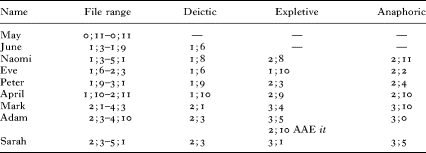
While expletive constructions in adult grammar have enjoyed much attention, considerably less attention has been paid to the acquisition of expletives in language learners. One exception to this is Shafer & Roeper (Reference Shafer and Roeper2000), who performed a comprehensive study on the acquisition of locative (deictic) vs. expletive there. Examining the files of nine children in the CHILDES database (MacWhinney & Snow, Reference MacWhinney and Snow1985), they found that deictic–locative pronoun there, illustrated in (5), was acquired first, followed by expletive there, as in (6).
(5) that Mom nose right there (Eve 1 ; 9)
(6) there no squirrels (Eve 1 ; 11)
However, anaphoric pronoun there, or locative there with an overt discourse anaphor, shown in (7), did not appear until after expletive there was acquired.
(7) I sticked it on these wood. Stays on there (Naomi 2 ; 11)
Shafer and Roeper's data are presented in Table 1.
First occurrences of deictic, expletive and anaphoric there

Shafer & Roeper explain this order of acquisition by saying that expletive there acts as a logical trigger for anaphoric there; that is, the anaphor cannot be acquired until the expletive has been acquired. Their analysis hinges on two claims. First, a grammatical element with variable reference (i.e. anaphoric there) should be a subcase of a grammatical element with no reference (i.e. expletive there). Second, the local syntactic chain between an expletive and its associate (i.e. the chain between there and a book in the sentence there is a book on the desk) is syntactically simpler than the non-local (i.e. extra-clausal) relation between an anaphor and its discourse referent. Shafer & Roeper predict a similar process of acquisition for other discourse anaphors. Importantly, they predict that anaphoric it should not be acquired until after expletive it is acquired.
However, evidence from the syntactic literature leads us to believe that this prediction is incorrect. Since the expletives it and there have distinct formal and functional properties – and possibly more important, since they are differentially useful to very young speakers – we predict that it and there should follow different developmental trajectories. Specifically, we follow Gentner's Natural Partitions Hypothesis in assuming that tangible objects will be easier to conceptualize, and therefore that their labels (viz. nouns) will be acquired earlier, as compared to non-referential words. Accordingly, we predict that all types of referential pronoun it, including the anaphor, should be acquired before expletive it.
PROCEDURE
To test this prediction, we examined 28 files from four children in the CHILDES database: Adam and Eve (Brown, Reference Brown1973), Nina (Suppes, Reference Suppes1974) and Peter (Bloom, Reference Bloom1970). The files included eight files each from Adam, Eve and Nina and four files from Peter. For the first three children, the first two available files for each child were coded, followed by two files each from (roughly) three, six and nine months later. Because Peter's files contain twice as much data as the other children's files, his first single available file was coded, followed by one file each from three, six and nine months later.
The beginning point for the examination of data files (i.e. the earliest available files) was chosen so as to match the ages of children examined by Shafer & Roeper. The end point for the data files was chosen so as to roughly align with children's attainment of an average MLU of 3. (While Nina appears to be an outlier, the data below illustrate that her expletive development is precocious.) Only a subset of the medial files (i.e. those at three-month intervals) were coded, since the labor-intensive process of hand-coding precluded the examination of every file between the initial and final data points; the use of non-sequential files allowed us to get a better picture of development over time. Finally, in order to have roughly the same amount of data per child, only half as many files from Peter were examined as from the other children, because his files are twice as long as those of the other children. The range of ages and MLUs of the children examined is given in Table 2.
Children's ages and MLUs for first and last files examined

The files were coded for occurrences of it. Two distinct types of it were identified, namely NP it and expletive it, as exemplified in (8a, b).Footnote 2 Occurrences of it were further coded as to whether they appeared in subject or object position in the sentence.
- (8)
(a) NP it:
here it is (subj.); find it (obj.)
(b) Expletive it:
it's fourteen o'clock (subj.); That make it dark outside (obj.)
The files were also examined for omitted uses of expletive subject it, in other words, uses of expletive it that would be obligatory in the adult grammar but were omitted by the child. An occurrence was considered obligatory if the sentence included a weather or time predicate, which requires an expletive subject.Footnote 3
Utterances were omitted from the coding process if they included unintelligible words, or if the syntactic category of it was totally irretrievable from context. These discarded utterances constituted only 3·1% of the total number of utterances examined; this total included children's omissions (193) and overt uses (1,336) of the expletive, as well as discarded utterances (49).
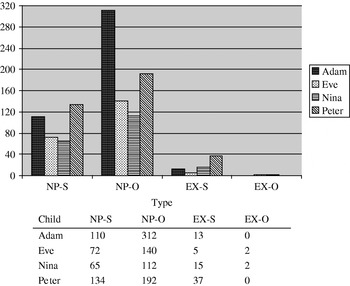
As is clear in Figure 1, which conflates all occurrences over time for each child, NP it is by far the most common type of it used overall, and it occurs especially frequently in object position.
Total uses of all types of it (files collapsed within children).

RESULTS
Referential (deictic) vs. expletive it
Looking at the children's data over time, we found that referential pronoun it was used by all children beginning in the earliest files examined. Some examples of the referential uses of it in these earliest files are included in (9).
(9)


In contrast, expletive it was not used until the fourth or fifth file examined for each child, three to nine months later. Examples of the earliest uses of expletive it found in this search are included in (10) (see Appendix A for all expletive uses). Verification of coding of overt expletives by an independent party yielded an agreement rate of 98·9% (1 disagreement in 87 overt uses).
(10)
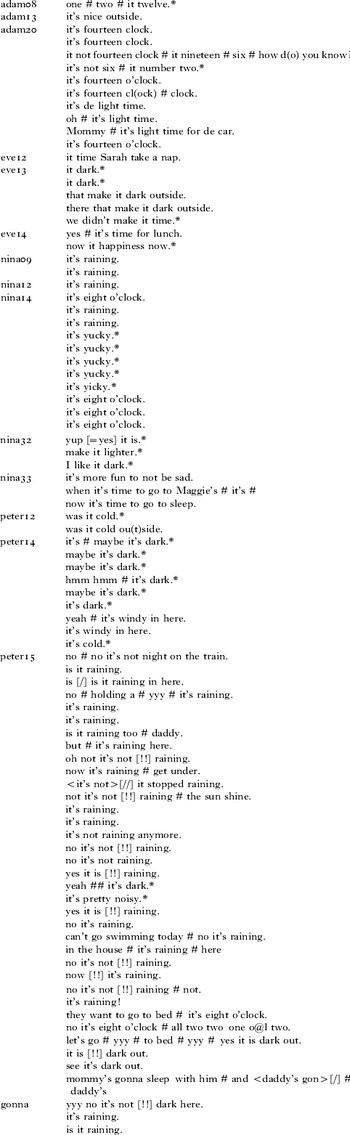
The children used expletive it primarily for weather/atmosphere (it's cold/dark/noisy) and time predicates (it's X o'clock, it's time for/to …); on the whole, they do not use it in extraposition, cleft or raising structures in the files examined (with the exception of it's more fun to not be sad (nina33)). In this way, children's use of expletive it is more restricted than the adult grammar allows. In fact, expletive it is used by children overwhelmingly in its quasi-argument form; true non-argument it appears only once in the data.
Two points regarding this pattern of usage should be noted. First, the constructions in which children use expletive it are the environments which have a higher token frequency in adult language as well; extraposition, clefting and raising structures are more marked than weather and time predicates. For instance, a corpus study examining 448 adult utterances including the raising verb seem yielded only 13% with an expletive (i.e. unraised) subject (Hirsch & Wexler, Reference Hirsch, Wexler, Davies and Dubinskyto appear). While these structures are marked in the adult language, they may furthermore be obviated in the speech of very young children as a result of MLU limitations, as mentioned above.
A second point that should be noted is the fact that although children do use the expletive in a proper subset of the allowable adult contexts for this element, they do so in ways that are highly productive and that indicate full incorporation of the expletive into their grammar. First, children use the expletive in questions, and not only declaratives (was it cold outside? (peter12), is it raining? (peter15)). Second, children extend the ‘atmospheric’ use of the expletive to include feelings (now it happiness now (eve14)), a phenomenon that is ungrammatical in adult English, but grammatical in adult Hebrew (Hazout, Reference Hazout2004). And third, children produce non-adult-like (and therefore not imitated) utterances involving the expletive in ‘time’ constructions (it's fourteen o'clock (adam20)). These pieces of evidence indicate that children's uses of weather-expletive it are productive and that children understand the referential/expletive distinction, rather than simply using the expletive in fixed phrases or as part of a social routine.
One could argue that true non-argument (pure expletive) it has not yet been acquired by children; the data clearly indicate that quasi-argument it is first to be acquired. Note that this pattern of acquisition meshes with the prediction that children should acquire referential items before non-referential items, if we are to imagine a scale of referentiality in which arguments and non-arguments fall at the poles and quasi-arguments (which are non-referential but still carry a theta-role of sorts) somewhere in the middle (see below for further discussion on this point).
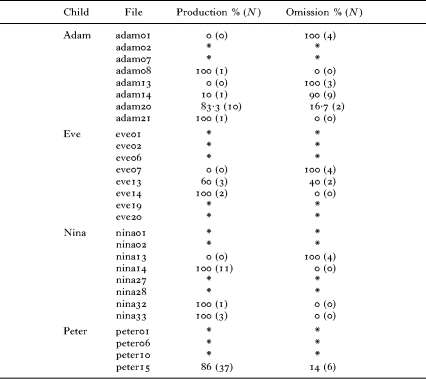
Table 3 shows the percent of omissions vs. productions of expletive it for each child over time. Importantly, expletive it is omitted in the files for Adam, Eve and Nina before it appears, indicating that the children do not have productive use of the expletive at this earlier stage. (The fact that we fail to see Peter omit expletive it before he produces it is likely an artifact of the smaller number of data points for him.) Conversely, the very high number of expletive uses in Peter's last file is a result of an extended pretending game, in which Peter repeatedly noted that it (alternatingly) was and was not raining.
Productions and omissions of expletive it in obligatory contexts

* No obligatory contexts.
Anaphoric vs. deictic it
In order to verify our prediction that anaphoric pronoun it is acquired earlier than expletive it, we coded each occurrence of NP it for whether it followed an overt discourse anaphor or not. For this first stage of coding, any use of it that referred to an object previously mentioned in the discourse was considered to be anaphoric. More precisely, a use was considered anaphoric if it occurred after any linguistic reference to an object whatsoever, including references such as it, that, this one, the red one, etc.
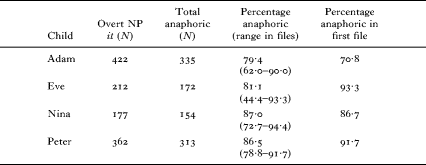
Table 4 shows the total number of overt (referential) NP it uses per child in all files, total number of anaphoric uses of NP it and the total percentage of anaphoric use (that is, anaphoric uses (N) divided by total uses (N)), as well as the lowest and highest percentage use across individual files. This total percentage is very high, indicating that children have acquired the use of referential pronoun it as a discourse anaphor. To show that children's use of anaphoric it is high not only in later files but also at earlier data points, we also present here their use of anaphoric it in the first file examined. Note that the lowest percentage use in the range of individual files presented is not representative of the use in the earliest file.
Children's production of anaphoric it, first criteria

However, with a definition of ‘anaphoric’ which includes discourse referents like that, this one, the red one, etc. (which are themselves deictic), it might be argued that the child is using it to pick out an object in the environment rather than to replace a linguistic object in the discourse. In order to address this argument, we coded NP it a second time with stricter criteria. This time, NP it was considered to be anaphoric only if it occurred as the immediate replacement for a full NP in the discourse. This method of coding, then, excludes from being anaphoric the NP its that occurred after referents like that, this one, the red one, etc., which do not contain a full concrete NP but rather contain a demonstrative or the pronoun one. This also excludes those uses of it which occurred as the second (or later) reference to a previously mentioned NP in the discourse. For example, under the stricter criteria, the first it in the exchange in (11) would be coded as ‘anaphoric’ while the second it would not be.
(11) a: Do you see the ball?
b: It's right here. (anaphoric)
a: Give it to me. (not anaphoric)
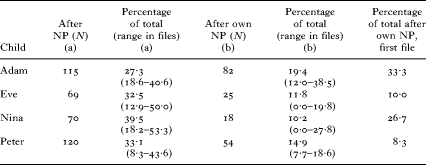
This set of coding criteria is likely to underestimate the linguistic ability of the child. However, this strict manner of coding was necessary in order to compare our results with those of Shafer & Roeper, who used similar criteria, and to illustrate decisively that the children had acquired the use of anaphoric it. To further bolster the argument that the children in this study understood the grammatical function of it as an anaphor, we also tallied the total number of uses of overt NP it which immediately replaced a full NP produced by the child herself. We considered this to be the most precise estimate of which NP it forms were truly anaphoric for the child speaker; if she both indicated an object linguistically and then replaced it with an anaphor, the mechanism of anaphoric replacement must already be mastered. Examples of this kind of anaphoric usage from each child's earliest file appear in (12).
(12)
Table 5 gives the number (and percentage) of the total uses of NP it that: (a) immediately followed a full NP produced by any speaker in the discourse; and those that (b) immediately followed a full NP produced by the child herself. As before, the range of percentages seen across individual files is also given. Note that the children produced anaphoric it at about the same percentage across time, beginning with the earliest files. Once again, the lowest percentage usage for individual files, also presented in this table, does not appear in the earliest files for the children.
Children's production of anaphoric it, second criteria

The percentages are indeed lower here than under the first coding run, which is to be expected under the stricter coding criteria. However, these lower means do not indicate non-adult-like competence on an obligatory grammatical structure. Rather, they indicate that children have a variety of ways to refer to objects in the environment around them, only one of which is direct anaphoric replacement. This observation is supported by Wagner, Kako, Amick, Carrigan & Liu (Reference Wagner, Kako, Amick, Carrigan and Liu2005), who note that given a handful of referential options, even deixis can be ‘a grammatically sanctioned phenomenon’ for both adults and children.
Indeed, it is the non-obligatory nature of anaphors which makes observing (and quantifying) their mastery most difficult. When a child (or an adult) wishes to refer to an object in the environment, she has a host of options at her disposal, including anaphors, demonstratives, lexical NPs and deixis. Since all of these options are grammatical, and the choice among them is nearly always a personal or stylistic one, it is difficult to measure the use of discourse anaphors in a strict statistical way.
This being the case, in order to determine whether the percentages in Table 5 are within a range where it is reasonable to claim that the children are using it as a discourse anaphor, we examined adults' production of anaphoric it as defined by the second set of criteria. We coded all adult occurrences of referential it in the last file examined for each child (i.e. adam21, eve20, nina33 and peter15) for whether each use occurred as the immediate anaphoric replacement for a full NP in the discourse, and for a full NP produced by the adult herself. Out of 540 total adult tokens of referential NP it, 146 (27%) were the immediate replacement to any full NP in the discourse, and 72 (13·3%) replaced a full NP produced by the same speaker. For comparison, the four children examined produce 1,173 tokens of referential NP it, with 374 (31·9%) of these being direct replacements to any full NP, and 182 (15·5%) being direct replacements to full NPs in their own speech. As such, there appears to be no difference between the frequency of use in the child and adult data. Variation in anaphoric usage by children between files should not be attributed to any dearth of adult-like grammaticality, but rather to natural variations in speech given the referential options.
Expletive vs. referential it
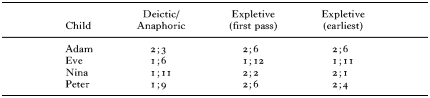
Table 6 shows the age at the first documented uses for deictic/anaphoric pronoun it and for expletive it for each child, as found in the files under consideration (labeled ‘First pass’). Recall that even under the stricter coding criteria, anaphoric it was found alongside deictic it from the earliest available files.
Age of appearance for referential pronoun it and expletive it

In order to find the earliest recorded occurrence of expletive it for each child, files in the CHILDES database were examined one at a time, beginning with the ‘First pass’ files and working backwards. For all the children but Adam, at least one occurrence of expletive it was found in an earlier file. Table 6 also lists the exact age of the children at the first documented use of expletive it, as found by this method (labeled ‘Earliest’). Thus, for the four children examined, expletive it appears two to seven months after deictic and anaphoric it.
For comparison with Shafer & Roeper's study, we can contrast these data with those data of the same children (minus Nina, whose data were not used by Shafer & Roeper) documenting the first occurrences of deictic, expletive and anaphoric there, presented in Table 1. It is clear that while expletive there appears to be acquired before anaphoric there, the opposite pattern of acquisition is observed with it; anaphoric it is acquired before expletive it.
The data presented here strongly indicate that children are productively using anaphoric it from the earliest files available, which refutes the hypothesis made by Shafer & Roeper and supports the current hypothesis that referential items, whether anaphorically linked to a discourse element or not, should be acquired before expletive items.
DISCUSSION
The appearance of expletive it
The logical trigger analysis account of Shafer & Roeper argues that the acquisition of anaphoric it should be a necessary step in the acquisition of the expletive; however, as we have seen, this order of acquisition does not obtain. In contrast, Gentner's Natural Partitions Hypothesis suggests that referential items should be acquired before non-referential ones; this is the attested order of acquisition, since deictic and anaphoric it are both acquired before the expletive.
How, then, can we account for the appearance of expletive it at all? We appeal to Inoue's (Reference Inoue1991) analysis of children's acquisition of expletive there after locative there. Although Inoue does not distinguish deictic from anaphoric there, he proposes that the acquisition of expletive there after locative there is a result of weakening the locative meaning of there in sentences like There is a polar bear in the kitchen and reanalyzing it as an expletive subject. This reanalysis takes place once the child realizes that two locative phrases may not co-occur in the same sentence, as illustrated in (13).
(13) *A polar bear is in the kitchen in the bathroom.
Two locatives may co-occur only if they are hierarchically arranged, as in A book is on the table in the kitchen.
We follow Inoue in proposing that the emergence of expletive it is a result of lexical–semantic reanalysis dependent upon the child's understanding of it as a pronoun that is used with variable reference, both as a deictic term whose referent is retrievable from context and as an anaphoric pronoun whose referent is retrievable from the conversation, be that from the child's own speech or from that of the child's interlocutor. However, in the case of the expletive, no referent can be found, since the expletive is non-referential. Because no referent ever appears in conjunction with the expletive in phrases like it's cold or it's five o'clock, the child is forced to reanalyze the lexeme it to include a subtype expletive which is completely bleached of any referential meaning. This, in turn, will allow the child to entertain the option that a predicate may not project a theta-role into its subject position, widening the child's grammatical options. As to what triggers this shift, we appeal to the difference, widely assumed, between ‘input’ (what the child is exposed to) and ‘intake’ (what the child assimilates) (White, Reference White1982), leaving for future work a more thorough answer to the question of exactly how that shift takes place. For now, we will suggest that multiple exposures to the relevant input will be required for the child to correctly assimilate the adult grammar (Yang, Reference Yang2002); this view contrasts with earlier positions on parameter setting (e.g. Hyams, Reference Hyams1986), in which the child was predicted to attain the adult grammar after exposure to a very small amount (perhaps even one sentence) of the relevant triggering data.
Because the child is argued to first search for a referent for the expletive, and then later – once none is ever found – to form a new lexical entry expletive for it, we assume that it is crucial for the acquisition of this expletive that the child first have an understanding of the homophonous referential pronoun.
We can further speculate that once children have assimilated quasi-argument it into their lexicon, the next easy move is to take the expletive status of this element one step further, by removing the ‘#’ theta-role assigned to this element and thereby allowing for acquisition of the true expletive (as used in extraposition, clefting and raising structures). A more detailed exposition of this process falls outside the scope of this paper; further research should examine the acquisition of it in these structures.
Alternative accounts
The most plausible alternative account for the acquisition of expletive it after the referential pronoun is based on the relative frequencies of the different forms of it in the input. Such an argument would claim that tokens of anaphoric and deictic it are more frequent in the input than tokens of expletive it; thus, the child receives more exposure to the former at a younger age and acquires them first.Footnote 4,, Footnote 5 Newport, Gleitman & Gleitman (Reference Newport, Gleitman, Gleitman, Snow and Ferguson1977) have provided indications that for certain grammatical items (e.g. auxiliary verbs), caretaker input has some influence on the order of acquisition in child speech. We do not know at present whether or not this is true of expletives.
However, although frequency is always likely to have some influence, an explanation based purely on input frequency cannot be the whole story. While referential pronoun it may appear in the same syntactic frame as a full NP, expletive it fills a syntactic slot that cannot otherwise be filled. This means that in non-null-subject languages, in the frames in which the expletive may occur, it in fact must occur. The upshot is that a child will hear expletive it in its licensing environment proportionally more often than referential pronoun it in its environment. This is due to the fact that referential it can occur in the same syntactic slot as a full NP and will therefore alternate with such an NP in this environment. In this way, frequency cannot be the sole guiding force in the acquisition of the expletive.
CONCLUSION
The research presented here contributes to our understanding of how different lexical items might be acquired, in particular in cases where an item is homophonous between being a content and a function word.
The data we presented have ramifications not only for a study of the relative order of acquisition among deictic, anaphoric and expletive it, but also for Shafer & Roeper's original predictions and findings, and for adult syntactic accounts of the English expletives.
Revisiting Shafer & Roeper (Reference Shafer and Roeper2000)
Shafer & Roeper suggest that the acquisition of expletive there before the corresponding anaphor ‘suggests some link between free variables (and assignment functions) and the absence of reference’ (p. 630) and predict a similar acquisition process for other discourse anaphors, including pronouns (it, that), temporals (then) and ellipsis (so). They close with the following:
The outstanding question is whether acquisition of expletive there, particularly the associate relation, triggers all discourse anaphors (it/s/he, that, then). Alternatively, in each case, interpretation as a discourse anaphor is only possible once a completely non-referential, functional interpretation is acquired. In this case we predict a number of acquisition sequences that are not directly connected: the expletive there before the anaphoric there; pleonastic it before anaphoric it; complementizer that before anaphoric that, and temporal complementizer then before anaphoric then. If the pattern repeats itself, then our claims about abstract triggers are decisively supported. (p. 631)
As we have seen, however, the pattern observed with there does not repeat itself with it. This is likely a result of the previously noted syntactic differences between the expletives. The logical trigger hypothesis as such is not supported by the data.
With the logical trigger hypothesis failing to find support in the pattern of acquisition between anaphoric and expletive it, it might be wise to give consideration to other possible explanations for the pattern observed with expletive and anaphoric there. We propose that Inoue's (Reference Inoue1991) reanalysis account for expletive there should be positively reconsidered in light of the data. Specifically, deictic (i.e. referential) there appears before expletive there, as expected according to the assumption that referential items should be acquired before non-referential items. Inoue's semantic reanalysis account may then prove preferable to that of Shafer & Roeper, such that a general phenomenon exists whereby expletive elements are acquired after they are reanalyzed from their referential counterparts.Footnote 6
Shafer & Roeper mention, as an alternative to the logical trigger, the possibility that the acquisition of expletive there triggers all discourse anaphors. We tested this hypothesis by comparing the ages given by Shafer & Roeper for the first appearance of expletive there (from their (4)) with the ages of the children in the first files in which they used anaphoric it (i.e. the first files available). These data appear in Table 7. As is clear upon quick examination, Shafer & Roeper's secondary prediction about logical triggers is not borne out.
Age at use of anaphoric it and at first appearance of expletive there

* Unavailable from Shafer & Roeper (Reference Shafer and Roeper2000).
Across the board, children use anaphoric it before acquiring expletive there. Thus it cannot be the case that the acquisition of the structure which contains expletive there triggers all discourse anaphors. This casts further doubt on the idea of a logical trigger.
Implications for adult syntactic accounts
Earlier, we contrasted the English expletives it and there in adult grammar. These contrasts included both formal syntactic facts (i.e. that: (a) there must appear with a postverbal NP, while it may appear with anything but an NP; and (b) in expletive constructions including there, the verb shows agreement with the associate, while no such agreement occurs in constructions with it) and functional facts (i.e. that there serves the function of presenting new NPs into the discourse and is therefore quite useful to both children and adults, while non-argument it is used with pragmatically presupposed information and is less useful to very young children).
The data from child acquisition, which show distinct trajectories of acquisition for each expletive, lend support to these observations about the differences in the expletives. Crucially, the acquisition data indicate several important patterns in the expletives' acquisition; namely that the expletives are not acquired at the same time, nor do they appear to be acquired in a uniform sequence across all children examined. Instead, it seems that each expletive is acquired independently of the other (although both are acquired by the children examined within four months; see Table 8). Furthermore, when considered as homophonous elements in two tripartite groups of deictic, anaphoric and expletive items, the sequence of acquisition within each group is not identical for it and there.
Age at appearance of expletive there and expletive it

* Unavailable from Shafer & Roeper (Reference Shafer and Roeper2000).
When two lexical elements have different characteristics (subcategorization features, phi-features, functional purposes, etc.), we should not be surprised to see them manifest separate trajectories in first language acquisition. In this way, different patterns of acquisition for it and there are predicted by (and serve as evidence to support) claims made in the adult literature about differences between the expletives.
COMPLICATING FACTORS FOR ACQUISITION
Several issues arise when we consider colloquial allowances surrounding the English expletives. For example, some colloquial uses (Time for bed) indicate that the use of expletive it may not always be obligatory, even in non-null-subject languages such as English. Other colloquialisms (There's some dogs outside) do not appear to require number agreement between the copula and the associate NP. Finally, some set English phrases (It's for you, as said about a phone call) include occurrences of it which are ambiguous between referential and expletive uses. All of these allowances make the input for language learners more complicated to analyze.
Might expletives be unnecessary?
As noted above, some phrases in colloquial English, like the examples in (14), allow a bare predicate to appear without expletive it, which is usually required.
- (14)
(a) Time for bed.
(b) Cold out there, huh?
(c) Your turn.
Note that these colloquialisms are stripped not only of the expletive but also of the copula, and that the same phrase containing the copula but no expletive is ungrammatical.
- (15)
(a) *Is time for bed.
(b) *Is cold out there, huh?
(c) *Is your turn.
For comparison, pro-drop languages such as Italian show agreement on the verb but no overt expletive in these constructions.
- (16)
(a) pro piove
[pro rain-3sg.]
‘It's raining’
(b) pro fa caldo
[pro make-3sg. hot]
‘It's hot’
The appearance of these phrases in colloquial English is likely to be a complicating factor in the acquisition of expletive it, and possibly also in the acquisition of the correct pro-drop parameter. While we will not pursue this issue in detail here, we will speculate that the lack of input like that in (15), i.e. with a copula but no expletive, is likely to be necessary for the child to conclude that the language is not pro-drop. However, the positive evidence in (14) is certain to make the child's learning task more complicated.
Implications for Hazout (Reference Hazout2004)
Recall that Hazout (Reference Hazout2004) claims that the only difference between expletive constructions containing there and those containing it is that expletive there is underspecified for phi-features, while it is specified for third singular.
Since it thus functions like all other NP subjects and does not require any new syntactic structures or feature movements to be implemented, we might expect constructions including expletive it to be acquired robustly by children before those containing expletive there. However, this prediction is not borne out in the data; Eve and Peter acquired expletive there before expletive it, while Adam manifested the opposite order of acquisition, as seen in Table 8.
One possible reason for this lies in the fact that in colloquial English, the structure in (17), containing the singular contracted copula with a plural postverbal NP, is grammatical.
(17) There's some dogs outside.
Meanwhile, the fully expanded verb remains ungrammatical, as expected.
(18) *There is some dogs outside.
As a preliminary hypothesis, it appears possible that the colloquial allowance in (17) could lead children towards an alternate analysis of there, in which its phi-features mimic those of it, since in (17) there appears to be fully specified as third singular.
If children entertain the hypothesis that there has third singular phi-features, a major structural and subcategorizational difference between the two expletives would be obliterated, and there, like it, would function like any other NP subject. In this case, it would be difficult to make a prediction as to whether expletive it or expletive there would be acquired first.
At the very least, it seems reasonable to suppose that the colloquial contracted singular form there's – as with the omitted expletive forms in (14) – is a further complicating factor in the task of learning the structure of presentational-existential sentences.
Where to draw the line on referentiality
The acquisition of expletive versus referential it is complicated by another issue; namely, where to draw the line between them. As discussed above, utterances from our data were discarded when it was impossible to determine to which syntactic category the it appearing there belonged. Some acceptable adult uses of it are similarly difficult to categorize, as they fall into a fuzzy area between referential and non-referential. Consider the utterance in (19), which is used by Peter (2 ; 6·14).
(19) It's for you.
This utterance, used to encourage the interlocutor to answer the telephone, includes an it that is difficult to classify. One possibility is to assume that this it is a deictic (and thus referential) pronoun, either because the speaker hands the phone to the interlocutor while uttering it, or else because both have heard the phone ring, thus leaving the referent obvious. (The referent, in this case, would be ‘the phone’ or perhaps ‘the phone call’.)
However, It's for you has come to be a set phrase; even without the interlocutor having heard the phone ring, she is unlikely to respond with, what's for me? In this way, It's for you comes to resemble It's your turn in some way, engendering the possibility that the it used here is actually an expletive.
The issue at stake is one of learnability. It may in fact prove incorrect to analyze it as having two homophonous but independent forms, one referential, one non-referential. Instead, in light of such ambiguous structures as (19), it may be the case that it is a single lexical item which may be used in a spectrum of ways, with true referential uses (it is heavy) and true expletive uses (it's raining) falling at the extremes. On such a spectrum, the most referential uses of it are semantically contentful, true expletive uses are semantically bleached and falling in the middle would be uses of it that replace VPs (I did it), CPs (It bothers me that John left) and ambiguous cases (It's for you). Alternatively, as suggested above, the spectrum might have argument it and non-argument it at the poles, with the quasi-argument, VP and ambiguous cases falling in the middle; because weather it has been argued to carry a type of theta-role, it may prove more ‘referential’ than pure expletive it. Future work might investigate whether a one-it or a two-it story better accounts for the data, and whether the CP it in extraposition structures, which may or may not ‘refer’ to a clause, has some effect for language learners on delineation among the uses or types of it.
FURTHER DIRECTIONS
This study leaves several questions unanswered, including, most notably, what the picture for cross-linguistic expletive acquisition might be. Further research should explore whether the acquisition of referential and expletive pronouns in other languages with two expletives, such as French (il and y), mirrors the acquisition picture we find occurring with English-acquiring children, or whether it differs, and if so, how. Similarly, we must explore what trajectory acquisition follows in languages such as German, in which a single expletive (es) is used for what would be distinct constructions using it and there in English. It should be explored whether the expletive in such a language appears in constructions across the board, or comes in piecemeal, with some constructions appearing before others.
As indicated above, future work should also examine the acquisition of pure expletive it in later childhood. Finally, the role of conflicting colloquial adult input should be examined in order to determine the extent to which such input may or may not temporarily derail children's correct analyses of the expletives.
Appendix A
CHILDREN'S USES OF EXPLETIVE IT PER FILE

* Context provided in Appendix B.
Appendix B
CONTEXTS FOR EXPLETIVE UTTERANCES (FROM THOSE STARRED IN APPENDIX A)