1. Introduction
The term ‘A-type’ granite was introduced by Loiselle & Wones (Reference Loiselle and Wones1979) to describe granites that were generated along continental rift zones (anorogenic), have mildly alkaline geochemistry (alkaline) and crystallized under low water fugacities (anhydrous). They are enriched in incompatible trace elements, including large-ion lithophile elements (LILEs) and high-field-strength elements (HFSEs), but low in trace elements compatible in mafic silicates (Sc, V, Cr, Co and Ni) and feldspars (Ba, Sr and Eu) (Bonin, Reference Bonin2007). Several petrogenetic schemes have been proposed for the origin of A-type granites, including: (1) fractionation products of alkaline basalts (Loiselle & Wones, Reference Loiselle and Wones1979; Turner et al. Reference Turner, Foden and Morrison1992); (2) low degrees of partial melting of F- and/or Cl-enriched dry, granulitic residue from which a granitoid melt was previously extracted (Collins et al. Reference Collins, Beams, White and Chappell1982; Clemens et al. Reference Clemens, Holloway and White1986); and (3) melting of a tonalitic I-type granite (Creaser et al. Reference Creaser, Price and Wormald1991; Skjerlie & Johnston, Reference Skjerlie and Johnston1992). It has also been recognized that these granites can form in a variety of within-plate and post-orogenic tectonic settings (Whalen et al. Reference Whalen, Currie and Chappell1987; Eby, Reference Eby1992). Therefore, the petrogenesis and tectonic significance of A-type granites remain controversial. There is a major debate as to whether A-type granites are characterized as particularly high in LILEs and HFSEs but low in Sc, V, Cr, Co, Ni, Ba, Sr and Eu, compared to other granite types. One potential geochemical test for this involves comparing the composition of A-type granites with other types of associated granites. This study focuses on the Caojian A-type rhyolites and I-type granites, which are significant components of the Changning–Menglian Palaeo-Tethys orogenic belt (Zhong, Reference Zhong1998). Analysis of these granites and rhyolites also provides a unique opportunity to study the orogenic process and crustal growth of the Palaeo-Tethys orogenic belt. Thus, it is of critical importance to understand how the Caojian A-type rhyolites and I-type granites petrogenetically relate to each other in the Changning–Menglian Palaeo-Tethys orogenic belt. Geochemical analysis of the Caojian A-type rhyolites and I-type granites, as performed in this study, was combined with the rejuvenation of crystal mush model to explore potential links between them. This study analysed zircon U–Pb geochronology and Lu–Hf isotopes, whole-rock elements and Sr–Nd isotopes to investigate the relationship between the Triassic Caojian rhyolites and granites. The lithospheric delamination model was then applied to constrain the orogenic process and crustal growth of the Changning–Menglian Palaeo-Tethys orogenic belt.
2. Geological background and samples
2.a. Geological background
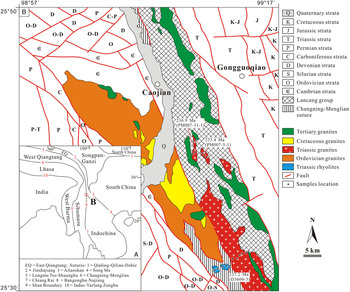
The southeastern Tibetan Plateau comprises a complex assembly of continental blocks, arc terranes, suture zones and accreted continental crust (Zhong, Reference Zhong1998; Metcalfe, Reference Metcalfe2013; Wang et al. Reference Wang, Qian, Cawood, Liu, Feng, Zhao, Zhang, He and Zhang2018). The two major continental masses within the southeastern Tibetan Plateau are the Baoshan and Simao terranes. They collided with each other to form the Changning–Menglian Palaeo-Tethys orogenic belt after the prolonged subduction of the Palaeo-Tethys Ocean. In the southeastern Tibetan Plateau, this is represented by the Changning–Menglian suture (Fig. 1a; Sone & Metcalfe, Reference Sone and Metcalfe2008; Metcalfe, Reference Metcalfe2013; Gardiner et al. Reference Gardiner, Searle, Morley, Whitehouse, Spencer and Robb2016). The Changning–Menglian suture contains ophiolitic mélanges, volcanics, shallow-marine carbonates and deep-sea sedimentary rocks with substantial pelagic cherts. It is unconformably overlain by the Late Triassic molasse formation (Zhong, Reference Zhong1998; Sone & Metcalfe, Reference Sone and Metcalfe2008). Zircons from gabbros in the Shuanggou ophiolitic mélange have been shown to yield U–Pb ages of 376–383 Ma (Jian et al. Reference Jian, Liu, Kröner, Zhang, Wang, Sun and Zhang2009). The Changning–Menglian suture is bordered on the east by the Simao terrane. It is considered to represent the northern continuation of the Indochina terrane of Southeast Asia (Fig. 1a; Sone & Metcalfe, Reference Sone and Metcalfe2008). The Lancang group mainly consists of amphibolite, schist and gneiss of amphibolite facies. It represents the lower continental crust of the Simao block (Zhong, Reference Zhong1998). However, Zhang et al. (Reference Zhang, Cong, Maruyamma and Liou1993) argued that the Lancang group had the characteristics of a subduction mélange. Recently, exposed lenses and blocks of lawsonite-bearing retrograded eclogites in the Lancang group have been reported by Li et al. (Reference Li, Sun, Huang, Xu, Tian, Deng and Zhou2017). Furthermore, Wang et al. (Reference Wang, Qian, Cawood, Liu, Feng, Zhao, Zhang, He and Zhang2018) reported metamorphic zircon U–Pb ages of 245–246 Ma on retrograded eclogites in Mengku, Yunnan Province. The Simao block is characterized by its widespread distribution of Triassic, Jurassic and Cretaceous strata. Furthermore, its Palaeozoic Metasedimentary rocks show similar lithology to those of the South China terrane, with Cathaysia flora and fauna (Zhong, Reference Zhong1998). The Changning–Menglian suture is bordered on the west by the Baoshan terrane, which is part of the northern segment of the Sibumasu continental fragment (Fig. 1a). It has stratigraphic and palaeontological affinities to Gondwana (Feng, Reference Feng2002; Sone & Metcalfe, Reference Sone and Metcalfe2008; Metcalfe, Reference Metcalfe2013). Its stratigraphic system is characterized by a metamorphic basement comprising Proterozoic amphibolite facies, which is overlain by a thick section of largely marine strata deposited from the Cambrian to Triassic (Fig. 1b; Wang & Burchfiel, Reference Wang and Burchfiel1997). In addition, the study area is characterized by widespread Phanerozoic granitic rocks, which were emplaced during four major episodes (the Ordovician, Triassic, Cretaceous and Tertiary). The Ordovician granites are mainly distributed in the northeastern margin of the Baoshan block and intrude the Cambrian strata (Fig. 1b). The major rock types include gneissic two-mica monzogranite and biotite monzogranite. The Triassic batholith has a length of 40 km and a width of 5–10 km and intrudes the Lancang group (Fig. 1b). Its rock type is characterized by coarse-grained and porphyritic-like biotite monzogranite and medium-grained granodiorite. The Triassic Caojian rhyolites represent a small lava flow (<10 km2), unconformably overlying the Changning–Menglian suture. Spatially, these Triassic volcanic and intrusive rocks are usually delimited by the Changning–Menglian suture, without obvious evidence of intrusion and/or eruptive contacts (Fig. 1b). The Cretaceous two-mica monzogranites intrude the Ordovician granites. The Tertiary granites intrude the Lancang group, the Late Triassic granites and the Ordovician granites. They are mainly composed of two-mica granite, muscovite-, tourmaline- and/or garnet-bearing granitic pegmatite.
Simplified geological map of the Caojian granites and rhyolites in the southeastern Tibetan Plateau. The zircon U–Pb ages of the Caojian granites and rhyolites are from Table 1.

2.b. Sample description
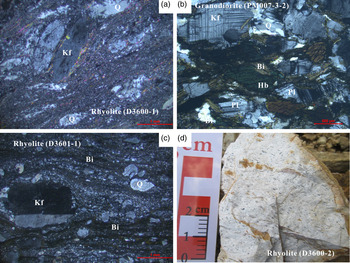
Representative rock types were selected from the Caojian batholith and rhyolites located in southeastern Caojian County. The samples were collected from the freshest outcrops available at each locality. A schematic map detailing all sample locations and associated U–Pb ages is shown in Figure 1b. Lithological classification of the analysed granites and rhyolites was performed based on visual estimations conducted on hand specimens and thin-sections. The granite samples were found to consist mainly of coarse-grained and porphyritic-like biotite monzogranite and medium-grained granodiorite (Fig. 2b). The biotite monzogranites consist mainly of alkali feldspar (20–50 %), plagioclase (25–45 %), quartz (20 %) and biotite (5–20 %). The accessory minerals consist of apatite, zircon, monazite and magnetite. The granodiorites are dominated by alkali feldspar (15–30 %), plagioclase (30–45 %) and quartz (20 %), with biotite (10–15 %) and hornblende (5–10 %) as the mafic components. The main accessory phases are apatite, zircon, sphene and magnetite. The rhyolites are crystal-poor (<30 vol. % crystals) and were found to generally display a porphyritic texture with phenocrysts of plagioclase (5–10 %), quartz (10–15 %) and alkali feldspar (<5 %). The matrix consists mainly of feldspar, quartz and biotite (Fig. 2a, c and d).
Mineral features of the Caojian granites and rhyolites from the southeastern Tibetan Plateau. (a, c, d) The rhyolites generally display a porphyritic texture and are made up of alkali feldspar, plagioclase, quartz and biotite. (b) The medium-grained granodiorite comprises plagioclase, alkali feldspar, quartz, biotite and hornblende. Mineral abbreviations: Kf = alkali feldspar, Pl = plagioclase, Q = quartz, Bi = biotite, Hb = hornblende.

3. Analytical methods
U–Pb analyses of zircon were conducted via laser ablation – inductively coupled plasma –mass spectrometry (LA-ICP-MS) at the Wuhan Sample Solution Analytical Technology Co., Ltd, Wuhan, China. Laser sampling was performed using a GeolasPro laser ablation system that consisted of a COMPexPro 102 ArF excimer laser (wavelength of 193 nm and maximum energy of 200 mJ) and a MicroLas optical system. An Agilent 7700e ICP-MS instrument was used to acquire ion-signal intensities. Helium was applied as a carrier gas. Argon was used as the make-up gas and was mixed with the carrier gas via a T-connector before entering the ICP. The laser spot diameter and frequency were set to 30 μm and 10 Hz, respectively. Zircon 91500 was used as the external standard, zircon GJ-1 was analysed as an unknown to monitor the data quality and silicate glass (NIST 610) was used to optimize the instrument. An Excel-based software package, ICPMSDataCal, was used to perform offline selection and integration of background and analysed signals, time-drift correction and quantitative calibration for trace element analysis and U–Pb dating (Liu et al. Reference Liu, Hu, Gao, Günther, Xu, Gao and Chen2008).
The Hf isotopes were determined using a Neptune multi-collector ICP-MS equipped with a Geolas-193 laser ablation system (LA-MC-ICP-MS) at the Institute of Geology and Geophysics, Chinese Academy of Sciences. The analytical procedures were similar to those described by Griffin et al. (Reference Griffin, Pearson, Belousova, Jackson, van Achterbergh, O’Reilly and Shee2000) and Wu et al. (Reference Wu, Yang, Xie, Yang and Xu2006). During the analyses, a spot size of 50 μm was used, with a laser repetition rate of 8 Hz at 100 mJ. Moreover, the 176Hf/177Hf ratios of the standard zircon (GJ-1) were 0.281998 ±0.000003 (2σ, n = 234), which are similar to the 176Hf/177Hf ratios of 0.282000 ± 0.000005 (2σ), as recommended by Morel et al. (Reference Morel, Nebel, Nebel-Jacobsen, Miller and Vroon2008).
Whole-rock major and trace elements were analysed at the Institute of Geochemistry, Chinese Academy of Sciences. Major elements were determined using an X-ray fluorescence spectrometer (XRF). Analytical uncertainties were 3 % for major elements. Trace element analyses were performed using a Finnigan MAT ELEMENT ICP-MS. Analytical uncertainties were 5 % for trace elements with concentrations ≥20 ppm, and 10 % for those <20 ppm.
The Rb–Sr and Sm–Nd isotopic compositions of the whole-rock powders were determined at the Laboratory for Radiogenic Isotope Geochemistry, University of Science and Technology of China. Approximately 150 mg of sample powder was dissolved in a mixture of HClO4 and HF acid at 120 °C for 7 days. The solution was dried and redissolved in an HCl acid solution. The Rb–Sr and Sm–Nd isotopic ratios were measured on a Finnigan MAT-262 spectrometer. Additionally, the analytical precisions were stated as 2σ standard errors. More details of the analytical technique are provided in Chen et al. (Reference Chen, Li, Wang, Li and Siebel2007).
4. Results
4.a. Zircon U–Pb ages
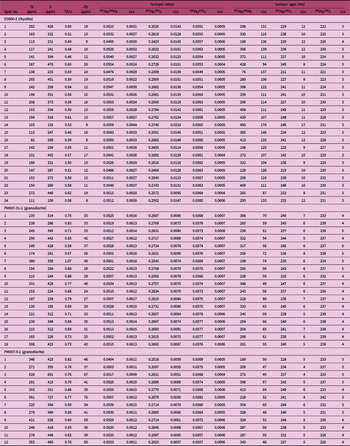
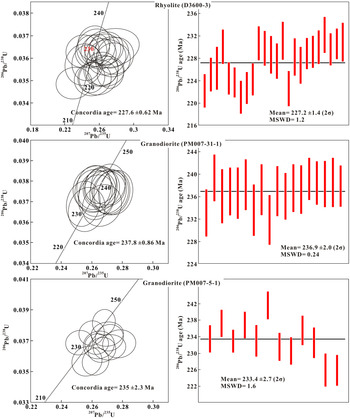
The LA-ICP-MS zircon U–Pb isotope data from the two granodiorite samples and one rhyolite sample are shown in Table 1. For the granodiorite (PM007-31-1), the analysed zircons were mostly euhedral, up to 100–200 μm long and exhibited length-to-width ratios of between 1:1 and 3:1. Oscillatory zoning was found to be common in most crystals. Eighteen zircons were analysed to obtain variable abundances of Th (135–380 ppm) and U (195–442 ppm). The Th/U ratios varied between 0.58 and 1.07. The weighted mean 206Pb/238U age was 236.9 ± 2.0 Ma (Fig. 3; mean standard weighted deviation (MSWD) = 0.24, n = 18, 2σ), which was interpreted as the crystallization age of the granodiorite.
LA-ICP-MS U–Pb zircon data for Caojian granite and rhyolite samples from the southeastern Tibetan Plateau

U–Pb isotopic results of zircons for the Caojian rhyolite and granodiorite samples from the southeastern Tibetan Plateau.

The zircons from granodiorite (PM007-5-1) were mostly euhedral with oscillatory zoning, up to 100–150 μm long, and had length-to-width ratios of between 1:1 and 2:1. Twelve analyses were performed on 12 zircons, showing variable abundances of Th (225–561 ppm) and U (351–727 ppm). The Th/U ratios were also variable and in the range 0.58–0.86. The weighted mean 206Pb/238U age was 233.4 ± 2.7 Ma (Fig. 3; MSWD = 1.6, n = 12, 2σ), which was interpreted to be the crystallization age of the granodiorite.
In the rhyolite (D3600-3), the zircons were mostly euhedral, up to 100–200 μm long and had length-to-width ratios between 1:1 and 3:1. Oscillatory zoning was common in most crystals, and we observed no inherited zircon cores. Twenty-four analyses of 24 zircons were carried out, demonstrating variable abundances of Th (82–287 ppm) and U (193–476 ppm). Furthermore, the Th/U ratios varied between 0.39 and 0.94. The 24 analyses resulted in a weighted mean 206Pb/238U age of 227.2 ± 1.4 Ma (Fig. 3; MSWD = 1.2, n = 24, 2σ), which was interpreted to represent the crystallization age of the rhyolite.
Overall, these zircon U–Pb dating results indicate that the Caojian granites were emplaced around 233–237 Ma, whereas the Caojian rhyolites erupted at 227 Ma.
4.b. Major and trace elemental compositions
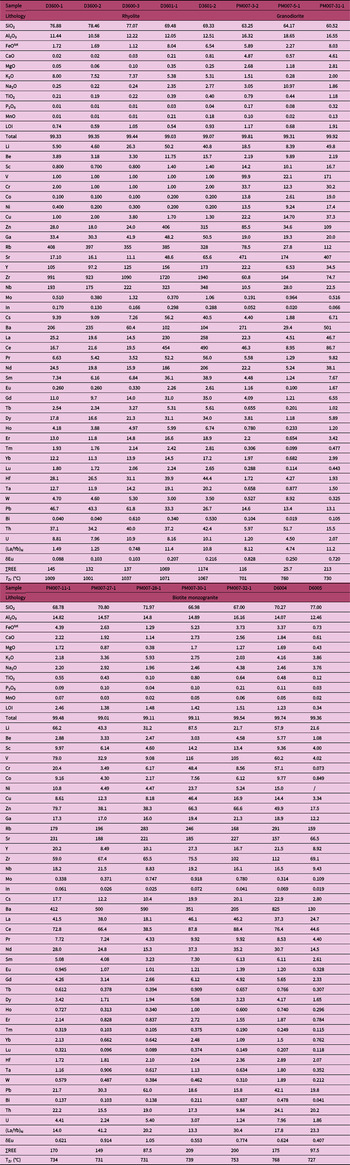
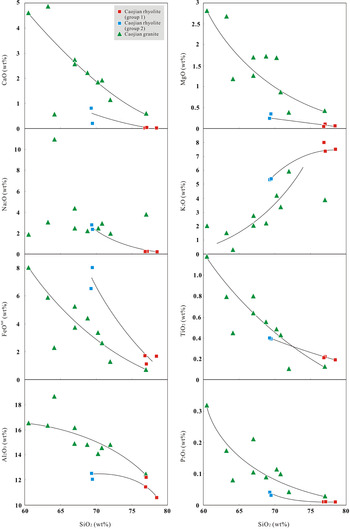
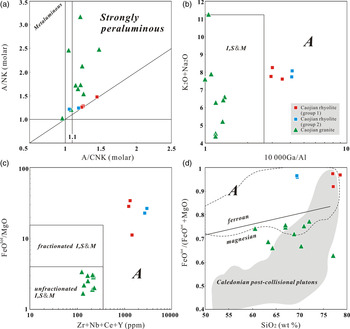
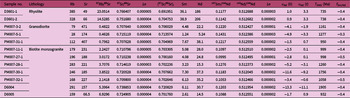
The results of the geochemical analyses are shown in Table 2. The rhyolite samples were divided into two subgroups based on their major and trace element contents, as shown in Fig. 4; Group 1 includes white rhyolite samples whereas Group 2 comprises grey rhyolite samples. Group 1 samples comprised highly siliceous (76.88–78.46 %) rocks with lower TiO2 (0.19–0.22 %), Al2O3 (10.58–12.22 %), FeOtot (1.12%–1.72 %), MgO (0.05%–0.1 %), CaO (0.02–0.03 %), P2O5 (0.01 %) and Na2O (0.22–0.25 %) contents than those of Group 2 but higher K2O (7.37–8 %) contents. Group 2 rhyolites exhibited higher Zr (1720–1940 ppm), Nb (323–348 ppm), Ce (454–490 ppm), Y (156–173 ppm) and Ga (48.2–50.5 ppm) contents than those of Group 1 and the granite samples. In addition, the biotite monzogranite and granodiorite samples exhibited higher and more variable contents of TiO2 (0.10–1.18 %), Al2O3 (12.46–18.65 %), MgO (0.38–2.81 %), P2O5 (0.03–0.32 %) and CaO (0.57–4.87 %) than those of Group 1 but lower SiO2 (60.52–77 %) contents. All the rhyolite and granite samples were peraluminous, as shown in a plot of A/NK versus A/CNK (Fig. 5a), except for sample PM007-5-1 (Fig. 5a), which comprised metaluminous granite. A/NK and A/CNK are defined as the molar ratios of Al2O3/(Na2O + K2O) and Al2O3/(CaO + Na2O + K2O), respectively.
Contents of major (wt %) and trace elements (ppm) for the Caojian granites and rhyolites in the southeastern Tibetan Plateau

Note: LOI = loss on ignition. δEu = EuN/(SmN × GdN)0.5. N stands for chondrite-normalized (Sun & McDonough, Reference Sun, McDonough, Saunders and Norry1989). T Zr (°C) is defined as 12 900/{lnD + 3.80 + [0.85(M − 1)]}, where M is defined as the cation ratio (Na + K + 2Ca)/(Al × Si) and D is the concentration ratio of Zr in zircon (496 000 ppm) to that in the sample (Watson & Harrison, Reference Watson and Harrison1983).
Comparison diagrams of major element compositions for the Caojian granites and rhyolites from the southeastern Tibetan Plateau. In general, as the silica contents increased in the Caojian granites and rhyolites, FeOtot, CaO, MgO, TiO2, Al2O3, P2O5 and Na2O decreased, whereas K2O increased.

(a) A/NK vs A/CNK plot showing the peraluminous nature of the Caojian granites and rhyolites from the southeastern Tibetan Plateau. A = Al2O3, N = Na2O, K = K2O, C = CaO (all in molar proportion). (b) (K2O + Na2O) vs 10 000 Ga/Al classification and (c) FeOtot/MgO vs. (Zr + Nb + Ce + Y) classification diagrams (Whalen et al. Reference Whalen, Currie and Chappell1987), indicating that the Caojian granites are unfractionated I-, S- and M-types. The Caojian rhyolites have A-type geochemical characteristics. FG: Fractionated felsic granites; OGT: unfractionated M-, I- and S-type granites. (d) FeOtot/(FeOtot + MgO) vs SiO2 diagram (Frost et al. Reference Frost, Barnes, Collins, Arculus, Ellis and Frost2001), indicating that the Caojian granites are magnesian granitoids and are similar to the Caledonian post-collisional plutons. The rhyolite samples plot in the fields of A-type granite.

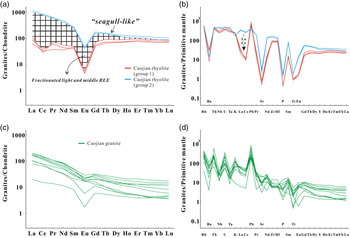
The chondrite-normalized rare earth element (REE) patterns and primitive mantle-normalized trace element spidergrams are shown in Figure 6. The chondrite-normalized REE patterns of Group 1 were characterized by nearly flat REE patterns ([La/Yb]N = 0.748–1.49). They showed pronounced Eu negative anomalies (δEu = 0.1) and a slight depletion of Ce (Fig. 6a). Group 2 displayed ‘seagull’ patterns with fractionated light REEs ([La/Yb]N = 10.8–11.4), deep negative Eu anomalies (δEu = 0.2) and relatively flat but enriched heavy REEs (Fig. 6a). Furthermore, granite samples showed variable enrichment of light REEs ([La/Yb]N = 4.74–41.2) and weak to moderate Eu negative anomalies (δEu = 0.3–1.1; Fig. 6c). In addition, Group 2 exhibited higher total REE concentrations (between 1069 and 1174 ppm) than those of Group 1 and the granite samples. Moreover, the spidergrams of granite samples showed characteristic negative anomalies for Ba, Nb, Ta, Sr, P and Ti, and a positive anomaly for Pb (Fig. 6d). However, Groups 1 and 2 showed more variation in spidergrams than the granite samples. These variations were characterized by pronounced Ba, La, Ce, Sr, P and Ti negative anomalies for Group 1 (Fig. 6b), and pronounced Ba, Sr, P and Ti negative anomalies for Group 2 (Fig. 6b). Zircon saturation thermometry (Watson & Harrison, Reference Watson and Harrison1983) was applied to estimate the temperatures of the granitic melts. The rhyolites exhibited higher temperatures (T Zr = 1001–1071 °C) than the granites (T Zr = 701–768 °C).
Chondrite-normalized REE and primitive-mantle-normalized trace element patterns of the Caojian granites and rhyolites from the southeastern Tibetan Plateau. Chondrite and primitive mantle values are from Sun & McDonough (Reference Sun, McDonough, Saunders and Norry1989).

4.c. Sr–Nd–Hf isotope data
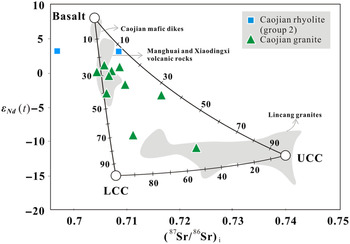
The Sr isotopic data for the white rhyolites (Group 1) have limited applicability because these samples exhibited high Rb/Sr ratios (24–25). This resulted in imprecise initial 87Sr/86Sr ratio calculations. The results of the Sr–Nd isotopic analyses are shown in Table 3 and Fig. 7. The Caojian granites displayed variable initial 87Sr/86Sr ratios (0.700160–0.720829) and 143Nd/144Nd ratios (0.511954–0.512559). The ϵ Nd (t = 235 Ma) values mainly ranged from –11.1 to +0.9, corresponding to T DM2 (two-stage model) ages of 932–1905 Ma. Most of the Caojian granites differed from the Lincang granites in their Sr–Nd isotopic composition. The Caojian grey rhyolites (Group 2) showed lower initial 87Sr/86Sr ratios (0.691951–0.704753) and positive ϵ Nd (t = 227 Ma) values (+3.3).
Sr–Nd isotopic compositions of Caojian granites and rhyolites in the southeastern Tibetan Plateau

Note: ϵ Nd (t) = 10 000 × {[(143Nd/144Nd)S – (147Sm/144Nd)S × (eλt – 1)]/[(143Nd/144Nd)CHUR,0 – (147Sm/144Nd)CHUR × (eλt –1)] – 1}.
T DM = 1/λ × ln{1 + [(143Nd/144Nd)S – (143Nd/144Nd)DM]/[(147Sm/144Nd)S – (147Sm/144Nd)DM]}.
T DM2 = T DM – (T DM–t) × (f CC – f S)/(f CC – f DM). f S = (147Sm/144Nd)S/(147Sm/144Nd)CHUR – 1.
f CC = (147Sm/144Nd)crust/(147Sm/144Nd)CHUR – 1.
f DM = (147Sm/144Nd)DM/(147Sm/144Nd)CHUR – 1.
(147Sm/144Nd)CHUR = 0.1967, (143Nd/144Nd)CHUR,0 = 0.512638.
(147Sm/144Nd)DM = 0.2137, (143Nd/144Nd)DM = 0.51315, (147Sm/144Nd)crust = 0.118.
(87Sr/86Sr)i = 87Sr/86Sr – (87Rb/86Sr) × (eλt –1).
λSm-Nd = 0.00654 Ga−1. λRb-Sr = 0.0142 Ga−1. t = 235 Ma for Caojian granites. t = 227 Ma for Caojian rhyolites. s = sample.
The formulas and parameters are based on literature of Wu et al. (Reference Wu, Jahn, Wilde and Sun2000).
87Rb/86Sr and 147Sm/144Nd ratios were calculated using Rb, Sr, Sm and Nd contents analysed by ICP-MS.
ϵ Nd(t) vs 87Sr/86Sr isotopic ratio plot of the Caojian granites and rhyolites from the southeastern Tibetan Plateau showing mixing proportions between the three end members of ‘Basalt’, ‘LCC’ and ‘UCC’. The parameters (after Wu et al. Reference Wu, Jahn, Wilde, Lo, Yui, Lin, Ge and Sun2003) used are ϵ Nd = +8, 87Sr/86Sr = 0.704 for ‘Basalt’; ϵ Nd = –15, 87Sr/86Sr = 0.708 for ‘LCC’; and ϵ Nd = –12, 87Sr/86Sr = 0.74 for ‘UCC’. Basalt: depleted mantle or juvenile components; LCC: lower continental crust; UCC: upper continental crust. Data sources – Caojian mafic dikes: Liao et al. (Reference Liao, Yin, Sun, Wang, Tang and Sun2013); Manghuai and Xiaodingxi volcanic rocks: Peng et al. (Reference Peng, Wang, Fan, Liu, Shi and Miao2006), Wang et al. (Reference Wang, Zhang, Fan, Peng, Zhang, Zhang and Bi2010); and (3) Lincang granites: Deng et al. (Reference Deng, Wang, Zi, Xia and Li2018), Cong et al. (Reference Cong, Wu, Li, Mou, Huang, Wang, Hu and Peng2020 a).

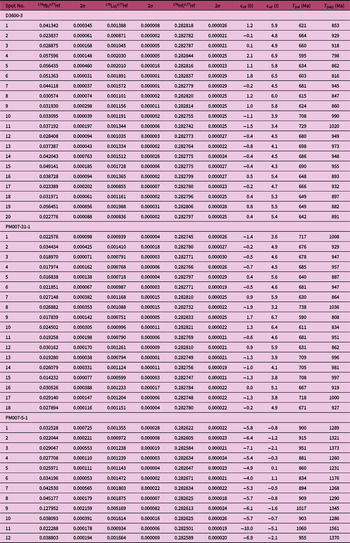
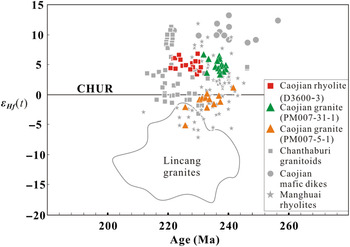
The in situ Hf isotope data of the magmatic zircons from rocks that had previously been analysed for U–Pb dating are shown in Table 4. The 20 analyses of rhyolite (D3600-3) demonstrated 176Hf/177Hf values of 0.282742 ± 0.000025 (2σ) to 0.282844 ± 0.000025 (2σ). Meanwhile, the zircon ϵ Hf(t) values, when calculated back to their U–Pb ages, ranged from +3.4 to +6.9 (Fig. 8), corresponding to T DM2 ages of 798–1020 Ma. A further 18 spot analyses were conducted for granodiorite (PM007-31-1). The measured 176Hf/177Hf values ranged from 0.282732 ± 0.000022 (2σ) to 0.282833 ± 0.000025 (2σ). The zircon ϵ Hf(t) values ranged from +3.2 to +6.7 (Fig. 8), corresponding to T DM2 ages of 808–1036 Ma. For the granodiorite (PM007-5-1), 12 analyses were conducted, showing 176Hf/177Hf values ranging from 0.282501 ± 0.000019 (2σ) to 0.282671 ± 0.000021 (2σ). Moreover, the zircon ϵ Hf(t) values from this sample ranged from –5.1 to +1.1 (Fig. 8), corresponding to T DM2 ages of 1176–1561 Ma.
Hf isotope composition of zircons for the Caojian granites and rhyolites in the southeastern Tibetan Plateau

Note: ϵ Hf (t) = 10000 × {[(176Hf/177Hf)S – (176Lu/177Hf)S × (eλt – 1)]/[(176Hf/177Hf)CHUR,0 – (176Lu/177Hf)CHUR × (eλt – 1)]–1}.
T DM = 1/λ × ln{1 + [(176Hf/177Hf)S – (176Hf/177Hf)DM]/[(176Lu/177Hf)S – (176Lu/177Hf)DM]}.
T DM2 = T DM – (T DM – t) × (f CC – f S)/(f CC – f DM).
f S = (176Lu/177Hf)S/(176Lu/177Hf)CHUR – 1.
f CC = (176Lu/177Hf)mean crust/(176Lu/177Hf)CHUR – 1.
f DM = (176Lu/177Hf)DM/(176Lu/177Hf)CHUR – 1.
λ = 1.867 × 10⁻¹¹/a (Soderlund et al. Reference Söderlund, Patchett, Vervoort and Isachsen2004). t = crystallization age of zircon. s = sample.
(176Lu/177Hf)CHUR = 0.0336, (176Hf/177Hf)CHUR,0 = 0.282785 (Bouvier et al. Reference Bouvier, Vervoort and Patchett2008).
(176Lu/177Hf)DM = 0.0384, (176Hf/177Hf)DM = 0.28325 (Griffin et al. Reference Griffin, Pearson, Belousova, Jackson, van Achterbergh, O’Reilly and Shee2000).
(176Lu/177Hf)mean crust = 0.015 (Griffin et al. Reference Griffin, Wang, Jackson, Pearson, O’Reilly, Xu and Zhou2002).
Zircon ϵ Hf(t) from the Caojian granites and rhyolites (this study), Lincang granites (after Kong et al. Reference Kong, Dong, Mo, Zhao, Zhu, Wang, Li and Wang2012; Nie et al. Reference Nie, Dong, Mo, Zhu, Dong and Wang2012; Dong et al. Reference Dong, Mo, Zhao, Zhu, Goodman, Kong and Wang2013; Wang et al. Reference Wang, Deng, Santosh, Lu, McCuaig, Carranza and Wang2015; Zhao et al. Reference Zhao, Li, Zhang, Wang, Sun and Tang2018; Cong et al. Reference Cong, Wu, Li, Mou, Huang, Wang, Hu and Peng2020 a, b), Manghuai rhyolites (after Wei et al. Reference Wei, Qi, Chang, Ji and Zhang2016; Cong et al. Reference Cong, Wu, Li, Mou, Huang, Wang, Hu and Peng2020 a), Caojian mafic dikes (after Liao et al. Reference Liao, Yin, Sun, Wang, Tang and Sun2013) and Chanthaburi granites (after Wang et al. Reference Wang, He, Cawood, Srithai, Feng, Fan, Zhang and Qian2016), plotted against the crystallization ages of the zircons.

5. Discussion
5.a. Emplacement time of the granites and rhyolites
The Triassic Lincang granites make up the largest peraluminous granitic batholith in the Changning–Menglian Palaeo-Tethys orogenic belt. The 233–237 Ma span of the two new U–Pb zircon ages from the Caojian granite presented here are consistent with the 211–239 Ma age range typical of the Lincang granitoids (Peng et al. Reference Peng, Wang, Fan, Liu, Shi and Miao2006, Reference Peng, Wilde, Wang, Fan and Peng2013; Hennig et al. Reference Hennig, Lehmann, Frei, Belyatsky, Zhao, Cabral, Zeng, Zhou and Schmidt2009; Kong et al. Reference Kong, Dong, Mo, Zhao, Zhu, Wang, Li and Wang2012; Nie et al. Reference Nie, Dong, Mo, Zhu, Dong and Wang2012; Dong et al. Reference Dong, Mo, Zhao, Zhu, Goodman, Kong and Wang2013; Wang et al. Reference Wang, Liu, Liu, Shi and Cai2014; Cong et al. Reference Cong, Wu, Li, Mou, Huang, Wang, Hu and Peng2020 a). Therefore, the Caojian granites were interpreted to form part of the northern extension of the Lincang batholith, such that these ages provide a firm constraint on the extension of this belt. To the east, the Lincang batholith is paralleled by the associated Manghuai and Xiaodingxi volcanic rocks (Zhong, Reference Zhong1998). Previous geochronological studies suggest that the Manghuai rhyolites were emplaced at 229–239 Ma (Peng et al. Reference Peng, Wang, Fan, Liu, Shi and Miao2006, Reference Peng, Wilde, Wang, Fan and Peng2013; Wang et al. Reference Wang, Zhang, Fan, Peng, Zhang, Zhang and Bi2010; Wei et al. Reference Wei, Qi, Chang, Ji and Zhang2016; Cong et al. Reference Cong, Wu, Li, Mou, Huang, Wang, Hu and Peng2020 a). The geochronological studies presented here suggest that the Caojian rhyolites erupted at 227 Ma. Therefore, the Caojian rhyolites exhibit similar ages to the Manghuai rhyolites. Thus, temporal kinship exists between the Triassic Caojian granites and rhyolites in the Changning–Menglian Palaeo-Tethys orogenic belt. They make up volcanic-intrusive complexes and extend southward to the Lincang batholith.
5.b. Genetic type: A- and I-type granite
Granitic rocks have commonly been divided into I-, S-, M- and A-types according to their geochemical compositions and formation settings (Pitcher, Reference Pitcher and Hsu1982). A-type granites are typically high in Ga, Zn, Zr, Nb and Y, and low in Ba and Sr (Collins et al. Reference Collins, Beams, White and Chappell1982; Whalen et al. Reference Whalen, Currie and Chappell1987). The Caojian rhyolites exhibited all the features common to A-type granites in terms of their trace element geochemistry. In the spidergrams (Fig. 6b), all the rhyolites showed characteristic negative anomalies in Ba, Sr, P, Ti and Eu. The 10 000 Ga/Al ratios in these rocks were 2.9–4.1 (Fig. 5b), with an average value of 3.5. These values are similar to the global average of 3.75 for A-type granites (Whalen et al. Reference Whalen, Currie and Chappell1987). Furthermore, the Caojian rhyolites exhibited high Zr + Nb + Ce + Y contents (Fig. 5c) and FeOtot/(FeOtot + MgO) ratios (Fig. 5d). This demonstrates A-type granite characteristics. Moreover, the white rhyolites (Group 1) were highly siliceous (>76 wt %), with very low TiO2, Al2O3, FeOtot, MgO, CaO, P2O5 and Na2O contents (Fig. 4) and strong light and middle REE depletion (Fig. 6a), compared to those of Group 2. This indicates that fractionation occurred in the generation of these white rhyolites. Generally, the variations in REEs were mainly achieved through the fractionation of apatite, monazite and allanite (Wu et al. Reference Wu, Jahn, Wilde, Lo, Yui, Lin, Ge and Sun2003). Thus, the lower (La/Yb)N ratios (0.748–1.49) of the white rhyolites simply indicate that there may have been monazite, allanite and apatite fractional crystallization in the magma system. The low total REEs (132–145 ppm) and P2O5 (0.01 %) contents of the white rhyolites further support this observation.
Geochemically, the Caojian granites in this study were characterized by low ratios of FeOtot/MgO (1.7–3.4), indicating unfractionated features (Fig. 5c). Harker diagrams (Fig. 4) show that the MgO, CaO, FeOtot, TiO2, Al2O3 and P2O5 contents had decreasing trends as SiO2 increased. Mineralogically, Caojian granite samples PM007-3-2 and PM007-31-1 contained diagnostic I-type minerals, such as hornblende (Fig. 2b). Thus, the Caojian granites present I-type affinity.
As shown in Figure 7, the Caojian rhyolites and granites exhibited chondritic ϵ Nd(t) values, suggesting that they were derived through the fractionation of mafic parental magma, or through the partial melting of a crustal source with similar ϵ Nd(t) values. The Caojian granites are characterized by low FeOtot/MgO ratios (1.7–3.4). Therefore, these unfractionated geochemical features eliminate the possibility of differentiation and crystallization of mantle-derived magmas. Figure 7 shows that two end members of mantle-derived basaltic magma and the lower crustal component (LCC) mixed during the generation of these granitoids, and that the upper crustal component (UCC) had a minor role in their generation. However, the biotite monzogranite samples (PM007-30-1 and D6004) that exhibited negative ϵ Nd(t) values (–11.1 to –9.2) were probably due to source inheritance and mixing of the three end members of LCC, UCC and basaltic magma in the generation of these granitoids. In addition, the Caojian rhyolites and granites in this study mainly showed positive and chondritic ϵ Hf(t) values (Fig. 8). The positive ϵ Hf(t) values suggest that there was a high proportion of mantle-derived material in the melt that formed these granitoids.
5.c. Rejuvenation of crystal mush model
Several processes can contribute to the generation of A-type granites, including partial melting, fractional crystallization, metasomatism, liquid immiscibility, crustal contamination, halide complexing and thermo-gravitational diffusion (see Clemens et al. Reference Clemens, Holloway and White1986 and references therein). Any theory of the petrogenesis of A-type granites needs to explain whether A-type granites are characterized by being particularly high in LILEs and HFSEs, but low in Sc, V, Cr, Co, Ni, Ba, Sr and Eu, compared to other granite types. A high melting temperature in the generation of A-type granites suggests that extensive fractional crystallization from mantle-derived intermediate and mafic magma is unlikely (Clemens et al. Reference Clemens, Holloway and White1986; King et al. Reference King, White, Chappell and Allen1997). It has also been proposed that A-type granites originate from the partial melting of F- and/or Cl-enriched dry, granulitic residue from which a granitoid melt was previously extracted (Collins et al. Reference Collins, Beams, White and Chappell1982; Clemens et al. Reference Clemens, Holloway and White1986). However, this residual model cannot explain the geochemical characteristics, particularly the high LILEs, in A-type granites (Creaser et al. Reference Creaser, Price and Wormald1991). Isotopic research has shown that the original magmas of some A-type granites are of mantle origin (Eby, Reference Eby1990, Reference Eby1992; Foland & Allen, Reference Foland and Allen1991; Turner et al. Reference Turner, Foden and Morrison1992). The fact that the Caojian A-type rhyolites exhibited depleted Nd–Hf isotopic characteristics, like most of the Caojian I-type granites (Figs. 7, 8), indicates that these rocks were derived from the same source within juvenile crust. Therefore, the parental magma of the Caojian rhyolites and granites was likely derived from the direct partial melting of a mixed source of mantle-derived basaltic magma and lower crustal rocks. Buoyant silicic magmas then rose from their deep source regions into the upper crust. Many lines of evidence suggest that magma reservoirs exist as high-crystallinity (‘crystal mush’) bodies in the upper crust (Lipman & Bachmann, Reference Lipman and Bachmann2015; Bachmann & Huber, Reference Bachmann and Huber2016). A crystal mush reservoir comprises a porous and permeable framework of closely packed crystals with melt present in the pore space. The pre-existing crystal mush reservoir could then be reheated from below by a fresh magma intrusion (Jackson et al. Reference Jackson, Blundy and Sparks2018). The rejuvenation of the mush by the new intrusion causes the dismantlement of the crystal framework, which frees the mush to form a mobile, more melt-rich layer (Burgisser & Bergantz, Reference Burgisser and Bergantz2011). Underlying mafic magma may have evolved H2O–F–S–Cl-rich fluids that contributed to fluxed melting in the overlying crystal mush, following the eruptions of intermediate to silicic volcanoes (Bachmann et al. Reference Bachmann, Dungan and Lipman2002). In this scenario, intermediate to silicic volcanics that have been expelled from a crystal mush will have a higher temperature and more volatile-rich signature (Bachmann & Bergantz, Reference Bachmann and Bergantz2006; Cashman et al. Reference Cashman, Sparks and Blundy2017) than granitoids, which will show a complementary record of cumulates (Miller & Miller, Reference Miller and Miller2002; Bachmann et al. Reference Bachmann, Miller and de Silva2007).
A potential geochemical test for this crystal mush model would be to compare the compositions of Caojian A-type rhyolites with I-type granites. Chemically, the Caojian A-type rhyolites were enriched in incompatible trace elements, including LILEs and HFSEs. They had lower Sc, V, Cr, Co, Ni, Ba, Sr and Eu trace element contents than the Caojian I-type granites. Perhaps the most diagnostic feature of A-type granites is their high Ga/A1 ratios. An-rich plagioclase cumulates in crystal mush reservoirs could lead to melts with high Ga/Al ratios, because Ga is preferentially excluded from the anorthite structure, relative to Al (Goodman, Reference Goodman1972). Such variations would suggest plagioclase accumulation, which was supported by the marked negative Eu anomalies observed in the Caojian rhyolites. Furthermore, the Caojian granites exhibited higher Sr (66.5–471 ppm) and Ba (29.4–825 ppm) concentrations, whereas the Caojian rhyolites showed significantly lower Sr (11.1–65.6 ppm) and Ba (60.4–235 ppm) concentrations. This can be explained by the accumulation of alkali-feldspar and/or plagioclase (Chappell & Wyborn, Reference Chappell and Wyborn2004). Recently, mantle-generated mafic input has been proposed to rejuvenate and prolong the lifespan of upper-crustal crystal mush. This could explain the complex petrogeochemistry of large volcanic-intrusive complexes (Bachmann & Bergantz, Reference Bachmann and Bergantz2004; de Silva & Gosnold, Reference de Silva and Gosnold2007; Huber et al. Reference Huber, Bachmann and Dufek2012; Lipman & Bachmann, Reference Lipman and Bachmann2015). Geologically, the Triassic Caojian mafic dikes are major components in the study area (Liao et al. Reference Liao, Yin, Sun, Wang, Tang and Sun2013). This provides direct evidence for recurrent open-system mafic recharge. Rising basaltic melts would mix efficiently with a crystal mush zone, thereby increasing the temperature and melt proportion of the mush body. Underlying mafic magma may have evolved F–Cl-rich fluids that fluxed melting in the overlying crystal mush. This speculation is supported by the chemical and mineralogical research on A-type granites, indicating F and Cl could have been present in exceedingly high concentrations in the magmas (Collins et al. Reference Collins, Beams, White and Chappell1982). This mafic recharge process can explain the observed elevated temperatures of the Caojian rhyolites (T Zr = 1001–1071 °C). Under these higher temperature conditions, the solubility of accessory phases such as zircon and apatite may have been high, and the solubility of zircon could have been enhanced by the high alkalinity of A-type granite magmas, thus contributing substantial HFSEs to the melt (Watson & Harrison, Reference Watson and Harrison1983). The other HFSEs that were relatively abundant in the A-type granites could also have partition coefficients that, like Zr, are dependent on temperature. In general, most A-type granites are generated late in the magmatic or orogenic cycle of any crustal province, after the production of other granite types (Creaser et al. Reference Creaser, Price and Wormald1991). Derivation of primary A-type magmas by rejuvenation of crystal mush could explain why these magmas are commonly developed late or last in the magmatic sequence. Furthermore, due to their relatively elevated temperatures, A-type melts have low viscosities (Clemens et al. Reference Clemens, Holloway and White1986). This allows them to rise rapidly from the crystal mush to the volcanic level. The fractional crystallization stages probably occurred during magma ascent. Therefore, the derivation of the A-type rhyolites from rejuvenated crystal mush represents a favourable interpretation, possibly followed by some differentiation to form the more evolved varieties.
5.d. Magmatic evolution
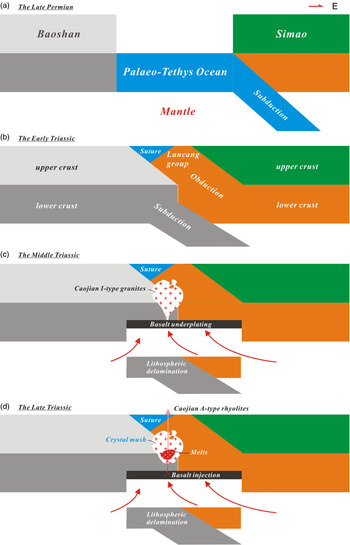
A-type granites can be formed in post-collision, post-orogenic and anorogenic settings (Whalen et al. Reference Whalen, Currie and Chappell1987, Reference Whalen, Jenner, Longstaffe, Robert and Gariepy1996; Sylvester, Reference Sylvester1989; Eby, Reference Eby1992; Bonin et al. Reference Bonin, Azzouni-Sekkal, Bussy and Ferrag1998). However, it is difficult to distinguish these kinds of A-type granites, as they do not have distinctive petrological, mineralogical or geochemical features (Sylvester, Reference Sylvester1989; Turner et al. Reference Turner, Foden and Morrison1992; Bonin et al. Reference Bonin, Azzouni-Sekkal, Bussy and Ferrag1998). The following lines of evidence indicate that the Indochina and Sibumasu blocks collided in the Early Triassic. (1) Early Triassic deposition is commonly absent and the pre-Triassic strata are unconformably overlain by the Middle Triassic Shanglan formation in the Changning–Menglian Palaeo-Tethys orogenic belt (YBGMR, 1990; Zhong, Reference Zhong1998). (2) Records of Early Triassic ultra-high-pressure metamorphism have been recognized in the Changning–Menglian suture zone (Zhang et al. Reference Zhang, Cong, Maruyamma and Liou1993; Wang et al. Reference Wang, Qian, Cawood, Liu, Feng, Zhao, Zhang, He and Zhang2018). (3) There are noted geochemical changes in volcanics, from intermediate in the Permian to felsic in the Middle–Late Triassic, in East Malaysia (Metcalfe, Reference Metcalfe2013). Moreover, the Caojian granites exhibited low FeOtot/(FeOtot + MgO) ratios, like those of the Caledonian post-collisional plutons (Fig. 5d). Therefore, post-collisional extension is the most feasible mechanism for the generation of Middle to Late Triassic magmatism in the Changning–Menglian Palaeo-Tethys orogenic belt, after the final closure of the Palaeo-Tethys Ocean. Thus, the Middle to Late Triassic Caojian rhyolites and associated granites were post-collision with respect to the Changning–Menglian Palaeo-Tethys orogenic belt. Most of the post-collisional magmatism has been well described, such as the Lincang batholith (Peng et al. Reference Peng, Wang, Fan, Liu, Shi and Miao2006, Reference Peng, Wilde, Wang, Fan and Peng2013; Hennig et al. Reference Hennig, Lehmann, Frei, Belyatsky, Zhao, Cabral, Zeng, Zhou and Schmidt2009; Catlos et al. Reference Catlos, Reyes, Brookfield and Stockli2017; Cong et al. Reference Cong, Wu, Li, Mou, Huang, Wang, Hu and Peng2020 a), the Manghuai A-type rhyolites (Peng et al. Reference Peng, Wilde, Wang, Fan and Peng2013) and the Xiaodingxi basalts (Wang et al. Reference Wang, Zhang, Fan, Peng, Zhang, Zhang and Bi2010). As mentioned above, experimental and geochemical investigations indicate that the generation of A-type granites requires a high melting temperature (Clemens et al. Reference Clemens, Holloway and White1986; King et al. Reference King, White, Chappell and Allen1997). This can be realized by the emplacement of mantle-derived mafic magma, or by upwelling of the asthenosphere. The delamination of thickened lithosphere might have achieved this process, with mantle lithosphere being convectively removed from below (Whalen et al. Reference Whalen, Jenner, Longstaffe, Robert and Gariepy1996). The orogenic process and crustal growth of the Changning–Menglian Palaeo-Tethys orogenic belt in the southeastern Tibetan Plateau was found to be typically episodic. It comprised four stages during the Late Permian to Late Triassic. First, the Palaeo-Tethys was subducted beneath the Indochina block in the Late Permian (Fig. 9a). Second, the Indochina and Sibumasu blocks collided in the Early Triassic to form the Palaeo-Tethys orogen. The lower crust of the Simao block was obducted onto the Baoshan block and the lower crust of the Baoshan block was subducted beneath the Simao block (Fig. 9b). Third, lithospheric delamination of the Palaeo-Tethys orogen occurred in the Middle to Late Triassic because the high density of the thickened lower crust caused it to become gravitationally unstable. The mafic magma formed by mantle upwelling would therefore have risen into the lower crust, where it would have further induced large-scale crustal melting and Caojian I-type granitic magma formation in the Middle Triassic (Fig. 9c). Buoyant granitic magmas would then have risen from their deep source regions into the upper crust, where they would have maintained a mush state. Finally, the crystal mush reservoirs were periodically rejuvenated by volatile-rich basalts. Such processes would permit assembly of a melt-rich zone at the core of the mush body, then cause the Caojian rhyolitic melt to move upward, and finally erupt in the Late Triassic (Fig. 9d).
Lithospheric delamination and rejuvenation of crystal mush models of the Changning–Menglian Palaeo-Tethys orogenic belt in the southeastern Tibetan Plateau. (a) The Palaeo-Tethys subduction beneath the Simao block in the Late Permian. (b) Collision of the Baoshan and Simao blocks in the Early Triassic to form the Palaeo-Tethys orogen. (c) Lithospheric delamination of Palaeo-Tethys orogen and Caojian I-type granitic magma formation in the Middle Triassic. (d) The crystal mush reservoirs were rejuvenated by volatile-rich basalts, then caused the Caojian rhyolite eruption in the Late Triassic.

6. Conclusions
The Mid- to Late Triassic Caojian rhyolites and granites are spatially and temporally related in the Changning–Menglian Palaeo-Tethys orogenic belt. However, these volcanic and intrusive rocks have significant geochemical differences. The geochemically analysed characteristics indicate that rhyolites and granites exhibit A- and I-type affinity, respectively. We propose that the petrogenesis of the Triassic Caojian rhyolites is characterized by rejuvenation of crystal mush represented at the surface by the Triassic Caojian granites. The necessary thermal input was supplied by volatile-rich mafic magma. This magmatic evolution was likely related to lithospheric delamination and the upwelling of the asthenosphere during the Mid- to Late Triassic, thus forming post-collisional A-type volcanics and I-type granites in the Changning–Menglian Palaeo-Tethys orogenic belt.
Acknowledgements
This study was supported by the National Nature Science Foundation of China (project No. 41888101 and 92055314). Yue-Heng Yang, Ping Xiao and Lei Xu are gratefully thanked for instrument analyses.