Introduction
Psychiatry and clinical psychology are the two dominant professions within the mental health field. Although they share a mission of understanding and treating mental illness, they differ in professional training, clinical activities and numerous other respects. Researchers have documented points of difference, and sometimes conflict and rivalry, in such matters as professional roles (Schindler et al. Reference Schindler, Berren and Beigel1981), practice characteristics (Pingitore et al. Reference Pingitore, Scheffler, Sentell and West2002), and beliefs about the nature, etiology and treatment of mental health problems (Wyatt & Livson, Reference Wyatt and Livson1994).
One difference between psychiatry and clinical psychology that has received little attention involves scientific research and publication. Although researchers with psychiatry and psychology backgrounds frequently collaborate and publish together, the journals in which they do so remain largely segregated by discipline. Publication databases tend to locate psychiatry journals in the broad Science category, whereas clinical psychology journals tend to be located in Social Science. Although journals in both fields are numerous and well-established, the relationships between them have not been examined systematically. Little is known, for example, about the nature of subareas within the mental health domain or the affinities among these subareas. Similarly, little is known about the degree and direction of influence between psychiatry and clinical psychology journals. The extent to which journals in each set cite research published in their own discipline rather than in the other remains to be determined, as does any tendency for one discipline to serve primarily as a consumer of the other's knowledge rather than a supplier of knowledge to it.
Questions of this sort are often answered using bibliometric analyses of journal citations. Such analyses allow relationships among journals and research fields to be mapped and visualized, often on a very large scale (e.g. Boyack et al. Reference Boyack, Klavans and Borner2005). In addition to representing the closeness of research areas in spatial terms, these analyses can also represent the dynamics of information flow between them. Patterns of citation are frequently asymmetric, and these imbalances imply differences in scientific influence. A journal that receives more citations from a source than it sends to it is likely to be a knowledge supplier, whereas one that cites other journals more than it is cited by them is a knowledge consumer, disseminating ideas and findings generated by suppliers. In principle, hierarchies of scientific influence among research fields can be inferred by examining patterns of citation asymmetries.
There have been few studies of citation patterns within psychiatry, and these have focused on specific disorders or clinical practices (e.g. Clement et al. Reference Clement, Singh and Burns2003; López-Muñoz et al. Reference López-Muñoz, Alamo, Quintero-Gutiérrez and García-García2008a, Reference López-Muñoz, García-García, Saiz-Ruiz, Mezzich, Rubio, Vieta and Alamob; Theander & Wetterberg, Reference Theander and Wetterberg2010) rather than attempting to map the field as a whole. Citation analyses have been more widespread in psychology, where researchers have examined the organization of knowledge across key journals or subdisciplines (Pinski & Narin, Reference Pinski and Narin1979; Yang & Chiu, Reference Yang and Chiu2009). Studies such as these have documented the relationships among psychology journals and research fields across the entire discipline, and how these have changed over time. However, no studies have focused specifically on clinical psychology and none have crossed the disciplinary boundary by examining its journals alongside psychiatry journals, with the partial exception of a very early study (Cason & Lubotsky, Reference Cason and Lubotsky1936), which examined citation patterns among 20 journals across psychology and eight journals in physiology, psychiatry or psychoanalysis.
The only relevant recent study was carried out by Boyack et al. (Reference Boyack, Klavans and Borner2005), who examined psychiatry and clinical psychology journals as two among 212 clusters of 7000 journals across the natural and social sciences. They found that psychiatry journals tended to be more insular than clinical psychology journals (i.e. less likely to cite outside their field) and tended to be cited more by clinical psychology journals than the reverse, implying that knowledge and influence tended to flow from psychiatry to clinical psychology. However, this analysis treated psychiatry and clinical psychology as monolithic and did not allow a more fine-grained analysis of their research domains.
The present study examined the structure of scientific research in mental health by investigating the flow of influence between journals in the broad fields of psychiatry and clinical psychology, the flow of influence among their specialized subfields, and the extent to which these citation networks are organized by the disciplinary distinction between psychiatry and clinical psychology. A dataset of all articles published in a single year by a large sample of the most prominent journals in both fields was assembled for that purpose.
Method
Sample
A large sample of prominent journals from the disciplines of psychiatry and clinical psychology was drawn from the Thomson Institute for Scientific Information (ISI) Journal Citation Reports (JCR) database. The 2008 Science edition of JCR lists 101 journals under ‘Psychiatry’ and the 2008 Social Science edition lists 88 under ‘Psychology, Clinical’. The two lists have modest overlap. The 50 highest ranked journals from each list were selected based on their 2008 impact factor (IF). Three selected journals appeared in both samples and one psychiatry journal with no recorded publications in 2008 was excluded, leaving 96 unique journals. Five journals appearing in the clinical psychology top-50 also appeared in the psychiatry journal list but outside its top-50. Thus, the final journal sample (see Appendix) contained 46 journals that appeared only on the Psychiatry list, 42 that appeared only on the Clinical Psychology list, and eight that appeared on both (i.e. a Mixed journal set).
Data collection
The JCR database was used to record the number of times articles published in 2008 in each of the 96 journals cited articles published in each of the 96 journals. For example, a value of 10 would indicate that when the references cited by one journal's 2008 articles are combined, 10 of these citations are articles from a particular journal. The former journal is the ‘citing’ journal and the latter is the ‘cited’ journal. This exercise yielded a 96×96 matrix of citing and cited journals that was asymmetric: columns represent the propensity of a journal to cite other journals and rows represent the propensity of a journal to be cited by other journals. JCR only reports cited journals that were cited two or more times, so journals cited a single time in a year are not recorded.
Results
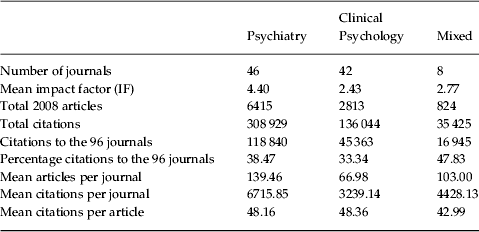
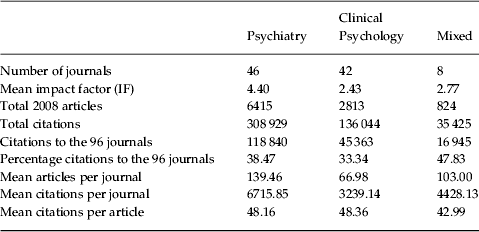
The 96 journals collectively published 10 052 articles in 2008 (excluding editorial material, letters, corrections, and book reviews), which made a total of 480 398 citations. Of these, 181 148 (37.71%) citations were to the 96 journals themselves. Descriptive data for the three journal sets are presented in Table 1. Psychiatry journals tended to publish more articles, make more citations, and have higher IFs than Clinical Psychology journals (all p<0.0001), with Mixed journals intermediate. As a result, Psychiatry journals as a set made many more total citations than Clinical Psychology journals.
Descriptive summary of the three citing journal sets
Citation patterns across journal sets
The extent to which journals in each set cited articles from the same versus different sets is presented in Fig. 1. The Psychiatry journals display a strong within-discipline citation preference, with 84.05% of their citations being to Psychiatry journals and only 7.94% to Clinical Psychology journals. The Clinical Psychology journal set also displayed a within-discipline preference, albeit weaker, with 58.75% of citations to Clinical Psychology journals and 36.02% to Psychiatry journals. Despite the Clinical Psychology journals making only 38.3% as many total citations as the Psychiatry journals, they made 73.3% more cross-disciplinary citations. Stated differently, Psychiatry was a net supplier of knowledge and scientific influence to Clinical Psychology.
Percentage of citations made by each citing journal type to journals of the same or different type.
 , Mixed; □, Clinical Psychology; ▪, Psychiatry.

Journal clusters
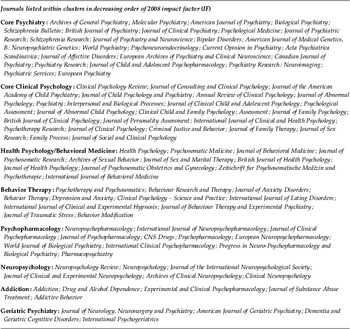
To assess the structure of scientific influence among narrower groupings of the 96 journals, a cluster analysis of the citation data was conducted. Clustering was carried out using Ward's method on pairwise correlations among all journals (i.e. journals with similar citing profiles correlated highly and were clustered together). An eight-cluster solution was selected on the basis of interpretability (see Appendix). In decreasing order of number of journals, these were a ‘Core Psychiatry’ cluster (generalist psychiatry journals), a ‘Core Clinical Psychology’ cluster (including many child- and family-related journals), a ‘Health Psychology/Behavioral Medicine’ cluster (including sexuality-related journals), a ‘Behavior Therapy’ cluster, a ‘Psychopharmacology’ cluster, and ‘Neuropsychology’, ‘Addiction’ and ‘Geriatric Psychiatry’ clusters.
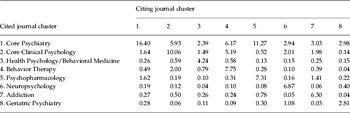
Each cluster tended to be composed predominantly of psychiatry or clinical psychology journals, with the exception of Addiction, which was evenly split. Excluding the eight ‘mixed’ journals, the association between discipline and journal cluster was very strong [χ2(7)=60.40, p<0.00001]. The Core Psychiatry, Psychopharmacology and Geriatric Psychiatry clusters contained no clinical psychology journals (excluding those jointly classified as psychiatry journals), but the Core Clinical Psychology, Behavior Therapy, Neuropsychology and Health Psychology/Behavioral Medicine clusters contained at least one journal classified as psychiatry only. Table 2 displays the mean number of articles from the eight clusters that were cited by articles from each cluster: for example, the average Core Psychiatry article cited 1.64 Core Clinical Psychology articles, and the average Core Clinical Psychology article cited 5.93 Core Psychiatry articles.
Mean number of articles from each journal cluster (rows) cited by articles in each cluster (columns)

The 96×96 matrix of citations between journals was submitted to a block model analysis (White et al. Reference White, Boorman and Breiger1976) using the UCINET program (Borgatti et al. Reference Borgatti, Everrett and Freeman2002). Block modeling is a well-established form of network analysis that examines the level of relational activity both between and within blocks; in the present case, within and between the journal clusters. The analysis identifies relationships within and between journal clusters that exceed a threshold based on the overall density of relationships in the network (i.e. elevated levels of citations received or sent, taking account of the overall number of citations sent and received by each cluster). Although often used with binary matrix data, block models can also accommodate valued data (Wasserman & Faust, Reference Wasserman and Faust1994).
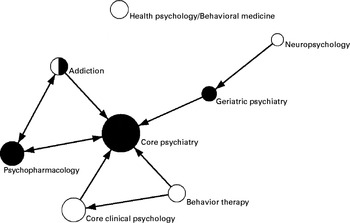
In the present block model, the 96×96 matrix was partitioned (or blocked) into submatrices according to the eight clusters. Using the average function (i.e. the arithmetic mean of all cells in each submatrix) and excluding diagonal values (i.e. journal self-citations) in accordance with previous citation analyses (e.g. Boyack et al. Reference Boyack, Klavans and Borner2005; Yang & Chiu, Reference Yang and Chiu2009), the result was a reduced 8×8 block density matrix that represents the eight journal clusters. By dividing the densities of each cell of this reduced block matrix by the overall density of the 96×96 network, any value above one indicates citation activity greater than average (i.e. above expectation based on the overall network density). In this reduced 8×8 matrix there are 64 possible directional links, of which 56 are between clusters (the remaining eight involve tendencies to cite within each cluster). Fig. 2 is a visualization using Pajek software (Batagelj & Mrvar, Reference Batagelj and Mrvar2010) of the 10 between-cluster links that exceeded the mean network density, with arrows indicating the direction of flow of citations (i.e. arrows point toward the journal cluster that is cited above expectation). The size of the nodes representing each cluster is proportional to its number of articles published in 2008, and their fill is based on the cluster's predominance of psychiatry or clinical psychology journals. Although not represented visually, all clusters other than Health Psychology/Behavioral Medicine have above-average cluster self-citations.
Visualization of the block model analysis. Arrows indicate high levels of citations sent in the direction indicated, node size is proportional to the number of articles published, and node fill indicates that the journal cluster is predominantly Psychiatry (black) or Clinical Psychology (white).

Fig. 2 reveals that the Core Psychiatry cluster occupies a central position in the network. In addition to being the largest cluster in number of journals and articles, it receives elevated levels of citations from five of the seven other clusters, implying a flow of knowledge, information and scientific influence from Core Psychiatry to these clusters. Only one of these links is bidirectional: Core Psychiatry receives high levels of citations from Psychopharmacology journals, and sends high levels of citations to them. Indeed, all psychiatry-dominated clusters (and the psychiatry-heavy Addiction cluster) were linked to the Core Psychiatry cluster, indicating a high degree of interconnection.
In contrast to the psychiatry-dominated clusters, the clinical psychology-dominated clusters were less clearly organized. Two clusters, Health Psychology/Behavioral Medicine and Neuropsychology, were not linked to any other clinical psychology-dominated cluster, and the former was isolated from all clusters. The Core Clinical Psychology and Behavior Therapy journal sets were closely linked, with the latter sending high levels of citations to the former and both sending high levels of citations to the Core Psychiatry journal set. By implication, there is a primary axis of clinical psychology publishing organized around general clinical psychology and cognitive-behavioral approaches to etiology and treatment, but this axis is somewhat subordinate to psychiatry research and relatively unintegrated with research on health psychology and neuropsychology.
Discussion
This study investigated the dynamics of influence and information flow among a large set of psychiatry and clinical psychology journals. It has three key findings. First, it demonstrates that psychiatry journals substantially exceed clinical psychology journals in the volume of research they report, in the number of citations they make, and in conventional indices of scientific influence such as the IF. Second, it shows that psychiatry journals are more insular in their citation patterns than clinical psychology journals: 92% of the citations that psychiatry journals made to our complete journal set were to psychiatry journals, whereas 64% of the citations that clinical psychology journals made were to one another (both figures include the eight ‘mixed’ journals in the respective citation-receiving journal sets). In short, clinical psychology journals were much more likely to cite psychiatry journals than vice versa. This finding accords with the less fine-grained analysis of Boyack et al. (Reference Boyack, Klavans and Borner2005) . Third, the 96 journals formed eight recognizable clusters based on similarities in inter-citation patterns, and the flow of citations among these sets clarified the structure of affinity and influence among them. In particular, psychiatry journals tended to be more central to the scientific network and their journal sets were more integrated with one another, whereas clinical psychology journals were less central, less integrated, and more likely to receive knowledge from psychiatry journals than to send knowledge to them.
The finding that psychiatry journals tend to publish a greater and more influential body of research is unsurprising as psychiatry is the pre-eminent profession in the mental health domain. Over and above their much greater publication volume, the greater average citation impact of psychiatry journals is consistent with a general trend for journals in natural science fields to obtain higher IFs than those in social science fields. As a result, the aggregate scientific impact of psychiatry journals easily outweighs the impact of clinical psychology journals.
This quantitative advantage may partly explain our second main finding, namely the greater citational insularity of psychiatry journals. It is easier to be insular on a larger island. If psychiatry research dominates in volume, it would be expected that psychiatry journals will cite one another more than they cite journals in smaller and less influential fields. Similarly, it would be expected that research in such fields, such as clinical psychology, will tend to take more knowledge and information from the larger, dominant field than they provide to it.
However, it is unlikely that this pattern of asymmetric influence between psychiatry and clinical psychology is entirely a function of size. It is also likely to depend on the differential institutional power and prestige of the two fields. It is well documented within the network literature that entities occupying central network positions, such as the psychiatry journal sets in our network analysis, are advantaged and prestigious (Bavelas, Reference Bavelas1950; Freeman, Reference Freeman1979). Indeed, clinical psychology journals were more subordinate to psychiatry journals in terms of citation flows than would be expected based on their relative collective impact. In our dataset, clinical psychology journals published a little less than half as many articles as psychiatry journals and made a little less than half as many citations, but they cited psychiatry journals at more than four times the rate that psychiatry journals cited them. This imbalance may reflect the fact that psychiatry frequently sets the research agenda for clinical psychology, that clinical psychology research is often insufficiently relevant to psychiatry researchers, or that psychiatry researchers pay less attention to clinical psychology research than clinical psychology researchers pay to theirs. The latter possibility may be assisted by institutional electronic subscription patterns that favour psychiatry journals. Regardless of its causes, the relative citational insularity of journals in psychiatry suggests that they might benefit from taking a wider perspective and learning from cognate disciplines. Interdisciplinary collaboration and the development of journals with avowedly interdisciplinary missions might help to reduce the insularity.
The journal clusters identified in our study are readily recognizable to researchers in the mental health arena, and the extent to which they are segregated by discipline is not surprising. Core Psychiatry, Psychopharmacology and Geriatric Psychiatry are research domains that reflect psychiatry's traditional emphasis on serious mental illness (all journals devoted to psychotic conditions fall in the first cluster), pharmacological treatment and biomedical etiology. Core Clinical Psychology, Behavior Therapy, Health Psychology/Behavioral Medicine and Neuropsychology are research domains that reflect clinical psychology's traditional emphases on milder mental illness (journals devoted to mood and especially anxiety disorders fall in these clusters), psychotherapeutic treatments, cognitive-behavioral approaches to etiology, and assessment.
Although the extent to which scientific publication in mental health is organized into clusters along disciplinary lines is not unexpected, the network of relationships among these clusters is less obvious. Even after accounting for its greater size, the Core Psychiatry cluster of journals plays a central or hub role in the network, receiving citations at a high rate from many other clusters, including those dominated by clinical psychology journals. By implication, this journal cluster, which includes the four highest IF journals among our 96, largely defines research directions for the field and sends knowledge and influence to more peripheral research areas more than it receives from them. The only journal cluster from which it receives knowledge to a substantial degree is Psychopharmacology, the second largest cluster in terms of published articles. Thus, scientific publishing in mental health is dominated by a biomedical psychiatry–psychopharmacology axis, around which most other subfields are organized.
The low level of integration among clinical psychology-dominated journal clusters contrasts with the strong links among psychiatry clusters. Although Core Clinical Psychology and Behavior Therapy journals had strong citational links, perhaps indicating the prominence of cognitive-behavioral approaches to etiology and treatment in mainstream clinical psychology, both journal sets were relatively disconnected from Neuropsychology and Health Psychology/Behavioral Medicine. Neuropsychology, a speciality whose traditional focus is on neurological conditions, tends not to share clinical psychology's emphasis on functional conditions and psychotherapeutic treatments, which may explain why the average clinical psychology article cited only 0.12 neuropsychology articles. Instead, neuropsychology has a closer affinity with areas in psychiatry that share its emphasis on organic conditions (e.g. stroke, dementia), hence its single link to Geriatric Psychiatry. Health Psychology/Behavioral Medicine was even less integrated with other research areas, focusing on physical health and illness in a way that distinguishes it from other domains of clinical psychology but lacking strong scientific links to mainstream psychiatry journals that might be expected to share its medical preoccupations. The somewhat peripheral and disconnected nature of health psychology and neuropsychology within the citation network may partly reflect the separateness of professional training programs in these specialities from clinical psychology programs in some countries, such as the UK and Australia. Whatever the reasons for the relatively loose interconnections among the clinical psychology-dominated journal clusters, they do suggest that, as a field, clinical psychology research is more dispersed and less integrated than psychiatry research.
The present study aimed to clarify the structure of mental health research at a single point in time, and therefore cannot illuminate changing patterns of scientific publication. It also excludes mental health-related journals from fields such as psychiatric nursing, social work, counselling, and psychotherapy. Nevertheless, the study reveals intriguing patterns in the flow of knowledge and influence within the mental health field, reminding us how, although the field is a diverse and pluralistic one (McHugh & Slavney, Reference McHugh and Slavney1998), some research topics and approaches are more central and influential than others.

Declaration of Interest
None.