Introduction
Fruit flies (Diptera: Tephtritidae) inflict heavy losses on fruits and vegetable crops because of their phytophagous habits (Norrbom et al., Reference Norrbom, Carroll, Thompson, White, Freidberg and Thompson1999). These losses are caused by different fruit fly species and vary between fruit species and between places, hence they are accorded different economic status in different farming systems in the world. In Africa, the damage to fleshy fruits is mainly caused by a limited number of highly polyphagous species, most of them belonging to the genus Ceratitis MacLeay. These losses can be very heavy. For example, Lux (Reference Lux1999) reports losses of up to 40% in mango in East Africa, while Vayssières et al. (Reference Vayssières, Goergen, Lokossou, Dossa and Akponon2005) mentions loss averages ranging from 12 to 50% for the same host in Benin, depending on the season. East African fruit production is mainly by smallholder farmers and most fruits are supplied to the local urban markets (Lux, Reference Lux1999). Presence of high populations of fruit fly species leads to economic losses for the smallholder farmers, as well as a reduced source of essential dietary components especially vitamins and minerals to local populations.
In addition to the native Ceratitis pests, several Bactrocera Macquart species of Asian origin have been introduced in mainland Africa, as well as islands of the Indian Ocean, thereby aggravating the economic significance of the group as a whole for the African horticulture (White & Elson-Harris, Reference White and Elson-Harris1992; White et al., Reference White, De Meyer and Stonehouse2001; Lux et al., Reference Lux, Copeland, White, Manrakhan and Billah2003; Mwatawala et al., Reference Mwatawala, White, Maerere, Senkondo and De Meyer2004; De Meyer et al., Reference De Meyer, Mohamed and White2007). The introduction of Bactrocera invadens Drew, Tsuruta & White in mainland Africa, which was first reported from eastern Africa (Lux et al., Reference Lux, Copeland, White, Manrakhan and Billah2003; Mwatawala et al., Reference Mwatawala, White, Maerere, Senkondo and De Meyer2004) and was successively reported from various parts of the continent (Drew et al., Reference Drew, Tsuruta and White2005), appears to have a severe impact on the local economy. Local studies show the predominant presence of this pest in a wide variety of hosts (Ekesi et al., Reference Ekesi, Nderitu and Rwomushana2006; Mwatawala et al., Reference Mwatawala, De Meyer, Makundi and Maerere2006a; Rwomushana et al., Reference Rwomushana, Ekesi, Gordon and Ogol2008) and its high infestation rate in commercial fruits like mango (Vayssières et al., Reference Vayssières, Goergen, Lokossou, Dossa and Akponon2005).
Despite their economic significance, our knowledge of host spectrum for the main fruit fly pests throughout their distribution range remains limited. De Meyer et al. (Reference De Meyer, Copeland, Lux, Mansell, Quilici, Wharton, White and Zenz2002) provide an annotated host check list for all Ceratitis species from Africa, but this paper does not give any information on the interaction and host-resource partitioning in particular areas. Differences in host range among different polyphagous pests and the importance of certain plant families in the natural history of these pests have been studied in Kenya (Copeland et al., Reference Copeland, Wharton, Luke and De Meyer2002, Reference Copeland, Wharton, Luke, De Meyer, Lux, Zenz, Machera and Okumu2006; Copeland & Wharton, Reference Copeland and Wharton2006), but this was before the introduction of B. invadens in Africa. Other studies focussed on the fruit fly spectrum of one commercial host only, such as mango (Vayssières & Kalabane, Reference Vayssières and Kalabane2000; Vayssières et al., Reference Vayssières, Goergen, Lokossou, Dossa and Akponon2005). Data on and a clear understanding of the use of the different potential hosts available in a given area and the host partitioning between the different competitive fruit fly pests is, nevertheless, a necessity in order to develop an IPM program.
Specifically for Tanzania, no data on biodiversity, host range and seasonality of fruit flies are available. In 2004, a collaborative research project between the Sokoine University of Agriculture (Morogoro, Tanzania) and the Royal Museum for Central Africa (Tervuren, Belgium) embarked on studies of the fruit fly diversity, seasonality and population dynamics in different orchards in Morogoro region.
This paper presents the basic information necessary for the development of an integrated fruit fly control program to reduce the damage caused by these native and alien pest species. Results on diversity and seasonality of B. invadens were published earlier (Mwatawala et al., Reference Mwatawala, De Meyer, Makundi and Maerere2006a, Reference Mwatawala, De Meyer, Makundi and Maerereb). This paper presents the results of a fruit collecting program from different agro-ecological systems in the important fruit producing areas of Morogoro Region in Tanzania. The aim of this program was to obtain data on the host range of the main polyphagous pests throughout the different fruiting seasons and the incidence in the main commercial crops grown in the region, as well other fruits that might serve as reservoir. These data will lead to a detailed host profile and host preference of the main pest species over the different fruiting seasons of the main crops in this part of the country. It would largely help in formulation of a sound IPM program by taking into consideration one of the four key issues put forward by Aluja (Reference Aluja, McPheron and Steck1996), i.e. the need to expand boundaries of agro-ecosystems and fully understand the role that agricultural habitats play in pest outbreak.
Material and methods
Morogoro Region is located between latitudes S5°58′−10°0′ and longitude E35°25′−38°30′ (United Republic of Tanzania, 2002). The region has been divided into three agro-ecological zones: river basin and valleys, plateau, and mountainous zones. Located in eastern-central Tanzania, Morogoro is situated in the transition zone between the bimodal and unimodal rainfall belts in Tanzania. With the presence of the different agro-ecological zones, it is a representative area for habitats occurring in Central Tanzania. It is also one of the major fruit-producing areas in the country, providing the urban markets of Dar es Salaam and Dodoma. Figure 1 provides a map of the study area with the major study sites indicated. Normally, the rainy season starts in October and reaches a first peak (short rainy season) around December and a second (long rainy season) around March-April. Weekly results for rainfall, relative humidity and average temperature at Sokoine University of Agriculture campus in Morogoro were recorded for the period October 2005–September 2006. A long dry spell dominated the year 2005, with low rainfall recorded during the long rainy season. On the other hand, high rainfall was recorded during the rainy season in 2006, with light rains extending to an otherwise dry period of the year. Weekly averages for minimum and maximum temperature varied between 15.7–27.2°C and 27.2–40.8°C, respectively, during the study period.
Location of main sampling sites (indicated by stars) within Morogoro Region. Insert indicates the relative position of Morogoro Region within Tanzania.

Fruits of economic importance were mainly collected at regular intervals between October 2004 and October 2006. To a limited extent, samples from non-commercial, as well as non-edible but potential hosts, were also collected. Two sampling programs were adopted. The first sampling program (conducted over two years: October 2004–October 2006) focused on random fruit collection from areas within the SUA campus and the other study sites of Morogoro Region (fig. 1; Nyandira, Mikese, Mkindo, representing the different agro-ecological zones). Full descriptions of the sites and plants grown at each of them, has been presented by Mwatawala et al. (Reference Mwatawala, De Meyer, Makundi and Maerere2006a). This program aimed at obtaining a more complete idea of the host spectrum of the major target pests. Since this program had no definite sampling interval, and due to the fact that the fruiting seasons and fruit availability varied, the size and number of samples collected varied widely and in some cases total number of samples were less than five. All samples comprised either tender skinned mature fruits (for most orchard fruits) or tender skinned immature fruits (mainly the case for cucurbits). The second sampling program was conducted from October 2005 till September 2006. In this program, fruits were randomly sampled every week from the four major horticultural fruits throughout their fruiting season: avocado (Persea americana Miller), mango (Mangifera indica L.), sweet orange (Citrus sinensis (L.) Osbeck) and guava (Psidium guajava L.). Additionally, loquat (Eriobotrya japonica (Thunb.) Lindley), soursop (Annona muricata L.), tropical almond (Terminalia catappa L.) and jew plum (Spondias cytherea Sonn), although economically less important, were also sampled under the same system. The purpose was to obtain data on presence and fluctuation of infestation incidence and infestation rates for the major fruit fly pests on these fruit species. Several samples of each fruit species were collected mostly from Sokoine University of Agriculture (SUA) and adjacent areas each month during their main fruiting season.
The number of fruits per sample and the number of samples reared depended mainly on fruit availability and abundance during the season. For both programs, samples were transported in plastic bags, which in turn were suspended in plastic boxes in order to avoid damage. They were labeled and registered with unique identifiers according to the protocol described by Copeland et al. (Reference Copeland, Wharton, Luke and De Meyer2002). Collected fruits were transported to the rearing unit established at the horticultural orchard at SUA, where they were kept in individual rearing boxes and provided with appropriate medium for pupation as given in Copeland et al. (Reference Copeland, Wharton, Luke and De Meyer2002). Conditions at the rearing unit were kept at 25±3°C and 60±10% RH. Emerged adults were removed and handled following methods described by White & Elson-Harris (Reference White and Elson-Harris1992).
Two parameters were initially determined for all the sampled fruit species: incidence and infestation rate. Incidence is the number of infested or ‘positive’ samples (=samples from which fruit flies emerged) in comparison to total number of samples per fruit species. A sample is defined, hereby, as a batch of fruit species collected from a particular tree at the same time. In addition, the infestation rate (using as infestation index the number of adult flies per weight unit (1 kg) of fruit: cf. Cowley et al., Reference Cowley, Baker and Harte1992; Copeland et al., Reference Copeland, Wharton, Luke and De Meyer2002) of the main pests in these hosts was investigated. The two parameters made it possible to compare infestation rate in different fruit species, despite the differences in sizes of individual fruit samples (both in weight as well as in the number of fruit pieces in each sample). The infestation rates of fruit fly species (source of variation) in plant species (replicates) were compared using Kruskal-Wallis test. Five major fruit fly species: B. invadens, C. cosyra (Walker), C. rosa Karsch, C. capitata (Wiedemann) and B. cucurbitae (Coquillett) and plant species with more than fifteen samples were used. This non-parametric test was adopted because the data were not normally distributed and their variances were not uniform.
The infestation rates of plant species (source of variation) by fruit fly species (replicates) were compared by one-way Analysis of Variance (ANOVA). The data were subjected to log-transformation to improve normality. The analysis involved the same plant species (this time as a source of variation) and the same fruit fly species (this time as replicates) that were used in testing the first hypothesis. Chi square was used to test uniformity in infestation rate of three fruit fly species, B. invadens, C. rosa and C. cosyra, in six of the most attacked fruit species, namely, mango, soursop, guava, loquat, tropical almond and strawberry guava (Psidium littorale Raddi). Data were analysed using GenStat (VSN International Ltd, UK) and pairwise comparison of means was done using Analyse-it plug in (version 2.12, Analyse-it Software Ltd, UK).
Results
Host range and incidence
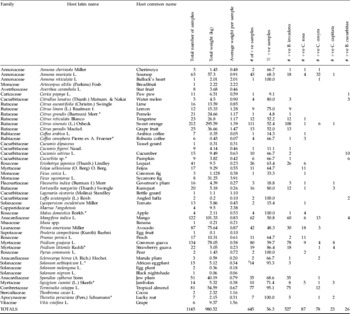
In total, 1145 fruit samples, totalling about 980 kg, were collected between October 2004 and October 2006. They were from 48 fruit species belonging to 20 different plant families (table 1). Of these, 645 samples (56.3%) were positive for emerging fruit flies. This is remarkably higher than the percentage (27%) observed by Copeland et al. (Reference Copeland, Wharton, Luke and De Meyer2002), but they sampled from a wider range of fruits (518 plant species).
List of all the sampled hosts, indicating number of samples, number of positive samples and number of positive samples per main fruit fly species.

* New hosts to Bactrocera invadens (some samples were infested by more than one fruit fly species, hence the sum of the individual positive samples can be higher than the total of positive samples in general).
§ Several samples were infested with a fruit fly species (Bactrocera latifrons) that is not included in this study.
Table 1 lists all the hosts that were sampled by both sampling techniques, indicating for each host the total number of collected samples, the total number of positive samples and the number of positive samples per fruit fly species (because some samples were infested by more than one fruit fly species, the sum of the positive samples per fruit fly species is sometimes higher than the total number of positive samples). Only positive records for the main five fruit fly species (B. invadens, C. rosa, C. cosyra, C. capitata and B. cucurbitae) are presented in table 1. Five species (Bactrocera latifrons (Hendel), Capparimyia melanaspis (Bezzi), Dacus bivittatus (Bigot), D. ciliatus Loew and Trirhithrum coffeae Bezzi) emerged from a minimal number of samples but were not included in the analysis or discussion of this paper.
Bactrocera invadens was recorded in the largest subset of samples (527 or 46% of all samples and 81.7% of all positive samples). Positive samples for the other main fruit fly species, B. cucurbitae, C. capitata, C. cosyra and C. rosa, varied between 23 and 87 of all collected fruit samples.
The positive samples belonged to 35 different plants from 14 different families. Again, B. invadens was found in the largest subset of collected fruit species (27 species, 12 families) and seems to have the largest host range. This study adds eight additional species (marked with an asterisk in table 1) to the already known 29 hosts for this species (Mwatawala et al., Reference Mwatawala, White, Maerere, Senkondo and De Meyer2004, Reference Mwatawala, De Meyer, Makundi and Maerere2006b; Drew et al., Reference Drew, Tsuruta and White2005; Ekesi et al., Reference Ekesi, Nderitu and Rwomushana2006; White, Reference White2006; Rwomushana et al., Reference Rwomushana, Ekesi, Gordon and Ogol2008), bringing the total number of reported hosts to 37. Host range of the other main fruit fly species ranged between 6 and 19. The host range of the major fruit fly species was different with respect to plant families except B. cucurbitae, which was recorded mainly from Cucurbitaceae. C. cosyra showed a predominance for Annonaceae and Anacardiaceae species.
Of all fruit types sampled frequently (more than 50 samples), tropical almond showed the highest incidence (95.1%) and was mainly infested by B. invadens. Other major hosts that recorded high incidences are jew plum and soursop. All major commercial fruit hosts (guava, sweet orange, mango and avocado) had a similar incidence varying between 48.3–59.7%. Incidences of the same range (between 50–65%) were observed for those fruits that were less frequently sampled (15–49 samples) with a few exceptions. Strawberry guava (Psidium littorale Raddi), kumquat (Fortunella margarita (Thunb.) Swingle) and African eggplant (Solanum aethiopicum L.) showed remarkably higher incidences. The high incidence in African eggplant is due to heavy infestation of B. latifrons, another Asian species that was recently introduced to Africa (Mwatawala et al., Reference Mwatawala, De Meyer, White, Maerere and Makundi2007) and that attacks mainly Solanaceous hosts. Of the 13 negative hosts, nine were sampled less than five times. The low number of replicates does not allow any statement on the suitability of these fruits as potential hosts. The remaining four were repeatedly sampled (between 6 and 16 times). Lime (Citrus aurantifolia (Christm.) Swingle), star fruit (Averrhoea carambola L.) and sycamore fig (Ficus sycomorus L.) are not considered suitable hosts for African fruit flies since all known records are mainly for Neotropical Anastrepha and Asian Bactrocera species (White & Elson-Harris, Reference White and Elson-Harris1992). Grape (Vitis vinifera L.), on the other hand, is known to be a suitable host for C. capitata and C. rosa, and there are known records from southern Africa and Réunion Island (De Meyer et al., Reference De Meyer, Copeland, Lux, Mansell, Quilici, Wharton, White and Zenz2002).
Infestation rate
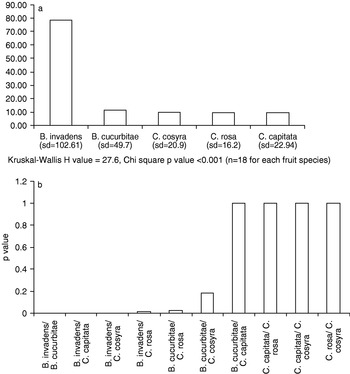
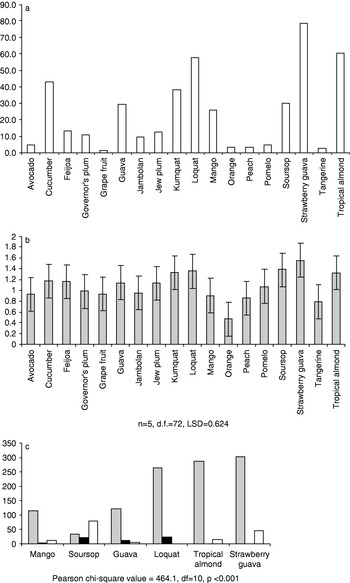
Figure 2a, b shows the average infestation rates of the five fruit species (combined for those plant species for which at least 15 samples could be obtained, limiting the analysis to 18 hosts) and the pair-wise comparison of infestation rates of fruit fly species. The average infestation rates of fruit fly species differed significantly (fig. 2a), with highest rate recorded by B. invadens compared to the other fruit flies (Kruskal Wallis H-value 27.6; Chi-square P-value<0.001). The infestation rate of B. invadens was highest and differed significantly with all other species (fig. 2b). On the other hand, the infestation rates of Ceratitis were not significantly different. When observing the infestation rates for individual fruit species (fig. 3), B. invadens was the dominant species for most non-cucurbit hosts. Ceratitis rosa had a higher infestation rate in peach (Prunus persica L.) and was the only infester of Feijoa (Feijoa sellowiana (O. Berg) O. Berg.). Ceratitis cosyra had a higher rate in soursop. Ceratitis capitata usually demonstrated lower infestation rates than B. invadens, C. cosyra or C. rosa. It was the predominant infester only of kumquat, showing infestation rates equal to those of B. invadens. It also showed comparatively high infestation rate for strawberry guava than the other Ceratitis species (fig. 3). Figure 4a, b shows the average infestation rate in the 18 host plants for all fruit fly infestations combined. Generally, highest infestation was recorded in strawberry guava, tropical almond, loquat, kumquat and cucumber (fig. 4a). The same trend was observed after log-transforming the data and performing ANOVA (fig. 4b). Significant differences in infestation rates were observed, and fruits with highest infestation rates differed with sweet orange, which recorded lowest infestation rate (fig. 4b). With particular reference to B. invadens, despite being polyphagous and showing high infestation incidences for some crops, not all potential hosts appear to be equally vulnerable to infestation by this species. Guava species, mango, loquat and tropical almond show the highest infestation rates, often of a magnitude of ten times higher than those observed for any of the other fruit fly pests. Citrus spp and avocado, on the other hand, although showing high incidence, in general, show low infestation rates. All six representatives of the genus Citrus sampled in this program had low infestation rates, in general, for all fruit fly pests. Lime and pomelo had negative or very low incidence. The other Citrus spp have an average incidence but a low infestation rate. B. cucurbitae is the dominant infester of cucurbit hosts, and was marginally recorded in other fruits. The six main reservoir plants were analyzed separately for the three main fruit fly pests (fig. 4c). Results show that B. invadens is the main infester in all these major reservoirs, except for soursop, and the infestation rates of each fruit fly species were not uniform across species, i.e. there is a relationship between fruit fly species and plants they attack (Pearson chi-square value=464.1, df=10; P<0.001). Thus, the highest infestation rate of B. invadens in fruits like strawberry guava, tropical almond and loquat did not occur by chance but could be due to host preference.
Infestation rate of five fruit fly species, pooled data: average infestation rates (average number of flies per kg) of fruit fly species (an average of infestation rates of each fruit fly species recorded in eighteen plants species) (a); and pair-wise comparison of the average infestation rates (b).

Average infestation rates (average number of flies per kg) for main fruit fly hosts ( , C. rosa; □, C. cosyra; ▪, C. capitata;
 , B. cucurbitae;
 , B. invadens).

Average infestation rate (average number of flies per kg) of plant species by five fruit fly species: average infestation rates (a); average infestation rates transformed and subjected to ANOVA (b); and infestation rates of six most attacked plant species by each of three major fruit fly species (c) ( , B. invadens; ▪, C. rosa; □, C. cosyra).

Seasonal fluctuations
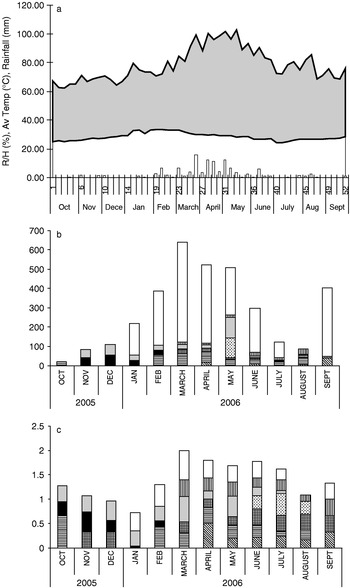
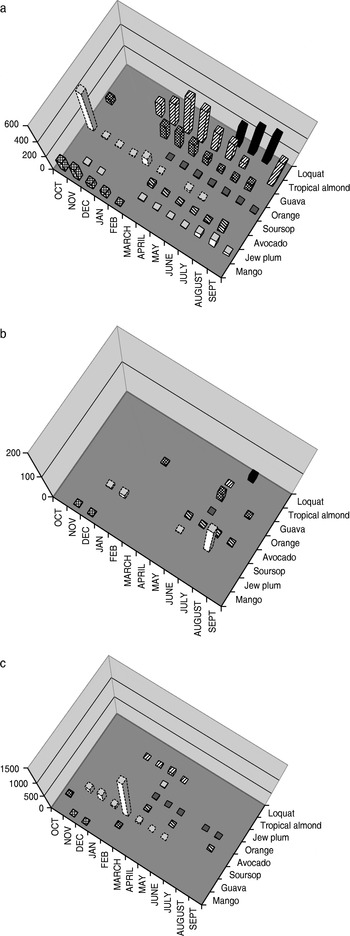
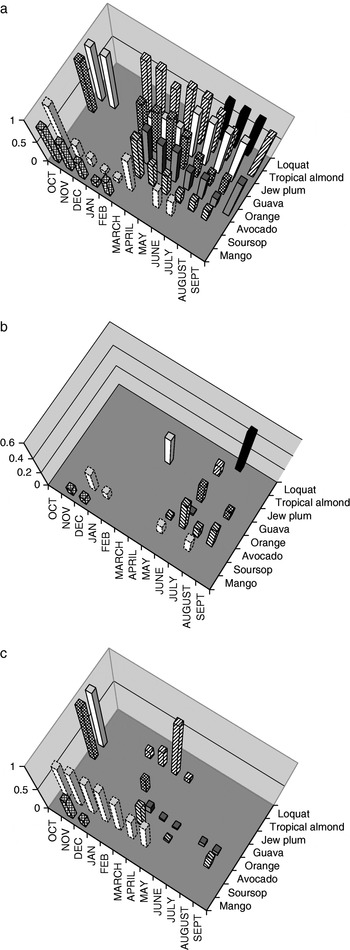
Commercial fruits have different fruiting seasons with mango being available from October to February while the other main fruits are present between February and October. Figure 5 shows the monthly climatic parameters at Morogoro (fig. 5a), as well as the monthly infestation rates (fig. 5b) and monthly incidence (fig. 5c) for samples collected through random sampling between October 2005 and September 2006. They are shown for the four main commercial fruits (avocado, mango, guava, orange; grouped on the month of sampling), as well as for tropical almond, jew plum, loquat and soursop, and this for the three main fly pests (B. invadens, C. rosa and C. cosyra) together. Figures 6 and 7 show the infestation rates and incidences for the three main fly pests separately, to demonstrate the interspecific differences in monthly patterns.
Weather parameters (average temperature, relative humidity and weekly rainfall) at Sokoine University of Agriculture for the period October 2005–September 2006 (a) (□, av temp; , R/H; □, rainfall); monthly averages of infestation rates of three major fruit fly species fruit flies (pooled average of B. invadens, C. rosa and C. cosyra) for eight fruit species (b); and monthly incidence rates of fruit flies (pooled average of B. invadens, C. rosa and C. cosyra) (c) for eight fruit species ( , avocado;
 , guava;
 , jew plum;
 , loquat; ▪, mango; , soursop;
 , orange; □, tropical almond).

Monthly averages of infestation rates (average number of flies per kg fruit) for Bactrocera invadens (a), Ceratitis rosa (b) and Ceratitis cosyra (c) (, mango; □, jew plum;  , soursop;
 , avocado;
 , orange;
 , guava;
 , tropical almond; ▪, loquat).

Monthly incidence (ratio of number of positive samples versus total number of samples) for Bactrocera invadens (a), Ceratitis rosa (b) and Ceratitis cosyra (c) (, mango; , soursop; , avocado; , orange;  , guava; □, jew plum; , tropical almond; ▪, loquat).

Suitable hosts are available throughout the year for B. invadens. Mango appears to be the principal host in the period October to January while guava is the principal host in the period February to August. Avocado and orange, although infested, are of lesser importance. Tropical almond, and to a lesser extent soursop and jew plum, provide alternative hosts for most of the year. B. invadens remains the main infester for all fruits (except in soursop), compared to C. rosa and C. cosyra. Ceratitis rosa and C. cosyra could not be reared throughout the full year cycle from these target hosts, with data lacking for March and April for C. rosa, and for June for C. cosyra. Mango is an important host for C. cosyra during the mango season. Soursop is taking over after the mango season and provides a suitable host for most of the period till the end of the rainy season in April–May. C. rosa has been reared from a variety of hosts over most of the months but in general at low infestation rates and very low incidence. Its presence seems to be restricted and does not seem to have a complete host range among the main fruit types sampled here.
The general trend in the commercial fruits avocado, mango and guava is a decrease in incidence and infestation rate towards the end of the fruiting season, but this was less apparent in the other fruits. Orange shows a decline in incidence but a rather stable (low) infestation rate throughout the fruiting season. Infestation rates of loquat and tropical almond are rather stable throughout their fruiting season while the data for jew plum and soursop are not definitive. During the short rains, the average temperature also gradually increases (fig. 5a). This largely co-incides with the availability of mango fruits, and results in high infestation rates in this host.
Discussion
Infestation and host range of Bactrocera invadens
Bactrocera invadens was the dominant fruit fly species in the hosts studied, in terms of number of positive hosts, abundance (number of positive samples) as well as infestation rate (number of flies emerging/kg of fruit from positive samples). In addition to the hosts so far reported, it is to be expected that many other potential hosts, especially among the indigenous flora, are not yet recorded. All the known hosts recorded are from Africa; there are no data available on hosts within the native range of B. invadens in Asia.
All major economic crops such as citrus, mango, avocado and guava show a high infestation incidence for B. invadens, except for Cucurbitaceae. Noteworthy is the rearing from robusta coffee. This record is unusual in that it represents the highest infestation rate of B. invadens (370 flies/kg of fruit) but is based on a single rearing (all other samples from Coffea species did not yield any B. invadens). Coffee is an important export crop from Tanzania and the attack by B. invadens needs to be confirmed since it could have important economic consequences.
In general citrus fruits and avocado do not constitute a favourable host for B. invadens (or any of the other fruit fly pests) in this region. The low infestation rate for Citrus was also confirmed by data from Kenya (Rwomushana et al., Reference Rwomushana, Ekesi, Gordon and Ogol2008). Some earlier reported host records for B. invadens could not be confirmed, in particular papaya (Drew et al., Reference Drew, Tsuruta and White2005) despite 11 samples collected during the study. The case of tropical almond is of special importance. Tropical almond has shown to be a suitable host of B. invadens, both with regard to level of incidence as infestation rate (Rwomushana et al., Reference Rwomushana, Ekesi, Gordon and Ogol2008). Tropical almond trees are largely planted as ornamentals, shade trees or for soil conservation. Their fruits are consumed, particularly among children. They are normally planted around homesteads, often close to small-scale orchards. Since they have high suitability as a reservoir host for B. invadens, they should be further studied.
Infestation and range of other fruit fly pests
Bactrocera cucurbitae, another invasive species of Asian origin, is known to mainly attack representatives of the family Cucurbitaceae although polyphagy is reported in some areas of Asia and the Pacific (White & Elson-Harris, Reference White and Elson-Harris1992; White, Reference White2006). Most East African records are from cultivated cucurbits (White, Reference White2006). In our study, it mainly infested Cucurbitaceae, usually with much higher infestation rates than any of the other fruit flies. Noteworthy are the low infestation rates of B. cucurbitae in papaya and mango, which are not regular hosts for this fruit fly species, and this should be further studied.
Temperate fruits, such as apple, pear and peach, were rarely infested by B. invadens but frequently infested by C. rosa. Mwatawala et al. (Reference Mwatawala, De Meyer, Makundi and Maerere2006b) have shown that B. invadens only occurs in low numbers and only during a short seasonal period in the agro-ecological area (high altitude area) where these fruit types are grown. C. rosa remains the predominant infester for these fruits. Most coffee samples also were taken at higher elevations and were mainly infested by C. rosa (but see above on single rearing of B invadens). In addition, this species showed high infestation rates for cherimoya, feijoa and tomato, but the latter is based on a single sample.
Ceratitis capitata is considered as the most polyphagous species within the genus Ceratitis and one of the most polyphagous fruit fly species worldwide (White & Elson-Harris, Reference White and Elson-Harris1992; De Meyer et al., Reference De Meyer, Copeland, Lux, Mansell, Quilici, Wharton, White and Zenz2002). In Kenya, it was recently reported from a wide variety (55 species) of indigenous host plants (Copeland et al., Reference Copeland, Wharton, Luke and De Meyer2002) and demonstrated to show a larger host spectrum than other fruit fly pests, including C. cosyra and C. rosa (Copeland et al., Reference Copeland, Wharton, Luke, De Meyer, Lux, Zenz, Machera and Okumu2006). In our study, however, the host range was the least diverse of all Ceratitis species. The study by Copeland et al. (Reference Copeland, Wharton, Luke and De Meyer2002) focused on indigenous hosts, while the majority of the host sampled in our study are commercials and/or exotics. However, more importantly, is the fact that the study by Copeland et al. (Reference Copeland, Wharton, Luke and De Meyer2002) precedes the detection of B. invadens in Kenya. Comparing the impact and host range in both studies, it appears that a widespread native pest, such as the Medfly, now seems to be restricted to a more limited commercial host range in areas where it co-occurs with B. invadens. Copeland et al. (Reference Copeland, Wharton, Luke and De Meyer2002), however, identified a wide variety of indigenous hosts (51 species in Kenya) for the native C. capitata. It is unclear, at this stage, whether it is affected in this indigenous range as well by the introduction of B. invadens.
C. cosyra, although polyphagous, has a more restricted host range than C. capitata or C. rosa (De Meyer et al., Reference De Meyer, Copeland, Lux, Mansell, Quilici, Wharton, White and Zenz2002; Copeland et al., Reference Copeland, Wharton, Luke, De Meyer, Lux, Zenz, Machera and Okumu2006). This is less apparent in the range of commercial hosts that we sampled, where the range of fruit hosts for C. cosyra is intermediate between the other two Ceratitis spp. The genus Annona, known as a major host plant genus for C. cosyra, was also heavily infested by this species in the study area. Anacardiaceae, in particular mango and marula plum, are known to be important hosts for C. cosyra. On the Kenyan coast, the latter host is an important reservoir during some of the months when mango is unavailable (Copeland et al., Reference Copeland, Wharton, Luke, De Meyer, Lux, Zenz, Machera and Okumu2006). Ekesi et al. (Reference Ekesi, Nderitu and Rwomushana2006) showed that the infestation rate in mango is proportionally much higher for B. invadens in samples from low elevations, and lower in samples from high elevations. All our samples for mango originated from lower elevations (380–520 m asl) since mango was not grown in our study site at high elevation (1650 m asl) (Mwatawala et al., Reference Mwatawala, De Meyer, Makundi and Maerere2006a), which could explain the relatively higher infestation rate of B. invadens.
Seasonal changes
From the sampling of the four commercial fruits and four economically less important fruits, it is clear that this host range can provide suitable hosts for B. invadens throughout a full year cycle but with fluctuating importance, depending on the fruit availability. Non-commercial fruits, in particular tropical almond, appear to play an important role in bridging the period between mango and guava fruiting season. The mechanisms behind the decline of incidence and infestation rate as the fruiting season progresses are insufficiently known. It is not clear whether this is due to the presence of other suitable hosts or whether mature mango fruits are less favoured for oviposition. Also, the observed patterns need to be confirmed through continuous sampling over successive years prior to any control programme.
Mwatawala et al. (Reference Mwatawala, De Meyer, Makundi and Maerere2006b) showed that B. invadens populations increase from the onset of the short rains period onwards in order to reach a maximum at the short rains period. The relationship between the start of the rainy season, with the increase of B. invadens and heavy mango losses, was observed also in Benin in western Africa (Vayssières et al., Reference Vayssières, Goergen, Lokossou, Dossa and Akponon2005). The period of short rains is followed by a shorter period of drier conditions (but with high relative humidity) in January-February, to be followed by a period of higher rainfall during a more extended period (long rains season). The average temperature remains high but gradually decreases during the long rains period. This season is the main fruiting season for guava and citrus. Populations of B. invadens remain high during this period (Mwatawala et al., Reference Mwatawala, De Meyer, Makundi and Maerere2006b) but seem to infest mainly guava, as well as other, non-commercial, fruits that are available around that time, such as tropical almond. When temperature and rainfall decrease during the dry season, the populations of B. invadens also decrease dramatically (Mwatawala et al., Reference Mwatawala, De Meyer, Makundi and Maerere2006b), but viable populations can be maintained in non-commercial hosts, such as loquat and jew plum, till the next short rains period. Host availability for C. cosyra and C. rosa is not so unambiguous from the present analysis. It is unclear what the predominant hosts are for this species in the dry season since only sporadic records were obtained from orange and avocado during that period.
B. invadens is currently considered as one of the major pests in Africa. Its polyphagous nature, predominance in certain hosts and rapid spread throughout Africa (Drew et al., Reference Drew, Tsuruta and White2005) makes it a devastating pest. Local farmers have indicated that there is a huge impact that this fly has made on their current fruit production (Yaya Touré, Reference Yaya Touré2007). Besides being an important pest, it also seems to have an impact on the indigenous fruit fly fauna in commercial fruit produce. Although pre-invasion data, generally, are lacking, there is some indication that it could have an impact on the presence of major indigenous pests, such as C. capitata and C. cosyra. Duyck et al. (Reference Duyck, David and Quilici2004, Reference Duyck, David and Quilici2007) indicated that K-selected species could be better invaders and, through interspecific competition, decrease the number and niches of pre-established species. Bactrocera spp. appear to have K-selected traits and to dominate representatives of the genus Ceratitis, at least in the case study of La Réunion. It is not unlikely that similar trends can be observed on mainland Africa in environments such as Central Tanzania.
In general, these findings imply that programs that aim at suppression of fruit fly population could focus on the hosts with high infestation rates with respect to particular fruit fly species. However, when it comes to export, fruits with a higher incidence of fruit flies become a major concern because of strong quarantine regulations imposed by importing countries. Non-commercial hosts with high incidence and infestation rates, and found in the vicinity of commercial orchards, should be removed since they can provide a major reservoir allowing fruit fly populations to build up in between crop peaks. In addition, any suppression of pest population should be conducted at the start of the growing season since higher infestation was reported at that time.
Acknowledgements
Many thanks to F.J. Senkondo, Lilian Shechambo, Resta Maganga and Y. Mgoba (Sokoine University of Agriculture) for their assistance in the field. We would like to acknowledge the valuable comments made by two referees on an earlier draft of this paper. This study was financially supported by the Belgian Development Co-operation through the Framework program with the Royal Museum for Central Africa (Project F13) and the International Foundation of Science (Project C3956).