Introduction
Use of sedative ‘as required’ or pro re nata (PRN) medication in older adults is controversial, since these drugs have been known for a long time to have the potential to impair cognition and precipitate falls (Aisen and Deluca, Reference Aisen and Deluca1992) and in the case of antipsychotics to cause increased cerebrovascular mortality in those with dementia (Schneider et al., Reference Schneider, Dagerman and Insel2005; Corbett and Ballard, Reference Corbett and Ballard2012). First-generation antipsychotic drugs, such as haloperidol, also have the propensity to cause depression and akathisia that often goes undiagnosed (Van Putten et al., Reference Van Putten, May and Marder1984). Benzodiazepines can cause important psychiatric side effects, such as anterograde amnesia, paradoxical agitation, and addiction (McIntosh et al., Reference McIntosh, Clark and Spry2011). A further problem in older adults is that the diagnosis of delirium may easily be missed and misattributed to dementia or depression (Teodorczuk et al., Reference Teodorczuk, Reynish and Milisen2012). In addition, non-psychiatric causes for agitation, such as pain and dehydration, may also be overlooked. This can lead to patients receiving increasing doses of PRN medication in an attempt to control their agitation while the underlying cause of their behavioral disturbance remains untreated.
The rationale for the use of PRN is to enable nursing staff to administer medication in a timely manner without having to call a doctor to write up a new prescription. Some have seen PRN use as an abdication of clinical responsibility from the professionals involved with patients potentially being exposed to large doses of medication with a considerable side effect burden (Baker et al., Reference Baker, Lovell and Harris2007). However, systematic reviews of the use of PRN medication have failed to demonstrate convincing benefit for the practice (Srivastava, Reference Srivastava2009; Chakrabarti et al., Reference Chakrabarti, Whicher, Morrison and Douglas-Hall2012). Most of the studies of PRN medication are of poor quality and there are no randomized controlled trials. Chakrabarti and colleagues (Reference Chakrabarti, Whicher, Morrison and Douglas-Hall2012) concluded that the practice of using PRN in the management of short-term violence or for acute psychotic symptoms is a practice based on habit and clinical experience and not on high quality evidence. In a study carried out in a US public psychiatric hospital, much of the PRN prescribed and administered appeared to be unnecessary as when for a three month period doctors were not permitted to prescribe PRN there was no associated increase in adverse aggressive behaviors or use of measures such as seclusion and physical restraint and no compensatory increase in the prescription of regular medication (Thapa et al., Reference Thapa, Palmer, Owen, Huntley, Clardy and Miller2003). Baker and colleagues (Reference Baker, Lovell and Harris2007) have suggested that sometimes PRN is administered rather than de-escalating the patient or having a 1:1 session with them. Another problem is that the prescription of PRN antipsychotics is frequently associated with high dose antipsychotics and antipsychotic polypharmacy both of which are associated with an increased side effect burden (Paton et al., Reference Paton, Barnes, Cavanagh, Taylor and Lelliott2008).
Most studies of PRN have been conducted on adult patients in acute inpatient settings. Several authors have commented upon the lack of clarity and protocols for nursing staff about when to use PRN and their potential to lead to medication errors (Usher et al., Reference Usher, Lindsay and Sellen2001; Baker et al., Reference Baker, Lovell and Harris2008). Use of PRN has also found to be associated with potential pharmacokinetic interactions (Davies et al., Reference Davies, Lennard, Ghahramani, Pratt, Robertson and Potokar2007). This factor is likely to be particularly important in older adults who are frequently prescribed medication for co-morbid physical disease. We could identify only two studies of PRN medication conducted among older adults (Baker et al., Reference Baker, Keady, Hardman, Kay, Jones and Jolley2010; Lindsey and Buckwalter, Reference Lindsey and Buckwalter2012). In the first study, the authors audited PRN use in 11 acute psychiatric wards for older adults (both functional and organic) in North West England and reported that just over half the patients were prescribed PRN and 17% had received one or more doses of PRN in the previous week. Documentation of PRN administration was absent in 60% of cases and prescribing practice also showed room for improvement. In the study by Lindsey and Buckwalter (Reference Lindsey and Buckwalter2012), the case note documentation of PRN administration was studied in two US acute care facilities for older adults. The main focus of the findings was on the poor and infrequent documentation as to why PRN was necessary and whether or not other measures had been tried before resorting to PRN.
Given the paucity of studies examining psychotropic PRN prescribing and administration to older adults, we decided to study PRN usage at our own hospital, a tertiary referral centre admitting patients from all over the UK. The aims of the study were to examine the nature, frequency, and timing of sedative PRN prescribing and administration to older adults in a secure setting and to compare the findings with those of patients of working age. A further aim was to determine how often PRN antipsychotic prescribing led to patients actually receiving high dose antipsychotics. We also wanted to know how often other interventions were tried before PRN was administered and what evidence was documented as to the efficacy of PRN. Finally, we sought to determine the characteristics of patients who were given PRN and whether or not they differed from the remaining patients.
Method
Setting
The study was conducted at St Andrew's, Northampton, a tertiary referral centre caring for over 700 inpatients with a variety of mental health problems. We studied the seven units catering for older adults (one open unit, three locked, two low secure, and one medium secure). We also collected comparative data from 18 units for adult forensic and rehabilitation patients.
Research ethics approval
The survey was considered to be an audit and a service evaluation and therefore not to require local research ethics approval. It was, however, approved by the Director of Nursing, Head of Clinical Audit and Head of Pharmacy.
Medication chart
The hospital uses a paper medication chart upon which all prescriptions are written and doses administered recorded. There are separate sections for regular medication, PRN medication, and once only (stat) doses. When prescribing PRN medication, prescribers are required to record the name of the medicine, dose, frequency, maximum dose to be administered in any 24 hour period and the indication(s) for administration. The nurse administering the medicine records the dose, route, and timing in boxes adjacent to the prescription. It is a requirement of the Hospital's medicines policy that the nurse also records in the patient's electronic notes the reasons for the use of PRN medication as well as the name of the medicine and the route of administration. If the use of PRN is considered to constitute rapid tranquillization, then there is a requirement to carry out physical monitoring of the patient at a frequency to be agreed by the nurse in charge of the ward and the relevant psychiatrist. The definition of rapid tranquillization used was that given in the NICE guideline on the short-term management of disturbed/violent behavior in inpatient psychiatric settings, Clinical Guideline 25 (National Institute for Clinical Excellence, 2005), namely the use of (oral or parenteral) “medication to calm or lightly sedate the patient and prevent injury to self or others and achieve an optimal reduction in agitation and aggression.”
Procedure
CH and LW visited the wards between May and September 2013. All available current medication charts were examined. If a medication chart had been re-written within the last 14 days the previous chart was also examined. A structured data collection form was used to collect details of current prescriptions for sedative PRN medicines and any dosages administered in the previous 14 days. The drugs studied were: PRN antipsychotics, benzodiazepines, hypnotics, and the sedative antihistamine promethazine. For each dose of sedative PRN medication administered, we recorded the dose, route, date, and time of administration. CH then checked to see if the administration of each dose of PRN medication had also been documented in the patient's electronic case notes. CH recorded the reason why PRN had been needed, whether the patient had requested PRN, whether other measures such as de-escalation had first been tried, and the recorded outcome after PRN had been administered.
We used the method of Yorston and Pinney (Reference Yorston and Pinney2000) to calculate the total percentage dose of antipsychotics each patient was receiving. The concept of total percentage dose for assessing the antipsychotic burden in patients is very widely used in the UK and has superseded the use of Chlorpromazine Equivalents. This is a different concept to “Daily Defined Dose”, which is the assumed average maintenance dose per day for a drug used for its main indication in adults. The total percentage dose of antipsychotics for each patient was calculated by expressing the total daily dose of each antipsychotic as a percentage of its British National Formulary (British Medical Association and Royal Pharmaceutical Society of Great Britain, 2012) maximum recommended daily dosage. If a patient was prescribed more than one antipsychotic the percentages were added together to calculate the total percentage dose. High dose antipsychotic prescribing was deemed to be present if the total percentage dose was in excess of 100%.
Demographic, legal, and clinical variables were collected from the patients’ electronic case notes. Details of patients’ ICD-10 clinical diagnoses were also taken from the notes. These diagnoses are made by the patient's consultant psychiatrist shortly after admission and are updated periodically.
Data analysis
Anonymized data were entered into SPSS version 20 (IBM SPSS Inc, 2011) and subject to a descriptive analysis. The χ2 test was used to examine for differences between groups.
Results
Characteristics of the patients studied
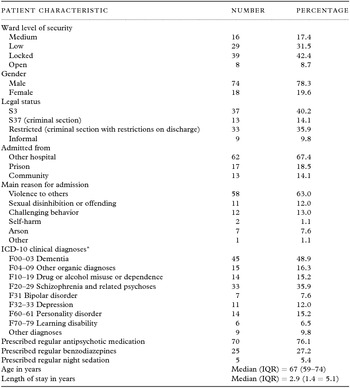
A total of 92 patients were studied. Their characteristics are shown in Table 1. The majority were male and almost all were sectioned patients detained under the Mental Health Act of England and Wales, 1983 amended in 2007. Most had been admitted from other hospitals and violence towards others was by far the most common reason for admission. Almost half had a diagnosis of dementia and a third had schizophrenia. Three-quarters were prescribed regular antipsychotic medication.
Demographic, legal and clinical characteristics of older patients (n = 92)

IQR = Inter-quartile range.
*Patients could have more than one diagnosis.
Details of prescriptions for PRN sedation
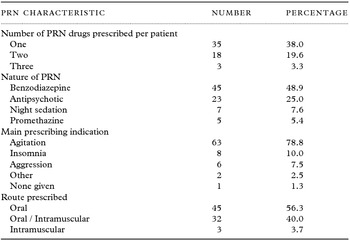
Of the 92 patients, 56 (60.9%) were prescribed PRN sedation. Details of the 80 PRN prescriptions are given in Table 2. PRN benzodiazepines were prescribed to half the patients and PRN antipsychotics to a quarter. Lorazepam (N = 38) was the most commonly prescribed PRN followed by haloperidol (N = 11), olanzapine (N = 7), zopiclone (7), promethazine (5), diazepam (5), quetiapine (4) clonazepam (2), risperidone (1). Agitation was by far the commonest prescribing indication (79%). Lorazepam and haloperidol were most commonly prescribed for agitation but anxiety was mentioned as a secondary indication for lorazepam in five patients and psychosis was a secondary indication for haloperidol in two participants. Although 56% of prescriptions were for the oral route, 40% were written for either oral or intramuscular administration. Where more than one PRN drug was prescribed there was rarely any guidance for nursing staff as to which drug they should administer first (there were just two instances where the doctor had prescribed one PRN drug for agitation and a second drug for severe agitation).
Details of sedative PRN prescribed to older adults (N = 80 prescriptions)

Details of PRN administered
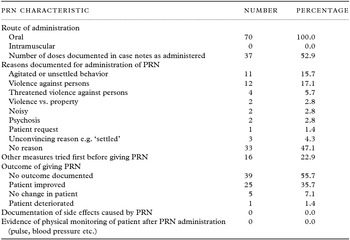
A total of 25 patients had received one or more doses of PRN in the previous fortnight. In contrast to the pattern of prescribing, all 70 doses of PRN were administered by the oral route (see Table 3). The medicines administered were: lorazepam (n = 39), zopiclone (11), diazepam (7), haloperidol (6), clonazepam (3), promethazine (3), and olanzapine (1). Only 53% of administered doses were documented in the case notes. The most common reason for administration was violence or threatened violence (25.7%) followed by agitated or unsettled behavior (16%). Non-pharmacological measures to try and calm the patient were described in 23% of all instances (e.g. 1:1 session, de-escalation, relocation to seclusion, or a low stimulus environment). The outcome of administering the PRN was documented in only 44% of instances but where it was the patient was in most cases reported as improved. No mention was made of side effects and for none of the doses was the intervention described as rapid tranquillization, which may account for the fact that there was no documentation of physical observations on any of the patients.
Details of PRN doses administered to patients (N = 70 doses administered)

Timing of the administration of PRN sedation
The peak time period for the administration of PRN sedative medication was between 20.00 and 24.00 hours when 42.9% of all doses were administered. When prescriptions for night sedation were excluded, the peak time period for PRN administration was between 08.00 and 12.00 hours (34.4% of doses).
One patient received both lorazepam and haloperidol together on one occasion. All the other administrations involved a single drug. No patient received a further dose of PRN within four hours of the initial dose being administered.
Comparison of dementia patients and those patients with other psychiatric diagnoses
Patients with dementia were no less likely to be prescribed PRN sedation than those patients with other diagnoses (27/45; 60.0% vs. 29/47; 61.7% χ2 = 0.028, p = ns). In particular, the prescribing of PRN antipsychotics was just as frequent in patients with dementia as in those with other diagnoses (9/45; 20.0% vs. 14/47; 29.8%, χ2 = 1.17, p = ns). Patients with dementia were just as likely to have received a dose of PRN medication in the last two weeks than those with other diagnoses (12/27; 44.4% vs. 13/30, 43.3%, χ2 = 0.007, p = ns).
Comparison of older adults and those of working age
We also collected data on 242 patients of working age which is reported elsewhere (in preparation). Compared with this younger group of patients, the prescription of PRN medication was less frequent in older adults (56/92, 60.9% vs. 175/242, 72.3%, χ2 = 4.09, p = 0.05), the number of patients who received sedative PRN was somewhat less but did not reach statistical significance (25/92, 27.2% vs. 90/242, 37.2%, χ2 = 2.96, p = 0.08). Dosages were lower for older adults, for example the mean single dose of haloperidol prescribed to older adults at was 4.2 mg vs. 5.4 mg for younger patients (mean maximum dose to be administered in 24 hours for older adults 8.5 mg vs. 12.3 mg for younger patients).
How often does PRN antipsychotic prescribing lead to high dose antipsychotics or antipsychotic polypharmacy?
A total of seven patients were receiving high dose antipsychotics taking into consideration their regular antipsychotic medication. When PRN prescribing was included, nine patients were on high dose antipsychotics. Of the 23 patients prescribed a PRN antipsychotic, there were only 2 days out of a potential 322 when the patient actually received high dose antipsychotics due to PRN prescribing (0.6% of potential days). Thirteen (14.1%) patients were receiving antipsychotic polypharmacy due to regular antipsychotic prescriptions. This number increased to 20 (21.7%) when PRN antipsychotic prescriptions were included. However, on only three days out of a potential 98 (3.1%) did the patient actual receive polypharmacy due to PRN prescriptions.
Comparison of patients who received PRN in previous fortnight with those who did not
Those patients who had received one or more doses of PRN sedation in the previous two weeks did not differ in terms of gender, length of stay, diagnosis, or main reason for admission with those who did not receive PRN. However, patients who had received PRN were younger (Median age 62 vs. 69 years, Mann–Whitney U test P < 0.05) and more likely to be detained on Section 3 (a civil section of the Mental Health Act) (17/37, 46.0% vs. 7/46, 15.2%, χ2 = 9.42, p < 0.005).
Discussion
The prescription of PRN sedation to older adults was fairly common (61%) in the inpatient setting studied, as was its administration (27% had received one or more doses of PRN in the previous two weeks), with benzodiazepines being favored over antipsychotics and most PRN being given in the evening. All doses of PRN were administered orally and in the vast majority of cases a single dose of PRN was given. No instance of administering PRN was considered by nursing staff to constitute rapid tranquillization and no physical monitoring followed administration. Lorazepam was by far the most popular prescribed and administered PRN. Haloperidol was the second most common prescribed and administered PRN medicine despite its adverse side effect profile, which includes extrapyramidal effects and QTc prolongation. Patients with dementia are particularly vulnerable to the side effects of sedation and received PRN no less frequently than patients with other diagnoses. Similar findings were reported by Baker and colleagues (Reference Baker, Keady, Hardman, Kay, Jones and Jolley2010) in a study of PRN administration to older psychiatric inpatients. Their study population was of older adults in 11 NHS wards (it is not stated if these were open or locked wards) for older people and, as in our study, included both patients with organic and functional mental illnesses. Baker et al. (Reference Baker, Keady, Hardman, Kay, Jones and Jolley2010) reported a very similar prescribing rate for PRN (56%) with 17% of patients receiving PRN in the previous seven days and almost all doses being administered orally. As in our study, most prescriptions and administrations were for lorazepam but zopiclone was administered much more frequently in their study. The similarity in findings is very striking, especially considering the patients in our study were particularly challenging patients mostly referred from other hospitals for specialist treatment.
It is difficult to draw conclusions about the antecedents to PRN being administered, since in only 53% of instances was the administration of PRN documented in the patient's case notes. The most common antecedent documented was threatened or actual violence but it is likely that when PRN was used to prevent or manage serious incidents then these would be more likely to be documented in the patient's case notes than when PRN was used in less pressing circumstances or at patient request. Agitation was by far the most common indication for which PRN was prescribed (79%), yet it accounted for only 30% of administered doses where the reason for giving PRN had been documented. Srivastava (Reference Srivastava2009) has pointed out that agitation is a vague and ill-defined concept that could be seen to cover a multitude of behaviors. There was a lack of a clear description of what was being treated and also of the outcome. Use of non-pharmacological measures, such as cognitive or emotion-orientated interventions (e.g. reminiscence therapy), sensory stimulation (e.g. aromatherapy), and behavioral management techniques (e.g. individualised behavioral reinforcement strategies) to manage agitation in the elderly is considered to be of high importance (Gray, Reference Gray2004), though robust evidence for their effectiveness is frequently lacking and there is a need for further large, good quality controlled comparative studies in this area (O'Neil et al., Reference O'Neil, Freeman, Christensen, Telerant, Addleman and Kansagara2011). There is now a limited body of knowledge for the short-term efficacy of certain interventions. These include behavioral techniques, music therapy, and massage and touch therapy (O'Neil et al., Reference O'Neil, Freeman, Christensen, Telerant, Addleman and Kansagara2011). However, in our study such measures appeared to be used infrequently and were mentioned in only 23% of instances. Incomplete documentation of outcome made evaluation of the effectiveness of PRN impossible to evaluate. Other authors have commented on the poor quality of documentation surrounding the administration of PRN in psychiatry (Curtis and Capp, Reference Curtis and Capp2003; Baker et al., Reference Baker, Keady, Hardman, Kay, Jones and Jolley2010; Lindsey and Buckwalter, Reference Lindsey and Buckwalter2012).
Psychiatric diagnosis did not appear to influence the prescribing or administration of PRN and patients with functional mental illnesses were no more likely to be written up for or received PRN than those with organic diagnoses. In particular, patients with dementia were just as likely to be prescribed or receive PRN medication. Studies of adults of working age have reported associations between PRN use and personality disorder (Craven et al., Reference Craven, Voore and Voineskos1987), and anxiety and psychosis (Walker, Reference Walker1991). Patients detained on section 3 were more likely to have received PRN when compared with those detained on criminal sections, perhaps reflecting the more settled mental states of the latter patient group. McLaren et al. (Reference McLaren, Browne and Taylor1990) also found patients on civil sections were more likely to have been given PRN than those detained on criminal sections. The other factor that was associated with administration of PRN was younger age. This has also been a finding of studies of adults of working age (Craven et al., Reference Craven, Voore and Voineskos1987; Studies of adult patients in acute psychiatric units have reported PRN administration to be greatest early in the course of admission; see for example Gray et al., Reference Gray, Smedley and Thomas1996; Curtis and Capp, Reference Curtis and Capp2003; Stewart et al., Reference Stewart, Robson, Chaplin, Quirk and Bowers2012). In our study, PRN usage was unrelated to patients’ length of stay but most of our patients were medium to long-stay with a median duration of stay of almost three years.
Our study has a number of limitations. First, it was conducted in a tertiary referral centre taking patients from all over the UK. A third of patients had a forensic background and were detained on restriction orders, with a fifth coming directly from prison. Most of the rest came from other hospitals where it had proved difficult to manage their behavioral disturbance. The patient group studied is therefore highly specialist and distinct from that found on acute wards for older adults and is likely to represent a particularly disturbed and challenging group of patients to treat. Males predominated, probably because they are over-represented among violent mentally disordered offenders (half of the patients studied had been placed by the courts on criminal sections of the Mental Health Act of England and Wales), whereas the gender ratio is generally much more even in acute inpatient psychiatric units for older adults. Thus, the findings of our study cannot be generalized to other settings and this is an important limitation. The study was a retrospective naturalistic analysis of medicine charts and case notes. This type of methodology has limitations and a prospective design would have enabled us to study the antecedents and non-pharmacological interventions tried in a more complete fashion and also whether any PRN was being administered covertly. When we started the project, we identified several instances where patients had received PRN covertly but due to the retrospective study design there were a number of cases where there was uncertainty as to whether or not individual doses had been administered covertly so we have not reported upon this variable. Given that covert administration is common in facilities for older people this is a neglected area of research (Hilton and Whiteford, Reference Hilton and Whiteford2008).
In conclusion, PRN was commonly prescribed and not infrequently administered to the older adults studied but it was impossible to assess whether its use was appropriate and useful as the case note documentation was so incomplete and vague. Some authors argue that PRN prescriptions expose psychiatric patients to unnecessary medication (Thapa et al., Reference Thapa, Palmer, Owen, Huntley, Clardy and Miller2003). Our own observations are that in some instances of PRN administration appeared appropriate and therapeutic but given the absence of documentation in such a large proportion of cases it cannot be said that PRN use was generally necessary and beneficial. Clearly, PRN is best kept to a minimum in older adults given their propensity to adverse drug reactions and side effects (Lindsey, Reference Lindsey2009). Best practice guidelines for the prescribing and administration of PRN medication in psychiatry are needed at national level in order to improve clinical practice and patient safety. Further, research is needed into PRN use in older adults both in inpatient and community settings in the form of prospective studies using standardized definitions and rating scales to measure outcome.
Conflict of interest
None.
Description of authors’ roles
CH designed the study, assisted with the data collection and wrote the paper. LW collected the data and contributed to the writing of the paper.