In this article, we exploit the ethnic and economic diversity of the Russian regions to investigate whether and under what conditions voters invoke gender-trait stereotypes and ethnic biases when evaluating the performance of local political leaders. We demonstrate that in multiethnic contexts, like the Russian regions, researchers need to account for several sources of bias in public evaluations of political leaders—most importantly, the politician's sex, ethnicity, and the intersection of sex and ethnicity—to reveal the complex dynamics of the public's bias. Our results reveal that the degree of regional economic concentration influences the number of women in local politics and explains the persistence of gender-trait biases.
We draw on insights from several theories in the social sciences to explore the degree of voter reliance on gender and ethnic biases in the evaluation of local political leaders on several characteristics associated with good leadership. First, we employ role congruity theory, which predicts that people develop a set of traits associated with good leadership based on the political context. If white men dominate local political offices, then female and minority politicians will be evaluated as inferior to white male politicians because of the perceived mismatch between the qualities associated with good leadership and the qualities stereotypically ascribed to women and minority groups (Eagly and Karau Reference Eagly and Karau2002; Huddy and Terkildsen Reference Huddy and Terkildsen1993). Exposure to female and minority politicians can alter those expectations about good leadership and change the stereotypes about female and minority politicians, thus reducing voters’ reliance on gender stereotypes (Beaman et al. Reference Beaman, Chattopadhyay, Duflo, Pande and Topalova2009; Benstead, Jamal, and Lust Reference Benstead, Jamal and Lust2015). To test role congruity theory in the Russian regions, we select regions with significant variation in the number of women and minority politicians at the local level.
Second, we employ social identity theory to test for voter reliance on ethnic biases when evaluating local political leaders (Brewer Reference Brewer1979; Tajfel and Turner Reference Tajfel, Turner, Hatch and Schultz1979). Social identity theory predicts that voters will have an affinity bias toward their co-ethnics and evaluate them more favorably than non-co-ethnics. This ethnic bias can influence leader evaluations in terms of the traits associated with good leadership: co-ethnic leaders will score higher on traits suitable for leadership roles than non-co-ethnic leaders. To bolster our test of social identity theory, we ensure variation in the degree of ethnic integration among the multiethnic regions and include as a “control” an ethnically homogenous region with no interethnic competition and no ethnic integration.
Finally, we employ intersectional analysis of voter bias to reveal whether voters negatively perceive politicians with a specific combination of sex and ethnicity, such as minority women, who can be particularly disadvantaged in a voter's evaluation (Weldon Reference Weldon2006). Intersectional analysis of voter prejudice uncovers biases against leaders with complex intersectional social positions that a nonintersectional analysis of social groups, focusing on sex or ethnicity alone, fails to expose.
We employ an experimental survey to evaluate these theoretical assumptions in four diverse regions of the Russian Federation to test whether and under what conditions Russian voters rely on gender-trait stereotypes when they evaluate local executives with respect to feminine, masculine, and gender-neutral paired characteristics associated with political leadership.
Our findings demonstrate the importance of the regional context for the reduction of both gender-trait stereotypes and ethnic bias. First, we find that ethnic bias in voter evaluations of leader performance declines in regions where there is a high degree of interethnic cooperation and integration. But citizens living in a region with more ethnic segregation and in a region marked by ethnic homogeneity show the highest use of ethnic stereotypes in their leadership evaluations. Second, gender-trait stereotypes decline in regions with diverse regional economies, which provide greater opportunities for women's career advancement and promotion to local political office. In a region where resource extraction dominates the local economy, the economic structures block women's advancement to managerial positions and their access to local political offices. As a result, citizens of that region exhibit a high degree of bias against female politicians and invoke gender-trait stereotypes when evaluating their performance as local political leaders. Finally, regions with higher ethnic integration and larger proportions of women in politics have reduced intersectional biases against minority women or in favor of nonminority males in leadership.
We complement our survey experiment with an analysis of responses to a question adapted from the World Values Survey (“On the whole, men make better political leaders than women”). This question directly measures bias against women politicians as a group, and the responses showing regional variation in voter bias confirm the findings of our experimental survey. In the Russian region where resource extraction dominates the regional economy, we find the highest preference for a man as a political leader.
We begin our analysis by discussing theoretical and empirical literature on gender stereotypes and the evaluation of women as political leaders. We then present our research design and describe the four regions of Russia in terms of women's participation in politics, the degree of ethnic integration, and the type of regional economy. Finally, we present and discuss the results of our regional surveys and experiments.
GENDER AND ETHNIC STEREOTYPES AND THE EVALUATION OF POLITICAL LEADERS
More than 40 years of research on stereotypes and leadership have produced a large interdisciplinary literature that documents the nature and effects of gender and ethnic biases. Here we evaluate two main theoretical frameworks that were developed to explain voter reliance on gender and ethnic biases when evaluating the performance of political leaders: role congruity theory and social identity theory. We also employ intersectional analysis to determine whether there are interactive effects between sex and ethnicity that affect how the leadership of certain social groups is evaluated by voters.
Role congruity and leadership categorization theories posit that leaders are viewed as effective if they possess the prototypical and culturally shared characteristics of good leaders (Lord and Maher Reference Lord and Maher2002). Role congruity theory investigates the perceptive bias posed by a leader's sex. Agentic qualities such as assertiveness, confidence, and competitiveness dominate the traits attributed to successful leadership, and these qualities are more likely to be associated with men than women (Eagly and Karau Reference Eagly and Karau2002). This relationship is confirmed by the Bem Sex-Role Inventory, which investigates self-reported gendered personality traits and develops a list of commonly cited masculine and feminine traits. Among the traits stereotypically associated with men are assertiveness, independence, and ambition, while the most commonly cited characteristics of women are gentleness, warmth, and nurturing (Bem Reference Bem1974; Donnelly and Twenge Reference Donnelly and Twenge2017). Stereotypes of women as communally or other oriented and of men as agentic and power seeking have been documented in several different psychological studies (Deaux and Lewis Reference Deaux and Lewis1984; Diekman and Eagly Reference Diekman and Eagly2000; Eagly Reference Eagly1987; Eagly and Carli Reference Eagly and Carli2007; Koenig et al. Reference Koenig, Eagly, Mitchell and Ristikaru2011). The most common feminine traits, therefore, are not associated with the role of successful leaders. Role congruity theory demonstrates that the characteristics people commonly attribute to women and leadership are incongruent, and thus gendered stereotypes contribute to the challenges that women face in competing for leadership roles and performing well as leaders (Eagly and Karau Reference Eagly and Karau2002; Koenig et al. Reference Koenig, Eagly, Mitchell and Ristikaru2011).
Leadership categorization theory adds nonbehavioral attributes of leaders, such as race, ethnicity, religion, and culture, to the list of attributes associated with good leadership. It develops a concept of leader prototype against which all leaders are judged (Ensari and Murphy Reference Ensari and Murphy2003; Lord and Maher Reference Lord and Maher2002; Rosette, Leonardelli, and Phillips Reference Rosette, Leonardelli and Phillips2008). Political figures who possess characteristics that are most consistent with the evaluator's leader prototype, including their sex, ethnicity, and race, are evaluated most favorably (Rosette, Leonardelli, and Phillips Reference Rosette, Leonardelli and Phillips2008).
Both of these approaches assume that as the demographic characteristics of the leaders change, voters’ perceptions of attributes associated with good leadership will change as well. Voters’ exposure to women leaders can lead to voter adaptation to female political leaders and the creation of the new stereotypical content of female leaders who share many characteristics associated with good political leadership (Schneider and Bos Reference Schneider and Bos2014). Similarly, ethnic biases may dissipate in political contexts where minority leaders regularly assume positions in political office, changing the stereotypical content associated with good leadership or expanding the list of attributes associated with a prototypical leader. Thus, we must take into consideration the local political context when evaluating voter reliance on gender-trait and ethnic biases associated with leadership in the Russian regions. Based on the foregoing discussion, we posit the following hypotheses.
H1: Male mayors will be evaluated more favorably than female mayors in regions where women have not attained local political offices.
H2: Ethnically Russian mayors will be evaluated more favorably than mayors of non-Russian ethnicity in regions where ethnic minorities have not attained local political offices.
Social identity theory predicts that prejudice or discrimination against ethnic out-groups is based on individuals desiring to identify with social groups that are viewed as positively distinct from other groups (Brewer Reference Brewer1979; Brown Reference Brown2010). In this social identification paradigm, members of the in-group are perceived as possessing positive characteristics (e.g., hardworking, smart) rather than those negative characteristics attributed to members of out-groups (Brewer Reference Brewer1979; Tajfel and Turner Reference Tajfel, Turner, Hatch and Schultz1979). The instrumentalist variant of social identity theory argues that co-ethnic favoritism goes beyond perceptional considerations and has a strong link to resource distribution and collective goods. In patronage-type economic and political systems, the ethnicity of a leader serves as a powerful signal of public resource distribution for co-ethnics and can exacerbate existing biases toward different ethnic groups. Multiple studies of ethnic voting show that ethnic favoritism exists across various states with multiethnic societies (Bates Reference Bates, Rothchild and Olorunsola1983; Chandra Reference Chandra2004). On the other hand, ethnic voting declines when political actors associated with ethnic out-groups favor the collective interests of local communities (Ichino and Nathan Reference Ichino and Nathan2013).
In sum, we expect that ethnic integration, as measured by the degree of interethnic cooperation in the local economy and regional political decision-making, will diminish the degree of ethnic bias among competing ethnic groups (Avdeyeva and Matland Reference Avdeyeva and Matland2020). To measure the degree of interethnic cooperation in Russian regions, we consider the degree of ethnic labor segregation as well as ethnic spatial segregation. Social identity theory predicts favoritism toward co-ethnic leaders: ethnically Russian respondents will favor ethnically Russian political leaders and view them as more capable leaders than non-co-ethnics. The members of titular ethnicities will favor their co-ethnic leaders and rank them higher on qualities associated with good leadership. However, this expectation is very different from what the leadership categorization and role congruity theories would predict, namely, favoritism toward the most dominant prototypical leader in society (in this case, the ethnically Russian male mayor).
H3: In regions characterized by high labor and spatial ethnic segregation, respondents will evaluate the mayors of their ethnic group more favorably with respect to the characteristics associated with leadership. In contrast, respondents will not favor their co-ethnics in regions with a higher ethnic integration.
In addition, social identity theory is often referenced as an explanation for sex affinity biases in voter evaluation of political leaders. Some studies show that female respondents assess female political leaders more favorably than male respondents, whereas male respondents tend to evaluate male politicians more favorably than female respondents (Benstead, Jamal, and Lust Reference Benstead, Jamal and Lust2015).
Finally, we employ intersectional analysis of ethnicity and sex and their interactive effects to illuminate the complexity of voter bias in multicultural and multiethnic contexts. Intersectional analysis allows researchers to investigate how “social structures combine to create social categories” to reveal that “certain experiences and forms of oppression are unique” (Weldon Reference Weldon2006, 196). To analyze all possible combinations of interactions between the categories of sex and ethnicity, we move beyond a conventional interaction dummy variable and create an analytic category for each possible combination of sex and ethnicity of the political leader (such as male minority or female minority, etc.). That approach allows us to specify the precise type of intersectionality that causes voter bias. Intersectionality theory predicts that a combination of oppressive social structures creates unique experiences for people of marginalized groups (Collins Reference Collins1990), which place them at a distinct disadvantage. These predictions comport well with role congruity theory, which argues that the dominant leader in society creates a prototype for the ideal leader. Since any marginalized social category will be less likely associated with those leadership characteristics, we therefore predict that:
H4: The mayor associated with the most marginalized social groups will be the least favorably evaluated in terms of good leadership attributes.
To evaluate these theoretical arguments, we develop a set of paired gender-trait characteristics adapted from the literature (Schneider and Bos Reference Schneider and Bos2014). We construct our measures of opposing pair characteristics using three trait categories: feminine traits, masculine traits, and gender-neutral traits. First, we develop three feminine paired characteristics: emotional–calm, dishonest–honest, and self-centered–caring. Several studies show that female politicians are viewed as more caring and compassionate than male politicians (Alexander and Andersen Reference Alexander and Anderson1993; Dolan Reference Dolan2010; Dolan and Lynch Reference Dolan and Lynch2014; Huddy and Terkildsen Reference Huddy and Terkildsen1993; Kahn Reference Kahn1994). Multiple studies find that female politicians are viewed as more honest, less corrupt, less corruptible, and more trustworthy than male politicians (Alexander and Andersen Reference Alexander and Anderson1993; Barnes and Beaulieu Reference Barnes and Beaulieu2014; Kahn Reference Kahn1994; Dolan and Lynch Reference Dolan and Lynch2014). Given that most Russian respondents are concerned with corruption in local and federal politics, we include the dishonest–honest characteristic in our analysis. Lastly, since women are perceived to be more emotional than men (Prentice and Carazza Reference Prentice and Carazza2002), and female politicians are viewed as more emotional and less controlled than male politicians (Alexander and Andersen Reference Alexander and Anderson1993; Huddy and Terkildsen Reference Huddy and Terkildsen1993; Koch Reference Koch1999; Lawless Reference Lawless2004), we are guided by recent scholarship showing that voters punish female politicians more harshly than men for displaying emotionality (Brooks Reference Brooks2011; Everitt, Best, and Gaudet Reference Everitt, Best and Gaudet2016).
Second, the three pairs of masculine traits are noncompetent–competent, cautious– decisive, and weak–strong. Male politicians are viewed as superior in intelligence and competence in a broad range of policies compared to female politicians (Bauer Reference Bauer2017; Brooks Reference Brooks2013; Dolan and Lynch Reference Dolan and Lynch2014; Kahn Reference Kahn1994; King and Matland Reference King and Matland2003; Lawless Reference Lawless2004; Schneider and Bos Reference Schneider and Bos2014). Moreover, female politicians are punished more harshly by voters when they demonstrate a lack of competence compared with male politicians (Ditonto Reference Ditonto2017). Voters also appreciate the decisiveness of political leadership and associate this quality more often with male than female politicians (Alexander and Andersen Reference Alexander and Anderson1993; Carroll and Dittmar Reference Carroll, Dittmar, Carroll and Fox2010; Dolan Reference Dolan2010; Dolan and Lynch Reference Dolan and Lynch2014; Huddy and Terkildsen Reference Huddy and Terkildsen1993; Lawless Reference Lawless2004). There is a large body of research showing that male leaders are perceived to be strong and assertive, not weak or lenient (Alexander and Andersen Reference Alexander and Anderson1993; Bauer Reference Bauer2018; Dolan Reference Dolan2010; Kahn Reference Kahn1994; Holman, Merolla, and Zechmeister Reference Holman, Merolla and Zechmeister2016; Huddy and Terkildsen Reference Huddy and Terkildsen1993; Lawless Reference Lawless2004).
Finally, we include three gender-neutral traits of political leadership: boring–charismatic, irrational–rational, and idealistic–realistic. We are agnostic about finding any differences in the evaluation of female and male political leaders based on those gender-neutral characteristics. Nonetheless, if ethnic biases are highly salient in a region, then we might uncover co-ethnic favoritism when evaluating political leaders with those gender-neutral leadership characteristics.
SELECTION OF REGIONS: REGIONAL ECONOMIES, WOMEN IN POLITICS, AND ETHNIC INTEGRATION
We chose Russian regions to ensure variation in levels of ethnic integration, the number of women in politics, and the structure of the local economy. The regions are dispersed geographically, which ensures cultural and religious diversity. In addition, we draw on rural and urban samples to investigate differences between different regional subsamples.
To investigate the links between regional economic structure, women's attainment of regional political offices, and public gender biases, we draw on Ross's (Reference Ross2008) political economy theory of female emancipation. Ross argues that women's access to political office is mediated by the structure of the economy and female labor force participation. Diverse state economies that accommodate female labor force participation create career paths for women's entry into managerial positions and, as a consequence, facilitate their promotion to local, regional, and national political offices. States dominated by resource extraction industries depress labor market opportunities for women's advancement to managerial positions and consequently depress their numbers in national political offices. We now briefly introduce our regions and discuss their variation across the parameters discussed earlier.
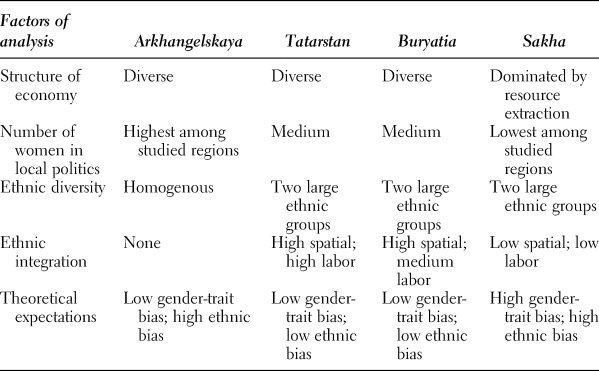
The Republic of Tatarstan in the central Volgo-Vyat region is home to Tatars, one of the largest ethnic minority groups in Russia. Tatars constitute about 50% of the republic's population, with ethnic Russians being the second-largest ethnic group in this region. Tatarstan is one of the richest regions in the Russian Federation, with one of the highest levels of industrial development, one of the highest levels of regional gross domestic product (GDP) per capita, low levels of poverty, and low levels of unemployment (Avdeyeva and Matland Reference Avdeyeva and Matland2020). Despite the republic's large deposits of gas and oil, the extraction industry constitutes only 15% of the total regional GDP. Industrial production, construction, trade, transportation, and state services (including education, health care, and social services) dominate the regional economic output (Russian Federal Statistical Services 2017). Tatarstan scores average in terms of women's participation in local politics compared with the other four selected regions: women made up 30% of mayors at the village level and 5% of mayors at the city level, but no women served as an executive at the district (county) level in 2017 (Avdeyeva, Vinokurova, and Kugaevsky Reference Avdeyeva, Vinokurova and Kugaevsky2017). Analysis of spatial and labor ethnic segregation in the republic suggests a high degree of integration between the largest ethnic groups, the Tatars and Russians. Both ethnic groups tend to live and work in ethnically mixed urban areas; ethnically segregated villages are quite common, but they are located close to each other geographically. In addition, analysis of the labor market does not reveal dramatic ethnic segregation in the labor market (Avdeyeva and Matland Reference Avdeyeva and Matland2020).
The Republic of Buryatia in southern Siberia is home to ethnic Buryats (30% of the population) and ethnic Russians (66% of the population). While labor segregation is more pronounced in Buryatia than in Tatarstan, with local Russians dominating the industrial sector and Buryats dominating the state administration and services, there is no evidence of spatial segregation. Buryats and Russians live in ethnically mixed cities and ethnically segregated villages located next to each other. Ethnic Buryats are also as likely as ethnic Tatars to speak Russian and to claim Russian as their mother tongue (Moser Reference Moser2008). There is a high degree of ethnic integration in this region, confirmed by low mobilization along ethnic lines. The nonextractive industrial sector, transportation, trade, and the rather large public sector dominate the regional economy. The extraction sector constitutes a modest 5% of the regional GDP. Women's representation in local offices is similar to that in Tatarstan: they make up 5% of mayors at the city level, 10% at the district level, and 25% at the village level.
The Sakha Republic is the third survey site. Located in northeastern Siberia, this region is home to the Sakha people, the majority ethnic group in the region. Ethnic Russians arrived in Sakha in large numbers during the period of the Soviet exploration of natural resources, and they mostly settled in the southern and western parts of the large republic, where resource mining is concentrated. Most people in Sakha live in the central nonmining districts, and there is clear spatial and labor segregation, which is underscored by the greater saliency of ethnic nationalism among the local Sakha population (Avdeyeva and Matland Reference Avdeyeva and Matland2020). The Sakha regional economy is dominated by the extraction industry: the share of diamond, gas, oil, and coal mining constitutes 40% of the regional GDP. Consistent with Ross's theory of gendered segregation of the labor force in extraction-driven economies, the numbers of women in political offices are lower than in the other studied regions: women make up 5% of city executives, 2% of district executives, and 20% of village executives.
Also included is one ethnically homogenous region, Arkhangelskaya Oblast, to explore any effect of ethic bias in a region with zero ethnic competition and ethnic integration. Located in the Russian European North, its regional economy is based on sea shipping, fishing, timber, and the multiple services that support those industries. The extraction industry constitutes a mere 3% of the regional GDP. Not surprisingly, therefore, Arkhangelskaya Oblast has the highest percentage of women in local political executives among the studied regions: 20% of city mayors, 18% of district executives, and 31% of village heads. These facts beg the question of whether those numbers translate into larger support for women as political leaders than in the other three regions. An overview of the main factors of regional variation is presented in Table 1.
Variation in regional economic structures, levels of ethnic integration, and number of women in local political offices in Russian regions

SAMPLING AND STUDY DESIGN
At each research site, we worked with social science faculty from the local university to procure respondents. To invite study participants, our recruiters used random procedures to select telephone numbers in a residential telephone directory. We recognize that this process biases our sample, as the telephones in these areas fail to provide 100% coverage. In addition, some groups of the population, such as elderly people, and especially elderly men, were difficult to recruit. Therefore, our sample moved in the direction of a quota sample.
Survey participants were paid between 300 and 600 rubles (US$10 to $20) for a session that was expected to last 90 to 120 minutes. Despite the limitations of the recruitment process, the sample is very diverse, with wide variation in age, sex, ethnicity, and educational background. Furthermore, since we are running experiments and not reporting poll results, our sample is appropriate for studying the effect of a politician's sex on public perception of his or her characteristics (Druckman and Kam Reference Druckman, Kam, Druckman, Green, Kuklinski and Lupia2011).
This study combines experimental survey and public opinion data to evaluate whether sex affects voter perceptions of political leadership. As noted before, attitudes about female politicians are directly measured using a question from the World Values Survey. Beyond that, the survey experiment measures public attitudes toward a specific type of politician in the context described in a vignette. All participants received a hard copy of the survey questionnaire, which included a vignette about a mayor deciding how to use the remaining public funds for the year. The policy dilemma described in the story (whether a mayor should invest the remaining city funds in a health care facility or a school) is typical for Russian small-town reality (full text is available in the Supplementary Material). We randomized three elements in the story: the sex of the mayor, the ethnic background of the mayor, and the mayor's policy choice (school or health clinic). Using a 2 × 2 × 2 design, we created eight versions of the questionnaire that were randomly distributed among participants at each session. The mayor's name is gender and ethnicity specific; there are also references to the mayor as “he” or “she” in the text. Other than the policy chosen and the sex and ethnicity of the mayor, the texts describing the dilemma are identical in all surveys. If the sex and ethnicity of the mayor are irrelevant to the evaluations, then the female and male mayors of Russian and non-Russian ethnicity should be evaluated similarly, regardless of the sex and ethnicity of the respondents.
STUDY RESULTS
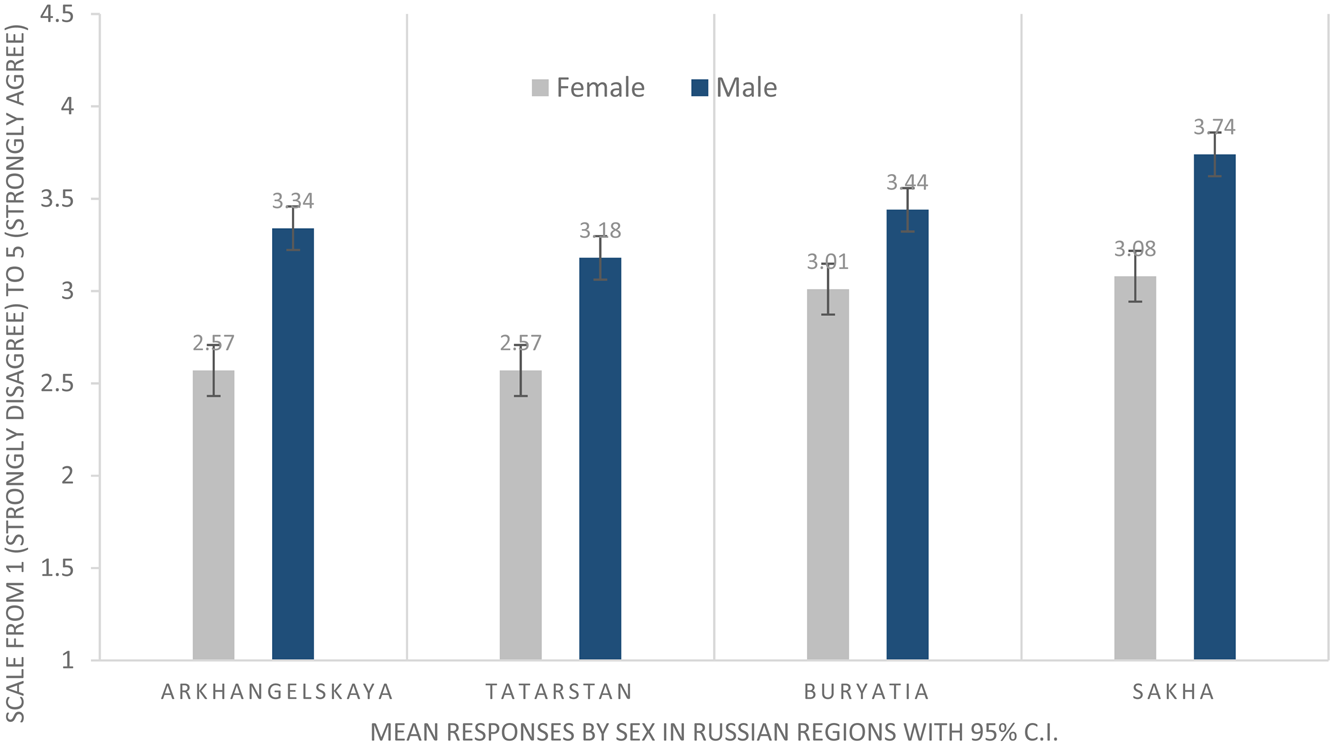
The first measure used to evaluate the impact of sex on political leadership is the respondents’ answers to the World Values Survey question “On the whole, men make better political leaders than women.”Footnote 1 Figure 1 presents the data for the four regions. The results show some variation across the regions. Respondents in Tatarstan, the region with the highest GDP per capita and a diverse economy, give the lowest support to the statement that men make better political leaders among the four regions (with a regional mean of 2.80 on a 5-point Likert scale). It is closely followed by respondents in Arkhangelskaya Oblast, with a regional mean of 2.88, as well as the largest proportion of women in local political office coupled with the lowest dependence on resource extraction. It is noteworthy that female respondents score similarly in these two regions; the difference in the regional averages is explained by the differential between the male respondents. Tatarstan men are significantly less patriarchal than men in Arkhangelskaya Oblast.
Average responses to the question “On the whole, men make better political leaders than women” for female and male respondents by Russian region, with standard errors.

There is a clear pattern in the geographic direction of patriarchal bias, increasing as we move from west to east. The southern Siberian region of Buryatia is ranked third with a mean of 3.16, substantially higher for female and male respondents compared with the first two regional samples. The highest support for male political leadership is voiced in Sakha, the region with an economic focus on resource extraction and the lowest proportion of women in local political offices. Both men and women tend to agree with the survey question, but the patriarchal bias is especially high among men in this region with a mean of 3.74 on a 5-point scale. This analysis of bias against women as political leaders confirms Ross's (Reference Ross2008) theoretical proposition that regions with an economy based on resource extraction will have fewer women in politics and, as a consequence, less public support for female political leaders. However, the question remains whether this generalized belief in male superiority translates into gender-trait biases when voters evaluate female and male political leadership.
EXPERIMENTAL RESULTS
Turning to the analysis of the experimental survey, the objective is to determine whether gender-trait characteristics figure prominently in the evaluation of mayors. After reading the vignette, our respondents evaluated the mayor on nine pairs of gender-trait characteristics based on a scale from 1 to 7, with each end of the scale anchored by the scale wording. For each pair, 1 is associated with a quality not desired in political leadership, and 7 is associated with a quality desired in political leadership. Three of the examined characteristics are qualities most often associated with women: emotional–calm, dishonest–honest, and self-centered–caring. Another three characteristics are qualities most often associated with men: noncompetent–competent, cautious–decisive, and weak–strong.
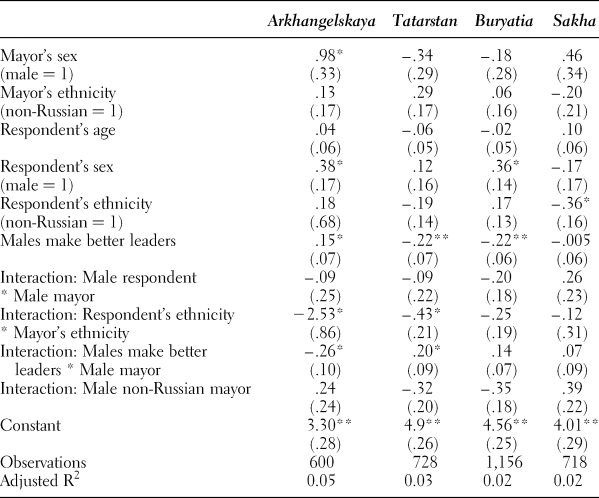
To probe voter use of gender-trait biases, ethnic biases, and intersectional bias, we model a series of ordinary least squares (OLS) regressions for each paired characteristic. Table 2 presents the results of the OLS regression for the emotional–calm paired characteristic, which address propositions gleaned from role congruity and social identity theory. We control for the mayor's sex (male = 1) and ethnicity (non-Russian = 1) and for the respondent's age (measured using five categories), sex (male = 1), ethnicity (non-Russian = 1), and expression of direct bias against female leaders (the respondent's answer to the “men make better political leaders than women” question, coded on a 5-point scale). We also include interaction terms to account for the complexities of intersectionality bias.
Modeling evaluations of mayor's characteristics, emotional–calm, in Arkhangelskaya Oblast, Tatarstan, Buryatia, and Sakha

Note: Standard errors in parentheses.
* p < .05; ** p < .001.
For role congruity theory, we interact male mayor with the respondent's answer to the direct question about the men being better political leaders. Our first expectation for role congruity theory is that male mayors will be evaluated more favorably in regions where women have not attained local political office (i.e., male bias should be more prominent in Sakha than in other regions). Our second expectation is that ethnically Russian mayors will be evaluated more favorably than mayors of non-Russian ethnicity in regions where ethnic minorities have not attained local political office (i.e., ethnic bias should be most prominent in Arkhangelskaya Oblast, an ethnically homogenous region).
For social identity theory, we also interact the ethnicity of the respondent with the ethnicity of the mayor, and we interact male respondents with male mayor to account for sex affinity. Our general expectation is that in regions characterized by high labor and ethnic segregation, we will find greater ethnic favoritism toward the respondent's co-ethnic mayor (i.e., in Sakha, we should find greater ethnic favoritism than in other regions).
For intersectionality, we interact the mayor's ethnicity with the mayor's sex, which essentially creates a dummy variable for non-Russian male mayors (which, we recognize, is a redundant way to account for intersectional complexity, but we deal with it in the next set of regressions). In general, we expect to reveal that the mayor of the most marginalized social group will be the least favorably evaluated. In ethnically homogenous Arkhangelskaya Oblast, we expect the respondents to evaluate ethnically non-Russian female mayors least favorably.
Arkhangelskaya Oblast gives support to role congruity theory: male mayors are viewed as calmer, but there is also a counterintuitive finding: those who believe that men make better political leaders tend to view men as more emotional. Thus, in Arkhangelskaya Oblast, the direct group bias does not translate into any biased evaluation of the mayor in the experimental survey. This region also gives support to social identity bias: co-ethnics evaluate the mayor as more emotional. Tatarstan is the only other region showing statistically significant results: co-ethnics evaluate the mayor as more emotional, and, consistent with role congruity theory, those who believe that men make better political leaders tend to see female mayors as more emotional.
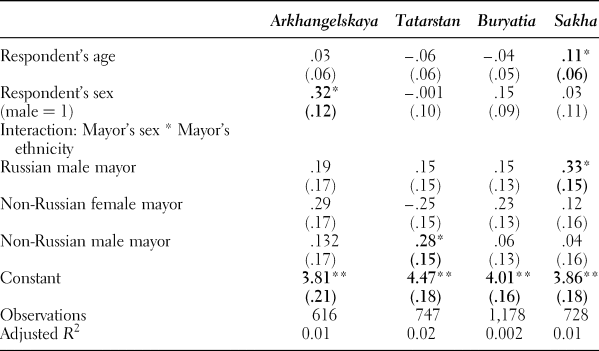
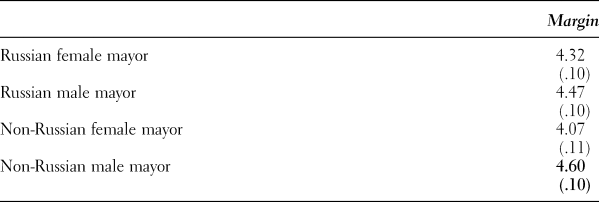
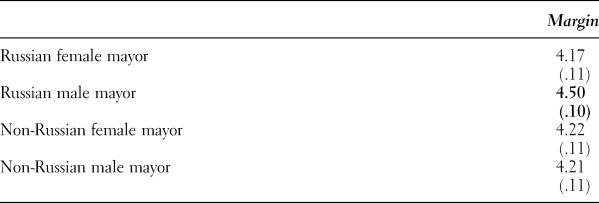
The intersectional analysis (Table 3) reports another OLS regression with interactions to capture all possible combinations of the mayor's ethnicity and sex: Russian male mayor, non-Russian female mayor, and non-Russian male mayor (Russian female mayor is excluded). A calculation of the margins for each group shows that the largest gap in Tatarstan (see Table 3a) is between the non-Russian male mayor, who is viewed as the calmest at 4.6 (.10), and the non-Russian female mayor, who is viewed as the most emotional at 4.07 (.11). In Sakha (see Table 3b), another region where there was a statistically significant difference in the evaluation of the mayor of different groups, the Russian male mayor is viewed as the calmest at 4.17 (.11), and the Russian female mayor is viewed as the most emotional at 4.50 (.10). These findings confirm that the marginalized groups in politics—women of different ethnic backgrounds—are evaluated more unfavorably in leadership characteristics.
Modeling evaluations of mayor's characteristics, emotional–calm, in Arkhangelskaya Oblast, Tatarstan, Buryatia, and Sakha, intersectional analysis

Note: Standard errors in parentheses.
* p < .05; ** p < .001.
Marginal effects of mayor's sex and mayor's ethnicity on mayor evaluation, emotional–calm, in Tatarstan (95% CI), intersectional analysis

Note: Standard errors in parentheses.
Marginal effects of mayor's sex and mayor's ethnicity on mayor evaluation, emotional–calm, in Sakha (95% CI), intersectional analysis

Note: Standard errors in parentheses.
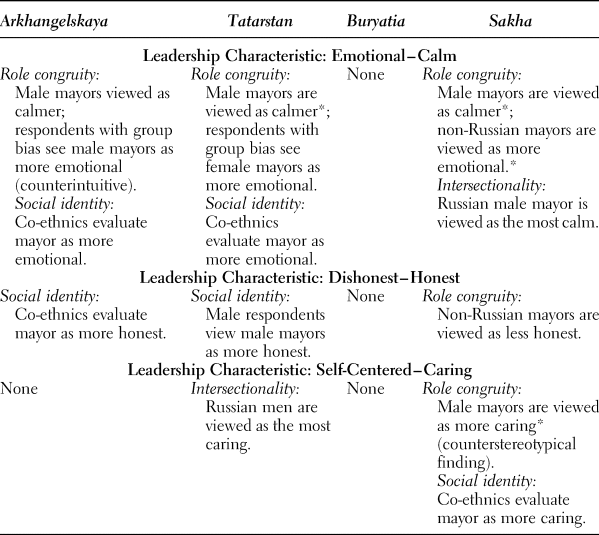
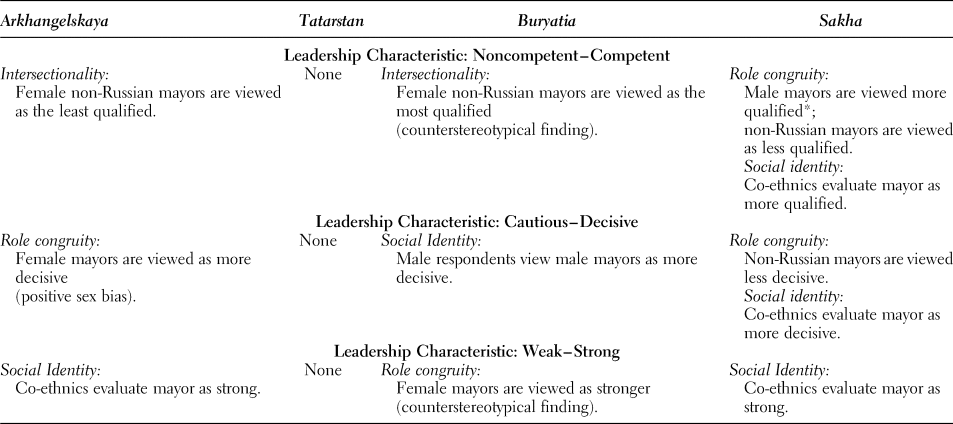
We perform the same statistical analysis for all eight remaining paired characteristics in four regions; the regression results are presented in the Supplementary Material. In Tables 4 and 5, we present the summary of the statistically significant results for all paired characteristics by theory and by region. We note that in addition to the major OLS regressions, we run truncated regressions to test for the effect of sex and ethnicity of the mayor (presented in full in the Supplementary Material), and we present statistically significant results from those regressions marked by the asterisk. Now we turn to the discussion of these results.
Summary of results from the OLS regression analysis: Feminine leadership characteristics by interaction effects of sex, ethnicity, respondents’ group bias, and intersectional analysis

Note: Only statistically significant results are reported.
* These results are from truncated regressions reported in Supplementary Materials.
Summary of results from the OLS regression analysis: Masculine leadership characteristics by interaction effects of sex, ethnicity, respondents’ group bias, and intersectional analysis

Note: Only statistically significant results are reported.
* These results are from truncated regressions reported in Supplementary Materials.
Table 4 presents the summary of results for feminine paired characteristics. We already discussed the results for the emotional–calm pair, but we added the results from the truncated models in this table, which indicate that in Tatarstan and Sakha, male mayors, on average, are viewed as calmer than female mayors, in line with the role congruity theory. In addition, non-Russian mayors are viewed as more emotional, and presumably less suited to a leadership position in Sakha, which also confirms role congruity theory.
For the dishonest–honest pair, we find support for social identity theory in Tatarstan (male respondents view male mayors as more honest) and Arkhangelskaya Oblast (co-ethnics evaluate mayors as more honest). Also, in Sakha, non-Russian mayors are viewed as less honest. The final pair of characteristics, self-centered–caring, produced the most counterintuitive results: men are viewed as more caring in Sakha; Russian men viewed as more caring in Tatarstan; and co-ethnics evaluate mayors as more caring in Sakha.
In reviewing the entire set of feminine trait characteristics, gender-trait characteristics are most prominently featured in the emotional–calm pair; in the two other pairs the results are counterintuitive, with male mayors being viewed as more honest and more caring. In this set of characteristics, the social identity biases feature prominently in Arkhangelskaya Oblast (an ethnically homogenous region) and in Sakha (a region with a low level of ethnic integration), where co-ethnics tend to favor mayors of their ethnic group. In Buryatia, we do not find evidence of ethnic bias and gender-trait reliance.
In Table 5, we present the results for three masculine paired characteristics. Sakha shows the prominence of gender-trait bias, as male mayors are viewed as more competent. The region of Arkhangelskaya Oblast shows the importance of intersectionality, because female non-Russian mayors are viewed as less competent. In Buryatia, we find another unexpected counterintuitive bias about female mayors: non-Russian female mayors are viewed as more competent, and female mayors are viewed as stronger. Similarly, in Arkhangelskaya Oblast, female mayors are viewed as more decisive than male mayors. Social identity biases dominate the results in this set of paired characteristics, with Arkhangelskaya Oblast and Sakha showing that co-ethnics view the mayor as more competent (Sakha), stronger (Arkhangelskaya and Sakha), and more decisive (Sakha). In Tatarstan, we do not find any statistically significant results for these characteristics.
We present the results for the gender-neutral set of characteristics in the Supplementary Material. For this set of characteristics, the respondents in Sakha use gender-trait and ethnic biases most consistently in their evaluation of the mayors. Ethnic biases prevail in this set of results: non-Russian mayors are viewed as less reliable and less realistic than Russian mayors. Co-ethnics view the mayor as more reliable in Sakha and more charismatic in Arkhangelskaya Oblast. Gender-trait bias is prominent in Sakha (male mayors are viewed as more realistic and more charismatic) and in Tatarstan (female non-Russian mayors are viewed as least charismatic), but in Buryatia, we do not find any ethnic or gender-trait biases.
The overall results from the experimental and nonexperimental survey confirm the importance of regional political context for explaining variation in gender-trait and ethnic biases within the Russian population. Ethnic biases are most prominent in two regions: Sakha Republic, with low levels of ethnic integration, and Arkhangelskaya Oblast, with zero ethnic competition and ethnic integration. In two regions with higher levels of ethnic integration, Buryatia and Tatarstan, ethnic biases do not feature prominently in voters’ evaluations of the mayor. This important finding strongly suggests that ethnic biases dissipate in the context of ethnic competition, ethnic cooperation, and successful ethnic integration. In other words, ethnic integration arises in contexts when ethnic competition gives way to interethnic cooperation and collaboration in day-to-day activities, including common workplaces. Ethnic homogeneity, therefore, serves as fertile ground for the persistence of ethnic biases. This also becomes fertile soil for the marginalization of social out-groups, as seen to some degree in Arkhangelskaya Oblast, where non-Russian female mayors are viewed as the least competent for political leadership among any other groups.
While we find gender-trait biases in all Russian regions, they feature most prominently in Sakha, both in the direct survey question and in the experimental survey. We employed the political economy hypothesis to explain the persistence of gender biases in voters’ evaluations of political leaders (Ross Reference Ross2008), because Sakha is the only region where resource extraction dominates the regional economy. A resource extraction economy favors a male labor force and men's career advancement while depressing opportunities for female workers to succeed as managers in industries dominated by male workers. The absence of women in key managerial positions undermines their chances to attain local political offices. As a consequence, low numbers of women in key managerial and local executive offices send signals to the public that women are less likely to succeed in the male-dominated political and economic environment, and thus, voters are less likely to support women as political leaders. Our analysis, therefore, further extends Ross's (Reference Ross2008) theory by validating the influence of the local political economy on public attitudes toward women as political leaders.
Intersectional analysis uncovers instances in which the combination of sex and ethnicity lead to bias against particular social out-groups. Russian men are considered the calmest and therefore most suited for a leadership position in Sakha. Russian men are also considered most caring in Tatarstan, which is strongly counterintuitive but may be a “noisy” finding. In ethnically homogeneous Arkhangelskaya Oblast, a non-Russian female mayor is considered least competent in the mayor's position, confirming role congruity theory that the most atypical local leader will be evaluated least favorably. On the other hand, in Buryatia, where non-Russian female political leaders are quite common, female minority mayors are considered the most competent. Thus, localized experiences matter for the persistence or absence of prominent social biases.
CONCLUSION
Our analysis shows the importance of regional political, social, and economic contexts for explaining the persistence of gender-trait stereotypes and ethnic bias in the diverse regions of Russia. We find strong support for social identity theory's link between ethnic integration and the persistence of ethnic biases. In two regions characterized by low or no ethnic integration, we report more voter reliance on co-ethnic favoritism in their evaluation of leadership traits. Spatial or geographic separation reinforced by segregation in the labor force explains low level of ethnic integration between ethnic Sakha and ethnic Russians. In the experimental survey, citizens of both ethnic groups tend to favor co-ethnic mayors. Similarly, the citizens of ethnically homogenous Arkhangelskaya Oblast evaluate a co-ethnic mayor more favorably than they evaluate a mayor of another ethnicity. We do not find ethnic favoritism in voter evaluation of political leaders in the two regions characterized by high degrees of ethnic cooperation and ethnic integration, which confirms the importance of ethnic integration as a key factor for reducing ethnic bias in how citizens evaluate political leaders.
We also find support for role congruity theory. In a region where women do not feature prominently in local political offices, we report the highest level of direct bias against female political leaders and higher reliance on gender-trait stereotypes in the experimental survey. But in regions where women are common as heads of local executive offices, we do not report gender-trait biases against female mayors.
The primary conclusion from our analysis is that to fully comprehend the complexity of social bias formation and its persistence scholars must embrace explanations beyond any single theory. This lesson has direct relevance studying bias in other contexts beyond Russia. Stereotypes of social groups and beliefs about their leadership traits undergird regional political biases, but those stereotypes and beliefs can vary across societies and persist or change across time. It is important to identify the relevant social out-groups that are salient in each social context and develop understanding about how stereotypes about these groups are associated with perceptions of leadership, electability, and support. Beyond that, we highlight the importance of the local political, social, and economic context, which explains the dynamics of relations between different social groups, reveals their relative empowerment in the labor market and politics, and informs the public's bias. In sum, this analysis underscores the complexity and seeming intractability of the public's bias and demonstrates how a local context structured by labor market opportunities, localized politics, and local relations between prominent social groups, especially gender and ethnic groups, largely inform those political biases.
Looking ahead, these findings prompt us to encourage scholars to engage in careful comparative investigation of social, political, and economic contexts, and the ways they influence the formation and change of social stereotypes. This kind of detailed contextual analysis will help scholars understand the roots of bias persistence and, thus, could suggest the kinds of appropriate policy measures that may ameliorate these problems of perceptual bias. The use of quota policies for women and minorities, for example, may erode the influence of stereotypes in public evaluation of political leaders. However, to achieve true parity between men and women or ethnic minority and majority groups in political office, it may not be enough to “add women (or minority leaders) and stir.” The roots of women and minority empowerment lie in complex structural changes such as economic diversification and ethnic integration of labor markets, systemic processes that would require significant political commitment and support.
SUPPLEMENTARY MATERIAL
To view supplementary material for this article, please visit https://doi.org/10.1017/S1743923X2000001X.