1. Introduction
In a recent essay addressing Joyce's proposed nonpragmatic justification of probabilism, Branden Fitelson (Reference Joyce2012) argues that a variant of Miller's argument for the language dependence of the accuracy of predictions can be applied to Joyce's notion of accuracy of credences formulated in terms of scoring rules. Fitelson focuses on a particular scoring rule, the Brier score, which falls under Joyce's constraints on epistemic scoring rules. After presenting an illustrative example, Fitelson states a theorem for Brier scores that he believes to reveal a general potential problem of language dependence for Joyce's argument for probabilism. This article shows that if Joyce's argument has any potential problems, the one Fitelson raises is not among them. We contend that Fitelson's argument has not successfully posed such a problem for Joyce, as both his illustrative example and his main theorem presuppose the validity of transformations of credence functions that Joyce's theory, charitably construed, would identify as invalid on the basis of the principle of simple dominance. As we shall see, with the validity of the transformations undermined, no relevant problem of language dependence of the sort Fitelson supposes arises.
Since we intend for our article to be a direct response to Fitelson's essay, we advise the reader to consult Fitelson's article (Reference Joyce2012) and Joyce's articles (Reference Joyce1998, Reference Predd, Seiringer, Lieb, Osherson, Poor and Kulkami2009) for details we have left out. Although we also intended for our article to be brief, and although we take our central point to be rather simple, we found it necessary to construct a rigorous explication of Fitelson's argument to avoid potential misunderstandings. Accordingly, the structure of this article is as follows. In section 2 we reconstruct the illustrative example Fitelson uses to motivate the alleged potential problem of language dependence, calling attention to some points that require clarification. To assist with such clarification, in section 3 we turn to a review of the notion of coherence pertinent to Fitelson's discussion of the Brier score, emphasizing basic assumptions of Joyce's theory and in particular the principle of simple dominance. In section 4 we state some basic facts regarding Fitelson's example in an effort to clarify the above mentioned points. Then, in section 5, we recall Fitelson's statement of his purported theorem, thereupon presenting a charitable interpretation of what it says. We argue that his theorem and illustrative example do not reveal a relevant problem of language dependence for Joyce's proposal. Finally, in section 6, we conclude with some brief remarks.
2. Fitelson's Illustrative Example
To set the stage, we begin with Fitelson's example. His notation is somewhat confusing, and it is best to begin by quoting him: “Now, following Joyce, we will associate the truth-value True with the number 1 and the truth-value False with the number 0. Let be the numerical value associated with P's truth-value, and let ψ be the numerical value associated with  's truth-value (of course, and ψ will vary in the obvious ways across the two salient possible worlds: w 1, in which P is false, and w 2, in which P is true)” (Reference Joyce2012, 169). In other words, and ψ are functions from a set W of states, w 1 and w 2, in which P is assigned values in
 , coding True and False, respectively, subject to the constraint that
 . Unfortunately, Fitelson does not clarify whether when he writes ‘’ he means a functional quantity or a particular truth value, and indeed he refers to and ψ interchangeably as truth values and quantities. Personal communication with Fitelson reveals that he intends for and ψ to be understood as real-valued functions on W.
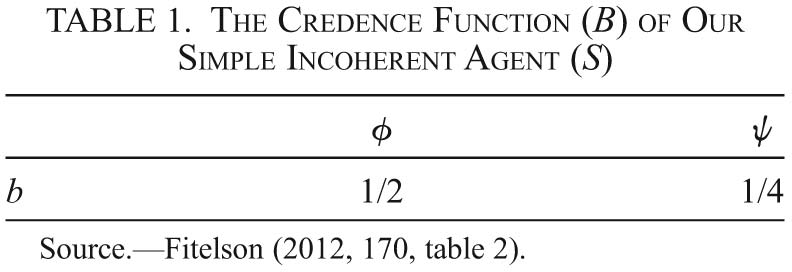
Fitelson writes: “Suppose that S's credence function (b) assigns the following values P and  (i.e., b entails the following numerical ‘estimates’ of the quantities and ψ; see table 2)” (see our table 1, which replicates Fitelson's table 2 [Reference Joyce2012, 170]). Clearly b is incoherent as defined for the quantities and ψ, as can be seen from the fact that the values b “entails” for and ψ (using Fitelson's terminology) do not sum to 1. As Fitelson remarks, according to Joyce's theory there is a coherent b′ defined for the quantities and ψ that dominates b with respect to the Brier score (we clarify what this means in secs. 3 and 4).

| ψ | ||
|---|---|---|
| b | 1/2 | 1/4 |
Source.— Fitelson (Reference Joyce2012, 170, table 2).
Fitelson then introduces two new functions defined on W (Reference Joyce2012, 170):


Note that  and
 . These are real-valued functions from W to
 whose values are determined uniquely in each world in W by the value of and ψ for that world, and
 .
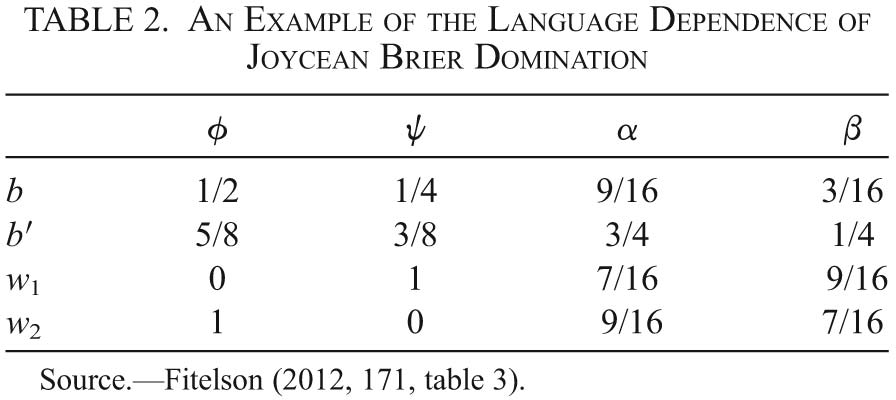
Fitelson assumes the “same” functions, b and b′, so α and β are “new” real-valued functions on which b and b′ are defined. In fact, Fitelson produces an entire table of values for b and b′ for all of , ψ, α, β without explaining quite what it means or how it was obtained. We have reproduced his table 3 as our table 2. Summarizing, we understand Fitelson to have introduced four real-valued functions  , by setting
 and
 (where
 is the indicator for event A) and defining α and β as given in equations (1) and (2). In addition, we understand Fitelson to have introduced two functions
 , where
 , as follows:

and

We point out that Fitelson may wish for the reader to consider independently b and b′ as defined on  , on the one hand, and b and b′ as defined on
 , on the other (thereby considering the restrictions of the above functions). Having said this, we claim that the present precise formulation, subject to the latter proviso, is a charitable formulation of the mathematical objects underlying Fitelson's example. In any case, in personal communication, Fitelson has indicated that our reading is correct.

| ψ | α | β | ||
| b | 1/2 | 1/4 | 9/16 | 3/16 |
| b′ | 5/8 | 3/8 | 3/4 | 1/4 |
| w 1 | 0 | 1 | 7/16 | 9/16 |
| w 2 | 1 | 0 | 9/16 | 7/16 |
Source.— Fitelson (Reference Joyce2012, 171, table 3).
We should mention now that Fitelson may have already stepped outside of Joyce's argument for probabilism, for Fitelson is considering functionals b and b′ defined for simple real-valued functions (i.e., real-valued functions taking finitely many values), whereas Joyce restricts his attention to functionals defined on propositions, or real-valued functions taking the values 0 and 1. Nonetheless, for the sake of addressing Fitelson's purported potential problem, let us grant that Joyce can accommodate simple real-valued functions in a more general argument for probabilism (i.e., for finitely additive expectations), establishing that the Brier score satisfies suitably reformulated constraints on scoring rules for functionals defined on simple real-valued functions (or even, say, bounded real-valued functions). Indeed, we understand Joyce to have such a larger goal in mind when discussing the special case of 0–1-valued quantities. Thus, in Joyce's framework, one can evaluate the quality of a person's estimates  of various quantities χ in terms of the accuracy of the estimates with respect to their true values at each state. Indeed, in personal communication, Joyce has indicated that this understanding of his program is correct.
This point aside, it is easy to see how Fitelson has arrived at the values for b and b′ for α and β, given the values of b and b′ for and ψ. Indeed, treating b as an operator preserving scalar multiplication, addition, and division, one obtains the values in table 2. Thus, in effect, Fitelson presupposes that the following equations hold:

and

where  and
 . Again, in personal communication, Fitelson acknowledges that he presupposes the aforementioned equations. Thus, again, we claim that our exposition of Fitelson's example is charitable.
Now to the important bit: Fitelson claims that b′, a coherent function, Brier dominates b “with respect to and ψ.” He further claims that b, an incoherent function, dominates the coherent function b′, using the Brier score, “with respect to α and β.” Fitelson announces that these claims constitute an illustration of his main theorem (Reference Joyce2012, 170), asserting that such a “reversal” reveals a potential “Milleresque” problem of language dependence of the accuracy of credences. However, the content of his claims is unclear. In particular, it is unclear what we he means by the locutions beginning with “with respect to.”
3. Coherence and Simple Dominance
In this section we briefly review two notions of coherence connected to finitely additive probabilities and more generally finitely additive expectations. Doing so will help to clarify the content of Fitelson's claims and some basic assumptions underlying Joyce's argument, accordingly being a natural place to introduce the Brier score. In addition, it will help us to understand the statement of Fitelson's theorem. It is illuminating to first review the notion of coherence for betting odds due to de Finetti.
Given a collection  of bounded real-valued functions, an agent posts his fair prices
 for each
 subject to the understanding that he is ready to accept any finite combination of gambles of the form
 , where
 . The payoff to any finite combination of gambles is given by the sum of the gambles. Thus, the value of
 is the number that leaves the agent indifferent as to whether c is positive, negative, or zero. The notion of coherence due to de Finetti demands that no finite combination of gambles leads to a sure loss.
Definition 1 (Coherence1). Let W be a set of states, let  be a collection of bounded real-valued functions, and let
 be a real-valued function. We say that P is coherent 1 if there are no
 ,
 , and
 such that for every


Otherwise, P is said to be incoherent 1.
Observe that when each real-valued function in  is simple, as in Fitelson's and Joyce's papers, then P is coherent1 just in case there are no
 and
 such that for every


Also observe that  may be an arbitrary class of bounded real-valued functions and in particular is not required to satisfy any measurability conditions with respect to an underlying algebra or σ-algebra.
As we have indicated, Fitelson's discussion is couched in terms of the Brier score. There is a well-known notion of coherence formulated in terms of this score due to de Finetti and explored by Joyce. Let  stand for the loss, or score, suffered by an agent who evaluates
 as the estimate of f. The loss given to a finite set of such evaluations
 is the sum of the losses for each evaluation. The Brier score is one of the “measures of epistemic disutility” satisfying Joyce's underlying philosophical assumptions about epistemic scoring rules. We recall de Finetti's notion of coherence for the Brier score.
Definition 2 (Coherence2). Let W be a set of states, let  be a collection of bounded real-valued functions, and let
 be a real-valued function. We say that P is coherent 2 if there are no
 ,
 , and
 such that for every


Otherwise P is said to be incoherent 2.
Much like above, observe that when each real-valued function from  is simple, then P is coherent2 just in case there are no
 and
 such that for every


Again,  may be an arbitrary class of bounded real-valued functions.
De Finetti has established the equivalence of coherence1 and coherence2. In fact, he has shown the following theorem:
Theorem 1 (de Finetti Reference de Finetti1974/1990). Let W be a set of states, let  be a collection of bounded real-valued functions, and let
 be a real-valued function. Then the following statements are equivalent:
i) P is coherent1.
ii) Pis coherent2.
iii) There exists a finitely additive probability p on W such that under the expectation functional
 under p, for every , .
 under p, for every
 ,
 .
This result holds generally and so in particular for 0–1-valued quantities (i.e., events). In addition, when  is finite, consisting of, say, n bounded real-valued functions
 , it can be shown that if and only if F is incoherent2 (incoherent1), there is a coherent2 (coherent1) P such that
 for every
 . Following Fitelson's choice of terminology, given P and F defined on
 , let us say that P Brier dominates F if
 for every
 . Again, Fitelson, like Joyce, restricts his attention to a finite collection of simple real-valued functions
 (as mentioned in sec. 2, Joyce focuses in particular on 0–1-valued quantities). For the sake of discussion, we do the same.
We emphasize that when  consists of simple real-valued functions, both coherence1 and coherence2, respectively formulated in terms of sums of gambles or sums of losses, follow from the principle of simple dominance, which states that if an option o 1 dominates an option o 2 in each state (i.e.,
 for each state w), then o 2 is inadmissible for choice in any decision problem in which o 1 is feasible. In particular, regarding coherence2, any function F Brier dominated by another function P is inadmissible whenever P is a feasible function. While perhaps formulated using different language, we understand Joyce to subscribe to (at least) the principle of simple dominance for the Brier score as well as any other scoring rule falling under his theory. As such, when the Brier score is adopted as a scoring rule, coherence2 follows.
4. A Clarification of Fitelson's Claims
As indicated at the end of section 2, it is unclear what Fitelson means by his claim that (i) b′ Brier dominates b “with respect to and ψ” and his claim that (ii) b Brier dominates the coherent measure b′ “with respect α and β.” The purpose of this section is to state some elementary facts regarding Fitelson's example and then to attempt to explicate Fitelson's claims. As mentioned in passing in the last section, doing so will serve to support the interpretation of Fitelson's theorem given in the next section.
 be defined as in


 be defined as in


Thus, we see that both b and b′ are incoherent2.
Let us now turn to a clarification of Fitelson's claims i and ii. Where  is defined by setting
 for every
 —that is, where
 is the restriction of b′ to
 —the statement that b′ Brier dominates b with respect to and ψ is given meaning in fact 1. Similarly, where
 is the restriction of b to
 , the statement that b Brier dominates b′ with respect to α and β is given meaning in fact 2. We mention that it trivially follows from fact 2 that
 is incoherent2.
We also have the following facts:
Fact 3. The restriction  is coherent2. That is, with respect to the collection
 ,
 is coherent2.
Fact 4. The restriction  is incoherent2. That is, with respect to the collection
 ,
 is incoherent2.
Fact 3 gives meaning to Fitelson's claim that b′ is coherent with respect to and ψ, while fact 4 explains Fitelson's apparent recognition that b is incoherent with respect to α and β. Yet whether we are considering  or
 , Fitelson's claim (Reference Joyce2012, 172) that his example illustrates that b′ is a coherent function Brier dominated by the incoherent b is plainly false or meaningless, as witnessed by the aforementioned facts.
5. The Theorem and Its Relevance to a Potential Problem of Language Dependence
We now turn to Fitelson's theorem and the (potential) lesson he wishes to draw from it.
Theorem 2 (Fitelson Reference Joyce2012, 170–71). For any coherent function b′ that Brier dominates S's credence function b with respect to and ψ, there exist quantities α and β that are symmetrically interdefinable with respect to and ψ, via the following specific intertranslations:

where b Brier dominates b′ with respect to α and β.
Fitelson believes it is “noteworthy that the true values of α and β ‘behave like truth values,’ in the sense that (1) the true value of α (β) in w 1 (w 2) is identical to the true value of β (α) in w 2 (w 1), and (2) the values of α and β always sum to one” (Reference Joyce2012, 171–72). He continues, “Indeed, these transformations are guaranteed to preserve coherence of all dominating b′'s, and the ‘truth vectors’” (171).
The statement of the theorem is unclear, and at first sight it appears that Fitelson's theorem contradicts de Finetti's result (theorem 1). Unfortunately, Fitelson does not furnish a proof of the theorem for possible clarification, instead pointing to a web address from which a Mathematica notebook containing verifications of all formal claims in his essay is said to be available for download. As of the writing of this article, the linked web address is broken.
In the absence of such assistance—yet in light of the discussion in the previous section—we take the above theorem to state something like, if  are such that b′ is coherent and Brier dominates b (in Fitelson's language, b′ Brier dominates b with respect to and ψ), then considering the quantities α and β as above:
I. b and b′ can be extended to {, ψ, α, β} by setting:
andwhere, as in section 2:andII.
Brier dominates (in Fitelson's language, b Brier dominates b′ with respect to α and β).


 Brier dominates
 (in Fitelson's language, b Brier dominates b′ with respect to α and β).
We claim that this, or a slight variation of it, is a charitable formulation of his theorem. In I, for example, Fitelson might wish for us to consider the “transformations” b and b′ defined on  in terms of the values assigned by b and b′ to and ψ rather than b and b′ defined on all of
 . In either case, the appropriate way to dispute our claim to a charitable formulation would be to furnish an equally rigorous formulation that is more charitable. Our remarks apply to either variation.
We note that Fitelson's theorem is apparently intended to hold for taking different values than ψ at each state and, depending on its precise formulation, for b and b′ assigning distinct values to and ψ. (Indeed, Fitelson's theorem is false if credence functions may take values outside of (0, 1).) As illustrated by Fitelson's example, while  may be coherent2, in general
 will not be coherent2. Furthermore, as Fitelson's own example illustrates, the coherence of b′ is not preserved by the transformations (contrary to his assertion; see the remarks at the end of the last section). While we do not wish to dispute claims 1 and 2 after the statement of his theorem, we do not know what Fitelson means by his claim that coherence is preserved. In any case, the theorem is unsurprising, as it is well known that coherence is not generally preserved by nonlinear transformations.
Having stated the theorem, Fitelson writes, “So while it is true that there are some aspects of ‘the truth’ with respect to which S's credence function b is bound to be less accurate than (various) coherent b′'s, it also seems to be the case that (for any such b′) there will be specifiable, symmetrically interdefinable aspects of ‘the truth’ on which the opposite is true (i.e., with respect to which b′ is bound to be less accurate)” (Reference Joyce2012, 171). Fitelson does not clarify what “aspects” he has in mind. In any case, he concludes, “I think the present phenomenon challenges us to get clearer on the precise content of the accuracy norm(s) that are applicable to (or constitutive of) the Joycean cognitive act of ‘estimation of the (numerical) truth-value of a proposition’” (171).
Later Fitelson elaborates on this challenge. Using Fitelson's notation, where  is understood to be the claim that agent S is committed to the values
 as “estimates” of the quantities
 , Fitelson thinks that “we need to know … the conditions under which the following principle … is acceptable, relative to Joyce's notion of ‘estimation’ :
(†) If
, then , where f is a symmetric intertranslation function that maps values of to/from values of ” (Reference Joyce2012, 173).
 , then
 , where f is a symmetric intertranslation function that maps values of
 to/from values of
 ” (
That is, Fitelson explains, he would like to know which translations f are acceptable. He presumes that Joyce would want to reject the translation as given in the theorem, but he thinks “it is natural to ask precisely what grounds Joyce might have for such a rejection” (174). Apparently Fitelson thinks that answering the aforementioned question would go toward a promising and useful response to his “reversal argument” (as he calls it): “I think the most promising (and useful) response to the phenomenon is to argue (i) that there are crucial disanalogies between ‘estimation’ (in Joyce's sense) and ‘prediction’ (in the sense presupposed by Popper and Miller), and (ii) these disanalogies imply that my ‘reversal argument’ is presupposing something incorrect regarding the norms appropriate to ‘estimation’” (172). Unfortunately, Fitelson does not present a clear argument indicating why such a response would be promising or useful. Nor does he supply a clear argument showing that Joyce must answer his general question about †. In the absence of such arguments, we think that for Joyce it is sufficient to show why Fitelson's theorem and illustrative example fail to present a Milleresque problem for his theory; he may oblige Fitelson with a partial answer to his questions about † and i and ii (or their subquestions) in the course of his response if doing so is expedient. We propose to respond on Joyce's behalf.
Consider a Joycean rational agent for whom the Brier score measures the epistemic disutility of estimates of quantities.Footnote 1 Among other things, such an agent at least respects the principle of simple dominance for the Brier score. Thus, in considering feasible functions b and b′ defined for and ψ and the quantities α and β defined in terms of and ψ as in the statement of the theorem or the illustrative example, the agent would identify b as inadmissible because it can be Brier dominated by a feasible function F. The agent would also rule the extensions of b and b′ to {, ψ, α, β} as given by the translation in I as inadmissible since each can be Brier dominated by an alternative feasible function F defined on {, ψ, α, β}. Alternatively, in considering the “jump” (i.e., transformations) from b and b′ defined on  to b and b′ defined on
 by way of the translations in I, the agent would rule b and b′ so defined on
 as inadmissible on the basis of simple dominance since each can be Brier dominated by an alternative feasible function F defined on
 . In either case, a Joycean rational agent has the resources to evaluate the inadmissibility of various functions b∗ on the basis of simple dominance, and the extensions/transformations of b and b′ are inadmissible.
In addition, although α and β as defined take values depending on and ψ (and vice versa), and although b and b′ as defined “reverse” the direction of Brier dominance when first considering and ψ and then considering α and β, no relevant Miller-Popper reversal has taken place since, by the above reasoning, the rational agent is in no way committed to the transformations giving rise to the numerical evaluations b and b′ which lead to a “reversal.” By contrast, we take the significance of the Miller-type transformations to depend on the logico-mathematical commitments following from quantitative theories being compared, where these commitments lead to genuine evaluative reversals depending on which quantities are taken as more “basic” in determining accuracy. For example, in the case of a Miller-type reversal, the values of quantities η and ξ are entailed by hypotheses H 1 and H 2, and consequently the values of the symmetrically interdefinable transforms η′ and ξ′ are also entailed by H 1 and H 2. Accordingly, depending on whether the pair η and ξ or the pair η′ and ξ′ is taken as more “basic,” H 1 may be judged closer to the truth than H 2 is, and vice versa. In Fitelson's illustrative example and theorem, b and b′, the presumed analogues of H 1 and H 2 (recall Fitelson's suggestive term “entail” from sec. 2; see Fitelson Reference Joyce2012, 169–70), are such that b′ Brier dominates b with respect to and ψ, and b Brier dominates b′ with respect to α and β (again, using Fitelson's language). But unlike a Miller-type reversal, the values of b and b′ for α and β do not follow from those of and ψ. They follow if it is assumed that I holds, a premise to which the agent is decidedly not committed. Of course, if the claim is that there is a reversal when considering the restrictions of b and b′ to  and then to
 , clearly the Brier score has been misapplied in determining the (in)accuracy of b and b′ on {, ψ, α, β} since the evaluation of (in)accuracy is to be applied at once to all quantities in {, ψ, α, β} (and here neither is more or less inaccurate than the other). In short, the relevant analogue after the adverb “consequently” above is missing. The mere fact that the assumed translations “reverse” the direction of dominance relations (or “epistemic disutility”) does not show that the agent's judgments are, or could, also be relevantly reversed, depending on whether the agent is considering, on the one hand, and ψ, or on the other hand, α and β. And this is so in spite of the translations having properties 1 and 2 mentioned above. The supposed analogy with a Miller-type reversal does not stand to reason.
To oblige Fitelson, if indeed  holds, on Joyce's theory it does not generally follow that
 also holds—in particular when these translated estimates can be dominated by a rival feasible function F. To the extent that an agent is committed to transformations f as in †, the presupposition of Fitelson's theorem—a particular such nonlinear transformation as given in condition I—does not respect the principle of simple dominance for the Brier score. In particular, if in fact a Joycean coherent agent evaluates and ψ according to b′, and b′ Brier dominates b with respect to these quantities, it unequivocally does not follow that he is therefore committed to evaluate b′ as defined for α and β, leading to a “reversal” of the sort Fitelson wants. Charitably understood, Joyce's proposal supplies normative standards that conflict with an unbridled †.
6. Concluding Remarks
As we have indicated, we believe that a charitable understanding of Joyce's work would recognize that his basic ideas can be applied to quantities taking values in {0, 1} as well as any other values. The Brier score satisfies his constraints on scoring rules for 0–1-valued quantities, and given his predilection for the Brier score, we think that Joyce would endorse suitably reformulated constraints on scoring rules for simple or even, say, bounded real-valued functions admitting the Brier score as considered here and in Fitelson's essay, leading to a more general argument for probabilism with respect to which scoring rules respect the principle of simple dominance for simple real-valued quantities. As we have mentioned in section 2, Joyce has confirmed that this understanding is correct. To be sure, Joyce has hinted at such a possibility:
Graded beliefs help us estimate quantities of interest. These can be almost anything: the fair price of a bet, the proportion of balls in an urn, the average velocity of stars in a distant galaxy, the truth-value of a proposition, the frequency of a disease in a population, and so on. Since the values of such quantities often depend on unknown factors, we imagine the believer being uncertain about which member of a given set w of total contingencies (= possible worlds) actually obtains, and we think of the quantity of interest as a function, or ‘random variable,’ f that assigns each world W in w a unique real number  . The objective in estimation is to come up with an anticipated value f∗ for f that is, in some sense, the best possible given the information at hand. … One can use a gradational, or closeness counts, scale that assigns estimates higher degrees of accuracy the closer they are to the actual value of quantity being estimated. (Reference Joyce, Huber and Schmidt-Petri2005, 155)Footnote 2
As we have seen, in the special case of the Brier score for simple real-valued quantities, Joyce, simply on the basis of a respect for the principle of simple dominance for the Brier score, can identify feasible functions b as incoherent.Footnote 3 The presupposed translations of Fitelson's theorem and illustrative example conflict with this requirement within Joyce's theory, thereby undermining Fitelson's claim to challenging Joyce with a relevant problem of language dependence. If Fitelson's portrayal of Joyce's arguments does not give proper place to the principle of simple dominance within his theory, then we fail to see how Fitelson has charitably represented Joyce's arguments.