I
It is now well established that nuptiality, the age and rate of marriage, lay at the heart of the British demographic revolution of the eighteenth and nineteenth centuries. In turn, recent growth in the secondary literature on English courtship patterns has fused with older discussions of marriage ages and motivations to create an increasingly rich picture of the nature of the marriage process.Footnote 1 Perspectives from historians of gender have emphasised the need to focus on the discrete marriage motivations of women,Footnote 2 while cultural histories of marriage and courtship, drawn from antiquarian works, stories, and other information from court cases and contemporary commentaries, have sought to highlight the importance of exploring the complex plethora of individual motivations that lay behind courtship and marriage decisions.Footnote 3 Church, legal and civil court cases, bigamy charges in the nineteenth century,Footnote 4 marriage breakdown in the eighteenth century,Footnote 5 and breach of promise or illegitimacy cases in the sixteenth and seventeenth centuries, have also been analysed to offer an anatomisation of individual marriage and courtship experiences, often showing that people sought to mix love and economic interests in deciding whom to marry.Footnote 6 At the same time, the dissection of courtships represented in eighteenth- and nineteenth-century literature has suggested that historians must give increased weight to the importance of kin and the emotional life of the individual in seeking to understand nuptiality decisions.Footnote 7 Others have sought an indirect approach to courtship, with Adair, for instance, melding perspectives on illegitimacy and on the cultural history of marriage to argue that there were distinct regional differences in the nature of courtship and that there were real uncertainties in the outcome of any courtship because of issues of reputation, property or proximity.Footnote 8
Yet, if this is an increasingly rich literature, there is still much that we do not understand about courtship and marriage motivations. While the secondary literature focusing on the sixteenth, seventeenth and late nineteenth centuries has flowered productively, that on the late eighteenth and early nineteenth centuries has lagged considerably. This is despite factors such as industrialisation, urbanisation, improved communication, changes to the nature and scale of women's work, and important shifts in the nature of the household economy, that suggest that the period ought to have been one of change in individual motivations for courtship and marriage. Likewise, and reflecting wider lacunae in the demographic literature and evidence, relatively little is known about whether the rapidly developing rural-industrial and industrial areas of counties such as Lancashire generated distinctive attitudes towards marriage and courtship. Given the rapid development of nonconformist networks and an economy in which prosperity and independence quickly came to be seen as fragile, there would be good reasons for thinking that distinctive attitudes could have developed in places like Lancashire.
Meanwhile, if the number of detailed analyses of individual courtships has increased, much of the focus of such work has been on elite groups and has tended to be based upon single sources, rather than reflecting wider source synthesis.Footnote 9 Perhaps partly for this reason, there are still markedly polarised views on the experiential dynamics of ordinary courtship, such as its rapidity, the degree of passion versus formality involved, the place of rhetoric versus sentiment, and the certainty or uncertainty of the process and its outcome.Footnote 10 By contrast, other potential influences on courtship, and most importantly the role of religious belief, have attracted relatively little attention in the upsurge of writing about nuptiality and marriage.
Nor are historians any closer to resolving other key questions about the human complexity of courtship. It has become ever clearer that thoughts of marriage were not delayed until young people could afford to set up their own independent household, as Hajnal once thought.Footnote 11 Nonetheless, the relationship between decisions about whom and when to court and a wider basket of economic considerations, such the size of potential dowries, work credentials, or the inheritance potentialFootnote 12 of a person, is still opaque, particularly for the later eighteenth and early nineteenth centuries. Equally, historians remain divided about the importance of love and emotional attachment in the courtship process,Footnote 13 and about whether courtship timing and potential spousal choice were tied up with issues of simple chance and habit. Pierre Bourdieu, for instance, has suggested that ‘the constraints surrounding every matrimonial choice are so numerous and appear in such complex combinations that the individual involved cannot possibly deal with them all consciously, even if they have mastered them on a different level. They can, therefore, not be expressed by a set of mechanical rules’.Footnote 14 For Bourdieu, understanding courtship is tied up with recognition of the existence or creation of ‘marriage cultures’ or habits. This is echoed by Josef Ehmer, who suggests that differences in the average marriage ages of different regions, or of communities in those regions, were too robust and enduring to be the simple reflection of the reactionary decisions of individuals.Footnote 15 Such differences might also reflect the differing roles of kin and friends in the courtship process. For some commentators these groups were critical to the conduct of courtship. Diana O'Hara, for instance, suggests that in sixteenth-century Kent the ramifications of marriage for established kinship patterns and household economies gave kin both a right and an incentive to be involved in the courtship process.Footnote 16 Peter Rushton, using evidence from church and consistory courts in the seventeenth century, pointed to considerable scope for kin and friends to facilitate or frustrate the courtship process.Footnote 17 The work of Naomi Tadmor reinforces this for the eighteenth century and, for the later nineteenth century, Ginger Frost suggests that forty-two per cent of all people in breach of promise cases met via kin, friends or neighbours. Frost also suggests that while middling and working-class parents might leave courtship relatively unsupervised by the later nineteenth century, they were ‘most effective at stopping weddings’.Footnote 18 Other commentators have been less positive about the role of kin, suggesting that their involvement constrained women in particular, who might kick against this asserted authority.Footnote 19 Such ideas chime with those of Antoinette Fauve Chamoux, who inserts the individuality of courtship much more keenly into the debate and draws renewed attention to the socio-economic, spatial and class stratification in marriage markets that may have played a much greater part in the nature, timing and longevity of courtship than kin and neighbourly intervention.Footnote 20 The need for more work on this issue is clear.
Addressing the questions raised by these continuing uncertainties in the secondary literature is, as we have seen, hindered by the lack of detailed anatomies of courtship processes outside the aristocracy, gentry and the highest ranks of the middling sorts. Yet, some hitherto unremarked and important records of courtship experiences for ordinary people have survived. This article draws upon and brings together three overlapping sources: the autobiography of the aspiring early nineteenth-century Lancashire entrepreneur, David Whitehead; a substantial set of love-letters between David and his intended wife Betty Wood; and letters written to Betty Wood by her friends at the start of her courtship. This conjunction of sources is rare and supplies a wonderful opportunity to examine the human complexities of the courtship process. And as Frost reminds us, by the nineteenth century courtship via letter was common, even if extensive caches of letters do not regularly survive.Footnote 21 Carefully used, the conjunction of letters and autobiography provides a valuable opportunity to anatomise the courtship process and begin to address some of the uncertainties outlined above. At the same time, these sources allow us to explore some of the nuances brought to the courtship process by issues of religion (both parties and their families were Methodists), space (the courtship was conducted over difficult terrain if not great distance) and class (Whitehead was an artisan entrepreneur and his intended wife the daughter of a small farmer). They also afford a window onto the nature of courtship in an area, industrial Lancashire, and time period, the early nineteenth century, which have figured little in the English hist oriography.
II
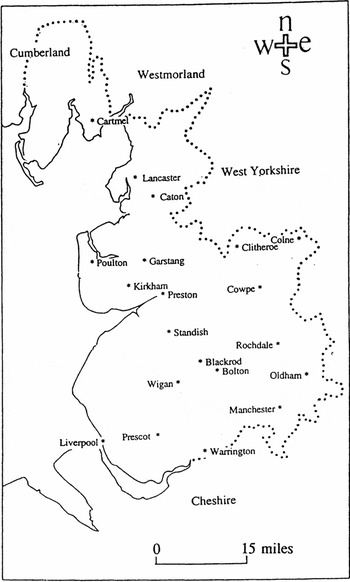
David Whitehead was born on 11th December 1790, growing up in the heartlands of the East Lancashire cotton industry around Cowpe (see figure 1).Footnote 22 His father John, a husbandman weaver, died in May 1802 leaving his second wife, Ann, to look after seven children from the thirteen over two marriages that John Whitehead had fathered. The death was clearly harshly felt, with a small estate divided in portions between the widow and the thirteen surviving children on their majority, the former getting only fifteen pounds per year.
Map of Lancashire showing the area over which the Whitehead-Wood courtship took place.

Details of David's life prior to his father's death are sparse, although his history thereafter is richer. At some unspecified date he and Peter and Thomas, the two brothers with whom he would later enter into business, were apprenticed. Initially David was sent to a Methodist tailor, testimony perhaps to the religiously based business networks that might build up in industrial areas like Lancashire.Footnote 23 He disliked the trade, however, and much of the early part of his autobiography is taken up by his, and his mother's, search for a suitable apprenticeship. He wove fustians, flannels and baize, milked cows, served in public houses, distributed the mail, cleaned shoes, did coopering and hawking, played in a band, served in the militia as a drummer, and was a warehouseman. His multiple experiences suggest just how fragile the apprenticeship contract was for the independent labouring poor who could not obtain the financial and power resources inscribed into poor law apprenticeship.Footnote 24 Around the age of nineteen David took a short-term job with a putting-out merchant in Haslingden and ‘I was very glad, as I always thought that I would be a cotton manufacturer’.Footnote 25
During these turbulent years he lived variously with a step-brother, John, from the first marriage; his natural siblings; and, most often, his mother. Between apprenticeships he taught himself reading, writing and arithmetic. Hence:
I began then to be very diligent in learning to write and read and do arithmetic, but not so diligent at my work. I never did like to weave so if possible I thought I would make myself fit for something else . . . I got on as well as I could myself, and when I was fast with a problem, I went to someone in the neighbourhood to set me right.Footnote 26
The development of his religious identity is less well documented in this early phase of life. Although raised by a Methodist mother, his autobiography suggests that a long illness in late 1813, when he was twenty-two, encouraged him to think of formally joining a Methodist class and circuit. He did not do so on this occasion, and the autobiography suggests a creeping and cumulative engagement with Methodism. Certainly by 1817 when he was thinking of courting, David Whitehead was professing a strong faith and had convincing Methodist credentials.
In 1812, David inherited his patrimony. His brothers having also inherited their portions earlier, they ‘agreed that when a suitable time came we would go partners together in the cotton trade, and until such time would save what money we could’.Footnote 27 This opportunity was to come in 1815 when, at the age of twenty-four, David began trading and manufacturing with his brothers Thomas and Peter. In 1817 they borrowed money from a Quaker relative, Thomas Hoyle of Manchester, to expand the firm, growing from small beginnings in which they rented space and power in the factory of another, kept their respective jobs and employed a manager for the day-to-day activities. As their spinning and weaving firm became established, it was agreed that Peter and Thomas would remain in employment with others and that David would manage the concern entirely. In this endeavour they were aided by their father's accumulated reputation which lasted long into the nineteenth century. Thus, David reflected that ‘I often thought that my father being well known and has a good character was worth more to us by ten times than all the money he left us: the benefit of a father with a good character cannot be valued’.Footnote 28
The early business records of the firm do not survive, but the fact that David purchased the lease of a farm in 1818, and that by 1820 he was riding to the Manchester market in his own carriage, suggests that the firm was very successful. By 1822 the brothers had purchased the farming estate outright and it was here that they were to construct a new mill complex between 1822 and 1824. Judging by their philanthropic activities, the founding of a savings bank, and contributions to Chapel building, the Whiteheads prospered greatly. In April 1851 David Whitehead was made a Justice of the Peace, and at his death in 1865 he had estate valued at more than £100,000.Footnote 29 By his own account, but in line with modern prosopographical studies of the origins of British entrepreneurs, David Whitehead was a self-made man in the heroic, if unrepresentative, mode of the Industrial Revolution.Footnote 30 His worth and wealth measured in money terms were considerable, but we might also measure him by the fact that an account of his funeral ended with the epitaph ‘Thus has ended the career of D. Whitehead, Esq., the architect of his own fortune, and the friend of the people’.Footnote 31
The building blocks for this rendering of David Whitehead's life come from his own autobiography. The dangers of using autobiographical material are well-established.Footnote 32 Whitehead himself refers to the work as a ‘rough sketch’, and more widely autobiographical accounts are beset with problems of memory and selective memory. The impact of some of these issues in the case of David Whitehead is obvious. In simple quantitative terms, the autobiography spends a considerable amount of time on what we might call Whitehead's ‘Methodist journey’, and on the building of an industrial powerhouse.Footnote 33 It reflects much less and much less keenly on issues related to the wider family, and particularly his step-family, childbirth, social interactions outside his Methodist ambit, his personal fortune and consumption, and everyday matters such as dress. A further and interrelated problem centres on the identity that David Whitehead wished to construct for himself, the so-called autobiographical self.Footnote 34 Autobiographical works might be part of a process of invention or reinvention, might employ a wider range of yardsticks of identity than other works such as letters and diaries, and might play to the role that the author aspired to have in family and society rather than the actual identity as perceived by others. In the sense that identity is at least partly ascribed, using autobiographical material to reflect on this issue might be problematic. David Whitehead's autobiography is perhaps richer than most, laying bare his missed opportunities, wrong turns, triumphs and frustrations in broad measure. At the core of the work, however, are two identity narratives: the self-made man and the sinner made good in the Methodist cause. These narratives do not necessarily introduce bias into the use of the autobiography, since newspapers and other records confirm that Whitehead really could lay claim to these identities in the locality, but they suggest the need for interpretive caution. An additional problem is the timing of the writing of autobiographical accounts. David Whitehead's preface is dated 1850, presumably at the time of his sixtieth birthday on 11th December, but it was clearly written over an extended period. In turn, the duration of writing can have important influences on what is written and how. Finally, the motivation for autobiographical works, particularly where they may have been written for publication or at least wider consumption, can influence what is said and how.Footnote 35
To these generic problems we might add others particular to this article. As Henry French and Jonathan Barry remind us, individuals might find themselves with little leeway to ‘present themselves in ways that deviated from or ignored embedded social assumptions about status or gender’.Footnote 36 Moreover, with issues as delicate as love, courtship and inter and intra-family relationships, autobiographical words have the power to ‘make, unmake and remake lived worlds’, at the same time as they offer a commuted version of the pain, longing, anxiety and stress that run through a courtship.Footnote 37 Autobiographical sources and letters are also, and particularly in the area of contested realities that lie at the heart of courtship, vehicles for rhetoric as well as the reporting of fact.Footnote 38 And, as Phyllis Mack reminds us, narrative sources written by Methodists may be underlain by very particular attitudes towards emotions, sex, marriage, and generational and inter-generational relationships. Restraint and self sacrifice were, as she reminds us, central to the Methodist narrative, such that the Methodist preachers often had an ambivalent attitude towards love, courtship and marriage.Footnote 39
Yet, if these are potentially serious problems, we should not overstate their real impact. David Whitehead, in his preface, celebrates the fact that he has included much that is ‘little and simple’ (that is, everyday), and while Chapman suggests that his lack of focus on his business is to be regretted, it is precisely this lack of focus that allows the autobiography to have such a wide ranging socio-cultural and religious remit and hence makes it fit for purpose here.Footnote 40 The fact that it was not apparently written for publication and that aspects of Whitehead's self-identification can be correlated to newspaper and other reports, should also give confidence in using the autobiography.Footnote 41 More importantly, in terms of the key matter explored in this article, it is possible to triangulate the perspectives provided by the autobiography with the letters that David and his intended sent to each other during the courtship, and with letters sent to Betty Wood by friends before the courtship began. We can thus tease out inconsistencies and the meaning of silences in one source by using the other, and reconstruct the courtship process from the point of view of David Whitehead, his future wife, and others involved. The rest of this article will thus conduct an anatomisation of David Whitehead's courtship with a view to drawing out more general early nineteenth-century perspectives on the length, conduct, stability and content of the courtship process.
III
We first hear of David Whitehead's marriage inclinations in the autobiography in February 1817 when he was summoned to Manchester by a distant relative, Thomas Hoyle, in order to talk about the loan of one hundred pounds for the three brothers to rent their first mill (see above). Hoyle lectured Whitehead on the importance of a good wife, recounting his own experience of codependency, with a wife whose spinning ‘kept us both. I saved my wages until I was able to set up dyeing on my own account’.Footnote 42 Whitehead was to be a regular visitor at Hoyle's house thereafter, and in December 1817, when Whitehead had just turned twenty-seven, Hoyle announced abruptly: ‘I think thou had better get married, it is better for young men in business to have a wife. Thou art old enough; has thou seen a woman that will suit thee?’Footnote 43 Whitehead replied that he did have someone in mind, the first reference to this fact in some fifty pages of the autobiography. This prompted further questions from Hoyle, but all of them tended towards establishing two facts: whether the woman would come with a good dowry; and whether she and her family were of the same religion as Whitehead. In the literature on English marriage motivations, there is much that is familiar here: the sense that in general economic terms, and particularly in the conduct of business, it was preferable to have a wife, who could work, keep house and conduct social networking; that there was a suitable age for men and women to get married; that kin, and older kin in particular, could be important in the instigation of the marriage process; and that economic considerations such as the standing of families and the size of dowries retained a core place in deciding when and whom to marry.Footnote 44 The focus on the religious suitability of Whitehead's intended wife is perhaps less familiar in the secondary literature, and we return to this issue below. Meanwhile, the autobiography hints that the younger man did not share Hoyle's view of marriage. Assuring Hoyle that his sweetheart was of the same religion and from a religiously respectable family, Whitehead reflected that on the question of asking how much her dowry would be, he ‘would do nothing of the kind’. This is an early indication of the relative lack of economic considerations underpinning this courtship.Footnote 45
His subsequent autobiographical reflections on how he had met his intended and reached the point of his conversation with Thomas Hoyle reveal much about both Whitehead's attitude towards marriage and the nature of the marriage market in early nineteenth-century Lancashire communities. Whitehead had set his heart on the daughter of a prosperous Methodist farmer, Jonathan Wood, from Clitheroe. This small industrial and market town was also the birthplace of Whitehead's sister-in-law, and she and his brother Thomas lived nearby. Born in July 1797, Betty Wood was barely twenty when Thomas Hoyle and David Whitehead were having their conversation in Manchester.Footnote 46 While the date of Whitehead's initial encounter with Betty is unclear, he notes that he first saw her when he was ‘seeking waste’ (low grade cotton) in the area around Clitheroe.Footnote 47 Other evidence from the autobiography suggests that the meeting may have been around 1815, but a letter to Betty from a friend called Elizabeth Grugson inviting Betty to a love feast on 28th March 1813 suggests that the first meeting may have been even earlier. Certainly by September 1815 another friend, Eleanor Guy, was writing to Betty hinting that the two were engaged in face-to-face discussion about an eligible man that Betty had met. Here, physical attraction was clearly important.Footnote 48 Accounting for his presence in the Clitheroe area rather than elsewhere, since ‘waste’ was a widely distributed product, Whitehead reflected that at some, unspecified, time before he had asked his brother Thomas ‘if he knew any young woman in his neighbourhood who would suit me for a wife’.Footnote 49 Thomas told him about Wood's daughter, a cousin to his own wife and a ‘very decent and religious woman’, from a good family. While Whitehead did not act at the time on this intelligence, when he subsequently wrote to his brother he would ask ‘how that young woman of mine was coming on?’Footnote 50 This almost jovial attitude towards identifying a marriage partner contrasts with Whitehead's later reflection on his feelings at the time, in which the issue of religion figured centrally. He writes that: ‘I thought, she is no worse for being religious. For I had thought for a long time that if ever I did marry, I should like to have a pious woman for my wife’. Interestingly, this was a core motivation even before his conversion to Methodism, for not to have a woman with religion appeared to Whitehead ‘a most awful thing’.Footnote 51
Clearly, then, David Whitehead had turned his thoughts to courtship at a relatively early age, perhaps in his early twenties, and fixed his attention on a woman who when he first took notice of her must have been no more than seventeen. These facts sit easily with wider analysis of early nineteenth-century declines in the singulate mean age at marriage for women in particular. His initial thoughts were passive and he sought help in finding a wife from an older brother, who in turn identified a relative by marriage. This is dressed up in the autobiography in the form of a jest, but is perhaps testimony to shyness. Such observations resonate with the literature on the importance of kinship for marriage in earlier periods, and particularly with renewed emphasis on the importance of siblings and cousins in the lives of individuals.Footnote 52
Three other observations also spring from the story of David Whitehead's initial decision to court. Firstly, while it is unclear whether his business and family connections led him to the marriage market of Clitheroe, or whether business and family were pretexts for courtship, it is clear that David Whitehead was an interloper in a spatially wider marriage market than might have been normal at this time and for someone at his stage of business career.Footnote 53 Secondly, we already see in the initial formulation of his courtship decision, the difficulty that David Whitehead encountered in keeping in touch with a distant marriage market. While his requests for information from his brother are set up in the autobiography as jests, we begin to see just how important epistolary connections might be in deciding when and whom to court. Finally, even before David Whitehead had converted to Methodism, religion and religious/moral compatibility would seem to have been important in shaping his romantic decisions. While Rosemary O'Day's analysis of marriage and courtship amongst the aristocratic and solidly middling families of early modern England has little to say on the importance of religion, this was clearly an important factor for the aspirant middling-sorts like David Whitehead, segmenting the marriage market and extending the courtship process spatially either positively, through a greater range of contacts via religious networks, or negatively, by forcing a wider search because of a lack of suitable partners. A detailed anatomy of the courtship allows us to explore these and other motivations in greater depth.
IV
What eventually spurred David to action in the courtship process is unclear. He narrates his story of searching for ‘waste’ around Clitheroe almost nonchalantly. Prior to this, however, his second brother, Peter, had visited the area. He had taken tea with the Wood family and ‘Peter said he did not know whether he would let me have her [Betty] or not as we were accustomed to trot [tease] one another a little’.Footnote 54 David Whitehead characterises the episode heroically, suggesting that Betty Wood's ‘associates’ wanted her to enter into an arrangement with Peter, but quotes Betty saying that she preferred to wait for the youngest of the brothers and have him. Such self- and situation-fashioning is difficult to reconcile with David's conversation with his brother Peter prior to his departure about whether he had an understanding with Betty Wood. Unable to obtain a straight answer, David said ‘without a positive answer from thee, I will be at liberty to do as I think proper. He laughed heartily, but I could get no answer’.Footnote 55 The episode also sits poorly with Betty's initial letter to David after he had proposed to her, in which she claims to have had no prior knowledge of his intentions and no thoughts in his direction. In short, it is entirely possible that jealousy, a sentiment rarely elaborated in autobiographical accounts, spurred David actively into the courtship process.
However motivated, David went to Clitheroe and stayed with his brother Thomas, where he met Betty Wood's cousin, George. Once again, David constructs the situation heroically, suggesting that Betty had been frustrated at having missed him. He recounts a conversation that Betty had with her father in which she said ‘I am always in the fields when I should be in the lane’.Footnote 56 A formal introduction did not have to wait long. On their way to chapel, and reflecting frequent practice, Thomas and his wife called at the Wood's farmhouse with David, and he and Betty spoke in the subsequent service. The party were then invited by Betty Wood to stay for tea, in order to hear the evening preaching at the chapel. David ‘felt quite at home with all the family’.Footnote 57 In his travels around the district immediately thereafter he recounts that he ‘could not get Miss Wood out of my mind. For I thought, from the first sight of her, she was just the person for me – if I should suit her’.Footnote 58 The latter comment evidences how important personal feelings were to the marriage decision, suggesting that, in David's conception of courtship, Betty Wood's tastes were an important arbiter of success or failure.Footnote 59 David resolved to make her an offer there and then, praying for guidance as he walked. This is interesting, for again his courtship is mediated, justified and explained by religion. Hence he prayed that:
If it was right in the sight of God for me to have her for my wife, that it might be so ordered that I might be able to have an interview with her that evening. And if He saw it not good for me to have her for my wife that all my attempts might be frustrated.Footnote 60
In short, David trusted in God to advance his cause rather than, as in other courtships that have been studied, kin or other intermediaries.
God was partly on his side. David Whitehead suggests that he gained an interview the same day but his offer was rebuffed and ‘she told me she was too young to take any steps like that at present [she was nineteen]’.Footnote 61 Undeterred, he ascribed her refusal to the fact that Betty ‘perhaps had not much knowledge of me or our family’. This clearly identifies these issues as crucial at the outset of courtshipFootnote 62 and David determined to ‘leave the matter with her for a month. In the meantime I would write, and after mature consideration and inquiry I hoped that she would reply’.Footnote 63
A reading of the letters between the pair seems to give a slightly different rendering of the start of the courtship, and in any case allows the detailed analysis of the texture of the courtship process. Whitehead's first letter of 22nd December 1817 confirms that the interview noted above did not take place. He writes that: ‘I had a desire to have a few hours of private conversation with you, but this apparently was impossible,’Footnote 64 suggesting that he may have reintoned his autobiographical account to cast himself in a stronger and more positive light. Opening with his desire to secure a wife, assuring her that she was the only person in his purview, the central core of this letter, both physically and rhetorically, sets his request for her hand in a firmly spiritual context:
I take you to be one of God's dear children which I do prefer before any other in the Kingdom . . . We ought to pray to God for directions; and may you and I pray God that if it be for our present and eternal welfare to be married together, that it may be forwarded. And if He sees that it will not be for our good, that it may be by Him frustrated . . . I have no doubt but that God, who made us, will join us together in holy matrimony.Footnote 65
Assuring Betty that ‘I sincerely love you or I would not have written unto you’, David signed his letter ‘Your loving and certainly your intended husband’ and asked for a reply to be sent via his brother Thomas, who was to be a constant intermediary.Footnote 66
Betty Wood's reply of 30th December 1817 was hardly positive, noting that his letter was unexpected, that she knew nothing of him and that had they not shared the same religion she would not have replied, because in deciding when and whom to marry she would wait for the ‘providence of God’ to ‘open the way’. Marriage was something to be entered into ‘in the fear and with the approbation of God’ but she felt at present too young. Youth, she reminded him, is:
The most favourable time for the growth of religion in the soul. And to get married when so very young seems to me as if it was cropping it in the bud . . . I think the single state is the best time to get Grace, and the married one to try it.Footnote 67
Her own ending, ‘I remain your friend and well-wisher in the bonds of Christian affection’, stands in stark distinction to his.
David's reply had to wait fully twenty-one days, testimony to indecision or delays of postage and business. He asked Betty for a meeting at her house on the evening of the 26th January because ‘Conversation on paper is suitable in its turn. But I think personal conversation is preferable in this case’, and signed his letter ‘your affectionate lover’.Footnote 68 The autobiography confirms that the meeting took place. Its uncertain outcome is reflected in David Whitehead's letter of 4th February 1818 addressed to his ‘Dear intended wife’. Again placing his religious belief at the core of the narrative, and quoting Wesley's advice to husbands and wives at length, he reflected:
We are to love one another with brotherly love but I would have you and I surpass this, so that we should be two happy companions through all our journey to another and better world, to be sincere friends, pleasant companions, faithful partners, and useful assistants to each other.Footnote 69
Reading between the lines, it is clear that David left his face-to-face interview with no assurance of Betty Wood reciprocating his passion. They were after all to demonstrate only brotherly love, and this is something confirmed in his closing appeal:
I tell you my mind so freely, I should like an answer equally so. For I think it is not good to carry on things of this kind far, except they be both of one mind, nor to enter upon them too rashly. But, may the Lord direct you and I that our steps may be sure.Footnote 70
In a postscript Whitehead also sought assurances that nobody except she and Thomas Whitehead had been party to their meeting. Betty's reply of 16th February 1818 gave him this assurance, and told David that she too had been reading Wesley's text on marriage.Footnote 71 He would perhaps have been less pleased with her coded reply on love. Noting that she had been deep in prayer on the subject of marriage in order to be guided by God, she concluded that marriage was:
A work of so difficult a nature [that it] should not be hastily undertaken. I think we ought duly to consider and carefully to watch the movings of the spirit of God herein, for hasty marriages often prove unhappy ones.Footnote 72
It is testimony to David Whitehead's faith in the power of prayer that he was much elevated by the tone and content of this letter, suggesting that ‘I am inclined to think that it is God's will for you to become my partner in life’.Footnote 73 He clearly followed up his letter with a visit not mentioned in the autobiography, because on 17th March 1818 Betty (‘Your true lover’) wrote ‘Agreeable to your request’ that she come to Manchester to meet David. She was, however, concerned that David did not visit the people with whom she was staying, for reasons which she could only disclose in person, and ‘My father and mother takes it better over you than I expected they would have done, but before you write to my father, I want to have a deal of talk with you’.Footnote 74 Betty had clearly broken the news of David Whitehead's courtship approaches to her family, but had done so with the expectation of resistance. The nature of the potential parental concerns may have been in terms of age or David's situation in life, starting out as an entrepreneur, although later letters are revealing on this point.
David, ‘Your real lover and intended husband’,Footnote 75 replied quickly that he would meet her on the road to Manchester. Neither the autobiography nor any letters reveal the nature and sentiment of their meeting. Indeed, the next, and breathless, letter in the preserved sequence is from David to Betty on 16th April 1818. David had sent a marriage proposal addressed to Mr Wood and to be delivered by his brother. He was confident of acceptance, urging Betty that if her father asked when they intended to marry to tell him one month as ‘You know it is a long way for me to come. I think we had better be married soon’.Footnote 76 Rarely is it possible to obtain a detailed anatomy of a marriage proposal, but a true copy of David's request survives and deserves analysis at length. Addressing Mr Wood as his intended father, David immediately sought to counter anticipated surprise at the speed of this proposal, suggesting that Betty had been not entirely candid with her parents, by outlining his correspondence. Mr Wood might:
Think that our intimacy is very short. Short it is, but sincere. Our hearts are so united to each other that it is impossible for a man to separate them, so I humbly beg that you will give her me to wife. In a short time I should like to be married, but not without your consent. I don't think it wisdom to marry rashly, without consideration, nor yet to drive it too long when affections are great and sincere lest mortal affections corrupt the immortal soul, and weaken the love of God in the heart . . . We think it is the will of God for us to be partners in life. Prayers have been offered unto God on that account, and we think nothing has been done without His approbation.Footnote 77
Clearly, David was worried that his not being there in person, the secret correspondence, and the speed of the marriage proposal would have looked disturbing to Mr Wood, and it is interesting in this sense that he appeals to the God-given nature of their match to trump such concerns.Footnote 78
By 30th April, another letter from David suggests that he had still not received word from either Betty or her father in response to this proposal. His first information came in Betty's letter of 6th May 1818 in which she said that upon reading the proposal both her father and mother were ‘much affected’. The formal response was perhaps less enthusiastic than David might have hoped, for:
I expected my father would have had a deal to say to me about being married but to my great surprise he has never said a word, one way nor another. My mother says she has nothing against me being married if it was to one I knew something more about, but she thinks I know but little either of your character or your circumstances; and I leaving home so far, she knows not how to bear it.Footnote 79
Making plans to ride to Clitheroe as soon as he could, David's reply assured Betty that ‘we shall not be confounded’ but noted that:
It is right that they should know my character, and, if it was not agreeable, not to accept me. But you know I cannot recommend myself. If I should paint myself in its own colour, it perhaps might not please; for I know more vileness of myself than those who are the most acquainted with me.Footnote 80
His subsequent visit clearly centred not on whether the couple should marry but upon David's desire for no delay to the marriage event and the need to bring her parents round to their point of view. Writing on 27th May 1818 to follow up his visit, Betty suggested that her mother was ‘more reconciled’ to the match but that ‘my father said nothing, and I have not courage to begin first’. His assent was crucial, for as Betty noted in this letter she was under-age. Faced with the silence of her father, Betty suggested that ‘we had better not be married till after I am at age which will be about eight weeks’ and that if David wanted a more rapid union ‘you had better write to my father and state some of your reasons for it being so soon’.Footnote 81 To give any such letter weight, she recommended that it be sent ‘as before’, that is via David's brother Thomas.
David's explanation for haste in his reply of 28th May 1818, addressed to Betty rather than to her father, was simply that ‘We are so far distant from each other’ and he recommended that she ‘talk with your mother about it [the date of the marriage]’. Announcing that he would meet her the following week, he thought it:
Good [in the courtship process] to adhere to more experienced people than ourselves. So you can see what your mother or father say about it. I should wish to do all things in peace and in such order as will give satisfaction to all if possible.Footnote 82
David's visit clearly enhanced Betty's affection for him further. On 10th June 1818 she wrote of her ‘pure love’ for him and noted that David's brother Thomas had visited the previous day to ask formally for leave for David to marry Betty. Her letter does not explicitly state that her father said ‘yes’ but she suggests that ‘They both seem better reconciled than I expected they would have been. But this I believe is the Lord's doing’.Footnote 83
This being so, the Lord had a further trial for them. On 13th June 1818, Betty wrote urgently to David. She said that her uncle understood from David's brother Thomas, and had told her father, that David had dissolved the partnership with his brothers, so that he was not the independent entrepreneur that the Wood family had heard. Her father's reaction had been severe:
He began to tell my mother about it, and he expected you intended me living with you, and weaving; or else you were making a fool of me altogether . . . you either thought of me living in a cottage house to weave, or work in the mill, and you were marrying me from some motive that was not good.Footnote 84
Betty's confusion and pain are clear, and ‘if things be as I am told they are, I will give all up though it cost me my life’. She reflected:
We have been making every preparation for us to be married, our folks say they were reconciled to it; but if what my uncle say be true, they are as far to the contrary, and say they never can think well of you again.Footnote 85
David was clearly mystified. He wrote on 20th June 1818 that he had a mill, that the partnership was ongoing and that he assuredly did not want her to ‘be my slave’, reminding her that he could get workpeople simply by paying wages. His further defence was eloquent, and speaks much for the expectations of young couples and their relatives. He told her explicitly that ‘I do intend to keep my wife, not as a servant but as a wife’, reminded her that it was his real love that lay behind his proposal and said that ‘if it were for any other motive than love, I could marry in my own country. But when I marry, I intend to marry for love in reality’. Continuing, he pointed out that he had money and goods to support him and his wife, and that:
If I want to marry for money I can have it in the neighbourhood. But before I marry for money I will remain as I am, for I am well off. But if I get someone that I do not like, and cannot get rid of her, I shall be badly off. And as I am well off, I desire to be truly thankful to God.
Uncertain as to whether her affections had changed given the differences in the tone and sentiment of her letters between the 10th and 13th June, he closed ‘Now I would have you to rue in time, not after we are married; and if you feel the least of rue in your mind, I would have us decline at once’, and arranged to visit in a few days.Footnote 86
In terms of its tone, rhetoric, sentiment and length, there can be little doubt that David believed his letter would be read by others as part of the defence of his character. This is not the kind of private, intimate and subtle letter that was his hallmark. At the same time it was not a confrontational letter, but offered clarity, principle and character in place of accusation, threat and resentment. As we see elsewhere in the letter series, David was keenly aware of the dangers to the courtship process posed by living at some distance from his intended wife. This and other letters were clearly intended as a proxy for the neighbourhood talk that would have assuaged nascent concerns about motivation or status had David and Betty shared the same proximate as opposed to just the same religious community.Footnote 87 Moreover, while much of the courtship goes unelaborated in Whitehead's autobiography, this particular incident receives considerable attention. Betty's uncle, it transpires, had removed Thomas Whitehead's household effects back to Rawtenstall because the brothers, as we saw above, had determined to upscale their business partnership. Whitehead's autobiography suggests that Betty's uncle had misunderstood the intent of the removal and:
Mr Wood [Betty's father] not having much acquaintance with us nor our way of doing business he thought there was something very strange in this affair and when he came home, he talked very keenly to his daughter, which led to the two unpleasant letters. After an explanation, we were all very sorry that there had been any misunderstanding. But all was made right and the marriage was to be according to the arrangement.Footnote 88
Certainly by the time Betty wrote again on 1st July 1818, to her ‘expected husband’, she was fully engaged in the arrangements for the wedding and her closing remark, ‘I remain yours in sincere affection, and believe me, yours with all the endearments of a wife’, presaged her marriage on 7th July 1818, at the age of almost twenty-one and in her parish.Footnote 89
V
The disparities in the courtship narratives between the letters and the autobiography illustrate one of the problems of relying on one source in isolation. More importantly, however, this anatomisation of the courtship process and our ability to reconstruct, albeit imperfectly, the experiences of both partners, offers the chance to reflect more widely on debates about the nature of English courtship, and for an area (Lancashire), time period (the early nineteenth-century) and groups (the aspiring artisan entrepreneurs and the daughters of farmers) that have all appeared lightly in the secondary literature.
An initial observation is that neither the love letters, nor the autobiography, suggest that there was any discussion of the dowry that Betty would bring to the marriage, notwithstanding Thomas Hoyle's probing on the matter before the courtship had begun. Indeed, there is no evidence that a dowry was ever paid. Rather, the autobiography suggests that David envisaged a networking and wider religious role for his new wife, with little sense that she would be making a direct economic contribution at marriage or thereafter.Footnote 90 Equally, while Betty, her family and David Whitehead himself were all keen that the Woods should know more about him and his family, there is little direct and unambiguous evidence outside Betty's letter of 6th May 1818 that a consideration of his economic circumstances and potential played any part in the courtship. Rather, David was concerned that the family should know his religious and moral character. To be sure, the courtship threatened to founder at a late stage over the idea that he wished to procure a wife to weave. Yet, this rumour, in and of itself, demonstrates how little economic considerations had figured up to this point in the courtship. If the Woods had received any more than the most general assurances about David's economic situation, then it is unlikely that Betty's uncle could in a subsequent conversation with Thomas have got the situation so wrong and that telling Betty's father would have sustained such an adverse reaction. The profound shock demonstrated by Betty as she sought clarification over his intentions from David also suggests this.
While overviews of English courtship and marriage have increasingly stressed the relative freedom of courting couples outside the highest ranks of society to engineer their own experiences, O'Day reminds us that ‘By the eighteenth century it was often the bride's dowry that played the largest part in making the marriage economically viable from the start’.Footnote 91 Other commentators, from Catherine Frances and Amy Erickson, through to Robert Morris, have also sought to stress the continuing importance of economic factors and the idea that such considerations did not exclude love matches.Footnote 92 Against this backdrop, the lack of intrusion of economic considerations in the courtship of Betty Wood and David Whitehead is notable. This might reflect the fierce independence of spirit for which the industrial areas of Lancashire have become well known, or perhaps the centrality of other considerations in a marriage between Methodist families. An alternative reading might be that some Lancashire families at least had a different and longer term way of thinking about the ‘economics’ of a match, concerned not with the immediate cash situation but rather with expectations of ongoing material and emotional support. Thus, while Mr Wood almost certainly did not pay a dowry, the autobiography shows that he was instrumental in terms of providing loans, advice and intermediary services on the several occasions when the Whitehead brothers sought to acquire land and landed estates. Moreover, and as we have seen, Betty herself played both a religious and networking role after marriage.
One of the other considerations that clearly influenced the courtship was religion, and within that framework, destiny, something that has often slipped beneath the radar of existing historiography. The couple looked for God's judgement in starting, managing and then bringing to a conclusion their courtship. Methodism fostered a wider marriage market than David Whitehead might otherwise have found himself in and offered a forum for the young couple to meet. David stresses on several occasions that if he had been interested in money or simply a partner he could have stayed in his locality. Methodism. also provided a rhetorical and linguistic structure through which the couple's expectations of one another and of their marriage could be elaborated and negotiated.Footnote 93 For Betty at least, such a structure was clearly empowering. Through reference to God and religious sensibility she was able to garner control of the speed and timing of the courtship and to insert a decision making layer other than simply her parents, between herself and David. Once the courtship had come to fruition, David's marriage proposal had at its core an appeal to the Methodist sensibilities of Betty's father, while Betty's response to the shocking revelations about David's character was coded and codified by and in her religious sensibilities. It was God, rather than the couple themselves or their friends and relatives, who would determine the fate of the courtship.
It would be easy to see the religious content of these letters as mere rhetoric, but there is much evidence in the autobiography that religion was the stock by which others were also judged, and that religion provided an ingrained framework of trust with which to order social relationships. And Whitehead's central concern with the spirituality of his wife is apparent throughout; when he ended his autobiography in December 1850, Whitehead reflected that he had been thirty-two years married to a woman whose ‘chief delight is the salvation of immortal souls’, something which gave him the greatest pleasure.Footnote 94 There is also practical evidence that religious sensibilities structured and segmented the marriage market for Methodists. David's brother Peter married Alice Kay of Haslingden in November 1824, who had been a Methodist for five years. Peter's second marriage, on 14th March 1832, was to Elizabeth Kay the daughter of a Methodist cotton manufacturer. Both of David's sisters married Methodists and his elder brother, Thomas, had previously married Alice Barnes, the daughter of John Barnes, a Methodist preacher from Clitheroe, and became a confirmed Methodist to secure the marriage.Footnote 95 For the Whiteheads then, Methodism was more than rhetoric and was clearly crucial to the courtship process. It shaped whom people courted and how, and while it did not remove risk it meant that courtship was also shaped by forces other than mere chance or local habit. Considerations of destiny are palpable. While this might come as no surprise to scholars of Methodism, it is striking how, in the wider literature, religious sensibility as a factor in courtship and marriage has lost credence. In Lancashire, an area with a large and rapidly growing nonconformist population from the later eighteenth century, the need for more extensive analysis of religious endogamy as a core factor shaping the nature, location and speed of courtship is clear.Footnote 96
Religious sensibilities apart, the love letters also lay bare the fragility of the courtship process, especially where a young couple did not share the same spatial as opposed to socio-cultural or religious community. The relative smoothness of the courtship constructed in the autobiography is belied by the fact that there were at least five points where the relationship might have floundered. Thus, it is clear that David's initial approach, notwithstanding his efforts to rewrite it in his autobiography, was clumsy. He signed his first letter ‘husband’, and while we might read Betty Wood's cool response as mere rhetoric, the sense in which she was truly shocked by his initial address is palpable. Indeed, had they not shared the same religious persuasion, she would have dismissed him out of hand. Secondly, having surmounted this difficulty, the courtship was initially dependent upon Betty's prayers for guidance, and while we might read this as rhetoric, David's cajoling, also framed in terms of his prayers, shows his evident concern for the outcome of that process. She could have turned him down and with no discredit. Thirdly, and as both David and Betty emphasise several times, this was a courtship that was conducted over difficult communications territory and against the backdrop of a young man establishing a business. The chances for the young couple to see each other were infrequent and brief and it would easily have been possible for affections to wane, which perhaps explains why both parties make increasingly elaborate endings, such as ‘your intended wife’, ‘your husband’ and ‘your true lover', to their letters. The distance clearly worried David, and he mentions it no less than seven times in his letters. As O'Day also reminds us, a protracted courtship at a distance might allow a rival to emerge, as well as foster the sort of misinformation that we see in the letters.Footnote 97 Fourthly, the courtship could have foundered on parental disapproval, and David was perhaps wise to defer to his future mother-in-law's direction and concerns on all points. He stated constantly that he wanted the courtship to be conducted ‘peacefully’. Finally, and most seriously, the courtship could have broken on the rocks of the supposed discovery of David's duplicity. David was obliged to conduct a robust defence in a letter that could be passed around to satisfy interested parties. In the aftermath of the affair he also warned Betty and her family that he could have had any number of women in his own locality if he chose. There are several potential readings of such a comment, but the one preferred here is that David was offering a compliment to Betty and her family. As it is, the marriage proceeded. While this was a much more rapid courtship than Richard Adair's analysis of the relationship between bastardy and courtship in the north allows, the Whitehead's story is nonetheless an important elaboration of the fragility of events up to the marriage day that underpins Adair's analysis and which is something much hinted at but rarely dissected. It also has wider lessons. While the English are usually deemed to have conducted largely endogenous marriages, there may in fact have been rather more exogenous courtships that failed than a focus on marriage as an end-event might allow.Footnote 98
Moreover the courtship of Betty Wood and David Whitehead exemplifies the multi-level importance and power of information in the courtship process. This is something that is a commonplace in discussions of aristocratic marriages but has been approached in a more broad brush manner for other segments of society. Both David and Betty were consumers of marriage guidance texts, and quoted them to each other as they negotiated the terms of their courtship and the speed of its transition to marriage. These were the writings of Wesley rather than the conduct books analysed by O'Day, Tanya Evans and others, but they were nonetheless an important part of the early courtship process and a way of defining marriage expectations.Footnote 99 Much of the subsequent courtship is shaped by the need for, or the nature of, information. This might be information on David's reputation or that of his family, since he constantly talks of ‘we’ and ‘our’ when referring to knowledge about him. It may relate to his economic potential, her desire to drip-feed knowledge of David to her parents, or the ‘character’ that Thomas Whitehead gave to his brother during his time as intermediary. The Wood family were certainly concerned to know more about David Whitehead, and he in his turn was eager to make sure that his initial, and apparently covert, courtship of Betty Wood was not the subject of surveillance. He seeks assurances on two occasions that only he, Betty and his brother Thomas had knowledge of their meetings and letters. Once the relationship was public, however, David in particular became concerned with the mediation of information, encouraging Betty to rely on the superior experience of her mother, and deferring to her judgement in his turn. The power of a fracturing of this information matrix, or at least the intercession of gossip or misunderstanding, is seen in the desperate interchange between Betty and David over his dark motivations for marriage. This episode might have reflected the specific circumstances of the couple, since both acknowledged the terrain over which their courtship was conducted as well as its breakneck speed. But, even where courtships were localised affairs, Gillis, Frost, David Turner and others have provided evidence of the power of information, gossip and malicious interventions to upset, elongate or curtail courtships.Footnote 100 A mobile society of the sort that we find in industrial Lancashire created histories, however innocent they might seem, and information on those histories had the power to make courtship turbulent.
The letters also evidence a complex inter-relationship between the public and private aspects of courtship, and between individual and familial actions. While aristocratic courtships tended to be a collective matter in which early negotiations were ‘a delicate and secretive affair’, succeeded by a very public game of reconciling the young couple, O'Day, Amy Erickson and Diana O'Hara have suggested that, for the period before 1800, there was a greater tendency for those in other social groups to negotiate their own courtships, or at least to assert themselves more forcefully in the face of family opposition.Footnote 101 This may have been particularly true in towns, although research on marriage and courtship is less voluminous for the key early nineteenth-century period of rapid urbanisation. Against this backdrop the courtship of Betty Wood and David Whitehead is interesting. Their early meetings and letter writing seems to have been unsupervised. Indeed, David's visit between 29th May and 10th June 1818 went completely unknown to her parents. Both Betty and David strived for secrecy, and this was very much a courtship played out in private. Clearly, they expected there might be resistance to the match if it were discovered, as witnessed, for example, by Betty's desire to meet David on her way to Manchester rather than at where she was staying. When Betty broke the news of the courtship and David's desire to marry to her family she candidly expressed this concern.Footnote 102 There was after all a narrow and uncertain dividing line between seemly and unseemly, open and covert, behaviour.Footnote 103 In fact, her parents took the whole affair better than she could have hoped, and although her father was reticent about responding to David's formal proposal, neither parent seems to have spoken actively against the marriage, apart from when they were responding to the gossip brought by Betty's uncle. Indeed, on several occasions Betty records the fact that her ‘folks’ had become reconciled to the match. In short, this was a courtship in which the wishes of the individuals, and their love and spiritual matchmaking, held sway, and in which the private overcame the public until very late in the process.Footnote 104 It was also a courtship in which, in keeping with recent attempts to relocate the role of women in marriage, Betty Wood held and played most of the cards. David Whitehead's letters are the more voluminous, insistent and impatient, but it is the rhetoric and strategy in Betty Wood's correspondence that controlled the process. She used her prayers; her youth; her inexperience; publications; the perceived, threatened and actual attitudes of parents and relatives; her observations of life; God; and consent to just enough physical contact, to control the courtship. This sort of detailed exemplification for a woman below the level of the aristocracy and the higher middling sort is just the sort of thing that a more detailed consideration of early nineteenth-century marriage strategies requires.
Perhaps a final observation is that while Betty and David were at the heart of this courtship, they could not have conducted it without the active or passive collusion of at least some of their family. This is more especially the case given that David had placed himself or was located in a marriage market that was segmented by class, religion and space. It was Peter Whitehead who, deliberately or otherwise, goaded David into an active courtship with Betty, and very probably Thomas Hoyle who drove some of the urgency of the process. In turn, Thomas Whitehead was crucial to the mechanics of courtship, turning the spotlight on his relative Betty Wood, acting as an unseen go-between for letters, delivering the marriage proposal, giving his brother a character, and finally intervening with Mr Wood to help engineer an early marriage.Footnote 105 If David Whitehead's family was involved in the essential mechanics of courtship, Betty Wood's family was the key to its emotional health. Unspecified relatives quickly became reconciled to the match, and her uncle was the architect of much heart-searching when he reported second-hand gossip about David. While her father brooded on both the courtship and the marriage proposal, her mother was a more active participant in advising Betty. Once her concerns about the lack of knowledge of David's character were overcome, Mrs Wood seems to have fostered her daughter's feelings, albeit with a due degree of protestation about being separated from her daughter over some distance. While neither family controlled the courtship they were nonetheless integral to it. There is also, of course, tantalising evidence that friends of Betty Wood were involved in her initial consideration of the courtship.
VI
David Whitehead and Betty Wood expressed complex feelings of love and destiny. While Nicole Eustace has suggested that essential socio-economic concerns lay behind the language of love in courtship letters, and that ‘sincerity in courtship remained a structural impossibility’, the sub-theme of a love that was destined and spiritually secure runs through all of the sources that throw light on these two young people.Footnote 106 Ongoing love was also a key building block of Whitehead's autobiography, and there is a clear sense that issues such as when to love, how to love and love as destiny were key facets of this courtship and subsequent marriage. Indeed, and perhaps surprisingly, there was little direct or indirect discussion of the economics of the match, despite the fact that David Whitehead's economic credentials were potential rather than realised. Indeed, the sole instance of direct discussion of the economics of the match was in the negative: David Whitehead insisting that if money were his object he could have had it in his own locality. Moreover, the single time in the courtship when economic co-dependency was raised, in the rumours about David needing a wife to weave, created potentially fatal currents in the courtship. Whether this lack of engagement with the economics of the individuals or the projected household reflected the religious underpinnings of the match, the particular circumstances of the couple or the cultural specificities of rural industrial Lancashire is unclear. Nonetheless, the failure to engage with economics stands in strong distinction to much of the secondary literature. Likewise, while kin were an integral part of this courtship, especially given the distance over which it was conducted, they were by no means as imperative as Frost has allowed for the later nineteenth century and others have suggested for the period before 1800. Indeed, there is much in this courtship narrative to support Antoinette Fauve Chamoux's emphasis on the individuality of the courtship process.
Whether this observation is incompatible with the idea that chance or habit shaped the decision of whom and when to court is unclear. For both Wood and Whitehead marrying within their religious ambit was clearly crucial and might be seen as a segmenting habit. Both, however, could easily have found Methodist partners in their own locality and the determination to marry for love as well as religion, elaborated at least five times in the letters and by both parties, suggests a much more active agenda. Yet David Whitehead demonstrated a keen appreciation of the vagaries of chance in his courtship letters, noting how his brother almost snatched Betty from under his nose and later pushing for a short engagement because he was worried that distance and a resulting loss of physical contact might make passions wane. Whatever role habit had to play, this courtship narrative gives lived substance to the ideas of scholars such as Gillis and Adair that courtships could often be turbulent and uncertain in outcome. This was perhaps more especially so in the urbanising and industrial/rural industrial region of Lancashire that was driving the Industrial Revolution. David Whitehead, as we have seen, accumulated a chequered history and he would not have been unrepresentative in this sense.
How far we can generalise from one courtship is problematic, and emblematic of a wider tension in the study of nuptiality and marriage between the case study and the broader brush and sometimes quantitative survey. Certainly, Whitehead was by no means unusual in keeping an autobiography, or in writing love letters. As Frost's work on the Victorian period suggests, Betty and David's courtship was, if anything, rapid and the number of love letters modest.Footnote 107 Although the survival of conterminus autobiographical sources and love letters is rare, this does not make the case unrepresentative. Nor was the religious fervour of either David or Betty at odds with wider nonconformist experiences; Lancashire, and rural industrial Lancashire in particular, was a hotbed of Methodism and other nonconformist denominations. And if Whitehead was unusual in going so far from his own parish to find a wife, there is wider evidence that the thickening of population in the industrial countryside and rapid urbanisation made courtship in this period both relatively rapid and very uncertain. It is, therefore, appropriate to generalise from this single case-study.
Acknowledgements
I am grateful to Jane Humphries, Elizabeth Hurren, Peter King, Keith Snell and Alannah Tomkins for perceptive comments on earlier drafts of this article.