It is a truth universally acknowledged, that a brain aiming to survive in a fast-changing environment must compensate for time delays. The bone of contention is the processing stage at which this compensation takes place. Is what we perceive compensated for delays? Or do we perceive the world as it was some time ago and merely adjust our actions so that they are appropriate now?
Motion perception is a domain in which latency compensation could be useful. Imagine a situation where a monkey is chased by a tiger. The tiger circles the monkey and continuously changes its direction. It is advantageous to the monkey to extrapolate the motion changes, such that it can react in a timely manner. Doing this extrapolation in the motor system would provide all the benefits to survival. Nijhawan's hypothesis is that the monkey perceives the tiger to move in the direction it moves “now,” rather than the direction in which it moved some time ago.
One major advantage of investigating delay compensation with motion perception is that – unlike the perception of position studied in the flash-lag effect – motion perception has been studied extensively at the neural level. There is convincing evidence to link the middle temporal area (MT) to the perception of the direction of motion (for review, see Born & Bradley Reference Born and Bradley2005). This strong association between MT activity and perceived direction allows me to pose the question whether visual delay compensation exists, in a very specific manner as follows: When a stimulus continuously changes direction, does MT encode the current stimulus direction, or a direction of motion that happened earlier?
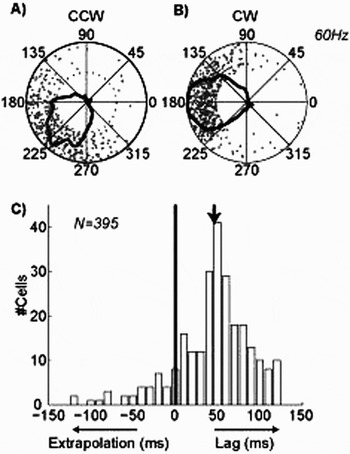
Figure 1A shows the responses of a single MT neuron to a random dot pattern that started out moving downward, but smoothly changed its direction of motion in a counterclockwise manner. During one second, all 360 degrees of motion direction were traced out (Krekelberg & Albright Reference Krekelberg and Albright2005; Schoppmann & Hoffmann Reference Schoppmann and Hoffmann1976).
The lagging neural representation of stimulus direction in the middle temporal area. (A) Counterclockwise (CCW) changes in direction. The direction of stimulus motion is shown on the angular axis; dots represent spikes recorded while the stimulus moved in a given direction. Each concentric circle of dots represents a separate trial. The solid line shows the neural response averaged over trials; the radial distance represents the firing rate. (B) Responses to clockwise (CW) changes in direction. (C) Histogram of lags in the representation of the direction of motion by single middle temporal area neurons. On average (arrow), the population of middle temporal area cells lagged 45 msec behind the stimulus direction.

The perception of direction is related to MT activity through a labeled line model (Born & Bradley Reference Born and Bradley2005). In this model, each spike counts as a vote in favor of a perceived direction of motion that corresponds to the label of the cell. I will show how the assumption of latency compensation in this model leads to a contradiction.
I choose the label of the neuron in Figure 1A such that its spikes represent the direction of motion as it is “now,” rather than how it was some time ago. It is easy to see that this lag-compensated label should be ~225 degrees – the direction of motion for which most spikes are recorded.
Now consider the response recorded when the same visual pattern initially moved upward but then gradually changed its direction of motion in a clockwise direction (panel B). For this trajectory, the largest number of spikes occurred when the stimulus moved in the 180 degrees direction. The label of the neuron does not change; hence, this peak activity signaled that a stimulus moved towards 225 degrees. Because stimulus direction changes at a rate of 360 degrees per second, the neuron is (180°–225°)/360°/s=125 msec too late in signaling this direction of motion.
Clearly the interpretation that a neuron would compensate for its response latency for clockwise changes in direction, but then respond 125 msec too late for counterclockwise motion, is nonsensical. The correct interpretation must be that the neuron's true label is the direction that lies halfway between the maximum response direction for clockwise (CW) and counterclockwise (CCW) motion (~203°), and the response lags the stimulus direction equally (62.5 msec) for both clockwise and counterclockwise motion.
This analysis does not suffer from the problems associated with comparing flashed and continuous stimuli, because it involves no onset or offset transients but compares two equivalent patterns of motion. If a neuron perfectly compensated for lag, the two tuning curves for clockwise and counterclockwise circular pathways shown in panels A and B should be the same. To quantify the similarity between the curves, I calculated the difference between the stimulus directions at the peaks of the average response curves. Half this difference, divided by the speed of the change in direction of motion, equals the time by which the neural representation lags the stimulus. Figure 1C shows a population histogram of lags derived from 395 MT neurons recorded in three awake, fixating macaques. In this histogram, neurons that compensated for neural latencies are found at lag=0. Clearly, there were few such neurons, and on average the MT population lagged the stimulus direction by 45 msec.
Neural activity in MT faithfully tracks the percept of motion, even when that motion is illusory (Krekelberg et al. Reference Krekelberg, Dannenberg, Hoffmann, Bremmer and Ross2003; Reference Krekelberg, van Wezel and Albright2006; Schlack & Albright Reference Schlack and Albright2007). As such, it is clearly a perceptual area. The analysis presented here, however, demonstrates that the representation of motion in MT lags 45 msec behind stimulus direction. If this lag for a predictable stimulus were less than the lag for an unpredictable stimulus such as a flash, one could still argue that MT does some (albeit incomplete) lag compensation. Data from many laboratories, however, show that abrupt visual onsets can reach MT cells in approximately 40 msec (Bair et al. Reference Bair, Cavanaugh, Smith and Movshon2002; Petersen et al. Reference Petersen, Baker and Allman1985; Price et al. Reference Price, Ibbotson, Ono and Mustari2005). This suggests that – as a population – MT does not compensate for lag at all.
These findings do not exclude the possibility that there is some compensation for time delays in other perceptual subsystems. However, motion perception is a subsystem in which compensation might be expected to benefit the organism most. If we cannot find evidence for lag compensation here, it seems prudent to conclude that while we may act in the present, we perceive the past.
ACKNOWLEDGMENTS
I thank Till Hartmann, Markus Lappe, and Tamara Watson for their helpful comments and discussion, and gratefully acknowledge the financial support of the Pew Foundations and the National Eye Institute (1R01EY017605).