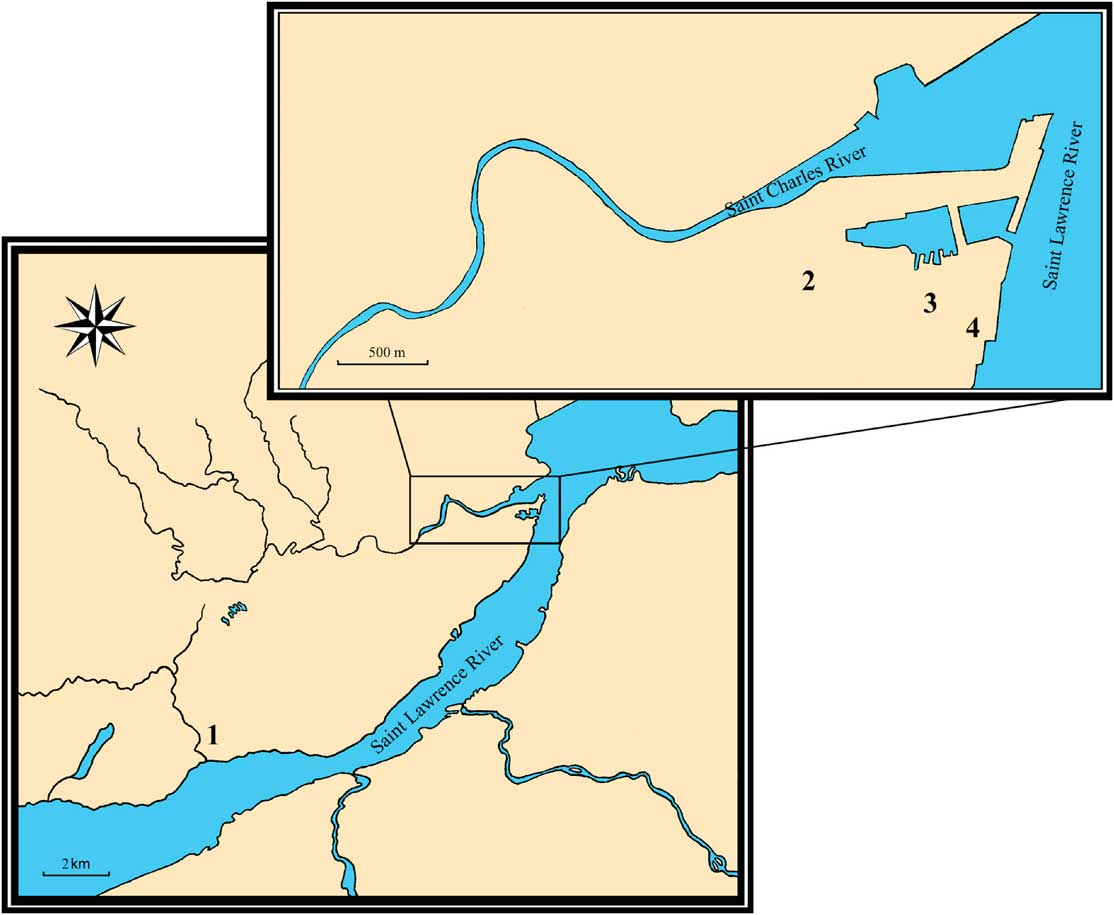
In 2010, various layers of sediment were sampled from the Intendant’s Palace archaeological site, Ville de Québec, Québec, Canada (Fig. 1). In 1668, the intendant Jean Talon purchased this land. Since then, the site has had an almost continuous occupation by people of European descent (Moussette Reference Moussette1994). The sediment samples were processed using standard methodology in archaeoentomology (Kenward et al. Reference Kenward, Hall and Jones1980). The organic and mineral fractions of the sediment were separated using hot water and a 300 µm geological sieve. The organic fraction was mixed with kerosene and cold water; kerosene adheres to the cuticle and is lighter than water. The fraction that floated on the surface of the water was entirely sorted under a binocular microscope (×10) while the fraction that sunk was entirely sorted under a macroscopic magnifying glass in order to recover all the coleopteran head, pronotum, and elytra. A pair of elytra of P. striolata (Fabricius) (Coleoptera: Chrysomelidae) was identified in a layer deposited before the European occupation in 1668, as underlined by its stratigraphic position under a layer itself located under the first building erected on the site.
Maps of the sites discussed in the vicinity of Ville de Québec, Québec, Canada: 1. Cartier-Roberval Site; 2. Intendant’s Palace Site; 3. Hébert’s Farm; 4. Champlain’s “Abitation”.

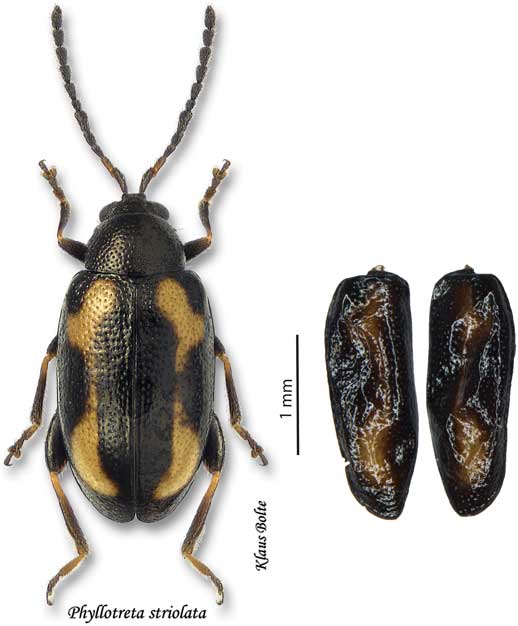
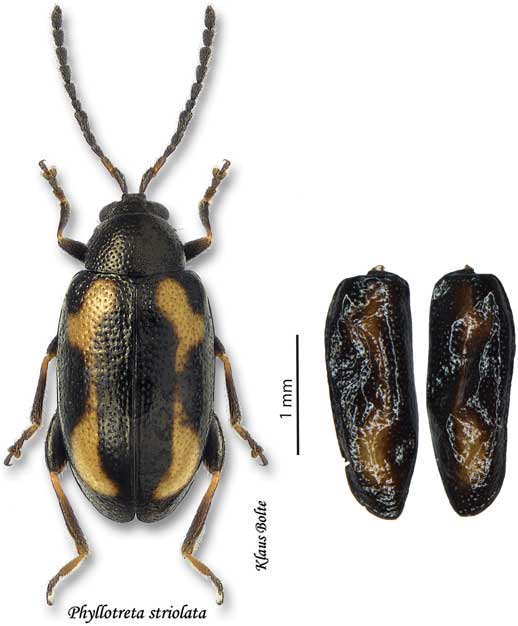
Phyllotreta striolata is a leaf beetle easily separated from the other species of the genus by the median pale sinuate to bilobed stripe on each elytron (Fig. 2). The elytra could be confused with those of P. zimmermanni (Crotch), which are much longer and more robust, and with those of P. bipustulata (Fabricius), “but in P. striolata the elytral subapical mark has incurved toward the suture instead of having its sutural margin straight” (Smith Reference Smith1973: 131). The coarse puncture of the elytra (Fig. 2), “separated by less than ½ to equal their diameter” (Smith Reference Smith1973: 125) also support the association with P. striolata. Larvae feed on roots of crucifers (Brassicaceae) while adults feed on cotyledons of various crucifers in spring and on their leaves later in the season (Smith Reference Smith1973). Many crucifers were introduced in North America as foodstock for the colonists and as a weed of their livestock’s fodder. If the population grows and cruciferous plants become too sparse, they will feed on plants of other families (Smith Reference Smith1973).
Left: Phyllotreta striolata. Right: Elytron recovered from the Intendant’s Palace site.
The weed Barbarea vulgaris Aiton (Brassicaceae), likely transported amongst hay and thus in fodder (MacDonald and Cavers Reference MacDonald and Cavers1991), could be a key factor in the establishment of colonies of P. striolata in North America. The leaves of the plant remain green throughout the winter and its growing period begins early in the spring, providing hosting opportunity for crucifer pests (MacDonald and Cavers Reference MacDonald and Cavers1991).
The first European endeavour to colonise New France was in 1541 with the Cartier-Roberval site (Fig. 1). Livestock was on board (Samson and Fiset Reference Samson and Fiset2013), and it can thus be speculated that fodder was also present. Archaeobotanical analyses confirmed that cabbage, amongst other edible vegetables, was carried from Europe and was still cultivated in 1543, when the settlement failed (Samson and Fiset Reference Samson and Fiset2013). In 1608, Champlain’s “Abitation” (Fig. 1) marked the foundation of Ville de Québec by Europeans. He tended a garden in which, in 1616, cabbage and “raves” are listed amongst the cultigens (Rousseau Reference Rousseau1964). The term “raves” most likely refers to radish (Raphanus sativus Linnaeus; Brassicaceae), but could also be a generic term referring to edible roots (Rousseau Reference Rousseau1964). In 1618, in the first settler’s farm (Fig. 1), Guillaume Hébert’s, “all sorts of herbs, such as cabbages, raves, lettuce, […] and many other vegetables […]” (Laverdière Reference Laverdière1870: 128) were growing. From then onwards, cultivation of various crucifers has been well established in town.
Although it is not possible to trace its exact moment of introduction, P. striolata was first introduced to North America before 1668, placing its introduction about 50 years earlier in the colonies history than previously recorded (Bain and LeSage Reference Bain and LeSage1998). This new record of P. striolata supports the hypothesis first mentioned by Lindroth (Reference Lindroth1957) that adventive species were introduced to North America shortly after the European settlement.
Acknowledgements
The authors are thankful to everyone who provided information on early culture of crucifers and/or commented on early versions of the text. The authors thank Klaus Bolte for the habitus, Karine Savard for the map, and the reviewers.