Introduction
Inferior turbinate hypertrophy is a common cause of chronic nasal obstruction. It is most frequently a result of vasomotor dysfunction, allergic rhinitis, chronic sinusitis or deviated nasal septum.Reference Anadolu, Ozgursoy and Tatlipinar1
Medical treatment with local corticosteroids, antihistamines and decongestants is usually effective in establishing comfortable nasal breathing, but frequently does not improve nasal congestion.Reference Hol and Huizing2 Consequently, many patients remain dissatisfied and seek surgical intervention.
Hol and Hiuzing identified at least 13 different surgical techniques used over the last 130 years to treat inferior turbinate hypertrophy; however, most of these techniques are not able to preserve tissue integrity.Reference Hol and Huizing2 Many of these procedures were found to be associated with a relatively high incidence of post-operative bleeding, crusting, pain, hyposmia and synechiae, attributed to inadvertent injury to the turbinate mucosa.Reference Passali, Passali, Damiani, Passali and Bellussi3, Reference Jackson and Koch4 The optimal surgical approach would enable successful volumetric reduction of tissue while avoiding damage to the mucosal surface.
Radiofrequency tissue ablation permits tissue volume reduction under local anaesthesia, and eliminates the need for post-operative packing.Reference Anadolu, Ozgursoy and Tatlipinar1, Reference Lee, Hwang and Kingdom5 This procedure is used to shrink the submucosal tissues; over time, the treated site is infiltrated by fibroblasts. Wound contraction during healing results in volumetric reduction of submucosal tissue and subsequent relief of nasal obstruction symptoms, with minimal damage to the mucosa and submucosal glands.Reference Lee, Hwang and Kingdom5 Post-operative swelling and bleeding are decreased, compared with other surgical techniques, since fibrosis promotes adhesion between the turbinate periosteum and the mucosa.
Materials and methods
Patients
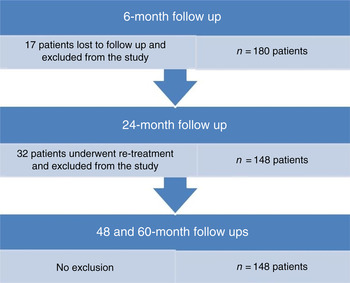
Patients presenting with chronic nasal obstruction between November 2002 and March 2005 (n = 197) were considered for this procedure. Seventeen patients were lost to follow up and were thus excluded from the study, while 32 patients underwent re-treatment (i.e. repeated radiofrequency tissue volume reduction or inferior turbinoplasty) between the sixth and 12th month of follow up. Thus, we evaluated 180 patients six months post-operatively, but this number decreased as the 32 re-treated patients were excluded from the study at the 24, 48 and 60 month follow-up visits. Only the remaining 148 patients were considered for the present study analysis (Figure 1).
Flow chart showing patient numbers and follow-up periods.

All patients had bilateral inferior turbinate hypertrophy, and all had failed to respond to medical treatment, which consisted of intranasal steroids and oral antihistamines with decongestant, administered for two months. Our patients' major symptoms were nasal obstruction and nasal discharge. Before undergoing the procedure, all viable treatment options were discussed with each patient. Patients who had received previous turbinate surgery or nasal radiotherapy, or who were found to have septal deviation, nasal polyps or tumour were not included in the study. None of the patients had a history of allergy.
In suspected cases of allergy, skin-prick testing, nasal smears and radioallergosorbent testing for specific allergens were performed. Test results were negative for all suspected cases included in this study.
All patients showed a reduction in inferior turbinate size after application of topical decongestant agents.
This study was approved by the ethics committee of İzmir Tepecik Training and Research Hospital. Informed consent was obtained from each patient prior to enrolment.
Patient demographics
Patients ranged in age from 18 to 74 years (mean ± standard deviation 32.7 ± 11.0 years). Of the 180 patients, 103 (57 per cent) were male and 77 (43 per cent) female. All patients had bilateral inferior turbinate hypertrophy and underwent a bilateral procedure.
Surgical procedure
The same senior surgeon (IC) performed all procedures. All patients were operated upon under local anaesthesia within the out-patient department of İzmir Tepecik Training and Research Hospital.
The topical anaesthesia was administered via pantocaine-soaked gauze followed by injection of 3 ml Jetokain Simplex (Adeka Drug Company, Istanbul, Turkey) without adrenaline into the anterior, middle and posterior portion of each inferior turbinate. Radiofrequency energy was delivered by a Reflex 45 probe mounted on an ENTec Coblator device (Coblator Plasma Surgery System; ArthroCare, Sunnyvale, CA, USA). The probe was inserted submucosally into the anterior end of the inferior turbinate, then advanced longitudinally through to the posterior end. Radiofrequency energy was applied for a period of approximately 20 seconds to the anterior, middle and posterior third of each inferior turbinate, delivering approximately 450–480 J. As the probe was withdrawn, radiofrequency energy was applied at a level to induce coagulation, to achieve haemostasis.
Patients were discharged two hours after the procedure. All were given a prescription for intranasal steroids, and recommended to use them for one month. During the first post-operative week, patients were also offered analgesics, antibiotics, a decongestant and nasal lavage with saline.
Self-reported outcome measurements
Patients were asked to rate their degree of nasal obstruction and nasal discharge, using a 10 cm visual analogue scale (VAS), before and six, 24, 48 and 60 months after the procedure. Our patients' major symptoms were nasal obstruction and nasal discharge. For nasal obstruction, a score of 0 (i.e. 0 cm on the VAS) equated to ‘completely open’, while a score of 10 (i.e. 10 cm on the VAS) equated to ‘completely obstructed’. For nasal discharge, a score of 0 represented no problems while a score of 10 represented severe discharge.
Acoustic rhinometry
All patients agreed to undergo acoustic rhinometry (using a SRE 2000 system; Rhinometrics A/S, Lynge, Denmark) before and six, 24, 48 and 60 months after the procedure.
Patients sat upright in an armchair and breathed gently through their mouth during rhinometry. They were allowed to acclimatise in this fashion for approximately 20 minutes before recording, to minimise variation. Background noise was minimised, and all measurements were obtained at the same room temperature. No decongestant was applied to the turbinates during measurements. Rhinometry measured the volume extending from the nostril to 5 cm within the nasal cavity, as this area includes the functional nasal valve and much of the septal and erectile tissue.Reference Kizilkaya, Ceylan, Emir, Yavanoglu, Unlu and Samim6 Volumes were calculated three times for both the left and right nasal passages, and the mean volume recorded for each patient.
Data analysis
Statistical analysis was performed using the Statistical Package for the Social Sciences version 10.0 software program. Comparison of pre- and post-operative VAS and acoustic rhinometry values was conducted using the Wilcoxon signed rank test.
Results and analysis
Overall, VAS scores and acoustic rhinometric measurements improved in 148 of the 180 patients (82%) after 60 months' follow up. The majority of our patients received only one radiofrequency tissue volume reduction procedure.
Revision radiofrequency surgery
Between the six and 12 month follow-up visits, we offered the option of surgical revision to 32 of the 180 patients (18 per cent) who did not have an acceptable response to the initial procedure. All these 32 patients had continued to report substantial symptoms, with objective evidence of ongoing inferior turbinate hypertrophy on endoscopy. Nineteen of these patients received a second radiofrequency tissue volume reduction procedure, and 13 patients underwent inferior turbinoplasty.
Subjective outcome
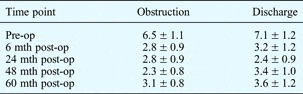
Patients' VAS scores were significantly decreased at six, 24, 48 and 60 months post-operatively, compared with pre-operative values (p < 0.001) (Table I). At 60 months post-operatively, a VAS score of less than 3 was seen in 117 of the 148 patients (79 per cent) for nasal obstruction, and in 98 of the 148 patients (66 per cent) for nasal discharge.
Vas nasal Symptom Scores

Data represent means ± standard deviations. VAS = visual analogue scale; pre-op = pre-operative; mth = months; post-op = post-operative
Acoustic rhinometry
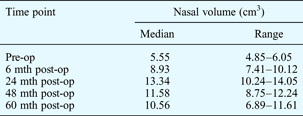
Patient's post-operative nasal cavity volumes were significantly improved at six, 24, 48 and 60 months post-operatively, compared with pre-operative values (p < 0.05) (Table II).
Acoustic rhinometry results
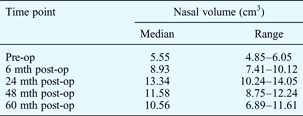
Pre-op = pre-operative; mth = months; post-op = post-operative
Discussion
Treatment of obstructive inferior turbinate hypertrophy using radiofrequency-based turbinate reduction is a minimally invasive, quick and effective technique. It can be performed on an out-patient basis under local anaesthesia, does not require nasal packing, and can be repeated if necessary.
Although most surgical approaches may be similarly effective for reducing obstructive symptoms, previous reports have suggested that the nasal epithelium and its function may not be preserved after such surgical turbinate reduction procedures as CO2 laser ablation and partial turbinectomy.Reference Passali, Passali, Damiani, Passali and Bellussi3, Reference Sapci, Sahin, Karavus and Akbulut7, Reference Back, Hytonen, Malmberg and Ylikoski8 Impairment of epithelial function and mucociliary transport can cause prolonged rhinorrhoea, greater nasal obstruction (secondary to oedema) and crusting. In contrast, radiofrequency ablation appears capable of preserving nasal epithelial function, and therefore has an advantage over other surgical treatments.Reference Sapci, Sahin, Karavus and Akbulut7, Reference Coste, Yona, Blumen, Louis, Zerah and Rugina9 Radiofrequency-based turbinate reduction is associated with fewer symptoms of allergic rhinitis following treatment. Histologically, there is formation of scar tissue in the submucosa, ablation of minor vessels in the treatment area, and reduction in the number of glands.Reference Coste, Yona, Blumen, Louis, Zerah and Rugina9, Reference Cukurova, Cetinkaya, Demirhan and Avci10
The clinical effectiveness of radiofrequency tissue volume reduction has been evaluated previously. Bhattacharyya and Kepnes treated patients presenting with inferior turbinate hypertrophy (due to chronic rhinitis), and concluded that the clinical benefits of the procedure persisted for at least six months.Reference Bhattacharyya and Kepnes11 We observed a similar trend. Furthermore, we observed that the clinical benefits of only one radiofrequency treatment appeared to last at least 60 months post-operatively.
• Radiofrequency tissue volume reduction is an effective, minimally invasive procedure that can be performed on an out-patient basis under local anaesthesia
• This study investigated long-term clinical outcomes for this procedure
• Most patients (82 per cent) showed long-term (60 months) subjective and objective improvement after only one treatment procedure
The effect of the number of radiofrequency tissue volume reduction sessions on treatment outcome has been evaluated.Reference Atef, Mosleh, El Bosraty, Abd El Fatah and Fathi12 Atef et al. found that at least three treatment sessions were required in order to achieve an effective, stable treatment outcome for one year. In our study, we offered the option of re-treatment to 18 per cent of our patients; however, the majority of our patients (82 per cent) were satisfied after receiving only one treatment (as assessed by improvements in VAS scores and acoustic rhinometry). The demographic differences between our patient group and that of Atef et al. are not clear. However, it is likely that the results expected following the procedure, and/or the subjective reporting of nasal obstruction, may have differed between the two cohorts, and this may have contributed to the differences in results.
After successful radiofrequency tissue volume reduction in patients with turbinate hypertrophy, there is a decreased risk of the inferior turbinate reacting negatively to vasoconstriction agents.Reference Anadolu, Ozgursoy and Tatlipinar1, Reference Bhattacharyya and Kepnes11, Reference Li, Powell, Riley, Troell and Guilleminault13 In our experience, patients respond better to vasoconstrictor treatment after radiofrequency-based turbinate reduction. Under normal circumstances, vasoconstriction agents act by reducing blood flow through the nasal cavity, thus reducing nasal congestion and shrinking nasal mucous membrane volume. It appears that, after radiofrequency turbinate reduction, patient response to vasoconstriction agents becomes more normalised, decreasing or possibly eliminating the risk of paradoxical post-operative nasal obstruction induced by vasoconstrictor use.
Conclusion
Radiofrequency tissue volume reduction is an effective, minimally invasive procedure that can be performed on an out-patient basis under local anaesthesia, with minimal discomfort to the patient. Radiofrequency tissue volume reduction can reduce the volume of the inferior turbinate without adversely affecting the nasal mucosa. The procedure is quick, easy, relatively painless, and has the additional benefit of not requiring post-operative nasal packing. Our long-term data (up to 60 months post-operatively) suggest acceptable long-term clinical results for this procedure.