1. Introduction
Brittany is one of the most representative French regions when it comes to rural life, as low urbanisation spaces are many and agriculture occupies an important place. While traditional villages exist, the region’s inland areas consist mainly of hamlets and bocage. This situation underwent numerous changes during the twentieth century, however. While farming activities were the main economic activity in the region up to the 1950s, their role then devolved, although remaining important,Footnote 1 and alternatives were required to retain young people in areas at risk of devitalisation and rural exodus.Footnote 2 This transformation occurred against a background of heightened leisure activity,Footnote 3 and, more particularly, outdoor practice. One such leisure activity, hiking, became increasingly attractive in the 1960s. Its national development was advocated by high-level French authorities,Footnote 4 which saw it as a chance for people to rethink their lifestyles by enabling urban populations to return home invigorated after enjoying the fresh air. It likewise embodied the need to envisage ‘the remodelling of rural space’ and rethink its development marked particularly, at the time, by reparcelling, and an emphasis on intensive farming.Footnote 5 Fifteen years later, the State sought to open up rural areas for leisure activities while ensuring access to a diversity of practitioners.Footnote 6 In charge of hiking since 1947, France’s national hiking association, Comité National des Sentiers de Grande Randonnée (CNSGR), was recognised by the decree of 22nd February 1971 as a public-interest organisation. This recognition highlighted the importance bestowed upon the activity in a context of social transformation. The role of rural areas in Brittany’s history, as well as the opportunities they offered for trail creation, made hiking a structuring element in territorial development. This was all the more so, since the region became the CNSGR’s growth laboratory for its practice.
While analysis of hiking implies significant heuristic potential,Footnote 7 research on the subject in France is relatively rare and primarily focuses on the history of its development in mountain areas.Footnote 8 Yet, in the same way as a physical activity, it is a political object generating social and cultural benefits for lifestyles and contributing to shaping territories.Footnote 9 As suggested by existing works concerning Lancashire, which highlight the structuring role of hiking and its political use in the 1930s,Footnote 10 it is necessary to look at trekking’s contribution to local identities. In the same way as trekking strengthens the national idea of some countries,Footnote 11 we also hold to the hypothesis that hiking promotes regional identity. This is especially the case for Brittany where attachment to the local values embedded in its language and all forms of sociability is very strong.Footnote 12 Adopting the approach that mobility shapes identities,Footnote 13 we will be attentive to the opportunities arising from the requirements linked to hiking growth. At the same time, we will analyse the role of hiking in Brittany’s territorial development. The direction followed for the activity in regional planning gave a changed meaning to landscapes, places, and territories. By modifying the environment to welcome different populations and giving new significance to territories, as well as transforming social relationships and favouring certain aspects of heritage to the detriment of other neglected sites, hiking transformed the vernacular landscape and created new challenges.Footnote 14
At the time of agricultural intensification in Brittany,Footnote 15 production focused on the region’s plains. Valley floors were drained or gradually abandoned and became wooded areas. Their reallocation for hiking was based on evolving trail use and the valorisation of a new state of mind,Footnote 16 created by the development of leisure activities. More than just a mere location, paths became a channel for political engagement, as well as a potential influence on lifestyles that were torn between modernity and tradition.Footnote 17 We will endeavour to define Brittany’s ‘sense of place’,Footnote 18 focusing on the changing relationships between city and country through the rediscovery of the region’s paths. The aim will be to examine the role of the latter in the transformation of Brittany’s social, economic and territorial values, via the enhancement of heritage, in particular.
As a physical practice often portrayed as an ancillary activity in abandoned spaces, it became not only a political object but also a social and cultural one in 1970s France, when the country’s public authorities became concerned about increasing desertification and decided to tackle its negative effects. Our study thus aims to analyse the role of hiking in Brittany’s territorial restructuring. We propose to identify the aspirations that shaped hiking and to comprehend its role in development and tourism enhancement. We aim to contribute to the history of mobilities, as well as to rural territorial history and that of a physical activity. We selected the decisive period from 1968 to 1983, with the year 1968 witnessing the implementation of a series of initiatives aimed at developing hiking in Brittany. The disruptive political and cultural crisis beginning the same year heightened the desire to take a fresh look at social relationships through the local territories with which people identified.Footnote 19 Promoting rurality became a major goal and took on new forms based on the attractiveness of leisure and nature.Footnote 20 During the 1970s, action intensified at both national and local level with the aim of stimulating hiking. Understanding the dynamics underpinning its development thus inevitably implies intersecting the national focus on regions with the regional implementation of initiatives.Footnote 21 The aim is also to grasp the cultural and political changes which, in the space of only fifteen years or so, led to the lasting transformation of Brittany’s rural space through the creation of a dense network of footpaths, as well as to its emergence as a major tourism destination.
To answer the questions underlying the research, we used a corpus of varied private and public archives. We studied those of the CNSGR, which became France’s Hiking Federation, the Fédération Française de Randonnée Pédestre, in 1978. Composed of the minutes of general assembly meetings, hiking conventions and all publications serving the diffusion of the activity, these archives made it possible to identify the stakes linked to its practice, as well as the difficulties encountered. Legislative texts were also consulted to measure the requirements established by the authorities in their support of its development. We analysed the public archives of three of Brittany’s departments (Ille-et-Vilaine, Côtes-d’Armor and Morbihan) for institutional data, and to identify the regional effects and reasons behind the initiatives. Studying topographical guides (known as topo-guides) enabled us to examine the ways in which the region was perceived. We were also able to access the private archives of Jacques Lemaître, regional hiking manager and a decisive player in its history from 1969. For the years between 1967 and 1984, related letters, journals and local meeting minutes allowed an understanding of the nature of the debates, and of the challenges and opportunities marking this history.
2. Urban return to rural territories
The early 1970s were characterised by the transformation of the rural landscape and its perception through the eyes of urban populations. Although the movement was nationwide, Brittany represented an emblematic change laboratory.Footnote 22 The mechanisation of production and the agricultural policies conducted from the mid-1960s by the then Minister of Agriculture, Edgard Pisani, increased the size of agricultural fields and led to the removal of trees and plants, remodelling the landscape as a result.Footnote 23 This change in the French agricultural model impacted the territories’ paths, and voices were raised to protect a heritage endangered by the effect of land reparcelling. At the same time, observers and political officials condemned the deteriorating rural living conditions, with social relegation, remoteness and increased poverty being the main stigmas denounced. Wide-open spaces contrasted with ‘city dwellers crammed into cities’,Footnote 24 and they became ‘a basic need’.Footnote 25 It was more a case of reacting to a situation that was taking root than anticipating difficulties.
Urban and rural areas were, in fact, compartmentalised in France from the end of the Second World War, and representational rhetoric through advertising images now sought to highlight the decline of an old world that was coming to an end.Footnote 26 The publication and success of farmers’ life stories was symptomatic of both a form of nostalgia and of rekindled interest in an environment that seemed distant,Footnote 27 yet essential for contemporary lifestyles.Footnote 28 Previously threatening regionalism became reassuring rusticity capable of strengthening a nation attached to its own unity.Footnote 29 Public discourse on the rural environment thus corresponded as much to the backwardness of a world perceived as isolated as it did to a temptation to return to past ruralities it by spotlighting its potential advantages. A process was thereby set in motion to position the countryside as a resource. Reweaving the link between city and country appeared essential for all inhabitants to benefit from this territorial restructuring. Those from the city would have access to nature’s healing power to combat their urban worries, while those in the country could reallocate unused land for popular activities, with leisure as an important opportunity:
With the changes in agricultural techniques and their mechanization, the issue of what will happen to paths and routes is clearly raised, as well as that of opening or closing the door to the rural world.Footnote 30
The Regional Delegate of the French Hiking Federation articulated footpaths as an essential tool for implementing change. Somewhere between the characteristic tradition of rural space and the modernity of the leisure activities promoted by city dwellers, walking routes became social and cultural transactional places to be valued.Footnote 31 They represented a lever for the modernisation of rural territories, despite already being a long-standing part of the landscape. For the administration of the Morbihan department, they combined advantages that were compatible with an ancestral lifestyle and the social changes underway:
the rural or city man on holiday needs footpaths: children going to school or the elderly to the village, they all need to use a car; the hours spent in an office or on a tractor must be offset by a minimum amount of muscular activity; 40% of French people’s leisure activities is dedicated to walking.Footnote 32
A new way of using rural territories was defined, as city dwellers gave them a compensatory role, and hiking became a major resource in this process of territorial legitimisation.
Both association leaders and local councils thus used trekking as a device for rural revival in a period that was conducive to ascribing value to lands in search of new resources. The support of the Ministry of Agriculture was moreover indicative of the stakes attached to hiking,Footnote 33 since the Ministry’s interests were generally directed towards economic and salary concerns. In this context, the CNSGR President recommended bringing natural rural spaces and cities closer together. Instigating a true rupture in the field of territorial development, he considered that while city dwellers should travel to the country, the country should also be an integral part of the city by providing new areas for leisure. For him, ‘Nature should not be hundreds of kilometres away from the large cities. Nature, the outdoors, leisure activities should be near the cities. We need to find ways of joining leisure centres and the great outdoors through hiking, walking and exchange.’Footnote 34
The Ministry of Equipment likewise took its own stance on the matter and urged local authorities to join the movement:
Brittany’s city dwellers should be given the opportunity to walk … if they live in city centres, they should be able to leave the city via special exit routes – or if they live in the outlying communes, any agricultural areas there should be protected for the purpose of walking.Footnote 35
Declared part of French heritage, the CNSGR considered such places as critical in encouraging a return to nature for those who had lost touch through urban migration: ‘Paths play an eminent role in territorial attractiveness through their contribution to rural renewal. You only have to remember that 90% of French territory is rural to measure the impact of paths on this vast part of national ground.’Footnote 36
There was thus no doubt that paths were the focus of converging attention, and that city life should be designed in relation to that of the country. The CNSGR President reiterated the fact that ‘it is time to think of paths as a fundamental element of territorial development.’Footnote 37 Such prioritisation came as hard-to-access valley floor fields were being abandoned and in need of redeployment to ensure the future of local life.Footnote 38 While territorial development had hitherto been fractured, policy was now aligned to make it a single dynamic space. This situation inevitably led to a redefinition of hiking trails for several reasons. The first was to ensure that rural populations remained in areas that were emptying and in which it was essential to maintain a social life. The second focused on their attractiveness, to be revived through new activities among which hiking held an essential role. The third reason was economic and intended to offset the drop in farming income.Footnote 39 As for the fourth reason, it was embedded in a movement of sociological change. In fact, several ministerial surveys conducted during this period observed that in rural areas the number of non-agricultural households exceeded that of agricultural ones. This transformation implied no longer considering lifestyles exclusively from the point of view of traditionally rural habits and practices. A shift in approach was necessary and the value of developing hiking became obvious: ‘Ensuring the potential leisure use of pathways currently being abandoned by agriculture is an urgent matter.’Footnote 40 Rural revival thus became a leitmotiv for the CNSGR to maintain activity in an area threatened with desertification: ‘It is an element of life, of rural revival which contributes to preserving this natural space, so fragile yet conserved for millenaries by the daily labour of rural life, but now threatened with being completely deserted in some regions.’Footnote 41 And so, as rural landscape changed because of modernisation, preserving existing paths became a priority.
Several booklets were published to aid developers in creating, preserving, and opening walking trails. From the height of the embankment to the width of the trail and the points of interest for tourists, every aspect was detailed to optimise their attractiveness.Footnote 42 Yet, it was more a complete change in the ways of travelling that resulted from this attention. Means should be gentle, respectful of nature and reinstate time’s legitimate place in people’s lifestyles:
we can say that there is no end to the creation of short hikes, trails from 1 to several hours that make it possible to value and take advantage of every little picturesque spot of our rural environment. We don’t notice them when we’re driving along shortcuts at 100 kilometres an hour … and yet there are marvellous places everywhere.Footnote 43
From 1972 on, the CNSGR Regional Delegate for Brittany was invited to the meetings of the Ministry of Planning, Public Works, Housing and Tourism to reflect upon an itinerant tourism policy in favour of rural revival.Footnote 44 The Ministry expressed the wish to intensify Brittany’s network and carry out the necessary adjustments. Being able to welcome city dwellers proved decisive in increasing its attractiveness: ‘The initial objective … was to create between 100 and 150 gîtes in inland Brittany. There were already sufficient facilities along the coast, and our associations are giving priority to discovering the rural world.’Footnote 45 These gîtes (overnight tourist accommodation for hikers) were designed to be meeting places with a twofold role. For city dwellers, they provided information on the region and local ways of life and encouraged the calling of those thinking about living in the country. For rural inhabitants, they were an opportunity to diversify their professional activities beyond agriculture and livestock farming. Walkers were, therefore, intended to allow other streams of income and the recovery of the economy in areas suffering from desertification. In the eyes of both national leaders and local actors, this physical activity should enable urban and rural dwellers to come together with a view to developing the former’s interest in rural life and showcasing the value of hitherto invisible territories. Local authorities thus jumped at the opportunity to benefit from the attractiveness of hiking:
[This study] is a direct contribution to achieving the goals [of the Comité d’expansion du Mené] for tourism development in this rural zone of the south-east part of the Côtes du Nord department. Tourism activities there are essentially considered as a way for city and country dwellers to meet, which will have a positive effect on the economic and social development of the region. By allowing closer contact with sites and men, the SGR [Sentiers de Grand Randonnée] solution of long-distance hiking trails seems particularly suited to this objective.Footnote 46
Paths were perceived as a necessary element in strengthening social cohesion. They ensured activity in the areas where they were located and, more importantly, represented an opportunity for people who did not know each other and were sometimes distant in their daily lives to meet and exchange.Footnote 47 In so doing, they served a social purpose, championed by the President of the national committee for regional development, Commission nationale d’Aménagement du territoire:
Hikers who greet the passers-by they meet and converse with them are interested in their lives and their particular problems, they request numerous services from the local population, asking for hospitality or accommodation, which allows them to get to know each other, dispel prejudice and ignorance, and do away with many misunderstandings.
… hiking trails are effective routes, not only for the rebirth of rural France, but also for understanding and friendship between French people.Footnote 48
Social ties were one of the fundamental elements behind the interest shown in hiking. While paths were long considered mere access routes for local people, rather than a place of entertainment serving to regenerate abandoned areas, new use was henceforth underpinned by aims that were more tourism-based than utilitarian. Their redevelopment proved essential in combatting extensive and production-driven farming which required space, and which encroached upon the areas that walkers wished to use.
Paths were also considered a way in which to connect rural and city territories, and ‘a (global) irrigation network shared by these two lifestyles’.Footnote 49 The national institution for hiking development went as far as to make them a cardinal reason justifying the activity’s expansion:
Can paths bring something positive to rural areas? In all likelihood, yes, through contact between city dwellers and rural inhabitants. It is by talking informally with farmers during a chance encounter on a trail or in a gîte that these contacts will happen and will be frequently enriching.Footnote 50
Keen to understand and contemplate the landscapes they discovered, hikers were intended to immerse themselves in a territory willing to welcome them. Paths became an opportunity to know and valourise a rural culture in harmony with its environment, in contrast to that of the city. Yet, far from being locked in a frozen ancestral past, it was the reinvention of a territory capable of valuing its natural assets and heritage, as well as its inhabitants, which constituted the guiding line of the action undertaken. Cohabitation between farmers and walkers was to be made possible through the development of host facilities set up outside urban areas, preferably in small hamlets. While such positioning reflected a form of utopia aiming to reconcile the different social categories, the national leaders of the French Hiking Federation were nonetheless aware of the potential tensions linked to the arrival of new populations, possibly seen as a tourist invasion. Anticipating such conflict in the coexistence of city and country dwellers, associations regularly reiterated the need for respect to be shown to rural inhabitants. Although hiking established a distribution of activities that led to a system of hierarchies (work in the city and leisure in the country), this approach aimed to allow the rediscovery of rural space by showcasing the natural assets it held. Several initiatives were consequently developed to promote a centrifugal movement from the city to the country.
3. Hiking trails: a social and territorial reinvention?
Seen as a tool for territorial development linked to the rediscovery of rural space, paths became a political object during the 1970s. Behind apparent morphological and landscape uniformisation, they were an element of spatial differentiation. While this interest was not new, it became a priority at the beginning of the decade, as shown by the analysis of the Breton trail association, Association bretonne des relais et itinéraires (ABRI), which played a decisive role in establishing hiking throughout the territory and bringing the activity to the political fore:
The value of creating long-distance hiking trails in Brittany became evident when the national committee for long-distance hiking trails, Comité national des sentiers de grande randonnée (CNSGR), was set up in 1947. The idea of a ‘Tour de Bretagne’, a ‘Tro-Breiz’, was given preference at the time. Such an itinerary was even considered an essential part of the French network.
For numerous reasons – high density of the network, lack of motivation – the project was only taken into consideration in Brittany in 1968 following the intervention of the DATAR (Interministerial Delegation of Land Planning and Regional Attractiveness).
Two phenomena then simultaneously occurred, making immediate action necessary: the rapid disappearance of paths during land restructuring and the ever-increasing demand for hiking itineraries at local, regional and international level.Footnote 51
A walking path and true ‘historiographical mirage’,Footnote 52 le Tro Breiz played its part in reactivating tradition via a modernised practice.Footnote 53 The increasing need for a change of scene(ry) and for exploration of unknown places gave new meaning to the countryside.
Bretons’ attraction to hiking came particularly from the new appeal of nature, which was being felt throughout the whole of continental Europe.Footnote 54 While it was necessary to make nature accessible to the greatest number of people for the benefits it provided, it should, nonetheless, be respected and protected to avoid the risk of damage feared by the inhabitants. Its original purity was, in fact, the main argument put forward for avoiding any possible degradation resulting from an influx of people unaware of its fragility. From 1972, the CNSGR was thus aware of the need to draw the attention of potential tourist hikers to such environmental respect. Hiking should therefore be part of a wide-scale nature awareness programme promoting the protection of the environment:
Those who know nature well will love it and learn to respect it. Walking along a path is less dangerous than trampling undergrowth, breaking branches, thoughtlessly picking everything in sight or quite simply poisoning nature with engine fumes.
Through these trails of varying lengths, we will help people acquire a taste for walking in nature and bring new enthusiasts to hiking. Walking is an important element in better physical and psychological balance, offsetting the varied nuisances of our civilization. It is vital.
Trails will thus have fulfilled their dual role of safeguarding nature and man.Footnote 55
Considered in this light, trails represented both a field of study and a training facility. While the aim was to promote well-being by means of a convivial activity, although it was also necessary to prevent nuisances linked to city hikers’ lack of preparation and their perceived low awareness of the fragility of natural spaces. Providing a multitude of benefits, already long enjoyed by some,Footnote 56 access to nature-rich rural spaces and was deemed a life-saving element of a humanity in danger from both physical and psychological points of view. Thus beyond giving new uses to ‘neglected’ spaces,Footnote 57 hiking was also a strategy in social regeneration through physical exercise, self-discovery, and discovery of others and of nature.Footnote 58 Indeed, the bodily health aspects linked to the growing interest in well-being was central, with the phrase ‘A 1-day trail = 8 days of health’ becoming the doctor-led CNSGR’s slogan during the 1970s.Footnote 59 A walking body was a self-maintenance tool capable of sensitising a wider public to the concept. The reiterated mentions of fresh air and inherent purity of rural space in the face of civilisation’s excesses referred to the myths of the natural benefits of salvational walking.Footnote 60
This concept of ‘wild’ nature determined the requirements of the hiking routes and itineraries. While the idea of freedom was raised to insist on hiking’s social value, it should nonetheless have guidelines. Such was the role of the trail marking process that began in Brittany in 1968. Certain associations tended, moreover, to criticise the existence of organised trails, considering them to be overly restrictive.Footnote 61 The decisive argument in their favour, however, was the fact that they were accessible to all and free of charge. Guided freedom that enabled everyone to hike through a domesticated, yet purifying nature became the general principle of the developments. Trails were established, structured, and became increasingly more complex as trail stages, and return, loop and point to point trails were added, creating a new regional spatiality as a result. Intended as a democratic activity in line with the sport-for-all public policies, hiking also required trails that were adapted to novice and ill-prepared practitioners.
However, such ambitions came face-to-face with a growing phenomenon that ran the risk of rendering the plan unworkable. The disappearance of the very paths that the scheme relied upon was a recurring source of concern for national and regional general assemblies.Footnote 62 As the result of the mechanisation of agriculture and underutilisation, some paths were overgrown and damaged. Policies for land reparcelling increased the size of workable parcels and often destroyed the paths therein. Intensification of the road network also drastically reduced their number.Footnote 63 Several hundreds of parcel hectares, and thus kilometres of paths, vanished to make way for paved roads as the Breton bocage underwent major remodelling during the 1970s.Footnote 64
It now became crucial to combat this trend and recreate a network of walking paths. Undergrowth was cleared, branches were trimmed, and the creation and waymarking of paths acted to make Brittany more accessible to both inexperienced and seasoned hikers alike. Primarily the result of the active support of individuals from the field of public education, this reconfiguration was often first achieved with paltry resources (for example, pots of paint, machetes) before state subsidies began to provide a significant amount of financial support. The challenge of reversing the collapse in path infrastructure proved the greatest challenge, it even being feared that if the trend continued hiking would only be possible along the sides of tarmacked roads. The aim was, therefore, to restore the trails. Path classification bore witness to the organising approach adopted and the impact of hiking: ‘paths as a natural way of entering the rural space; paths as a way for the city dweller to know the country; paths as a way for the rural world to develop and open up; paths as the source of nuisance and pollution.’Footnote 65 The situation created tension with landowners, who considered it economically more profitable to sell their land for the construction of roads rather than the upkeep of trails that were free to use. While legislation gradually led to the improved maintenance of hiking trails, this did not prevent certain inhabitants from banning access to paths on their land.
In relation to Brittany, its coastline hiking trail, ‘le sentier des douaniers’, attracted particular attention in the early 1970s.Footnote 66 Trails in inland Brittany were likewise important, especially those enclosed in fields and rapidly disappearing. Both on the coast and inland, setting up the network became urgent to avoid the invasion of tarmac and the risk of preventing hiking for all.
In this context, the annulment of the court ruling dated 7th January 1959, authorising mayors to sell rural paths, became the priority, justified by the intended benefits of hiking development as stated by the President of the CNSGR:
Opening up nature to all; Protection of nature and the environment; A new breath of life with and for the rural world; Sport for all; Active, sports and social tourism; Safeguarding our physical and psychological health [is] considered a national priority from every point of view.Footnote 67
Institutional leaders were henceforth committed to action. The contributions of Michel d’Ornano, Minister for Culture and the Environment, and of Paul Dijoud, Secretary of State for Youth Affairs and Sport, during the national hiking convention in 1977 showed clear political support.Footnote 68 CNSGR President Bernard Woimant also took advantage of the political networks of his half-brother Michel Woimant, Technical Advisor to Georges Pompidou, President of the Republic, and instigator of the initiative to create the Ministry for the Environment. While responsibility for sporting activities in France fell solely to the Ministry of Sport, hiking became the focus of interministerial action, with the Ministry of Tourism and that of Agriculture and Territorial Development working alongside those already mentioned. Such mobilisation was a clear sign of the new importance given to the activity by the public authorities and of its strategic position at the heart of health, tourism, ecological and economic concerns. Although the State already supported the development of hiking prior to 1977, its commitment strengthened from this date on due to the social, territorial and tourist opportunities offered by the activity. While it had previously contributed to the sport’s growth by publishing official texts legislating on path protection,Footnote 69 it now became a key actor. This change in stance was the result not only of the initiatives (land clearing, appeals, etc.) of militant members of non-profit organisations, such as Émile Orain and Jacques Lemaitre in Brittany, but also of a belief in the collective benefits of a return to nature.Footnote 70
This generalised commitment led to the ‘sanctuarisation’ of trails via an unprecedented legal framework that facilitated and guided the reshaping of rural space. As the State’s representatives in the regions, prefects themselves then received, in 1974, a missive signed by five ministers, stating that: ‘Hiking tourism, both on foot and on horseback, is experiencing major growth, which is engendering a number of problems, often related to the protection and maintenance of the itineraries.’Footnote 71 Prefects were reminded in the missive that the matter was the subject of a presidential decision to ensure the necessary conditions for the trails’ protection: ‘In its concern to encourage tourism at outdoor leisure centres, the Council of Ministers adopted measures on 28th August 1974 to facilitate hiking.’Footnote 72 The stance taken was the first step in a series of texts aimed at safeguarding the endangered trails and leading to the implementation of departmental plans for boosting hiking.
The interministerial circular dated 18th December 1974, followed by that of 7th July 1977, insisted on safeguarding the paths as a way of contributing to the natural environmental balance and the development of leisure activities. The injunction to implement departmental plans for tourism based on walking and horseback riding stimulated some decisive local action and rallied the players and associations who advocated hiking. Measures included granting right of way and banning fencing along trails, particularly on the coast already under pressure from property developers (1976). ‘National and municipal forests’ in Brittany ‘are centres of attraction; they can be home to long-distance hiking trails or be used for short paths signposted by the National Forestry Office.’Footnote 73 The authorities thus established a protective legal arsenal, translating into a rapid increase in the number of trails open to the public. In the Côtes-du-Nord department, there was a move to bring together local councils, key players in tourism and the department’s decision-makers.Footnote 74 A few months later, the Prefect appealed to each one’s sense of responsibility:
Among the elements of land heritage essential to enhancing rural space, country paths are an utmost priority. As well as their traditional role of allowing communication between farm holdings, they are also an increasingly valuable instrument for the development of hiking.
Hiking is one of the most favoured forms of rural tourism. It is therefore important to ensure the conservation of the network of rural paths which irrigate the countryside via an irreplaceable system of routes.Footnote 75
Playing with the metaphor of irrigation in a letter to underline the diversity and value of paths in reaching the largest number of people, the Prefect requested that all town and city councils vote to ban the destruction of rural paths forming part of a hiking trail. In this respect, local coordination proved crucial for hiking to exist. The State called upon communes to form tourist boards with the aim of ensuring the upkeep and use of the paths.Footnote 76 Liaison between the different communes was facilitated as a result. Following a number of land development operations, the communes then acquired connecting roadways and turned certain farm roads into trails for hikers.Footnote 77
A vast census of existing itineraries was carried out, first in the Morbihan and then in the other Breton departments, to map the territory and provide the public with detailed information, as well as to identify and finance any necessary maintenance work. The whole region joined forces to renovate its paths. Created on 25th June 1974, the Association Bretonne des Relais et Itinéraires (ABRI) coordinated action, interfaced with the State, and promoted the hiking assets of the region.Footnote 78
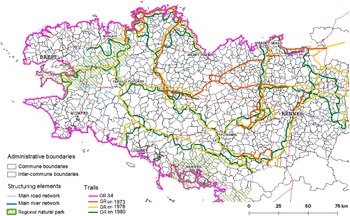
As a result, hiking in Brittany underwent considerable expansion. The number of trails increased over time, as shown in Figure 1. In the Morbihan department alone,Footnote 79 while there was not one single identified route in 1974, 150 kilometres of long-distance hiking trails were in use in 1976. Hikeable trails covered 275 kilometres in 1977, 450 kilometres in 1978, 645 kilometres in 1979 and 850 kilometres in 1982.Footnote 80 Moreover, in his 1982 review, the Regional Secretary of the French Hiking Federation placed particular emphasis on the importance the activity had acquired in under ten years.Footnote 81 Such trail densification was both remarkable and unprecedented when compared with other regions worldwide,Footnote 82 especially since it was brought about by the action of militants with limited means before the mid-1970s. This situation meant that hiking was now accessible to the vast majority and bore witness to the impact of the action taken during the 1970s.
Brittany’s ‘Grande Randonnée’ (GR) long-distance hiking trails, 1973 to present.

4. Exploring heritage on foot: Breton identity and rural enhancement
A vehicle for rural renewal and spatial development, hiking likewise represented an opportunity for territorial valourisation. A form of tangible heritage in their own right, paths served also to highlight the local landmarks and notable sites. Itineraries were thus not only designed along existing routes, but also according to the points of interest they included, this a way of making them more appealing to potential hikers. Far from being guided by chance, choices were founded on the tourism potential of the locations through which the paths passed. For CNSGR’s Technical Secretary, such potential was the corollary of rural accessibility from 1968, with the GR34 hiking trail that would make its way along the whole of the Breton coastline:
We would like to draw your attention to the value of Brittany’s trail passing through your commune. It will contribute to bringing an increasing number of hikers to your locality, shopkeepers will have new customers and, as a result, enjoy greater prosperity.Footnote 83
There was thus no longer any doubt for the Prefecture of the Côtes-du-Nord department that ‘hiking represents one of the most advantageous forms of rural tourism’.Footnote 84 Mobilising landscapes and monuments as heritage resources and aesthetic enhancement and developing landscape knowledge were key issues conditioning the success of the hike and the prosperity of the area.Footnote 85 It is important to note though that the value of a trail was in part a function of its accessibility for a large number to points of interest.Footnote 86
It thus seemed obvious to integrate trails and hiking in the schemes drawn up to develop tourism.Footnote 87 While several territories were being relegated and marginalised, hiking became a means to reveal their assets and attract new visitors mindful of the ideals the activity conveyed, and of the treasures of the areas through which they walked. In this way, a key emphasis on tourism was asserted, with a particular focus on exploration and discovery, which was out of line with the aspirations of Brittany’s territorial hiking strategy. This choice reflected social engagement towards ‘popular’ tourism and its access to outdoor leisure activities as opposed to the desired physical and psychological improvement: ‘While the slow pace of the hike allowed much deeper knowledge of things and people, it also implied that the interest of the trail should be long-lasting, attractive and as natural as possible.’Footnote 88 According to the Regional Delegate of the French Hiking Federation, it was well and truly this principle that guided the development of hiking trails throughout Brittany at the time.
This approach made it possible to spotlight the remarkable features along the way, not only the buildings but also the landscapes, which could be accessed via the trails. Natural heritage thus joined with architectural heritage:
Brittany’s climate makes hiking possible all year round. A 5-day trail will show you all the features of the Trégor region: the coast and inland, with its woods and its moors, its sites, and its monuments: its megaliths, chapels, and manors.
A visit to Lannion is a must, with its houses (XVth and XVIth century), Saint Jean du Baly Church (XVIth and XVIIth century), Saint-Roch Chapel (XVth century) and its beautiful rood screen, and 2 kilometres away, the Church of Longuivy-lés-Lannion (XVIth century) with a XVIIth century altarpiece, a monumental door, a XVth century fountain, and a renaissance fountain with basin dating from 1557.Footnote 89
Written with potential walkers in mind, this type of description – drafted by one of the key actors in the practice’s development, Emile Orain – could frequently be found in hiking guidebooks and underlined the influence of heritage in the value of a hiking trail. Heritage was as much an element of territorial enhancement as a source of attractiveness for a region asserting its identity through the resources it wished to showcase. Activating the myth of common ancestors became the founding narrative of heritage action,Footnote 90 with its use of stereotypical characteristics,Footnote 91 making it possible to assert an identity around shared referents. In this respect, the cover of issue number 57 of the hiking journal Randonnée GR, dated June 1981 and featuring two women with Bigouden headdresses and traditional costumes in the foreground, and granite boulders overhanging the ocean at the back, was indicative of this attachment to Breton identity. The hike was the meeting point between cultural, architectural, and environmental heritages, bringing together people, monuments, and nature.
The value of landscape diversity along the routes was clearly apparent for the CNSGR:
The main and decisive reason is the presence of natural or constructed sites of interest to hiking. Landscape is thus a criterion. … And so, the itineraries proposed show off forests, ponds and marshland, ridgelines and traditional bocage, as well as chapels and crosses, châteaux, and manors, etc. These itineraries are proposed in agreement and collaboration with the various local people and organizations interested in walking tourism.Footnote 92
The treasures of Breton architecture to be discovered through hiking became the crystallisation point of the territory’s attraction and contributed to highlighting the value of rurality. From abandoned châteaux to sea panoramas designed by rough weather, descriptions proliferated to make people want to visit.
The topo-guides published by the French Hiking Federation were used as promotional material, along with explanations of the various hiking trails:
Land of transition between the harsh Celtic Brittany and the Anjou cradles of French culture, Ille-et-Vilaine is a mix of the two. The Rance-Vilaine waterway roughly marks the eastern boundary of the landes landscape, with the sharp relief of its hills rising up to ancient Brocéliande; the coast remains wild and jagged until Cancale. On the other side are the edges of Normandy with its large pastures and the marches of Brittany as witnesses to French invasion and theatre for the fighting that took place there …. Finally, in the centre, the bassin de Rennes is undoubtedly Breton through its role as regional administrative, intellectual, and industrial centre … yet Paris is only 3 hours away!
As for the language, it hesitates between Brittany and France: Breton is not spoken in Ille et Vilaine, but rather Gallo, a Latin language like French, with its own expressions and turns of phrase.Footnote 93
Hiking became part of a back-to-roots dynamic and the assertion of ‘bretonnité’ as a Breton identity embodying landscapes and places, territories, and people. Yet more importantly, it was to be appropriated through journeys that gave it meaning. The use of terminology linked to the regional language, and the valourisation of a landscape identifying a region as the reference of a historicity engraving in granite the ancients’ memory, enabled the transmission of values to local tourists and of attractiveness to people from other regions in search of authenticity. Hiking took them to a forgotten heritage that was regularly resuscitated through narratives and descriptions combining a quest for roots, ‘bretonnité’ and escape from isolation. Identities were constructed on the search for a specificity that hiking in Brittany brought to the fore.Footnote 94
Through geographical descriptions showing the originality of a hospitable and welcoming Mother Nature, the walker became aware of the need to stroll and take his time. Intended to attract non-experts sensitive to the nature and charms of rurality, guidebooks aimed to widen the tourists’ profile. The advice often given by local tourism actors, as in the case below, was moreover often prescriptive to direct the walker’s gaze and guide the hiker’s steps along the designated paths:
Taking the time to look, discuss, understand and appreciate … it’s also all part of the journey for the walker who takes pleasure in discovering a whole host of architectural treasures as he strolls along the path … Through the undergrowth, then along a path of ancient oaks, the GR trail reaches la Cailletière. Dating from the 18th century, the southern facade has matching door and window jambs, and ancient bars with a decorative heart on a ground floor window.Footnote 95
There then followed a long description of the architectural characteristics of the monument for walkers who were invited to discover its treasures. Remarkable points of interest were interspersed along the trail, leading the walker towards sites he may not know. Almost metre for metre, every point was detailed so nothing was missed. Each topo-guide contained a precise description, combining the cartographic representation of the itinerary with the various landmarks scattered along the way. Map after map showed routes of varying difficulty. Information on elevation change and the distances between the trail and cities could also be found. Yet rather than the physical dimension of the activity linked to the difficulty of the hike, it was well and truly the tourism and heritage aspect that took priority. Reading about an itinerary enabled walkers to find their bearings in relation to a particular chapel or menhir drawing attention to Breton identity, to an incredible chasm or château that was worth a view despite being abandoned for several decades.Footnote 96
Through words that stirred the reader’s emotions, the tone was often poetic and appealed to the walker’s imagination. With vales that rippled like the sea and meditation at the forest’s edge, the walker was rocked by the magic of the landscapes:
this series of patiently prospected and waymarked paths and trails offer multiple aspects of this region, rich in the endearing scenery of the magnificent and historical site of Huelgoat; the Tro Breizh trail continues towards the West, towards the ocean, passing on its way one of the highest points in Brittany, the Mont Saint Michel de Brasparts (382m). The scenery along the trail is very different: first the forest of Huelgoat, image of the ancient Breton forest and laden with mythical memories …. The market town of Le Faou, with its striking old houses, marks the beginning of a more maritime itinerary.Footnote 97
Alternating natural and cultural heritage was a constant that gave greater interest to the routes proposed, making them more appealing to new visitors attracted by the chance to explore. Their interest did not lie in distance or physical effort, but rather in the pilgrimage of identity that hiking allowed. While it was therefore still possible at the beginning of the 1970s to offer itineraries of over 100 kms, distances gradually became shorter over the decade to refocus attention on what there was to see rather than do. The permanent relationship between hiking and Breton heritage demonstrated a cultivated approach to the activity, where intellectual discovery was just as important, if not more, than physical effort. Primarily an agricultural region, Brittany thus opened its doors to tourism during the period. Yet, although it seems reasonable to think that hiking played a part in this transformation, it would nonetheless be bold to consider that it was the central element. For while the tourism success of the coastline was very real and increased over time, it should be noted that it led to an overvaluation of the coastal areas to the detriment of those inland. As a result, action aimed at developing Central Brittany (boat fleet for river trips or tourist accommodation) was not as successful as hoped.Footnote 98 As for the motivation underlying such tourism, it aimed more for economic profit than cultural awareness. The effects of the policy implemented for hiking in the region thus appear somewhat mixed with regard to the initial objectives.
5. Conclusion
Over and above topographical considerations, the development of the activity was underpinned by social and economic change, as well as by the assertion of a local identity. Several stakes were thus involved, which contributed to its promotion and the appeal it would enjoy at regional, national, and international level.Footnote 99 Walking made it possible to rediscover territories, value local cultures and compensate for urban ways of life. Yet, more importantly, hiking led to the remodelling of Brittany’s rural space during a decade when it was at risk of being downgraded, more particularly because of agricultural transformations. By giving the activity a key role, rural communities seized upon the appeal of the leisure activity to turn it into a resource while, only a few years earlier, it had not even existed. Behind the attention directed towards the essential rural paths for walking lay also a concern for environmental and social sustainability,Footnote 100 and its contrasting benefits for lifestyles, tourism and regional image. The development of hiking rested less on the spatial division of landscapes and territories than on an approach that was integrative.
Segmentation occurred, however, in relation to the attractiveness of certain places as opposed to others. Thus, coastal trails sometimes captured the attention of tourists in detriment to those of inland Brittany, despite the activism of local players. Between multifunctionality making it possible to open up rural areas and spatial specialisation (certain places dedicated to leisure practices, others to agricultural activities, etc.) synonymous with autarky, the line was fine, and competition between certain territories created differences that led to economic, social and environmental dysfunction.Footnote 101
Analysing the role played by hiking in the development, identity, and territorial restructuring of Brittany in the 1970s shows that the activity contributed to a major transformation of the significance and use of the French countryside and became a tool for its increased accessibility. While these rural territories were, above all, intended to remain areas of agricultural production, it was also necessary to rethink them to allow other activities capable of attracting more visitors, and thus prevent them from disappearing. Among such activities, we have seen that hiking contributed significantly to attaching economic, social, and cultural stakes to Brittany’s territories. It also enabled urban populations to rediscover areas that were long considered of no interest. Heritage and environmental enhancement led as much to new uses of hiking as to a new understanding of rurality by individuals who lived elsewhere. Hiking thus became part of a reallocation strategy for both rural areas and their uses.
In general terms, this work suggests that opening up the countryside to new visitors in search of authenticity, nature and discovery rested on a shift of agricultural activities towards tourism or the provision of multiple services. As the result of the policy implemented by public authorities fifty years ago, Brittany’s coastal long-distance hiking trail (GR 34) attracted 9.1 million hikers in 2018, with a total of 99 million kilometres covered during the year.Footnote 102 The same year, the trail was elected the French favourite, showing how it was now part of the region’s heritage in the same way as the buildings it gave access to. It would be interesting to know if, in the same way as Brittany, hiking has served as a strategic tool to rethink or reorient the organisation of other rural territories in which it has proven to be a structuring practice. The heuristic contribution of this study would therefore benefit from being extended by works focusing on other French regions.
Acknowledgements
We are grateful to Mr Lemaitre and the FFRP for the access to their archives.