Potbelly sculpture is, at minimum, an art form found in the Guatemalan highlands and the Pacific slope from Chiapas to El Salvador, as well as at two Maya Lowland sites (Palka Reference Palka2000; Sharer Reference Sharer1994). Archaeological investigations at Santa Leticia have generally assigned potbelly sculptures to the Late Formative period (500 b.c. to a.d. 100; Demarest Reference Demarest1986; Eldridge et al. Reference Eldridge, Stipp and Hattner1976:116; Hatch Reference Hatch, Frederick and Heller1989:25). Although the potbelly sculpture style has been tentatively dated, and examples have been excavated, inventoried, and described, little has been done in the way of interpretation. There are significant questions to contend with when attempting to interpret the potbelly sculpture style. The complexity of sites' ceramic histories and limited habitation data do not provide an easily understandable framework for the interpretation and contextual history of potbelly sculpture (Demarest Reference Demarest1986).
The objectives of this paper are to provide a descriptive inventory of, and posit possible responses to some of the questions about, the intriguing iconographic sculpture style known as “potbelly.” First we examine how the inventory of monumental stone sculpture categorized as potbelly is stylistically defined; at the same time, we observe the considerable disjunction within that body of sculpture style and discuss whether “potbelly” can be considered a coherent group. Second, we study the geographic region and distribution of potbelly sculpture. Third, we deliberate the possible origins and cultural affiliations of potbelly sculpture, as well as the meaning and function of the sculptures by later cultural groups that likely reused them. And fourth, we consider past interpretations of the meaning and use of potbelly sculptures. We conclude by positing new suggestions, based on the inventory of potbelly sculpture represented here, for the meaning of potbelly sculpture and propose directions for further research.
DESCRIPTIONS OF THE POTBELLY STYLE
Stylistic descriptions of potbelly sculpture, while common, vary slightly throughout the literature, constituting a broad “stylistic description” that leaves room for liberal personal interpretation. Colossal stone-boulder sculpture was first noted by a nineteenth-century traveler, Simeon Habel (Reference Habel1878), whose description of those monuments, according to Arthur Demarest (Reference Demarest1986:6), is consistent with so-called potbelly sculptures. As archaeological research began to develop in Mesoamerica, studies by Francis B. Richardson (Reference Richardson, Hay, Linton, Lothrop, Shapiro and Vaillant1940) and Suzanne Miles (Reference Miles and Wauchope1965) directed significant attention to the massive boulder sculpture of the Pacific Coast and the highlands of Guatemala, and it became clear to many researchers that this type of monumental stone sculpture was in a class by itself.
Richardson recognized that potbelly sculpture was non-Maya and belonged in a distinct category of monumental art. He placed it in a second category—“crude human figures in the round, usually seated cross-legged” (Richardson Reference Richardson, Hay, Linton, Lothrop, Shapiro and Vaillant1940:396). Miles (Reference Miles and Wauchope1965) assigned potbelly sculpture to her Division 1 of Preclassic sculpture. She placed the large boulder sculptures of human figures in the Early Preclassic but acknowledged slim chronological indications (Miles Reference Miles and Wauchope1965:242). Lee A. Parsons (Reference Parsons and Benson1979:262) assigned potbelly sculpture to his Division III: Post-Olmec (500–200 b.c.), which overlaps with the Middle and Late Preclassic periods today. He defined this period as a changeover from Olmec to Izapa and stated that this time saw the combination of many specialized and regional stylistic elements that also showed “a vague retention of prior Olmec concepts.” Thus, not only do assignments of potbelly sculptures to categories vary, but the physical descriptions of the sculptures differ enough to create problems with designating a “potbelly” category, thus impeding interpretation.
Samuel Lothrop (Reference Lothrop1926:164) classified the potbellies of Finca Arévalo—later known as Kaminaljuyu—as a distinct sculpture style “characterized by figures sculptured in the round with fat bodies, thick short necks usually encircled by a broad collar, and with large heads—the whole very crudely yet vigorously carved … . [T]he faces are heavy and coarse, and the features are usually indicated by incised lines. The legs often curve around the base of the barrel-like body, and are parallel to the ground, while the arms are clasped against the sides with elbows bent.”
Miles (Reference Miles and Wauchope1965:244) described potbellies as “fat heavy-shouldered individuals each clasping his chest or belly, with small legs wrapped around the lower part of a sexless body … . [T]he soles of the feet face each other.”
Parsons and Peter Jenson (1965:137) described the sculptures as “archaic-looking rotund, or even pot-bellied, human figure[s].” Parsons (Reference Parsons and Benson1979:270, 281) also commented that the potbelly sculptures of Sin Cabezas are “seated cross-legged human figures with full-rounded modeling and a minimum of adornment,” and he described the gigantic sculptures of Monte Alto and Santa Leticia as “bulging bodies with low-relief limbs wrapped around their circumferences” with “an attempt to join the soles of the feet at the midline.” They have “neckless, fat-faced heads,” he stated, most with “closed eyes and a similar variety of ear forms”; the “smaller scale” potbellies show “baby faces with heavy closed eyes; engaged, wraparound limbs with hands holding protruding bellies; and characteristically flattened backs” and tend to have more ornamentation, “including plain or dentate collars, medallions, and occasional navels and loincloths” (Parsons Reference Parsons and Benson1979:281).
Demarest (Reference Demarest1986:6) described potbellies as “fat, heavy-shouldered individuals with arms clasping bloated bellies … . [T]hey were carved in a generally crude style to the natural contours of the boulders”; both the head-only and full-figure sculptures have facial features of “heavy flat noses, fat full cheeks, and thick lips”; and “full-figure versions sometimes have protruding navels on their distended bellies.” Muriel Porter Weaver (Reference Weaver1993:111) added the characteristic of “avian features” to the descriptive mix in her definition of the potbelly sculpture style.
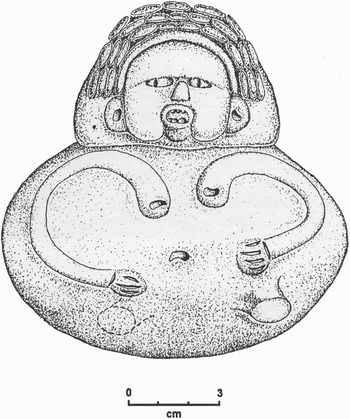
A ceramic censer excavated at Cohla, in northern Belize (Anthony and Black Reference Anthony, Black, Hester, Eaton and Shafer1994:51), is in the form of a potbelly figure that is very similar in design to sculptured potbellies. The figure is a bloated or fat, neckless individual with the arms encircling the belly. The center of the belly is marked with a navel indention. Leg representations protrude from the front lower center of the vessel. The individual's mouth is open, as are the eyes. While the figure is ceramic and very small compared with the boulder sculptures, it nonetheless provides valuable iconographic and temporal information concerning the style, as well as, perhaps, information concerning the style's extent and origins. The potbelly censer from Colha is contextually dated (by artifact association and 14C) to the Middle Preclassic period at circa 880–600 b.c. The implication is that the “style” may have had its origins in the Middle Preclassic period, and many of the boulder sculptures may also be from that early period. The item found at Colha may have been an import. It is odd that no similar ceramics have been noted in the collections of other sites in northern Belize (Valdez Reference Fred1987).
The censer vessel was found in a burial (Strat 63) excavated from Operation 2031 in the Main Plaza (the largest enclosed plaza within the ceremonial plaza at Colha). All architecture of the Main Plaza is thought to “represent civic and/or religious buildings, shrines, or elite residential buildings” dated to the Late or Terminal Classic occupation, the final episode of monumental construction at Colha (Anthony and Black Reference Anthony, Black, Hester, Eaton and Shafer1994:39). “At the base of the cultural deposits are Middle Preclassic (Bolay complex) domestic structures and middens” (Anthony and Black Reference Anthony, Black, Hester, Eaton and Shafer1994:41). Strat 63 occurred within a deep Bolay Complex midden and was “the extended burial of an older individual, probably female, lying face up” (Anthony and Black Reference Anthony, Black, Hester, Eaton and Shafer1994:50). The potbelly vessel was found on the left femur. (For a plan view of Operation 2031, see Potter et al Reference Potter, Hester, Black and Fred1984; for more information about the archaeological context, see Anthony and Black Reference Anthony, Black, Hester, Eaton and Shafer1994.)
Potbellies are typically carved from natural porphyritic basalt, a rock composed of large and small mineral grains (Parsons and Jenson Reference Parsons and Jenson1965:135) that is abundant in the piedmont of Central America. However, there are examples of the potbelly style in other mediums, including ceramic (e.g., the Colha censer) and other types of stone (used for diminutive figurines). Although they were created in atypical mediums, these examples are unmistakably representative of the potbelly sculpture style. In general, they depict excessively fat individuals with enormous swollen bellies clasped by the figure's arms and legs. The heads are characteristically round, predominately portraying closed eyes with puffy eyelids and mouths with prominent lips.
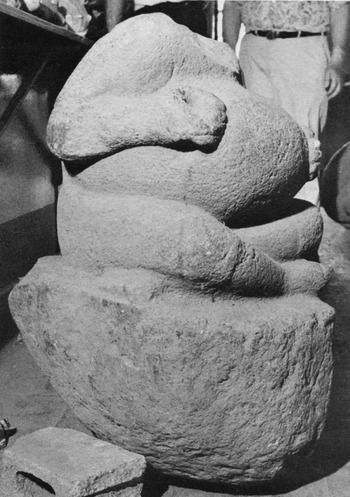
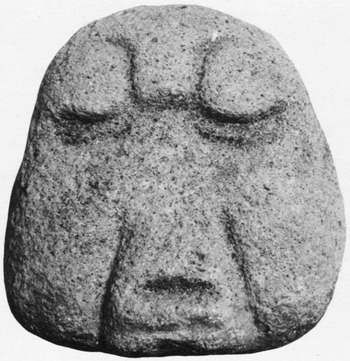
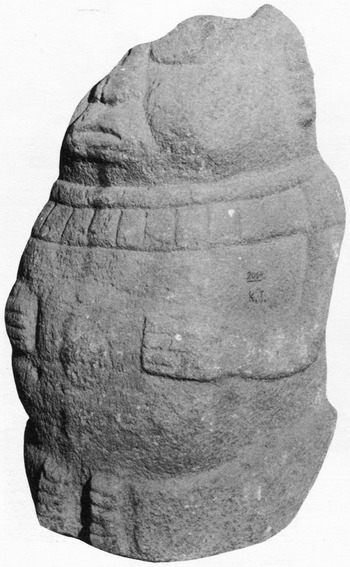
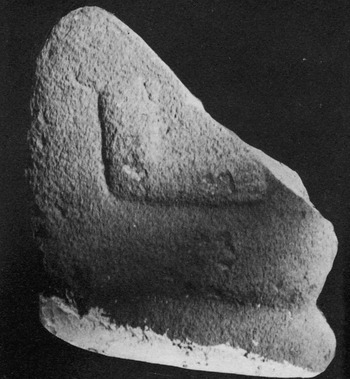
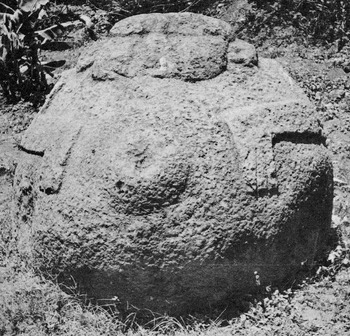
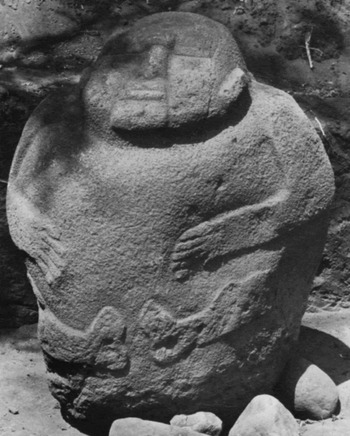
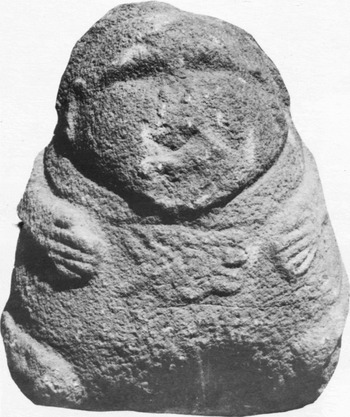
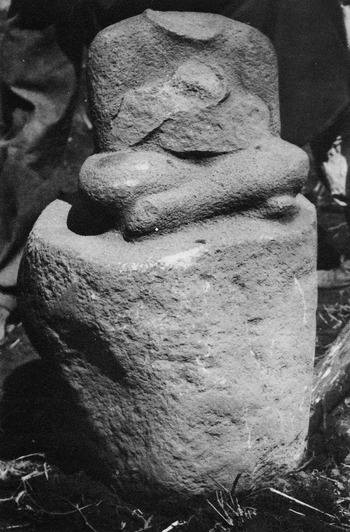
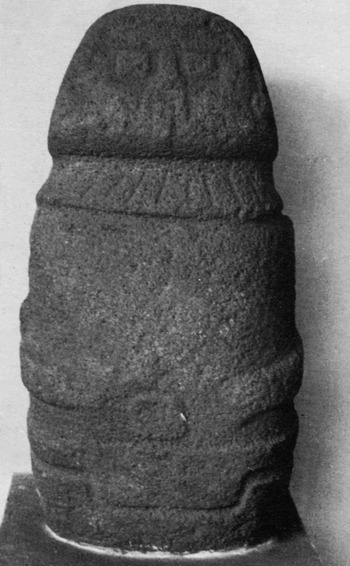
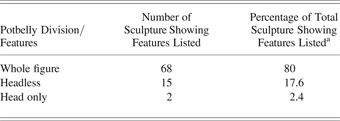
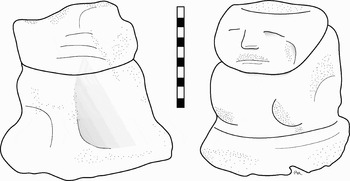
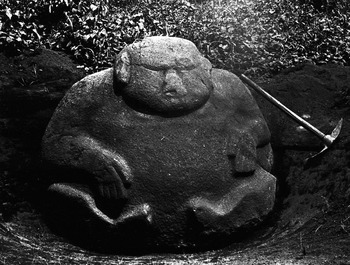
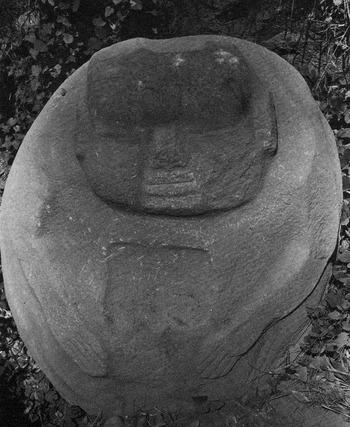
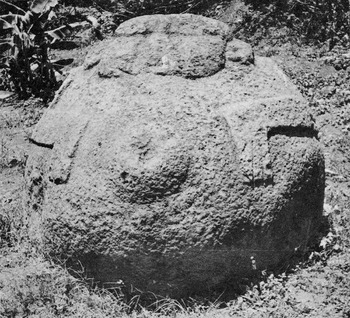
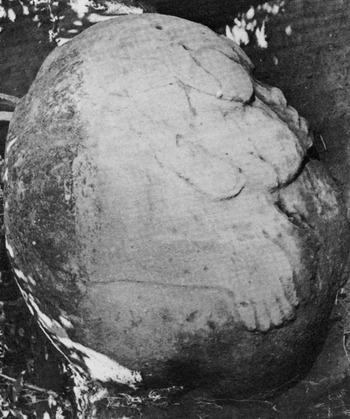
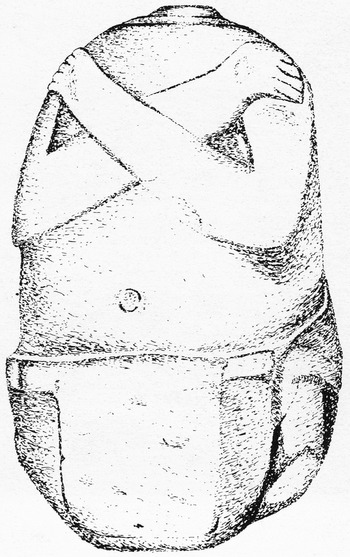
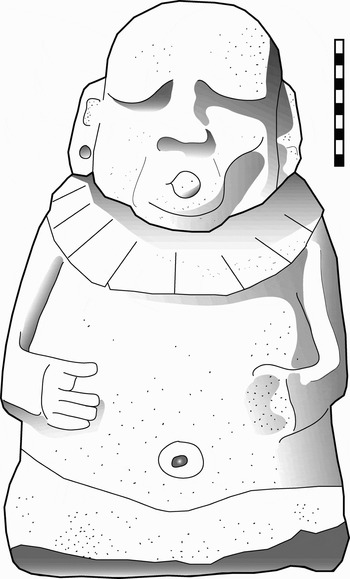
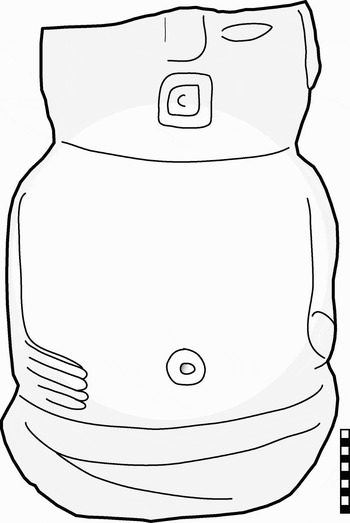
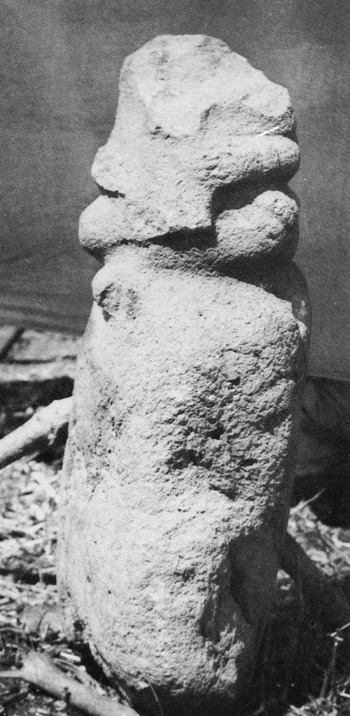
One can argue that the potbelly sculpture style is aptly named. However, any examination of objects classed as “potbellies” reveals many disjunctions within the style. There are, for example, complete potbelly sculptures (Figure 1), headless potbellies—some possibly intentional (Figure 2), and head-only potbellies (Figure 3). Head-only potbellies are indicative of the style even though they are not associated with a potbelly body. There are also collared and clothed potbellies (Figures 4–5), while other examples appear to be naked (Figure 6). Some potbellies have extremely distended navels (Figure 7) while others have no emphasis on the navel (Figure 8). Some potbelly sculptures appear to display a pectoral or chest plate (Figure 9). Finally, some potbellies are seated on pedestals (Figure 10). While adhering to the definition of disproportionately fat individuals with enormous bellies and wraparound limbs, some not so distended “potbelly” sculpture must also be considered (Figure 11).
Bilbao Monument 58 (after Parsons Reference Parsons1986:Number 107). Copyright Dumbarton Oaks Research Library and Collection, Washington, DC. Courtesy Milwaukee Public Museum.

Headless potbelly: Sin Cabezas Monument 3 (after Parsons Reference Parsons1986:Number 17). Copyright Dumbarton Oaks Research Library and Collection, Washington, DC. Courtesy Milwaukee Public Museum.

Head-only potbelly: Kaminaljuyu Monument 38 (Mound F-VI-2, above Tomb B-I; after Parsons Reference Parsons1986:Number 101). Copyright Dumbarton Oaks Research Library and Collection, Washington, DC.

Collared potbelly: Kaminaljuyu Monument 6 (after Parsons Reference Parsons1986:Number 96). Copyright Dumbarton Oaks Research Library and Collection, Washington, DC.

Clothed potbelly from El Baúl (after Parsons Reference Parsons1986:Number 112). Copyright Dumbarton Oaks Research Library and Collection, Washington, DC.

Unadorned and unclothed potbelly: Kaminaljuyu Monument 39 (after Parsons Reference Parsons1986:Number 100). Copyright Dumbarton Oaks Research Library and Collection, Washington, DC.

Potbelly with a distended navel: Santa Leticia Monument 1 (after Parsons Reference Parsons1986:Number 113). Copyright Dumbarton Oaks Research Library and Collection, Washington, DC.

Potbelly with no navel: Monte Alto Monument 9 (after Parsons Reference Parsons1986:Number 116). Copyright Dumbarton Oaks Research Library and Collection, Washington, DC.

Potbelly with a pectoral: Tonala–Tapanatepec (after Parsons Reference Parsons1986:Number 105). Copyright Dumbarton Oaks Research Library and Collection, Washington, DC. Courtesy Milwaukee Public Museum.

Potbelly on a pedestal: Sin Cabezas Monument 1 (after Parsons Reference Parsons1986:Number 15). Copyright Dumbarton Oaks Research Library and Collection, Washington, DC.

“Slim” potbelly: La Nueva Monument 1 (after Parsons Reference Parsons1986:Number 111). Copyright Dumbarton Oaks Research Library and Collection, Washington, DC.

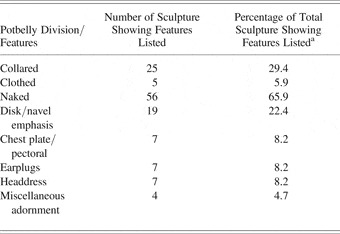
Potbelly sculptures also vary in size, weighing from several tons to a few grams (Figure 12–13). Mediums also vary, as the ceramic example from Colha (Figure 14; Anthony and Black Reference Anthony, Black, Hester, Eaton and Shafer1994:51) demonstrates. The disjunctions in form (whole versus headless versus head only; collared or clothed versus unadorned; distended navel versus no navel; pectoral versus no pectoral [Figure 15]; pedestal versus no pedestal [Figure 16]; slim versus rotund; and stone versus ceramic) and size demonstrate the extent of the problems in interpreting the potbelly style. (The category of miscellaneous adornment was developed to incorporate sculptures that do not fit the other established categories and to avoid multiple categories with one item each [see Tables 1–2].)
List of the potbelly sculpture evaluated for this study

Notes: Total number of potbelly sculptures tallied = 92; number of unavailable images = 7.
aBased on a total count of 85; includes the subtraction of unavailable images.

A 2 m, 12 ton potbelly: Santa Leticia Monument 2 (after Parsons Reference Parsons1986:Number 113). Copyright Dumbarton Oaks Research Library and Collection, Washington, DC.

A 4 cm potbelly (weight unavailable) from Ujuxte (after Love Reference Love, Grove and Joyce1999:142). Illustration courtesy Rachel Menegaz.

Middle Preclassic ceramic representation of a potbelly from Colha (Anthony and Black Reference Anthony, Black, Hester, Eaton and Shafer1994:51). Image courtesy Thomas Hester and the Colha Project.

Potbelly without a pectoral from Chocola (after Sharer Reference Sharer1994:104). Copyright University of Pennsylvania Museum.

Potbelly without a pedestal from Copan (after Richardson Reference Richardson, Hay, Linton, Lothrop, Shapiro and Vaillant1940:408). Illustration courtesy Rachel Menegaz.

THE POTBELLY GEOGRAPHIC DISTRIBUTION AREA
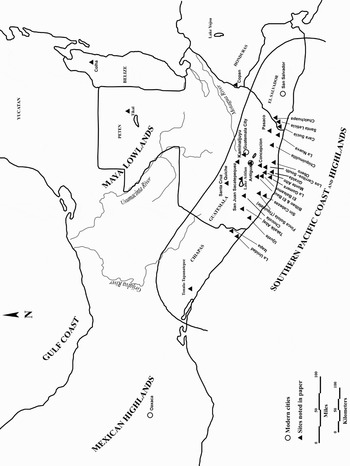
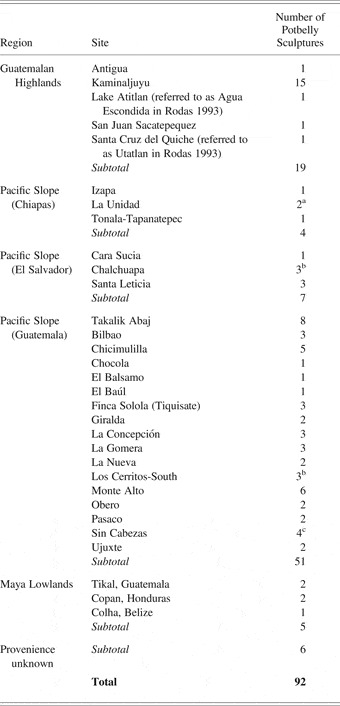
The geographic distribution area (Figure 17) for potbelly sculptures is primarily in the Guatemalan highlands and on the Pacific slope from Chiapas to El Salvador. Sites in the Guatemalan highlands at which potbelly sculptures have been documented include Antigua, Kaminaljuyu, Lake Atitlan, San Juan Sacatepequez, and Santa Cruz del Quiche. Pacific slope locations include Izapa, La Unidad, and Tonala-Tapanatepec in the modern state of Chiapas, Mexico. Pacific slope sites in Guatemala include Takalik Abaj, Bilbao, Chicimulilla, Chocola, El Balsamo, El Baúl, Finca Solola (Tiquisate), Giralda, La Concepción, La Gomera, La Nueva, Los Cerritos-South, Monte Alto, Obero, Pasaco, Sin Cabezas, and Ujuxte. Pacific slope sites in El Salvador include Cara Sucia, Chalchuapa, and Santa Leticia. Potbelly sculpture has also been found in the Maya Lowlands at Tikal in Guatemala, Copan in Honduras, and Colha (the ceramic censer) in Belize.
Potbelly distribution area (adapted from Parsons Reference Parsons1986:138–139).

Most of this area is a humid piedmont zone. This land form, situated at the base of a mountain range, is formed by earth and rubble carried down by mountain streams. The composition of the land is volcanic soil, with varying sizes of naturally occurring basalt boulders, a practical raw material in prehistoric times for stone sculpture (Parsons Reference Parsons1967:17).
To date, a total of 92 potbelly-style sculptures appear to have been recorded: 19 (21%) in the Guatemalan highlands, four (4%) on the Pacific Slope of Chiapas, seven (8%) on the Pacific Slope of El Salvador, five (5%) in the Maya Lowlands, and 51 (55%), the largest concentration, in the Pacific slope region of Guatemala. Six more (7%) are of unknown provenience (see Table 3).
Geographic distribution of potbelly sculpture by region and site

aImages not located.
bTwo images not located.
cOne image not located.
CULTURAL AFFILIATIONS: ORIGINS AND REUSE?
The possible origins, cultural affiliations, and potential reuse (including meaning and function) by later cultural groups of potbelly sculpture deserve deliberation. A basic goal in archaeology is to understand prehistoric peoples and their societies from the material culture in the archaeological record. To do this, one must establish a chronological framework and understand its cultural components (Sharer Reference Sharer and Sharer1978:4). Stone sculpture, however, is “difficult to date on other than stylistic or epigraphic grounds, in that it was capable of being moved and reused” (Parsons Reference Parsons1976:329). At Monte Alto, only one monument (Monument 11) has been found in what appears to be its original context (Parsons Reference Parsons1976:329). The context assigned to Monument 11 (Figure 18) is based on associated ceramics: “a mere handful of small, very weathered sherds that appear to be Late Preclassic” (Hatch Reference Hatch, Frederick and Heller1989:25). This tenuous dating led Hatch to state that the goal of her seriation of the Monte Alto sculptures was to “arrange the sculptures of Monte Alto in sequential order of their manufacture,” not “to elucidate or explain the chronology of the South Coast in general” (Hatch Reference Hatch, Frederick and Heller1989:25). She later concluded that, without firm stratigraphic data, the chronological placement of the stone sculpture continues to be only theoretical, and her stylistic-progression order from naturalistic to stylized (from heads to potbellies to heads) could actually be argued in a reverse order (Hatch Reference Hatch, Frederick and Heller1989:39).
Monte Alto Monument 11 (after Parsons Reference Parsons1986:Number 115). Copyright Dumbarton Oaks Research Library and Collection, Washington, DC.

Assigning cultural affiliations is a problematic endeavor: connecting pots or monumental stone sculpture to peoples is a difficult, if not an impossible, task. The origins of potbelly sculpture have also been a controversy of magnitude. Scholars such as John Graham (Reference Graham1977, Reference Graham and Graham1978), Philip Drucker (Reference Drucker1952), and Miguel Covarrubias (Reference Covarrubias1957) once suggested that the potbelly style was either affiliated with the Olmec or even, perhaps, pre-Olmec, relating potbelly sculpture conceptually to the Olmec sculpture tradition and positioning the sculptures as such chronologically. Parsons (Reference Parsons1969b) called the style a “derivative … out of the Olmec tradition”. Miles (Reference Miles and Wauchope1965) placed potbelly sculpture in her Early Preclassic Division 1, the first chronological division of the Preclassic period. Demarest's (1986:2) Santa Leticia investigations were problem-oriented, focusing on the dating and cultural associations of the potbelly sculpture style, focused specifically to answer the chronological and cultural questions of the potbellies. Since the sculpture at Santa Leticia appeared to be in a primary context, it provided an inimitable prospect for assigning a chronological position to the potbelly style within the category of Mesoamerican monumental stone sculpture. The Santa Leticia excavations produced radiocarbon samples and ceramic evidence from beneath Monuments 1 and 3 (Figure 19–20) that effectively disproved the pre-Olmec hypothesis by securely dating those monuments to circa 500 b.c. to a.d. 100 (2320 ± 100 b.p. uncalibrated; with calibration, the dating is 435 ± 112 b.c. [Demarest et al. Reference Demarest, Switsur and Berger1982:569]). This was the only period of human activity at the site of Santa Leticia other than Late Classic squatters.
Santa Leticia Monument 1 (after Parsons Reference Parsons1986:Number 113). Copyright Dumbarton Oaks Research Library and Collection, Washington, DC.

Santa Leticia Monument 3 (after Parsons Reference Parsons1986:Number 113). Copyright Dumbarton Oaks Research Library and Collection, Washington, DC.

Although the Santa Leticia investigations did not answer the question of ethnic affiliation, they indicated in a chronological context the possibility of Olmec-influenced origins of a later art form. This finding is consistent with a proposed shared communication sphere in that region of Mesoamerica . The possible origins are further complicated by the “recycling” of stone sculpture by later peoples who perhaps had a different cultural or ethnic association from the sculptors. It has been noted that evidence for reuse in general is found among the current populations of Mesoamerica (Proskouriakoff Reference Proskouriakoff and Benson1968:132–133). Examples of the possible reuse of potbellies are found at Sin Cabezas and Copan. The potbelly sculptures from Sin Cabezas have been noted as being stylistically related to Olmec-style sculpture (Parsons Reference Parsons and Benson1979:270), yet they were found in Late Classic fill (Proskouriakoff Reference Proskouriakoff and Benson1968:127). The Sin Cabezas sculptures were headless when found, and no fragments of the heads were recovered, indicating that later occupants may have set them up in a mutilated condition (Miles Reference Miles and Wauchope1965:247). At the Maya site of Copan, two potbelly sculptures were found in the base deposits of Altar X and Altar Y—in a Classic-period context (Newsome Reference Newsome2003:11). One significant question that specifically affects the idea of origin is that concerning the motivation for reuse. Was it reuse for revival—an interest in archaism? Were the revivalists using the sculpture for modeling, or, perhaps, was the reuse an action of respect for the ancient style (Proskouriakoff Reference Proskouriakoff and Benson1968:133)? If the latter was the motivation, and the reuse was due to identification with the heritage or lineage of a “previous cultural horizon,” did the revivalists somehow serve “to invoke geographical and temporal” connections between the past and the present (Newsome Reference Newsome2003:11)? These questions create a hermeneutic dilemma: did the reuse imply a perceived origin connection by the later peoples to ancestors? If such a perceived affiliation cannot be substantiated with present archaeological data, how, then, can origins be ascribed? Parsons states that there is a “demonstrable Olmec heritage” in the potbelly sculpture style that demonstrates the “stimulus of Early Preclassic or early Middle Preclassic Olmec intrusions into the Pacific coast region” (Demarest Reference Demarest1986:138). However, based on geographic data, we suggest that the concentration of potbelly sites on the Pacific slope indicates a direction of diffusion of the style from south to north rather than the reverse, as is so often assumed if Olmec origin and influence are heavily weighted. This would also suggest that, when interpreting potbelly sculptures, it is perhaps time to consider them outside the context of the Olmec.
When considering the role of potbelly sculpture in prehistoric society, it is necessary to examine the meaning and use of past interpretations. Unfortunately, because of the lack of interpretive work, all postulations seem to be logical but unelaborated assumptions. Scholars have theorized that the sculptures symbolize dead ancestors and that they are associated with either babies or the Mesoamerican deity Fat God (Miller and Taube Reference Miller and Taube1993:86; Palka Reference Palka2000:100). The Fat God himself is described as “among the more curious and least understood deities of ancient Mesoamerica” (Miller and Taube Reference Miller and Taube1993:86). It seems that the description just submits to the category of strange and leaves it there without further elaboration or context . Another interpretation includes the potbellies in a class of supernatural beings that are identified with the domestic hearth (Taube Reference Taube and Houston1998:436–437). Elizabeth Newsome (Reference Newsome2003:11) postulates that the reuse of potbellies at Copan “served to invoke the geographical and temporal distance that Mesoamerican migration lore transposes between the present and events belonging to the legendary past.” These attempts to interpret the potbelly sculpture style leave ample room for new theories and research with the expansion of the archaeological data.
CONCLUSION
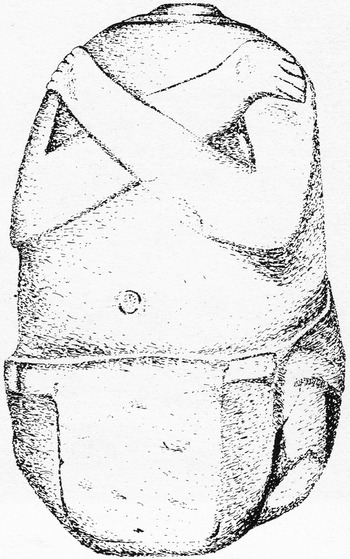
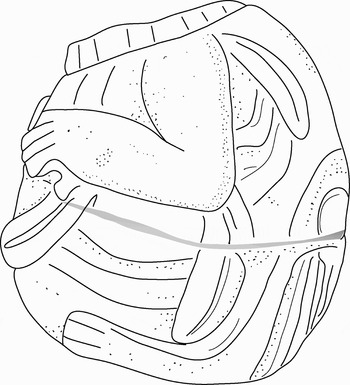
Potbelly sculpture can be described stylistically as seated, cross-legged, human, full-round sculpture that shows a minimum of adornment. The first impressions of the bloated beings are that they depict deceased individuals and are, perhaps, even burial markers. It must be noted that only three sculptures in any medium have been found in direct association with burials; however, the idea that they depict deceased individuals is not unreasonable. The sculptures show qualities that are observed in death: bloating, distended bellies and navels, closed eyes, and puffy faces. Although their shapes follow the natural contours of the boulders, with wraparound limbs, the bodies also give what could be a picture of the “bundling” that one finds among later Maya groups' flexed burials. The El Baúl sculpture (Figure 21) gives an especially persuasive picture of a “wrapped” individual, with the arms placed in a folded position, which can be considered representative of the flexed or bundled burial posture common among the Maya. One could also reasonably argue that the San Juan Sacatepequez potbelly (Figure 22) and, possibly, Pasaco Monument 2 (Figure 23) portray a deceased individual with a bead or piece of jade/greenstone in the mouth. The idea of associating potbelly sculpture with the event of death is strengthened, to some extent, by the Colha ceramic representation, which was located with a primary burial (Anthony and Black Reference Anthony, Black, Hester, Eaton and Shafer1994:50). Because the number of potbelly sculptures found in association with burials—at Kaminaljuyu, Chalchuapa, and Colha—is limited, the idea that they were used as burial markers is problematic. However, as mentioned earlier, potbellies rarely have been found in primary contexts, and when they are found in secondary contexts, we cannot know whether they originally functioned as burial markers.
Wrapped or perhaps flexed potbelly from El Baúl (after Parsons Reference Parsons1986:Number 112). Copyright Dumbarton Oaks Research Library and Collection, Washington, DC.

Potbelly with a bead, greenstone, or jade in its mouth(?) from San Juan Sacatepequez (after Lehmann Reference Lehmann1968:Number 200; Parsons Reference Parsons1986:Number 103). Illustration courtesy Rachel Menegaz.

Potbelly with a bead, greenstone, or jade in its mouth(?): Pasaco Monument 2 (after Rodas Reference Rodas1993:Number 24). Illustration courtesy Rachel Menegaz.

It is also possible that potbelly sculpture had a meaning and use connected with the representation and communication of rulership. There are several reasons for investigating this possible association, including the body positions and adornment of the sculptures, the pedestal bases of some of the sculptures, the types of sites at which the sculptures occur, and the spaces within the sites that the sculptures occupy.
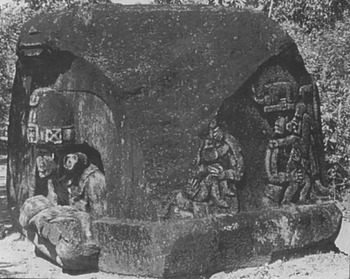
The body position of potbelly sculpture—seated, cross-legged, with the arms wrapping the body or, in some cases, holding an object in the lap—is unmistakably symbolic of rulership. The gesture of holding an object, e.g. a baby for sacrifice or a staff as an indication of lineage, is emblematic of ritual (Houston and Stuart, Reference Houston and Stuart1996). The postures of the figures on the pedestal of Sin Cabezas Monument 2 (Figure 24) and in the niche of La Venta Altar 1 (Figure 25) show a striking resemblance.
Sin Cabezas Monument 2 (after Parsons Reference Parsons1986:Number 16). Copyright Dumbarton Oaks Research Library and Collection, Washington, DC.

La Venta Altar 1 (after Weaver Reference Weaver1993:Figure 3.15). Copyright Academic Press, Elsevier.

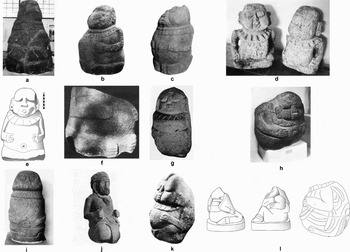
The next characteristic that would perhaps support the hypothesis that potbelly sculptures were used as a depiction of rulership is their adornment. Of the available photographs of potbelly sculpture, 25 (29.4%) display a type of collar. Again, the figures on the Sin Cabezas Monument 2 pedestal and in the La Venta Altar 1 niche have unmistakable similarity in their collars. Figure 26 illustrates available examples of potbelly sculpture with collar adornments.
Collar-adorned potbellies: (a) Kaminaljuyu Monument 3 (after Parsons Reference Parsons1986:Number 94). Copyright Dumbarton Oaks Research Library and Collection, Washington, DC; (b) Kaminaljuyu Monument 8 (after Parsons Reference Parsons1986:Number 95). Copyright Dumbarton Oaks Research Library and Collection, Washington, DC. Courtesy Milwaukee Public Museum; (c) Kaminaljuyu Monument 6 (after Parsons Reference Parsons1986:Number 96). Copyright Dumbarton Oaks Research Library and Collection, Washington, DC; (d) Kaminaljuyu Monuments 57–58 (after Parsons Reference Parsons1986:Number 102). Copyright Dumbarton Oaks Research Library and Collection, Washington, DC. Courtesy Milwaukee Public Museum; (e) San Juan Sacatepequez (after Lehmann Reference Lehmann1968:Number 200; Parsons Reference Parsons1986:Number 103). Illustration courtesy Rachel Menegaz; (f) Kaminaljuyu Monument 7 (Parsons Reference Parsons1986:Number 98). Copyright Dumbarton Oaks Research Library and Collection, Washington, DC; (g) Bilbao Monument 46 (after Parsons Reference Parsons1969a:Plate 45). Copyright Dumbarton Oaks Research Library and Collection, Washington, DC. Courtesy Milwaukee Public Museum; (h) La Concepción (after Parsons Reference Parsons1986:Number 109). Copyright Dumbarton Oaks Research Library and Collection, Washington, DC; (i) La Nueva Monument 1 (after Parsons Reference Parsons1986:Number 111). Copyright Dumbarton Oaks Research Library and Collection, Washington, DC; (j) Obero (after Parsons Reference Parsons1969:Plate 45, Figure f). Copyright Dumbarton Oaks Research Library and Collection, Washington, DC. Courtesy Milwaukee Public Museum; (k) Bilbao Monument 47 (after Parsons Reference Parsons1986:Number 108). Copyright Dumbarton Oaks Research Library and Collection, Washington, DC; (l) Copan (after Richardson Reference Richardson, Hay, Linton, Lothrop, Shapiro and Vaillant1940:404, 408). Illustration courtesy Rachel Menegaz.

The presence of pedestal bases is also a feature that argues for a rulership interpretation of potbelly sculptures. The Sin Cabezas sculptures (Figures 2, 10, 24); examples from Antigua, Kaminaljuyu, Santa Cruz Quiche, Chalchuapa, Takalik Abaj, El Balsamo, La Nueva, Los Cerritos-South, Tikal, and Copan; and even the miniature examples from Ujuxte have obvious pedestal bases. This means that approximately 42% of the sites with potbelly sculptures have examples with pedestals. If pedestals can be connected to thrones, then Bilbao Monument 58 is worth noting. According to Parsons (Reference Parsons1969a:54), it was discovered on its side, with its head resting on the bottom step of a stairway and with Monument 59, “a four-legged stone altar, or throne … superimposed upside down” on it. He suggests that the original placement of Monument 59 was at the top of the stairway and that the potbelly (Monument 58) was at its base. However, the archaeological context also suggests that Monument 58 was originally seated on top of Monument 59. That position would be consistent with the later in situ discovery of Monument 59's upside down placement above Monument 58 (the potbelly sculpture). The placement of the potbelly sculpture on top of the pedestal and/or throne would be consistent with a portrayal of rulership.
The sites at which potbelly sculptures occur are well-known ceremonial centers. Kaminaljuyu had the greatest single concentration of potbelly sculpture. Parsons (Reference Parsons and Benson1979:238) reports that “several of them were found in the palangana,” which he refers to as a “monument plaza.” Another example is Chalchuapa, where the El Trapiche grouping of potbellies was determined to be an obvious ceremonial center (Sharer Reference Sharer and Sharer1978:193; Fowler Reference Fowler1984: 603–604). This would seem to indicate that the potbelly sculpture style was an important part of defining a sacred site or a political/ceremonial center.
In conclusion, we have attempted in this paper to create a groundwork categorization of potbelly material. The effort to identify a coherent corpus of potbelly sculpture is made problematic by the individuality and diversity of examples within the style. It is possible, however, that this individuality and diversity actually support the argument that potbelly sculptures depict individual rulers. Posture and adornment are defining characteristics of rulership; pedestals and thrones can be connected and are considered representative of rulership. The individual sites and the location of the potbelly sculptures within those sites can be associated with ceremonial importance.
When these factors are taken into consideration, it is plausible that potbelly sculpture represents either individual rulers or the concept of rulership. This would suggest that the prehistoric peoples of Belize, El Salvador, Guatemala, Honduras, and Mexico viewed the iconographic complex known as “potbelly” as a connection to both ancestors and rulership. Whatever it may represent, the potbelly concept is much more widespread than previously thought, though the execution of potbellies as stone monuments remains a characteristic of the Pacific slope. A thorough exploration of the conceptual link between the potbelly style, rulership, and ancestors is beyond the scope of this paper but is an important avenue for future research.
RESUMEN
Desde hace varias décadas existe un gran interés por las esculturas mayas prehispánicas conocidas con el nombre de “barrigones.” La mayoría se encuentra en las tierras altas y en el piedemonte de la costa del Pacífico en Guatemala y El Salvador. El principal motivo de estudio de los investigadores ha sido encontrar la función específica de las esculturas y fechar estos objetos. Este estudio resume los datos e intenta clasificar las esculturas por grupos estilísticos o identificables, lo que a su vez puede permitir elaborar hipótesis sobre su función en general.
En la mayoría de los casos las esculturas son representaciones de personajes excesivamente gordos sujetando entre piernas y brazos sus enormes barrigas hinchadas. Las cabezas son característicamente redondas, con ojos predominantemente cerrados, párpados hinchados y bocas de labios prominentes. En el estudio de todas las esculturas catalogadas como barrigones, se observan variaciones notables. Estas diferencias en formas (de cuerpo entero contra sin cabeza contra una cabeza solamente; ornamentados o vestidos contra sin adornos; con ombligo distendido contra sin ombligo; con pectorales contra sin pectorales; sobre pedestal contra sin pedestal; delgados contra corpulentos; y de piedra contra de cerámica) y en tamaño han hecho difícil la interpretación del estilo barrigón.
Una de las hipótesis es que estas esculturas simbolizan a los ancestros muertos y que están asociadas con bebés o con el dios mesoamericano conocido como Dios Gordo. Otra sugerencia es que la reutilización de las esculturas ofrecía una conexión con el pasado legendario. Este estudio sugiere que los barrigones también pueden haber servido como representación y transmisión del poder gubernamental. Aunque la diversidad y la individualidad dentro de este estilo de escultura han sido obstáculos para definir un cuerpo de escultura coherente, estas mismas características pueden dar respaldo a la teoría de la representación de gobernantes específicos. Las posturas y los adornos son características definitorias de un gobernante. Los pedestales y los tronos pueden tener una conexión entre ellos y son considerados como representación de poder gubernamental. Los sitios arqueológicos y las ubicaciones de las esculturas de barrigones dentro de esos sitios tienen importancia ceremonial. Así, es posible creer que la escultura de un barrigón puede representar a un gobernante en particular o al concepto mismo de gobierno.
El hallazgo de un barrigón de cerámica, en Belice, en un sitio funerario del período preclásico medio, fechado ca. 880-600 a.C., podría ofrecer evidencia para establecer la fecha aproximada del concepto de barrigones. Esto sugiere que el complejo iconográfico conocido como “barrigones” puede haber servido múltiples funciones para los pueblos prehistóricos de Belice, El Salvador, Guatemala, Honduras, y México, siendo tanto una conexión con sus ancestros y la antigüedad como una representación del poder gubernamental.
ACKNOWLEDGMENTS
We thank the editors of Ancient Mesoamerica for their assistance with this publication. We are grateful to Joel Palka for his extensive, thoughtful comments on the manuscript. We thank the other reviewers, Vern Scarbrough, R.E.W. Adams, and two anonymous reviewers, for their time and suggestions. Don McInnis gave generously of his time and editorial opinions through our many revisions. We thank Liwy Grazioso for her comments and encouragement. We also thank Thomas Hester, and the Colha Project, for permission to use the Colha drawing. We are grateful to Rachel Menegaz for her illustration work. We thank our colleagues: John Kappelman, Rissa Trachman, David Hyde, Adrienne Witzel, Summer Klein, Stuart Ross, and Sophia Salgado for their support in all our endeavors. We also thank our field colleagues, Eleanor King, Leslie Shaw, and Stan Walling for their support.