INTRODUCTION
The spiritual, religious, and existential aspects of care constitute one of the eight core domains of palliative care (National Consensus Project for Quality Palliative Care, 2013; Kelley & Morrison, Reference Kelley and Morrison2015). Multiple studies have shown religion and spirituality (R/S) to be important factors that influence medical decision making in the event of a terminal illness, especially in non-Caucasian populations (Ehman et al., Reference Ehman, Ott and Short1999; Koenig, Reference Koenig1998; Balboni et al., Reference Balboni, Vanderwerker and Block2007; MacLean et al., Reference MacLean, Susi and Phifer2003). About half of the patients in ambulatory settings express wishes to interact with their physicians regarding R/S beliefs in a near-death scenario (MacLean et al., Reference MacLean, Susi and Phifer2003). Lack of R/S support has been shown to be widespread in cancer patients of diverse backgrounds (Balboni et al., Reference Balboni, Vanderwerker and Block2007), which is associated with a significantly lower quality of life (QoL) compared to those whose spiritual needs are adequately addressed. Less than a fifth of the goals-of-care conversations in intensive care units (ICUs) include discussions regarding R/S (Ernecoff et al., Reference Ernecoff, Curlin and Buddadhumaruk2015). One study of patients with advanced cancer showed a significantly increased likelihood of aggressive EoL measures in patients who received spiritual support primarily provided by religious communities (Balboni et al., Reference Balboni, Balboni and Enzinger2013). In contrast, patients receiving R/S care from a medical team had higher rates of hospice utilization, fewer ICU deaths, and underwent fewer aggressive interventions. Spiritual support from a medical team is also associated with a better QoL near death (Balboni et al., Reference Balboni, Paulk and Balboni2010) and lower costs of care (Balboni et al., Reference Balboni, Balboni and Paulk2011).
Despite the overwhelming evidence on the positive impact of appropriate R/S EoL care (El Nawawi et al., Reference El Nawawi, Balboni and Balboni2012), its routine incorporation in clinical practice is lacking. While abundant data are available on the spiritual aspects of the end of life, a gap in the literature has been identified in peer-reviewed scientific publications when it comes to addressing religious beliefs at the end of life. To address this issue, we conducted a systematic review of the empirical evidence on EoL beliefs and practices of those belonging to the five major world religions: Christianity, Islam, Hinduism, Buddhism, and Judaism. To our knowledge, this is the first systematic review on the religious aspects of EoL care that could help clinicians in any specialty (e.g., internists, psychiatrists, oncologists, palliative medicine experts, ICU specialists, psychologists) as well as chaplains and social workers to analyze the specific belief systems of the world's five major religions.
SEARCH STRATEGY
We conducted a systematic review with a comprehensive search of databases in the English language beginning at the time of each database's inception: Ovid MEDLINE In-Process & Other Non-Indexed Citations, Ovid MEDLINE, Ovid EMBASE, Ovid PsycINFO, Ovid Cochrane Central Register of Controlled Trials, Ovid Cochrane Database of Systematic Reviews, and Scopus. Our search strategy was designed and conducted by an experienced medical librarian with input from the other authors.
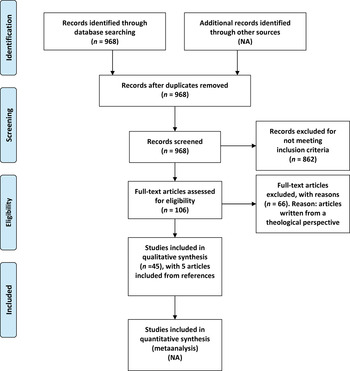
Observational studies, including surveys of healthcare providers (HCPs) or the general population, as well as case studies were included for review. Those written from a purely theoretical or philosophical perspective and those providing guidelines for providers were excluded. Studies on pediatric populations were also excluded. Whenever possible, empirical data were divided into two categories: (1) the attitudes of HCPs and (2) the attitudes of patients and the general population. Our systematic review was conducted in accordance with the Preferred Reporting Items for Systematic Reviews and Meta-Analysis (PRISMA) Statement (see Figure 1) (Liberati et al., Reference Liberati, Altman and Tetzlaff2009).
PRISMA flow diagram. Adapted from Moher et al. (Reference Moher, Liberati and Tetzlaff2009).

Results
Our search strategy generated 968 references, 40 of which were deemed relevant for review. After manually reviewing the references from relevant full-text manuscripts, we added five more studies to the systematic review (see Figure 1). All the publications were descriptive, as there were no clinical trials published on this issue. Based on the contents of the articles, we organized our results into five areas for presentation: (1) advanced directives; (2) euthanasia and physician-assisted suicide; (3) physical requirements (artificial nutrition, hydration, pain management); (4) autopsy practices; and (5) other EoL religious considerations.
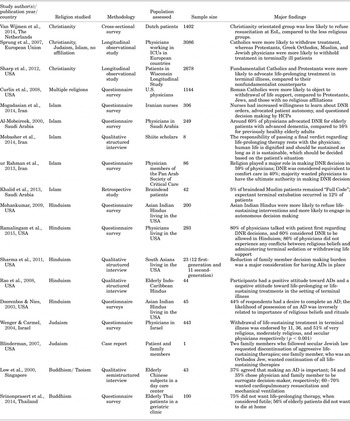
ADVANCE DIRECTIVES AND TREATMENT DISCONTINUATION (SEE TABLE 1)
Advance directives (ADs) are utilized to record patients' wishes regarding instituting life-sustaining treatment in a living will and/or with respect to identifying a surrogate decision maker with a durable power of attorney (DPOA) for healthcare (Silveira et al., Reference Silveira, Kim and Langa2010).
Advance directives

AD = advance directive; ANH = artificial nutrition and hydration; DNR = do not resuscitate; HCP = healthcare professional; ICU = intensive care unit; NPV = Nederlandse Patiënten Vereniging.
Christianity
Attitudes and Beliefs of HCPs
A European study on terminally ill ICU patients reported increased frequency of discussions about ADs among critical care physicians belonging to the Protestant, Catholic, and Jewish faiths or to no religious faith (60–80%), compared to those of the Greek Orthodox or Muslim faith (25–30%) (p < 0.001) (Sprung et al., Reference Sprung, Maia and Bulow2007). Catholic physicians were generally more likely to withdraw treatment, whereas Protestant, Greek Orthodox, Muslim, and Jewish physicians were more likely to withhold treatment from terminally ill patients. The median time from ICU admission to withdrawal or withholding of treatment varied from 1.6 days for Protestant to 7.6 days for Greek Orthodox physicians (p < 0.001). In the United States, physicians with a Roman Catholic affiliation were three times more likely to object to withdrawal of life support, compared to Protestants and Jews, and those with no religious affiliation (Curlin et al., Reference Curlin, Nwodim and Vance2008).
Attitudes and Beliefs of Patients and the General Population
A survey of a Dutch population showed a significantly lower likelihood of refusing resuscitation in the setting of advanced dementia and cancer in the Christianity-oriented group (47 and 53% for advanced dementia and cancer, respectively) compared to those belonging to the Right-to-Die–NL group (99 and 99%. respectively) or the general population (86 and 86%, respectively) (van Wijmen et al., Reference van Wijmen, Pasman and Widdershoven2014). People with no religious affiliation were more likely to refuse treatment for a terminal illness. A U.S. longitudinal study found that fundamentalist Catholics and Protestants are significantly more likely to desire life-prolonging treatment compared to their nonfundamentalist counterparts (Sharp et al., Reference Sharp, Carr and Macdonald2012). A case report of a Pentecostal Christian woman indicated an expression of miraculous visions at the end of life, which can have a strong impact on EoL decision making (Henin et al., Reference Henin, Arbaje and Fuchs2013).
Islam
Attitudes and Beliefs of HCPs
A study of Iranian nurses, mostly Muslims, revealed an increased willingness to learn more about do-not-resuscitate (DNR) orders (Mogadasian et al., Reference Mogadasian, Abdollahzadeh and Rahmani2014). No significant differences were observed between Shiite and Sunni nurses. A survey of physicians in Saudi Arabia found that the proportion of physicians advocating DNR for previously healthy elderly and demented patients was 16 and 61%, respectively (p < 0.001) (Al-Mobeireek, Reference Al-Mobeireek2000). Along with religious and legal concerns, the dignity of patients was found to be important for physicians while making decisions. Some 40% of physicians trained in the Middle East were found to consider DNR as equivalent to comfort care, and more than 50% favored “do-not-escalate” therapy as opposed to DNR in futile scenarios (ur Rahman et al., Reference ur Rahman, Abuhasna and Abu-Zidan2013). Almost half of these respondents wanted physicians to have the ultimate authority in making DNR decisions.
Attitudes and Beliefs of Patients and the General Population
In a retrospective review of braindead Muslim patients, 12% were treated with expectant terminal extubation; after being declared braindead, and 5% still remained “full code” (Khalid et al., Reference Khalid, Hamad and Khalid2013). In structured interviews, Shiite scholars stated that the responsibility of passing the final verdict regarding life-saving therapy should be taken by those who were well-informed about saving lives, implying that physicians were best positioned in this regard (Mobasher et al., Reference Mobasher, Aramesh and Zahedi2014).
Hinduism
Attitudes and Beliefs of HCPs
In a study of Hindu physicians working in the United States (Ramalingam et al., Reference Ramalingam, Saeed and Sinnakirouchenan2015), 80% of respondents acknowledged talking first with patients about DNR decision making and 70% involved family members in these DNR discussions. A total of 60% considered DNR to be allowed in Hinduism, and 86% did not believe that withdrawing life-support measures was incongruent with their religious beliefs. Of note, only 6% of the physicians in this study considered themselves to be highly religious.
Attitudes and Beliefs of Patients and the General Population
Mohankumar (Reference Mohankumar2009) found that Asian Indian Hindus are more likely to refuse life-sustaining interventions compared to non-Hispanic whites and are more likely to engage in autonomous decision making regarding ADs. Reduction of the burden of decision making placed on family members has been indicated as an important consideration for having an AD in place (Sharma et al., Reference Sharma, Khosla and Tulsky2011; Rao et al., Reference Rao, Desphande and Jamoona2008). Doorenbos & Nies (Reference Doorenbos and Nies2003) found that 44% of Asian Indian Hindu respondents expressed a desire to complete an AD, and that the desire to complete an AD was inversely related to the importance of religious beliefs and a family-centric form of decision making.
Buddhism
Attitudes and Beliefs of Patients and the General Population
In a study of elderly Chinese subjects in Singapore, where the predominant religion is Buddhism/Taoism, 37% have been found to believe in the importance of having an AD in place (Low et al., Reference Low, Ng and Yap2000). Physicians were considered the preferred surrogate decision maker by 54% of these respondents, followed by a family member (35%). About 60 to 70% of these subjects were in favor of EoL cardiopulmonary resuscitation and mechanical ventilation. Srinonprasert et al. (Reference Srinonprasert, Kajornkijaroen and Bangchang2014) surveyed an elderly Buddhist population in Thailand and found that ~75% were unwilling to continue with life-prolonging treatment when the chances of survival were low. A majority (56%) did not want to die at home. These elderly Thai subjects also preferred to know the truth about their illness.
Judaism
Attitudes and Beliefs of HCPs
The perspectives of Jewish healthcare providers tends to vary based on their degree of conservatism. Highly religious Jewish physicians have been found to be less likely to withdraw life-sustaining treatment during a terminal illness, and their desire for EoL supportive care is universally high irrespective of degree of religiosity (Wenger & Carmel, Reference Wenger and Carmel2004).
Attitudes and Beliefs of Patients and the General Population
A case report of an elderly Jewish male who was comatose and mechanically ventilated in an ICU reflected the contradictory positions of secular and Orthodox Jewish laws pertaining to EoL decision making (Blinderman, Reference Blinderman2007). The patient had three daughters, two of whom were secular Jews who wanted to discontinue aggressive life-sustaining therapy. The other daughter, an Orthodox Jew, wanted all life-sustaining therapies, including artificial nutrition and hydration (ANH), to be continued, after consultation with a rabbi. Having witnessed starvation in concentration camps, Holocaust survivors tend to be unwilling to forego ANH in terminal illness, even in futile situations (Goldberg, Reference Goldberg1999).
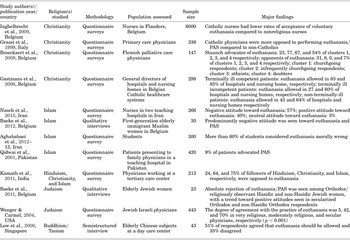
EUTHANASIA AND PHYSICIAN-ASSISTED SUICIDE (TABLE 2)
Voluntary euthanasia involves intentional ending of a life by a physician via administration of drugs. Physician-assisted suicide (PAS) is defined as a physician providing drugs for a patient to self-administer, so that he or she can end their own life (Materstvedt et al., Reference Materstvedt, Clark and Ellershaw2003). Voluntary euthanasia is currently legal in the Netherlands, Belgium, Colombia, and Luxembourg. Physician-assisted suicide is legal in Switzerland, Germany, Japan, Albania, and in parts of the United States (in Washington, Oregon, Vermont, New Mexico, Montana, and California).
Euthanasia and physician-assisted suicide

PAS = physician-assisted suicide.
Christianity
Attitudes and Beliefs of HCPs
A nationwide survey among nurses in Belgium found that Catholic nurses have lower rates of acceptance of euthanasia compared to nonreligious nurses (Inghelbrecht et al., Reference Inghelbrecht, Bilsen and Mortier2009). Only 15% of Italian primary care physicians have been shown to favor euthanasia/PAS, whereas 33% agree with withdrawing/withholding treatment in appropriate situations (Grassi et al., Reference Grassi, Magnani and Ercolani1999). In addition, Catholic physicians have significantly higher rates of disagreement with non-Catholic physicians regarding legalization of and active participation in euthanasia/PAS (p < 0.001; Grassi et al., Reference Grassi, Magnani and Ercolani1999).
Among Flemish palliative care physicians, 75% of “infrequently churchgoing” respondents strongly favored euthanasia, as opposed to 25% of “churchgoing” respondents (Broeckaert et al., Reference Broeckaert, Gielen and Van Iersel2009). However, more than 80% of the Catholic healthcare systems in Belgium permit euthanasia for competent terminally ill patients (Gastmans et al., Reference Gastmans, Lemiengre and van der Wal2006).
Islam
Attitudes and Beliefs of HCPs
Naseh et al. (Reference Naseh, Rafiei and Heidari2015) studied a population of Iranian nurses, the majority of whom were Muslims, and found negative attitudes toward euthanasia in about 60% of respondents, with no significant impact of degree of intrinsic religiosity. Kamath et al. (Reference Kamath, Bhate and Mathew2011) conducted a study in India where the proportion of patients opposed to euthanasia was 24% among Hindus, 64% in Christians, and 77% in Muslims. Patients with any religious affiliation had a significantly higher likelihood of opposing euthanasia compared to those not affiliated with any particular religion.
Attitudes and Beliefs of Patients and the General Population
Qidwai et al. (Reference Qidwai, Qureshi and Ali2001) conducted a patient survey in Pakistan, where only 9% advocated PAS, and those who did were likely to be female, married, elderly, and educated. Elderly Muslim immigrant women in Belgium have been shown to have a predominantly negative attitude toward euthanasia (Baeke et al., Reference Baeke, Wils and Broeckaert2012). Aghababaei (Reference Aghababaei2012–13) found that intrinsic religiosity was the strongest correlate for negative attitudes toward euthanasia among Muslim students in Iran, followed by personal extrinsic orientation.
Buddhism
Attitudes and Beliefs of Patients and the General Population
More than half of elderly Chinese subjects in Singapore agreed that euthanasia should be allowed under appropriate circumstances (Low et al., Reference Low, Ng and Yap2000). However, a third of these respondents disagreed about pursuing euthanasia even in the case of futile circumstances.
Judaism
Attitudes and Beliefs of HCPs
The probability of agreement with the practice of euthanasia was found to be inversely related to degree of intrinsic religiosity by Wenger & Carmel (Reference Wenger and Carmel2004) in a study of Jewish Israeli physicians.
Attitudes and Beliefs of Patients and the General Population
Among elderly Jewish women in Belgium, an overwhelming majority of Orthodox Hasidic and non-Hasidic women absolutely rejected euthanasia/PAS (Baeke et al., Reference Baeke, Wils and Broeckaert2011). A trend toward a positive outlook on euthanasia/PAS was seen in secularized Orthodox and non-Hasidic Orthodox respondents.
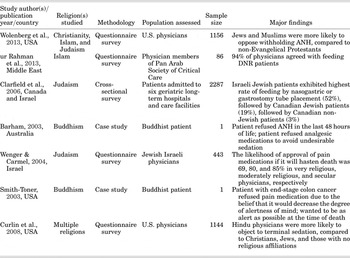
ARTIFICIAL NUTRITION AND HYDRATION (ANH) AND PAIN MANAGEMENT (TABLE 3)
Delivery of ANH in a terminal illness can create complex scenarios and requires an understanding of the nutritional, cultural, psychosocial, and R/S needs of patients, with the final decision usually being made by members of the healthcare team (Maillet et al., Reference Maillet, Potter and Heller2002).
Artificial nutrition and hydration (ANH) and pain management

DNR = do not resuscitate; ANH = artificial nutrition and hydration.
Islam
Attitudes and Beliefs of HCPs
A study of American physicians showed that Jewish and Muslim physicians are more likely to oppose withholding ANH compared to non-Evangelical Protestants. These differences were significant after controlling for religious importance and attendance (Wolenberg et al., Reference Wolenberg, Yoon and Rasinski2013), and the least religious physicians were less likely to oppose withholding or withdrawing ANH. Another study showed that the majority of Muslim physicians in the Middle East believe in feeding DNR patients (ur Rahman et al., Reference ur Rahman, Abuhasna and Abu-Zidan2013).
Hinduism
Attitudes and Beliefs of HCPs
Hindu physicians in the United States have been shown to have a fourfold higher likelihood of objecting to terminal sedation compared to their counterparts with another or no religious affiliation (Curlin et al., Reference Curlin, Nwodim and Vance2008). A different American study showed that 86% of Hindu physicians do not think that their religious beliefs interfere with administration of terminal sedation, but only 6% of these healthcare providers reported having high intrinsic religiosity (Ramalingam et al., Reference Ramalingam, Saeed and Sinnakirouchenan2015).
Buddhism
Attitudes and Beliefs of Patients and the General Population
In a case report of a Buddhist with end-stage colon cancer, the patient refused EoL pain medication due to a fear of decreased alertness of mind (Smith-Toner, Reference Smith-Toner2003). Another Buddhist patient opted to forego ANH and analgesics during the final 48 hours of life (Barham, Reference Barham2003).
Judaism
Attitudes and Beliefs of HCPs
Among Israeli Jewish physicians, degree of religiosity was found to be inversely related to the likelihood of approving EoL pain medications, if the medications were thought to hasten death (Wenger & Carmel, Reference Wenger and Carmel2004).
Attitudes and Beliefs of Patients and the General Population
Among terminally ill Jewish patients, Clarfield et al. (Reference Clarfield, Monette and Bergman2006) found that the rate of nasogastric and gastrostomy tube placement for ANH was higher in Israeli (52.9%) compared to Canadian Jewish (11%) subjects (Clarfield et al., Reference Clarfield, Monette and Bergman2006).
AUTOPSY PRACTICES (TABLE 4)
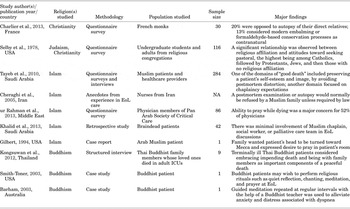
Acceptance of autopsy and postmortem examination can vary widely, depending on the religious and spiritual beliefs of the individuals involved.
Autopsy and miscellaneous issues

EoL = end of life; ICU = intensive care unit.
Christianity
Attitudes and Beliefs of Patients and the General Population
A survey of French Catholics found that about a fifth of this population are opposed to autopsy of close relatives (Charlier et al., Reference Charlier, Joly and Champagnat2013).
Islam
Attitudes and Beliefs of HCPs and Patients
Muslim patients and HCPs have been shown to believe in preserving the self-esteem of the patient by avoiding postmortem examinations that could lead to distortions, deformities, and changes in the appearance of the body (Tayeb et al., Reference Tayeb, Al-Zamel and Fareed2010). Cheraghi et al. (Reference Cheraghi, Payne and Salsali2005) found that autopsy is usually refused by Muslim families in Iran, unless required by law.
Judaism
Attitudes and Beliefs of Patients and the General Population
Orthodox Jewish law encourages rapid burial of the deceased, and physicians are expected to contact the family immediately and encourage them to contact a Jewish burial committee (Loike et al., Reference Loike, Gillick and Mayer2010). Burial occurs within 24 hours unless the next day is a Saturday (the Sabbath), which can make an autopsy difficult due to its potential for delaying burial.
MISCELLANEOUS (TABLE 4)
Christianity
Positive attitudes about seeking pastoral help in the United States are highest among Catholics, followed by Protestants, Jews, and those with no religious affiliation (Selby et al., Reference Selby, Calhoun and Parrott1978). Chaplain EoL visits in the United States have also been demonstrated to improve patient satisfaction in standardized surveys (Marin et al., Reference Marin, Sharma and Sosunov2015).
Islam
More than half of Muslim physicians surveyed in the Middle East consider the ability to pray an extremely important aspect of EoL care (ur Rahman et al., Reference ur Rahman, Abuhasna and Abu-Zidan2013). However, Khalid et al. (Reference Khalid, Hamad and Khalid2013) found that there is minimal involvement of Muslim chaplains or social workers in EoL discussions in the region. Additionally, a survey of Muslim patients and a case report highlighted the need for someone to be present at the bedside at the time of death to recite chapters of the Quran (Tayeb et al., Reference Tayeb, Al-Zamel and Fareed2010; Gilbert, Reference Gilbert1994).
Buddhism
Kongsuwan et al. (Reference Kongsuwan, Chaipetch and Matchim2012) found that terminally ill Thai Buddhist patients consider preparing for a peaceful state of mind and being with family members to be important components of a peaceful death. Guided meditation by a Buddhist teacher, quiet reflection, and chanting have also been shown to reduce anxiety and dyspnea (Barham, Reference Barham2003; Smith-Toner, Reference Smith-Toner2003).
DISCUSSION
This systematic review indicates the diversity of religious beliefs and how they relate to EoL care. It also demonstrates the inconsistencies and major gaps in the literature in terms of studies on the beliefs and preferences of HCPs and patients who belong to different religions. Receptivity to advanced directives is greatest among Roman Catholic, Protestant, Jewish, and Hindu populations. Meanwhile, the major religions vary dramatically in terms of their views on termination of care, euthanasia/PAS, ANH, pain management, and autopsy. Perspectives may vary even within the same religion based on the subgroup to which the patient or provider belong, or even their country of residence. A nation's cultural practices and laws have a significant influence on beliefs and practices. For example, Catholics in Europe were found to be more likely to withdraw treatment in an EoL situation than Protestants, whereas American Roman Catholics were three times more likely to object to withdrawal of life support than Protestants. The diversity of our findings also indicates that the views within a religion can shift among those who set the guidelines, those who provide the care, the patients themselves, and their families.
Religion and spirituality are known to influence health by helping patients and families cope with an illness, by developing a positive state of mind, and by maintaining emotional integrity (Curlin et al., Reference Curlin, Sellergren and Lantos2007). The important barriers to provision of R/S care by HCPs include inadequate training and a perception of R/S care as being outside the scope of clinical practice (Koenig et al., Reference Koenig, Hooten and Lindsay-Calkins2010). A review by Setta and Shemie (Reference Setta and Shemie2015) demonstrated how a theological line of reasoning can lead to complex conclusions on various EoL issues. For example, the differences in ANH practices among Israeli and Canadian Jewish patients can be explained by varying degrees of conservatism and obedience to Jewish laws among those affiliated with Orthodox, Conservative, and Reform Judaism. Level of education can also play an important role, as evidenced by an increased rate of acceptance for euthanasia/PAS among educated respondents in Pakistan (Qidwai et al., Reference Qidwai, Qureshi and Ali2001). As is evident from our review, pharmacotherapy for EoL pain control can have different implications for people belonging to different religions. The Judeo-Christian view endorses the use of pain medications as long as the intent is to comfort the dying patient. However, Eastern religions (including Hinduism and Buddhism) often object to the use of opioid medications at the end of life due to the undesirable consequence of a decreased level of consciousness at the time of death. Furthermore, EoL fasting is sometimes considered to be a source of spiritual purification by Hindus, and so they might object to tube feeding once the end is near (Firth, Reference Firth2005).
LIMITATIONS OF THE STUDY
Our study has certain limitations. Most of the data presented are primarily based on studies of religious practices pertaining to EoL issues in the general population and include a wide heterogeneity in terms of degree of intrinsic religiosity. Hence, there may be disagreements among scholars who are well versed in the theological perspectives of individual religions. Many of our studies were based on surveys with HCPs, with a disproportionately high level of health literacy compared to the general population, which could have influenced their responses.
CONCLUSIONS
To conclude, this is the first systematic review of empirical evidence published in the medical literature on EoL practices of people belonging to the five major world religions, with the primary objective of enhancing R/S competence among HCPs. In addition to highlighting the religious perspectives on the major EoL issues, our results help us conceptualize how religious teachings and beliefs translate into HCP and patient decision making in the “real world.” Prospective studies with validated tools for religiosity and spirituality are needed in order to yield a detailed characterization of their impact on longevity and quality of life at the end of life.
AUTHORSHIP CONTRIBUTIONS
R.C. and S.K.H. designed the study, abstracted the data, wrote the first draft, and approved the final version of the manuscript. A.R.E.J., M.R.L., K.L.S., and A.D.P. revised the manuscript and approved the final version.
ACKNOWLEDGMENTS
We would like to express our thanks to Larry J. Prokop, m.l.s., of the Mayo Clinic Libraries at the Mayo Clinic in Rochester, Minnesota, and to Katherine M. Piderman, ph.d., from the Chaplain Services at the Mayo Clinic Hospice in Rochester, Minnesota.
DISCLOSURES
All the authors have completed the unified competing interest form (see www.icmje.org/coi_disclosure.pdf; available on request from the corresponding author) and declare the following: (1) none of the authors have any financial interests related to the submitted work in the previous three years; and (2) their spouses, partners, and children have no financial relationships that may be relevant to the submitted work. All the authors had full access to all of the study data and can take responsibility for the integrity of our study and the accuracy of its analysis.