Introduction
Population ageing is happening worldwide. Following the global trend, by 2030, Asia will contain up to 60% of the world's older adults aged 60 years or above and 50% of the world's oldest-old (United Nations, 2015). In particular, Singapore is projected to experience the highest growth rate of 97% in the number of seniors aged 60 years or above, which will exceed 900,000 by 2030 (National Population and Talent Division, 2013). This has also resulted in Singapore's declining old-age support ratio, with only 5.4 residents aged 20–64 years supporting every senior resident aged 65 years and older in 2015 (Singapore Department of Statistics, 2016). The number of persons with dementia (PWD), a neurodegenerative illness, is estimated to rise exponentially from 22,000 in 2005 to 187,000 by 2050 (Alzheimer's Disease International, 2014).
Dementia exerts a heavy toll on both PWDs and their caregivers. With the expected rise in the number of PWDs in Singapore, an increasing number of familial caregivers will experience difficulties in their caregiving journey. Research has shown that extensive hours of care require familial caregivers to take time off work, shift to less challenging jobs, or give up working altogether (Kramer and Kipnis, Reference Kramer and Kipnis1995; Seow and Yap, Reference Seow and Yap2013). As a result, loss of income coupled with high medical fees and informal care charges heighten financial burden (Yap et al., Reference Yap, Seow, Henderson and Goh2005). The cost of informal care of seniors with dementia has been shown to be significantly lower compared to those who engage foreign domestic workers (FDWs) (Chong et al., Reference Chong2013; Woo et al., Reference Woo, Thompsonb and Magadic2017). Caring for frail older persons and those with dementia in their own homes is generally preferred to institutional care, yet children caregivers often hold full-time jobs. Hence, there is a growing need to engage FDWs to assist with long-term eldercare at home (Yeoh and Huang, Reference Yeoh and Huang2009). This is also more culturally acceptable in the oriental context where filial piety features strongly. The latest statistics show that one in five households employs FDWs, and nearly 50% of familial caregivers engage FDWs specifically to care for frail seniors in Singapore (Tam et al., Reference Tam, Koh, Legido-Quigley, Ha and Yap2017).
An FDW is a full-time, live-in, migrant worker who is typically female, hired to perform domestic duties. Majority of FDWs come from Indonesia, Philippines, and Myanmar, while others hail from Sri Lanka, India, Thailand, and Bangladesh (Ministry of Manpower, 2016). The FDW spends a substantial proportion of their time with the PWD, typically living together with their employers (Yap et al., Reference Yap, Seow, Henderson and Goh2005). Familial caregivers thus have a shift of roles – from care providers to moderators of care. FDWs have been found to significantly moderate the effects of caregiving burden in spouses (Chong et al., Reference Chong, Chi, Lou and Leung2014), and shown to confer benefit in physical, cognitive, and behavioral parameters of community dwelling seniors (Østbye et al., Reference Østbye, Malhotra, Malhotra, Arambepola and Chan2013). Importantly, those with FDW assistance were 70% less likely to be admitted into residential care within one year (Chau et al., Reference Chau, Woo, Kwok, Chan, Hui and Chan2012).
Despite these advantages, reports find FDWs to be at risk of developing mental health problems. Over 24% of FDWs were considered to have poor mental health since starting work in Singapore (Humanitarian Organization for Migration Economics, 2015). Furthermore, employment conditions such as lack of personal rooms, limited social engagement, and communication with their own family members back home render them vulnerable to isolation, exploitation, and abuse (Humanitarian Organization for Migration Economics, 2015). For FDWs who undertake caregiving roles, they may find themselves experiencing caregiving burden, often when the employers’ family pressurizes them to deliver most of the caregiving and domestic responsibilities (Tam et al., Reference Tam, Koh, Legido-Quigley, Ha and Yap2017). FDWs were found to manage better when they developed an ability to adjust (Bai et al., Reference Bai, Kwok, Chan and Ho2013), derived satisfaction from caregiving (Tam et al., Reference Tam, Koh, Legido-Quigley, Ha and Yap2017), had adequate rest, and were socially supported (Chiou et al., Reference Chiou, Chang, Chen and Wang2009; de la Cuesta-Benjumea et al., Reference de la Cuesta-Benjumea, Donet-Montagut and Galiana-Gómez de Cádiz2012; Østbye et al., Reference Østbye, Malhotra, Malhotra, Arambepola and Chan2013; Tam et al., Reference Tam, Koh, Legido-Quigley, Ha and Yap2017). However, studies that investigate the determinants of caregiver stress and coping strategies in FDWs are still limited. In recent times, the development of culturally sensitive caregiver interventions or health communication programmes has been much advocated. However, these have not been specific to FDWs, despite FDW caregivers coming from a variety of cultural backgrounds.
This study aims to examine the factors associated with caregiving burden in FDWs looking after older adults in Singapore, as well as explore the differences between FDWs caring for PWD and those who do not. The insights garnered from this study can guide the development of targeted and culturally sensitive interventions for FDW caregivers to provide them with socio-emotional support and alleviate their caregiving burden. The findings of the study will provide vital information that could inform future policies for FDWs.
Methods
Participants
A convenience sample of 221 FDWs was recruited from an inpatient geriatric ward and outpatient geriatric clinic in a tertiary hospital in Singapore. Ethics approval for the study was obtained from the Domain-Specific Review Board (DSRB) of the National Healthcare Group. The inclusion criteria included FDWs who were (1) caring for an older person aged 65 years and above, (2) providing care for at least 6 months, (3) 21 years old and above, and (4) literate in English, Bahasa Melayu, or Burmese. FDWs who did not meet the inclusion criteria were excluded.
Procedures
Recruitment was carried out using convenience sampling, with participants (FDWs) recruited at the geriatric ward or outpatient clinic. Through the recommendation of healthcare providers, a team member explained the study details to FDWs and obtained their consent. Whenever appropriate, nurses who were able to speak FDWs’ preferred languages such as Bahasa Melayu or Burmese, assisted with the study explanation and recruitment. FDWs completed a short questionnaire gathering demographic, employment, and employer's information, followed by the Zarit Burden Interview (ZBI). These were available in English, Bahasa Melayu, or Burmese, and the participants (FDWs) were provided a copy in the language they were most comfortable with. In cases where participants were accompanied by family employers, the study team sought assent from their employers first before approaching the participants (FDWs). Approximately 80% of all FDWs we approached consented to participate in the study voluntarily. Those who refused to take part cited reasons such as having no time or a lack of ability to complete the questionnaire. Data collection took place over six months from January to June 2016.
Measures
Demographic factors included age, marital status, number of children, educational level, and presence of physical health problems. Employment factors included working experience and FDWs’ reasons to work in Singapore. Last, employer factors included employer demographics, presence of language difficulties, sleeping accommodation, and whether or not FDWs cared for a PWD. The ZBI is a 22-item questionnaire that assesses caregiving burden, which evaluates both objective and subjective caregiving stress. To cater to FDWs’ native languages, the ZBI was translated into Bahasa Melayu and Burmese.
Statistical analysis
Data analysis was performed with STATA V12.0. FDWs’ demographic characteristics were stratified into subgroups based on nationalities and whether FDWs cared for a PWD. Univariate and multivariate analyses by linear regression were used to determine the association of factors such as socio-demographic, employment, and employer demographics with caregiving burden measured by the ZBI.
Results
Demographic characteristics (Table 1)
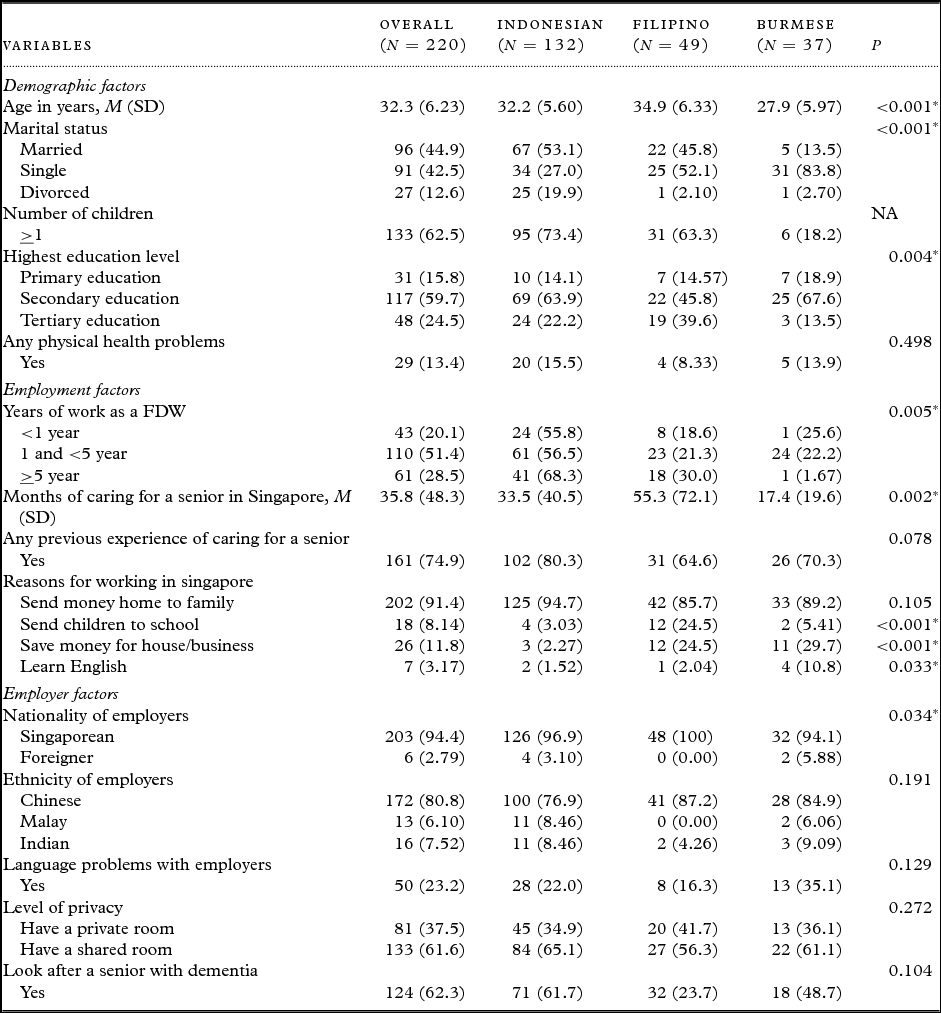
On average, the FDWs (M age = 32.3, SD = 6.23) were married (44.9%) or single (42.5%) with children (62.5%). Regardless of nationalities, most FDWs (59.7%) were educated up to secondary school level (p = 0.004). A small proportion of them (13.4%) experienced physical health problems such as back pain, breathing difficulty, dyspepsia, and thyroid illness. FDWs’ working experience significantly differed across nationalities (p < 0.001), ranging from less than one year (20.1%) to more than five years (28.6%). Overall, majority had previous experience caring for an older person (74.9%) and sending money home was the primary reason most FDWs chose to work in Singapore (91.4%). Regarding employer demographics, majority of the employers were Singaporeans (94.4%), Chinese (80.8%), and provided FDWs with shared rooms to live (61.6%). Importantly, more than half of FDWs cared for a PWD (62.3%), while a proportion (23.2%) faced language problems with employers.
FDW's demographic characteristics, N (%)

The Filipinos were the oldest (M age = 34.9, SD = 6.33) among the FDWs with slightly more than half single (52.1%), and 63.3% with children. In comparison, the Burmese FDWs were the youngest (M age = 27.9, SD = 5.97, p < 0.001), most being single (83.8%) and without children (81.8%). Our findings showed that 15.5% of the Indonesian and 13.9% of the Burmese FDWs reported physical health problems. In terms of working experience, most Indonesian FDWs (68.3%) had been working for more than five years, while Burmese FDWs (25.6%) had significantly less working experience. Although not statistically significant, a higher proportion of Burmese FDWs encountered language difficulties with employers (35.1%), while a high number of Indonesian FDWs (61.7%) took care of a PWD.
Caregiving burden (Table 2)
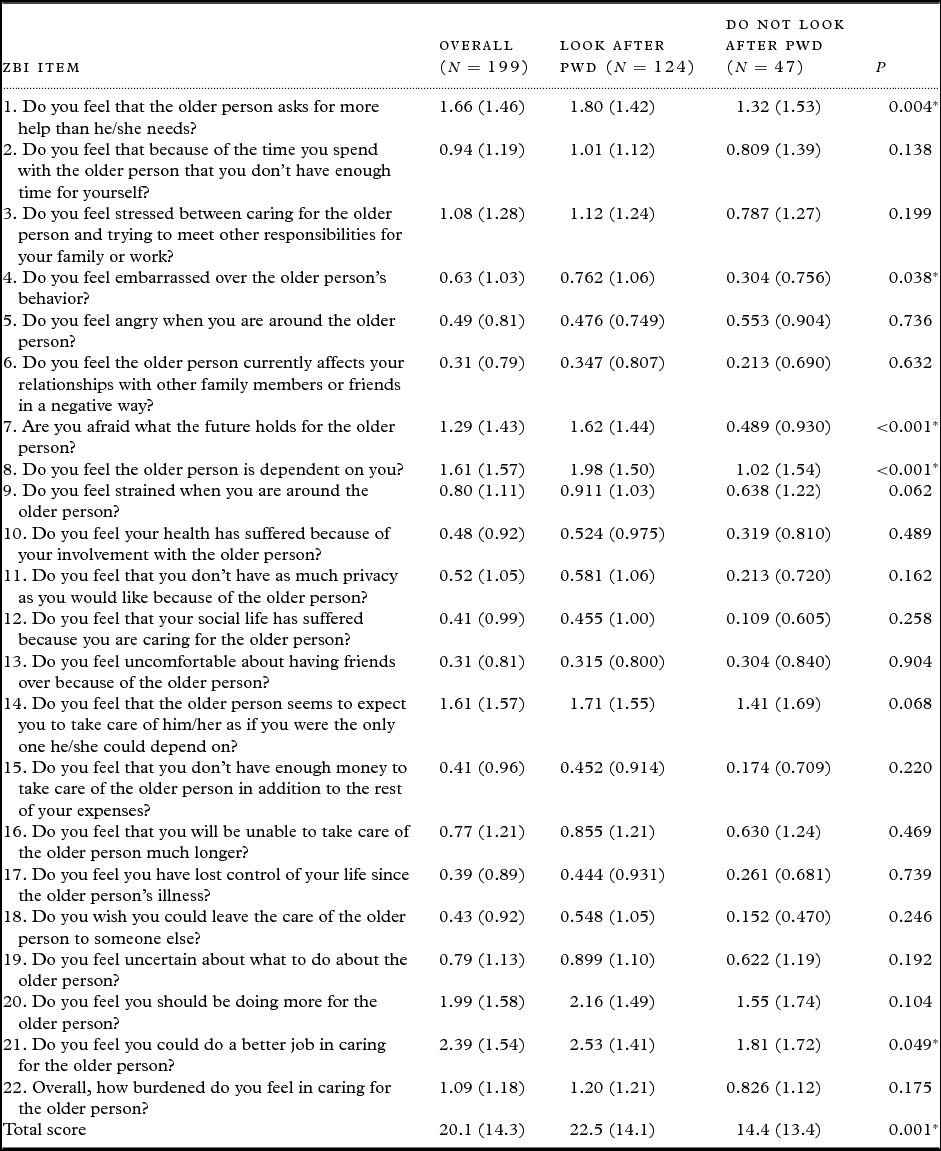
The total ZBI score ranged from 0 to 58 out of a maximum score of 88, with the mean and standard deviation being 20.1 and 14.3, respectively. The mean scores for individual items of ZBI ranged from 0.31 to 2.39, reflecting specific aspects of caregiving that imposed stress on FDWs. The highest burden was derived from the feeling that they “could do a better job” (M = 2.39, SD = 1.54), followed by “should be doing more” (M = 1.99, SD = 1.58), and the perception that “the older person asks for more help than he/she needs.” The items, “the older person is dependent” and “he/she seemed to expect FDWs to take care of him/her as if FDWs were the only one,” were rated equally high (M= 1.61, SD = 1.57).
FDWs’ ZBI individual scores, M (SD)

FDWs who cared for a PWD had one year less experience in elder care (2.7 years, p = 0.010) than their counterparts (3.8 years) and were more likely to share a room with the PWD (60.2%) than have their own room (38.2%). They (M = 22.5, SD = 14.1) had significantly higher burden score (p = 0.001) than those who did not look after a PWD (M = 14.4, SD = 13.4). Notably, FDWs looking after PWD felt that the PWD requested for more help than needed (M = 1.80, p = 0.004) and were dependent (M = 1.98, p < 0.001). They were afraid of what might happen to the older person (M = 1.62, p < 0.001), embarrassed over his/her behavior (M = 0.762, p = 0.038), but felt that they could do a better job (M = 1.62, p = 0.049).
Univariate and multivariate analyses
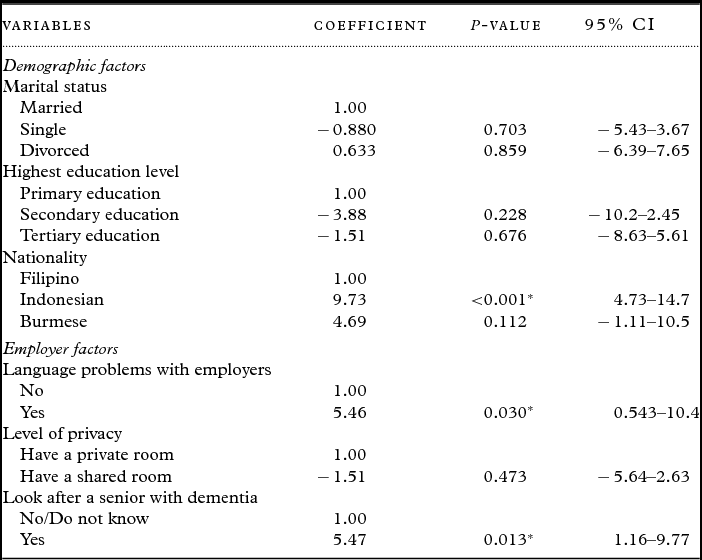
Univariate analysis revealed the factors that significantly predicted caregiving burden, namely, nationality (p < 0.001), privacy (p = 0.029), and whether or not FDWs looked after a PWD (p = 0.001). It showed that FDWs who were more likely to experience caregiving stress included Filipino and Burmese FDWs, having to share a room with the senior under their care and looking after for a PWD. As these factors were significant on univariate analysis, they were subsequently included in the multivariate model. In addition, to make up the multivariate model, we selected other predictors with little co-linearity or interaction between them, and perceived to be modifiable factors based on clinical judgment. Hence, the multivariate full model consisted of six factors, namely marital status, highest education level, nationality, language problems with employers, level of privacy, and whether or not FDWs cared for a PWD. Multivariate analysis showed nationality, language problems, and whether or not FDWs looked after a PWD remained significant (Table 3). The model (R 2 = 0.162) explained 16.2% of the variance in caregiving burden scores.
Multivariate analysis on factors predicting caregiving burden in FDWs

Discussion
This study adds to the limited literature that explores caregiving burden in FDWs providing care to frail seniors. The pertinent findings are that FDWs who cared for PWDs and those who encountered language issues were 5.47 and 5.46 times more likely to experience caregiving burden, respectively. Nationality also factored importantly in determining caregiving burden with Filipino and Burmese FDWs more likely to express significant burden compared to their Indonesian counterparts.
The increased burden in FDWs who care for PWD may be explained by the numerous challenges faced as they typically possess limited awareness and knowledge of dementia. A Hong Kong study found job satisfaction in FDWs to be associated with confidence in caregiving and the ability to cope with challenging behaviors in the PWD (Bai et al., Reference Bai, Kwok, Chan and Ho2013). As such, training for FDWs is essential to increase caregiving self-efficacy and job satisfaction. The training can be provided with a group-based classroom format and should extend beyond formal structured sessions to an accessible telephone helpline for the workers to dial for advice and assistance to cope with ad-hoc problems. These helplines can also provide guidance and counseling for FDWs to receive psycho-emotional support. Beyond general content (Ministry of Manpower, 2015; Singapore Silver Pages, 2017), training for FDW caregivers should be specific to dementia so as to equip them with relevant dementia caregiving skills (Alzheimer's Disease Association, 2017). Preferably, dementia-specific training should commence at the start of their employment. As a one-off training may not be sufficient for FDWs to cope with the day-to-day problems they encounter, refresher courses should be provided preferably by the same agency to ensure sustained competence and continuity of support. In addition, healthcare professionals and other support groups can play an advocacy role to raise awareness of training and dementia-focused courses for FDWs (Yeoh and Huang, Reference Yeoh and Huang2009). Last, FDWs caring for PWD can benefit from the cooperation and involvement of family employers to lend them the appropriate support.
Problems with communication, which is inevitable as the workers hail from foreign countries, have been consistently identified as a significant determinant associated with caregiving burden. The HOME study (Humanitarian Organization for Migration Economics, 2015) reported that 30% of FDWs experienced language-associated difficulties with their hiring families. As unmet physical or emotional needs often underlie challenging behaviors in PWD, barriers in communication can fuel these behaviors as FWDs fail to understand the wishes expressed by their care recipients. Therefore, FDWs can be granted opportunities to learn local dialects and languages at least at the conversational level. In fact, a Singapore-registered charity organization offered training to foreign workers in English and Mandarin language classes (Humanitarian Organization for Migration Economics, 2015). Improved language competence would help build rapport between FDWs and the seniors, as well as family employers, and thus helps to improve coping and reduce burden. Knowledge of these languages helps to put them in a better stead for their work application. For example, Hong Kong employers preferred to hire Indonesians as a higher proportion of them could speak Cantonese compared to other nationalities (Bai et al., Reference Bai, Kwok, Chan and Ho2013). Hence, FDWs may even consider taking up language courses before commencing their work overseas.
The results show that nationality was the strongest factor associated with caregiving burden. We surmise that Filipino FDWs may be more expressive with their feelings, and hence rated their burden levels with less reserve. While there is little evidence about the influence of ethnicity and culture on migrant workers, not unlike Chinese-American caregivers, Filipino FDWs may tend to seek help from their own ethnic organizations (Lehman, Reference Lehman2016). Moreover, similar to African-American caregivers, for Filipino FDWs who come from a minority ethnic group in lower to middle income countries, support from family members and friends is important to them (Sun et al., Reference Sun, Ong and Burnette2012). Past research has shown that caregivers’ help-seeking behaviors and coping strategies differ among racial and ethnic groups (Lehman, Reference Lehman2016). A recent qualitative study with 35 familial caregivers from different ethnic groups in America highlighted that minority groups tended to be more susceptible to a sense of isolation (Pharr et al., Reference Pharr, Dodge Francis, Terry and Clark2014). This provides a noteworthy comparison, as FDWs have limited opportunities to socialize outside the family they work for. It is thus important to identify and address feelings of isolation among FDWs to encourage their help-seeking behaviors beyond the family (Pharr et al., Reference Pharr, Dodge Francis, Terry and Clark2014). In general, migrant workers normally find ways to gather in their own communities when they meet on their off-days during weekends and may maintain remote contact in the course of the week (Iecovich, Reference Iecovich2011). These peer networks are crucial in providing FDWs with social and emotional support, and may become a platform for ethnic-targeted activities to take place.
The top-scoring items on the ZBI revealed specific areas of caregiving that burdened the FDWs. These items pertained to the perceived level of dependence of the older person (items 1, 8, and 14) and “worry about performance” (WaP), which refers to the desire of caregivers to do more (item 20) and do a better job (item 21) (Cheah et al., Reference Cheah, Han, Chong, Anthony and Lim2012). Reports by familial caregivers for PWD have indicated that nearly one-third dedicate themselves to caregiving for 40-hours or more every week (Ory et al., Reference Ory, Hoffman, Yee, Tennstedt and Schulz1999) and more than 80% of PWD, especially those exhibiting behavioral problems, require perpetual care (Vaingankar et al., Reference Vaingankar2016). WaP is likely to stem from FDWs’ appraisal of their own performance, which may lie along a continuum from positive characteristics such as conscientiousness, to the negative in shame and guilt (Lim et al., Reference Lim2014). FDWs can be validated for their efforts and given encouragement to bolster their emotional resilience. Providing affirmation and reassurance may go a long way to helping them persevere in caregiving and care better for the older person.
Some limitations of the study should be mentioned. First, the multivariate model only accounted for 16.7% of the variance in caregiving burden, leaving a sizable proportion unexplained. This could be attributed in part to the lack of investigation into disease-related factors such as the degree of functional impairment and severity of behavioral problems, as well as caregiver factors, in particular mental health status, which has been shown to mediate caregiving burden. Second, we only performed forward translation of the questionnaire with no backward translation to ensure content validity. Last, the presence of employers may have resulted in some FDWs under-rating their responses to the items of the ZBI.
Conclusion
FDWs experience significant burden in providing care for seniors. Potential ways to better support and alleviate FDWs’ burden include providing dementia-specific and language training opportunities, as well as ethnic-specific support. Future studies should consider a qualitative or mixed-methods approach to gain a deeper understanding into the determinants of caregiving burden in FDWs.
Conflict of interest
None.
Description of authors’ roles
NHL Ha collected, analyzed, and interpreted the data, and wrote the manuscript. MS Chong interpreted the data and revised the manuscript. RWM Choo analyzed part of the data. WJ Tam and PLK Yap conceptualized the study, supervised data collection and analyses, interpreted the data, and revised the manuscript. All authors approved the final manuscript.
Funding
This research did not require any funding.