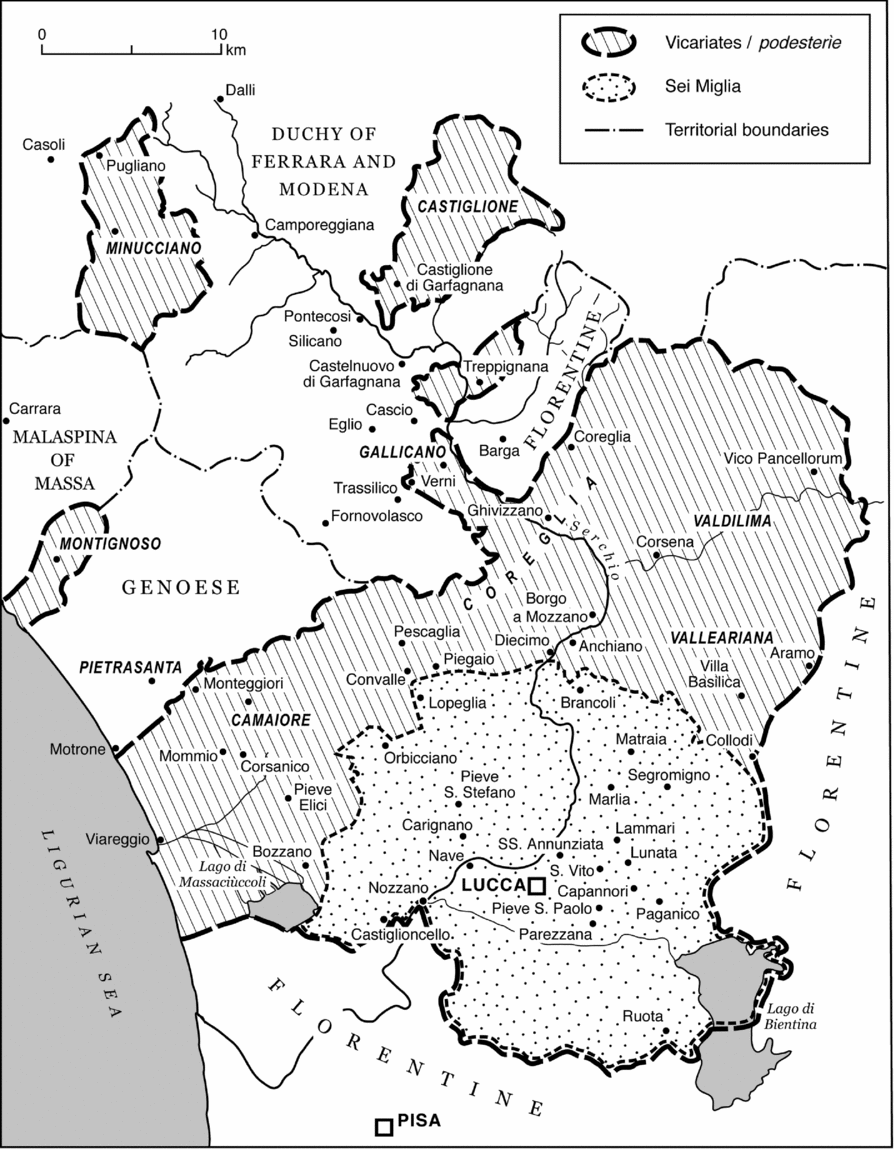
Lucca is a city of north-western Tuscany. The city was a republic for most of its history, surviving as a classic example of an Italian city-state until the wars of the French Revolution at the end of the eighteenth century. Lucca's history as a republic was punctuated during the fourteenth century by periods of despotic and foreign rule, and between 1400 and 1430 by the princely rule of Paolo Guinigi. With the restoration of the republic in August 1430, Lucca was again ruled by a General Council (Consiglio Generale) of elected citizens, and by an executive of nine Anziani headed by a Gonfaloniere di Giustizia. Externally – beyond the fertile plain that immediately surrounded the city (the Sei Miglia) – Lucca's territories had been divided since the late thirteenth century into consolidated vicariates.Footnote 1 At the time of Paolo Guinigi's fall, Lucca's territory consisted of nine vicariates (Camaiore, Camporeggiana, Carrara, Castiglione, Coreglia, Massa Lunese, Pietrasanta, Valdilima and Valleariana/Montecarlo) and five podesterìe (Avenza, Casoli oltre Giogo, Monteggiori, Nozzano and Ruota). The number and size of the vicariates were to change significantly over the course of the fifteenth century as a result of war and the conquests of neighbouring powers (for the vicariates c. 1460, see Figure 1).
The Lucchese state c. 1460

Each vicariate was headed by a Lucchese citizen elected as its vicar. At least 207 men were elected to the office of vicar during the period 1430–1501, of whom 18 declined appointment on the one occasion (two in the case of Lorenzo di Arrighino Arrighi) when they were so chosen.Footnote 2 Smaller units within and beyond the vicariates were ruled by podestà. Over the period 1430–1501, 174 individuals were elected as podestà. The office of podestà was reserved to Lucchese notaries in Avenza, Casoli oltre Giogo, Minucciano (1454–63), Monteggiori and Montignoso – but not in Nozzano (where the podestà was likely to be drawn from the same men and families who served as vicars). During the troubled 1430s, and later in the months immediately after the recovery of a territory, both vicars and podestà might be replaced or supplemented by a commissario. Sometimes a commissario was specifically granted the powers of a vicar, but in the fifteenth-century Lucchesia the office of commissario became a permanent institution only in Viareggio.Footnote 3 The Lucchese vicar was accompanied in office by one or more Lucchese notaries. Between 1430 and 1501, 146 men were elected to notarial appointments in the vicarial administrations. According to my calculations, a total of 407 Lucchese citizens were elected as vicars, vice-vicars, commissarii, podestà and notaries in the subject countryside during the seven decades after the recovery of liberty (of whom 28 appear never to have actually served).Footnote 4
The questions posed by the appointment, responsibilities and actions of vicars are rather different from those that concern notaries. The present article will focus only on the former. A prosopographical study of 189 men who occupied the post of vicar in the Lucchesia in the decades after 1430 tackles, within a single case-study, a range of problems relating to the nature of office-holding in the city and regional states of Renaissance Italy.Footnote 5 The themes of office and office-holders in Italy have generated a rich empirical and theoretical literature since the publication of Federico Chabod's essay on the Renaissance state.Footnote 6 Following Chabod, much of the discussion has tended to focus on the emerging princely courts – and, by extension, on the (contested) differences between the princely and republican regimes that governed the regional states of fifteenth-century Italy. Guido Castelnuovo has noted recently the exclusion from the debates of earlier political formations, whose very ‘stateness’ has been denied, and where ‘studies of offices and officials have been relegated to the margins of the socio-institutional historiography of late medieval communal Italy’.Footnote 7 The point can be extended to Lucca, which survived from the fifteenth to the nineteenth century as the sole significant example of the small city-states that had once dotted the map of northern and central Italy. Lucca was sui generis, but in many respects the republic restored in 1430 retained most of the defining characteristics of an old-style Italian city-state.Footnote 8 In this respect, a study of Lucchese vicars fills an important lacuna in the history of Italian office-holding (whilst expanding the range of experiences that constitute the process of state-formation in the Renaissance).
The specifics are different; the questions to be addressed remain very much those set out by Franca Leverotti for the delegates at the Pisan colloquy on office-holding in Italian states during the fifteenth century.Footnote 9 The article will show how vicars were appointed, and the terms and duration of their office. It will identify the kind of citizens who were chosen for – and accepted – administrative and judicial office in the countryside, and will ask how far some individuals may have carved out a career for themselves in this role. It will explore the kind of excuses that might be proffered in order to escape service away from the urban environment and the pronounced resistance to deployment in certain areas (predictably those more distant, most mountainous and most troublesome). Many of these questions impinge upon the broader debate over the professionality (or lack of professionality) of the short-term office-holders of urban regimes. Beyond the contribution to the study of office-holding, a study of Lucca's vicars offers insights into the relationship between city and countryside. At the end of their period of office, vicars (like other officials) were examined for misdemeanours committed whilst in office (syndication).Footnote 10 These judicial examinations, combined with other evidence, have been examined for information on the role of vicars as intermediaries, the control of the city over its more distant representatives and the possibilities of redress that were available to both contadini and citizens.
Vicarial appointments: norms and practices
In September 1430, shortly after the restoration of the republic, a balìa of 12 men, appointed to rule Lucca after the overthrow of Paolo Guinigi, elected vicars to fill the vacant posts of Camaiore and Massa Lunese.Footnote 11 In December 1430, the balìa de’ Riformatori, together with the executive council of Anziani (re-established in August), elected vicars (and their notaries) for the forthcoming year.Footnote 12 By the first semester 1432, it seems certain that regular officials for both city and territory were being elected in November/December for the following two semesters by the Anziani meeting together with the Council of Thirty-Six.Footnote 13 This marks a rapid return to the electoral procedures of the pre-Guinigi period. It is true that irregularities occurred throughout the period 1430–42 when, against the background of the wars with Florence, there were often very few extra-urban appointments to fill. In troubled times, the Anziani acting alone, or else a special emergency war-time council (balìa), meeting sometimes with the Anziani, can be found appointing both regular vicars and also the ad hoc commissarii entrusted with the safeguarding of particularly vulnerable territories.Footnote 14 In March 1442, until the recommencement of regular elections at the end of June, the Anziani alone were granted powers by the Consiglio Generale to appoint officials – in practice, commissarii – for all the lands recently recovered from the Florentines (on such terms as might seem appropriate to the Anziani).Footnote 15 Elections might always be superseded by a decision of the Consiglio Generale – which was especially likely in cases involving the substitution of an existing (perhaps deceased) official. But in normal circumstances, the election of vicars (and usually of all officials) required a meeting of the Anziani with the members and invitati of the Council of Thirty-Six. At these meetings, officials were elected in accordance with customary Lucchese practice by a form of secret ballot that involved the placing of small coloured balls into two different receptacles.Footnote 16
Permanent changes to the procedures by which vicars were elected were rarely attempted, and even more rarely successful. In February 1454, it was decided to move away from the traditional annual elections and to create a biennial tasca from which the holders of certain offices, including vicars and the podestà of Nozzano, were to be drawn – elections to be made as usual by the Anziani and Council of Thirty-Six. Appointments according to this new form were actually made for the vicariates of Camaiore, Coreglia and Castiglione, but the experiment was cancelled without explanation before its implementation.Footnote 17 When the commissariato of Viareggio was created in 1481, and for the following year, appointments to that office were entrusted to the Anziani and the six citizens super introitibus.Footnote 18 Finally, with the recovery in 1496 of the very important town and territory of Pietrasanta, and to ensure good appointments, it was decreed that future vicars of Pietrasanta (and the castellani and connestabili of Pietrasanta and Motrone) were to be elected by the Consiglio Generale itself.Footnote 19 The exceptional situation of Pietrasanta, and the need to secure its effective administration, is reflected in the decision in November 1497 to name an unbroken succession of vicars, nominated by the Anziani and elected by the Consiglio Generale, for the entire period from the first semester 1498 to the first semester 1501 – an ambitious plan, later supplemented by a tasca of six men from whom future vicars of Pietrasanta could be drawn, that was largely thwarted by the subsequent non-cooperation (and alleged unavailability) of many of the men elected.Footnote 20
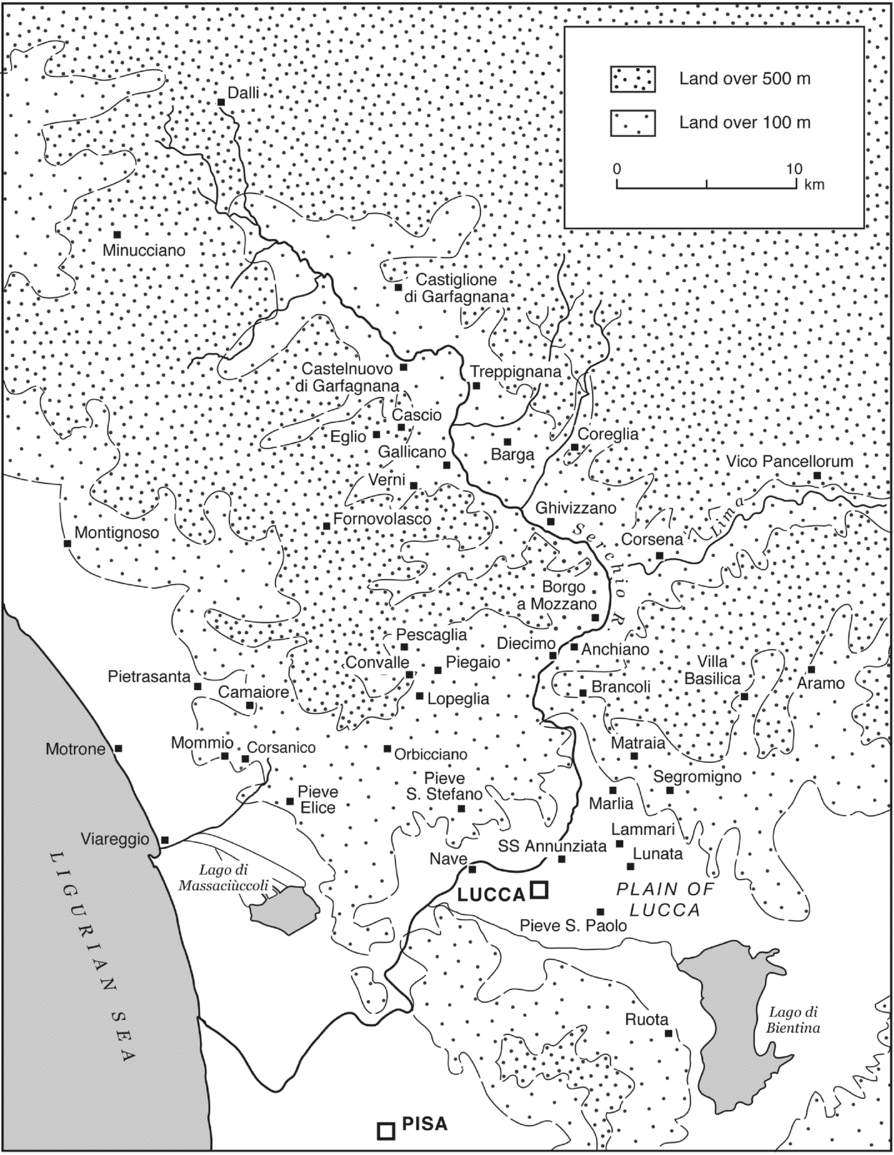
Commissarii, especially during the Florentine wars, were often appointed for an indeterminate period at the pleasure of the Lucchese authorities. Vicars, by contrast – like most regular office-holders – were generally appointed for a term of six months. In 1448, it was found that offices in the vicariate of Castiglione and the podesterìa of Montignoso could only be filled if offered for a full year.Footnote 21 In December 1453, the Anziani and Council of Thirty-Six were again given the choice of appointing annually to certain posts that were proving difficult to fill.Footnote 22 The practice of annual appointments was regularized for vicars of Castiglione from July 1458,Footnote 23 and for vicars of the new vicariate of Minucciano from January 1464.Footnote 24 Because of the distance of Minucciano (38 miles north-west of Lucca), and the difficulties that newly appointed vicars would face in making the journey into the high mountains during winter, it was later decreed that appointments to Minucciano would run from July to June (as had been the case for Castiglione since 1458).Footnote 25 The change from semestral to annual appointments was always justified in terms of distance and the need to secure suitable officials for potentially unattractive posts (for the physical geography of the region, see Figure 2). The argument had its flaws. The 1481 decision that the castellano and commissario of Viareggio should be appointed annually in order to attract the best men to these posts was revoked in November 1483 on the grounds that annual appointments had been found in practice to encourage negligence.Footnote 26
North-western Tuscany
The statutory provisions are clear. Vicars held office for a semester, in a few cases for a year. They were ineligible for any new vicarial appointment thereafter for a prescribed period (the vacanza).Footnote 27 But all things were possible through a dispensation that the Consiglio Generale might grant either to the electoral council or directly to an individual candidate. Practice never fully conformed to the rules. Particularly at time of plague or war, elections were made to the same or to a different vicariate notwithstanding the vacanza. A sitting vicar might have his term extended for all or part of the next semester if circumstances made it impossible for another to take his place. Cristoforo Ricciardi was elected vicar of Camporeggiana for the second semester 1436. Because of the war, he was confirmed in office by the Otto della balìa for the first semester 1437. Giannino Fatinelli was elected vicar of Camporeggiana for the second semester 1437, but was unable to take up the office; first because of his appointment as Anziano in Lucca, later because of the war. Therefore, Ricciardi, with letters and commission from the Anziani, persevered in office in Camporeggiana through the second semester 1437 (and, in fact, into 1438).Footnote 28 Giorgio di Andrea Lucchesini, vicar of Gallicano for the first semester 1488, moved without any vacanza from Gallicano to Minucciano in July 1488, and was to remain in Minucciano until June 1490.Footnote 29
Conversely, a single semester might see the arrival and departure of a series of vicars: Camaiore had seven different vicars during the first semester 1459.Footnote 30 Death in office was the most pressing reason for a vicar's replacement, but living vicars might show persistence and some ingenuity in explaining why they should not complete their full allocated term. In 1446, at the petition of Silvestro di Matteo Trenta, the doctor of law messer Benedetto de’ Medici da Moncigoli, vicar of Coreglia, was granted leave of absence of up to three months so that he could escort Silvestro's sister Lippa from Bologna to Lucca.Footnote 31 In 1454, Nicolao de Fondora asked to be substituted as vicar of Gallicano for two months, that he might take a cure for his infirmities at the baths of Corsena.Footnote 32 In November 1457, the vicar of Camaiore, Paolo Miliani, pleading the death of his wife and other impediments, successfully petitioned to be substituted for the rest of his term by his son Guglielmo.Footnote 33 In 1468, messer Giovanni Vanni, doctor of law, explained to the Consiglio Generale that he had only accepted the post of vicar of Valleariana out of respect for the signoria. Vanni duly travelled into the Valleariana on 1 July 1468 to set up his lodgings, returning to Lucca to collect his wife and the rest of his servants. On 3 July, he was stricken with fever, and, appealing to natural law and to the self-interests of the commune, he petitioned to be relieved of his office. The truth of Giovanni Vanni's excuses is attested by his death a few days after the granting of his request.Footnote 34 In October 1496, Giovanni di Filippo di Poggio, having occupied the office of vicar of Valdilima for only two months before he was substituted for the duration of his term as Gonfaloniere di Giustizia, cited his age and the approaching winter as reasons why he should not return to his vicariate – though di Poggio's age did not prevent him from becoming vicar of Camaiore, Pietrasanta (twice) and Castiglione in the years (and winters) to come.Footnote 35
Seekers and evaders of rural office
The data is sometimes ambiguous, and the precise figures that follow should be treated with a degree of caution. I have calculated that in 12.8 per cent of elections, the chosen candidate failed, for a variety of reasons, to take up his appointment. Of those who arrived in their vicariates, 7.6 per cent of vicars did not occupy their posts for the full duration of their appointment.Footnote 36 These figures are an imperfect guide to the willingness of candidates to accept and execute vicarial office. In fact, only 5 per cent of the men elected as vicars explicitly refused their appointment (or failed to accept it within the specified period). On 13 occasions, men petitioned successfully to exchange the post allocated to them for another vicariate; five others were permitted to exchange their vicariate for an urban office. Three men died before they were due to take up their appointments. The remainder, having accepted office, were replaced or granted absolution on the grounds of succeeding impediments that seemed convincing to the Consiglio Generale. Of those vicars who failed to complete their full term, 11 died in office; infirmity explains the substitution of at least four others. Three vicars were temporarily substituted for the two-month period when they were drawn to reside in Lucca as Anziani or Gonfaloniere di Giustizia.Footnote 37
The overwhelming impression is that most men accepted their election and served their allotted term. This is hardly surprising. The election process was not a random one. Office-holders were drawn from those who had given notice of their wish for public office.Footnote 38 In the small political world of late medieval Lucca, we may reasonably assume that the Anziani and Council of Thirty-Six were well-informed about willing and suitable candidates – though their freedom of choice (without special dispensation) was substantially limited not only by the vacanza, but also by a plethora of laws relating to minimum age, marital status and exclusion from honours.Footnote 39 In normal years, the problem faced by the electors seems to have arisen from competition for office rather than from a dearth of candidates.Footnote 40 Clearly, there was lobbying for certain favoured vicariates. The baths at Corsena, and the hope of a cure for themselves or their wives, were the occasion for Piero di Andrea dal Portico, Zaccaria Totti, Filippo Guidiccioni and Andrea Pini to petition the Consiglio Generale (successfully) for appointment to the vicariate of Valdilima.Footnote 41 Equally clearly, some positions were notoriously difficult to fill: the podesterìa of Montignoso, and the vicariates of Castiglione and Minucciano.Footnote 42 Gallicano had to be made more attractive with offers of increased salaries and improved terms of appointment.Footnote 43 More surprising are the difficulties periodically presented by Pietrasanta and Camaiore – important centres, close to Lucca, and (particularly in the case of Camaiore) areas of extensive citizen investment. Vicars for Pietrasanta were only required in the turbulent war years at the very beginning and end of our period. In both cases, the obstacle may have been one of finding leading citizens of sufficient status and experience for such important postings.
The recent literature has tended to emphasize that officials in late medieval Italy did not constitute a recognizable group or closed social class.Footnote 44 Disagreement remains over the level of ‘professionality’ of citizen officials.Footnote 45 The argument that citizen office-holding was random, unspecialized and unprofessional would seem to be supported in Lucca by the fact that, within the terminal dates 1430–1501, 63 per cent of those elected as vicars (and 54 per cent of those who actually held office) were elected three times or less. These figures would be lower were we to follow the career of individuals back into the Guinigi period or forward beyond 1501. Moreover, it is certainly possible to identify groups, families and individuals who were appointed to vicarial office with great regularity over long periods.
In Lucca, the electoral procedures privileged two groups: doctors of law and knights. These were subject to a shorter vacanza, and they were voted on in the scrutiny process before ordinary citizens.Footnote 46 The nature of the extant sources has probably over-emphasized the primarily judicial role played by vicars. Nevertheless, it is easy to see why university-trained legal professionals should become favoured candidates for the post of vicar. But there were problems. In Lucca, as elsewhere,Footnote 47 members of the college of judges were not always enthusiastic about exchanging their lucrative public and private practices in the city for a spell of exile in the distant countryside. Messer Lazzaro di Bartolomeo Arnolfini claimed that it would be not only to his own great damage and prejudice, but also to that of the many citizens who needed his services, should he be forced to take up the office of vicar of Pietrasanta.Footnote 48 The Lucchese authorities themselves were well aware that ‘homines sapientes et praesertim doctori legum’ might be more usefully domiciled in the city. For the first semester 1452, messer Nicolao Manfredi and messer Gregorio Arrighi were elected vicars of Coreglia and Castiglione respectively. In both cases, the Council of Thirty-Six decided that these two prominent doctors would be more effectively deployed in Lucca as paid consultants and ambassadors of the commune.Footnote 49 Over the course of their entire careers, both men served only one term as vicar: Manfredi in Pietrasanta in 1433; Arrighi in Camaiore in 1459. Having accepted office, doctors of law were especially likely to be called away from their vicarial duties by pressing business far from Lucca: messer Libertà di Nanni Franceschi, vicar of Valleariana in 1467, received letters that made it necessary for him to depart immediately for Rome;Footnote 50 messer Giovanni Marco di messer Benedetto de’ Medici left prematurely from several of his vicariates for podestral appointments in the service of the duke of Milan and in Modena.Footnote 51
The records of the Collegio de’ Dottori e de’ Notari provide the names of a few jurists who were never elected as vicars.Footnote 52 Others served one or two terms. It remains true that some doctors of law occupied the post of vicar so regularly and so frequently that we might reasonably speak of a career choice. Messer Alessandro di Filippo Rapondi was elected as vicar thirty-two times between 1434 and his death in office in 1473, requesting only once to be absolved from his appointment (because of ill-health).Footnote 53 He governed nine different vicariates, including six appointments to distant Castiglione and one to inaccessible Minucciano. Messer Bonaccorso Bocci, who replaced the deceased Rapondi in Valleariana in 1473, and who himself was to die in office, was vicar for twenty-four terms. Bocci was regularly elected to vicarial posts almost every year between 1447 and 1474 (and never sought to be excused). Together with six or seven other dottori, Alessandro Rapondi and Bonaccorso Bocci provided a stable inner core of administrators for the fifteenth-century Lucchese state.Footnote 54
Knights, with their personal prestige and their military and adminis-trative experience, were also favoured candidates for the post of vicar. Indeed, it is not easy to separate them from the jurists. Messer Giovanni Marco de’ Medici was designated knight, count and doctor of law; messer Gregorio Ciampanti as knight and doctor of law.Footnote 55 Messer Nicolao Tegrimi, knight and doctor of law, and his brother, the knight messer Pietro, regularly requested permission to substitute for each other when called away from vicarial duties. Clearly, many knights were very willing to serve in the vicariates. The salaries paid to vicars (and to other Lucchese officials) were periodically cut – sometimes halved – when the commune was in need of money for the expenses of war or to feed the population at times of plague and famine.Footnote 56 But the salary of a vicar (which was usually between 12 and 36 florins per month), together with the other fruits of office, offered an attractive supplement to the income of a knight. Planning to return to Lucca in 1463, the knight messer Antonio Buonvisi petitioned the Consiglio Generale for some public office – which he needed to cover the great expenses incurred by his military status. Buonvisi was by statute excluded from office because he was unmarried; a condition explained, he said, by the fact that he had been moving about so frequently between different cities and territories.Footnote 57 Antonio Buonvisi was granted a dispensation for three years, and was subsequently elected as vicar of Gallicano for the first semester 1464.Footnote 58
As in the case of the dottori, the election of a knight was not without disadvantages. Knights were even more likely than jurists to be called from their vicariates at short notice to serve in the administration of princes and cities throughout the whole of Italy. Following his petition and absolution of 1463, messer Antonio Buonvisi was elected to two vicariates: Gallicano in 1464, and Camaiore in 1465. He left Gallicano prematurely in May 1464 to take up office in Siena;Footnote 59 in 1465, he was absolved from Camaiore because of his election as podestà of Recanati.Footnote 60 In 1469, Buonvisi re-appears as capitano of the city of Lecce, and a few years later as governor of Calabria.Footnote 61 Though their office-holding was seldom confined to Lucchese territory, individual knights rivalled the jurists in the regularity and frequency of their vicarial appointments. Messer Giovanni Sbarra was elected vicar 15 times between 1443 and 1465 – refusing the appointment twice. Messer Giannino Fatinelli and his son Pietro, between them, were elected to vicarial office 39 times – serving all or part of 35 of these terms. It is true that the father, Giannino, was knighted only towards the very end of his vicarial career.Footnote 62 But if we are to identify a core group of semi-professional administrators, it is to the doctors of law and to the knights (or future knights) that we must look.
Vicarial salaries and emoluments attracted knights and jurists; it attracted other citizens too. Iacopo Prosperi held the office of vicar eight times. In 1449, he petitioned to be temporarily substituted as vicar of Coreglia because of a lingering dispute with his brother. Prosperi was concerned to avoid the statutory fine for leaving his post, but he was much more anxious not to be excluded from future vicarial appointments because, he said, ‘without office he will be unable to support his family’.Footnote 63 A similar anguished plea emanated from Pino Pighinucci in 1469.Footnote 64 Yet, vicarial office was not universally sought by Lucchese citizens. For the greater part of the fifteenth century, the names of many of the great merchant/banking families who dominated city government are very largely absent from the lists of vicars. We find very few representatives of the Buonvisi or the Cenami or the Micheli, and not one of the Bernardini or the Burlamacchi. Generalizations fall foul of the idiosyncracies of personal choice. Nevertheless, two different profiles emerge of the kind of families that were likely to produce candidates for vicarial office.
First, there were families of military reputation, whose individual members were not necessarily belted knights. Cristoforo Turchi, who commanded a galley with 200 soldiers sent by the republic into the service of Pope Pius II against the Turks,Footnote 65 was elected vicar 10 times between 1448 and 1476. Alessandro di ser Giovanni Streghi (16 times vicar) commanded 300 troops sent in 1446 to the assistance of the condottiere Iacopo Piccinino.Footnote 66 Into this category, I would place families of ‘feudal’ origin (with due caution in the use of the term).Footnote 67 Thirteen different members of the di Poggio family were elected as vicars between 1430 and 1501 – two of whom refused office, whilst others served only a single term. In the same category, I would include the Avvocati (counts palatine), and (more ambiguously) the Totti and the brothers Lodovico and Marchese Gigli.Footnote 68 Secondly, many of Lucca's vicars were drawn from new families like the Lucchesini and the Miliani for whom the appointment brought both honour and welcome subvention. The Lucchesini were a family emerging from artisanal roots in the period after 1430.Footnote 69 Gherardo Burlamacchi described the Miliani as an ancient family that later fell on hard times. The energy of Lucchese genealogists has traced the Miliani back to 1259. But there are few records of the family before the merchant (and later vicar) Paolo di Francesco.Footnote 70 They seem to me characteristic of many of the vicar-producing families of Quattrocento Lucca.
There is a caveat. In the very last decades of the fifteenth century, members of some of Lucca's great families start to appear more frequently in the lists of vicars. The Buonvisi remained reluctant; Paolo Buonvisi fought his appointment to Pietrasanta with great tenacity in the closing years of the century.Footnote 71 But we start to see more and more vicars drawn from families like the Arnolfini, the Bernardi, the Cenami and the Trenta. These are matters involving value judgments that largely defy quantification. For greater certainty, one would need to carry this study deep into the sixteenth century. On the basis of present evidence, there would seem to be some support for the thesis of a growing aristocratization of Lucchese society – with core families of the Lucchese oligarchy distancing themselves from their ignoble commercial roots and gradually coming to privilege the honours and fruits of public office, backed by the secure revenues of their landed estates, over the profits still to be gained from a committed involvement in trade, manufacture and finance.Footnote 72
Clientage and mediation: a re-assessment
Studies of office-holding in late medieval and early modern Italy invariably engage the issue of clientage.Footnote 73 The role of clientage has probably been exaggerated even in the developing territorial states;Footnote 74 it is of limited relevance to a traditional city-state like Lucca. According to Lucca's statutes, no one could be elected to any vicariate in which he, his father or grandfather had been born or had their residence. No one could be elected to any vicariate where he had a direct or indirect right to any provento or gabella collected there.Footnote 75 There are no petitions from vicars (and only one from a notary)Footnote 76 requesting dispensation from this statute. Furthermore, I can find no correlation between landholding and vicarial appointments. Within the Lucchese state, Camaiore was an area of substantial citizen landed investment; citizen landholding in many of the other vicariates was virtually non-existent. Interestingly, the only hint of specialization comes from the most distant, most difficult to fill vicariates – where appointees were likely to have least private material interests. Messer Alessandro Rapondi showed more willingness than most to be posted to mountainous Castiglione and Minucciano. Giorgio Lucchesini was despatched to Minucciano on no less than five occasions (with two spells in almost equally unpopular Gallicano). For the rest, any vicar who held office with any degree of regularity served indiscriminately across the full range of Lucchese vicariates.
Countrymen may have had some influence over the choice of podestà – who were often created in response to local requests, and who were paid (unlike the vicars) by local communities. There are few signs of local involvement in the choice of vicars. I know of only one instance when the inhabitants of a vicariate – Gallicano – petitioned (partly successfully) for the reappointment of a popular vicar (Girolamo di Andrea di Poggio).Footnote 77 Less formal pressures are likely to have escaped the written record. In 1468, the men of Valleariana found avenues for advancing the names of two favoured former vicars of Valleariana when the Council of Thirty-Six had difficulty in filling that post. The successful candidate, messer Pietro Fatinelli, was probably their second choice.Footnote 78 The very few recorded cases suggest that local voices were most likely to be heard if the electoral council was having protracted problems in finding a suitable vicar – or when a sitting vicar was seeking a temporary locum tenens. The Lucchese vicar was a Lucchese citizen, appointed from the city, with no particular connections with the territory over which, for a semester, he presided.
This may explain why the intermediatory role played by vicars – so central to studies of office-holding in contemporary Florence, Venice or Milan – seems, in a traditional city-state like Lucca, to have been quite slight. Petitioning, with its formal, stylized conventions, was the usual means of political complaint and grievance resolution throughout late medieval Europe.Footnote 79 Numerous petitions were directed by communities and by individual countrymen to the Consiglio Generale, sometimes to the Council of Thirty-Six, or directly to the Anziani. Countrymen knew the value of influence in high places. In particular, they might turn to a native of their own region who had attained pre-eminence in the city. An example would be the Lucchese citizen and humanist messer Domenico Bertini who appeared frequently in the Consiglio Generale as spokesman for petitioners from his native Gallicano.Footnote 80 A wise vicar no doubt cultivated the good will of local communities. But there is little sign that the vicar constituted the regular conduit for the expression of local grievances to the city authorities. In a technical sense, the vicar was by definition a mediator: conveying instructions from the centre to the localities; writing to the Anziani on circumstances and tensions within his vicariate. But the Lucchese vicar does not seem to have played the ambivalent role associated in the literature with the rural office-holders of the new regional states: part representative of the hegemonic city or prince; part representative of the region that he governed.
The image of the vicar as a public official, appointed at the will of the electoral council, is somewhat dented by changes that were clearly taking place over the course of the fifteenth century – and not only in Lucca.Footnote 81 From the 1470s, there are more and more instances of vicars negotiating to exchange their posting for another vicariate or for an urban office (always with the consent of the Consiglio Generale). In 1472, Antonio Streghi referred to the vicariate of Gallicano as his ‘benefice’, which he had lost because of his inadvertent failure to accept it within the time-frame prescribed by statute.Footnote 82 From this same period, we find increasing references to vicars being permitted to appoint their own substitutes when absent from the vicariate, whom they paid out of their own pockets (subject always to the approval of the Consiglio Generale). In 1483, the heirs of Francesco di Stefano di Poggio petitioned successfully that the late Francesco be replaced as vicar of Castiglione by Battista di Giovanni di Poggio – with the condition that the heirs were responsible for Battista's salary, and with the promise from their spokesman, messer Giovanni Marco de’ Medici, that he would go personally to Castiglione to act as vicar, without pay from the public purse (though presumably with remuneration from the heirs), whenever this was deemed necessary by the Anziani.Footnote 83 In the years to follow, permission was granted with increasing frequency for the heirs of deceased vicars (and particularly of castellani) to appoint replacements whilst retaining the salary – ‘ad commodum et utilitatem’ – of the supplicants.Footnote 84 Vicarial appointments had always combined the subvention of an individual with the need to fulfil a public function. By the end of the century there was gradual movement towards the idea that the profits could be pocketed, and the work delegated to someone else.
Syndication and the monitoring of city officials
Gene Brucker has argued that fifteenth-century Florence, to protect rural populations from exploitation, was becoming very conscious of the need to elect just and honest representatives.Footnote 85 Trevor Dean and Katherine Lowe, writing more generally, have spoken of ‘constant muttering’ in the countryside against the various forms of extortion practised by officialsFootnote 86 – a view supported by Alessandro Barbero and Guido Castelnuovo for princely Savoy and Franca Leverotti for Milan.Footnote 87 In Lucca, soon after 1439, the Anziani were exempted from syndication – which was seen as prejudicial to the dignity of their office. All other Lucchese officials, including vicars and their notaries, were subject to syndication at the end of their term of office. The massive surviving records of the syndication process might appear as a fruitful source for any assessment of the day-to-day working of vicarial administration and of its relations with local communities. In practice, the records of the sindaco maggiore e giudice degli appelli are deeply frustrating. At the end of their period in office, vicars (and other officials) faced a comprehensive list of charges that centred on their embezzlement of public funds,Footnote 88 accusations of extortion and their failure to provide justice. The charges are usually entirely formulaic, and they are followed by an equally formulaic acquittal. Besides this general examination, specific charges might be levied by individual complainants. These specific charges were not uncommonly levied against the foreign officials (i.e. those city officials who, according to statute, were appointed from beyond Lucca's borders): the Podestà, the Capitano del contado and their entourage of notaries and enforcement agents. Specific accusations against vicars are much rarer. It is clear that the foreign officials were viewed as fair game; citizen officials were pursued in the syndication process with much greater caution.Footnote 89
Citizen officials were not immune from the authority of the sindaco maggiore, one of whom, in 1478, wrote letters to a number of vicars summarily ordering them to visit the prisons of their vicariates, and to return to Lucca mid-term to report to him.Footnote 90 It was not at all unusual for the syndic – who was also the judge of appeals – to write to a vicar, during the course of normal appeals proceedings, instructing him to summon witnesses to testify on the material facts in cases that had previously been judged by one of his predecessors (or by the arbitrators appointed by that predecessor).Footnote 91 In the syndication process itself, the relatively rare accusations against vicars are overwhelmingly concerned with technical errors in the trial proceedings. This is not surprising: the medieval judge (unlike his modern counterpart) was held individually and personally responsible for his court decisions.Footnote 92 But in consequence, the syndication records are of greater value to historians of legal process than to those seeking some trace of intentional vicarial misdeeds (or at least some insight into the relationship between the vicar, as judge and administrator, and the communities over which he presided). The same may be said of appeals proceedings, that are likewise dominated by issues of due legal process.Footnote 93
Although vicars themselves were often not learned in the law, the opportunities to make a mistake were actually quite limited – which may explain the small number of successful prosecutions against them. At his side, the vicar had a notary with some legal training. By the fifteenth century, the order of proceedings was clearly defined. The records of all criminal cases before the vicarial courts were reviewed by a professional jurist who was a member of the college of judges, and who was responsible for determining sentences.Footnote 94 Nevertheless, mistakes were made. Girolamo Miliani as vicar of Valleariana in 1486–87 fined some men of Collodi for not going to Lucca to clean out the ditches as ordered by the Anziani. He did not realize that the case required the usual summons of the defendants, and was subsequently ordered by the sindaco maggiore to recompense them for the fines he had imposed on them. The case was resolved when the Consiglio Generale absolved the men of Collodi from their fine, which had the effect of freeing Girolamo Miliani from having to pay it.Footnote 95 Procedural irregularities (and perhaps poor record-keeping) seem to lie behind another case against Girolamo Miliani, vicar of Valleariana, in 1486–87.Footnote 96
The nature of the legal sources, and the failure – thus far – to find supplementary non-official material in the form of letters or diaries, mean that we have a clearer picture of the office-holders themselves than of their activities at a local level. Some tentative conclusions may be drawn. The men of Bozzano identified Giovanni de’ Gigli as a good man, a lover of peace and concord between citizens and contadini; they saw Giovanni Sbarra as a proud and manipulative knight.Footnote 97 In this instance, neither man appeared in a vicarial capacity, but countrymen clearly had some views on the men who might rule over them. There are rare glimpses of the unpopularity – or perhaps weakness – of individual vicars. The court records show a series of cases of disobedience and injurious words against Giorgio Lucchesini by the men of Gallicano and Minucciano in the 1480s.Footnote 98 Lucchesini's problems may have resulted from a combination of his own shortcomings and the kind of difficulties faced everywhere by officials sent to control mountain peasants.Footnote 99 But Lucchesini's problems were perhaps compounded by the fact that he was a new man from an emerging family of limited prestige and connections.
The records of the curia del fondaco provide details of many protests to the sindaco maggiore from individuals claiming to have been excessively or wrongly taxed. These protests were more likely to be directed against local officials than against the vicar; they sometimes resulted in the sindaco ordering the vicar to summon the responsible officials to appear before him.Footnote 100 But in 1452, representatives of the vicariate of Valleariana accused their former vicar, Nicolao Domaschi, of negligently providing inflated data on the number of taxable men resident in the vicariate.Footnote 101 It would be naïve to believe that the negligence (or malice) of Nicolao Domaschi was an exception, or that Lucchese vicars always administered justice wisely and fairly. Yet, when Lucca's rulers reversed vicarial judgments, it was inevitably because of political expediency and in the interest of peace between the factions, rather than because of any partiality detected in the original sentence.Footnote 102 Nor did the vicar's court always privilege the interests of citizens. In 1489, Bartolomeo Angiorelli, a frequent litigant in defence of his properties around Camaiore (and an inveterate appellant), challenged as ‘null, iniquitous, and unjust’ a sentence issued by Francesco Cenami, vicar of Camaiore. Cenami had overturned the arrest, at Angiorelli's behest, of Lazzarino di Giovanni della Rocha of Camaiore. He had fined Angiorelli and had ordered him to pay Lazzarino £25 in compensation.Footnote 103 As a preliminary contribution towards a wider assessment of Lucchese justice, it is revealing that a vicar from one of Lucca's great patrician families might take the side of a contadino in a suit brought by a fellow citizen, himself the occasional holder of vicarial office.
Conclusion
At one level, the administration of the Lucchese state is a continuation of the story of the interconnection of the Italian city and its territory that goes back to the civitas of ancient antiquity.Footnote 104 But by the fifteenth century, Lucca's intrusive rule over its traditional contado was becoming an anachronism. Citizen office-holding in Lucca was not transformed by the need – as in Mantua – to accommodate the encroaching power of a prince. The rule of the contado did not become an exercise in the restructuring and manipulation of local autonomies – as was the case in the neighbouring conglomerations of Florence, Venice and Milan. It is difficult to compare patterns of office-holding in a citizen-ruled, centripetal stato semplice or monocittadino like Lucca with those in the princedoms and the political conglomerations that surrounded it. Lucca, with the monopolization of office by citizens, and with the frequent rotation of offices, retained the defining characteristics of city-states of the late communal era. Officials were elected by the city councils from the body of citizens at large, though this was not incompatible with the emergence of an inner core of individuals who were semi-professionals in the role of rural administration. Even Lucca was not immune from changes in the world around it – particularly those emanating from the princely courts. By the end of the fifteenth century, in Lucca as elsewhere, the appeal of office-holding seems to have spread more widely through the upper ranks of society. In princely states and in urban republics alike, the change seems to have been accompanied – and was probably pre-dated – by an increasingly patrimonial attitude towards the holding of rural office.