1 Introduction
This article is a contribution to the on-going debate regarding the role of frequency in phonological change, based on data collected from a community in east-central Scotland by the first author. The phonological change we describe is the spread of TH-Fronting (Wells Reference Wells1982) into the accents of speakers from a community in Fife. Although Wells invokes ‘TH-Fronting’ to refer to ‘the replacement of the dental fricatives [ɵ,ð] with the labiodentals [f] and [v] respectively’ (Wells Reference Wells1982: 328), we follow Stuart-Smith & Timmins (Reference Stuart-Smith, Timmins, Caie, Hough and Wotherspoon2006) who adopt the term only with reference to the voiceless variants. The first reported evidence of TH-Fronting in Scotland is given by Macafee (Reference Macafee1983: 54) as occasional and sporadic but the main body of research on TH-Fronting in Scotland comes from the analysis of two corpora collected in 1997 and 2003, both of which form part of a much larger research project on language variation and change in Glasgow (Stuart-Smith & Tweedie Reference Stuart-Smith and Tweedie2000). The spread of TH-Fronting has also recently been investigated in the New Town of Livingston (Robinson Reference Robinson2005) which is situated between Edinburgh and Glasgow, approximately 15 miles to the west of the former and 30 miles to the east of the latter.
A brief overview of the sociolinguistic literature on TH-Fronting in nonstandard varieties across the British Isles (e.g. Williams & Kerswill Reference Williams, Kerswill, Foulkes and Docherty1999; Kerswill Reference Kerswill, Britain and Cheshire2003; Stuart-Smith & Timmins Reference Stuart-Smith, Timmins, Caie, Hough and Wotherspoon2006; Robinson Reference Robinson2005) reveals a number of consistencies between the use of ‘fronted’ variants and the social factors age, gender and social class. The main finding seems to be that TH-Fronting is favoured by working-class adolescent males in most communities. However, none of these projects has yet examined the effect of lexical frequency as a motivating factor in the spread of this sound change. This is perhaps surprising given that recent research on sociophonetics and phonological change has prompted a considerable debate on the role of frequency in the propagation of innovations. We begin by reviewing some of this research and then, in what follows, we expand the analysis of variation and change in TH-Fronting in Scotland to explore the role of token frequency as a possible motivating factor in the spread of this innovation.
2 The role of lexical frequency in sound change
Certain researchers (e.g. Bybee Reference Bybee2007; Philips Reference Phillips2006) have provided evidence in support of the claim that frequency has a very significant role to play in the spread of sound change, while others (e.g. Labov Reference Labov2006) have provided other sets of evidence which have downplayed the importance of frequency. This apparently contradictory state of affairs may be in part due to the fact that some phonological changes (e.g. the spread of /ð/ deletion in Spanish, Bybee Reference Bybee2002) have been shown to affect high-frequency words first, some others (e.g. the unrounding of high-mid rounded vowels in Middle English, Philips Reference Phillips1984) affect low-frequency words first, and yet others (e.g. the spread of ‘Canadian Raising’ in present-day American English, Labov Reference Labov2006) show no effects of frequency at all. In order to contextualise our findings within the larger discourse on frequency and change, we provide a summary of the contrasting positions taken on the role of frequency by Bybee (Reference Bybee2007), Phillips (Reference Phillips2006) and Labov (Reference Labov2006)Footnote 2 and discuss how the results of the correlations in our data compare with certain generalisations that have been proposed in the literature on frequency effects in phonological change.
2.1 Bybee (Reference Bybee2007)
Joan Bybee's work on frequency is wide-ranging, and so for present purposes we focus only on a particular set of distinctions she has made regarding token frequency. We do not deal with type frequency at all in this article. In her discussion of token frequency effects, Bybee has noted two distinct tendencies, which she labels the Conserving Effect (hereafter CE) and the Reduction or Reducing Effect (hereafter RE). The CE suggests that frequent use of linguistic tokens strengthens the mental representation of those tokens; in the terminology of the usage-based model (e.g. Langacker Reference Langacker1987), such representations become more and more entrenched, with the result that they are more directly accessible (since they acquire unit status), and are more resistant to analogical changes. For instance, the regularisation of the past tense of climb from early Modern English clomb:
(1) So clomb this first grand Thief into Gods Fould (Milton [1667] Paradise Lost Book IV, 192)
to climbed in present-day English stands in contrast to the past tense of run, i.e. ran, which shows that the verb has remained ‘strong’. This can be explained as a result of the CE, since the higher frequency of tokens of ran compared to tokens of clomb protects the former from undergoing analogical change as rapidly as the latter. By contrast, the RE suggests that high-frequency tokens regularly undergo attrition, whether this is part of a process of lexicalisation from a phrase to a word (e.g. How do you do > Howdy) or a process of lenition within a particular morpheme (e.g. t/d deletion in last week). Bybee has argued that the RE occurs because ‘repetition of neuromotor sequences leads to greater overlap and reduction of the component articulatory gestures’ (Bybee Reference Bybee2007: 11). The RE therefore means that high-frequency tokens are more readily affected by reductive sound changes than low-frequency tokens are.
2.2 Phillips (Reference Phillips2006)
Phillips invokes the concept of ‘lexical analysis’ to explain her interpretation of the relationship between sound change and lexical frequency: ‘changes which require analysis. . .during their implementation affect the least frequent words first, others affect the most frequent words first’ (Reference Phillips2006: 56). This hypothesis is the consequence of an investigation in Phillips (Reference Phillips1998) on changing stress shift patterns in verbs with the -ate suffix in English. The study in question examined the relationship between lexical frequency and the stress placement in verbs like lactate, pulsate and stagnate (where the stress placement is variable but typically initial) compared with verbs like frustrate and dictate (where the stress is final). Phillips (Reference Phillips2006: 41) explains that this stress shift has been in progress for over a century. This sound change is not physiologically motivated and yet it follows a pattern often associated with reduction and assimilation processes because high-frequency words are changing first.
The idea expressed in Philips (Reference Phillips2006) is that sound changes which affect only the phonetic realisation of lexical items, without first invoking the abstract generalisations (or schemas) that have emerged from these word forms in the grammar, affect the most frequently used words first. These changes are typically (although not always) physiologically motivated changes such as assimilations and reductions. Changes which require access to a deeper level of lexical representation such as phonotactic constraints or generalisations over stress patterns affect the least frequent words in the language first. These changes typically involve analogical levelling.
Explanations for the generalisations proposed by Phillips (Reference Phillips2006) are based on the discussion of lexical analysis in Bybee (Reference Bybee1985: 118). Here, Bybee claims that lexical items which have high token frequency are less dependent on their related base words, are more autonomous and therefore less likely to undergo ‘analysis’ than items with low token frequency which, by contrast, tend to require more access to information in the ‘lexical entry’ including generalisations drawn on the part of the speaker across related or similar items in the grammar.
2.3 Labov (Reference Labov2006)
Labov discusses frequency within a larger context of sociophonetics and language change, and suggests that data from the Atlas of North American English (Labov et al. Reference Labov, Ash and Boberg2006) do not support some of the predictions made by exemplar theory regarding the role of frequency in the spread of phonological innovations.Footnote 3 For instance, in Columbus, Ohio, the fronting of /uw/ in morphemes without a following liquid has no correlation with frequency – there is no difference in the likelihood of fronting with highly frequent do when compared with the more infrequent dew. Instead, the spread of /uw/-fronting is primarily conditioned by linguistic environment, with the progression of change inhibited in morphemes in which a liquid follows (Labov Reference Labov2006: 509–10). This is not to say that token frequency may never have an effect in the spread of this change: rather, ‘as the change progresses, it is still dominated by phonetic factors, but within these constraints, the variation can show small lexical as well as social effects’ (Labov Reference Labov2006: 511). Thus the relative weighting of frequency with regard to other factors in change is fundamental to Labov's analysis. This point is central to the remainder of our discussion and we deal with it specifically in relation to the data from east-central Scotland in the following section.
3 Methods
3.1 Collecting the data
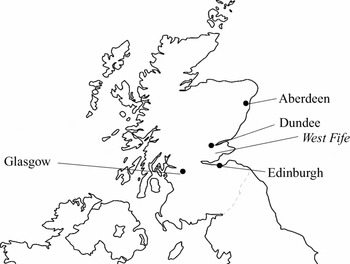
The data presented here were collected from a group of 54 speakers who play together in two interrelated pipe bands that will be known as West Fife High Pipe Band (hereafter WFHPB) in west Fife, the area shown in figure 1.
Map showing the west Fife area in relation to major cities along the east coast of Scotland

The area in which WFHPB are based is located around 22 miles north of Edinburgh, over the Firth of Forth. The data were collected by the first author over a period of thirty months using the ethnographic technique of long-term participant observation (Eckert Reference Eckert2000). The conversations that comprise the majority of the corpus were collected in the summer of 2006 and centre on a sorting task that the informants were asked to complete in small groups of friends.Footnote 4 The resulting data consist of thirty-eight hours of recorded speech which have been fully transcribed and amount to a corpus of 360,000 words. All instances of the variable (th) were extracted from the corpus and then random selections of these tokens were cross-checked for accuracy of transcription. This resulted in an initial data pool of 5,205 sites of (th).
3.2 Measuring lexical frequency
In order to discover whether there is a significant correlation between lexical frequency and TH-Fronting in WFHPB, it is first necessary to consider how best to measure lexical frequency, as there are a variety of different methods available. We consider frequency of use as a local phenomenon and so measure the lexical frequency of a particular item against the frequency of other items only in this locally based corpus. Often researchers interested in frequency effects take the frequency value of a particular lexical item from a large corpus such as the Brown Corpus (e.g. Dinkin Reference Dinkin2008 and Abramowicz Reference Abramowicz2006) or from a list of frequency counts such as that provided by Baayen et al. (Reference Baayen, Piepenbrock and Gulikers1995) in the form of the CELEX lexical database (employed by Hay Reference Hay2001). However, certain local forms (e.g. place names, nicknames and other nonstandard lexical items) which occur fairly frequently in the WFHPB corpus are much less frequent in a 100-million-word corpus of British English such as the BNC or even a more local corpus of Scottish English such as the SCOTS corpus. This was a particular problem for our analysis because a large number of the conversations that took place were in nonstandard dialect and so, had the frequency counts for these nonstandard lexical items come from a large database of lexical frequency rather than the WFHPB corpus itself, the frequency value assigned to these items would not have been an accurate representation of the frequency with which they are used by these speakers. We also decided (where possible) to avoid categorising lexical frequency into discrete categories such as ‘high frequency’ and ‘low frequency’. Instead we follow Hay (Reference Hay2001) in treating frequency as a gradient phenomenon. We therefore assume that lexical frequency is gradual and relative, not categorical or universal.
Most frequency research to date has examined the effects of lexical frequency on variation and change in isolation and so we begin our analysis by following this typical procedure. A Pearson's correlation was initially used to measure the extent to which values on the variables ‘lexical frequency’ and ‘(th):[f]’ co-vary. Also, following Hay & Baayen (Reference Hay, Baayen, Booij and van Marle2002), the measurements of lexical frequency and the token frequency of (th):[f] were converted into a logarithmic transformation since ‘there is evidence that humans process frequency information in a logarithmic manner – with differences amongst lower frequencies appearing more salient than equivalent differences amongst higher frequencies’ (Reference Hay, Baayen, Booij and van Marle2002: 208). The data were normalised using the Log10 transformation. This transformation was selected because, in their raw form, the data have a moderate positive skew based on the analysis of kurtosis, skewness and Kolmogorov-Smornov Z test of normality (see de Vaus Reference de Vaus2002: ch. 11 for details of these tests for normality). Also, because some of the raw frequency data for (th):[f] contain a value of 0, and there is no logarithm of the value 0, it is necessary to add a constant to the original values in the transformation. In this case, we simply added the value of 1 to the raw frequency scores.
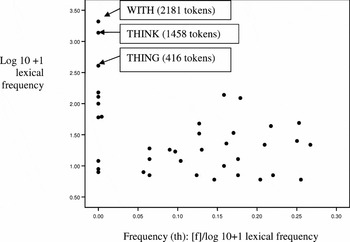
The lack of a standard method to conduct correlations on frequency research led us at the outset to correlate word frequency with the number of tokens of a particular word in which the variable is realised with one variant (in this case, the number of tokens of (th) realised as [f]). However, as Vsevolod Kapatsinski (p.c.) points out, it is possible that these two variables may correlate independently of any frequency effect using this method. In order to combat potential interference, it was therefore necessary instead to correlate word frequency with frequency of (th):[f]/word frequency. In other words, this method correlates the proportion of each word in the corpus which appears with (th):[f] against the lexical frequency of that word. While this may be a more accurate method of calculating lexical frequency in a large corpus, this method may be less well suited to a smaller corpus such as the WFHPB corpus or to low-frequency lexical items (only those lexical items with three or more tokens were included in the analysis) because it depends on large numbers for accurate results. This method of correlating lexical frequency with phonological change is therefore only likely to find a significant result if the effect of lexical frequency is very large. The results of this correlation are charted in figure 2.
Pearson's correlation of log lexical frequency and TH-Fronting

Notice that there are a large number of lexical items, some of which have very high frequency counts, which are not participating in this change to [f]. We shall deal with these lexical exceptions first before moving on to analyse the remainder of the data.
3.3 Exceptions to TH-Fronting
The Pearson's correlation allowed us to identify two sets of exceptions to the general spread of TH-Fronting in this community, and this section proposes an analysis to explain these exceptions. The sets are as follows:
(a) morphemes in which the dental in SSE precedes /r/ in a syllabic onset, e.g. three and throw (281 tokens in the corpus, 5 per cent of all (th) sites). While such words do participate in TH-Fronting (in that variants such as [fri] do appear in the corpus), the set is exceptional because another variant is possible and is exclusive to this set. The variant is a palato-alveolar fricative [ʃ], so we consider the pre-onset /r/ context to be a different context of variation;
(b) the lexemes thing, think and with, including derivatives of the first, such as everything and anything (4,140 tokens in the corpus, 80 per cent of all (th) sites).
With set (a), we propose that the assimilation of place, combined with the fact that /r/ is the only consonant that can follow the dental in an onset cluster, mark these words out as a special set. The palato-alveolar form is, to our knowledge, not found in non-Scottish varieties of English, suggesting some dialectal or sociolinguistic markedness, and the constraint in terms of onset-phonotactics suggests some language-internal markedness. The Linguistic Atlas of Scotland (Mather & Speitel Reference Mather and Speitel1986) shows that similar variants, which are further reduced phonetically, such as a monomoraic onset with a devoiced liquid, are quite widespread in Scotland, but that variants with a palatal or palato-alveolar initial consonant are highly localised, with the only recorded instance being in Dunino, in east Fife.Footnote 5 However, we are also aware of such forms having appeared in a recent corpus of speech of young adults from Ayrshire (Pukli Reference Pukli2007) and in middle-class speakers from Glasgow (Jane Stuart-Smith, p.c.), so it may be that this form is more widespread than was previously recorded, or is becoming more frequent. Nonetheless, the present corpus suggests that, for these Fife speakers at least, TH-Fronting may be sensitive to phonetic and phonological environment.
Some of the exceptions in set (b) are more complicated. The behaviour of with is unremarkable, since the existence of zero-variants of the final consonant of this preposition has a long history in many varieties of (British) English; however, the effect of the existence of local variants for think, thing and derivatives of the latter does require analysis. In this community, and indeed in many others across central Scotland (see e.g. Chirrey Reference Chirrey, Foulkes and Docherty1999; Robinson Reference Robinson2005; Stuart-Smith & Timmins Reference Stuart-Smith, Timmins, Caie, Hough and Wotherspoon2006), think and thing have highly localised variants [hɪŋk] and [hɪŋ], i.e. where the first consonant is a glottal fricative. This pattern is different from widespread TH-Fronting because the change from [ɵ] to [h] involves a reduction (in the form of lenition), and could legitimately therefore be counted as a phonetically motivated sound change (unlike TH-Fronting which seems instead to be a case of lexical diffusion). However, while the verb think is high frequency (largely as a result of its appearance in the grammaticalised prefab I think), tokens such as everything and anything are of much lower frequency – and yet both sets are undergoing reduction from [ɵ] to [h].
We propose that the lenition here may in part be a result of the lexicalisation of the -thing compounds. The fusion involved in the univerbation process often involves phonological reduction or loss (cf. the lexicalisation of OE hlafweard ‘loaf guardian’ > lord, or of forecastle > fo'c'sle). This is perhaps more systematic than some cases of lexicalisation, but is clearly an instance of this type of change. Such lexicalisation is also likely to lead to greater entrenchment of the item as a unit (i.e. it will be more likely to be accessed holistically than compositionally), which will make it even further resistant to TH-Fronting. Since we are here viewing lexicalisation as a diachronic process, we hypothesise that this may be a change in progress, with variants [ɵ], [h], [ʔ] and zero, this last being yet a further instance of lenition. Although the age range of our informants does not allow us to provide definitive evidence of a change in progress, evidence for lexicalisation, at least in the -thing compounds, can be found when we examine the ways in which these variants pattern with lexical frequency.
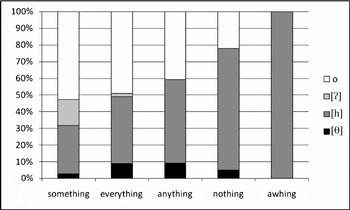
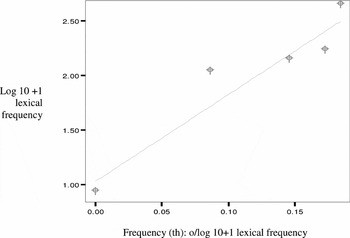
Figure 3 shows the variants of (th) in each of the -thing compounds in the WFHPB corpus. The data are arranged according to the frequency of the lexical item, with something as the most frequently occurring -thing compound in these data. The pattern in the graph seems to support the proposal that this is a phonological change because the more frequently occurring -thing compounds are displaying evidence of more reduced variants of (th), e.g. [ʔ] and the ‘zero’ variant. This pattern is statistically significant, as we can see in figure 4.
Variants of (th) in the -thing compounds arranged by lexical frequency (from highest to lowest along the x axis)Footnote 6

Pearson's correlation of log lexical frequency and frequency of (th): 0 in the -thing compounds

The correlation coefficient here is –.938, which is highly significant; there is a highly significant correlation between more frequent -thing compounds and the occurrence of the most phonetically reduced ‘zero’ variant of the (th) variable. In other words, there is evidence to suggest that the -thing compounds are involved in a different phonological change from TH-Fronting; these lexical items may be becoming more lexicalised. If this does constitute a change in progress, it is much slower than TH-Fronting, since the latter seems to have spread rapidly in the community over one or two generations.
When these very high-frequency lexical exceptions (discussed under (a) and (b) above) and their lower-frequency derivatives are removed from the analysis, the simple correlation coefficient of the Pearson's correlation is 0.171 and is not significant. This means that there is no large correlation between TH-Fronting and token frequency in the remainder of these data.
4 Embedding frequency within a larger framework of language use
4.1 The relative importance of frequency
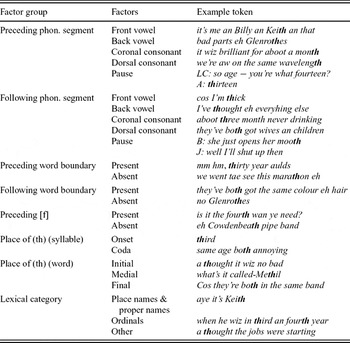
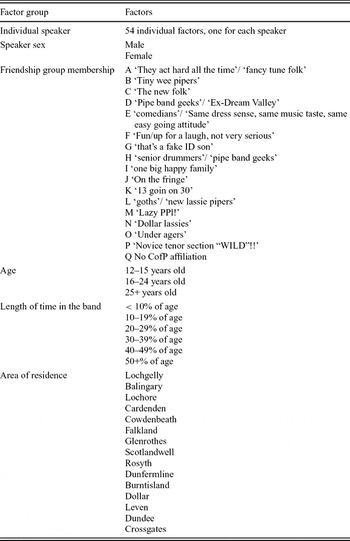
Our analysis of variation has so far only examined lexical frequency in isolation (as is typical in the frequency literature) and only using a simple linear correlation. More sophisticated statistical techniques such as multiple regression can, however, spot smaller effects because, while computing the effect of one independent variable, it can explicitly control for the effects of all other independent variables, therefore reducing the statistical ‘noise’ that can interfere in a simple linear correlation. We therefore decided to investigate the relative importance of the role of frequency in comparison with other factors in the spread of this sound change. To do this, we included a factor group testing for lexical frequency in a variable rule (hereafter varbrul) analysis using the statistical software package Goldvarb X (Sankoff et al. Reference Sankoff, Tagliamonte and Smith2005). A varbrul analysis can be used to ascertain the effects of various independent factors influencing the distribution of a dependent variable by means of stepwise multiple regression. The ‘linguistic’ factor groups that were included in the analysis are provided in table 1 and the ‘social’ factor groups are in table 2. These factor groups are discussed in more detail below.
Linguistic factor groups for varbrul analysis of (th)

Social factor groups for varbrul analysis of (th)

Preceding and following phonological context: these factor groups coded for the possible effects of phonological context as an influencing factor in motivating (th) variation as no other studies of (th) have considered the effect of phonological context on this variation. We began by coding phonological context in detail with each individual segment as a separate factor but a number of cells were left empty or had very low cell counts (see Guy Reference Guy, Ferrara, Brown, Walters and Baugh1988: 129–32 on the problems of low cell counts) and so it was necessary to collapse some of these factors together. We have chosen to represent the factors in this factor group on the front/back dimension. The main difference in articulation between [ɵ] and [f] is the position of the tongue in the vocal tract – the tongue occupies a fronted position in the mouth when articulating the dental fricative. We therefore hypothesised that if TH-Fronting is influenced by phonological context, the dental variant may be more likely to occur either immediately preceding or following other fronted articulations.
Word boundary: again, as this has not been considered in previous studies of TH-Fronting, we were interested to discover if the variation in (th) was perhaps sensitive to morphological information such as the occurrence of a word boundary either immediately preceding or following the variable.
Preceding [f] in the word: the motivation for including this factor group was to test for a priming effect. Is the labiodental variant more likely to occur if the word in question has a labiodental voiceless fricative somewhere else (preceding the variable)?
Place of (th) in the word: Stuart-Smith & Timmins (Reference Stuart-Smith, Timmins, Caie, Hough and Wotherspoon2006) investigated the role of the lexicon in TH-Fronting in Glasgow and found that the labiodental variant occurs more frequently in word-final position than word initially or word medially. They do not analyse the think/thing set of words separately from the remainder of (th) sites and they attribute their finding to the high frequency of these words and the fact that [h] occurs word-initially (thing) and word-medially (everything) in these lexical items. We were interested to know if this effect remains once the think/thing set of words are removed from the analysis of (th).
Place of (th) in the syllable: there is a great deal of typological evidence (see Kiparsky Reference Kiparsky and Good2008) that place and manner features are frequently neutralised in syllable codas. We therefore might expect to find that TH-Fronting occurs more frequently in coda position.
Lexical category: Stuart-Smith & Timmins (Reference Stuart-Smith, Timmins, Caie, Hough and Wotherspoon2006) note in their discussion of TH-Fronting in Glasgow that several of the lexical items that seem to be resisting TH-Fronting in their corpora are ordinals and proper names and so we were interested to test this factor on these data.
Individual speaker: we initially coded each individual speaker separately because of the discomfort we felt at grouping sets of speakers into categories. In the end this was unmanageable as a factor group because there were too many speakers who either showed no variation (and so produced a *knock out* in varbrul – it is impossible to include these speakers in an analysis of variation as the data are not variable) or had a small number of tokens of (th). This factor group was therefore not included in the final analysis.
Speaker sex: based on the results of previous studies of TH-Fronting, it would appear that speaker sex should be a significant factor influencing variation. However, we wanted to test this variable and find out whether speaker sex is equally important in this community.
Community of practice/Friendship group membership: the friendship groups presented here are based on cliques found in a UCINET analysis of the social structure of this groupFootnote 7 and the labels in table 2 were given by the members of the community. These groups are therefore not categories that we have imposed on the community; they represent how the speakers themselves view the social organisation of the pipe band.
Age: age is a continuous variable and so the position of boundaries between factors is a somewhat arbitrary decision. The factors represented here are the result of several attempts to find the best fit of the model to the data.
Length of time in the band: we were aware that some individuals felt a great deal of affiliation to the band and had been a part of this organisation since they were young children while others had joined more recently or had played with other bands at different times in their lives. We attempted to measure the strength of affiliation to the band by quantifying the amount of time each individual had spent there as a percentage of their life.
Area of residence: when we asked the speakers in the corpus if they were aware of linguistic variation in the group, they mostly responded that they were. When we asked them why they thought these differences existed, they were often quite insistent that this was simply the result of dialectal variation:
Extract 1
LC: see aw the folk in the band, dae they aw talk the same?
Bobby: nuh
LC: how no?
Campbell: aye you've got different eh dialects like it's amazing how many dialects are in Fife alone eh
We decided to test their intuitions with this factor group. Although table 2 shows a number of different localities (two of which are not in Fife), the large majority of the group live in and around west Fife (only 4 of the 54 speakers do not live in Fife) and so the group is actually fairly homogeneous both socially and geographically.
In order to achieve a valid varbrul analysis, the factor groups must be ‘orthogonal’ (Guy Reference Guy, Ferrara, Brown, Walters and Baugh1988: 136), i.e. there must be minimal overlap between the factor groups. This can often be difficult to achieve: for example there is a great deal of overlap between the factor groups ‘place of (th) in the syllable’ and ‘place of (th) in the word’ as the first consonantal segment of any morpheme is by default also in the onset position of a syllable. Independence of social factor groups is perhaps even more difficult to achieve as there is more potential for overlap (see Bayley Reference Bayley, Chambers, Trudgill and Schilling-Estes2002: 131). In this case, almost all of the social factors interacted substantially, as one might expect, given the multidimensional nature of social characteristics that make up any given individual. We attempted to tease apart the different factors influencing variation by running the analysis multiple times, testing different social and linguistic variants against each other until all possible combinations had been exhausted.Footnote 8 We then compared the results of each analysis using a likelihood ratio test to find which provided the best ‘fit’ and therefore the best indication of the likely factors influencing this variation.
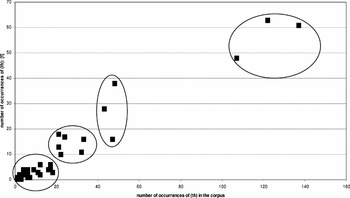
Because variable rule analysis requires discrete variants of all variables, it was unfortunately necessary at this stage to convert the continuous measurement of lexical frequency adopted in the Pearson's correlations into discrete categories. Rather than create arbitrary cut-off points in the data or force category divisions in order to make the number of tokens in each approximately equal, we plotted the results for (th):[f] against lexical frequency in a scattergram and searched for natural ‘bunches’ in the data (see figure 5).
(th):[f] plotted against lexical frequency in the WFHPB corpus (excluding lexical exceptions to TH-Fronting)

Four natural categories emerged in the data and these were coded into the following factors: ‘low frequency’ (up to 20 instances), ‘low-mid frequency’ (21 to 33 instances), ‘high-mid frequency’ (43 to 48 instances) and ‘high frequency’ (107 to 137 instances). While these categories do not contain an equal number of tokens or types, they represent the frequency categories that naturally emerged from the data.Footnote 9
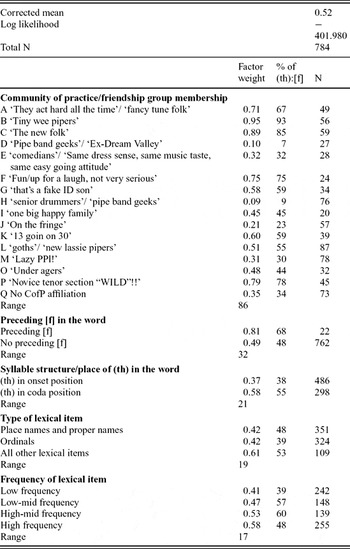
When the factor group ‘lexical frequency’ is included in the varbrul analysis, the results are as presented in table 3.
Multivariate analysis of the contribution of factors selected as significant to the probability of (th):[f]. Factor groups not selected as significant are not shown in this table.

Table 3 is organised to show the factor groups in the order of their significance on the variation. The results of the varbrul analysis show that lexical frequency is a significant factor influencing this variation but it is the last significant factor group to remain in the analysis. In other words, of all the factors influencing variation in these data, lexical frequency has the weakest effect. We will now take some time to interpret these frequency results in light of the generalisations that have emerged from the literature on lexical frequency before discussing the other factors affecting TH-Fronting in this community.
4.2 Interpreting frequency correlations
Results of the multiple regression and the Pearson's correlation on the WFHPB data suggest that the sound change TH-Fronting may be displaying patterns associated with both Bybee's RE and CE. On the one hand, in lexical items where the only possible variation is between the voiceless labiodental fricative and the voiceless dental fricative (i.e. in the 15 per cent of the corpus that are not of the type with/think/thing or THR_), there is a significant RE pattern – speakers seem to be adopting the innovation more readily in words with higher token frequency than lower token frequency, as we can see from the results at the foot of table 3. Bybee's explanation for the reduction effect is that language production is a neuromotor activity and as neuromotor activities are repeated, their execution becomes more efficient; gestures are thereby reduced, which, in language, leads to assimilation and reduction processes. As words with a higher token frequency are more exposed to this reduction, they change more rapidly. However, while the RE may be suitable for general processes of assimilation and reduction, it cannot explain the pattern found here because TH-Fronting is not a reduction; it is not a phonetically motivated sound change.Footnote 10 It is a straightforward case of lexical diffusion or ‘the abrupt substitution of one phoneme for another in words that contain that phoneme’ (Labov Reference Labov1994: 524).
There is also evidence of a type of CE in this data but only in the lexical items with, think and thing (and derivatives of think and thing). The Pearson's correlation showed that these very high-frequency lexical items (and their derivatives) appear very infrequently with the [f] variant. Bybee typically invokes the CE to explain the pattern of change often found in grammatical and analogical change. The explanation for this pattern is that high-frequency words become more entrenched and resist change on the basis of more productive patterns in the language. Again, however, lexical frequency can only go some way to explaining the pattern of frequency effects found in these data. For instance, while it is possible to explain the resistance to TH-Fronting shown by the very high-frequency lexical items think, thing and with, frequency alone cannot explain why lower-frequency derivatives of these lexemes (e.g. thingmie) are also not participating in this change.
In order to explain the different frequency patterns found in the WFHPB data with the generalisations proposed by Phillips (Reference Phillips2006), it is necessary to assume that the lexical items that allow TH-Fronting require no lexical analysis beyond phonetic coding in order for the change to take place. This means that there is no need for the speaker to access either more abstract schemas such as the item's word class, or phonotactic generalisations, in order to implement this change; the change simply requires ‘shallow access’ (Phillips Reference Phillips2006: 75) to the phonetic form of the word. However, if TH-Fronting was simply a change that affected the realisation of the word form and required no ‘deeper’ level of lexical analysis in its implementation then we would expect to find no correlation between TH-Fronting and word class. The analysis of variation presented in table 3 suggests that this is not the case. Not only is there a statistically significant relationship between, for example, word class and the realisation of the labiodental fricative, which suggests that more abstract generalisations or schemas are important to the spread of this sound change, but this factor group actually accounts for more of the variation in these data than lexical frequency (and so is perhaps even more important in the spread of TH-Fronting).
4.3 Returning to the analysis of variation
After lexical frequency, the factor group which displays the least effect on the variation in TH-Fronting while still remaining significant is lexical category. These results support the proposition made by Stuart-Smith & Timmins (Reference Stuart-Smith, Timmins, Caie, Hough and Wotherspoon2006) that ordinals and place names may be more resistant to the spread of TH-Fronting than other lexical items, as ordinals, place names and proper names favour retention of the dental fricative. Kunter (Reference Kunter2007) has also found that proper nouns and place names behave differently than other lexical items as they show significantly less variation in stress placement.
Syllable structure/place of (th) in the word is the next most important constraint on the variation in TH-Fronting. The results for this factor group suggest that when (th) occurs in syllable/word-initial position, it favours the dental fricative and when it occurs syllable/word-finally, the labiodental is more likely to occur. As stated, there is a great deal of typological evidence that marked place and manner features are frequently neutralised in favour of their unmarked values in syllable codas, e.g. in the final devoicing of obstruents in German, most Slavic languages, Catalan, Turkish, Korean and many dialects of English. Following Steriade (Reference Steriade, Hanson and Inkelas2008), Kiparsky (Reference Kiparsky and Good2008) suggests that a plausible reason for coda neutralisation might be the low perceptual salience of the relevant featural distinctions in the syllable coda. We therefore might expect to find that TH-Fronting occurs more frequently in coda position. Stuart-Smith & Timmins (Reference Stuart-Smith, Timmins, Caie, Hough and Wotherspoon2006) found that in Glasgow, the labiodental variant occurs more frequently in word-final position than word initially or word medially. They attribute this to the high frequency of the think/thing set of words and the fact that [h] occurs word initially (thing) and word medially (everything) in these lexical items and do not analyse the think/thing set separately as we have done. The results from the WFHPB corpus would appear to suggest, however, that this effect remains even after the think/thing set of words are removed from the analysis.
The next most significant constraint on variation in (th) is the factor group which codes for a priming effect at the phonological level.Footnote 11 As Hudson (Reference Hudson2007: 37) explains, priming experiments in the psycholinguistics literature show that a preceding word or segment can prime a following word or segment by making it more quickly retrievable. This happens at all levels of the grammar: words with similar phonological, morphological, syntactic or semantic structure will act as primes. For instance, verse primes nurse, hedges primes hedge and bread primes butter (see Hudson Reference Hudson2007: 38–9 for a detailed discussion of this phenomenon and for further examples). In this case, if the lexical item in question contains a labiodental fricative somewhere before the variable (such as in the lexical item fourth) then the variable itself is much more likely to be realised as a labiodental fricative. This would suggest a type of priming effect. Hudson invokes this phenomenon as evidence for the existence of a network structure of organisation in the mind in which every node in cognition is ultimately connected to every other node. In this model, the activation of one node will automatically induce the secondary activation of an infinite number of connected nodes. One possible interpretation is that priming takes place through a process of ‘spreading activation’ (Collins & Loftus Reference Collins and Loftus1975; Langacker Reference Langacker1987: 385). Nodes in the network that the speaker perceives to be similar in some way are more closely linked in cognition, and the further apart two nodes are in the network, the less likely they are to activate each other. In this case, it is possible to invoke spreading activation to explain the fact that a preceding [f] in the lexical item seems to prime the realisation of the variable (th):[f]. When a particular instance of the [f] node is activated, it spreads activation to phonologically similar nodes, making the variable (th) more likely to be realised as [f].Footnote 12
Finally, the factor group ‘community of practice/friendship group membership’ substantially outranks all other constraints on the variation. In other words, there is a very strong correlation between the use of the labiodental fricative and membership in a particular social group in this community.Footnote 13
The main advantage of employing a varbrul analysis of the variation in TH-Fronting is that we have the capability to model both social and linguistic factors simultaneously impacting on a speaker's choice of variants and to rank their relative strength and significance. We have seen from the above analysis that a number of linguistic and social factors are important in influencing this variation and that the role of lexical frequency is perhaps less important than it would appear from the number of studies which examine it in isolation. However, in order to interpret these findings, it has been important to embed the discussion of lexical frequency within a larger theoretical framework of language use. In other words, in order to fully understand the results that are apparent in the WFHPB data, it is necessary both to consider a wide range of possible motivating factors that may be influencing this variation and to interpret the results of these factors within an explanatory socio-cognitive framework such as a usage-based model (Kemmer & Barlow Reference Kemmer, Barlow, Kemmer and Barlow2000).
5 Conclusion
The patterns of TH-Fronting in WFHPB do show frequency effects but these are not entirely in line with what has been predicted based on previous research on the progression of sound change and lexical frequency. Clark (Reference Clark2008) finds a similar result to this in an examination of vocalic change in a subsection of WFHPB. Furthermore, when lexical frequency is considered independently of all other influences on variation (as is typically the case in frequency research) the correlation between lexical frequency and TH-Fronting is different than when other more relevant contributory factors are also included in the analysis. These results together indicate that there is rarely ever one single motivating factor responsible for the spread of a linguistic change, a fact which we have been aware of since at least the 1960s:
Explanations of language which are confined to one or other aspect – linguistic or social – no matter how well constructed, will fail to account for the rich body of regularities that can be observed in empirical studies of language behaviour. (Weinreich et al. Reference Weinreich, Labov, Herzog, Lehmann and Malkiel1968: 188)
We propose that it is vital not only to consider the role of lexical frequency as an explanatory factor in the spread of sound change but to embed this further within a wider theoretical framework of language use.